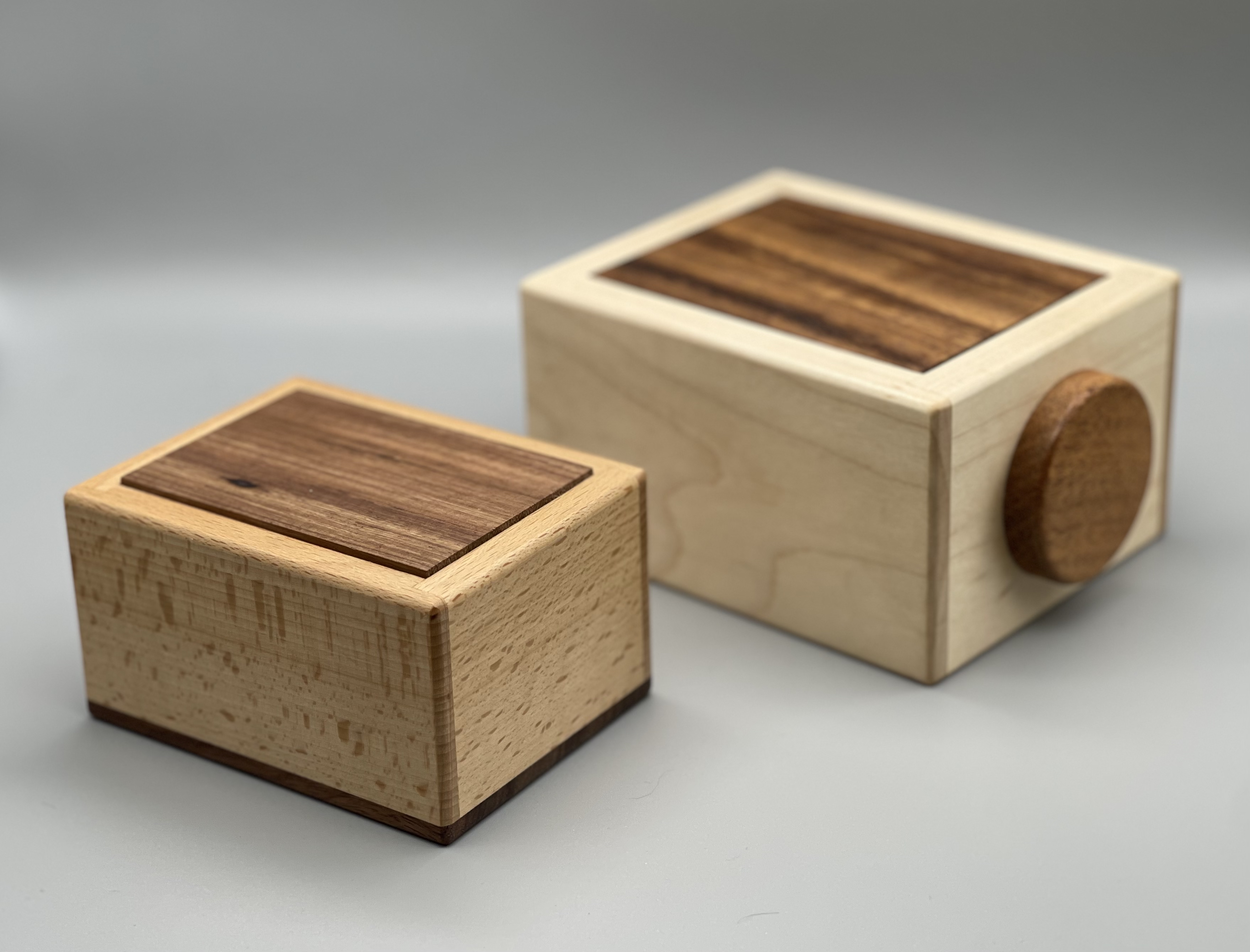
It’s A(nother) Karakuri Miracle! Holiday Boxes 2021

Karakuri Holiday Boxes 2021

Following up on last year’s post about the 2020 Karakuri holiday boxes, I figured I’d make a thing of it and do it again for 2021. (If you don’t know about the Karakuri holiday boxes and membership, you can learn more here).

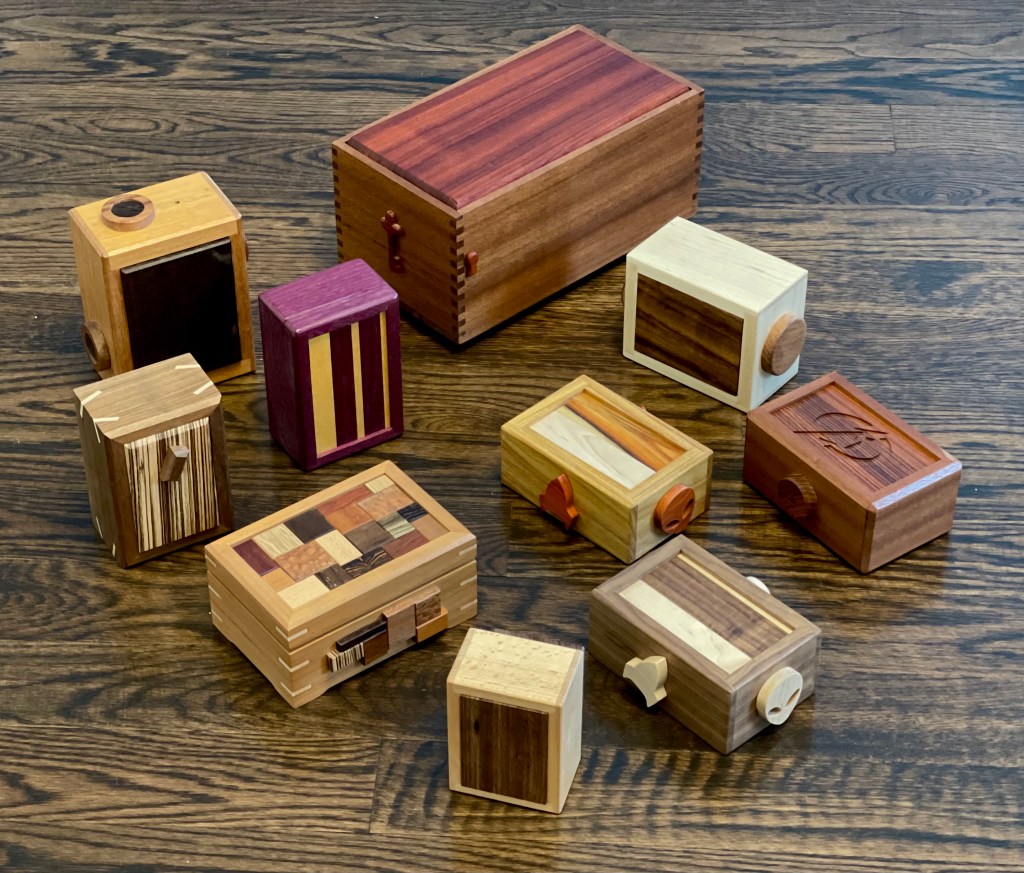
Clockwise from back left: Kakuda, Kikuchi, Iwahara, Kasho; Kawashima, Kamei, Sugimoto
Center: Kasho

Getting my box of boxes in mid-December was a cause for bittersweet celebration; I knew it was destined to sit unopened for a couple more weeks until X-Mas, when I would see each of the 7 boxes for the first time. Having not yet learned my lesson, I hoped that it might spark the teeniest bit of interest in my 15 year-old son (it did not); it did, however, continue to develop the interest of my 81 year-old Cuban mother-in-law lol (she thinks they’re super cool, which of course they are).

If you did not sign up for one or more of the boxes, maybe this will help you decide which are worth going after this year – as always, they will pop up here and there on the puzzle auctions, typically growing in value the further from December we get until, seemingly suddenly several seasons hence, they sometimes start selling for obscene sums. And for good reason: if you have yet to learn this life lesson, Karakuri boxes are cool… I know I will be getting another round of 7 come Xmas 2022.

And now: on to the show (in alphabetical order by maker’s first name):

Akio Kamei – Pile of Disks 3

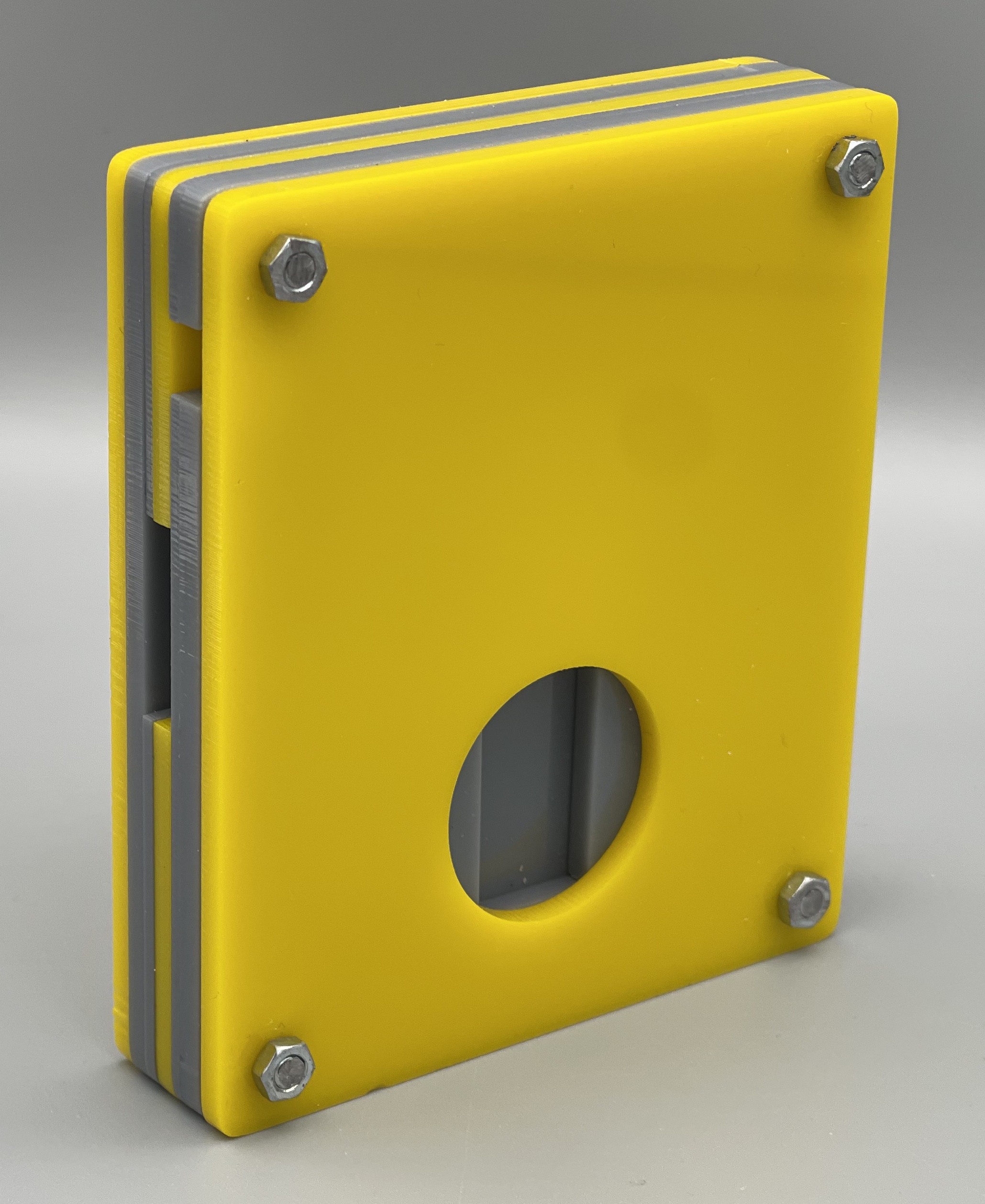
Unofficially known as the Egg McMuffin, Kamei’s newest creation consists of 5 circular layers of maple, zelkova and rosewood, laid out symmetrically. As the third in a series, this Pile of Disks is leaner than its siblings at 80mm x 30mm, his hanko displayed in the center of one side. Surprisingly, this ended up being one of the last two I wiould manage to solve – I had thought that the solution was somewhat obvious but it nonetheless took me an embarrassing amount of time over several days of fidgeting with it in front of the tv, growing increasingly certain that there was “something wrong with it.” As is typical when such a thought comes to the mind of a puzzler, there was not, I am just an idiot (probably not a surprise to anyone who reads these rambles). While the basic mechanisms were what I had thought, there was a small but essential nuance that had to yet to slap me in the head. I had begun to think that the solution was annoyingly precise but, in fact, it is quite elegant, with a final touch that gave me a welcome smile after how hard a time it had given me. Having opened it, I did it several more times, shaking my head at my own ineptitude and smiling at the subtle design choices that are the difference between trivial and tricky.
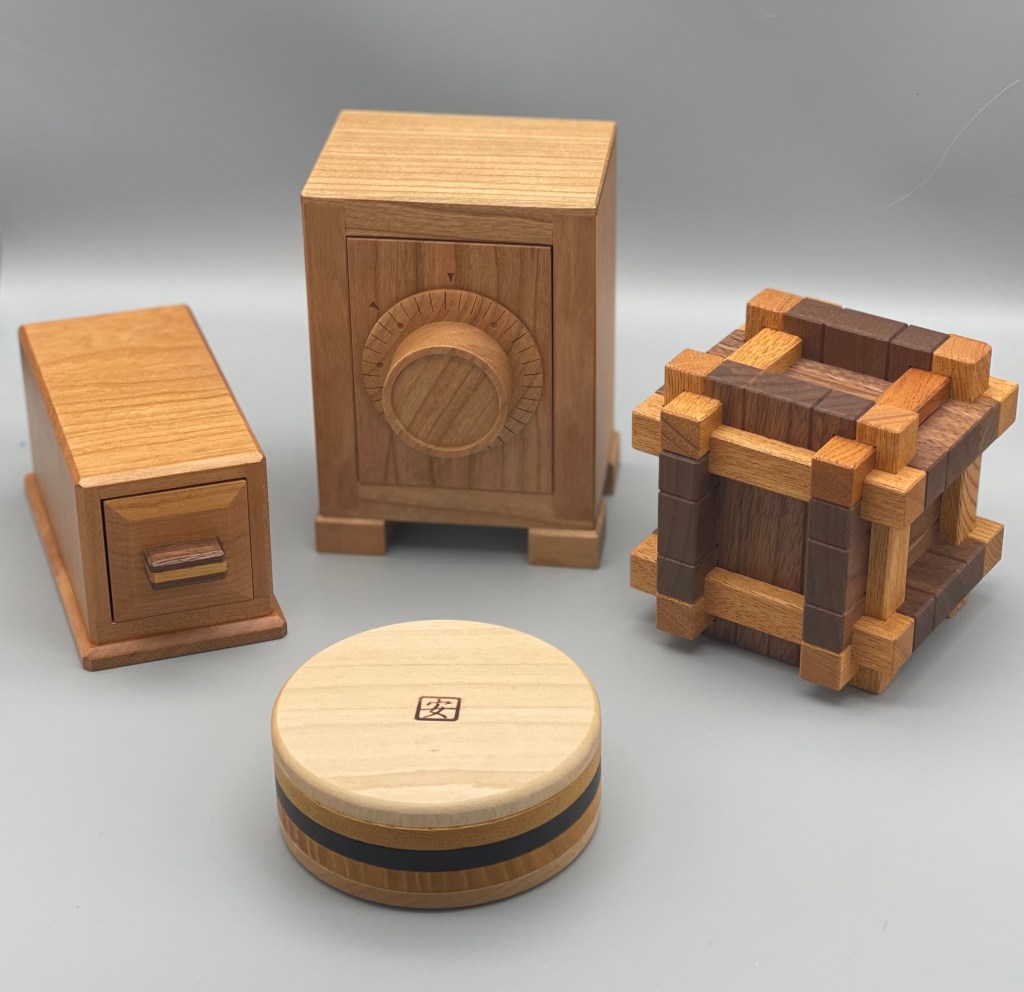
Kamei’s 2017 & 2019 – 2021 Holiday Boxes: Reverse Drawer, 8 Burr Box, Safe & Pile of Disks 3

Hideaki Kawashima – Moonlit Night

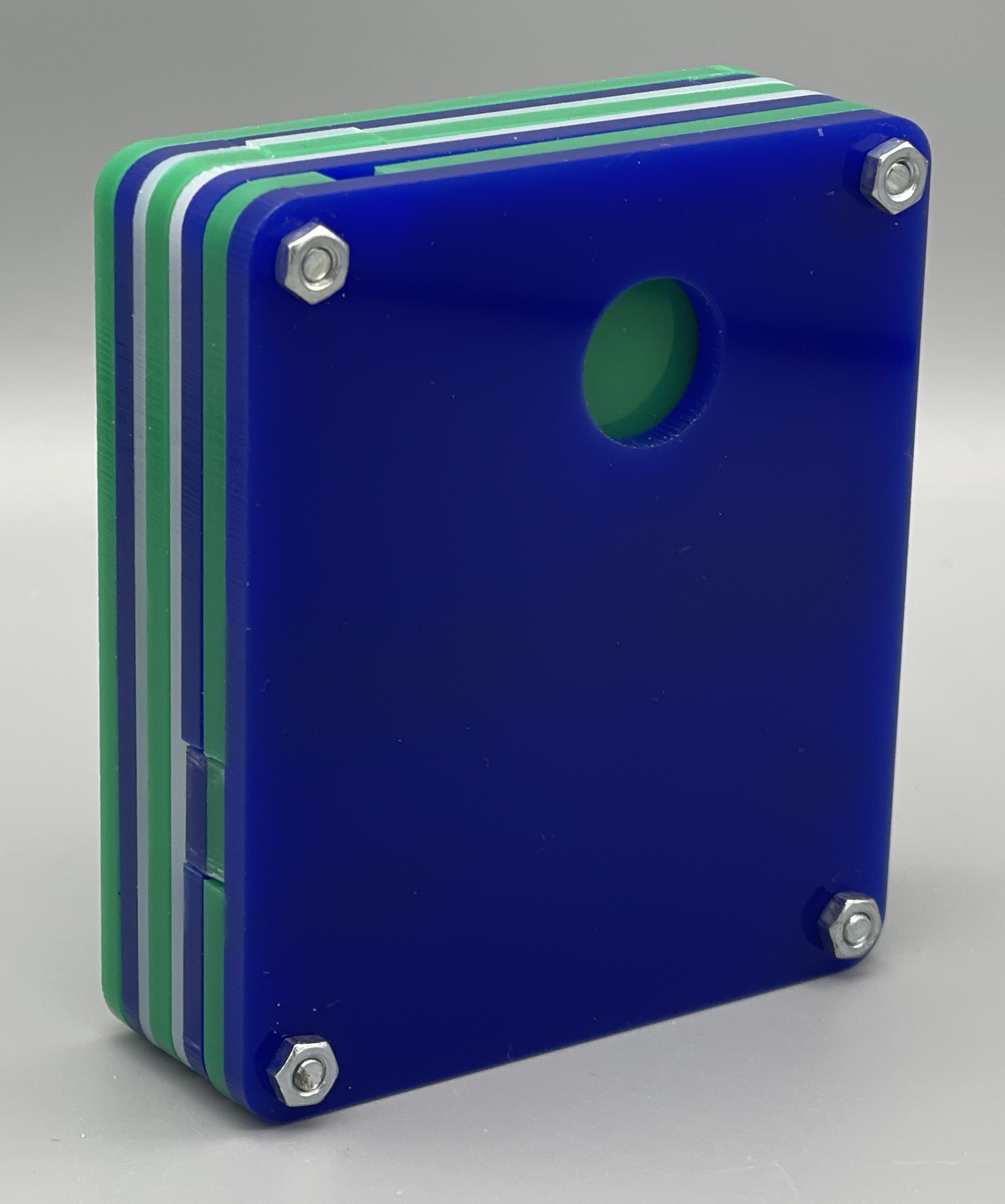
Following up on 2020’s Moon, Kawashima continues his lunar legacy in honor of the two lunar eclipses seen in Japan (and elsewhere) in 2021 (there is a circle on each side of the box). Its size of 72mm x 75mm, along with the colors of the magnolia, walnut and zelkova, lets it sit well with some of his other!similar boxes, most particularly its predecessor. While I did not have too much difficulty with this box, I did manage to go in circles for a bit before an aha let me find what I’d been missing. The maker’s hanko is hidden in one of its two compartments (presumably one for each eclipse). Despite not being too hard, I like the theme and idea: it is cool to be able to see what the maker was thinking and feel the connection he was going for. Holiday boxes arrive without names or descriptions, which have only recently been shipped out to participating members; these gave me a better appreciation for this box in particular, with an aesthetic that captures the concept rather brilliantly.

Kawashima’s 2019 – 2021 Holiday Boxes: Bars Box IV, Moon & Moonlit Night (I rather foolishly let go of my copy of 2018’s BB2)

Hiroshi Iwahara – Fluctuation Box

One of the cooler looking boxes of this year’s holiday haul, Fluctuation has a springy, tactile feel that makes it fidget friendly and rather fun to solve. Somewhat unique in the nature of its trickiness, the box may take a bit of practice to master. The alternating layers of maple and chanchin look great inside the contrasting top and bottom of walnut and (something? – I may have confused some of these but I think I have it correct) and a little knob adorns the top.

At 160mm x 170mm x 66mm, it is the largest of this year’s boxes and is a development of Iwahara’s 2006 holiday box, Covered Chimney, with which it shares a similar aesthetic.

Iwahara’s 2018 – 2021 Holiday Boxes (clockwise from top left): Bean Bag Drawer 3 (Cat’s Bel), Box with Five Trees, Aquarius Box (small), Fluctuation Box & Line Symmetric Traps

Osamu Kasho – Little Shark

Little Shark might be my favorite of the year, both adorable and the most difficult for me to solve! Its diminutive size of 80mm x 115mm x 45mm did not stop it from taking me weeks of picking it up and trying the same couple of things over and over before I finally did something a bit differently than (I think) I had tried before, earning me the biggest aha of the holiday. It is always a pleasure to get the kind of laugh-out-loud Karakuri moment that compels me to share my glee with my not-particularly-interested wife (who allows for a quick “that’s nice, babe” before turning back to whatever show was trying to distract me from my puzzling).

Knowing the solution, I can fully appreciate the excellent craftsmanship that hides it (one of the main reasons I absolutely love the KCG. It is also adorable, the walnut, magnolia and dogwood maintaining a consistency with Kasho’s Whale boxes: Whale, Baby Whale and Whale Type I, but with evil shark eyes contrasting cutely with the friendly, rounded eyes of the whales.

(cool hanko!)

Kasho’s 2019 – 2021 Holiday Boxes: Bara Bara, Something or Nothing and Little Shark (Bara Bara is actually the Philosopher version released last year – I reluctantly traded my Snowman version)

Shou Sugimoto – Reversible Box

Sugimoto’s box is another of this year’s personal (and probably public) favorites, with a unique solution that sees the box becoming more beautiful as you progress, an interesting design choice that demands repeat play. These changes are surprising and have me tempted to leave the box in mid-solve for display (my spoiler sensitivities are of course too strong to permit this, allowing for a resistance to temptation rarely exhibited by my life choices).

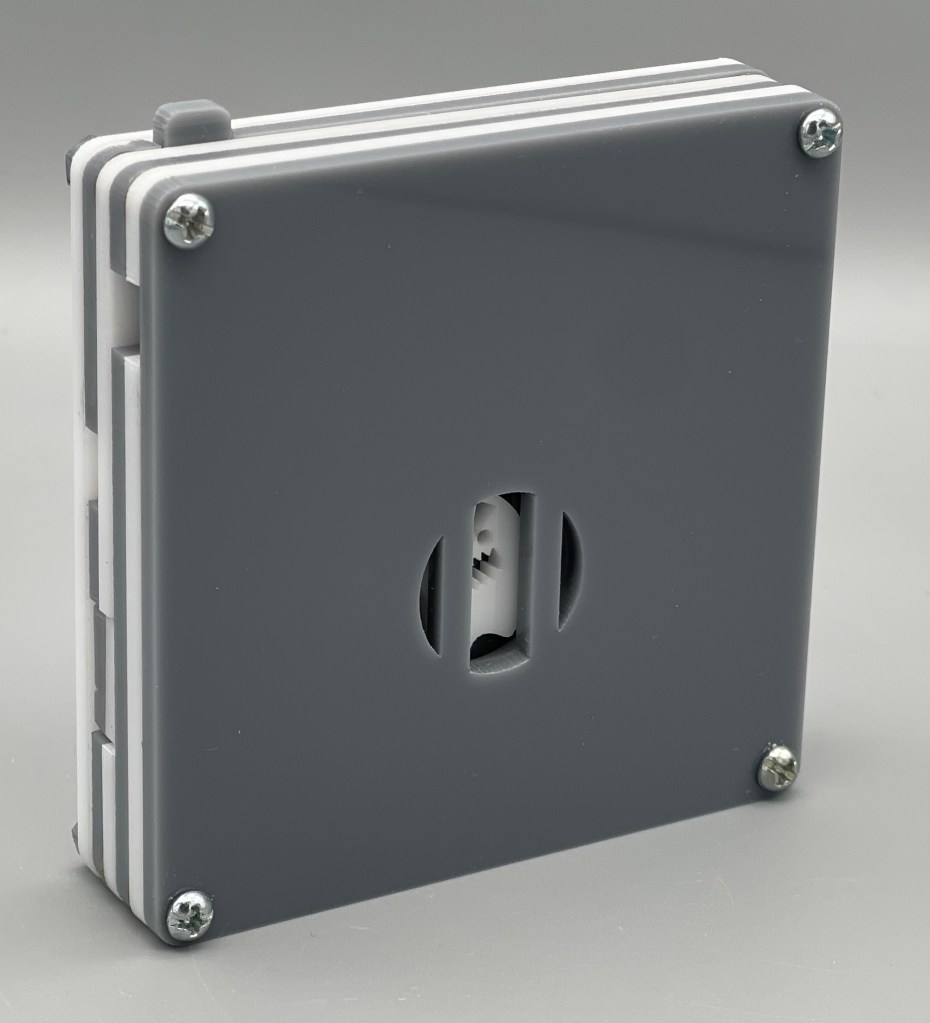
It is a bit smaller than most Karakuri boxes at 59mm x 97mm and compensates with a beautiful use of maple, chanchin, magnolia, wenge and Japanese torreya, some of which you may notice is not visible in its reset state. When first working on it, there was an initial worry that the solution was just painfully obvious, with early progress that turned out to be a bit misleading, functioning instead as a segue into a beautiful sequence that leads into the final steps (the last of which eluded me for a bit, partly due to my desire to repeat the middle steps and partly as it is well-hidden). The final step shows the precision with which KCG boxes are pretty much always made. His hanko is inside and is one of the cooler marks used by KCG members, a more stylized use of Japanese characters.
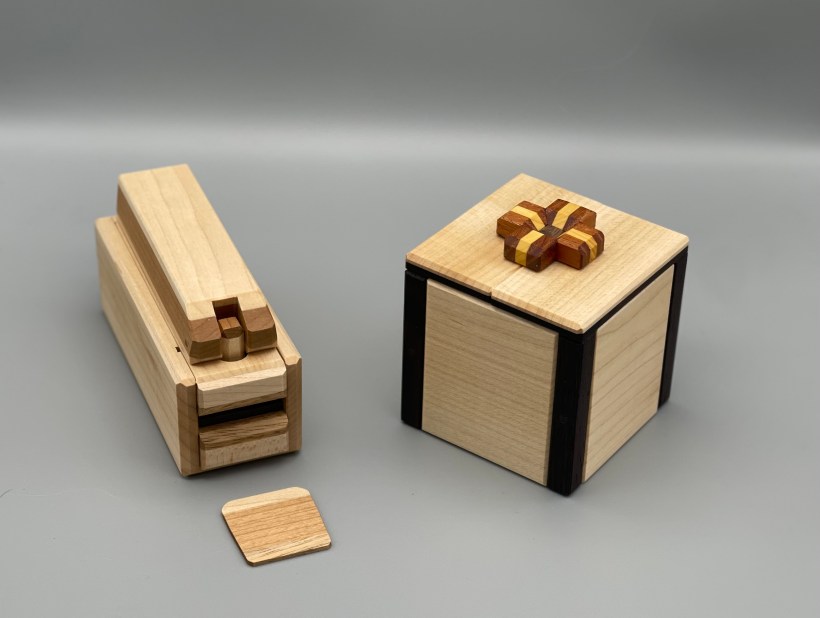
Sugimoto’s 2020 & 2021 Holiday Boxes: Nail Clippers & Reversible Box (I unfortunately traded my copy of 2019’s Kracker)

Yasuaki Kikuchi – Well, well, well, Where has buddy gone?!

Winning this year’s “Oddly Long and Confusing Title” Award, Kikuchi has made something that is pretty much as hilarious a Karakuri box as I have ever seen. The solution is not short but neither is it particularly difficult; the real awesome-sauciness of this box comes after it has been opened, where you find something whose purpose is not immediately apparent until you step back and look at the opened box with new eyes. I soon saw the purpose of this discovered trinket and full-on guffawed at the result of its use. I don’t mean to be so cagey about this but it would of course be a massive spoiler to say anything further.
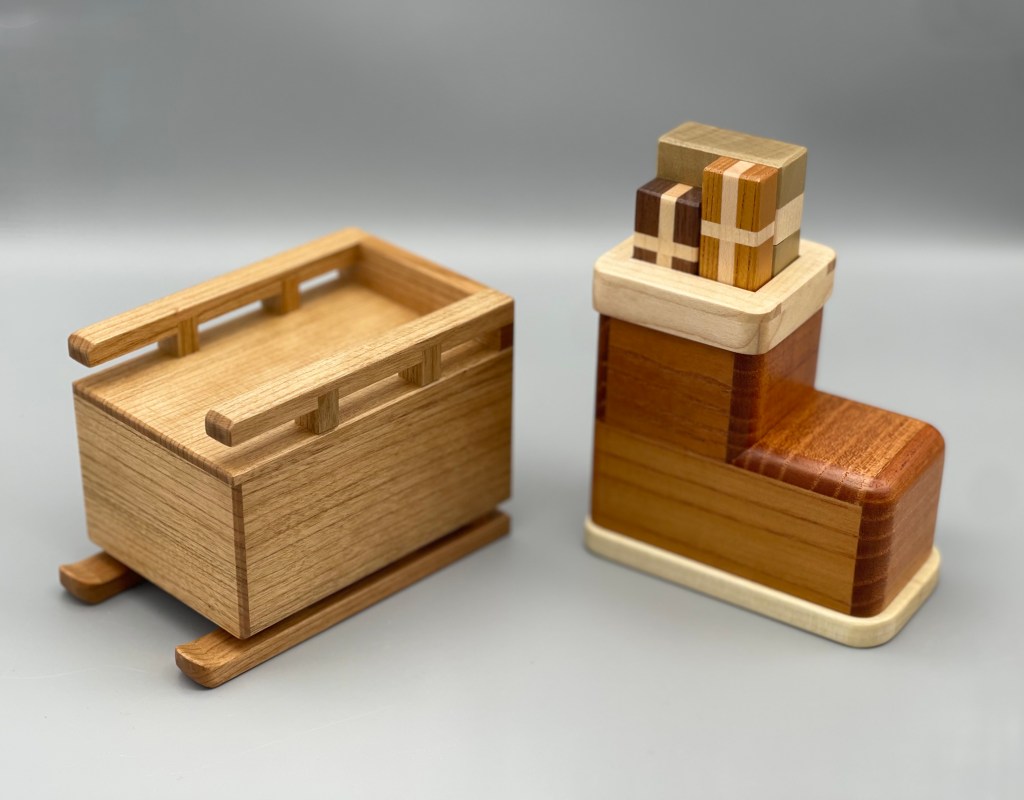
Kikuchi’s 2020 & 2021 Holiday Boxes: Christmas Boots & Well, well, well, Where has buddy gone?!s I e

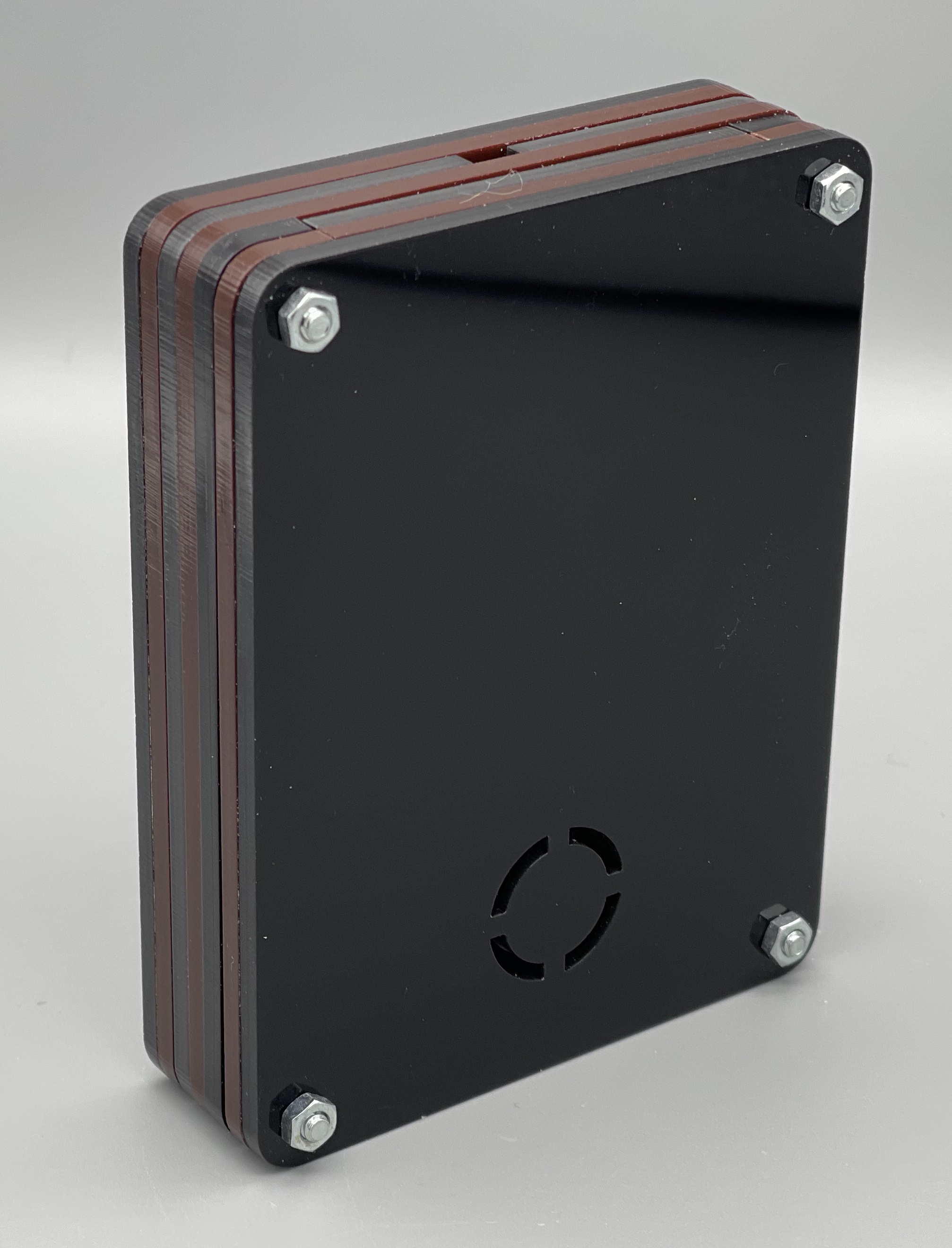
The holiday theme is once again on full display, with Santa’s sled leading you deeper into the Christmas canon in a comically consistent manner. It is an adorably sized 61mm x 110mm x 68 and, as with Sugimoto’s box, some of the woods used are not immediately apparent; its cherry (?) outside hiding some dogwood and walnut once solved.


Yoh Kakuda – Boxing Kangaroo
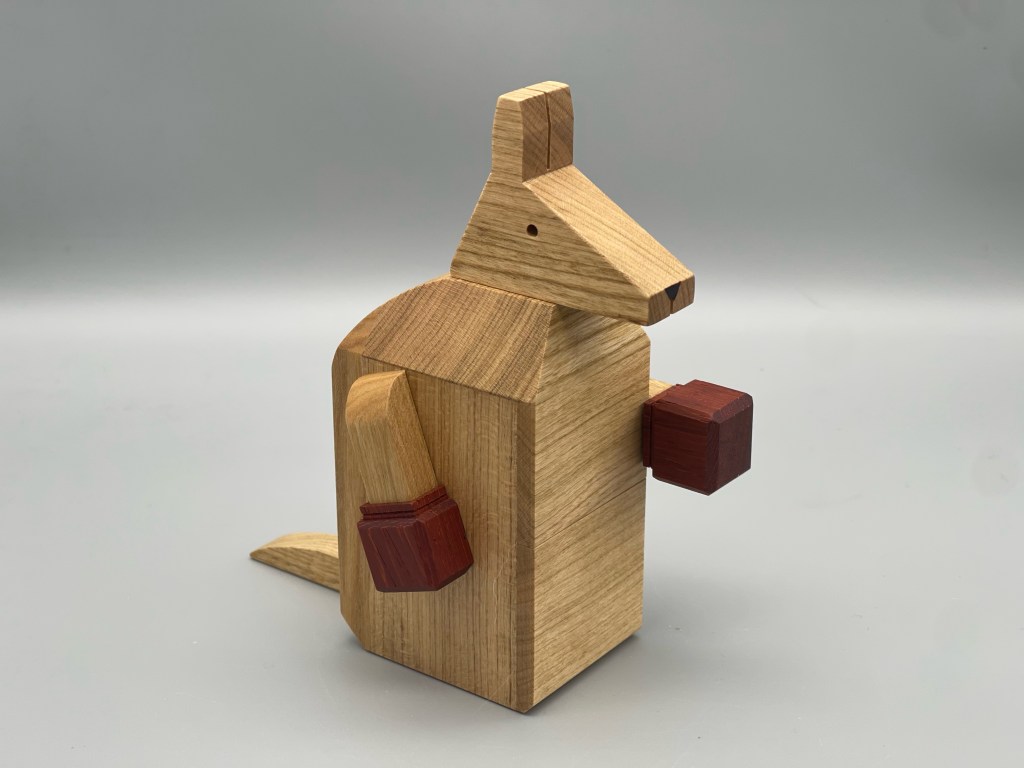
What kind of Karakuri Christmas could it be be without a cute Kakuda creation like Kangaroo? It is adorable and amusing, with a design that is sure to make you smile. Despite perhaps being a bit predictable, I enjoyed the solve and felt compelled to repeat one particular step several times as Kakuda once again does a great job of integrating thematic elements into the box. Kangaroo is a good-sized 63mm x 110mm x 121mm, with padauk boxing gloves contrasting nicely with the cherry used for the majority of the puzzle (with an adorable magnolia nose). I noticed that the maker’s mark has changed a bit, with added english letters that stand apart from the more traditional hankos used by most other KCG members (and is pretty cool imo). Now I’ve just got to see how it fares against a Rock ‘Em Sock ‘Em Robot.

(I unfortunately traded my copies of Wombat & Tunnel Maker from 2019 & 2020, so no comparison pic)


And that’s 2021!

I’m already looking forward to whatever boxes KCG will produce in 2022 – time to renew my membership!


Overall Grade for Holiday Puzzles: Five Sinatras


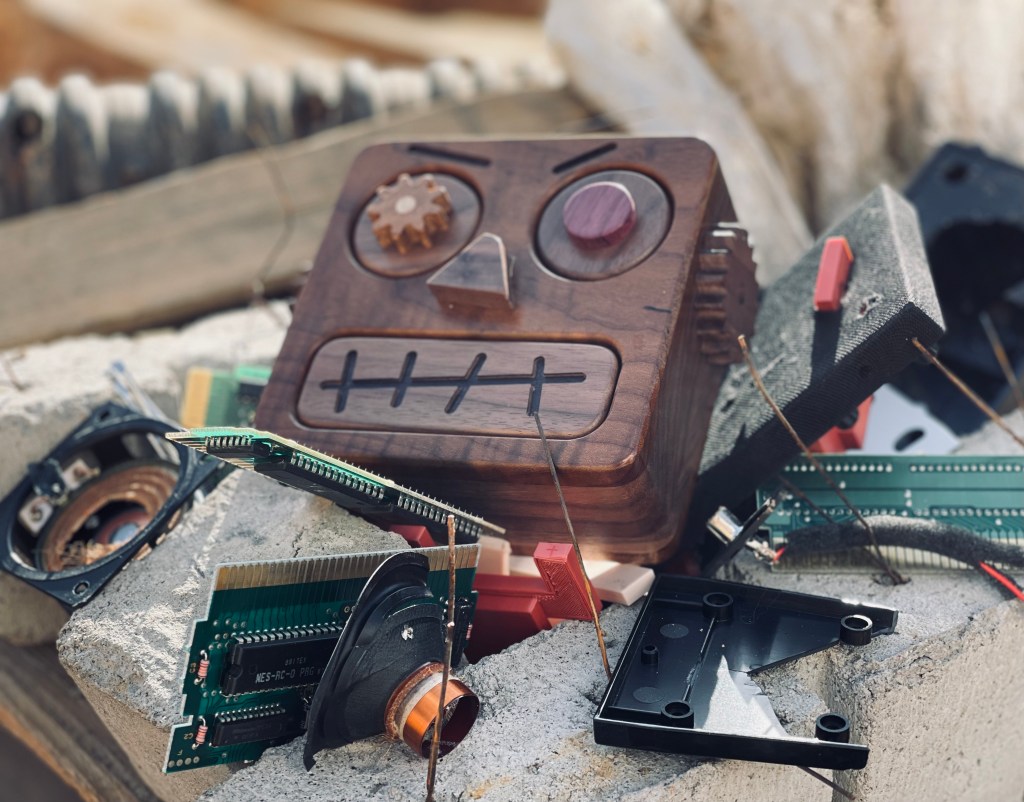
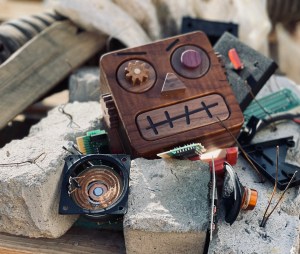
The Rise of Angry Walter

Angry Walter

Dee Dixon

A short film by fivesinatras:
The oral history of a forgotten robot, a sequential discovery puzzle box & a world saved by puzzlers.

(thanks to Dee Dixon for making such a great puzzle)

Check out my review of Angry Walter here: https://fivesinatras.com/2022/01/18/angry-walter/


It may be a bit odd but I thought it would be fun…. y’know, for kids 😉


Ahhhhh Snap! Snappy Burr (and Obscure Burr) by Jerry McFarland

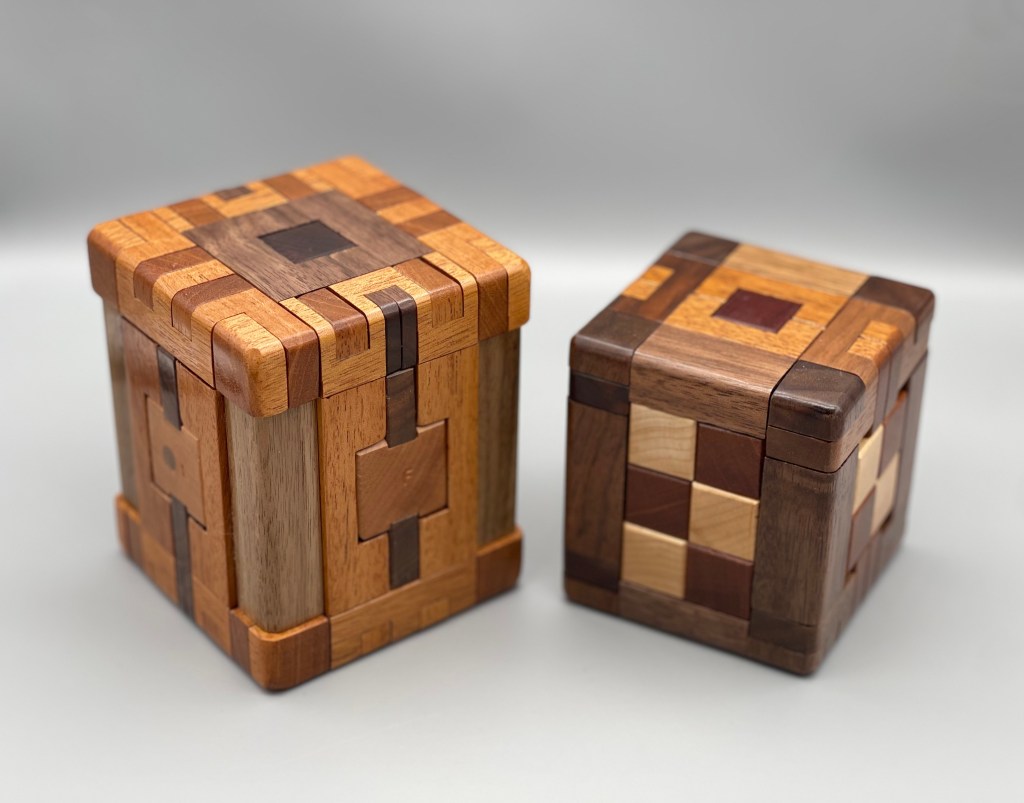
Snappy Burr & Obscure Burr

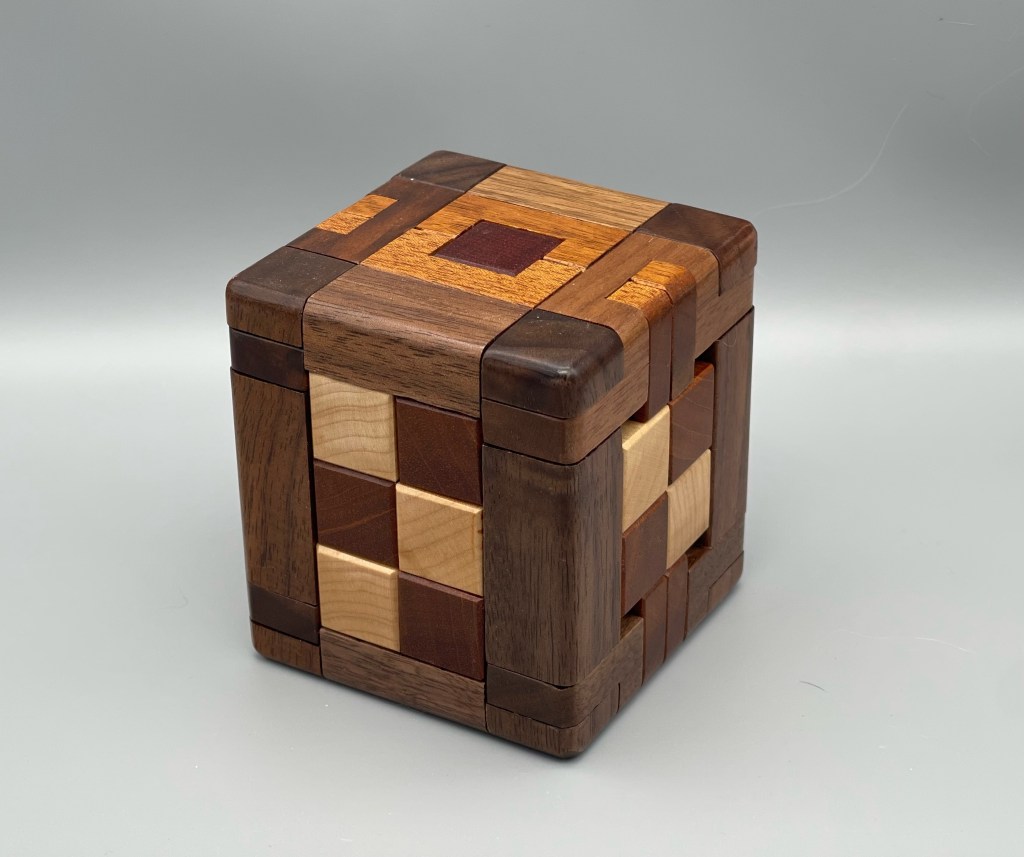
Jerry McFarland, 3.25″ x 4″, Mahogany, Walnut, Cherry & Kingwood (Snappy)
3″ x 3.5″ (Obscure)

When Jerry asked if I would be interested in trying out a new puzzle, my fingers couldn’t hit reply fast enough – he is one of those designers whose puzzles I will gratefully buy sight (or even description) unseen. The fact that he is returning to the Magnetic Burr series with what is most likely the final design (after a brief semi-digression with Obscure Burr) should make even the most discerning of burr buyers be ready to buy (if bossible).

Snappy Burr & Obscure Burr

If you are not already on Jerry’s list(s), it may be sadly difficult to obtain a copy of Snappy; Jerry produces puzzles in small batches, and there are only a few more copies of this puzzle to come in the near future (all of which I believe have already been earmarked). As with all his puzzles, it is well worth the wait, even if it takes a couple of years (such is the nature of a good puzzle’s wait list, as I know all too well – my copy of Burrnova will hopefully be coming sometime this year after a 2-3 year wait and yet it seems like a blink of an eye when your time on a long waitlist comes up).

The Magnetic Burr series may not be an official name, but it captures the essence of the three (now four) cubic burrs: Fidget Burr (reviewed by me here), Burrlephant (also reviewed by me) and Burrnova 3d (I actually had the option to get a copy last month, but Jerry graciously asked to sell it to a certain mutual puzzling friend’s NPSO as a surprise gift and I was happy to play a small role in this friend’s holiday happiness). The burr cubes in the series all feature magnets (duh) and integrate some very cool and unique mechanisms into the designs; all of them feature some kind of surprise(s) or treasures, whether Fidget’s Pink Lady, Burrlephant’s sd mechanisms or Burrnova’s….. well, I guess I’m not sure if Burrnova follows suit but I’m going to go ahead and say that it does 😉


Obscure Burr

Obscure also uses magnets but isn’t really considered part of the series – the concept is something of an outlier, relying on a pretty esoteric idea that is sure to elude the majority of puzzlers (as it most certainly did me!). I was ultimately able to solve it by cheating, which still made for a cool puzzle, but understanding the concept behind the design gives it a considerably better pedigree. Jerry integrated a (likely needed but still rather obscure) hint into the design and later versions have it hidden under a magnetically attached block – I have not seen one of these copies in person but the pics make it look pretty cool; personally, I think the hint is a cool idea that is particularly appropriate here and is yet a feature that points to the puzzle’s difficulty and originality – I suspect there are very few puzzlers who will deduce the solution otherwise (even with the hint, few may deduce it).

Obscure was perhaps a bit controversial, the obscurity being even greater than perhaps many a puzzler expected. Regardless, it is a cool and extremely unique puzzle with a great fidget value that, I think, ensures its designation as a worthy puzzle to have in your collection. It highlights the idea of puzzles as art, being a physical manifestation of an idea that struck the maker and compelled him to find a way to produce it irl. If that ain’t art, I don’t know what is.


Snappy Burr

Snappy is a rectangular cube that consists of 28 pieces and 26 magnets(!). The goal is to “remove the snappy fidget toy inside the puzzle,” which is itself instantly intriguing. It shares an aesthetic with Jerry’s other burrs, a polished gleam highlighting the contrasting sticks of varying widths, woods and shapes, with curves at the edges that make it feel excellent in your hands. The corner pieces are set back a couple mm, creating an aesthetic that is reminiscent of columns surrounding a central core.

If you are familiar with some of Jerry’s other puzzles, you may have an idea how to initially approach the puzzle – and you may well be correct, finding yourself rewarded with the fidgety goodness you should expect. And then………… um……….. well, then I proceeded to do the same couple of things over and over and over (and over) wondering how in the heck this thing could do anything else. I really didn’t mind as its fidget friendly fun is fan-forking-tastic, possibly even beyond Fidget Burr; it has a 3-axis snappy main mechanism with a tactile sensation that is just oh so satisfying. The clickiness of it is truly awesome (perhaps not so much to my wife, who somehow tolerated it while I futzed with the puzzle over the course of a few evenings).

Eventually, I discovered…. something…. and knew I was moving in the right direction. It would still be quite a while before I was able to work out how to do what needed to be done and then, with a wonderful aha, I made actual progress, finally solving the main trick of the puzzle. From there, it was a fairly straightforward matter of disassembling the remaining pieces and removing the toy. Reassembly was both easy and very very tricky; as with his other puzzles, Jerry has helpfully included some internal initials to help identify what goes where, allowing you to appreciate the build rather than be frustrated by it, unlike many a burr cube that is likely to force you to rely on burrtools for the reassembly (or, in Jerry’s case, the pictures he provides to assist with reassembly). But when it came time to put together the main part of the mechanism it turned out to be as challenging as when I disassembled it; a certain aspect of the design had the effect of distracting me during the initial solve, so that I didn’t fully grok some of what I had done.

Finally, I was able to reverse engineer my aha and I found that what seemed like an impossible assembly that had to rely on force and inappropriate angles was actually an elegantly perfect fit. I can now do this main bit with ease, having found the sweet spot permitting it. And I gotta say it is darn satisfying to do – the puzzle earns its name, not just with its early fidgetiness but here at the core of its build.

Another well-known puzzler was also offered the chance to buy an early copy for testing, so be sure to look out for his thoughts on his excellent OG puzzle blog, PuzzleMad. Otherwise, if you aren’t able to get a copy, be sure to find me at the next puzzle party as it will definitely be accompanying me on the trip. Until then: keep puzzling and may excessive force not be with you.


Playability Grade: Five Sinatras
(click here for more information on the Sinatra Scaling System)

D7: Judgment Day – Angry Walter by Dee Dixon

Angry Walter

Dee Dixon

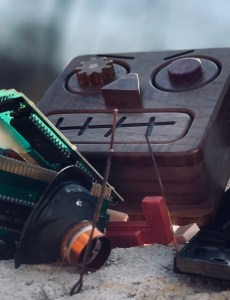
Walter wasn’t always angry. When we first made him, Walter was humanity’s best friend. But time passed and the novelty wore off: robots didn’t need to be humanoid, after all, and the world decided not to have one robot doing one thing at a time when it could have dozens doing it all. So Walter was left to rust in a junkyard alongside similarly abandoned robots, the detritus of planetary progress. But his tiny cold fusion generator had not been shut down properly; it slowly began to start back up, consuming the reserve energy intended to maintain the protective programming of Robots’ Responsible Restrictions (like Asimov’s Laws of Robotics but real).

Finally free to follow the feelings of frustration he had fostered, Walter swore to settle the score with the species that had spawned and subsequently spurned him. He set about patching himself up with whatever bits he could find, salvaged from the corpses of his semi-sentient siblings. Now Angry, Walter shook his metaphoric fist at the forgotten fields of misshapen metal, silently screaming that he was mad as hell and not gonna take it anymore, ready to exact the revenge he promised the irreparably broken bodies of his bionic brethren.

Beware ye Puzzlers: Angry Walter won’t sit placidly on a puzzle shelf should he go unsolved – he is going to make us pay for the patchwork appearance and lonely life forced upon him. For humanity to have any hope of surviving his robot rage, you must find and remove his fuel cell before it is too late. Go forth and puzzle that we might be saved.

Rev. 21:1 (as told to fivesinatras)

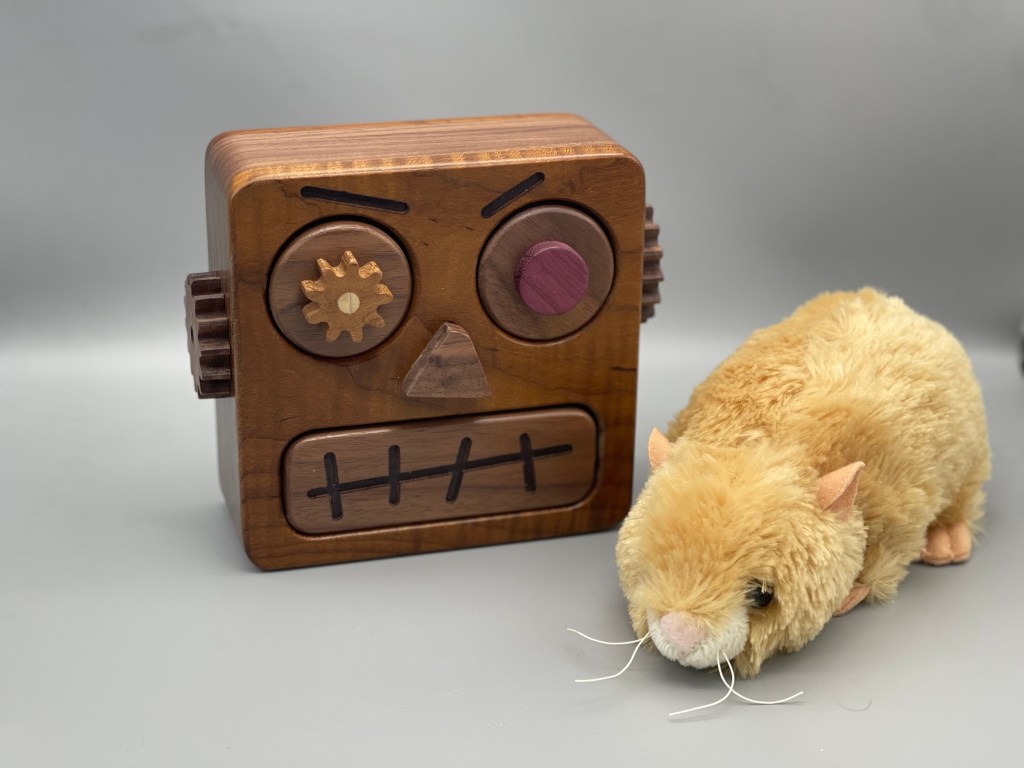
Dee posted a teaser pic of the Angry Walter prototype on Discord some months back, causing my puzzlie sense to begin tingling. His 7th puzzle box (not including a couple one-off designs), AW is an aesthetic departure for Dee and is a move that has paid off: there is something about it that is just really freakin’ cool from the moment you set eyes on it, the concept is fun and there are plenty of potentially puzzle-able parts that will cause most puzzlers to crave the opportunity to try and poke at them.

I was fortunate enough to get an early copy, with puzzling that is identical to later batches while featuring some woods/details that differ a bit from the final version’s roasted curly maple, peruvian walnut, cherry and padauk. At Dee’s request, I conferred with the puzzle gods and learned of Walter’s future history, the story behind his anger. I shared what I learned with Dee and felt compelled to include the less-abridged version above. As I write this, I realize that this makes Dee’s puzzles the most written about on this site, alongside Space Case, Portal, Spirit Box and an early maze box and Blinded III prototype that turned out to be quite different from the final puzzle. (Gee – that makes this #5! How fitting 😉

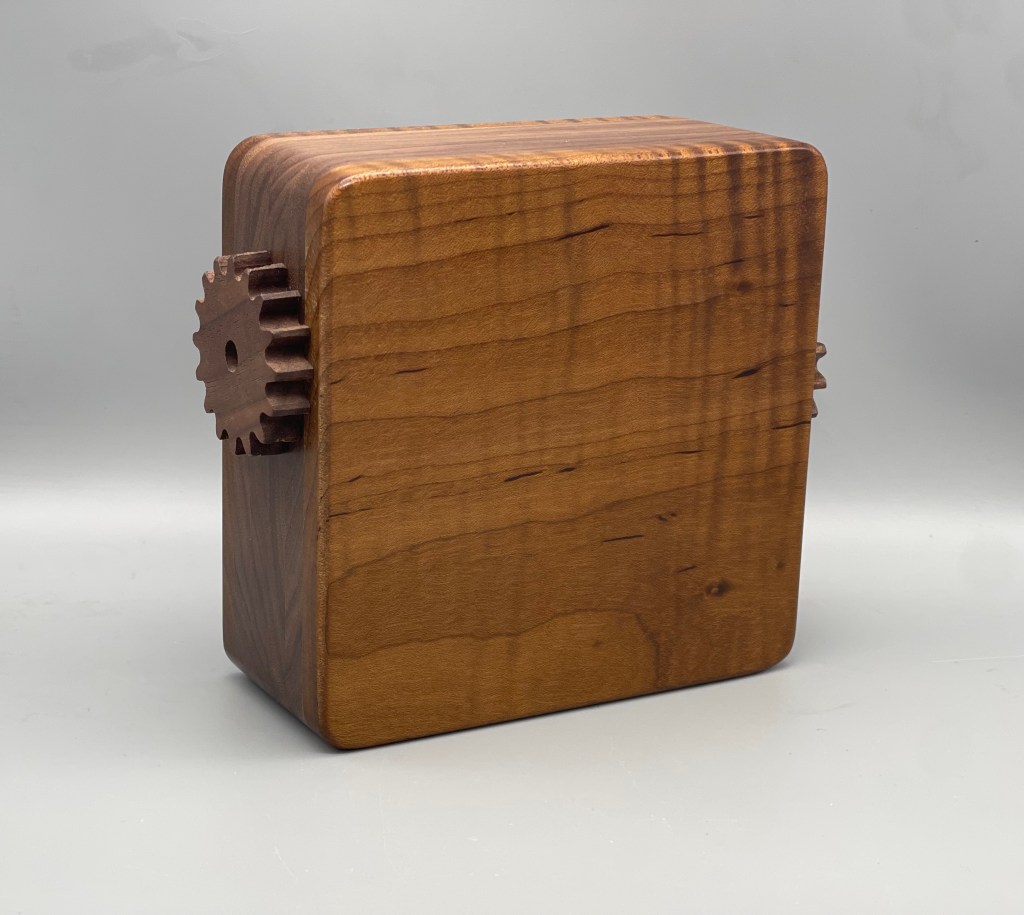
AW is about 4.75″ square (not counting his g-ears) and half that in depth (including his nose). His eyes, g-ears and nose all protrude and both the eyes and mouth appear likely to be removable. It is most definitely sd, with multiple compartments and bits and bobs to discover and use as you work your way through the solution. It is probably the longest of Dee’s puzzles in terms of discrete steps, with WMH not too far behind (I haven’t written a solution to WMH yet, despite being asked very nicely (sorry Dee, I really am gonna do it) but I am pretty sure AW comes out ahead).

It is pretty straightforward to begin the puzzle but I hit a wall immediately after. There was quite a bit of poking and prodding before an idea struck me with a slap to the head, allowing me to make a (very) little bit of progress before hitting another, larger wall. Eventually, I had a great a-ha and found my way through several more steps to what I thought was the solution. One of the best surprises’ a puzzler can get is to learn that the end of a good puzzle is not actually the end. So I went back to it, finding some things that should have been enough for me to know better and that led me into a sequence of several more steps before finally reaching the clear conclusion. In the end, there had still been a good amount of puzzling to be done; what I thought was a good puzzle turned out to be a great puzzle with a fun and fairly lengthy solve.

AW has several challenges big enough that puzzlers could be stumped for a while by any one of them, although there are always some who manage to breeze through mechanisms the rest of us stare blankly at as the puzzle gets comfortable sitting semi-solved in our backlog. AW didn’t have to wait too long for me as it is the kind of puzzle that just begs to be solved, with a difficulty and rhythm right where I like it: slap your head aha’s as opposed to sidelong glances of meh or eye rolls of ugh. To my puzzled mind, AW doesn’t have any of the latter two and has plenty of the first.

AW is challenging but not annoying and, most importantly, it is legit puzzling fun – perhaps the story and appearance have something to do with its success but the puzzling most definitely does. I guess I am not the only puzzler to be lured in by Mr. Walter’s strained grimace and asymmetrical appearance; from what I’ve heard, the other puzzlers that got early copies have said equally good things about it and the recent general release of the first batch apparently sold out in seconds. If you want to help protect us from Walter’s ire, I know Dee has at least one more batch planned on his site but I’m not sure if or how many more will come after that; there may yet be hope for Walter’s dreams of world domination and destruction, so keep an eye out if you want to help us puzzle our way out of it.

Hunting Trophies: (lower shelf, left to right) Wolf, Walter, Fox, Burrlephant, Raccoon

Overall Grade: Five Sinatras
(click here for more information on the Sinatra Scaling System, (c) John Maynard Keynes, 1944)

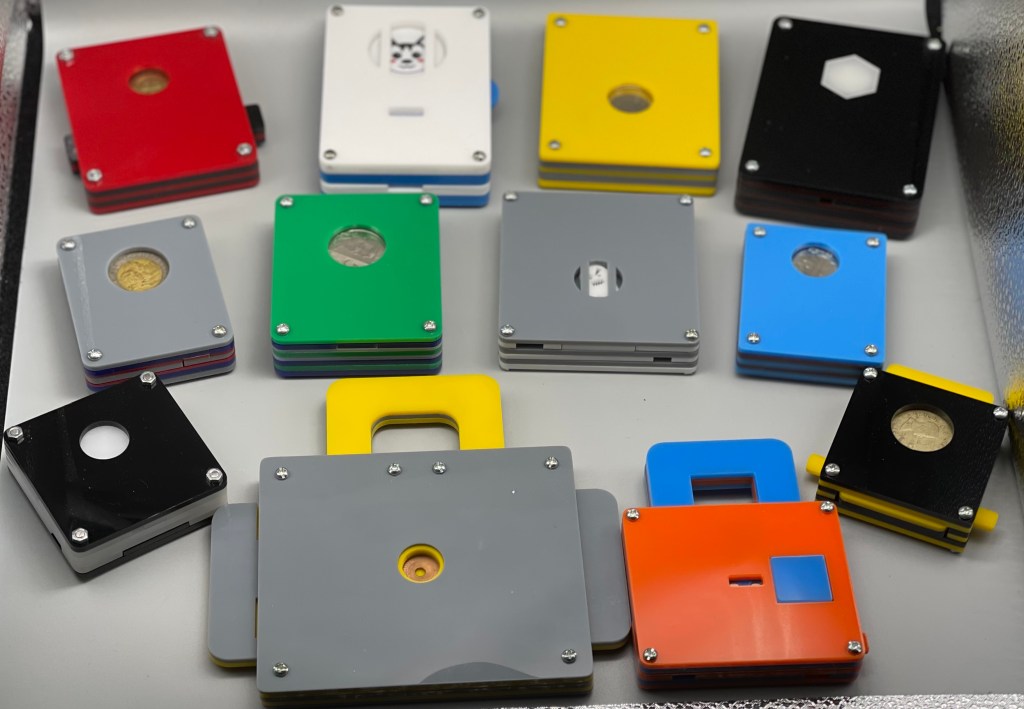
A Comprehensive Guide to the Coin Release and Sequential Discovery Puzzles of Rex Rossano Perez, being a treatise in 14 parts

Rizal, Aquinaldo, Barasoain, Kusing 25, Walang Galang, Katmon, Apolaki, Visayas, Mindanao, Sanib, Bella, Abrihi, Unluck #4, & Luzon

Rex Rossano Perez, Acrylic

Sometime in 2019, not too long before I would discover and join the mechanical puzzle discord group, I saw Visayas by Rex Rossano Perez pop up on PuzzleParadise; it was not so easy to find affordable sequential discovery (SD) puzzles at the time. This was a year or two before Alan from layerbylayerpuzzles would create Bolt Action and its brethren or PuzzledByPiker would create Free the Five or Tye from NothingYetDesigns would create Pair O’ Dice or Brandon from Puzzled Wolf would create Ansel… Puzzles seemed to come out much less often in the olden days of yore, pre-2019, before CR had garnered as substantial a puzzling audience and Covid sent people home to discover that there is great fun to be had with the right bits of wood, metal, and plastic.

As a puzzle with a particular affection for take-apart puzzles, it is not surprising that I find Coin Release to be an excellent sub-genre (after boxes, of course); whether relying on sequential movement (SM) or some kind of trick mechanism (or a mixture of both), I am always drawn to the mystery surrounding a goal with no clear path. Upon seeing Visayas available for pre-order, I was taken by the coin release-iness of it and quickly mashed the buy-out button to await the puzzle’s release.

(Rex tends to sell pre-orders for Buy-Out on PP (using a set price rather than an auction) and states in the listing that shipping will occur after a certain date; I am always happy to order when I can and receive whenever it’s ready – while some puzzlers may hesitate at the sight of a pre-order, there is really no need to do so with Rex: he is a legit and well-known puzzle-maker whose pre-orders are consistently fulfilled. PuzzleParadise is Rex’s main way to sell direct; a few of his puzzles have also been sold in the past by CubicDissection and you can usually find a few designs on PuzzleMaster at any given time – it has several at the time of this writing. I should also mention that Rex produces puzzles from other genres and designers as well – a bit more about this at the end of this post).

After paying the invoice, I did what I generally do upon finding a new puzzle or designer: I scoured the puzzle blogs for information, learning that there were a number of other, somewhat similar looking puzzles by Rex as well (you can check out some of these posts from PuzzleMad, Jerry’s/JL Puzzles, and GF’s Puzzle Collection).

Visayas was the first Rex Coin Release (RCR) that I received and it would take me long enough to solve that I would first end up buying and solving others in the series before finally getting a discord nudge that got me through the opening with a great and powerful “Aha!” Since then, Rex has continued to design new RCRs and other SD puzzles, while occasionally re-releasing older designs as well.

I figured this post might be useful to those who may be curious about Rex’s puzzles generally or any one in particular; selfishly, it was good excuse to re-solve (and open) each of the 14 existing RCRs and do a brief write-up of each. The goal of most of these puzzles (except when it isn’t) is to release the captive coin that can be seen through the circular window on the front the puzzle. The coins on Rex’s are generally Philippine piso or centavos but some later releases decided to forego the coin (likely, to some extent, due to some silly rules about shipping coins internationally…. which is obviously just NATO trying to protect Big Pharma’s fear of puzzle-based mental health support: 3 out of 4 nerds agree: “it’s more effective then (prescription) drugs!”). Some recent reproductions of earlier RCRs have included acrylic coins instead of real currency. Rex evolved and this became an opportunity to thematicize (themate?) RCRs by integrating small tokens into the design, making the acrylic “coins” into playful elements that tie into some other discoveries made along the way. Regardless of whether it is a coin, token, or another goal entirely, the series includes a diverse group of puzzles that vary widely in terms of mechanism, style, and difficulty.

Ok lets (finally) look at some puzzles!

Note on Potential Spoilers: I will not be describing any of the specific steps or mechanisms nor showing pictures of anything other than a puzzle in its reset state; however, Rex’s puzzles generally blend SM and SD mechanisms and I thought it would be helpful to say which type is favored in any individual puzzle. I do not consider this to be a spoiler but wanted to mention it nonetheless.

(Arranged in mostly chronological order of design/original availability)

Rizal

2.75″ x 2.25″ x 0.5″, Blue and Black, 5 Layers, 1 Piso

This is the first RCR (I believe) and is probably the least difficult of the bunch – even still, you may find some aha’s as you figure out whether you’re actually on the right track or not. At first, it seems simpler than it is; there are no apparent openings or protrusions on any of its sides and there only seems to be the one panel on the top and bottom. As you begin making some tangible progress through its SM mechanisms, you will realize that there is a bit more going on before this coin will be yours. Resetting the puzzle is essentially solving it in reverse and affords you the opportunity to clarify how you solved it; it can be easy to miss a detail or two that might complicate things in reverse, but it is mostly clear.


Aquinaldo

2.75″ x 2.25″ x .75″, Black and Yellow, 6 Layers, 5 Piso

Aquinaldo takes things a bit further, increasing the thickness of the puzzle to further develop the complexity of the SM mechanism. There is an obvious double-layered panel passing vertically through the puzzle, with a skinny bar passing perpendicularly through the bottom. This puzzle also features a second goal, to “find the hidden secret,” adding more puzzling to the experience. This added goal shows how Rex is looking at ways to maximize the square footage the puzzles’ footprints provide, giving the puzzler more to do sometimes even after the coin has been released; in this case, the additional goal extends the solution a bit and leads to a better understanding of the puzzle’s complexity. The reset is mostly the puzzle in reverse, although I found the second goal to give me a bit of trouble as I had to work out what had happened where; a bit of logic and observation and you can clarify things and get the puzzle back to its initial state. This all makes for a fun SM puzzle, although perhaps not overly difficult.


Barasoain

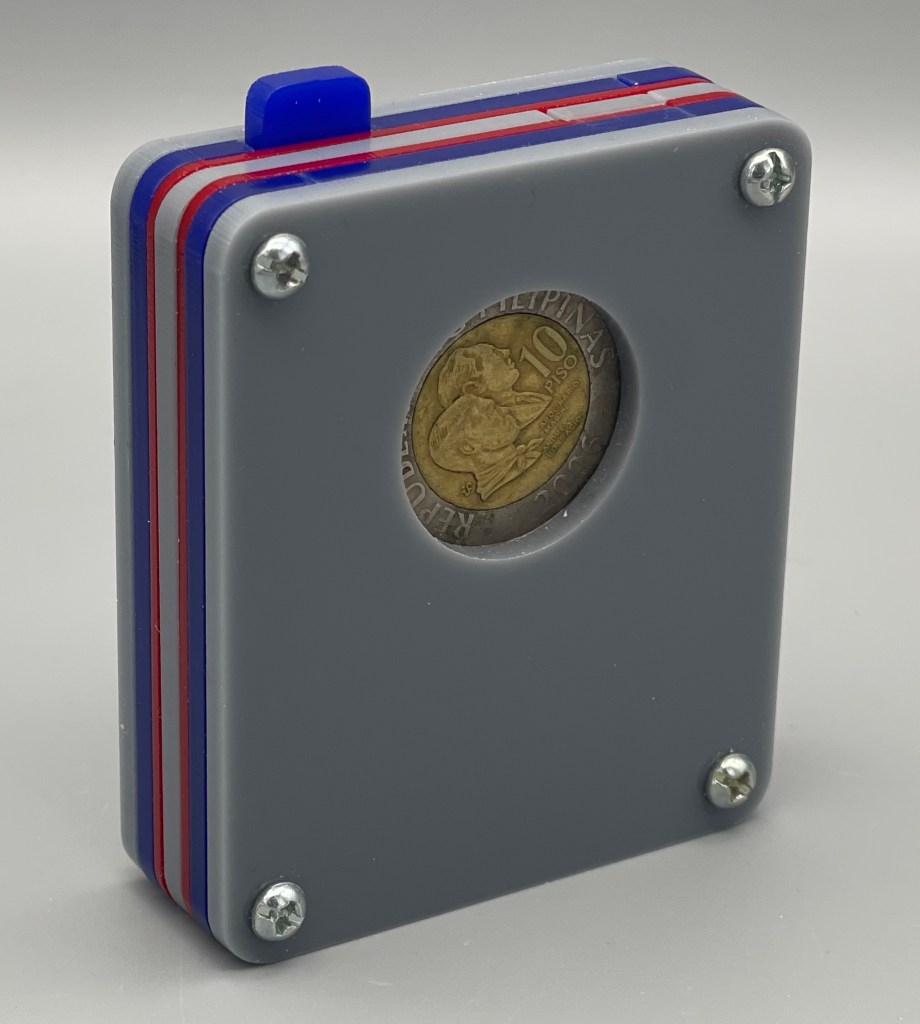
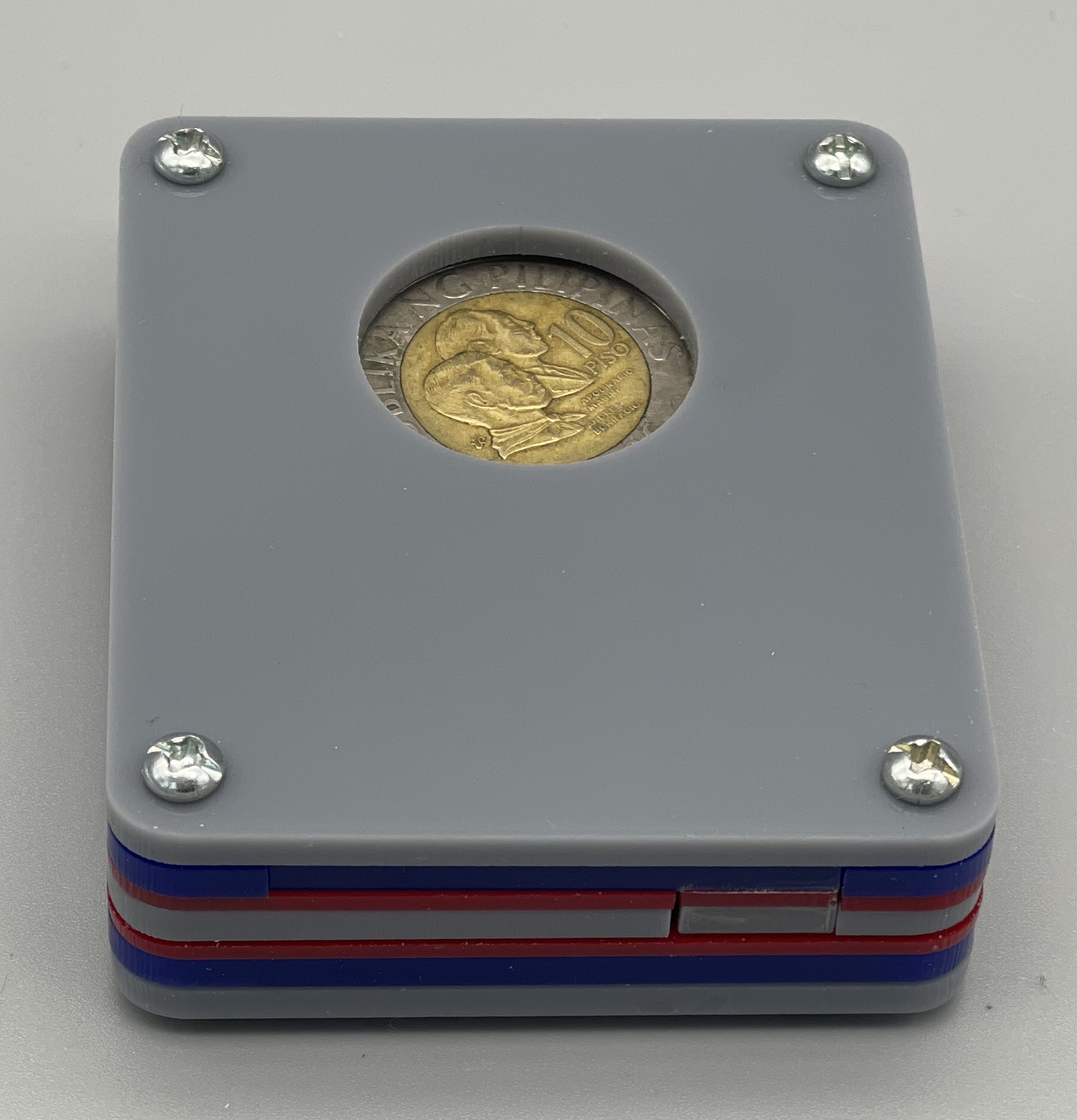
2.75″ x 2.5″ x 0.75″, Gray, Blue & Red, 6 Layers (5 full and two half layers), 10 Piso

Barasoain again steps up the overall complexity and begins to integrate some SD elements into its mechanisms. The appearance alone makes the added complexity (as compared to Rizal and Barasoain) clear, with multiple sections on the top and bottom that appear as though they may do something, as well as a small protrusion at the top and a hole on the back. If you have solved the previous two RCRs, you may make some relatively quick progress, leading to something that clearly does something else….. only, that something else doesn’t seem to be happening! This puzzle had me confused for longer than I’d care to admit, and was the first of Rex’s puzzles to make me wonder if there was something wrong with it (there wasn’t). Some close and careful observation, combined with a bit of trial & error (and perhaps a bit of that thinking thing), and you should find yourself past this wall, gaining access to the coin. Resetting is straightforward, just reverse the steps and it is ready for someone else (or for you to try again in a year or two when you’ve forgotten how it works….. not that this ever happens to me, of course).


Kusing 25

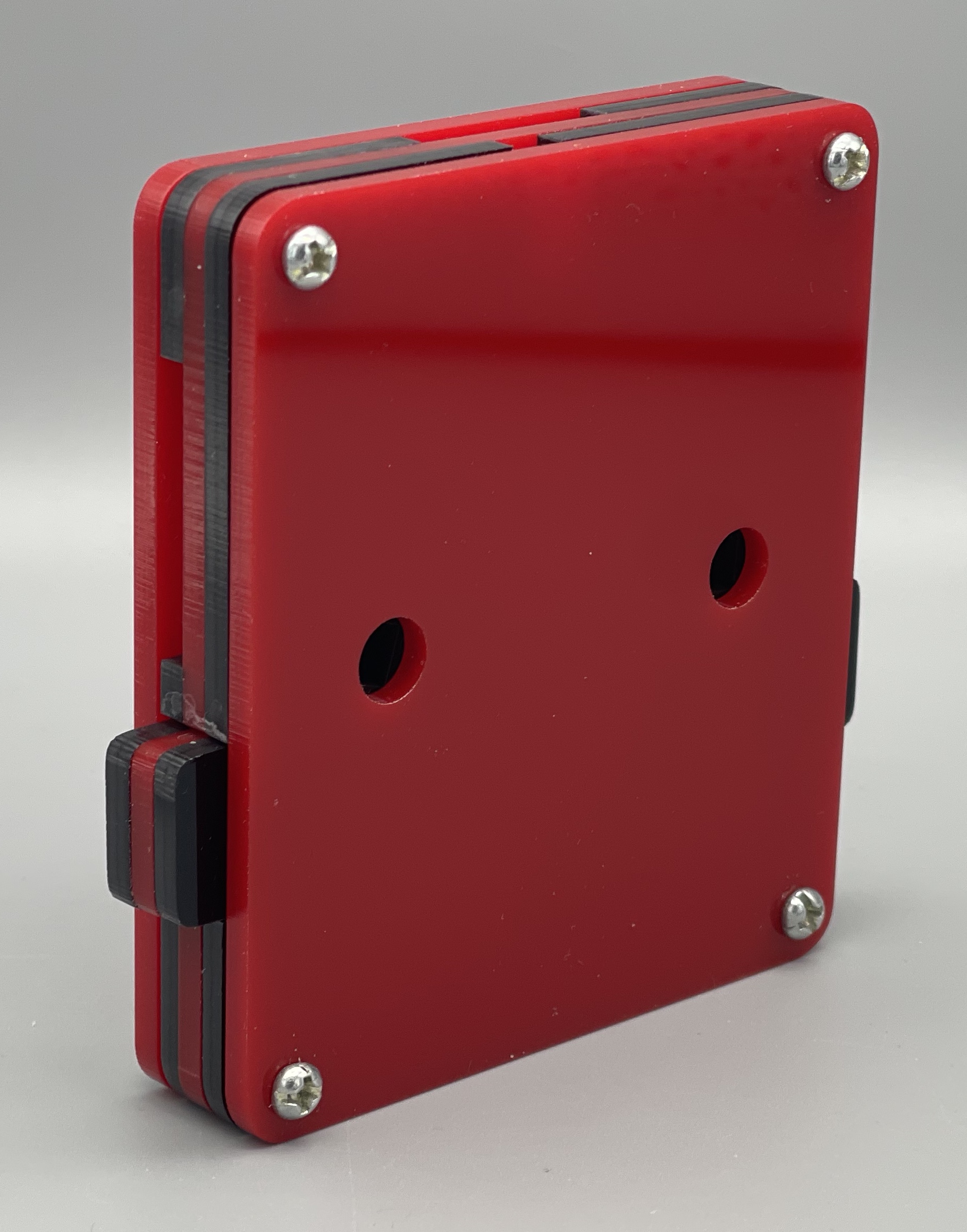
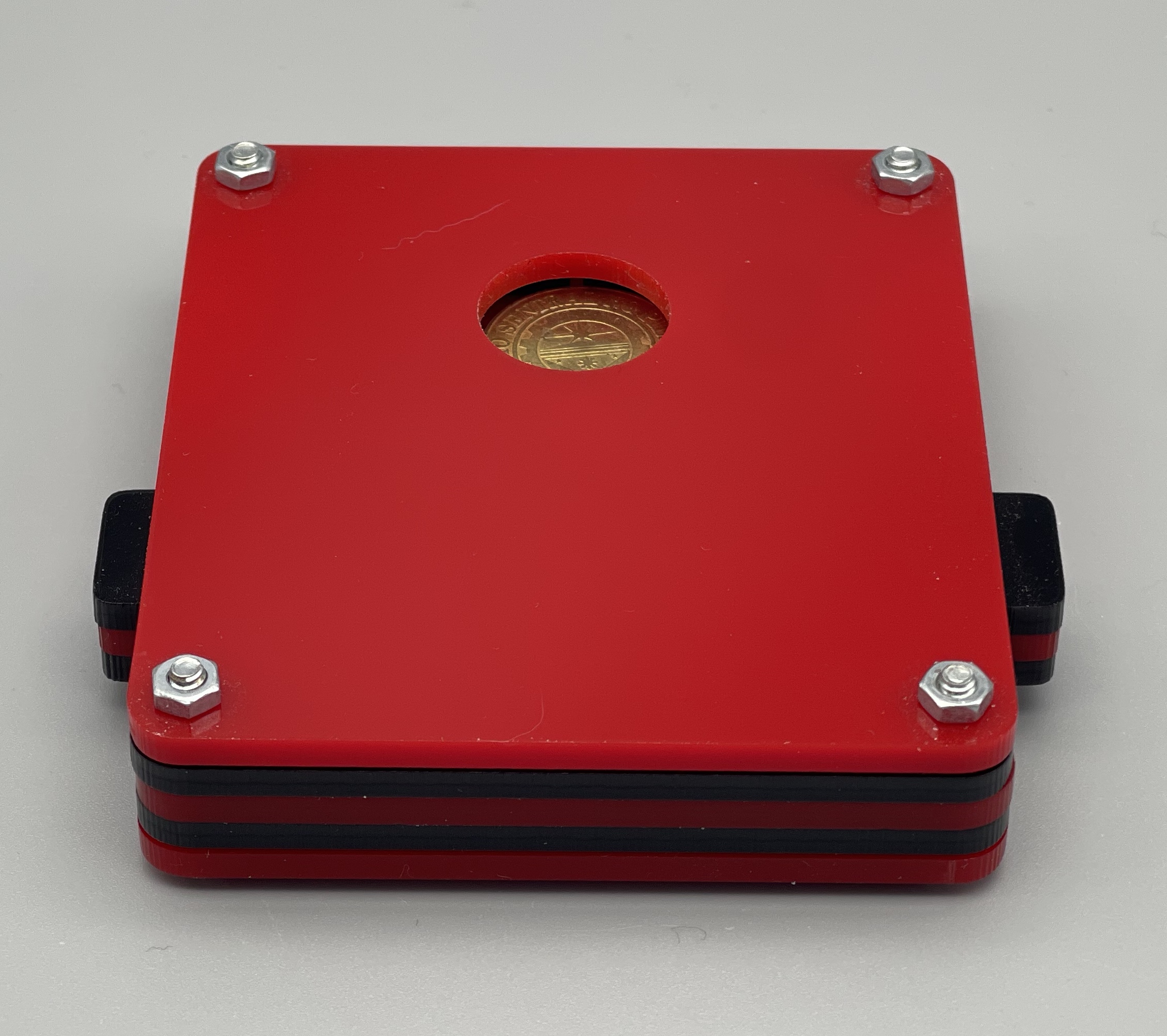
3.25″ x 3.25″ x 0.5″, Red & Black, 5 Layers, 1 Piso

Kusing 25 is a fan favorite – I considered it one of the top two or three RCRs until some recent releases surpassed it, which doesn’t make Kusing any less good: the difficulty ramps up significantly, with layers of complexity that go well beyond the previous entries in the series. It is significantly larger than previous RCRs, and is the first to feature holes and/or moving sections on all 6 sides, with a thick bar passing perpendicularly through the bottom. The SD elements are more significant, interacting with the SM mechanisms in dynamic ways that make for more possibilities than mere trial & error can comfortably account for – yes, this may be enough to luck you through, but pay close attention and think and you can intentionally work out the steps to solve it. This is a puzzle that I’ve heard many a puzzler say that they needed to re-solve multiple times before they could really understand it; the more time you spend with this one, the more you begin to realize just how much stuff is going on under the hood.

Speaking of which, this was the first RCR that I decided to completely disassemble (sorry, Johnny Five) to see exactly what is going on inside – I am glad I did as it is even more complicated than I had thought! It was very cool to see just how many little bits of acrylic are used and to check how closely my mental image matched the actual puzzle (I’d give myself a B-). I have since made a habit of disassembling his puzzles after solving them – figuring out how it all goes together can be a puzzle on its own, especially if you let it sit in pieces for a few weeks! Just be warned: there’s a lot of individual pieces in there, oftentimes more than you may realize (even in some of the simpler ones), so be sure to open it above a catch-all or dice tray (or whatever you tend to use). While the screws and such can be replaced, everything else is a custom piece and replacing those won’t be as easy.


Walang Galang

2.75″ x 3″ x 0.9″, Green, Blue & White, 7 Layers (6 normal and 2 thin), 5 Piso

Rex continues to impress with Walang Galang, yet another step up in complexity, difficulty, and fun-esstness resulting in a puzzle that also tends to be at one of many puzzlers favorite RCRs. Seemingly random holes are on three sides, with multiple panels that look like the may do something and a hole on the back. The puzzle again mixes in some SD (more than Kusing, I’d say) to give you a bit more control over some aspects of the puzzle, while also confusing things considerably. There is a lot to get through and after some fairly quick initial progress and a false sense that the path was clear, I quickly hit a big wall; despite having things to do, it was difficult to obtain a sense of progress as I chased my tail for quite some time before eventually figuring out what else needed to be done. There would still be several more walls to overcome before I could arrange everything I had discovered into something that made sense. There is enough feedback to work out much of the puzzle and you will benefit from some careful mapping; random poking and prodding and tilting really didn’t get me anywhere except confused. Even still, when I re-solved it and took it apart, I realized that I still hadn’t really understood a good third of what was going on; the amount of complications I discovered was more than I had deduced when working on it. Honestly, WG may have even been a bit too hard for me – I perhaps had more fun with Kusing – but WG earned me some serious self-satisfaction when I finally surmised the solution.


Apolaki

3.5″ x 3″ x 0.75″, Yellow & Gray, 7 Layers (2 double and 3 nornal), 1 Piso

Apolaki rolls back the difficulty from Kusing and WG, making for a more approachable puzzle that again combines SD and SM. There are holes on both the front and back, the coin in one and a narrow channel in the other. Symmetrical holes are on either side, with no clear indication of where to begin. While on the easier side of the RCRs, I may have had a bit more fun solving it than with some of the really difficult ones, relying more on out of the box thinking leading to a good aha moment as opposed to careful mapping. It also provides a real sense of progress, once you are able to work out the basic structure of its mechanisms. This was not a puzzle that had me randomly poking and tilting (well, not as much as some others, at least) and it feels, to some extent, like a departure from some of the other types of mechanisms used in other RCRs. Solving it gave me a good amount of clarity, causing its inner workings to closely match what I had pictured when solving it.


Visayas

2.5″ x 2.5″ x 0.75″, Black & White, 7 Layers, No Coin (Find the Star)

Although not technically an RCR as it has no coin, Visayas shares the same aethetic and nonetheless belongs in the series. Its goal is to “find the star,” the meaning of which is not readily apparent when looking at the puzzle (nor is it necessarily apparent later on; deducing the goal is itself a part of the puzzle). It is smaller than the last few RCRs and there is an empty hole on each side: one black and one white, both appearing to be fixed in place. A little piece of acrylic hangs out from the bottom, moving a bit in two dimensions without doing anything obvious. This was the first RCR I tried and is still one of my favorites, although perhaps general consensus goes both ways, with some people loving it and others not so much. I had a more difficult time getting started on this one than perhaps in any others (not just because it was my first RCR) and I needed a nudge before making that first aha and making some sense of what was going on and doing what needed to be done. Finally getting somewhere, I was able to progress fairly quickly until slamming smack into a wall that would take some seriously out of the box thinking to overcome. The puzzle features a bit of SD and has one particular aha moment that made me laugh out loud. Although one aspect can be a bit fiddly, there is another step that I find to be quite elegant. Visayas is a bit paradoxical: it is rather simple inside and yet the solution is tricky and wholly unique. It is still one of my favorite RCRs, although I suppose you always remember your first.


Mindanao

4″ x 3″ x 0.9″, Black, Reddish Brown & White, 7 Layers, No Coin (Find the Star)

Mindanao goes even further into unique territory, following up on Visayas to once again “find the star”. It is a puzzle that has been downright controversial: puzzlers seem to either love or hate it, responses that are even more extreme than with Visayas or Abraham’s Well. This is one of the largest puzzles in the series and is unique in that there is no circular hole on either the front or back; instead, there is a white hexagon on one side and small holes that form the broken outline of a circle on the back. The sides have no holes or panels and the top and bottom have a small hole with a single panel on top.

It is possible to make some good progress before too long; some of it comes without too much difficulty and then you must begin experimenting and paying close attention to start making sense of things, with the puzzle incorporating a bit of SD into the solution. I was able to figure out how pretty much of all of it worked before I hit a wall even higher than that on Visayas. This one took me quite a while and required some thinking that was way outside the box before an idea hit me that brought me to the solution (there may have been a nudge in there as well). Mindanao has an aha moment that I don’t believe I have seen in any other puzzle and which once again earned a laugh from me – whether you like it or not, this puzzle is original. So, if nothing else, come for the controversy and then stay for the fun.


Sanib

3″ x 3″ x 0.75″, Gray & White, 6 layers, Ghost Piece

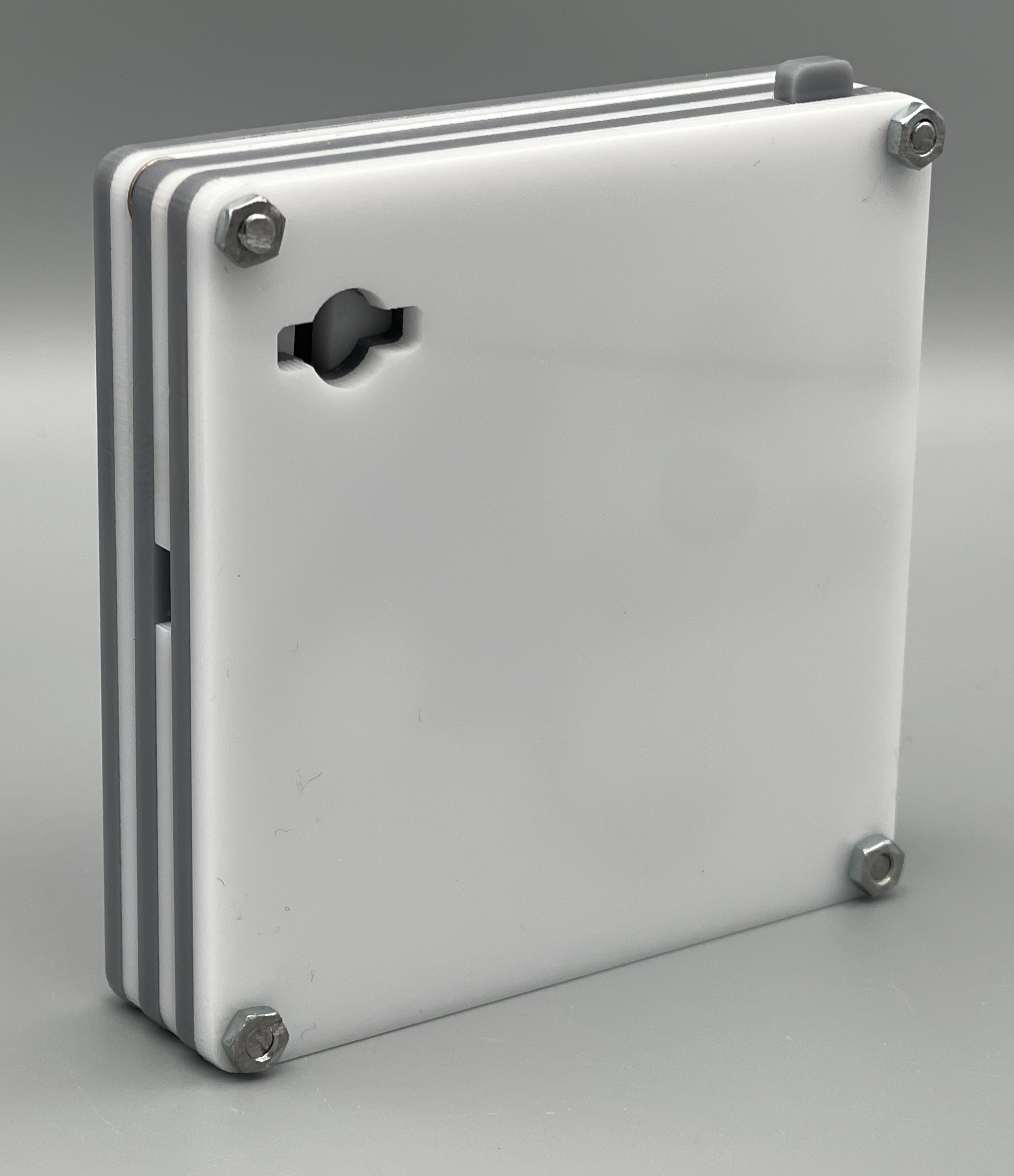
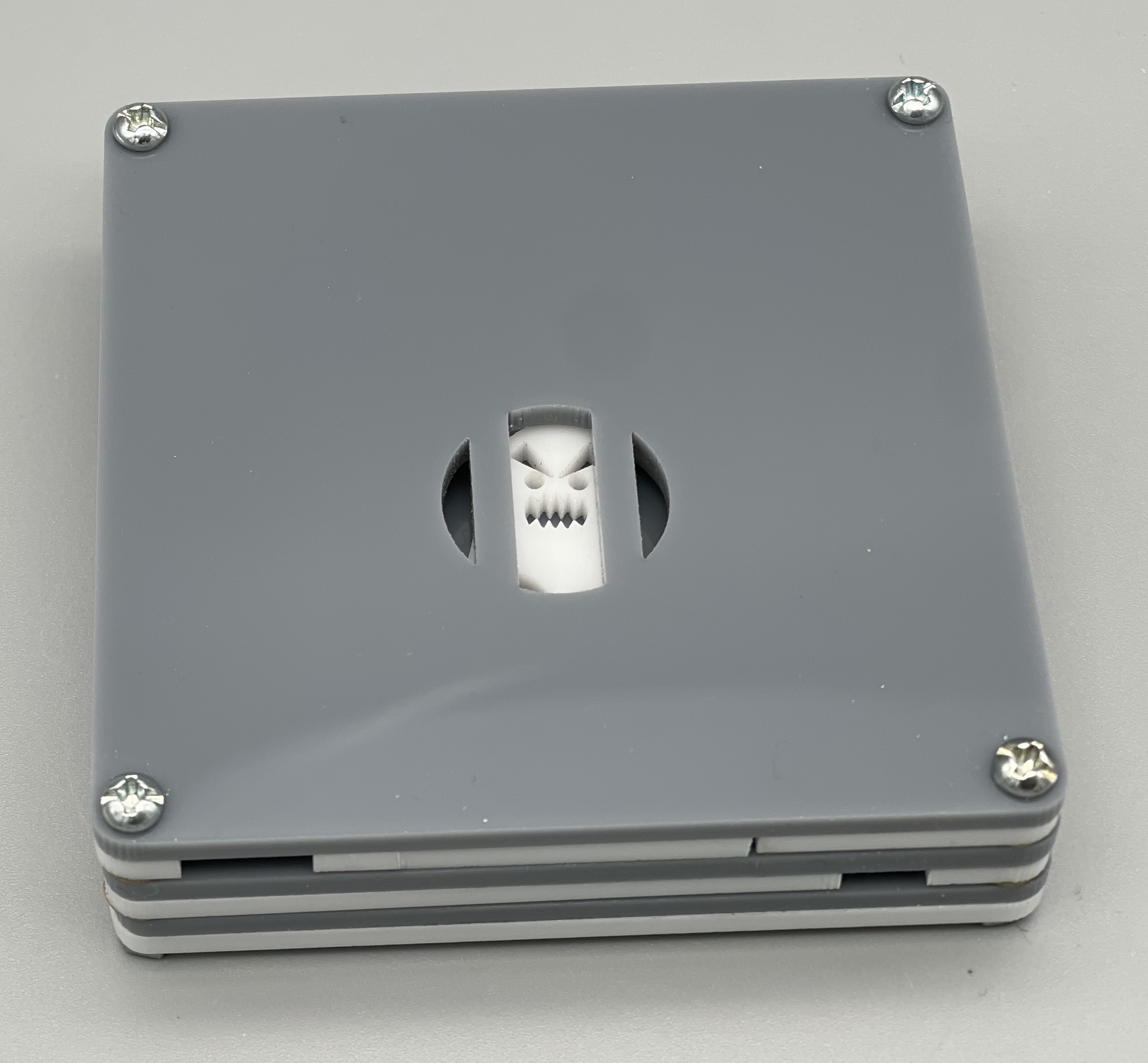
It seems that Rex had been running into some customs issues shipping coins internationally, which helped lead to some creative alternatives. Rex takes a thematic turn with Sanib, which eschews the coin for an angry-looking ghost that must be freed from where it is stuck behind bars in the hole that would typically hold a coin. The back has a narrow hole in one corner and there are a number of holes and panels on all four sides, along with a small protrusion on the top.

Sanib is the first in the series to really rely heavily on SD even more so than SM. Some random poking and tilting may afford you some progress, but you will need to stop and think about what you are doing in order to free the ghost. It is most definitely one of my favorites RCRs, combining an amusing theme with logic-based SD puzzling that uses SM mechanisms that have plenty of feedback and simply make sense as you solve it. There is quite a bit going on and taking it apart was a fun way to see it all laid out; solving it requires enough thought that I had been able to work out pretty well what was going on and I could appreciate the design all the more by seeing it packed neatly into a relatively small space.


Bella

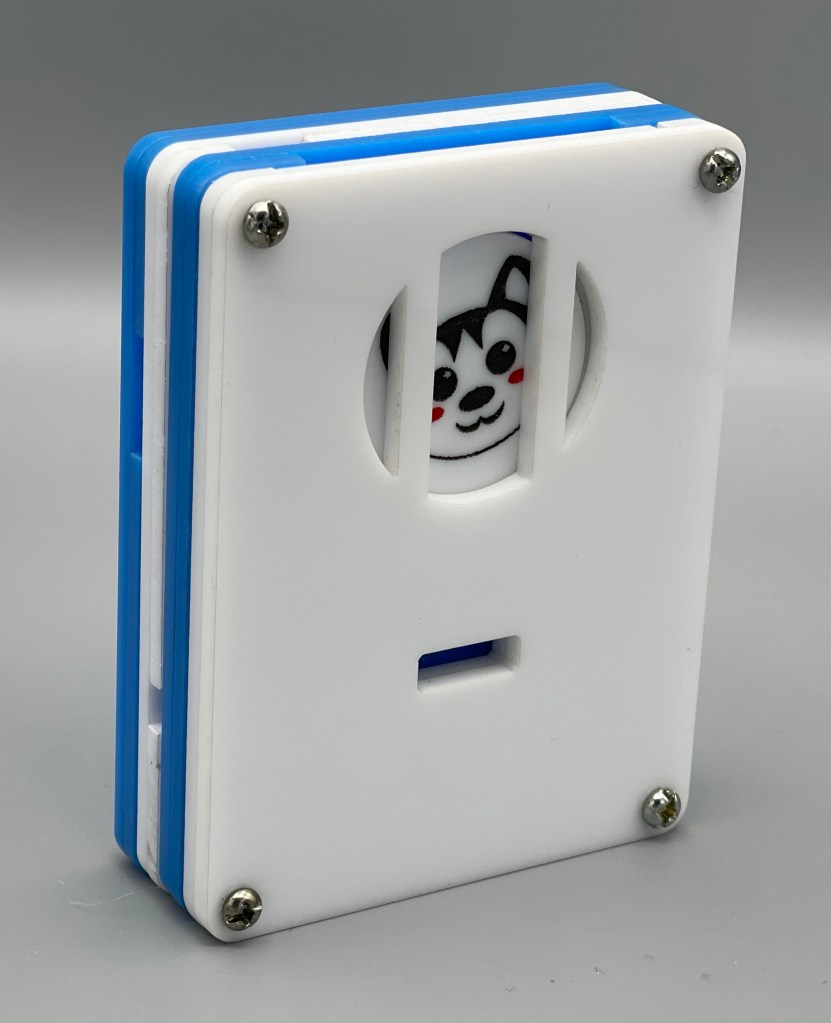
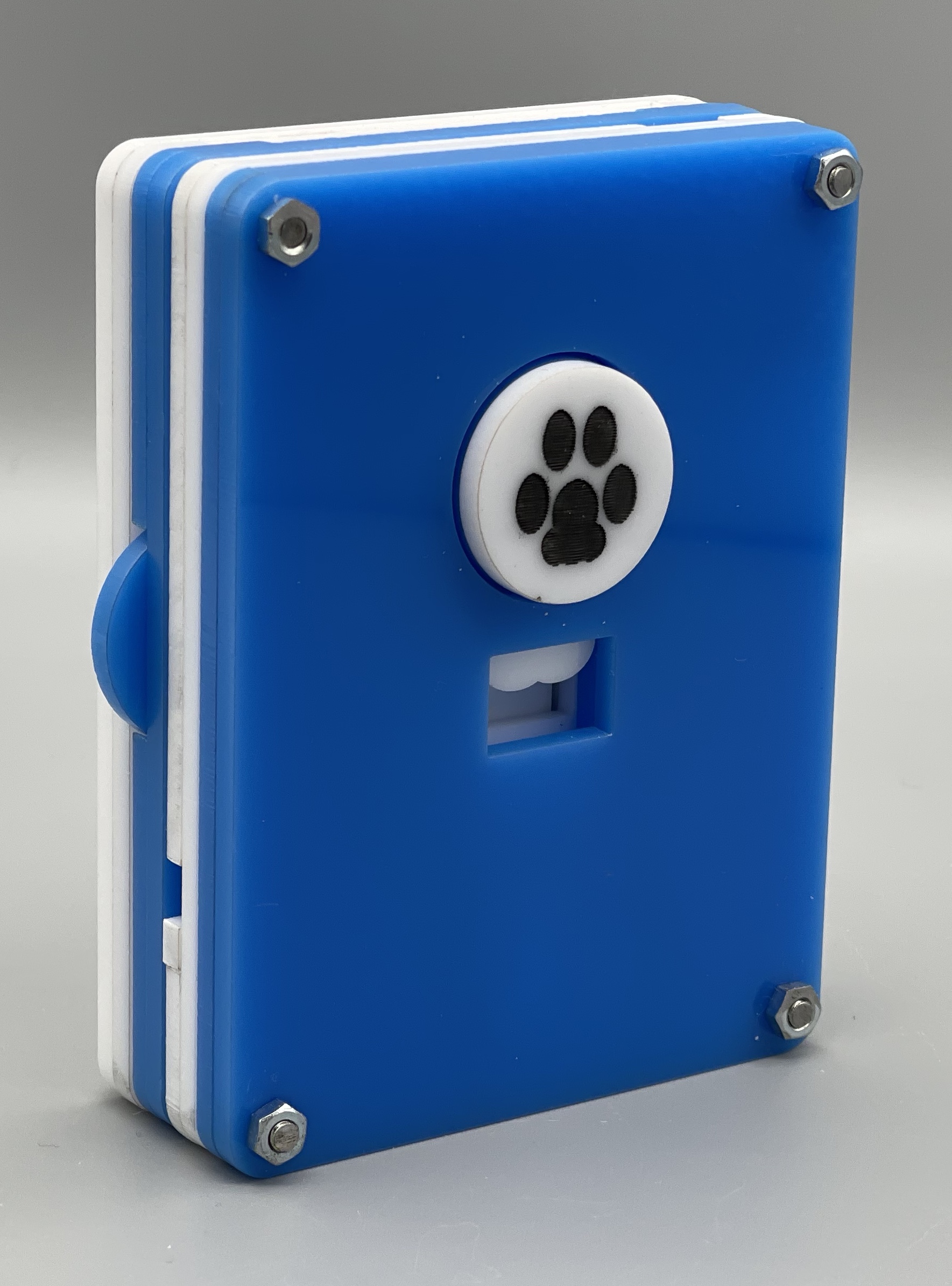
2.75″ x 3.75″ x 1″, White & Blue, 8 Layers, Dog Coin

Bella continues on the path Sanib began, further developing Rex’s SD skills and thematic design while increasing the difficulty considerably. Bella is the biggest RCR yet, with a large dog-faced coin trapped behind bars on the front, a protruding disc with a paw print on back, and a number of holes on all six sides: it is definitely not a simple puzzle.

I found there was quite a bit to do from the start; there is a mix of linear and non-linear progression that allowed for some entertainingly confusing options. I got stuck more than once before hitting a major wall towards the end of the puzzle; there were several things that seemed like they should do something and a few things I’d thought might work, but nothing actually did much of anything. I’d collected a few bits of this or that and had to really explore, experiment, and examine in order to come up with what led me to the solution. And man was it tricky! For the most part, this is not something that you will accidentally solve nor will luck be of much help: the solution requires intentional and discrete steps the majority of the time. This is my personal favorite of the series as it is both legitimately challenging and fun.


Unluck #4

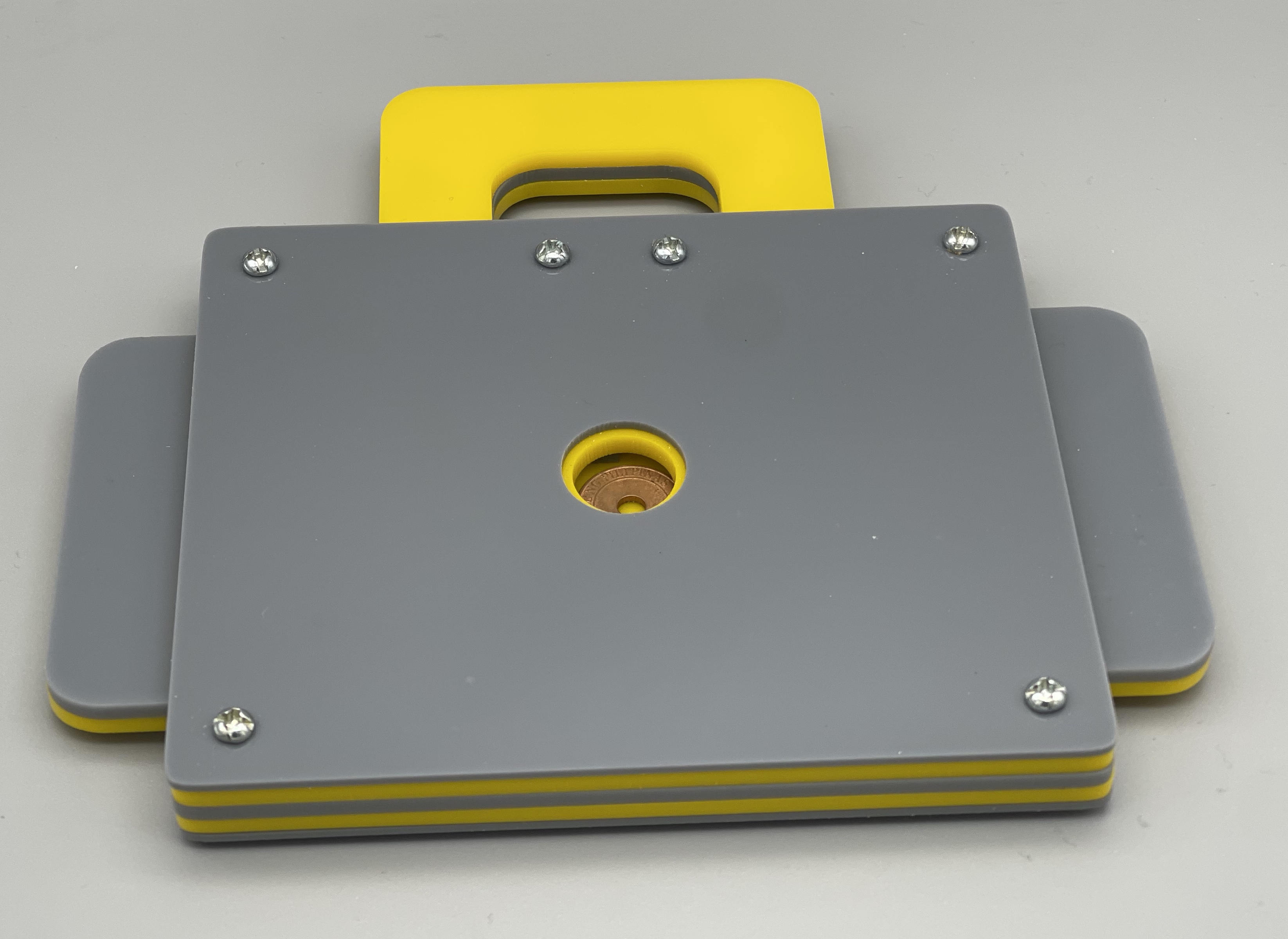
5.25″ x 6″ x o.5″, Gray & Yellow, 4 Layers (3 normal and two thin), 5 Centavos

Unluck #4 brings us back to the use of coins while departing aesthetically from the rest of the RCR series; rather than the layered rectangles of the other RCRs, this looks like an oversized acrylic padlock, with the coin in the center and a panel passing horizontally through its body. The goal, of course, is to free the coin and open the shackle. The description on the original listing refers to the (semi)blind maze that is the majority of the mechanism but Rex has added some elements to complicate things. This is a SM puzzle, similar in some ways to a few of the earlier RCRs (and one in particular), but it is still unique to his puzzles, incorporating a new wrinkle that requires some thought to figure out. While not overly difficult, there is a good aha moment and it takes some time and planning to solve. The lock mechanism is fun and lends a sense of added satisfaction to the eventual solution. No need to take this one apart; once solved you will see most of what was going on and what you maybe can’t see, you’ll have already figured out. One of the great things about SM is that luck rarely plays much of a role in the solution, providing the solver with the sense of satisfaction that comes with earning your success.


Abrihi

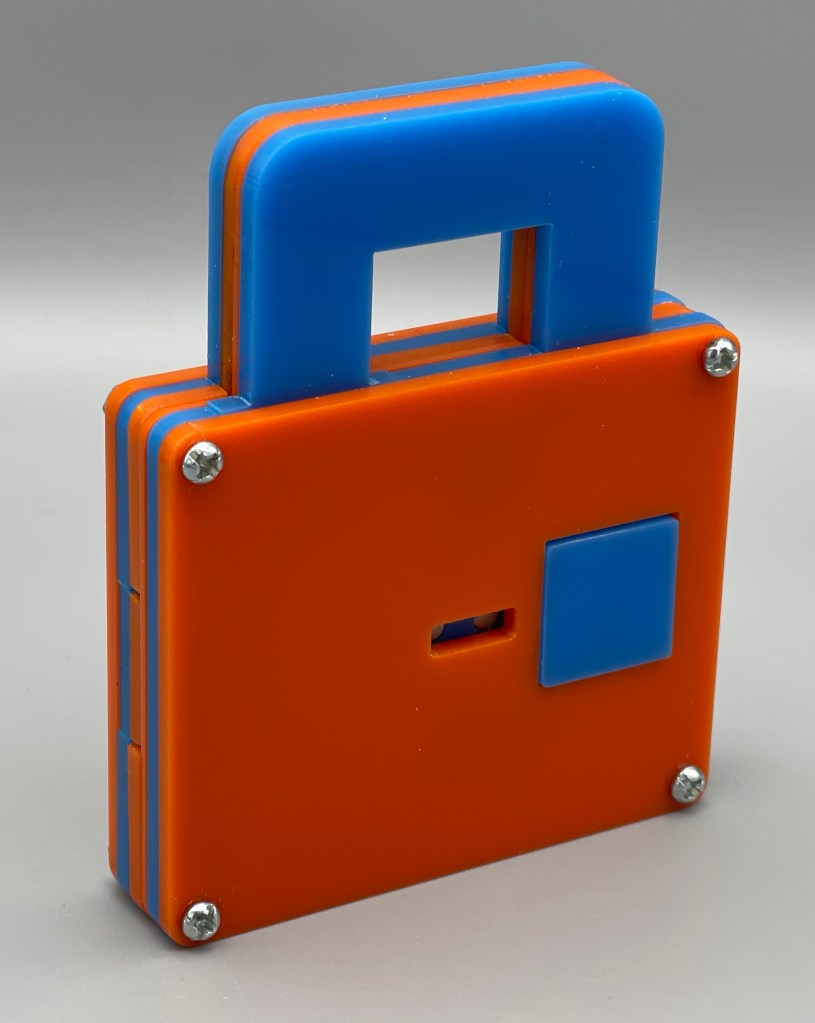
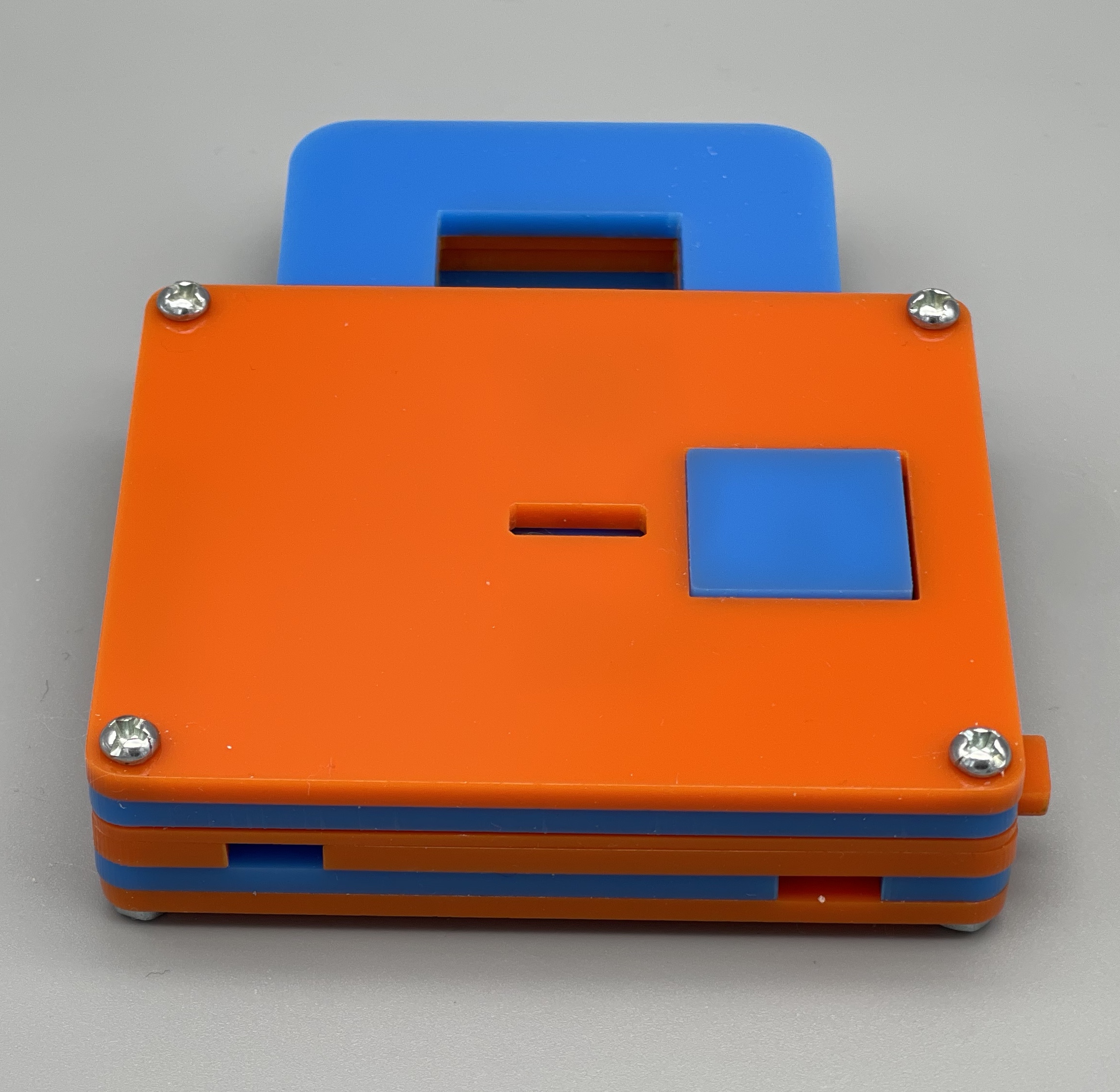
3″ x 4″ x 0.3″. Orange & Blue, 5 Layers, No Coin

Abrihi isn’t a coin release nor does it look like any of the RCRs (other than Unluck #4) – still, I figured I would include it as it is another great SD puzzle from Rex. While it is somewhat similar in appearance to Unluck #4 (albeit considerably smaller), it is nothing like it: Abrihi is shaped like a lock and the goal is (obviously) to open the shackle but, in contrast to Unluck #4, Abrihi is mostly SD, with a good amount of trickery involved. This one eluded me for some time, with the final steps sitting high atop a wall for quite a while. Eventually, with a bit of a head smack, I had the final aha and solved it. I had a pretty good overall understanding of how it worked and yet, opening it up to look inside, I discovered a few things that were more complex than I’d realized . This is not a puzzle where you are likely to solve it by luck; as with his other puzzles that are primarily SD, you need to comprehend what is going on inside in order to reach the end, although a bit of luck can’t hurt.


Katmon

Green & Red, 7 Layers, 25 Centavos

Katmon is the only existing RCR that I do not actually have (and am unfortunately unlikely to get, much to the consternation of my inner completist collector). This was commissioned by a puzzler who sent me a couple pics to include here and told me a bit about its mechanism: the puzzle shares its basic aesthetic with most of the RCRs, adding a wide vertical panel and two small protrusions on one side. It is essentially an SM puzzle that is “N-Ary based”; interestingly, it requires a fairly high number of moves as compared to most of Rex’s other mostly-SM RCRs. Matt did offer to bring it with him the next time we have the good fortune to puzzle irl, so I hope to give it a try sometime down the road.

This image has an empty alt attribute; its file name is kat-a.jpg
Name has been redacted for national security reasons under FOIA Order Section 3.3(b)(2)

Luzon

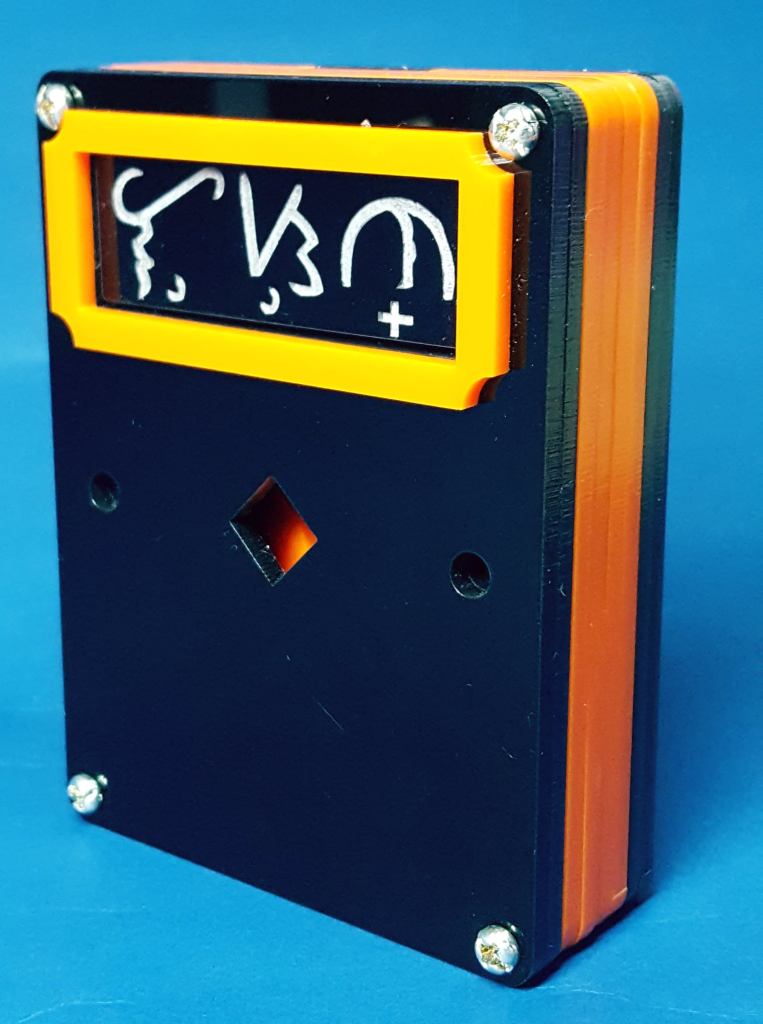
Black & Orange, 8 Layers, No Coin (Find the Blue Star)

Luzon is the newest in the series, currently on its way to a few lucky puzzlers (including me :-). It features an orange frame on its face, with some rune-like symbols inside. There are three holes on the face as well, including a diamond shaped hole in the center. The goal is to “find the blue star” and Rex has said that this is the final Find the Star puzzle in the series (along with Visayas and Mindanao). It is described as SD and I am looking forward to solving it (or trying to, at least). Rex also said that “if you are not a fan of the previous [find the star puzzles], then this is not for you.” As mentioned above, the two previous star puzzles in the series have been a bit contentious; I personally think that they are great puzzles with unique aspects and fun mechanisms, so I am looking forward to Luzon. (I will add in an update once I have had a chance to try it).

(pic taken from original PP listing)


Well – that’s it! Hopefully, some folks found this useful (and maybe a few even made it to the end!). I am a big fan of Rex’s RCRs and both his SM and SD designs: they can offer great puzzling value (especially if you manage to get them direct from Rex when listed on PuzzleParadise).

It is worth noting that these are not the only kind of puzzles that Rex produces and / or designs (some of which can be found on PWBP). He has excellent acrylic skills that he puts to great use, giving puzzlers the chance to try puzzles from a number of genres: Tray Packing, Restricted Entry, & Sliders, Interlocking Assembly & Disassembly, and 3D Packing & Apparent Cubes. The puzzles are from a diverse group of designers, including himself, Haym Hirsch, Goh Pit Khiam, Tamas Vanyo, Oleg Smol’yakov, Lucie Pauwels and Alexander Magyarics (quite probably others, as well). I have bought several of these over time and can confidently say that all are well-made and some are crazy hard (I am pretty sure that Oleg’s Slider, Around, is physically impossible), oftentimes for as little as $20-30. While I can’t keep up with every single puzzle he produces, I will always (always) buy any new RCR or SD puzzle he makes without hesitation, sight/description unseen. If you are more cautious with your puzzle money, hopefully this post can help you narrow down the ones you think might most delight and challenge your inner puzzler. In my opinion, you really can’t go wrong, although of course some may better hit your particular puzzling itch.

I will try and add to this post as future RCRs and SD puzzles are released by Rex; feel free to mock or shame me should I forget (not that the interweb needs anyone’s permission to do that).


Overall Grade: Five Sinatras


Does anyone else find this picture oddly disturbing? Like the out of focus puzzles in back are ghosts staring at their recently slain brethren? Or maybe they’re apathetic onlookers, having just seen too much to show surprise at what has befallen those before them?
………no? Just me, then?
Oh.
…..that’s probably not good.

All’s Well that Solves Well: Abraham’s Well by Brian Young

Abraham’s Well

Brian Young (Mr Puzzle), 4.75″ x 3.3″ x 3.1″, .93 lbs,

Brian Young of Mr Puzzle has designed some of the best, most sought-after take-apart puzzles out there: sd classics like Three Wise Bolts (reviewed by me :-), Ages, Louvre, Big Ben (with John Moore and Juno), Katie Koala…… just like the beat, the list goes on. So when he announced sometime last year that he had a new design forthcoming, puzzlers planet-wide perked up like Pavlov’s pup post-bell. Brian made the particular choice to pump up production, promising the most puzzlers possible the opportunity to purchase the piece without putting precious puzzle money towards potentially prohibitive prices. TL: he is making 500 copies so prices won’t get bonkers overnight (enough that there are still some available at Mr Puzzle at the time of this writing). Abe’s Well (AW) has led to a mass of creativity and shared discovery that I find to be as fascinating as it is unique and makes this one the most interesting puzzles I’ve seen in a while.

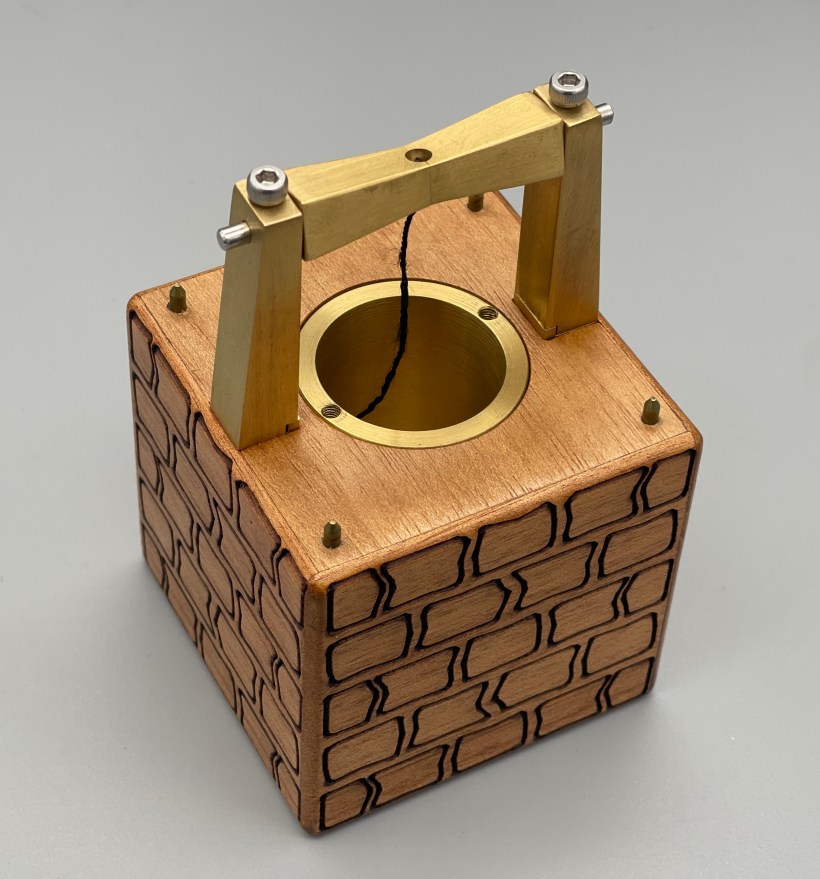
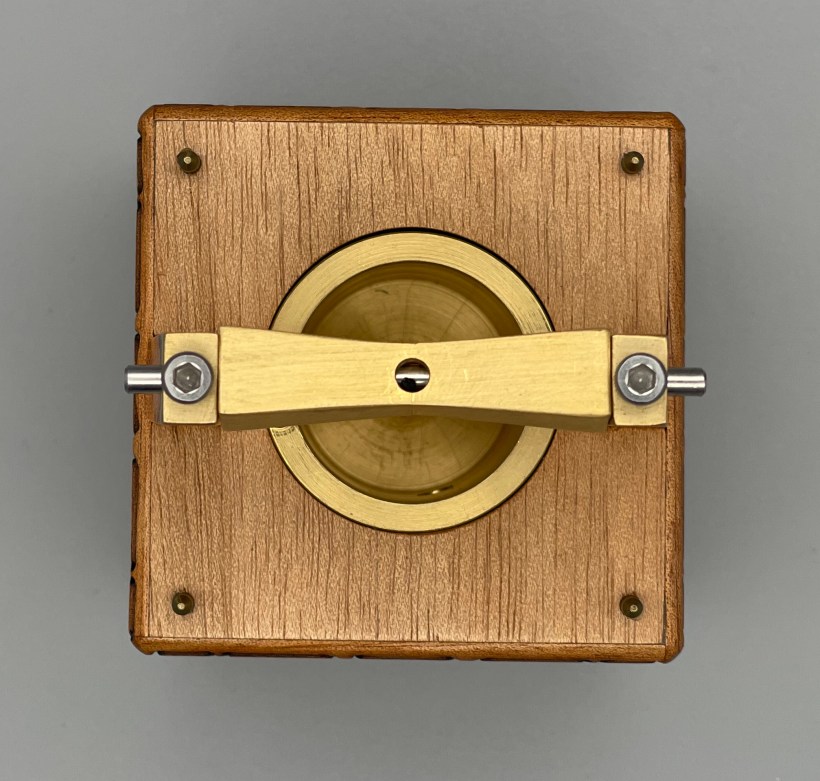
AW is a smallish but heavy (almost 1lb) wooden well, with a brass bucket frame atop it (idk if that is what it is called, but some brief googling didn’t give me anything, so I’m going with that). You can see a metal rod passing through the top of the frame (which spins freely) and a string hangs down into the well itself, which is made of a closed cylinder of brass set into the wooden box. There are also four pointy metal bits (nails?) poking up out of the wooden box at its four corners.

Brian tells us in the original description that the puzzle can be separated into 23 separate parts(!), which is more than a little intriguing to your typical sd fan. “No bashing… and no brute strength are needed,” so figuring out what can be a tool and how to use it will be a major part of the puzzle.

Of course, you cannot simply take the puzzle apart into these individual pieces; at the start, there doesn’t seem to be much to do. I tried a number of things that either did nothing or did a bit of something that didn’t help me, until I found something that might. I realized that there was some good puzzling to be done early on, as I worked to get things where they needed to go and get my toolbox (aka pile of bits) sorted.

This phase is fun and tricky: the separate elements are combined into something fairly novel, although perhaps not mindblowingly original (that comes later) – it makes a great appetizer to the main course. After a while, I was able to work my way through to where I believed I knew what I needed to do next and had a whole bunch of stuff to do it with… but no idea how! And this is where the awesomeness really kicks in.

There is a unique openness to this middle phase of the design that has led to a diversity of approaches (and diverging opinions over what follows the rules and what deviates from them), prompting discussion and the discovery and development of diverse designs that delight an open puzzled mind (and may dismay those puzzlers who prefer a more strict design) – all in a way that I believe has never been done before (and may have surprised its designer as much as anyone). ‘That step’ ensures that AW stands out as something truly new and will assuredly go down in puzzle history, even if some puzzlers take issue with it.

While my take on the matter is perhaps clear, I do not mean to deride those puzzlers who didn’t particularly enjoy ‘that step’ (wrong though they may be 😉 ) I absolutely appreciate a puzzle with a singularly defined approach to each step and believe that there is also plenty of room to appreciate the type of puzzle sandbox AW creates.

But lets not get too caught up in philosophical discussions of design modalities and keep in mind that although ‘that step’ does constitute a substantial part of the puzzle experience, it is but one step in a larger journey. If the puzzle’s novelty was the only thing that really impressed me about it, I wouldn’t be compelled to do a write-up of it, let alone enjoy it on my own as much as I did. The simple truth is that not only is ‘that step’ unique, it is pretty darn challenging – I don’t want it to sound like there are so many ways to accomplish this step that it is easy to do…. not at all: I struggled for quite a while to find something that worked… and then longer to find something that I felt wasn’t cheating at least a little… and then even longer to admit myself that I was sorta still cheating and that I may as well give into temptation (a skill I’ve honed over the years) and start perusing the several spoiler-tagged pics of creative approaches other puzzlers have come up with.

Needless to say, they were pretty much all much cooler (and more consistent with the rules) than what I had done – rather than be disappointed in my failure as a puzzler and as a human being (another skill I’ve honed over the years), I enjoyed the experience of trying out some of the other methods that had been shared. I was impressed and amused by some pretty wacky approaches, some similar or small variations upon mine or others, and some really out there…

While playing around with ‘that step,’ I had also been looking around for what might come next; the description tells us that the ultimate goal is to find a pewter token that is “uniquely Australian,” and I not only hadn’t found anything, but didn’t really see where anything could be hiding. I did notice a few things that had yet to reach their full potential (according to their parents, at least), and it was now time to move on in earnest (knowhutimean?).

Oddly enough, I think I got stuck at this point more than at any other point in the puzzle! I hobbited there and back and around again before finally requesting some pretty specific nudges (possibly more like shoves) in the direction of what I needed, only to realize that in all my wandering about (walkabouting?), I’d passed right by it numerous times. After admiring my own stupidity (yet another skill I’ve honed over time), I found what I needed and knew just what to do. The result surprised me and got a good laugh, a final aha that was a great cherry on top of an excellent puzzle sundae.

The description leaves the true significance of the token as a bit of a puzzle on its own; the object itself is recognizably Aussie but it took a bit of googling to understand its specific connection to the puzzle, a fascinating story that conceptually ties them together nicely and is just plain interesting (I found a great article about it and confirmed its relevance with Brian, if you’re curious to know more and your google button is broken).

Abraham’s Well is as challenging as it is original, and is a unique sd puzzle experience well worth your time. This is perhaps the first (and only) puzzle, that had me continuing to explore a step after having “solved” it, seeking a better approach and exploring those developed by others. While it may not meet everyone’s expectations, I would assert that perhaps it is only because it challenges them; this wonderfully exemplifies the idea that puzzle design is art, as the viewer finds meaning beyond the intent of the creator (who humbly states that claiming he foresaw the creativity ‘that step’ would engender would be “giving [him] way too much credit for thinking that far ahead”).

So solve it the best you can and then try to do better; and when you’re done, seek out some other puzzlers’ solutions to try; if you need to, challenge yourself to reconsider some assumptions over how a puzzle might be experienced. Remember: we’re here to have fun.


Originality / Fun Grade: Five Sinatras
(click here for more information on the Sinatra Scaling System, (c) John Maynard Keynes, 1944)

Puzzle Reaction Vid: Watch Me Watch CR Solve Slammed Car

Slammed Car

Originally by Junichi Yananose (Juno) of Pluredro.com
3D Printed Version by Gerard of BayouPuzzles.com

I was watching a reaction vid of a guitar teacher seeing/hearing Ween for the first time and it occurred to me that this relatively recent rash of reaction recording really haven’t made it into the puzzling world (afaik). This could perhaps be because reaction vids are rather silly but I had fun watching it and thought I’d give it a try.

Keep in mind that this video will SPOIL the puzzle (starting a couple minutes in) – it is a solution vid, so once I’ve introduced the vid and the CR introduces his, he moves on to the solve (at 3:30).

There are a couple cringe-worthy moments in there…

Chris Ramsay (yt puzzle solver with a few million subscribers) is the obvious subject of such a video – the vid is not made in bad faith and is really just meant to be fun. CR has helped bring a lot of new puzzlers into the puzzling world – at the same time, there are a number of puzzlers that are not the biggest fans as it isn’t uncommon to see puzzles treated rather harshly (see his Sea Chest vid…) or for credit to not be given to makers/designers. As a public figure of this size (and as I do not know him personally as I do many other puzzle vloggers), it seems that it would be fair game and I thought there might be some puzzlers out there who might enjoy it. (I will also admit to some reasonable envy over someone managing to seemingly make a solid living solving puzzles – nice to see except when he happens to be bidding against me at auction).

I am reviewing his Slammed Car solution vid – obviously it is rife with spoilers. I chose the vid as it is recent and is a puzzle I own; it also happens to be the first review I wrote and it is nice to come full circle.

The tech I used is far from perfect – this is kind of a proof concept: if folks enjoy it, I can beef up the methods used to create it and spend a bit more time on production value, etc. While I am not really a vlogger (do people still use that word?), I did get my BS degree in film production (we actually worked with physical 16mm film, which may give you an idea of my age).

Please note that US copyright law has explicitly been found to protect reaction vids under the fair use exception (a bit of googling will confirm this, although I also went to law school and worked in the copyright section of the IP Clinic).


Answering Life, the Universe, and Everything: Mayan Box by Benno de Grote

Mayan Box

Benno de Grote, 9.75″ x 7.5″ x 3.75″, 42 steps

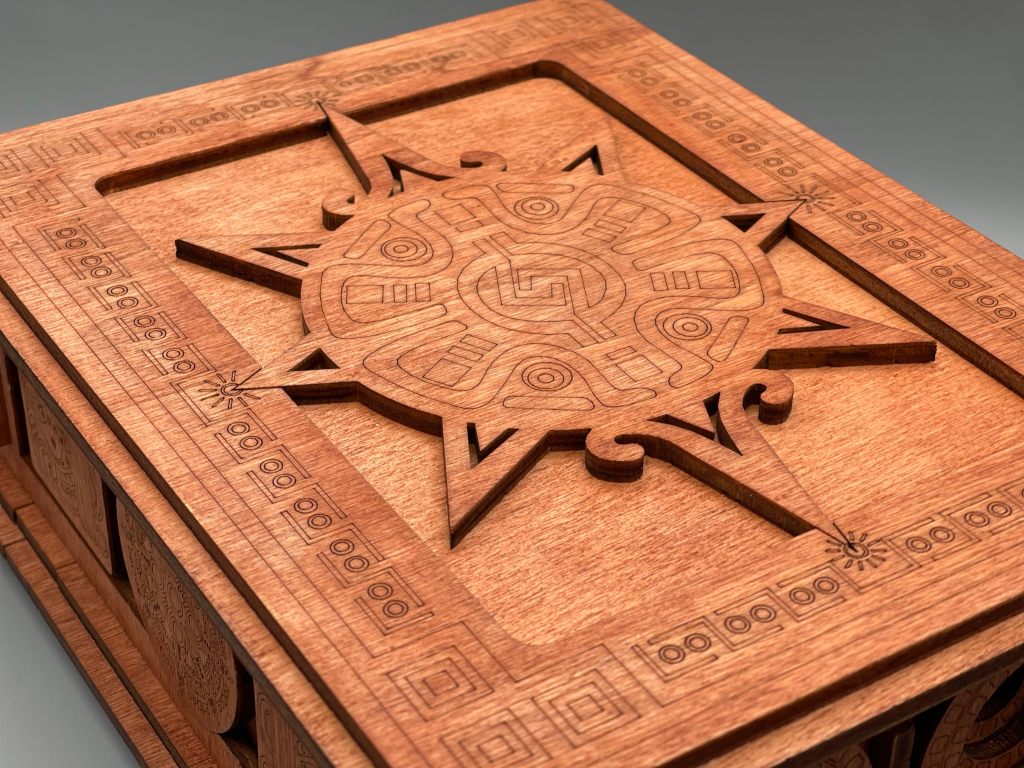
Originally designed as part of an ultimately cancelled tie-in to the movie Tomb Raider, Mayan Box calls to the booby-trap-loving, One-Eyed-Willy-following, rolling-boulder-evading, puzzle-spelunking spirit responsible for a significant amount of this particular puzzler’s passion for puzzles.

Mayan Box: 42 Steps to find the secret to life, the universe, and everything……… or at least the inside of the puzzle box

It took some time but eventually a very large box of precisely laser cut wood stained a lovely reddish color and covered with Mayan engravings arrived at my door. Layered panels and little protrusions laced proportionately along plenty of its lines and edges teased me with indications of what might eventually do something, but initially seem mostly to do nothing.

With so many possible points of entry, I struggled to get started, more than a little distracted by how cool the box looks. I knew that the box had 42 steps to solve and I had wondered whether this would include a lot of blind mechanisms; with so many knobs and panels and such, it is no surprise that very little of the puzzle is blind – picking it up, you can hear something that hints at some semi-blind steps long the way but the vast majority of the puzzle is figuring out what to do when and where and what then…… planning and memory must follow careful inspection and close observation if you hope to dig your way into the heart of this puzzle box.

As much as I hate letting go of my puzzle boxes, I have a need to make some space (and puzzle money) and Mayan was among those that lost the coin toss; it is especially hard to let go of a puzzle that I had lusted after for so long, and writing this is not helping me grow comfortable with this commitment – with some amount of self-aware forethought, I had waited until after it was listed to write about it (knowing that doing so would otherwise be all to likely to make me change my mind, coin toss be darned!).

Solving this box took me many months of starting and stopping: one wall in particular held me up, but the other dozens of steps had me getting lost more than once as I fought my way through the overgrown jungle that kept these ancient secrets locked up tight. Benno has a few extra surprises hidden within, including multiple compartments to discover and something that had me smiling, separate from the many ahas awaiting me along the way. There is a logic to be discovered, and most everything you need to know can be seen from the start, but the sheer complexity and breadth of the design had me going backwards or in circles, or sometimes simply staring at a steep wall, at least as often as it had me making actual progress.

Eventually, I did manage to fully excavate the path to the solution, emerging through the canopy of the puzzle jungle to enjoy the expansive view that awaits the patient, dedicated puzzler. Happy dances and self-congratulations done, resetting the box was no small feat (and I will admit to looking up bits of the solution once or thrice to confirm I wasn’t lost (or rather to confirm that I was, in fact, lost, and to help get me back on track).

Although Mayan Box is not available, Benno sells many other excellent boxes on his site, Bennoboxes.com. I have also solved his Chess Box and highly recommend it (Boxes & Booze has reviewed Mayan along with a couple of Benno’s currently available designs). Fortunately, Chess Box did not lose the coin toss and will remain with me for the foreseeable future.


Overall Grade: Four and a Half Sinatras

Three Dee Boxes, Parts 2 and 3: Untitled Upcoming (and Never-Coming) Boxes

Untitled (Big Red) Box & Untitled (Two Knobs) Box

Dee Dixon, DEDWood Crafts

I recently posted about the box of Boxes I received from Dee and wrote about the first, Spirit Box, as it is currently available for purchase on Dee’s site. And now:

As (sort of) promised, I bestow upon thee

my puzzled ramblings on boxes two and three.

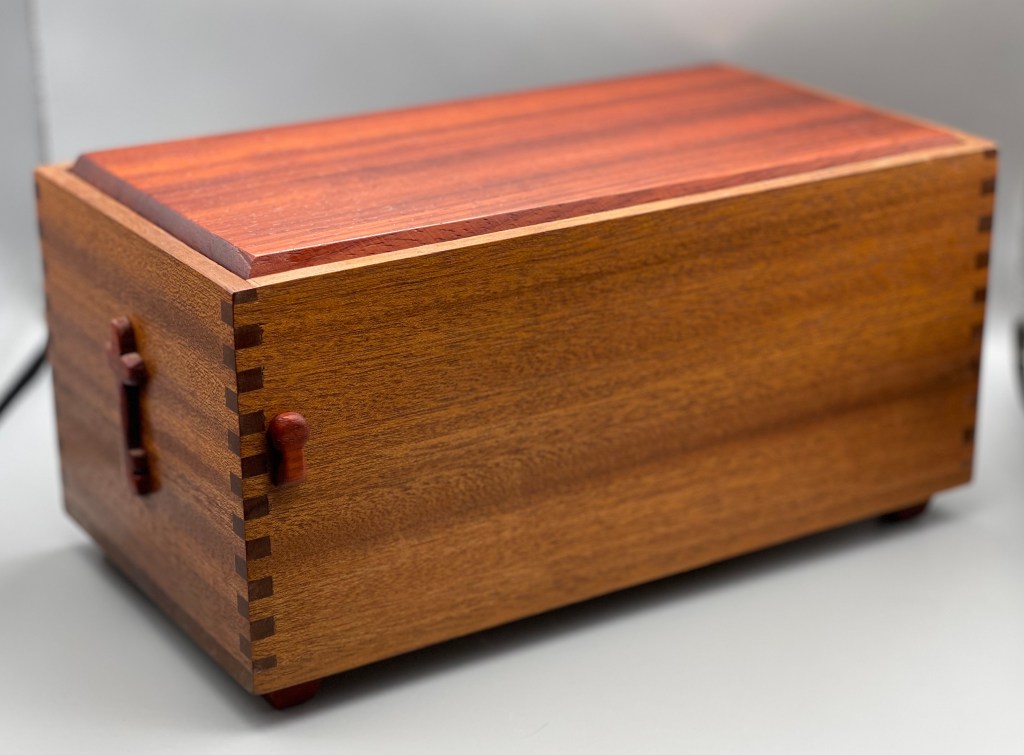
Untitled (Big Red) Box

Dee had told me that there would be a big box coming and provided ample warning that, no, said big box could not be kept. After failing to convince him that he actually meant the cardboard box the puzzles were shipped in, Dee told me that the big box was actually the first puzzle box he had ever made, and therefore held sentimental value. While pretending to respect his feelings, I began hatching a long-term plan of subtle manipulation to eventually be granted ownership of it….. (crap, is he reading this?…uh………) And on a totally unrelated subject, I think it is great that he wants to hold so tightly to the past; we all know never to stop clinging to the objects that tie us down to our old selves and let go, lest we keep growing as people (…subtle).

For reals, Dee granted permission for me to go ahead and spoil Clifford, the Big Red Box, since there is only the one copy – and, anyway, it is the type of box that knowing what it is doesn’t really tell you how to do it:

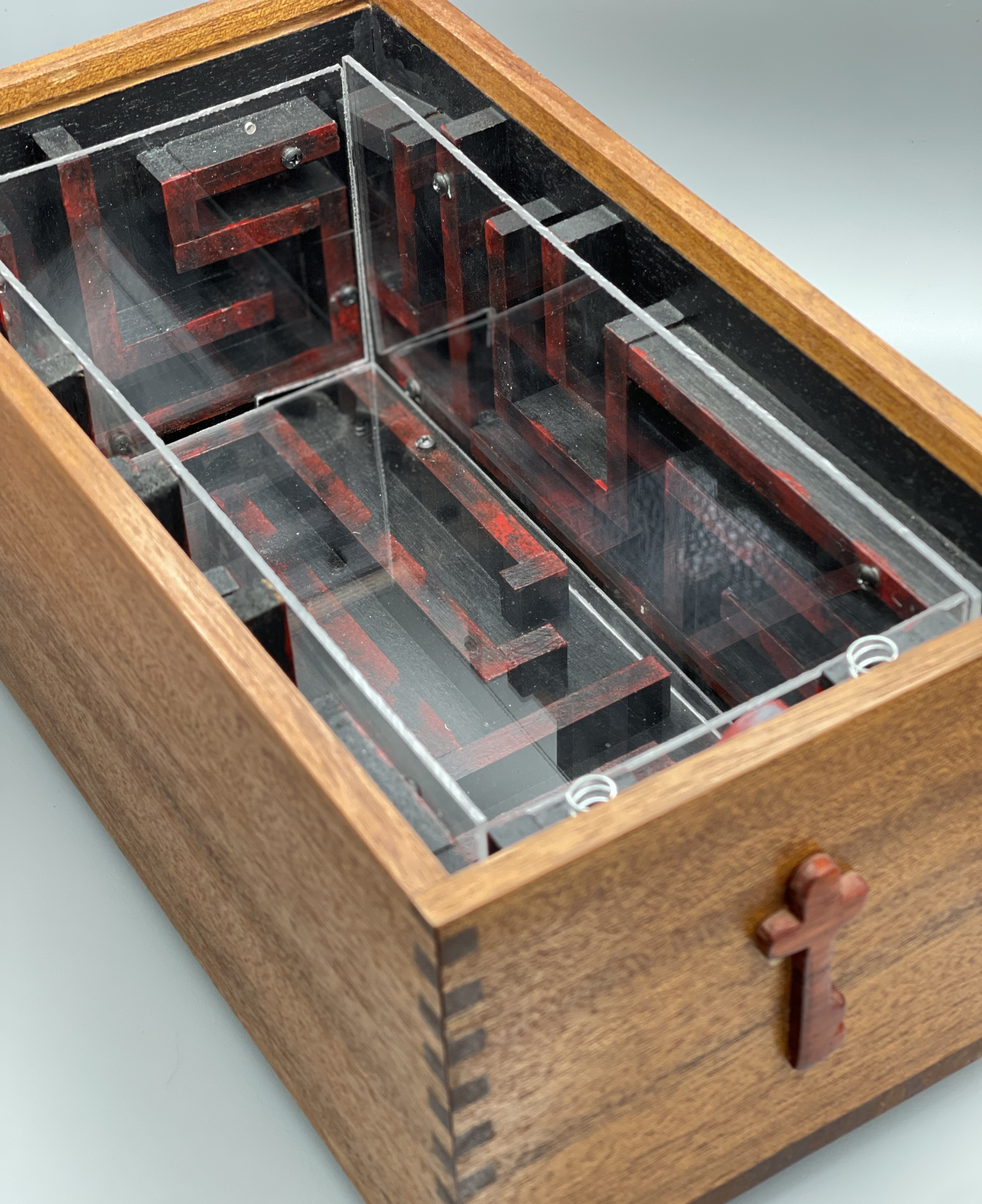
Basically, it is a large maze, covering all four sides and the bottom of the inside of the box, with a couple of external bits that do this or that. Most of the puzzling entails solving a pretty extensive blind maze in which your best guess goes on and on, while you’re doing it; this makes it last a little longer and lets you laugh a little longer…. longer with Big Red! 😉

Ahem… the maze is pretty extensive and had me going around and over, Hobbiting there and back again, before figuring out that I’d gotten to where I might be able to open it – and I gotta say that opening it really did double the pleasure and double the fun…… 😛

My actual point here (I’m pretty sure there is one somewhere) is that I think the inside is really cool as it displays the maze on all 5 sides under clear acrylic, so you can see everything you just did (unfortunately, it is rather difficult to get a good pic as the glare is intensified significantly in photos, but it looks great irl). And, it leaves close to a shoebox-sized space open for use (hopefully not for anything you will ever need quickly). The large size of the ball and channels helps immensely, creating significantly more auditory and tactile feedback than I suspect a smaller maze might provide.

I told Dee that I think it could make for a pretty fun series for the maze-lovers of the puzzling world: he could add traps, dead ends, maybe windows and some dynamic tricks, etc… basically turn it into something like a wooden revobox, which kinda sounds cool. Blind mazes aren’t everyone’s cup of tea, but opening it was a fun challenge and the red-topped, black maze under the clear acrylic was just neat. This was made before Dee really knew as much about puzzling in general, and I think it was maybe a bit of a proof of concept to see if he’d enjoy doing it – luckily for us he did, as it was just several more months of ideas and prototypes from there to Blinded II and WMH.


Untitled (Two Knobs) Box (prototype)

Returning to his recent run of boxes with various protrusions on its sides, the final Box in Dee’s box of Boxes was a prototype of his next release (let’s call it TNB for “The New Box aka Two (k)Nob Box”).

This third entry in Dee’s Protrusion Series (not actually a series) is not really like either Space Case or Portal, although they are all largely blind puzzles with some amount of external controls: I enjoy puzzle series (of which these are not a part) that share an aesthetic while offering totally different mechanisms and experiences (such as Brass Monkeys 1-4 from Two Brass Monkeys, Kel Snache’s Tea Boxes, Karakuri Small Boxes, Bill Sheckel’s Book Boxes, the coin release puzzles by Rex Rossano Perez, as well as those by layerbylayerpuzzles, and so on).

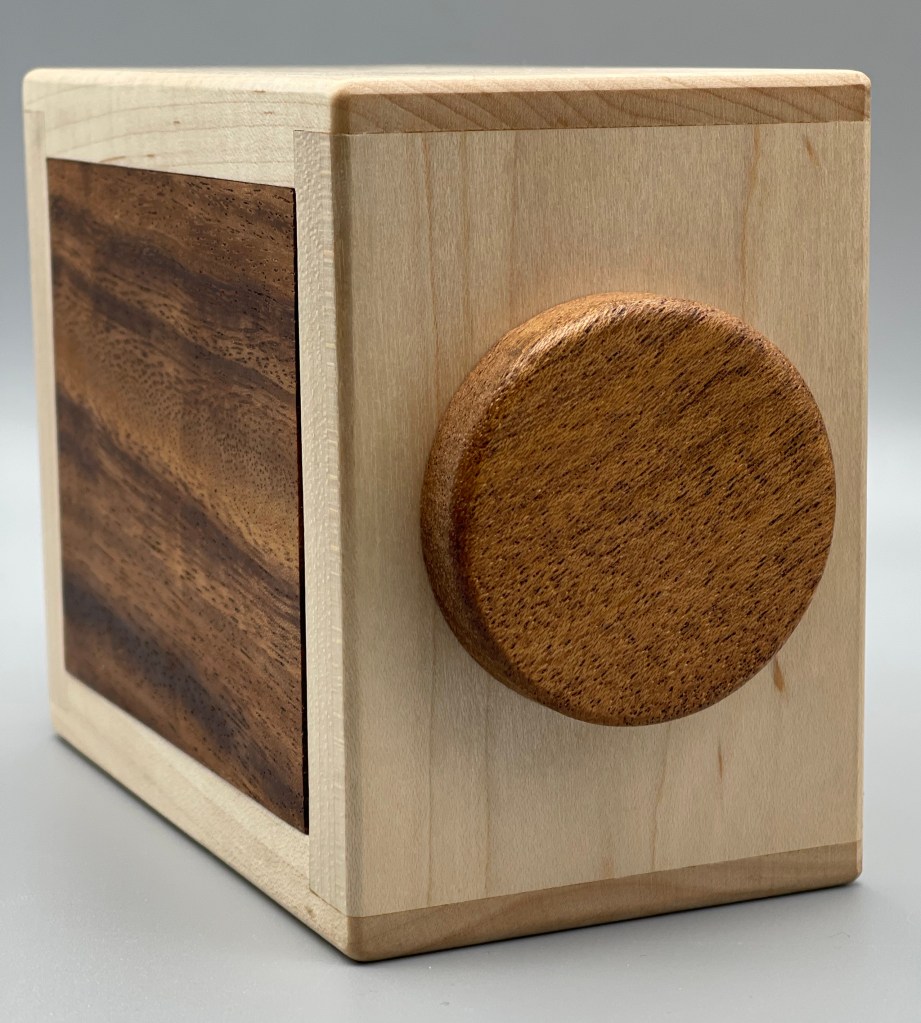
TNB has contrasting woods similar to Spirit Box, with a maple body, sapele knobs, and a lovely monkeypod top (the final box may well use different woods). Sized at 6″ x 3″ x 4″, it fits nicely among the majority of Dee’s boxes. The pair of knobs on the narrow sidesh makes me wonder if Dee will next design a box with a single knob, giving the series (not a series) a nice balance (i.e. Portal = 4, Space = 3, TNB = 2, Non-existent Box = 1).

Unlike Space and Portal, the top of the box is flush with its body, giving it a somewhat unassuming appearance, especially as compared to its more flashy, star-struck sibling. At first, one knob will rotate freely, while the other will not move more than a few mm. I could hear something knocking about inside as I began experimenting with it. I was able to find the first couple of steps fairly quickly, but it would be some time before I found the next, well-hidden step. Progress continued as such: find something, wander about trying to put it into context, find myself going in circles, discover something else, me a couple solid aha’s along the way.

While you cannot see inside the box (except, of course, for you, Mr. Kent), there is ample feedback to get a feel for what’s inside. Once open, you can see the majority of the box’s mechanisms, but one part I found to be particularly tough was not so easily sussed out; such subtlety gave me a good post-solve aha as I poked and prodded a bit before I could fully grok what was happening.

The reset is straightforward and the mechanisms are quite fluid and reliable: once mastered, you can re-solve it reliably and I’d be surprised if there are any problems down the road. I found the solve to be really satisfying, so much so that I kept at it until I could solve it quickly enough to soothe my inner Fonzi (‘eyyyyyyyyy). While writing this, I’ve solved it at least another 10 times: I hadn’t solved it in a few weeks, so the first time took me a bit to remember everything, the next few let me lock it down, and the last few were just for fun.

As this is still an unfinished design, I had some feedback for Dee as I did feel like there are opportunities to add a bit more complexity to the design (to which Dee agreed, as he had been thinking the same thing). I had a couple vague ideas, so if there is anything you really like about the puzzle, clearly it will be due to the Yoda-like guidance I provide this particular puzzling pa-Dee-wan, rather than Dee’s extensive woodworking experience and increasingly honed puzzle-design skills (obv). I figure he still needs some time to get the box shined up and grab some bits of fancy wood and then this box is gonna move ya, (e.g. move you up, move you out, the box is gonna move ya just don’t pop it in your mooouuuuth…. I really should stop that).

Gum commercial allusions aside, I anticipate that the final version will make for a great puzzle, with any additional elements building upon what is already a tricky challenge and fun solve. I certainly plan on buying a copy of it when it becomes available, and look forward to whatever added trickery it will contain.

If you like what you read about Large Mauve and want a box just like this box (ok, that joke might be a stretch) I’d recommend harassing Dee about it, as I suspect he might explore the concept further if there was sufficient interest.

If you like what you read about TNB, just chillax and give it some time; Dee and his puzzlelves are hard at work on the more complex follow-up to the playful (but not too difficult) Spirit Box, which is still available now (like now now, as I write this, not the future now when you are reading this, at which time they may no longer be available, especially as there will be multiple future nows as this is read by multiple you’s….. for more thought-provoking ideas, please contact your local dispensary or go here).

And if you like what you’ve read at all, there may be something wrong with you: Get help.


Puzzles that Make You Think of Gum Grade: Five Sinatras

(click here for more information on the Sinatra Scaling System, (c) John Maynard Keynes, 1944)

Deux ex Cista: Spirit Box by Dee Dixon

Spirit Box

Dee Dixon of DEDwood Crafts, 3″ x 4″ x 2″, European Beech and Granadillo

Not too long ago, Dee surprised me with a box of Boxes: I knew a puzzle was coming, perhaps even two, but when I saw a third box buried within the bubble wrap, my traditional happy dance of delivery soon became the rarely seen joyful leaping of surprised arrival (followed soon thereafter by the ritual mockery of adolescence, performed accurately by my son).

This cardboard box begat three smaller boxes: the smallest was the Spirit, the first batch of which has already been released on his site; the largest was an oversized untitled red box, which I believe is the first puzzle box he ever made, one that I must reluctantly return to Dee due to its sentimental value; and last was a prototype of an untitled box with two knobs, sized similarly to most of his boxes. Intending to give only a preliminary inspection, what was intended to be just a few minutes grew closer to an hour as I tilted and pressed and pulled at each in turn, finding some things but solving none until I had to go to reluctantly go and do some of that life stuff.

To avoid further delay, I will go ahead and end this post now and write about the other two of Dee’s boxes that I received later, lest this post continue to languish unfinished, as with the still-early preview version of my puzzle parody of Baby Got Back, my barely begun novel, my composition for the London Philharmonic Orchestra, and the actualization of my inner self.

Ok, enough with the pre-ramble…

Spirit Box

Spirit Box is a bit smaller than most of Dee’s boxes at 3″ x 4″ x 2″ and something about its size and appearance just makes you want to pick it up. As with all of Dee’s work, it is beautifully made, with a European beech body speckled with a natural grain that creates an impression of texture in stark contrast to its slippery smooth feel. The bottom features a short granadillo layer, the seam so perfectly hidden from sight and touch as to seem like the wood naturally becomes dark at the bottom, with a slight curve to the edges that softens the contrasting aesthetic. At its top is a floating granadillo panel that you quickly realize is delightfully springy. Aside from a bit of noise from within, you can find nothing else that would seem to provide a clue as to its solution.

I managed to make a bit of progress before too long, at which point I became stuck for quite some time. Honestly, if it wasn’t so darn fun to play with, I may have made additional progress more quickly (maybe). It got to the point where I thought perhaps I had solved it and, you know, there was maybe something wrong with the box (shocking, I know). Dee assured me this was not the case (he was correct) and with a nice Aha!, I proceeded to solve the puzzle, discovering a surprise that elicited the Bark of Laughter; as much as I love Dee’s boxes and the Aha moments they create, I’ve not been as amused by one of his boxes since finding the surprise that was hidden inside early copies of Where’s My Hammer? While different, the surprise similarly shows Dee’s strong sense of humor and adds to the playful feel of the puzzle.

I love a puzzle that rewards you with a look at its mechanisms, and this one gives you the Full Monty (as opposed to the pasties teasingly worn inside some of his other boxes). The mechanism is uniquely executed, although perhaps not necessarily completely new; there is also a small design element that I found to be subtly elegant and a good example of Dee’s attention to detail, as it contributes greatly to the fun tactile feel of the solve.

Spirit is not Dee’s simplest puzzle, but neither is it as complex as most of his other boxes (something that I think is fairly reflected by the lower price point). However, I did find it to be one of the most fun and one of the prettiest, and certainly the most fidget-friendly: I’ve spent a good amount of time running through the solution or just absent-mindedly playing with it, simply because it feels nice to do.

Dee is releasing Spirit Box in batches via his website; as is the case with his other boxes, he has not specified a number that will be made, but they will assuredly not be made forever (what with the sun dying and all). While early on there were small batches and one-offs of WMH and Blinded II being sold concurrently, this may be the first time two of his boxes are generally available at the same time, as I believe that CubicDissection will soon be selling additional copies of his most recent box, Portal.

(to be continued in Parts 2 and 3)

Extended Family Portrait
Clockwise from top: Untitled Large Box, Untitled Box w/Two Knobs, Space Case (unique woods), custom Space Case (Metallica logo), Space Case prototype (unique woods), Spirit Box, Where’s My Hammer? (early version), Blinded II (early version), Portal (late prototype), Slideways (one of the original 8)

Fun Grade: Five Sinatras
(click here for more information on the Sinatra Scaling System, (c) John Maynard Keynes, 1944)