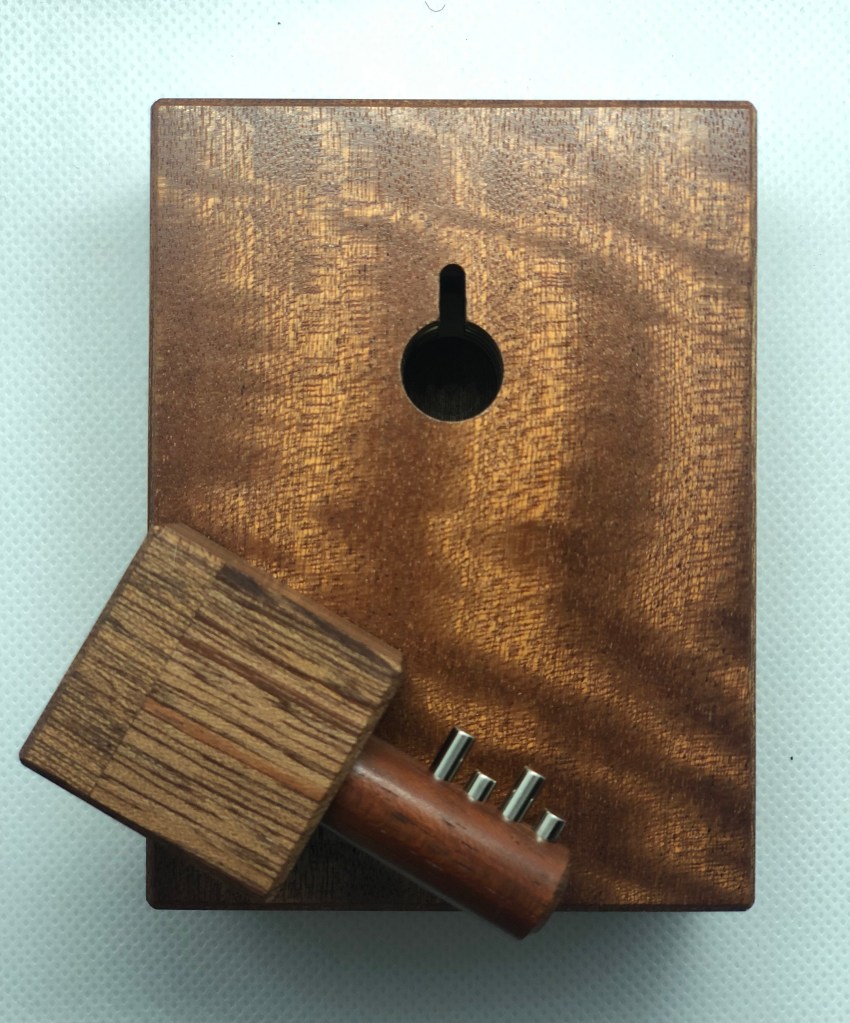
Puzzle Parrrrrr-ty: Sea Chest by Jesse Born

Sea Chest

Jesse Born, 2020,
Wenge, Holly, Katalox, Bocote, Mahogany, Bloodwood and Copper

Avast ye mine puzzlers, thar be fine puzzlin’ on the horizon for those that be wantin’ of it… Dragons there may be, but the risk be worth takin’ for such a fine piece o’ work as this here box!

Captain Woodbeard of the Puzzler’s Revenge

A few days ago I got notice from Jesse that my copy of Sea Chest was ready – as one of the first to be lucky enough to get on the list, I soon received what is number 6 of an overall release of 100 copies. Sea Chest is the first in the three-box “Voyager” series; the next (named SunDial) has apparently been mostly designed (in collaboration with a certain other amazing puzzle designer), and I expect we shall learn more in a few months, once the other 94 Sea Chests have all made it to their various X-marks-the-spots. The third and final box in the series is named Alien and is fittingly otherwise unidentified.

Here There Be Puzzlin’

My copy arrived quickly, as is typically the case when crossing the state or two between me and Jesse’s workshop. I dug through the brown wrapping paper as I unearthed my newest acquisition. The box is a great size: about 8″ x 4.5″ x 3.5″ and somewhere between Slammed Car and SDBBM (or First Box and Pachinko) in weight, making it feel good and solid in your hands.

The box is both meticulously detailed and delightfully distressed: the top is a precise carving of two ships at sea, while the back features a medallion that rotates in a frame that appears to have been worn down in its time buried underground. Copper handles are affixed to the sides and a copper compass rose adorns its front. On either side of the compass/medallion, there are a total of 4 wooden pistons that pass through the body of the box. These are quite amazing when examined closely: the red wood moving in and out of the darker frame as they are pushed and pulled, held together with wooden pins at their base. There’s an unexpected feature to the bar that connects the pistons passing through the box, with gilded numbers appearing and disappearing as the pistons are moved.
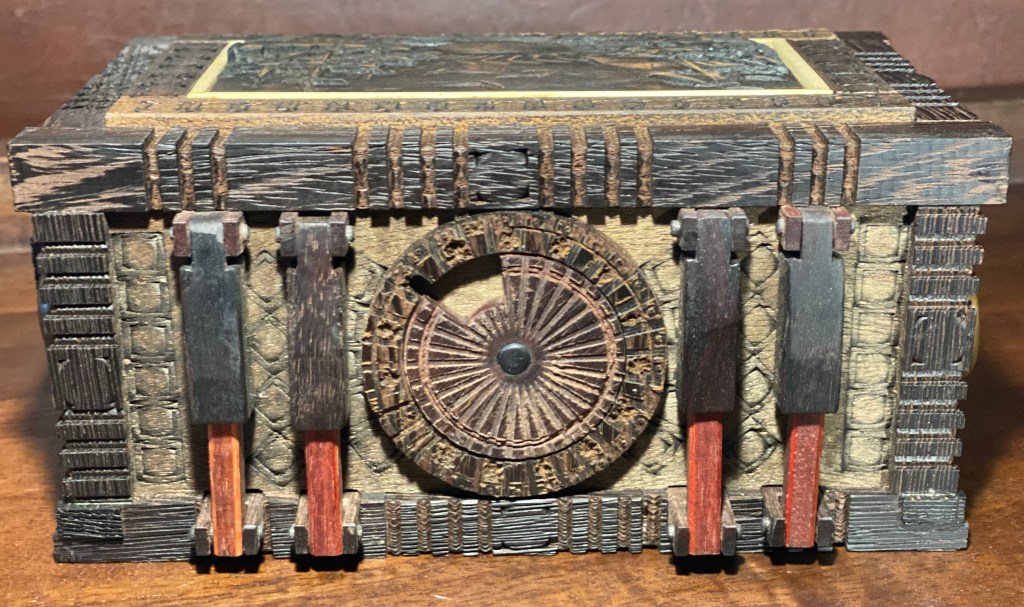
Every aspect of the box is thematically consistent, down to the ample serifs used to make the numbers recognizable to the puzzle pirate inside all of us. Numerous details adorn the design, some surely there to serve as clues, implying that perhaps this puzzle is both treasure map and chest in one (as I’ve not yet solved it, this may well not be the case – just speculating here, so no spoilers my seafaring friend). It even comes with a folded sheet of “parchment”, with a wax seal identifying it as the solution.

The overall look is pretty awesome – the pistons remind me of the rows of oars of an ancient ship, emerging from port and starboard as your crew struggles to make your way to your final destination. While I do not think we will see sirens or cyclops on this journey, the Argonauts on board may yet be waiting a while to reach dryland as the solution is most definitely not obvious (to me, anyway).

Which leads us to why we are really on this journey: the puzzling. First off, it is not entirely clear what our destination will be – I know the puzzle will open, but my initial assumptions on where and how may well be incorrect. I have already had a great aha moment and have made additional discoveries that tell me what likely needs to happen, without showing me how how to actually do it. This is that type of box where the journey is at least as good as the destination, allowing me to be in no great hurry to get there. I couldn’t wait to solve this before sharing it, as it is just too darn pretty.

Captain SPH Sits Atop His Treasure

Jesse has once again produced a puzzle that is both striking and fun: Sea Chest has a thematically distressed aesthetic that seamlessly blends potential clues and red herrings with meticulously designed details, hiding whatever puzzling intricacies lay buried within.

(Past reviews of Jesse’s Jack in the Box and Secretum Cista)
Sealed Solution Sheet and Certificate of Authenticity

Captain’s Grade: Ye Olde 5 Sinatras


Check out Jesse’s Website and his Facebook page!

Lucky Number 13

Stickman #13: Chopsticks

Robert Yarger, 2007

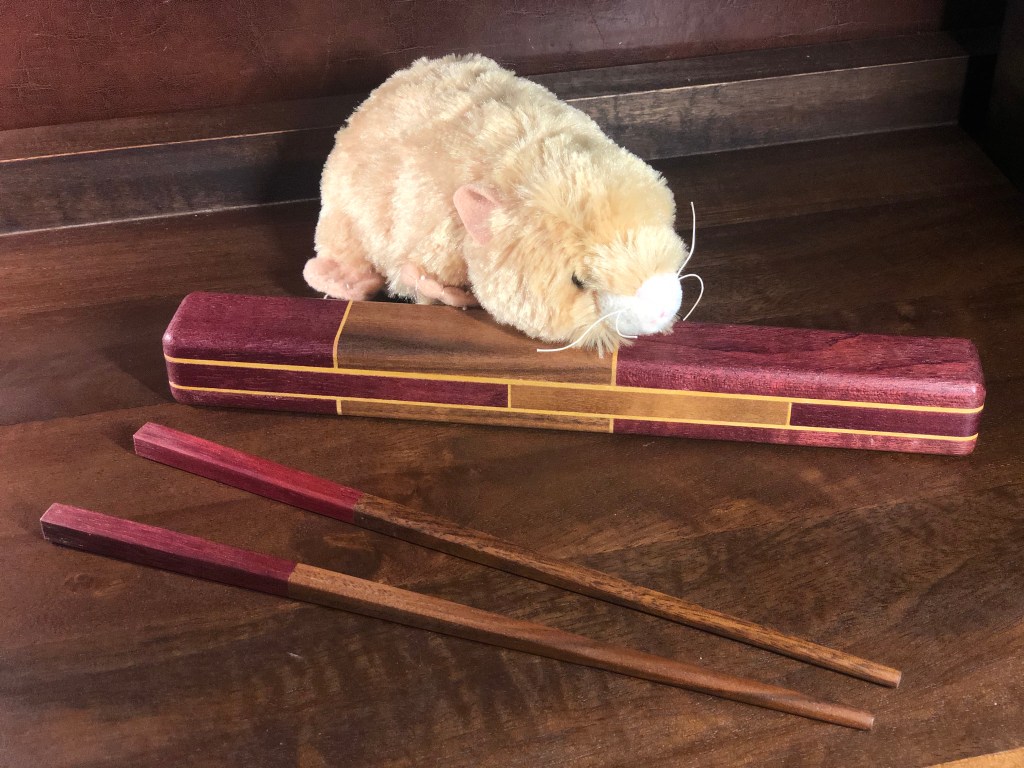
Robert Yarger’s 13th puzzle box is as fun as it is pretty. After re-solving it today, it occurred to me that some folks might want to know more about it, and so here I am: telling some folks more about it, in case you might want to know.

This is one of the rare puzzle boxes with a practical use: in addition to being a fun puzzle, it is a case for a lovely pair of chopsticks. Now, I wouldn’t personally carry this around to eat with, because I don’t typically put hard-to-come-by puzzles in my mouth (I don’t put easy-to-come-by puzzles in my mouth either, but you get the point). However, it would be pretty cool to bust these out at dinner, nonchalantly puzzling my way to dinner…. ok perhaps most people would not think this was cool, but those people are probably not reading this, so who cares what they think…

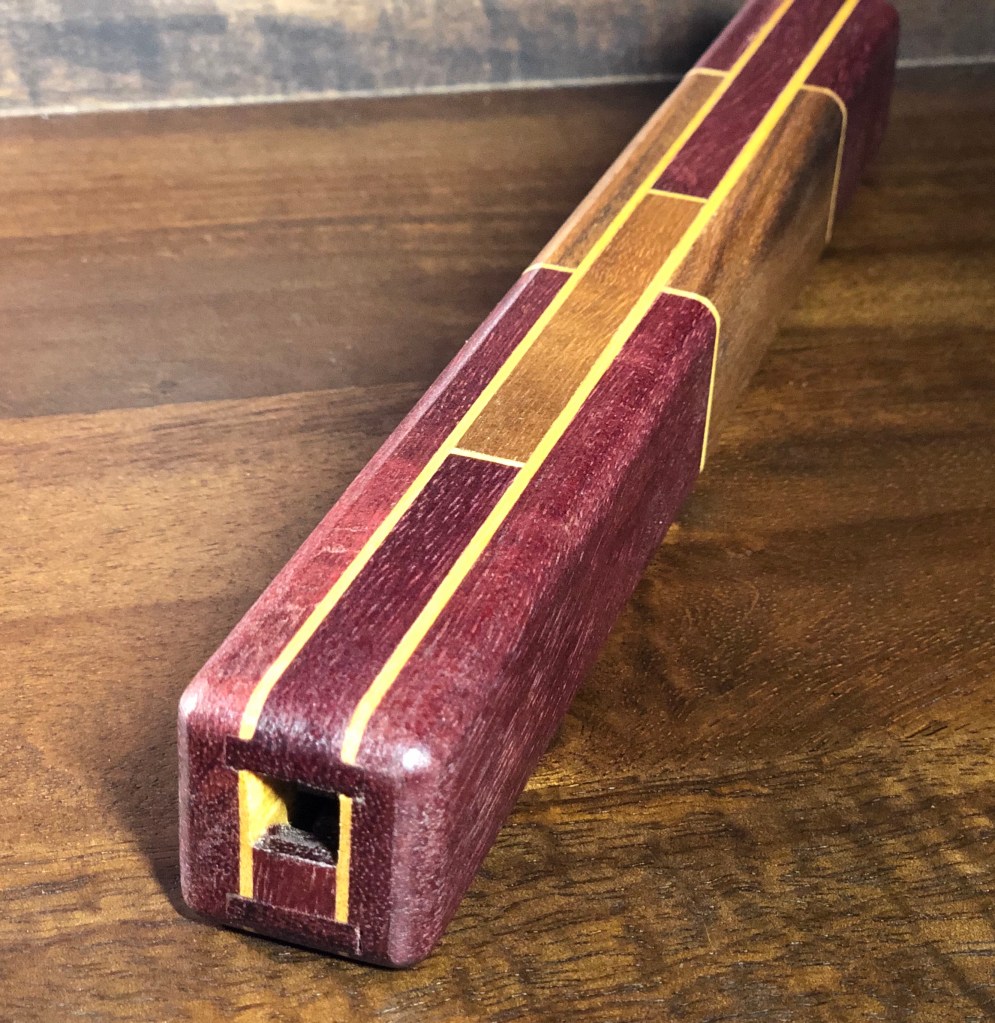
The box is smaller than most of Robert’s puzzles at 10″ x 1″ x 1” and uses puzzle box tricks to solve what is, in some ways, a 4×3 voxel packing puzzle. The steps are wonderfully smooth, and there are some really cool movements that I suppose are spoilery enough that I won’t share them (feel free to ask, though, if you’re curious) – apparently, Robert had been playing with the mechanism and realized it would make for a great puzzle (which it does).

Interestingly, there were two runs of the puzzle, using slightly different woods; the first was in 2007, with the second not too long after, in collaboration with excellent OG puzzle-maker, John Devost (the biggest upgrade: they are no longer lacquered bloodwood, but rather waxed purpleheart and leopardwood (I think), lending them their practical edge).

I got my copy about two years ago: as the first box by Mr. Yarger to come my way, I suppose it may have some added sentimentality, but this is truly a beautiful and fun box. The movements are wonderfully smooth; the puzzling is ingenious, even if not terribly difficult, with the chopsticks themselves integrated into the mechanism. The box feels solid in your hands; while narrow, its overall size is nonetheless substantial. More importantly, it has a look that is memorable, a cool mix of contrasting wood that demands to be picked up and handled. Its shape adds something special to the puzzle, standing apart from other boxes, making you wonder just what is inside (assuming you didn’t already know the name).

Needless to say, if you have a chance to pick up a copy, I do not think that you will be disappointed. And if you ever see me grabbing some sushi, perhaps you’ll get a chance to try it for yourself.

The 13th Stickman puzzle is a totally unique and oddly practical box, with a lovely mix of woods and chopsticks so perfectly balanced that I am tempted to use them; normally, I wouldn’t seriously consider it, but I suppose I can make an exception for Hiroshi Iwahara’s Sushi…
My Stickman logo has unfortunately faded a bit due to numerous and frequent solves – the box nonetheless works perfectly.

Overall Grade: 5 Sinatras

Jerry Does It Again (and Again): Quadlock I & Burrlephant 3

Quadlock I & Burrlephant 3

Jerry McFarland

By now, you may have heard about the awesomeness that is Jerry McFarland’s Fidget Burr (you can check out my review here); since enjoying the pleasure of solving Fidget Burr, I have had the good fortune of obtaining and solving two more of Jerry’s puzzles: the older Quadlock I and the quite new Burrlephant 3. Both are excellent puzzles, offering unique takes on burrs by adding take-apart / trick box-type elements to the mix, with perhaps a dash of sequential discovery.

Quadlock 1

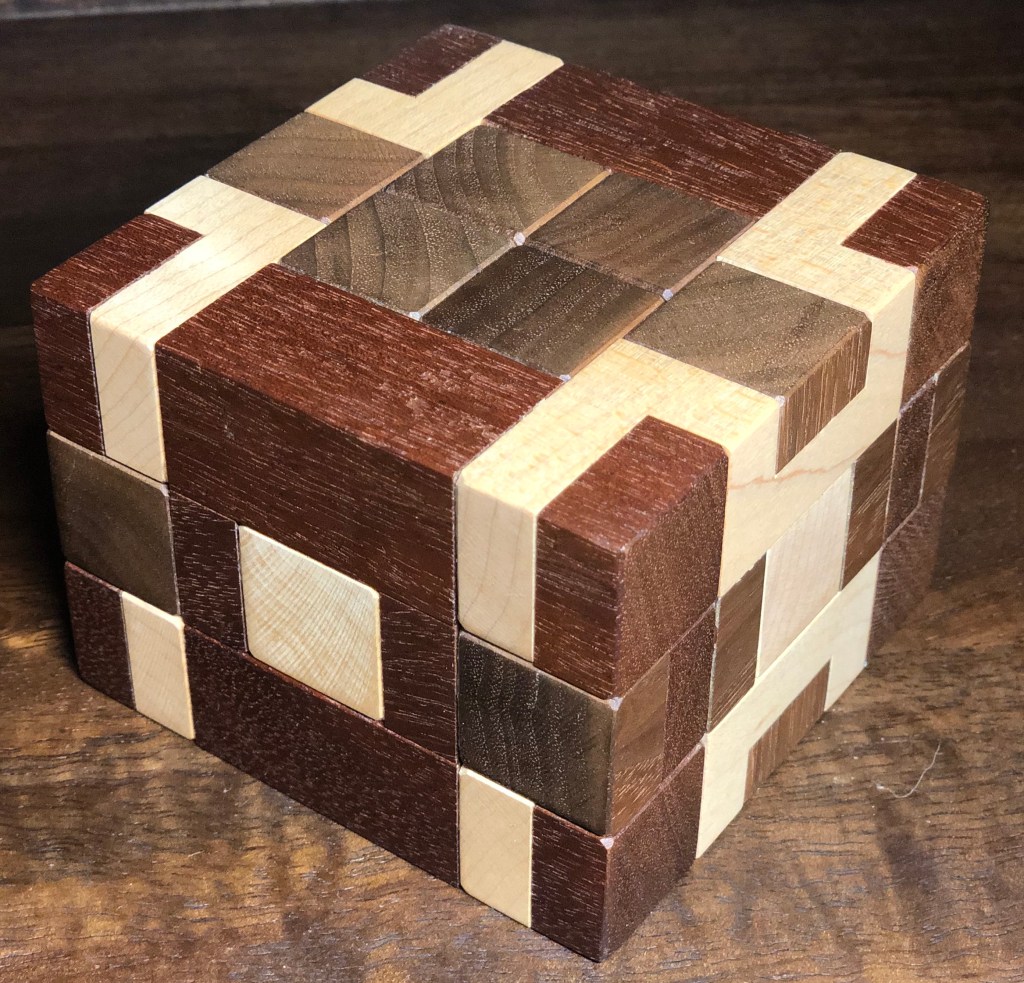
Quadlock 1 is a squashed cube made of 19 individual burr sticks, originally made by Jerry in 1992, and remade in 2008 and 2011 (possibly again since then). It is a 4 x 4 x 3 “cube” that measures 3.5″ x 2.6″ (after 2011, Jerry began making a slightly smaller version). It is made of Walnut, Mahogany, and Maple, although there are some versions made of alternate, exotic woods, as well. I have two copies of this excellent and quite challenging puzzle, which only goes to show that I truly think it is a great puzzle: they are both copies of the earlier, larger versions (one has the serial number “14 JM 94” and the other copy has “10 JM 92” – I am not certain if this means that they are from 1994 and 1992 but I will update once I ask Jerry about it).

If you have solved interlocking puzzles, you will know that many feature some sort of key piece, which must be discovered and moved before you can hope to progress. Quadlock 1 takes this a few steps further, with four pieces that work together to form a lock, preventing any further movement. After fumbling for some time, I found that it is better to approach this almost as I would an attempt at lock-picking, as I was better able to conceptualize how I might find my way past. As you are working on these early steps, you have no indication of what it might lead to: the other pieces permit no movement, whatsoever, forcing you to add some tension in various places as you struggle to find the correct movements and configuration of the four locking pieces (again, as one might a lock). You are unlikely to succeed early on without some amount of close observation, finding the correct moves step by step rather than all at once. It has only been a few weeks since I solved the puzzle for the second time, and I am already confused as to how I can repeat the process, showing the puzzle’s excellent replayability.

Once you find your way past this first wall, you are rewarded with some interesting movements, opening the puzzle up enough to permit the removal of some pieces. You are not done, of course, as you must now discover steps necessary to fully disassemble the puzzle, although you have now successfully navigated the main challenge. From this point, you will still need to think and explore as some of the next steps are certainly non-trivial, albeit perhaps not as difficult as the opening sequence of moves. Having found these next steps, the puzzle comes apart in a way that is conceptually similar to Fidget Burr, while consisting of totally different arrangements; at this point, disassembling it completely is pretty straightforward, leaving you with a nice pile of lumber.

My first time through, I chose to let the pieces sit for a day or two before returning to it for reassembly. I was able to reassemble the puzzle (mostly) without the assistance of burrtools or the instructions Jerry provided with the puzzle. His instructions are quite welcome, as they provide clear assistance without actually showing you specific the moves (as with burrtools); it will tell you which pieces need to be manipulated but leave it to you to find how this must be done (which at times is certainly not totally straightforward).

There were a couple particularly tricky aspects to reassembly – the main locks were actually not so difficult in reverse, but I found a couple steps midway that had me turned around, requiring more than a little Ikea-style mid-process disassembly; the pieces have enough non-uniformity to create the need for careful observation lest you find yourself painted into a corner.

I found this puzzle to be an excellent interlocking burr cube (squashed or otherwise) – the addition of a “trick” locking mechanism making it especially fun. I hope to eventually collect Quadlocks III and IV (II was essentially a 23-piece version of I, and very few copies were made, so my completist urges are that much more likely to go unfulfilled).

Burrlephant 3

I am clearly a fan of Jerry’s work – I have pieces he made for Bill Cutler that show his skills as a craftsman, and his own designs blow me away. Burrlephant 3 is another example of Jerry’s ingenuity as a puzzle designer, with multiple trick phases belying its playful exterior. First off, it is important to distinguish this from Don Closterman’s Elephant puzzle; I’ve not done that puzzle, but it appears to be a kumiki-like 3D assembly, and, as such, is nothing like Burrlephant in anything other than a cursory look at its appearance. Closterman’s Elephant could be an amazing puzzle, I’ve no idea, but I am mostly sure that it does not contain the mechanics of Jerry’s that separates his puzzles from most interlocking burrs.

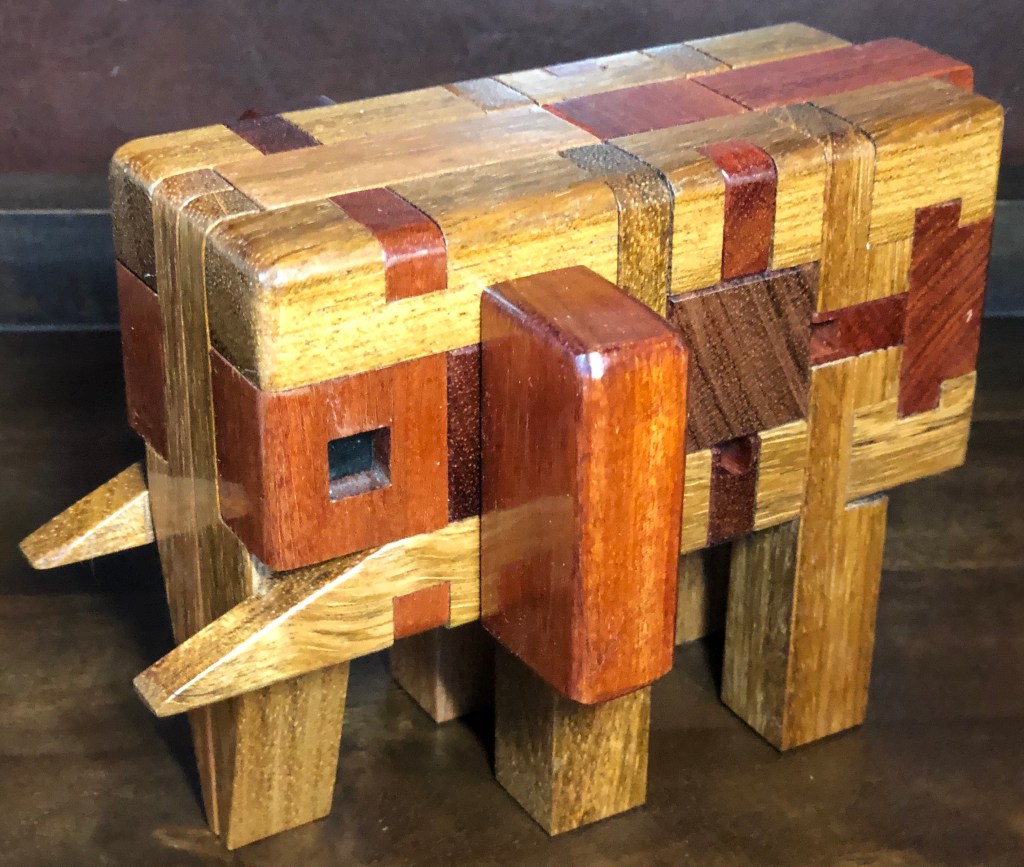
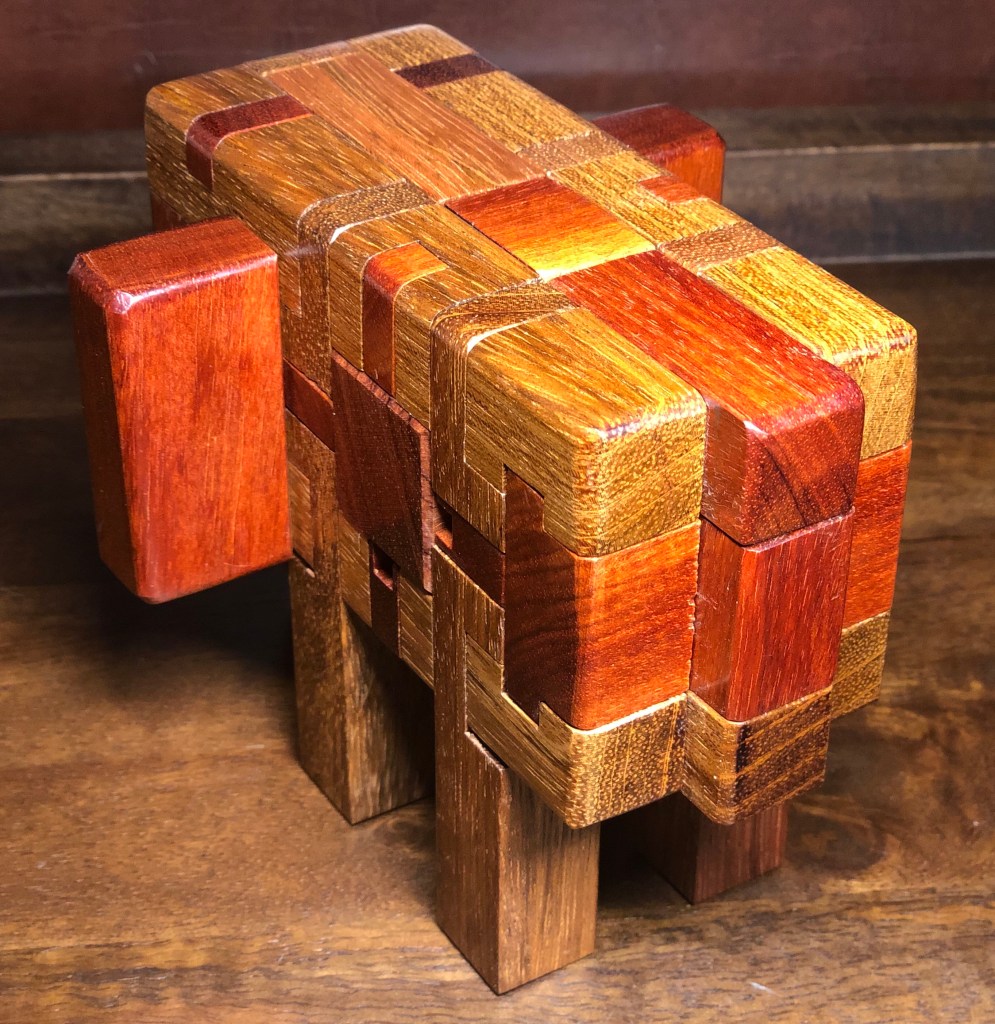
Burrlephant 3, in case you’ve not noticed, looks like an Elephant, complete with trunk, tusks, eyes, and big ole ears. It is an interlocking figure, comprised of 27 interlocking pieces of Jatoba, Bloodwood, Bubinga, and Ebony, as well as a few additional magnets and metal pins. Not counting its ears or tusks, it is a sizable 4.4″ x 5.5″ x 2.2″, making it significantly larger than Quadlock 1 or Fidget Burr.

When I started working on it, I quickly found that there looks like there is at least one aspect that appears similar to Fidget Burr, which a halfway close inspection of the photos will show; however, the mechanisms are not at all similar: Fidget Burr has an easily accessible button that leads to instant action, whereas Burrlephant requires much more exploration to make any sort of progress. You are able to find some movement quickly, but this does not appear to do anything helpful.

Burrlephant 3 essentially consists of 4 challenges, some requiring several steps to complete. Only after solving the fourth challenge, which rewards you with the key piece containing the serial number, are you are able to fully disassemble the puzzle into its 29 distinct parts. The puzzle succeeded at misdirecting my focus for some time, before I was able to fall upon the first challenge, decidedly the easiest of the four as trial and error will most likely get you there before too long. The second challenge requires some thought, and develops a better understanding of certain aspects of the puzzle, before leaving you with a few pieces in your hands and no idea how to proceed.

This third challenge is my favorite and is the one on which I spent the most time (mostly doing the same few things over and over while incredulously shaking my head and wondering it it was broken – spoiler: it wasn’t). You must first use what you know about the puzzle to determine what needs to happen next before you can hope to do anything else. Once you have considered the what, the how is going to take even more thought; trial and error will help to eliminate your options, but I found I was only able to find my way through by engaging in some good old critical thinking. Having found the solution, I am impressed by how simple and elegant it is to do despite having been so difficult to figure out. This part of the puzzle is pretty ingenious and relies on some precise designing and craftsmanship to accomplish. I actually repeated the step a few times, just because it made me happy – always a sign of a good puzzle.

At this point, it is fairly clear what you need to do for the fourth challenge; accomplishing this task is a bit tricky, and I was able to figure it out before too long, some trial and error pointing me in the right direction and leading me to the removal of the key piece. Having removed most of the tricky parts of the puzzle in overcoming the various challenges, complete disassembly is now fairly straightforward.

The puzzle comes with Jerry’s description and solution, in text and pictures, and Jerry has again labelled some of the pieces to aid in reassembly; he stepped it up a bit from Fidget Burr, etching them into a few pieces that could easily get mixed up otherwise. Sitting back and looking at the rather enormous spread of pieces before me, I nonetheless felt confident that I would be able to reassemble it without too much frustration; there is one part that is a bit tricky, due to the necessary placement of some magnets, but a bit of dexterity gets me through, allowing me to return to reassembling the main challenges of the puzzle.

Overall, Burrlephant 3 is an excellent and super-fun burr puzzle with elements of sequential discovery and take-apart trickery that earns it the right to stand apart from other puzzles, unique in its cross-genre design and its slick and playful appearance. In many ways I prefer its quiet, contemplative rhythm to Fidget Burr’s in-your-face action; either way, it is just another example of Jerry’s craftsman-informed ingenuousness, which has me craving his next creation.


Overall Grade: 5 Sinatras

(click here for more information on the Sinatra Scaling System, (c) John Maynard Keynes, 1944)

Kakoi: I couldn’t think of a witty title for this post but the box is still super cool.

Kakoi

Shiro Tajima, 2016, Monarch Birch, Black Walnut and Japanese Cherry, 4” x 4” x 4”

Shiro Tajima was creating puzzle boxes with the Karakuri Group until a few years ago; his Hermit Crab and Goblet boxes are probably the most recognized of his boxes, as they have been produced in larger numbers. I reviewed his Uroboros box a few months ago (with one of the few solution vids I’ve done, as it was requested by a fellow puzzler). Kakoi is quite different, not only from Uroboros but from any box I’ve seen or done.

Kakoi consistently gets listed in community polls as being among puzzlers’ favorite boxes; in fact, it won the 2017 Nob Yoshigahara Puzzle Design Competition Jury Grand Prize, which is basically a long way of saying it’s a damn good puzzle. The only reason it likely doesn’t get an even better showing is simply due to its rarity.

It is a bit bigger than your typical Karakuri box and eschews the traditional panels for a look that is anything but traditional (or a panel). Your first impulse is pretty clear from looking at it and it does in fact lead to some success, or at least it seems to: this is one of those puzzles where movement early on doesn’t necessarily give you much info on how to proceed from there. While I have chosen not to post pics that display these early movements, a simple search will let you see some slight spoilers for said steps.

After futzing with it for a while, essentially just poking the same few things back and forth, I began to get a sense of what might be possible and started experimenting. This is one of those puzzles where things have to be juuuust right before you’re able to proceed, and it’s not so easy to see what that is until things are, in fact, just right, a tautological conundrum that helps to build the aha into something truly satisfactory.

One you find that perfect setting and the move it permits, the main movement is quite elegant and unique. Having accomplished this, it doesn’t take much to find the final steps, allowing you to access a total of four(!) hidden compartments.

Opening the compartments makes the puzzle impossible to close and it is pretty easy to get turned around such that knowing how to close it and actually doing so are not quite the same thing, at least for a few moments. This forces you to really look at how everything works together to first prevent and then permit the main movement. Once again you need to find the exact right arrangement before you can reverse the main step; when closing it you can really appreciate the close tolerances, a bit of a vacuum is even created, with the displaced air acting as excellent evidence of this precision.

Resetting the box is quite satisfying: enough so that Kakoi is among the puzzles that I have a tendency to re-solve most frequently. There is something about that main movement that I find to be so pleasant to do; the fine adjustments never seem to get easier, such that a moment of confusion feels inevitable with each run-through.

Shiro Tajima’s Kakoi is an excellent example of the uniqueness of Karakuri boxes; its aesthetic and movement stand apart from other boxes and offer an elegant and fun solution that relies on high levels of precision that others might sometimes struggle to obtain. If you happen to see this one available somewhere, I’d recommend considering it – it certainly sits comfortably amongst my favorite Karakuri.


Overall Grade: 5 Sinatras

(click here for more information on the Sinatra Scaling System, (c) John Maynard Keynes, 1944)

When EWE Need a Sheep Alternative to Puzzle Boxes

EWE UFO

Kel Snache, 5.5″ x 5.5″ x 5.5″, 2020

“In what can only be described as a freaky fluffy encounter of the 5th kind, an apparent rag tag group of crafty and clever ewe’s mellifluously stormed the gates of Area 51. Witnesses say they saw what must have been their larcenous leader take command of not one, but 17 super secret flying machines!

As [we] have come to understand things from [the Captain’s] view, they don’t all enjoy being shorn. So apparently a small group hell bent herbivores decided to tell the freaky farmer to ram it, and ran!

Somehow, whether it be the grindage grazing or the foreseeable fact that they don’t have pockets, but they lost any comprehensible clue as to what they were. [We are] afraid that you all will have to sort your way through their retrofitting of this ubiquitous UFO…”

– EWE UFO Back Story (excerpt)

Kel Snache has yet again made a puzzle that is not only challenging, but also wildly unique and fun. Last year’s Puzzleduck Pastures was awesome and he has further outdone himself with a puzzle that is even more complex and satisfyingly silly than was helping Lil’ Miss Fairy Pants unlock her door. Kel has created a backstory about four sheep determined to make a break for it (and one forced to come along): the intrepid Captain Fran, and her crew of Fern, Flo, Fanni and the sheep-napped Wee Fae. The story is told in facebook posts (reproduced in 13 pages alongside pictures of his progress taken over the course of several months): the “Fluffy Five” have built a ship and we have the rare opportunity to explore it, if we can find our way inside.

EWE UFO is not quite a puzzle box – as Kel says, it is “disguised to look like one [but] there is no internal space to store tiny objects de jour.” It would be more accurate to describe it as a sequential discovery take-apart puzzle, as it will ultimately break down into 23 separate pieces after successfully navigating 32 steps (plus an additional four steps to fully disassemble it), revealing tools and red herrings along the way. The craftsmanship is excellent, with a build quality that feels like it will stay strong over time and aesthetic details that add to the sense of wonder that the puzzle brings.

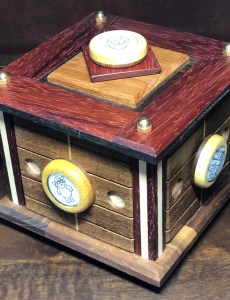
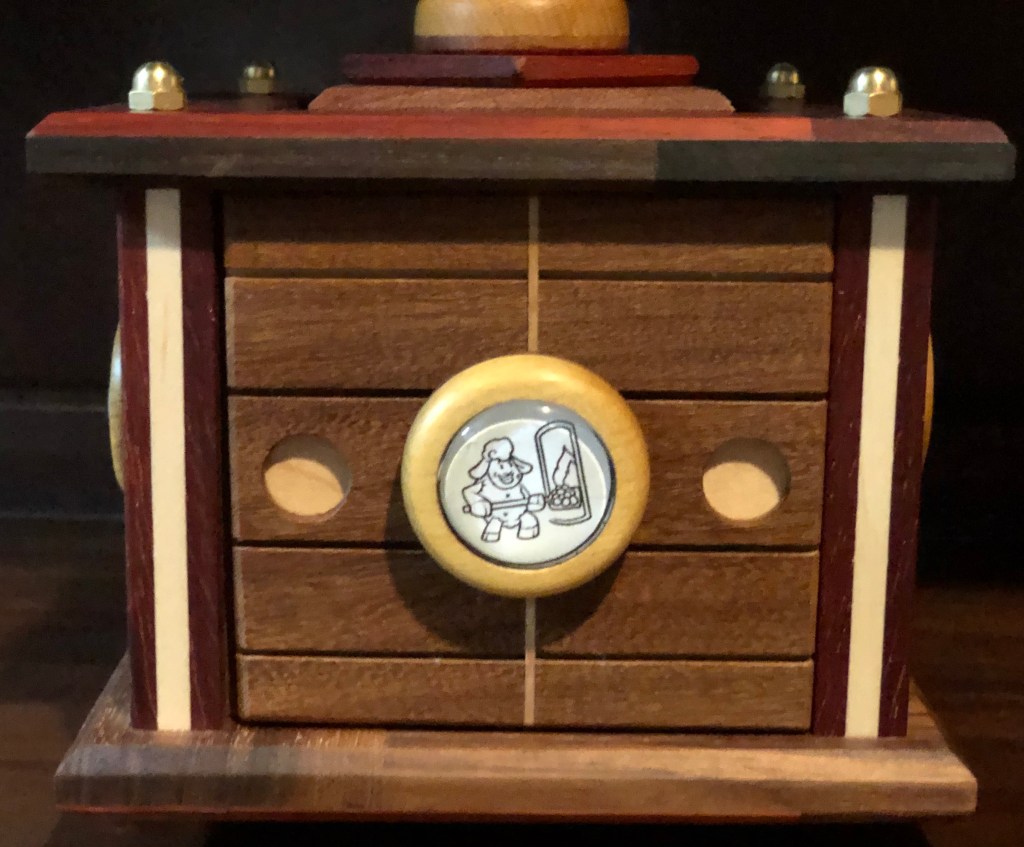
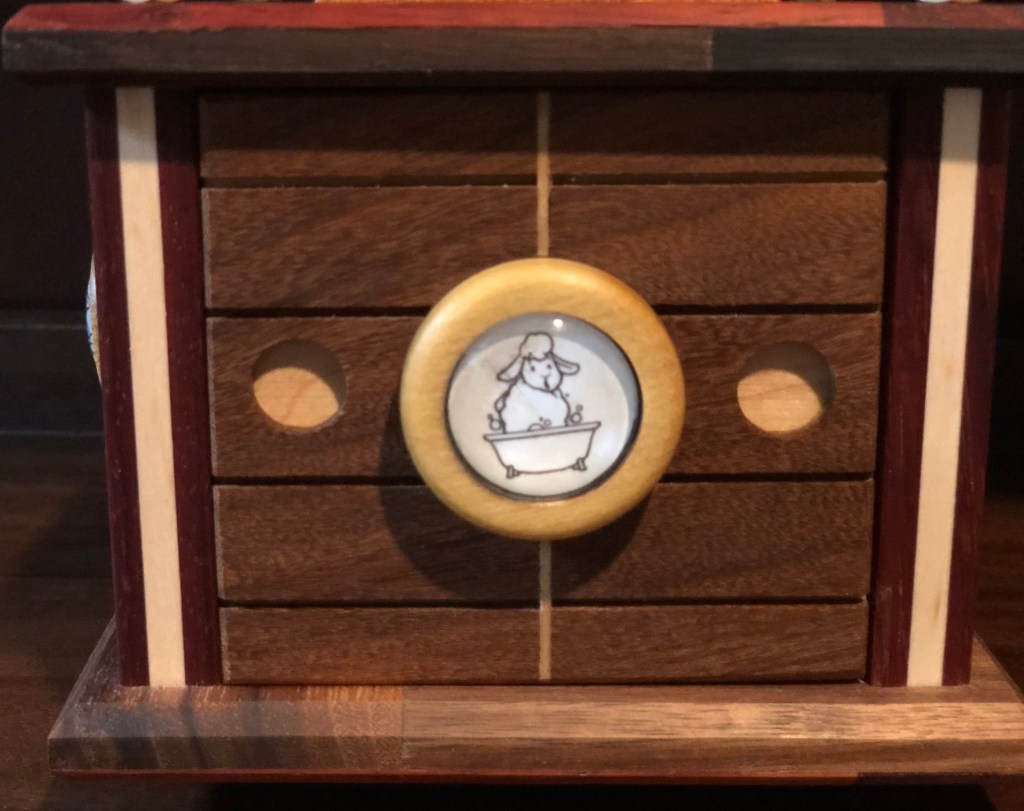
EWE is a cube made of a variety of woods that seems to float a few cm above whatever surface it is on, due to the placement of the escape hatch on the bottom. All four sides are identical, except for a little acrylic portholes giving us a view of the sheep crew as they cook pizza, take a bath, extinguish a fire, and look back at us with X-Ray glasses; all except for Wee Fae, desperately reaching up to us as we look down the fifth porthole on top of the ship. Our goal: “Be the noble hero and join the quest to remove Wee Fae from the top of the craft. She just wants to go home before the others resume their zoom into space.”

Some of the portholes spin freely, while others do not. Other than this, there appears to be no way in or out. As we work out way through “six sides of play,” we must navigate through (as it says in the instructions) “a Trap Door, A Guillotine and a Four Finger Force Field,” before we can do a bit of post-solution disassembly for a “full visual tour of the Inner Core.”

The instructions at the front of a 14-page packet, which also includes detailed solution steps with accompanying pictures), informs us that there is no need for tapping and no tricky magnets. You will instead enjoy a journey through diverse mehanical mechanisms that meanders along an otherwise linear path to success. Steps build upon one another; pieces removed may serve multiple purposes or none at all; things sometimes move only to confuse us; and our assumptions will be used against us.

Escape Hatch

Throughout the puzzle, we find pieces and mechanisms that are so instantly recognizable as being from Kel; while the puzzle is totally original and quite different from any other piece of his that I have had the pleasure of working on, it also manages to have an aesthetic and method that is uniquely his.

The rhythm is exactly what I love in a puzzle: I am pulled into the experience with some early success, which pays off with some tools and moving parts that provide unknown opportunities to do…. something (maybe). From there, I hit a series of walls as I proceed through the puzzle, steps discovered in fits and starts, forcing me to backtrack and explore and question what I’ve done and what I am trying to do. Things that seem like they must do something, actually do nothing (nothing useful anyway); other things that seem to fade into the background, end up being essential to my continued progress.

After a few hours spread out over several days, I manage to remove the top porthole, liberating Wee Fae from her wooden, spacefaring prison, and finding Kel’s snake mark burned into the piece. The open porthole, as indicated in the instructions, allows me to peer into the internal mechanisms at the core of the puzzle (with the aid of a flashlight). The “further disassembly” referred to earlier, essentially consists of removing the four brass nuts in the top corners of the puzzle, allowing me to lift it off, exposing the “Inner Core,” and showing the copy’s edition number (mine is #12/17).

At this point, I was able to slide the central cube out, allowing me to see how all the varied mechanisms fit together. While not exactly a fusion drive, there is a lot going on in there! Mostly wooden pieces (with a few metal parts) are stacked and organized, with sufficient room to allow for the movement necessary to solve it. I went through the steps again, watching the internal machinations of the puzzle and appreciating it all the more for it. Reassembly was mostly straightforward, a matter of following the steps backwards. I was proudly admiring my brilliance until I noticed a piece that I had somehow left out – so I was treated to another run through the majority of the puzzle, until I found where it should go, acting as another lock on an otherwise locked piece, yet another step along the way.

From the wacky story, to the beautiful craftsmanship and complex mechanisms, and, finally, to the eventual full disassembly and exposure of the puzzle’s inner workings, EWE UFO stands among the best puzzles I have had the pleasure of working on: it is playful without being easy, challenging without being impossible, tricky without being annoying, and very unique.

(SPOILERS: click here to see some pics of the puzzle totally disassembled, including the outside and inside of the inner core, where the majority of the puzzling occurs)

Overall Grade: 5 Sinatras

Packing it in 3: Pack Hard with a Vengeance

First, there was Packing It In: Pack Hard.

Then. there was Packing It In 2: Pack Harder.

Now, it’s time for Vengeance.


(The order of these posts do not indicate relative levels of difficulty. Please puzzle accordingly).

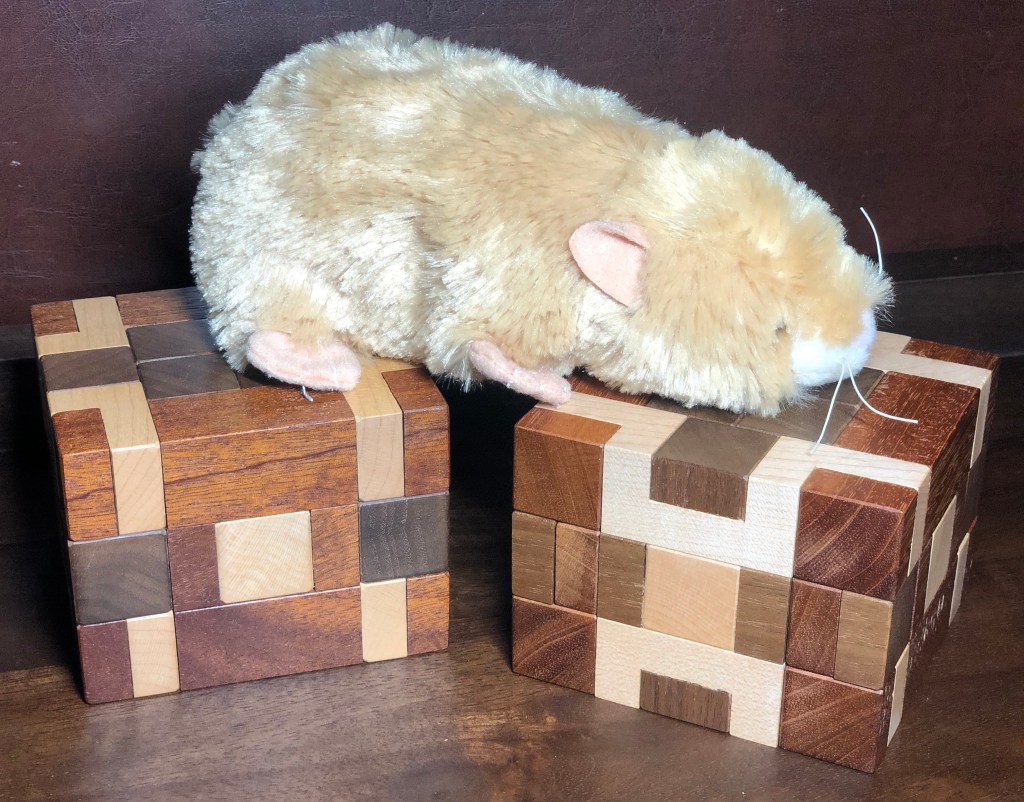
Squary Packs, Quadro, Snake Pit, Mushkila

Yavuz Demirhan (check out his Etsy store)

In case you haven’t noticed, there are a lot of puzzles out there. A lot. Within the various subgenres of mechanical puzzle-dom, therein lies nearly infinite possibilities – who would have thought that even “just” a 4×4 cube could contain so many possibilities as to continuously bring us more TICs and Somas and so on…

Squary Packs

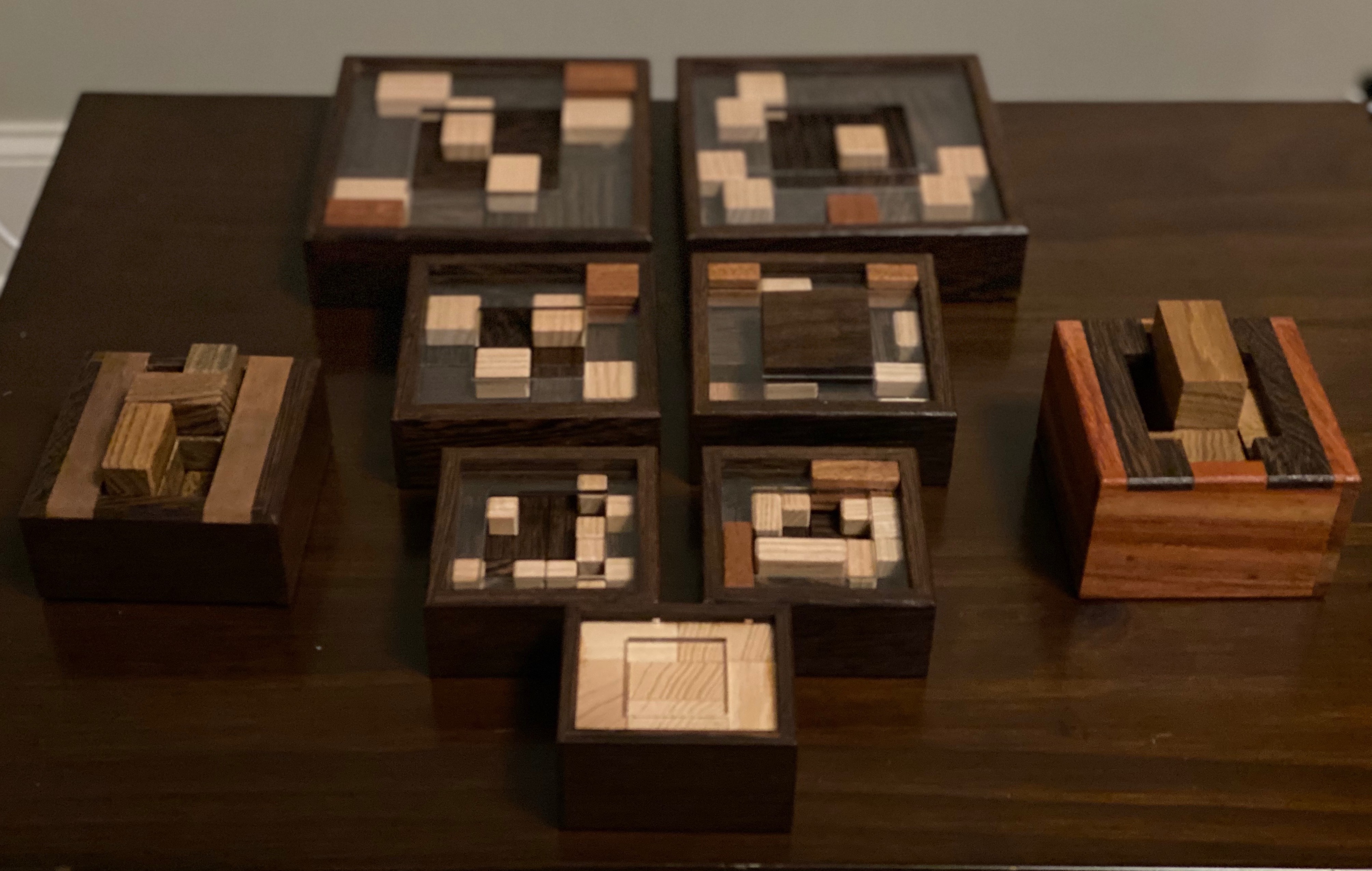
Some puzzles push out into their own territory, their movements and solution sitting somewhere amidst or between those that already exist. Yavuz Demirhan’s Squary Pack series is a great example of such a design: they are 2D/3D packing sliders that require you to navigate four dual-leveled pieces through a restricted one-piece-size opening at the center of the space to cover the bottom of the square box. The pieces are all flat-bottomed, with various voxels of different dimensions further complicating the solution, requiring you to slide your pieces around as you attempt to find a way to insert whichever piece needs to go in last; some of the series are further encumbered by blocks affixed to the box. You need to get all pieces in with the blocks facing up and you will find varying degrees of difficulty identifying where and when in the dance of pieces you can insert the final pieces.

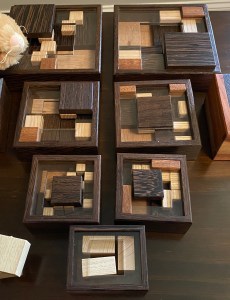
The result can be quite tricky and is most definitely fun. I initially got #2 and 4 (knowing as I did that I would almost certainly end up wishing I had just gotten them all – my recent delivery of #1, 5, 7, and 8 shows I was most definitely right in thinking I had been wrong). My first impression was that they are quite attractive looking puzzles: his work is always wonderful looking and these are no exception. Dark wenge boxes with a reddish sappeli for those with blocks attached, which cover one of the two levels and protrude above the acrylic top for half that height. The pieces match the boxes with the same wenge contrasted by light ash blocks atop them. On the bottom of the box he has his logo/initials engraved above the name and # of the puzzle. Interestingly, they range considerably in the square’s dimensions (while all sharing a height of 3.5 cm): 1 & 2 are 7.5 cm, 3-5 are 9.5 cm, 6 is 11.5 cm, and 7 & 8 are 13.5 cm (ranging in price for a reasonable $30 – $50 depending on size). I’m happy to say that Yavuz is designing additional Packs, extending the series to (at least, I believe) 15.

Sitting down with the Packs, it took a minute to orient myself to what exactly I needed to do – initially, I solved my first two incorrectly by placing one of the pieces upside down (which was itself a non-trivial solve). I later learned that this was not correct and proceeded to attempt to (re)solve them correctly. It is necessary to find a way to get three of the pieces into the Pack such that there remains room for the 4th to be inserted and slid into the existing space – oftentimes requiring that the remaining pieces dance around before this becomes possible. This is complicated further in those Packs that contain internal pieces blocking the way. Each solution is unique and while these puzzles share a pleasantly consistent aesthetic, they are quite diverse. They range in difficulty: all the feedback I have heard from our fellow puzzlers has been most definitely positive, although some have felt that a couple of them were a bit easy. Regardless, I found them all to be challenging, with some being quite difficult (particularly #2 & 4). The coming versions are apparently a further step up in difficulty, and I look forward to getting them once available.

Yavuz has been making puzzles for a while and has a LOT more interlocking and packing puzzle designs out there (he has a few hundred on PWBP); while he produces his own works from time to time, it is not at all uncommon to find his works included in the puzzle releases of others (including one design set to come out in this week’s CubicDissection release). While I have a few of his designs that were made by other puzzle-makers, I also have the pleasure of owning a few more that he made himself – also 3D packing puzzles with restricted openings. His work is all wonderfully precise, using quality woods that look and feel great.

Quadro

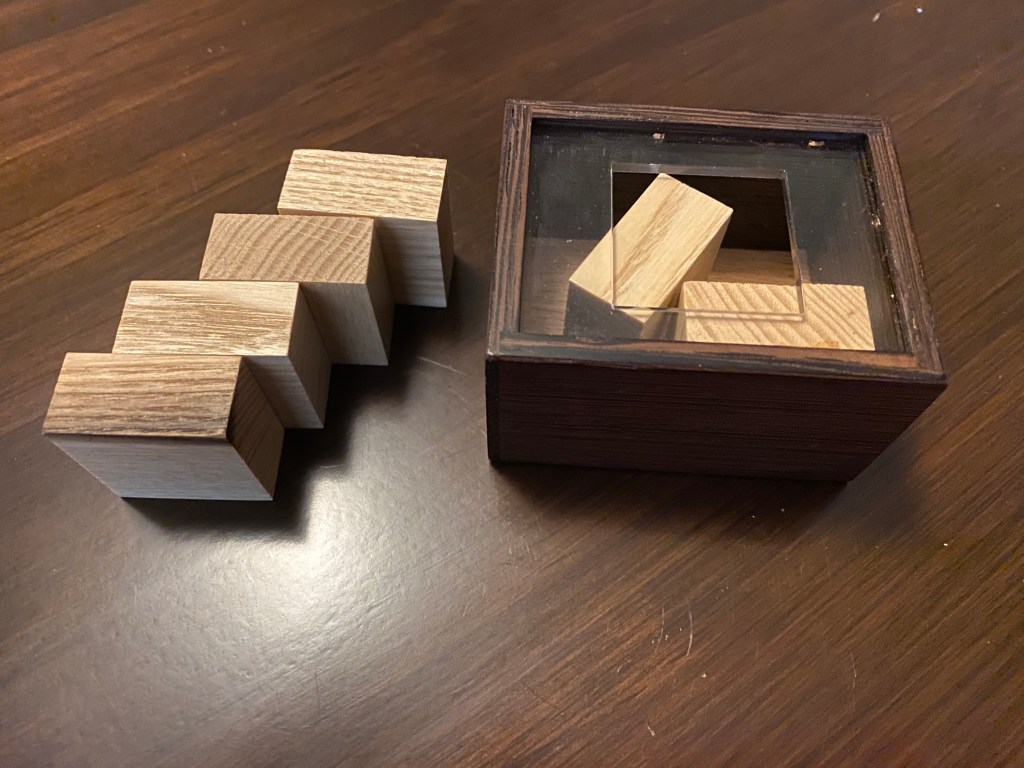
Quadro is a small-ish puzzle whose wooden box and acrylic top share an aesthetic with the Squary Packs (the puzzle’s name also etched into the bottom). It consists of 6 identical squares that must fill a rectangular box – while not interlocking, the solution will require a rather delicate dance to allow you the chance to drop that last block in with the satisfaction the comes with finally filling this up with those. This is one of those puzzles that is more complicated than it looks without being something insurmountable – I still managed to go in circles for quite a while, even asking other puzzlers if perhaps there was a “trick” that I was missing. Eventually I actually stopped and tried that thinking thing I’ve heard so much about, soon managing to find the right moves (leaving me wondering how I had managed to do everything but the one thing that would work).

Snake Pit

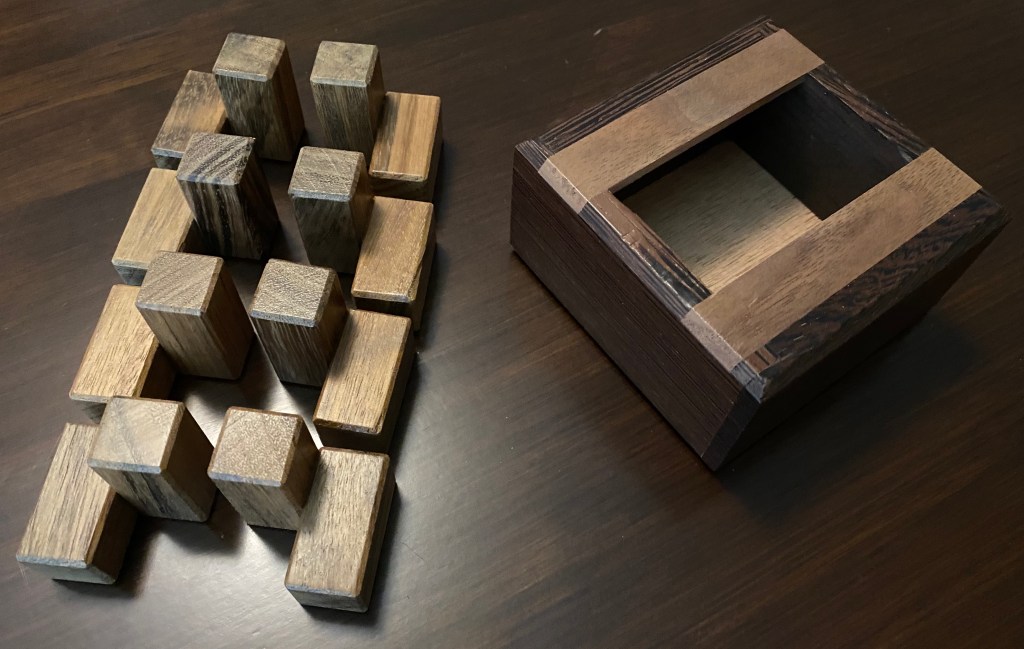
Snake Pit eschews the acrylic top for an attractive mix of light and dark woods with an opening that runs the length of the puzzle and is 1/2 as wide, leaving one voxel on either side. There are 4 pairs of mirrored pieces that must find their way inside for a fun solution that was just the right level of difficulty for me.

Mushkila

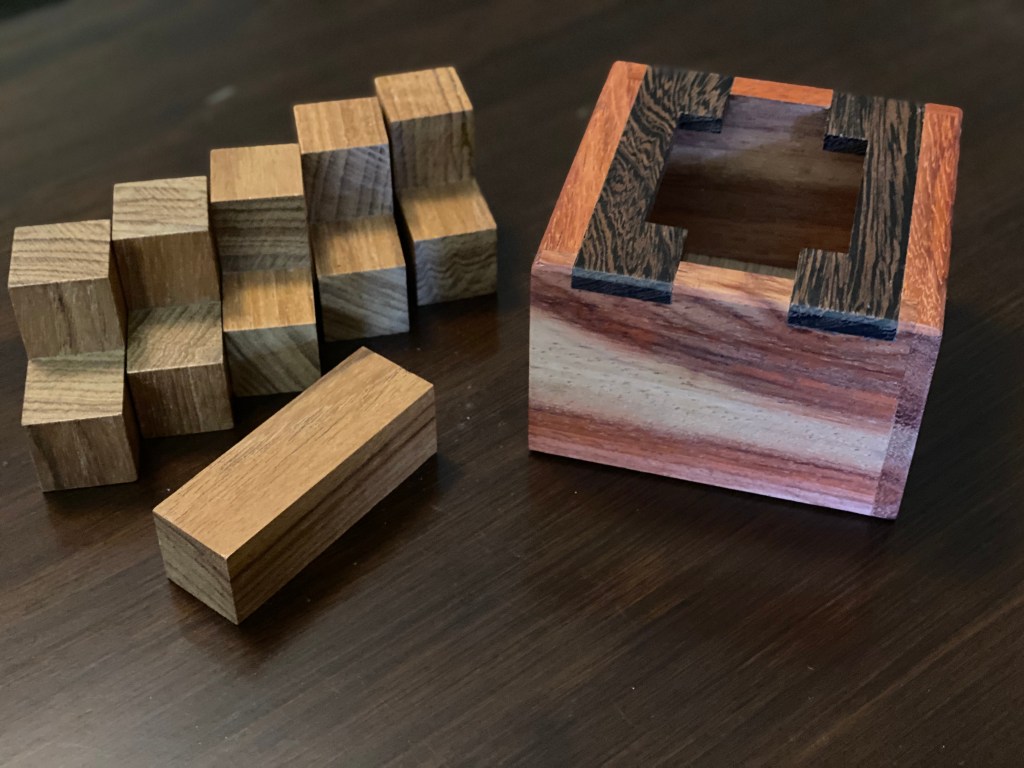
Mushkila is my newest acquisition, having received it along with my second order of Squary Packs. It uses a beautiful mix of woods with lovely grain patterns that play nicely with the mix of red and dark and light brown. Interestingly, the opening is not a regular shape: it runs the length of the box (similar to Snake Pit) to allow the single rectangular piece to go in and also adds a square cut-out to allow the five angled pieces to go in at any orientation. This gives it a bit of a deco look, which meshes well with his choice of woods. I have yet to solve it, but having spent a little bit of time on it, it is clearly a non-trivial solution that should provide a fun solve while looking great on my shelf.

All of these packing puzzles share a simplicity and elegance, both in terms of their aesthetic as well as their movement – I highly recommend following Yavuz’s Etsy page as I know that any time Yavuz has something available, I will happily say “yes, please” to whatever it is, sight unseen


Fun Grade: 5 Sinatras

Difficulty Grade: 3 to 4 Sinatras

Another Day, Not Just Another Drawer

Unlocked Drawer

Kathleen Malcolmson and Perry McDaniel, 2.5″ x 2.5″ x 1.6″

A few weeks ago, I reached out to a fellow puzzler on the social media site that shall not be named who, so I had heard, might be looking to let go of a few puzzles from his rather immense collection. After a bit of back and forth in which I listed out a number of names of makers and designers whose works are generally a bit difficult to find, he let me know that he did indeed have a couple boxes by none other than Kathleen Malcolmson. I have admired her boxes from afar but never before had the chance to get one (at least not for anything resembling a reasonable price). Not only was this a box made by her, but it was designed in collaboration with another hard-to-obtain designer, Perry McDaniel. The story goes that she had been working on the design for some years, unable to get it just right until Perry chimed in with a needed final touch that would allow her to produce it as envisioned.

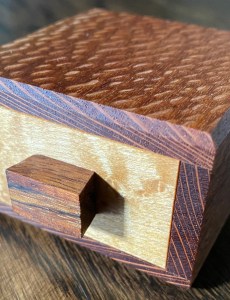
Unlocked Drawer is a relatively small box, consisting of just a drawer in a frame. It is beautifully made of contrasting lacewood and primavera, an aesthetic that is pretty consistent across her creations, at least as far as I can tell. Upon receiving it, I quickly found that its secrets were well-hidden: other than a bit of noise to be heard when shaken (presumably the Texas quarter to be found inside), the seams visible from the front do not permit any movement and no other breaks could be seen.

And that’s it! Fabulously frustrating in its simplicity and elegance, it would take me quite a bit of poking prodding pushing and pulling over the course of several days before a genuine aha that startled me with its sudden appearance. I love a moment like this: it is the reason many of us puzzle and we spend quite a bit of time chasing the feeling which is well represented in this little box. Closing it, there remains no indication of the solution, which I of course had to repeat several times since solving solely to revel in its gracefully hidden presence. A close relative of the box (Three-Layered Dovetail) was recently available at a Haubrich Auction, and was claimed by a puzzling French friend of mine, with whom I would not wish to engage in a bidding war – hopefully, I will be able to find a copy of my own, and/or any other Malcolmson boxes (particularly perhaps its predecessor, Locked Drawer, designed by Robert Sandfield). It more than lived up to the hype in its beauty, craftsmanship, and deviousness.


Elegance Grade: 5 Sinatras

Difficulty Grade: 4.5 Sinatras

When is a Drawer not a Drawer? When it’s a Puzzle.

Surprising Drawer

Osamu Kasho, Keyaki (Zelkova), Magnolia, Wenge, 4.6″ x 4.6″ x 4.25″

Each year, the Karakuri Creation Group (KCG) has an Idea Contest, in which people (in Japan) are free to submit box ideas to the master craftspeople, who select a few to be produced and sold via lottery. Contest winners have a tendency to be comparatively simple, while telling a story or portraying something whimsical or odd. Some dork blogger (with a cool name) posted a video and review of last year’s He Can Not Get the Ball!, which backs this claim up (assuming he can be trusted).

This year, I was able to resist buying any of the Contest Winners; although some, including Osamu Kasho’s Surprising Drawers, certainly sounded intriguing, I did not initially succumb to temptation (shocking, I know – but 2020 is shaping up to be an especially expensive puzzling year and some lines must be drawn…. and redrawn…. and then moved back a bit). The KCG descriptions will sometimes contain clues to box solutions, at times to the point of giving too much away, but for Drawers it (mostly) just said: “I tried to express the joy of its movement more than the difficulty. This product might be one that you’ll want to open again and again.” This was a head-scratcher, for sure, but I somehow still managed to resist. On top of this, Kasho is fast becoming one of my preferred KCG members: his Bara Bara Box was my favorite of last year’s holiday gifts and my recently received Ripple Out turned out to be much much cooler than I had honestly thought it would be.

And so I waited. Patiently lurking about the puzzling fora, awaiting the imminent arrival of said boxes to the homes of unsuspecting collectors, whose opinion would soon be sought for the final determination of the satiation of my desire – which is to say, I waited until some people got theirs and asked what they thought of them to see if I should try to get some after all.

Haym H., puzzle designer, collector, and all around good guy, received his in short order and was especially taken by Surprising Drawers (or, at least, I was especially taken by what he said about them – he had good things to say about all the boxes, any of which is likely to be an excellent box). Due to my cyber-stalking of the KCG site, I was well aware that the boxes had not yet sold out (ed. although a couple other contest winners are still available at the time of this writing, all of which have also received praise, Drawers is now sold out), and jumped on it quickly. I had heard enough to know that the puzzle gods must be given their due, and I feared their wrath were they to be ignored (judging from the amount of unsolved puzzles around me, I may be feeling that wrath regardless).

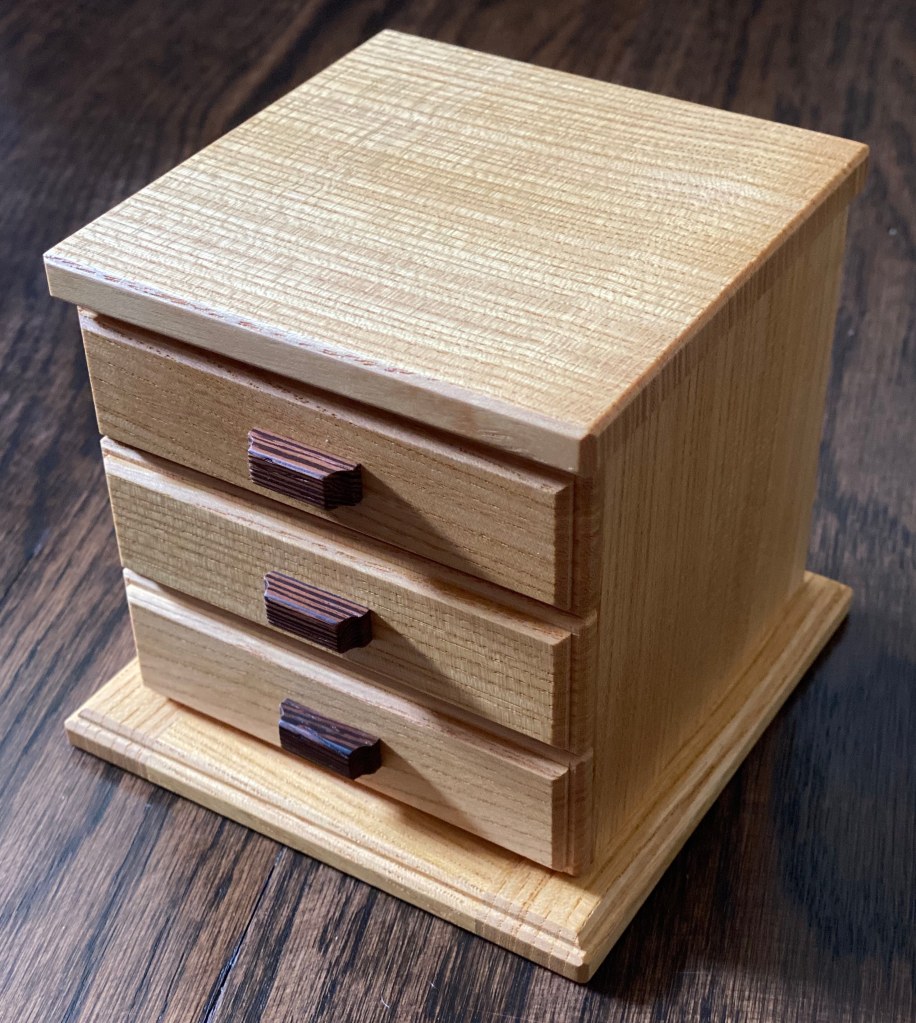
As usual, the box arrived within a matter of days from Hakone. My first impression was that the box is bigger than I had expected. The Idea Contest winners I have had in the past have all been larger than most of their regular counterparts, but for some reason I had not expected this to be quite so massive. The craftsmanship is, as I expect from any KCG box, excellent – the wood feels satiny and solid and the drawers could easily pass as bedroom furniture for a very tiny person. There is a hole approximately the size of a quarter on the bottom of the box, through which a bit of magnolia can be seen and felt. The three drawers have handles made of wenge, whose darkness is a lovely contrast to the lighter Zelkova of which most of the box’s exterior is made. As one would expect from drawers, they all wiggle a bit, each moving independent of the others and feeling as though they should come right open. Of course, they do not….. as that would be, in the words of the Ancient Greeks, hella lame.

If you read any of my posts, you may come to the realization that my passion for puzzles far exceeds my skills with them – which is to say, wrath of the puzzle gods aside, I’m just not all that great at them sometimes. And while this box was said to not be difficult to open, I nonetheless struggled for longer than I should have, missing what now seems obvious and getting caught up in some misdirection stemming from my own assumptions. After wondering if it was broken for longer than I care to admit (a step that should be included in the solution of every good puzzle as surely as angrily resenting one’s decision to buy Ikea furniture should be included in the directions of every Skurpingdhenghenr nightstand sold), I soon found the first step, a relatively simple move that unlocks the solution, allowing me to…….. OMG!!!

I actually LOL’ed as it came open in a shockingly unexpected manner, looking around as if the ghosts of Christmas past might wish to share in my glee. I took the rare step of demanding that my NPSO watch me open it (if she wanted to, please and thank you), and even she thought it was pretty cool. Closing the box took a little bit of thought as the solution seems, in more ways than one, to be physically impossible at first glance. After reflecting for a moment and observing how the pieces work together in such a simple and ingenious manner, designed so as to appear both obvious and impossible at the same time, it was clear how to reset the puzzle. At which point, I immediately opened it again. And then one more time. And several times since then…. and one more just now.

I am not exaggerating when I say that this has quickly become one of my favorite Karakuri and that I am grateful to Haym for sharing his impressions with me (and that there were still copies left!). I just opened it again and it still makes me smile! I may have to delve into the wondrous inner working of wordpress to discover how to write and post pics using spoiler tags; regardless, I will be sure to bring this box with me if and when our regular scheduled puzzle parties resume so that we might all bask in its puzzling glory together.


Originality Grade: 5 Sinatras

Locked Out: Lock Box by Eric Fuller

Lock Box

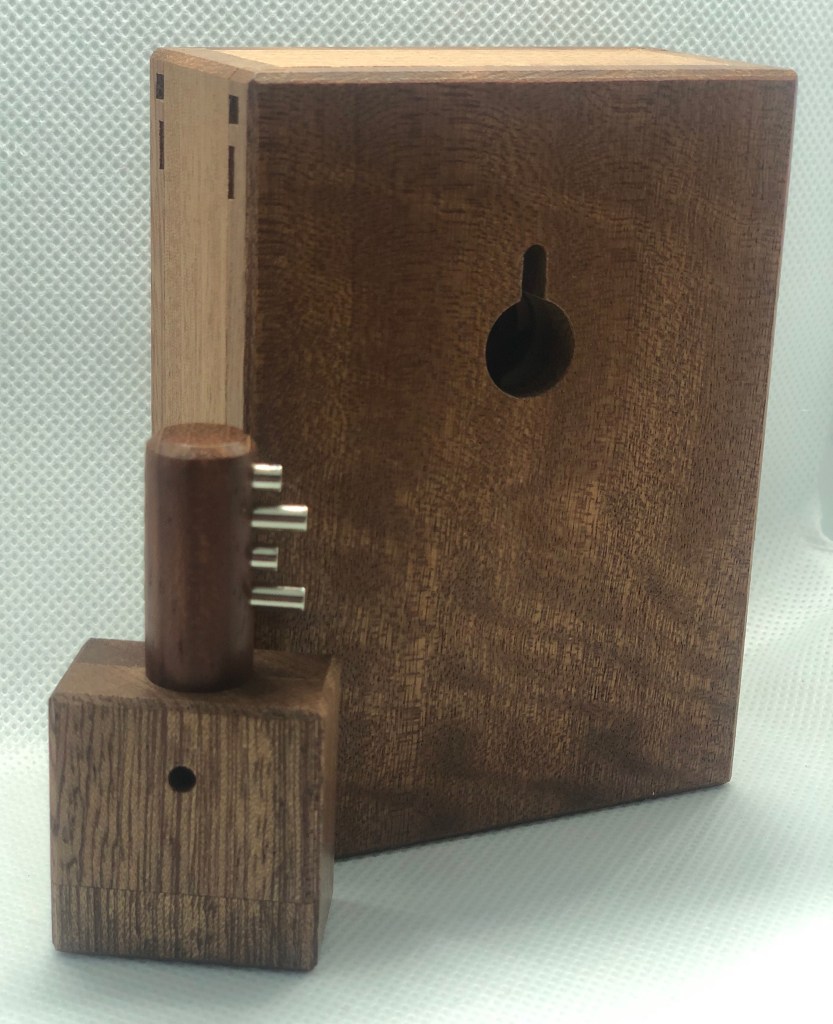
Eric Fuller, Figured Quartersawn Sapele 3″ x 4″ x 1.45″ Box, 2.45″ x 1.25″ x 0.75″ Key 133 Copies

I have a tendency to write about puzzles that may not be easy to obtain – I enjoy reading about such pieces, that I might live vicariously through the vague reminiscences of puzzlers more fortunate than I, adding to my ever-expanding list of unicorns and future lost auctions.

This is also due to the simple fact that great puzzles sell quickly. In a bout of good fortune, Eric Fuller’s Lock Box will again be available in limited quantities on CubicDissection.com in late July (2020). Personally, I need only hear Eric Fuller + Puzzle Box to anxiously wait to give him my money, but if you are unsure, my suggestion is: buy it. If you cannot afford it (at $450 it ain’t cheap), sell some other puzzles and then buy it. In the unlikely event you do not like it, there will be plenty of people happy to take it off your hands; I believe it is destined to be yet another unicorn with auction prices that get bonkers fast.

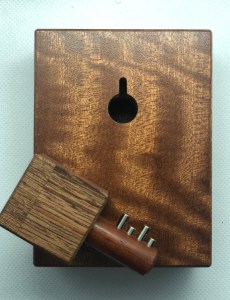
At first glance, we have a key and a box with a keyhole; so far we have more to go on than the T12 initially shows. Unsurprisingly, after dutifully inserting the key (because you’ve got to try, right?), you will find it will not get you very far. And that’s it.

Before too long, I had my first aha. Followed by a few more. Followed by a wall. And more wall. Then another aha. More wall. Aha. Wall. Wall. Think, plan, take notes. Wall. Aha? Hm, no: Wall……… and here I am: a pretty good understanding of the wall I am facing, with no idea how to get past it. I have made good progress, with the end somewhere in sight and I can confidently say this will be very satisfying when that final aha has been found.

The puzzle has so many of the things I love in a box (some of which I will not say): things that look they should work that don’t; a bit of progress that may not come right away, but before too long; a series of stops and gos, extending the pleasure of solving across a spread of mini-solves; the ability to make progress during my first, focused session; the inability to fully solve it during that same session; the need for both trial and error as well as actual thinking; pretty, pretty wood; and while it has some similarities with other great puzzles, it is mostly very unique.

Everything works well and consistently, which is always nice (and is not always the case even with some excellent puzzles). And did I say that it is pretty? The instructions do warn that this will not stand up to humidity well – we are advised to keep it between 40% and 60% lest it be ruined (!), so some folks may be facing a dilemma (I’m looking at you my Hawaiian puzzling friends).

I expect that the final step (or steps) will be something quite different from what has worked thus far: this is something many of Eric’s puzzles feature; were it not the case, I probably would have found it (them?) already, after all. It took me a while to determine how to get to my current stopping point reliably and with full comprehension but this final wall may be staring me in the face for some time.

But man, this reminds me of why I love puzzle boxes.


Puzzle Oddity: Anti-Gravity Box by Frederic Boucher

Anti-Gravity Box

Frederic Boucher, 3D Packing Puzzle, 2.25″ x 2.25″ x 1.5″

A few months ago, I wrote to Frederic in the hopes that he might happen to have a few puzzles that were seemingly unavailable. Most were, but he did happen to have a last copy of Anti-Gravity Box, which I happily requested, along with a few other new puzzles that he had on hand.

March 2022 Update: CubicDissection will be releasing a new version of AGB (titled: “Anti-Gravity Box+”) in it’s upcoming March 21, 2022 release – not only will this feature the ever-awesome craftsmanship and woods CD is deservedly known for, but, according to Frederic: “This new version includes a 2nd set of pieces with a solution that includes a trick that I think has never been seen in any other design yet…” This presumably constitutes the + in CD’s AGB+. So get your clicky finger ready as I don’t expect that these will last long: (EF + FB)CD = Awesome Sauce!

I have solved several of Frederic’s puzzles in the past – 3D and 2D packing puzzles that offer a serious challenge, comparable to pieces by Osanori Yamamoto, Koichi Miura, and Volker Latussek, and featuring elements such as interlocking elements and restricted openings.

Anti-Gravity, however, adds new mechanics by introducing a number of magnets into the mix. This makes for a unique and novel puzzling experience; it is no longer “just” about finding a way to get the pieces into their frame, as the magnets throw one’s general approach out the window.

The box is a 3×2 voxel frame that features a removable, acrylic top, allowing you to easily reset the puzzle and view your progress. The box has two, single voxel openings at 90 degrees to one another; both are in the middle of the bottom level, allowing you to enter each axis, but offering no room for angles of any kind. You must fill it with 6 identical rectangular 3×1 blocks; 2 have two magnets on one side, 3 have magnets on one end, and one block has none.

There are rules, of course: you need to place it on a flat surface and you are not meant to pick it up or tilt it (of course, you may hold it while you insert other pieces); you cannot poke your finger into either of the openings to push the pieces; it goes without saying that you cannot just lift off the top and place them in. The removable top is a kind addition, as it avoids the need to struggle to remove pieces when you have eventually found you had made a mistake. The puzzle arrived with the pieces stacked neatly inside. It is kind of cool to have a puzzle so confident in its structure, that it can come fully solved without having spoiled anything.

While by no means simple, neither is it an overly difficult puzzle – in my experience, one of his other packing puzzles was more challenge than I could meet (I am admittedly not so great at packing or interlocking puzzles generally – my interest far exceeds my ability when it comes to these types of puzzles).

More importantly, this is a very fun puzzle, and one with which trial and error will not get you very far; knowing the pieces you can eventually figure your way through it.. After spending a few minutes playing with it, experimenting to get to know the pieces and what they can and can’t easily do, I had to stop and think. This led to the first big aha moment of a series of such moments, leading to the full solution. Each step is its own planned approach, each piece requires forethought once a workable order has been determined. Apparently, this has two approaches that lead to similar solutions; I have found one and will undoubtedly spend some more time to find the second.

TL;DR: Anti-Gravity Box by Frederic Boucher is an original approach to a 3D packing puzzle, with magnetic pieces needing to be stacked using entries that allow for little margin of error. While not Boucher’s hardest puzzle, each move must be planned and purposeful through thoughtful approach and not just trial and error. It features a convenient removable top to reset after you inevitably make a mistake, and is so confident in its own puzzling, that it can arrive solved without lessening its challenge.


Originality / Fun Grade: 4 and a Half Sinatras

Difficulty Grade: 3 and a Half Sinatras

Instructions Included