The Other Best Blue Metal SD Puzzle Cube

Wishing Well

Perplex Puzzles, Stainless Steel, Aluminum, and Brass, 3.5″ x 3″ x 3″, Currently Available

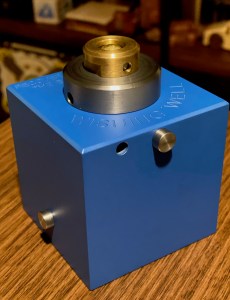
Recently, a puzzling friend of mine sent a pic of a metal puzzle box that had my puzzling parts tingling: Wishing Well is a new (currently available) puzzle from Perplex Puzzles; while seemingly a newcomer to the mechanical puzzle scene (afaik), the creator is a machinist with 39 years experience and the impeccable craftsmanship of the puzzle is definitely consistent with this expertise. At first glance, it seems somewhat similar to Will Strijbos’s First Box: it is a blue metal cube, with a cylindrical protrusion on its top. However, it is a bit bigger and significantly heavier than that puzzling classic; its blue surface is ceramic-coated “for long life,” and it has a number of holes and nubs and such located around its periphery.

Perhaps more importantly, this puzzle boasts an approximate number of 50 steps to solve(!) – this is made even more sweet by its instructions, informing us that there are no magnets, no need to spin or shake, and no smacking or excessive force needed. Described as “sequential mechanical,” after spending time with it, it most definitely falls squarely into the sequential discovery sub-genre of take-apart puzzles: it contains an “intricate assembly” of various metal parts that have been “precision machined on both CNC and conventional machines.” Presumably, this requires a lot of time and effort to make (a fact belied by its significant price tag); I took a bit of a leap of faith and bought it (who am I kidding – a brand new 50 step, SD puzzle box?! yes, please). As stated on the website, these are made in small batches: “[d]ue to the extremely close tolerances and tight fits, they are individually fit and assembled.” Yet again, music to my puzzling soul.
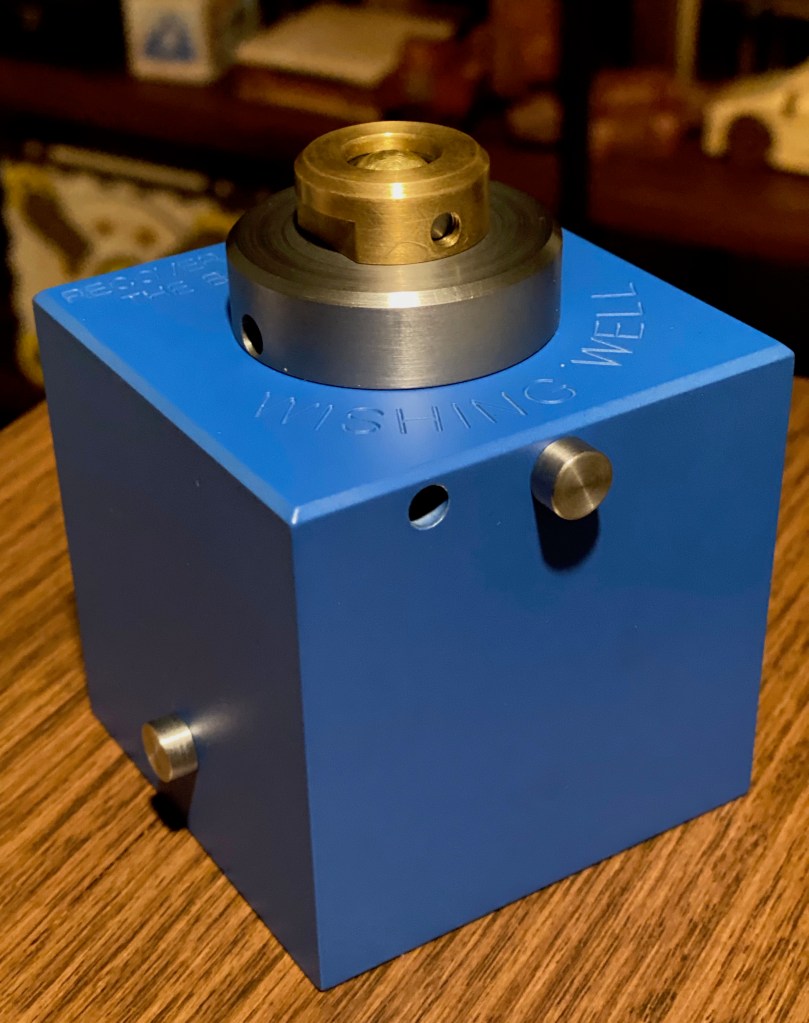
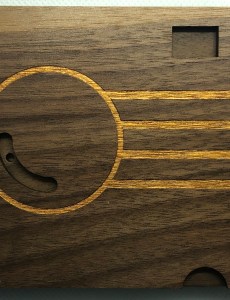
Made in the US, it arrived in just a couple days, arriving in a heavy wood crate with a dozen or so screws around its edges. This was obviously extremely cool and had me anticipating the puzzling experience all the more. Opening the crate, I found a wooden case with a metal clasp taking up about half its interior. Inside this unassuming (not a puzzle) box, lay Wishing Well, comfortably nestled in the foam-lined interior. Lifting it out of its perfectly-sized hole, the first thing I noticed is that it is heavy. Like really heavy. I mean, noticeably heavier than Pachinko, let alone First Box. Its ceramic coating feels smooth and softer than most metal puzzles had led me to expect, and the two-stage, two-toned protrusion on top immediately grabs my eye: a two inch metal circle (aluminum, presumably) topped by a one inch brass circle with what appears to be a brass ball nestled within. The primary directive has been etched into the surface of the box, just above the circles: “Recover the Coin from the Bottom of the” (and then, curving around the bottom of the circle) “Wishing Well.” There is something so practical about it that I like – almost like coming across an odd-looking lock box deep inside the guts of a factory.

Inside its wooden case were two folded sheets of paper: one were the instructions (see below), which included several points in addition to those listed above, instructing the puzzler to not only recover the coin, but to reassemble it completely before it can be considered solved. But the unassuming line that mechanical puzzlers will be likely to find most intriguing sits somewhere in the middle: “Disassembly and removal of the coin can be accomplished easily when taking the proper steps in the proper order.” Wunderbar! This is a puzzle that seems to follow a series of discrete steps – rather than vague movements blending into one another, I have found a tool-based mechanical progression that is by no means easy.

In addition to the instructions, there is a hint sheet – after spending a significant amount of time on the puzzle, I peeked at it, almost as much out of curiosity for the sheet’s contents as for the hint itself. Included hints are not a common occurrence with puzzles for some reason (many don’t even show up with instructions), and I found this to add to my enjoyment of the puzzle, especially as the hunts themselves are conceptual and do not really spoil anything: there are a couple quotes that provide as vague a nudge as any esoteric comment from a fellow puzzler might, as well as (wait for it) a crossword puzzle! Apparently, by solving the crossword, you can then put the words into the order provided to reveal an additional hint. The quotes were not anything particularly helpful – an experienced puzzler is likely to find them to be advice that is generally good to keep in mind when approaching a new, complicated take-apart puzzle, but I appreciate the vague nudges (and I think it is especially welcome to include something for those that may be relatively new to the puzzling world). I have not yet done the crossword, which I suspect may contain something a bit more concrete.

Along with the wooden case, there is a manila letter-sized envelope labelled “Solution.” Because of how heavy it is, I had to open it and at least peek in the top; careful not to reveal any of the actual content, I was able to see that it contains 10 laminated pages with printed text and pictures(!) – pretty awesome and likely quite thorough.

Finally, on to the puzzling experience. As I mentioned, I have not yet solved it fully (I suspect it will cause me to flounder and flail about for quite a while, which should come as no surprise if you know me at all); at this point, I have progressed through about dozen steps and I can confidently say that this thing is badass. As claimed, when you find a step, it is clearly a step; and yet, it is oftentimes totally unclear what to do – it seems like there is so much that you should be able to do, and yet at any given time it may take a while to find anything that you actually are able to do. The visible holes and nubs hide tools and inner working that change in nature as I work my way along – what did little, now does much; what was sticking out, is now sticking in; things move and potential pathways begin to open up, moving the puzzle along at a decent pace until I get to a point where I find myself yet again going in circles, able to do several things, but unsure which to do or in what way or order. Do I need to do this before I do that? Should this go here or should that go there? I am gathering intel on what lies inside the box, details emerging as I discover ways to make this or that happen. Each piece moves perfectly; this is a puzzle clearly made by an expert in the craft that knows how to get metal to do what he wants. Unlike some puzzles I have done, it does not feel like round pegs are being forced into square holes, where you are unsure whether you should do this or that – while it is by no means always clear what to do, I have found it very clear what not to do; this puzzle hides but it does not cheat.

I will end by saying this: it is very clear that this took a lot of thought to design and a lot of effort to make. The puzzling is very enjoyable, with well-concealed, discrete steps that incorporate tools and non-obvious movements that keep me interested and excited as I struggle to find my way through to the next wall. Perplex’s product page features a “Coming Soon” sign beneath Wishing Well; the new puzzle is named Turn, Turn, Turn and comes in at a slightly lower price tag. If it is anything like Wishing Well, the price is likely to be well worth it. I don’t know whether Perplex will continue to make Wishing Well after the new puzzle has been released, but I assume that once the puzzling world gets wind of these, they may start disappearing, so start saving or selling your solved stuff because this thing is seriously fun.


Craftsmanship: Five Sinatras

(No Terence Trent D’Arby jokes were made during the writing of this blog… until now)

Sitting with Cista: The Secretum Cista Puzzle Chest Experience (without Spoilers)

Secretum Cista

Jesse Born, 30 copies, 55 lbs., 13.5” x 20.5” x 11.5”

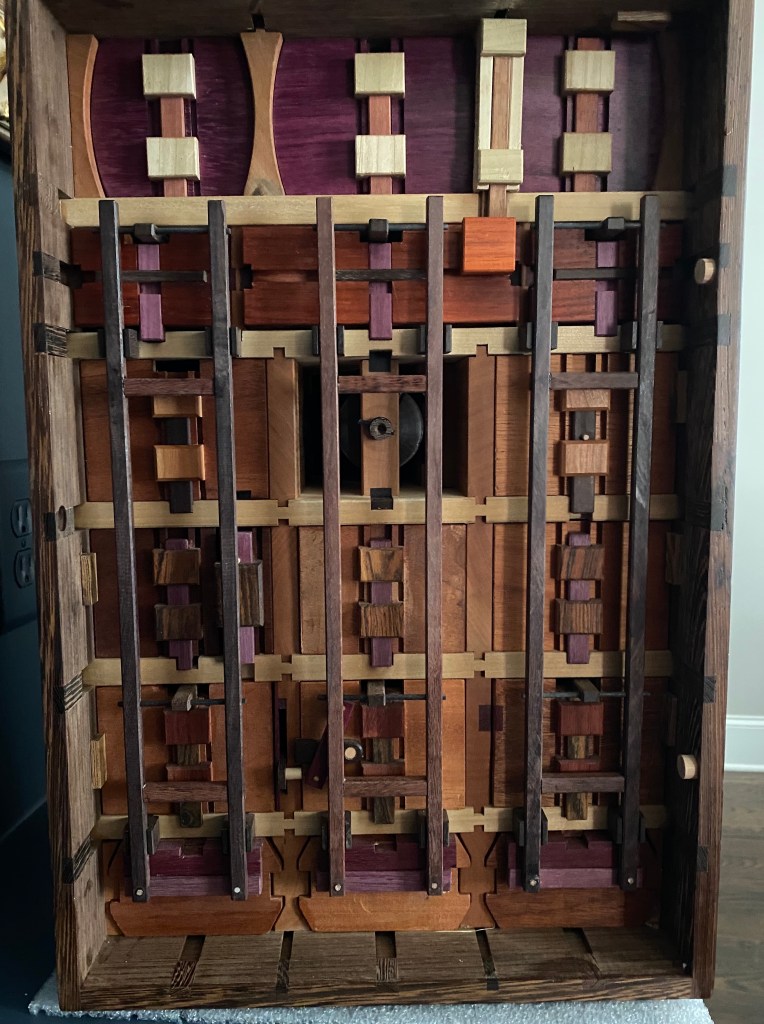
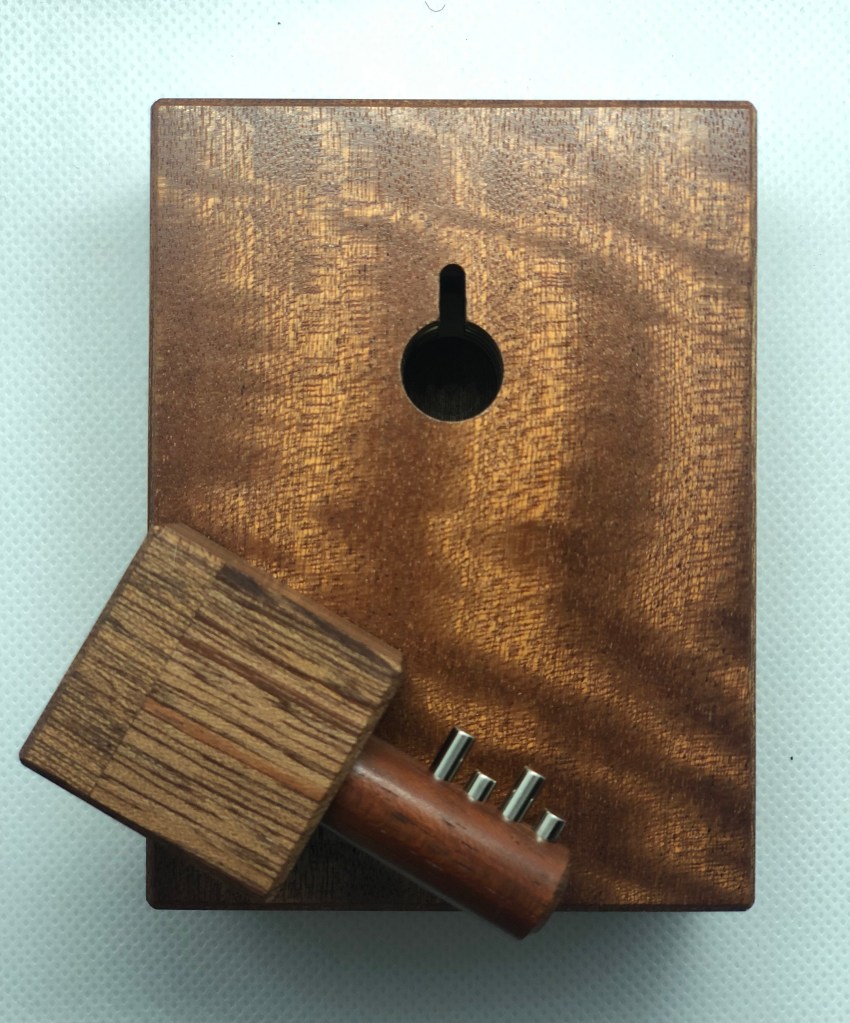
Well, I had my fun making my introduction to the Cista – a minute or two of video does a better job of showing how pretty the chest is; that and its back is more than enough to whet your appetite.

So I figured I would talk about how it is as a puzzle experience – I am of course not going to spoil anything, but I will also describe some of what it does in its fully reset position (which I assure you isn’t much).

In case you haven’t guessed, the box does not actually emit a bright glow accompanied by the sounds of the heavens and glory (my film degree affords me the ability to produce such amazing movie magic) – it also required a signature at delivery, which was not shown in my otherwise completely accurate depiction of its arrival.

Once I had ooh-ed and aah-ed enough for the time being, I set about exploring. I had already determined that all drawers were locked, except for the circular one in the center, which opens freely (although perhaps not completely) as seen in the vid. This drawer is dark and cylindrical, with a number of squares running down its length, contrasting wood (purpleheart?) filling it partway, which can be seen as it rotates more or less freely. Other than that, no drawers will open, but many do feel unique; some have more give than others, or there may be other differences you can sense with just a bit of a tug on the handle.

The back is behind a glass door (with a neat magnet-based lock) but while you can see quite a bit of the inner workings of the chest, casual observation does not provide any clear spoilers. However, after a fairly thorough, albeit somewhat cursory, exploration of the chest overall, it becomes pretty clear where to begin. With a bit of time and patience, I begin to have some initial success, which leads to further discoveries, which then eventually leads to forking paths with suspect dead ends. I’ve made it through about 1/3 of the chest (which definitely seems to be getting progressively more difficult), and I have had to backtrack to go in a different direction, or maybe do something again but in a different way for a different result.

Looking at the pictures, I had come up with a few ideas for things that would be likely to produce results. I don’t know if this was by design, but Jesse managed to use all of these ideas in the first few drawers; it feels like he wanted to get rid of these early on and the chest ramps up in difficulty following these initial successes. And even these ideas are integrated into larger, more complex mechanisms the integrate or conceal tools or other aspects that interconnect these comparatively simple steps into the larger whole. It does not feel like you are taking on isolated puzzles; so far, 7 of the 8 drawers I have solved relate directly to the solution of at least one other drawer in some way (and of course, it is entirely possible that the 8th does as well).

This is sequential discovery in all its finery – SD is a term that we love to use, as it is a favorite among many of us puzzlers (for good reason); some puzzles have SD elements as part of a lock or other take-apart (many of which are absolutely fantastic puzzles that can be as good as or better as any other puzzle you can bring to the table) – fewer, though, have SD running through its veins (I’m thinking of puzzles like Slammed Car, Turtle Trip, Dark Fairy Door, Puzzleduck Pastures, Rex Rossano Perez’s coin release puzzles, Where’s My Hammer?, Three Wise Bolts, and so on).

As I proceed through the puzzles, I have already found several tools and have had to go back to go forward. My progress so far has been made over the course of several days; steps have been discovered by me in fits and starts, requiring equal parts exploration, experimentation, and exposition (daaaaaamn that’s some fine alliteration). Jesse’s workmanship is amazing and any cosmetic imperfections are entirely insignificant and endearingly inevitable in a handmade chest. In fact, the chest has been deemed fit for public consumption and has not been banished upstairs to my office (although I do plan on bringing it up once solved as the humidity os more closely controlled there).

I am currently at a wall – I’ve unlocked 8 drawers and am now good and stuck. There are some things that I know do something somehow, but damned if I know what. Which is perfect – I am confident that it will continue to confuse and create contentment as I consider the controlled consequences and considerable options concealed by the content-creating craftsman’s contemplation of a cunningly convoluted puzzle (wow that alliteration got way out of con-trol).

I reached out to Jesse (who is always quick to respond to offer assistance or clarification if sought) and he gave me permission to shoot a solution vid. I generally don’t make (or watch) such content because I have learned that you may well get your hands on a puzzle you thought was unattainable, but considering the fact that the 30 people who have a copy of the chest are likely to carry 55 lbs. of puzzle to a puzzle party, I may yet put something together showing what I’ve managed to figure out so far.


Overall Grade: The illustrious and rarely bestowed Presley

“[D]espite the justified reliance on the Sinatra as the coolness quotient upon which said methodology is based, there must simultaneously exist an indicator to be used should a commodity’s value be calculated such that the Sinatra be rendered insufficient; in this event, the Presley is the more apparent and precise control to represent the coolness being commodified insofar as it exists in excess of the standardized Sinatra metric.”

Quantified Cool, John Maynard Keynes, 
Chairman of the World Bank Commission, 1944

Another Day, Not Just Another Drawer

Unlocked Drawer

Kathleen Malcolmson and Perry McDaniel, 2.5″ x 2.5″ x 1.6″

A few weeks ago, I reached out to a fellow puzzler on the social media site that shall not be named who, so I had heard, might be looking to let go of a few puzzles from his rather immense collection. After a bit of back and forth in which I listed out a number of names of makers and designers whose works are generally a bit difficult to find, he let me know that he did indeed have a couple boxes by none other than Kathleen Malcolmson. I have admired her boxes from afar but never before had the chance to get one (at least not for anything resembling a reasonable price). Not only was this a box made by her, but it was designed in collaboration with another hard-to-obtain designer, Perry McDaniel. The story goes that she had been working on the design for some years, unable to get it just right until Perry chimed in with a needed final touch that would allow her to produce it as envisioned.

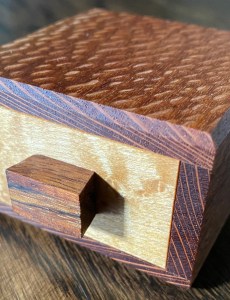
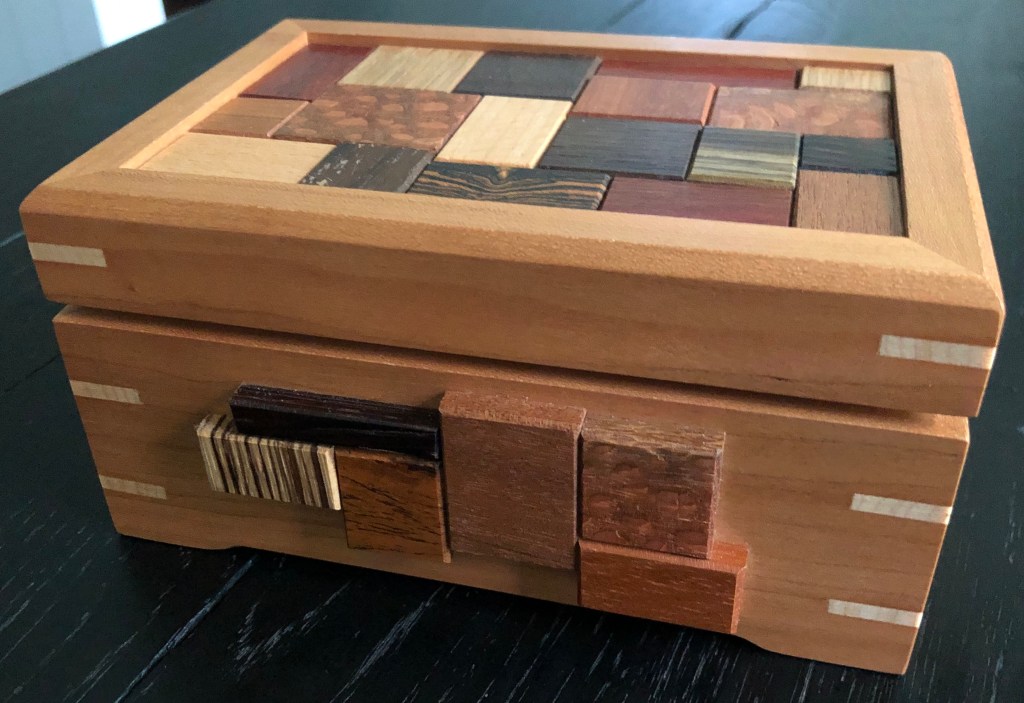
Unlocked Drawer is a relatively small box, consisting of just a drawer in a frame. It is beautifully made of contrasting lacewood and primavera, an aesthetic that is pretty consistent across her creations, at least as far as I can tell. Upon receiving it, I quickly found that its secrets were well-hidden: other than a bit of noise to be heard when shaken (presumably the Texas quarter to be found inside), the seams visible from the front do not permit any movement and no other breaks could be seen.

And that’s it! Fabulously frustrating in its simplicity and elegance, it would take me quite a bit of poking prodding pushing and pulling over the course of several days before a genuine aha that startled me with its sudden appearance. I love a moment like this: it is the reason many of us puzzle and we spend quite a bit of time chasing the feeling which is well represented in this little box. Closing it, there remains no indication of the solution, which I of course had to repeat several times since solving solely to revel in its gracefully hidden presence. A close relative of the box (Three-Layered Dovetail) was recently available at a Haubrich Auction, and was claimed by a puzzling French friend of mine, with whom I would not wish to engage in a bidding war – hopefully, I will be able to find a copy of my own, and/or any other Malcolmson boxes (particularly perhaps its predecessor, Locked Drawer, designed by Robert Sandfield). It more than lived up to the hype in its beauty, craftsmanship, and deviousness.


Elegance Grade: 5 Sinatras

Difficulty Grade: 4.5 Sinatras

When is a Drawer not a Drawer? When it’s a Puzzle.

Surprising Drawer

Osamu Kasho, Keyaki (Zelkova), Magnolia, Wenge, 4.6″ x 4.6″ x 4.25″

Each year, the Karakuri Creation Group (KCG) has an Idea Contest, in which people (in Japan) are free to submit box ideas to the master craftspeople, who select a few to be produced and sold via lottery. Contest winners have a tendency to be comparatively simple, while telling a story or portraying something whimsical or odd. Some dork blogger (with a cool name) posted a video and review of last year’s He Can Not Get the Ball!, which backs this claim up (assuming he can be trusted).

This year, I was able to resist buying any of the Contest Winners; although some, including Osamu Kasho’s Surprising Drawers, certainly sounded intriguing, I did not initially succumb to temptation (shocking, I know – but 2020 is shaping up to be an especially expensive puzzling year and some lines must be drawn…. and redrawn…. and then moved back a bit). The KCG descriptions will sometimes contain clues to box solutions, at times to the point of giving too much away, but for Drawers it (mostly) just said: “I tried to express the joy of its movement more than the difficulty. This product might be one that you’ll want to open again and again.” This was a head-scratcher, for sure, but I somehow still managed to resist. On top of this, Kasho is fast becoming one of my preferred KCG members: his Bara Bara Box was my favorite of last year’s holiday gifts and my recently received Ripple Out turned out to be much much cooler than I had honestly thought it would be.

And so I waited. Patiently lurking about the puzzling fora, awaiting the imminent arrival of said boxes to the homes of unsuspecting collectors, whose opinion would soon be sought for the final determination of the satiation of my desire – which is to say, I waited until some people got theirs and asked what they thought of them to see if I should try to get some after all.

Haym H., puzzle designer, collector, and all around good guy, received his in short order and was especially taken by Surprising Drawers (or, at least, I was especially taken by what he said about them – he had good things to say about all the boxes, any of which is likely to be an excellent box). Due to my cyber-stalking of the KCG site, I was well aware that the boxes had not yet sold out (ed. although a couple other contest winners are still available at the time of this writing, all of which have also received praise, Drawers is now sold out), and jumped on it quickly. I had heard enough to know that the puzzle gods must be given their due, and I feared their wrath were they to be ignored (judging from the amount of unsolved puzzles around me, I may be feeling that wrath regardless).

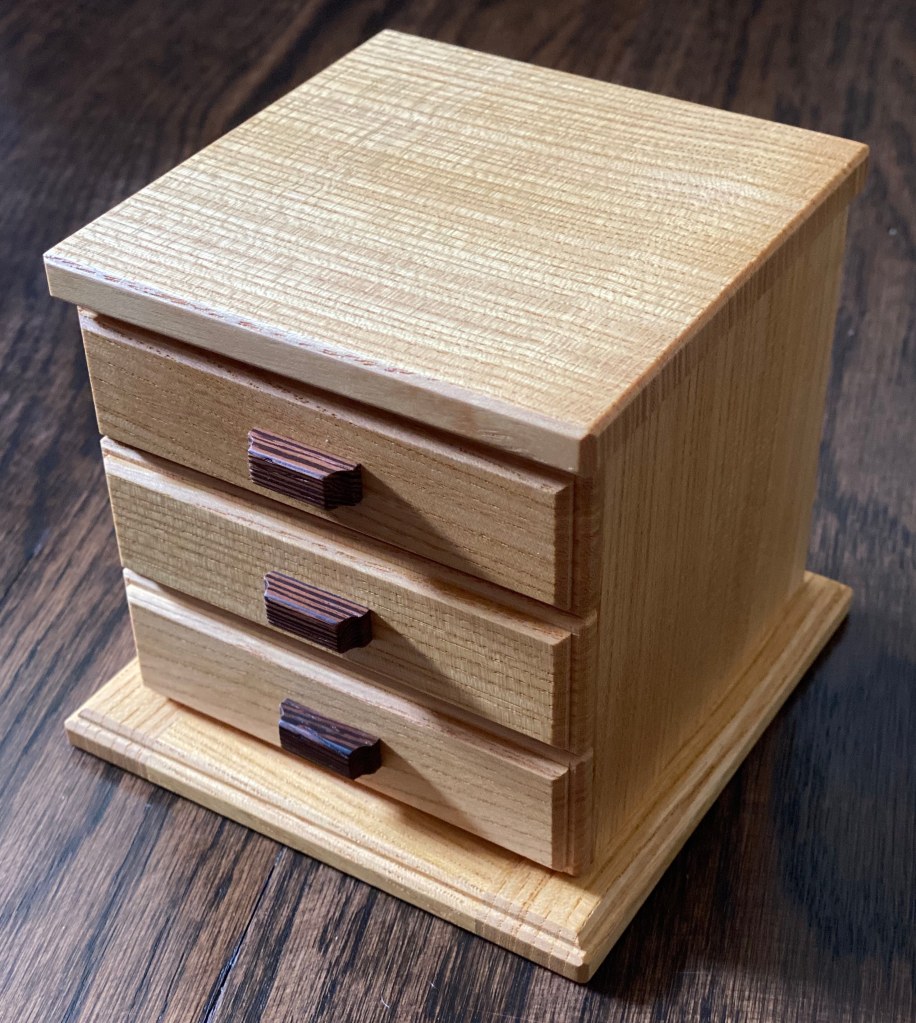
As usual, the box arrived within a matter of days from Hakone. My first impression was that the box is bigger than I had expected. The Idea Contest winners I have had in the past have all been larger than most of their regular counterparts, but for some reason I had not expected this to be quite so massive. The craftsmanship is, as I expect from any KCG box, excellent – the wood feels satiny and solid and the drawers could easily pass as bedroom furniture for a very tiny person. There is a hole approximately the size of a quarter on the bottom of the box, through which a bit of magnolia can be seen and felt. The three drawers have handles made of wenge, whose darkness is a lovely contrast to the lighter Zelkova of which most of the box’s exterior is made. As one would expect from drawers, they all wiggle a bit, each moving independent of the others and feeling as though they should come right open. Of course, they do not….. as that would be, in the words of the Ancient Greeks, hella lame.

If you read any of my posts, you may come to the realization that my passion for puzzles far exceeds my skills with them – which is to say, wrath of the puzzle gods aside, I’m just not all that great at them sometimes. And while this box was said to not be difficult to open, I nonetheless struggled for longer than I should have, missing what now seems obvious and getting caught up in some misdirection stemming from my own assumptions. After wondering if it was broken for longer than I care to admit (a step that should be included in the solution of every good puzzle as surely as angrily resenting one’s decision to buy Ikea furniture should be included in the directions of every Skurpingdhenghenr nightstand sold), I soon found the first step, a relatively simple move that unlocks the solution, allowing me to…….. OMG!!!

I actually LOL’ed as it came open in a shockingly unexpected manner, looking around as if the ghosts of Christmas past might wish to share in my glee. I took the rare step of demanding that my NPSO watch me open it (if she wanted to, please and thank you), and even she thought it was pretty cool. Closing the box took a little bit of thought as the solution seems, in more ways than one, to be physically impossible at first glance. After reflecting for a moment and observing how the pieces work together in such a simple and ingenious manner, designed so as to appear both obvious and impossible at the same time, it was clear how to reset the puzzle. At which point, I immediately opened it again. And then one more time. And several times since then…. and one more just now.

I am not exaggerating when I say that this has quickly become one of my favorite Karakuri and that I am grateful to Haym for sharing his impressions with me (and that there were still copies left!). I just opened it again and it still makes me smile! I may have to delve into the wondrous inner working of wordpress to discover how to write and post pics using spoiler tags; regardless, I will be sure to bring this box with me if and when our regular scheduled puzzle parties resume so that we might all bask in its puzzling glory together.


Originality Grade: 5 Sinatras

A Puzzle with a View

Ansel

PuzzledWolf, Walnut

The Silver Age of Puzzling is surely upon us; perhaps Puzzle Renaissance is more accurate. The Golden Age would be that time a decade or two in the past when mechanical puzzles began showing up more and more, with amazing makers making amazing puzzles, almost all of which are now unicorns. However, the puzzle world was perhaps more limited: fewer makers, fewer collectors, fewer puzzles, fewer dollars……

With YouTubers encouraging a growing awareness of mechanical puzzles, an increasing number of people are being drawn into the puzzling world – the initial interest fostered by the growing presence on Reddit and (of course) Discord (go team!). This has brought more makers out of the woodwork (sorry) as the demand for new and unique puzzles grows:

Cue PuzzledWolf, busting out with Ansel: The List (LIST!!!) was born in May with shipping and public sale soon starting in June (2020). (There are plans for additional releases at the time of this writing, with a likely hiatus to allow for the development of future puzzles)

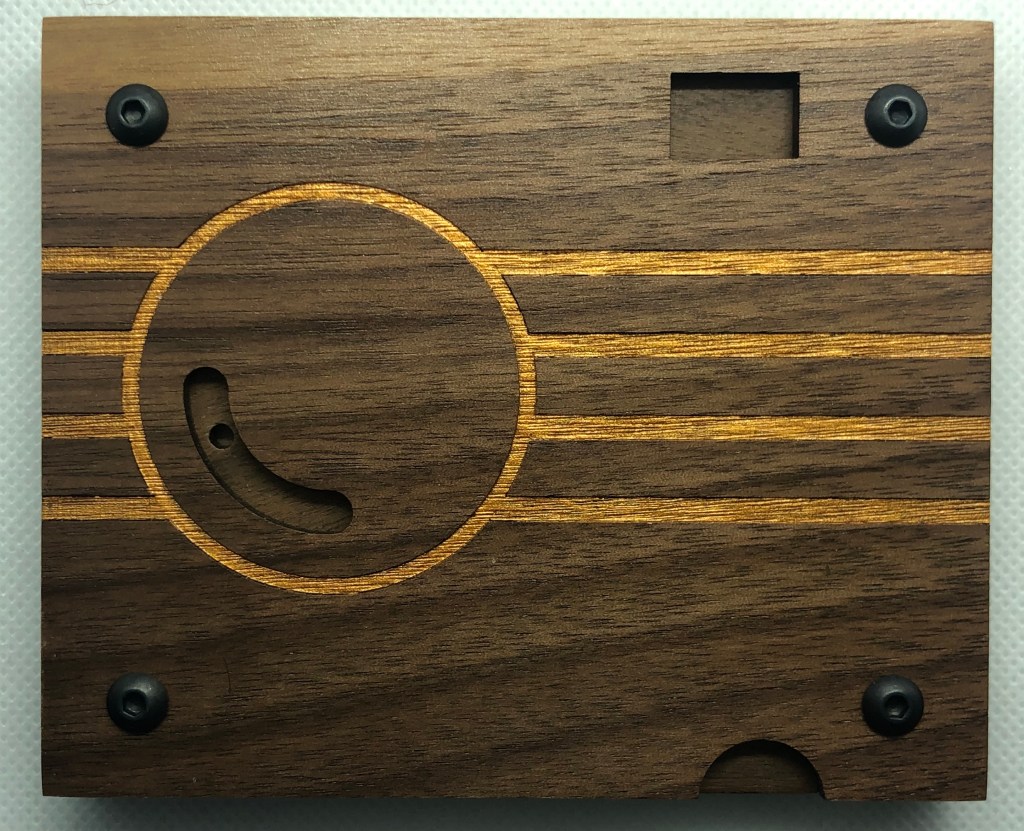
Ansel itself is a wooden rectangle with a relatively slight depth, its appearance a line-drawing take on a classic camera (and we can now understand its name). The puzzle’s goal is extremely unique: the camera’s view-finder is stuck and we need to open it. This makes classifying it a bit tricky: its thematic journey has the feel of an SD take-apart but really the goal is the most puzzle-y of puzzle goals: move this bit of wood here to just a little bit over there! (A Puzzler can most definitely appreciate the joy of figuring out how to move a piece of wood a couple inches and doing so here is extremely satisfying)

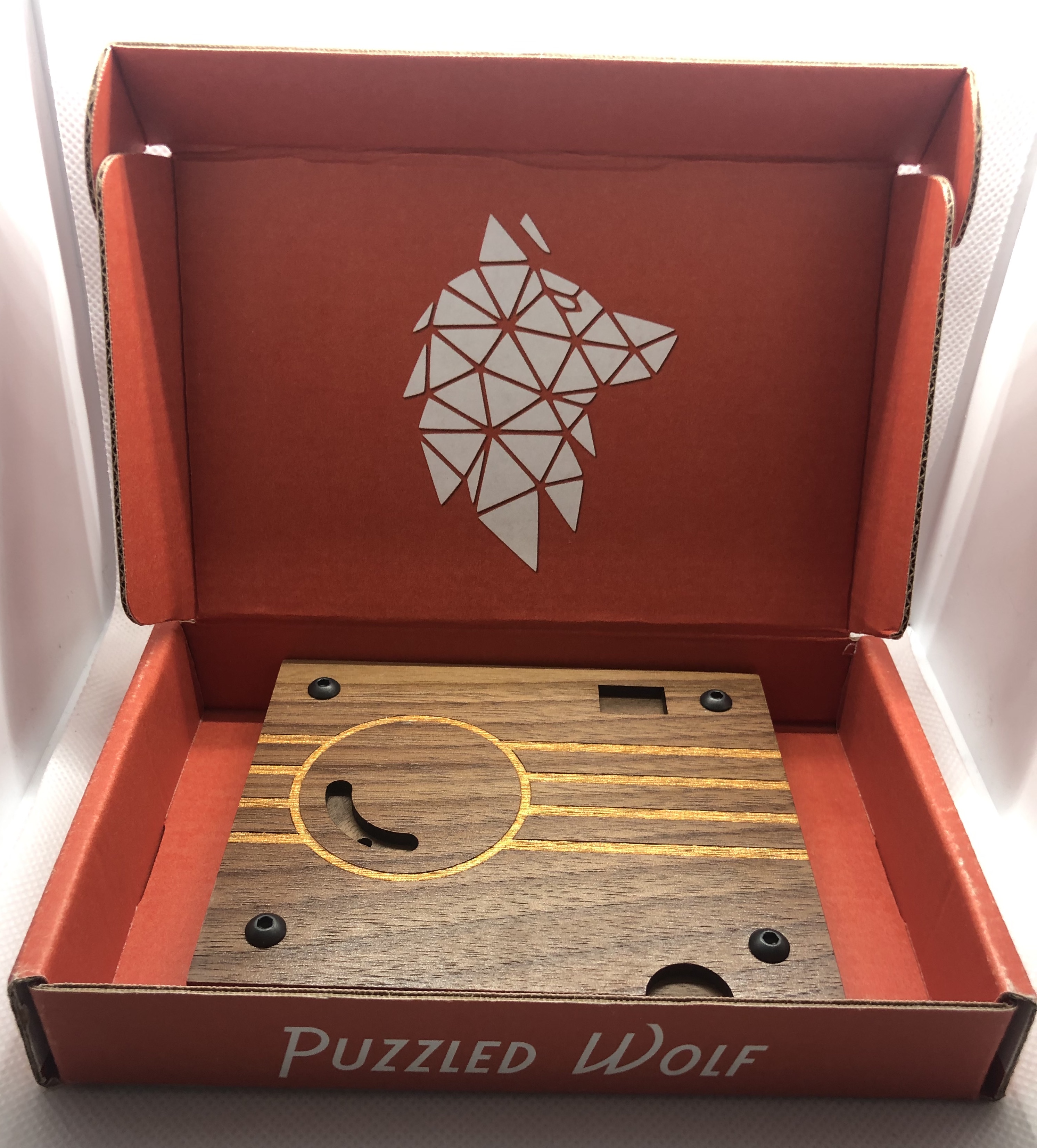
I would be remiss if I did not reflect momentarily upon the puzzle’s presentation: PW pulled out all the stops, branded by an eye-catching color and distinct wolf mark adorning a custom box intentionally made with Ansel in mind.

Pretty much everyone I’ve heard speak of Ansel got stuck right off the bat, taking some time to find what is one of my favorite first steps in a while: I thought it was one thing or another and it turned out to be a totally different thing and even though I generally like being able to make a little bit of progress before getting stuck, the sneakiness of it makes me smile. The early struggle satisfyingly resolved, one can move on to a bit of study: patient observation mixed with trial and error as you work your way through the puzzle, which still has some surprises up its lens.

Resetting Ansel is relatively straightforward (following the obligatory photo of a pet or puzzle through its now-open viewfinder). I found myself fidgeting with it after solving it and have picked it up several times since to enjoy one moment in particular.

Ansel is quite original, very well-made, and offers really good puzzling at a great price point. It’s thematic and has an aesthetic that is readily recognizable as a puzzle while also being totally different from pretty much anything I’ve seen before. I look forward to PuzzledWolf’s (hopefully relatively imminent) follow-up to Ansel – a Washing Machine puzzle currently in development, which seems to maintain some aesthetic consistency with Ansel while also appearing totally unique, which is itself pretty cool (perhaps to be called the Alva after none other than Alva Fisher, the man sometimes considered to be the inventor of the electric washing machine, apparently unjustly but it sounds cool as a name and is quite wonderfully alliterative….. and yes, I had to look that up).


Originality and Presentation: Five Sinatras
Difficulty: Four Sinatras

Midcentury American Photography Signification: One Adams


Deez (boxes are) Nuts

Space Case

Dee Dixon, Canarywood and Bloodwood, 5.5″ x 4.25″ x 2.25″

Dee Dixon burst onto the puzzle scene in 2019, and his 4th box, Space Case, is set to be released on CubicDissection in August. He made a huge splash with Where’s My Hammer? (WMH), a great puzzle box that has been pretty much loved by everyone who has gotten their hands on one, and proved he was no one-hit-wonder with his follow-up box, Blinded II.

I am fortunate enough to have an early (Etsy) copy of both WMH and Blinded, the woods or designs of which are a bit different from what was ultimately released on CD (WMH in particular had a few more rectangular bits of exotic wood on top and were made out of different woods for a unique, semi-custom appearance). Fortunately, their amply attractive aesthetics could well accommodate the slight concessions made for the sake of getting them into the hands of more puzzlers.

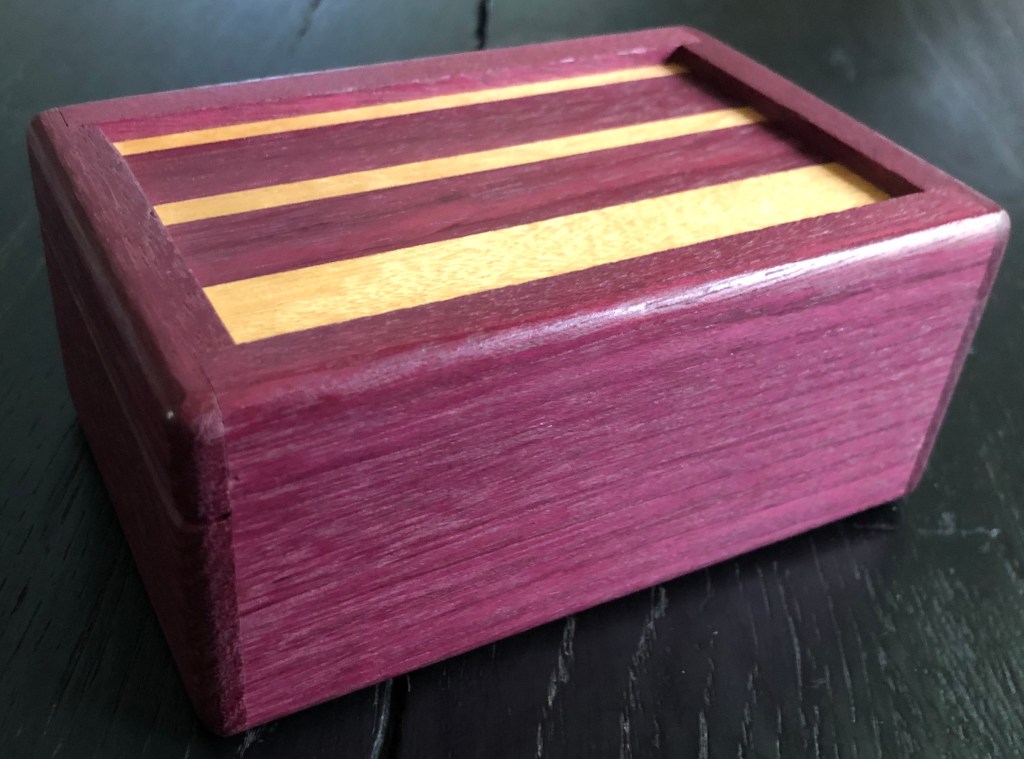
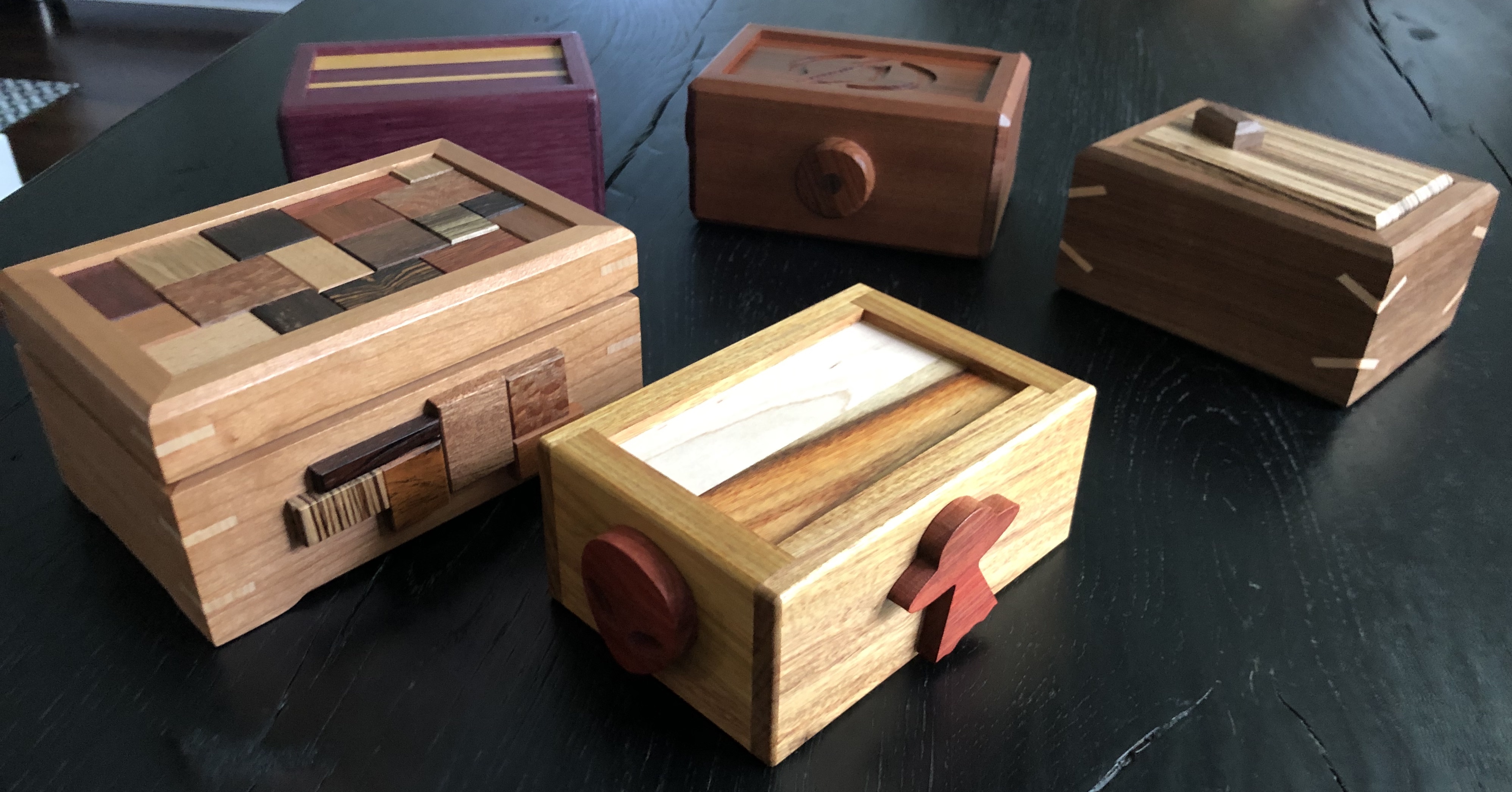
Dee’s first box, Slideways, was made in 2019 – there are not many established makers who can come out with four solid puzzle box designs in less than two years. With this kind of prolificity, it makes sense that he was able to start working on puzzles full-time, much to our collective benefit. There were only 8 copies of Slideways released (one of which sits happily among its siblings on my shelf) – it is a beautiful box, purple with some asymmetric strips of yellow wood (canarywood, maybe?) on top. While the simplest of his designs (just 2 or 3 steps), the concept is well-executed and shows Dee’s nascent puzzle-designing chops.

WMH is an especially excellent puzzle: it has plenty of misdirection, tools, and a tempo that I love to find in a box, with some relatively quick success at first, followed by fits and starts until you have found everything there is to find at which point you must actually think before you can hope to solve! The last step took me a few weeks of letting my subconscious work on it before I awoke one morning and somehow just knew the solution (admittedly following some conversations about it that had helped me eliminate some wrong moves) – I went upstairs, grabbed it, and bam! it worked! Super satisfying and very fun to re-solve. All in all one of my favorite puzzles boxes (although it does have one middle step that uses a mechanism I don’t love and may cause some puzzlers to need a nudge to find).

Blinded II is another excellent and attractive box and shares some similarities with WMH: there are misdirections that left me spinning my wheels for longer than I’d care to admit. With the first two or three steps finally found, it was not too much longer until I worked out the last half of the solution.

However, this is (supposed to be) about his newest release, Space Case, a canarywood box with a bloodwood figure on three of its sides: an alien head, a rocket, and a flying saucer with a tractor beam. Some of these figures will move off the bat; I don’t think I am giving anything away by saying that some will spin freely….. at first (in fact, this is the state in which I believe you can know it is fully reset).

I managed to get an early copy prior to its upcoming release – it is a 10-12 step puzzle box that requires close and careful observation to solve. You will need to develop an understanding of what is happening inside before you will have much hope of opening it.

Trial and error will help at first – if you’re not paying attention you may start to think that this is a blind solve but there is plenty of feedback inside and outside the box to let you know when things are happening. It quickly becomes apparent that manically shaking the box isn’t going to get it open. Instead, with some patience and focus, you will begin to get a picture of what is happening, helping you to build up a mental blueprint of each successive step until you can finally get it open.

Once open you will be rewarded with some clarity and it may yet take several resets to fully grok how it all works. This only adds to the fun as you can continue to work on the puzzle even after opening it – the full solution means making sure that each step is understood in detail, allowing you to open it quickly thereafter. Space is quite different from his previous boxes and highlights Dee’s ability to approach a puzzle box in different ways – while it is different in its mechanisms, it still features the practical attention to detail that makes his puzzles work reliably. As with all his designs, it has a wonderful aesthetic, using contrasting woods to create an excellent look. It also adds a bit of whimsy and fun to your collection that looks great on display.

I should add that I have the pleasure of possessing a copy of a metal prototype of Space Case (I pun – it has the Metallica “M” etched into its wonderfully dark wood). As it remains unsolved, I am not yet certain as to how it differs from the final version – I am not sure of whatever steps diverge from its improved offspring, but as a completist I’m grateful to have lucked out to get it from a fellow puzzler.

I look forward to whatever Dee comes up with next – we are fortunate that the appetite we puzzlers share has allowed him to eschew his workaday life to focus on what is really important: giving me more puzzles (us, I meant us: giving US more puzzles).


Space Case Difficulty Grade: Four Sinatras

Complete Oeuvre Grade: Five Sinatras
Locked Out: Lock Box by Eric Fuller

Lock Box

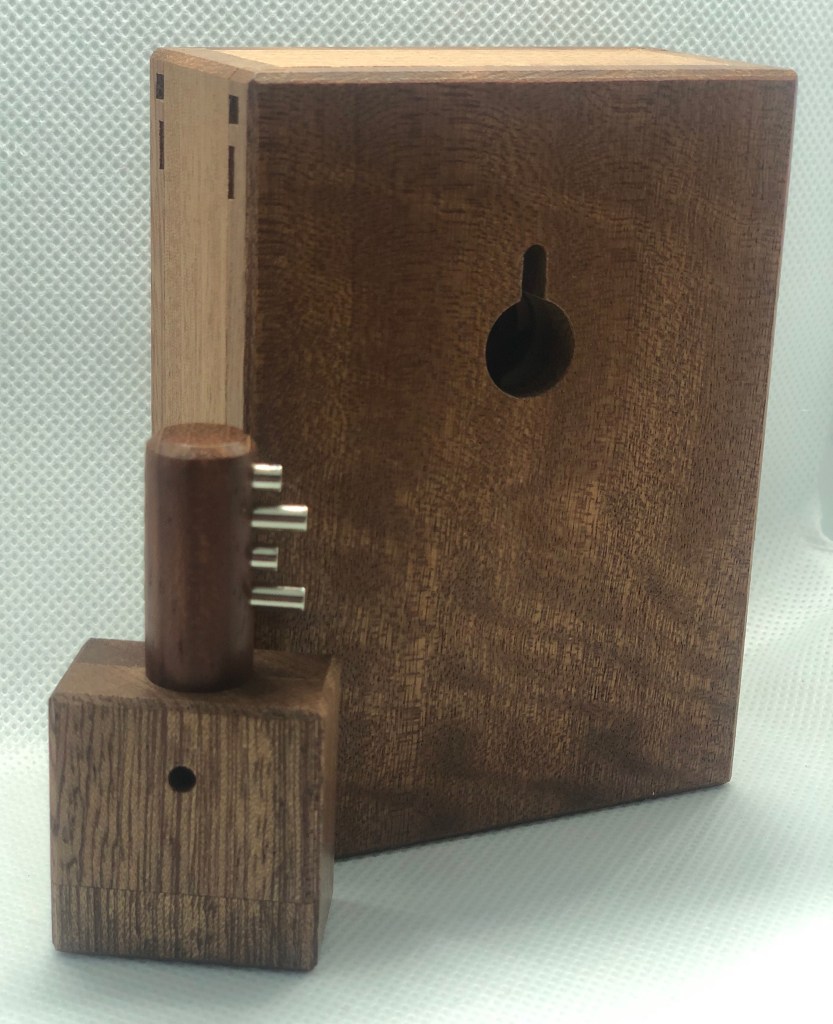
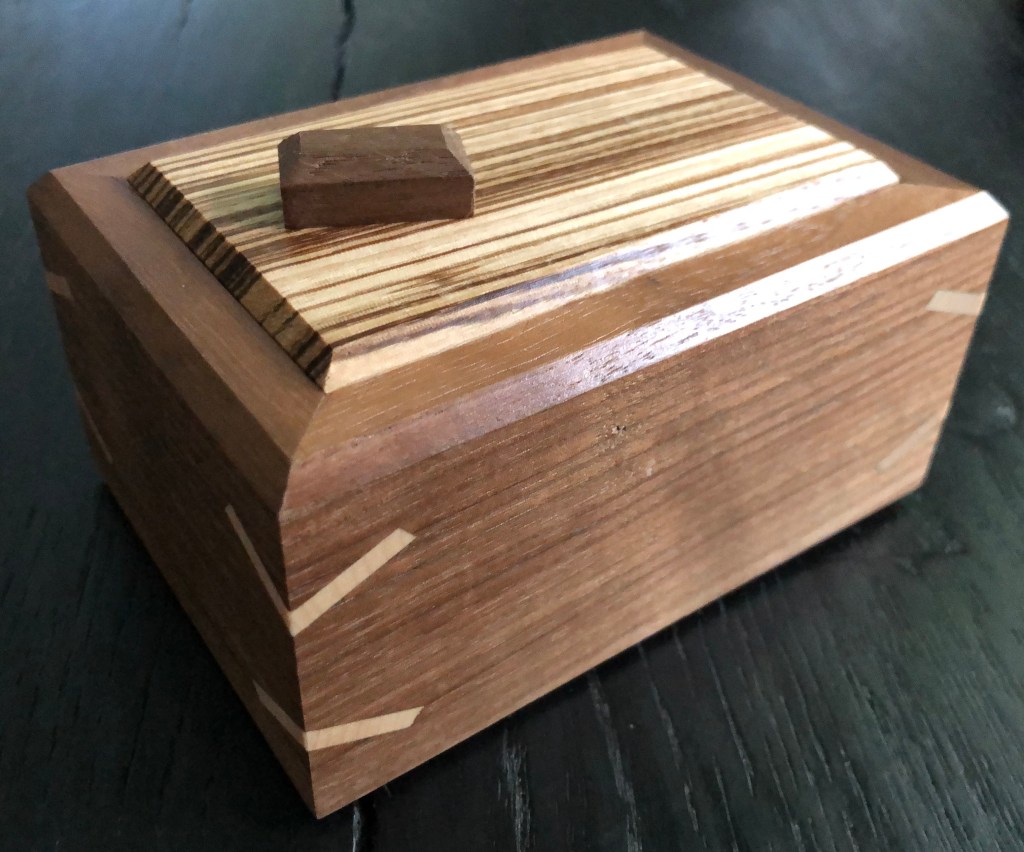
Eric Fuller, Figured Quartersawn Sapele 3″ x 4″ x 1.45″ Box, 2.45″ x 1.25″ x 0.75″ Key 133 Copies

I have a tendency to write about puzzles that may not be easy to obtain – I enjoy reading about such pieces, that I might live vicariously through the vague reminiscences of puzzlers more fortunate than I, adding to my ever-expanding list of unicorns and future lost auctions.

This is also due to the simple fact that great puzzles sell quickly. In a bout of good fortune, Eric Fuller’s Lock Box will again be available in limited quantities on CubicDissection.com in late July (2020). Personally, I need only hear Eric Fuller + Puzzle Box to anxiously wait to give him my money, but if you are unsure, my suggestion is: buy it. If you cannot afford it (at $450 it ain’t cheap), sell some other puzzles and then buy it. In the unlikely event you do not like it, there will be plenty of people happy to take it off your hands; I believe it is destined to be yet another unicorn with auction prices that get bonkers fast.

At first glance, we have a key and a box with a keyhole; so far we have more to go on than the T12 initially shows. Unsurprisingly, after dutifully inserting the key (because you’ve got to try, right?), you will find it will not get you very far. And that’s it.

Before too long, I had my first aha. Followed by a few more. Followed by a wall. And more wall. Then another aha. More wall. Aha. Wall. Wall. Think, plan, take notes. Wall. Aha? Hm, no: Wall……… and here I am: a pretty good understanding of the wall I am facing, with no idea how to get past it. I have made good progress, with the end somewhere in sight and I can confidently say this will be very satisfying when that final aha has been found.

The puzzle has so many of the things I love in a box (some of which I will not say): things that look they should work that don’t; a bit of progress that may not come right away, but before too long; a series of stops and gos, extending the pleasure of solving across a spread of mini-solves; the ability to make progress during my first, focused session; the inability to fully solve it during that same session; the need for both trial and error as well as actual thinking; pretty, pretty wood; and while it has some similarities with other great puzzles, it is mostly very unique.

Everything works well and consistently, which is always nice (and is not always the case even with some excellent puzzles). And did I say that it is pretty? The instructions do warn that this will not stand up to humidity well – we are advised to keep it between 40% and 60% lest it be ruined (!), so some folks may be facing a dilemma (I’m looking at you my Hawaiian puzzling friends).

I expect that the final step (or steps) will be something quite different from what has worked thus far: this is something many of Eric’s puzzles feature; were it not the case, I probably would have found it (them?) already, after all. It took me a while to determine how to get to my current stopping point reliably and with full comprehension but this final wall may be staring me in the face for some time.

But man, this reminds me of why I love puzzle boxes.


Puzzle Oddity: Anti-Gravity Box by Frederic Boucher

Anti-Gravity Box

Frederic Boucher, 3D Packing Puzzle, 2.25″ x 2.25″ x 1.5″

A few months ago, I wrote to Frederic in the hopes that he might happen to have a few puzzles that were seemingly unavailable. Most were, but he did happen to have a last copy of Anti-Gravity Box, which I happily requested, along with a few other new puzzles that he had on hand.

March 2022 Update: CubicDissection will be releasing a new version of AGB (titled: “Anti-Gravity Box+”) in it’s upcoming March 21, 2022 release – not only will this feature the ever-awesome craftsmanship and woods CD is deservedly known for, but, according to Frederic: “This new version includes a 2nd set of pieces with a solution that includes a trick that I think has never been seen in any other design yet…” This presumably constitutes the + in CD’s AGB+. So get your clicky finger ready as I don’t expect that these will last long: (EF + FB)CD = Awesome Sauce!

I have solved several of Frederic’s puzzles in the past – 3D and 2D packing puzzles that offer a serious challenge, comparable to pieces by Osanori Yamamoto, Koichi Miura, and Volker Latussek, and featuring elements such as interlocking elements and restricted openings.

Anti-Gravity, however, adds new mechanics by introducing a number of magnets into the mix. This makes for a unique and novel puzzling experience; it is no longer “just” about finding a way to get the pieces into their frame, as the magnets throw one’s general approach out the window.

The box is a 3×2 voxel frame that features a removable, acrylic top, allowing you to easily reset the puzzle and view your progress. The box has two, single voxel openings at 90 degrees to one another; both are in the middle of the bottom level, allowing you to enter each axis, but offering no room for angles of any kind. You must fill it with 6 identical rectangular 3×1 blocks; 2 have two magnets on one side, 3 have magnets on one end, and one block has none.

There are rules, of course: you need to place it on a flat surface and you are not meant to pick it up or tilt it (of course, you may hold it while you insert other pieces); you cannot poke your finger into either of the openings to push the pieces; it goes without saying that you cannot just lift off the top and place them in. The removable top is a kind addition, as it avoids the need to struggle to remove pieces when you have eventually found you had made a mistake. The puzzle arrived with the pieces stacked neatly inside. It is kind of cool to have a puzzle so confident in its structure, that it can come fully solved without having spoiled anything.

While by no means simple, neither is it an overly difficult puzzle – in my experience, one of his other packing puzzles was more challenge than I could meet (I am admittedly not so great at packing or interlocking puzzles generally – my interest far exceeds my ability when it comes to these types of puzzles).

More importantly, this is a very fun puzzle, and one with which trial and error will not get you very far; knowing the pieces you can eventually figure your way through it.. After spending a few minutes playing with it, experimenting to get to know the pieces and what they can and can’t easily do, I had to stop and think. This led to the first big aha moment of a series of such moments, leading to the full solution. Each step is its own planned approach, each piece requires forethought once a workable order has been determined. Apparently, this has two approaches that lead to similar solutions; I have found one and will undoubtedly spend some more time to find the second.

TL;DR: Anti-Gravity Box by Frederic Boucher is an original approach to a 3D packing puzzle, with magnetic pieces needing to be stacked using entries that allow for little margin of error. While not Boucher’s hardest puzzle, each move must be planned and purposeful through thoughtful approach and not just trial and error. It features a convenient removable top to reset after you inevitably make a mistake, and is so confident in its own puzzling, that it can arrive solved without lessening its challenge.


Originality / Fun Grade: 4 and a Half Sinatras

Difficulty Grade: 3 and a Half Sinatras

Instructions Included

Dr. PinkLady, or How I Learned to Stop Fidgeting and Solve the Burr

Fidget Burr (a/k/a Dollar Burr, a/k/a Chin Burr)

Jerry McFarland, 3.28″ x 3.28″ x 2.92″

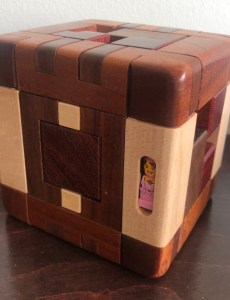
Recently, I was lucky enough to get a copy of Jerry McFarland’s Fidget Burr (not to be confused with the puzzle of the same name designed by Tim Alkema and recently produced by Eric. Fuller of CubicDissection). It has quickly become one of my all-time favorite puzzles, with an extremely original design replete with fun and challenging nuances.

First off, the puzzle is beautiful, consisting of 23 wood pieces crafted from walnut, maple, mahogany, and bloodwood (with the keypiece possibly made in a different exotic wood, such as Bubinga, Santos Rosewood or Cocobolo), for a interestingly contrasting aesthetic. It feels soft, presumably waxed into a delightful sheen that allows the puzzle to stand out, adding to the temptation to play and fidget beyond one’s attempts at finding the solution.

But what really makes it stand out is the addition of 22 magnets integrated into the puzzle, adding layers of novelty, difficulty, and stability that makes it stand out from its (still excellent) burr cube brethren. And last but not least, a Lego minifig can be seen, trapped within a window on one piece of the puzzle’s frame, lending the puzzle a hint of puzzle box / take-apart puzzling.


NOTE: The following paragraph reveals details of the puzzle’s first move – I feel comfortable writing about it as this has been blogged about before and is not really a hidden feature of the puzzle, but for those purists out there who want to know absolutely nothing about a puzzle, I thought I would give you fair warning – it has been formatted to make it easy enough to skip:

iIt is readily apparent which piece offers the first move (being the only piece that can move) and, when you press it, you are rewarded with a chain of clacking, automatic movements as 4 pieces are released, magnets forcing them out. This chain will most certainly be repeated again and again, both in the search of its solution, as well as the sheer entertainment value.


Following this first step, I immediately hit a wall. Fortunately, this first step is more than fun enough to play with absent any further progress. However, after numerous attempts at exploring possibilities through trial and error, I explored that other method of puzzle solving: thought. With this, I was able to narrow down the possible next steps, more quickly finding my way past this wall. Soon, it is possible to remove some pieces of the puzzle.

However, this is not the end as one must deal with some (possibly less difficult, but still non-trivial) additional steps, revealing the reason for at least one of the puzzle’s aliases. As you continue through the puzzle, you find a number of added details, magnets, chamfers, clips, and pins that really show off Jerry’s expertise, as they allow for a more consistent and stable puzzling experience (these are detailed in the included instructions in a series of notes, which would be spoilers if shared). One such detail does double duty, causing me several minutes of confusion as I lost all momentum just as I thought I was about to free my Pink Lady. Moving past this, the lovely lady can be freed (and even her window frame reveals evidence of Jerry’s thoughtful and precise approach to puzzle-making, as it is designed in such a way as to make her intended orientation obvious when looking to cruelly force her back into her wooden prison).

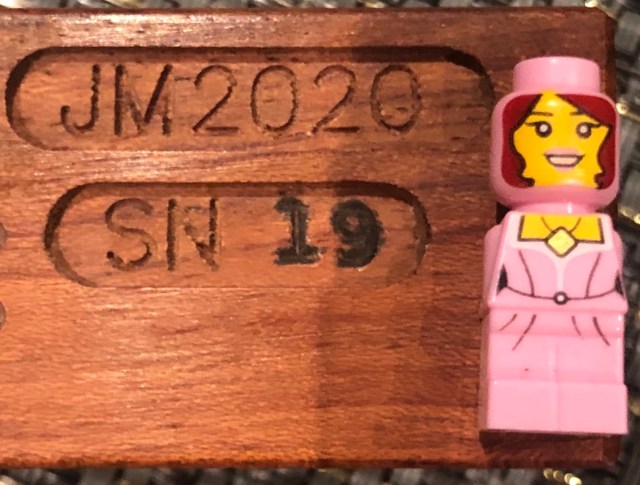
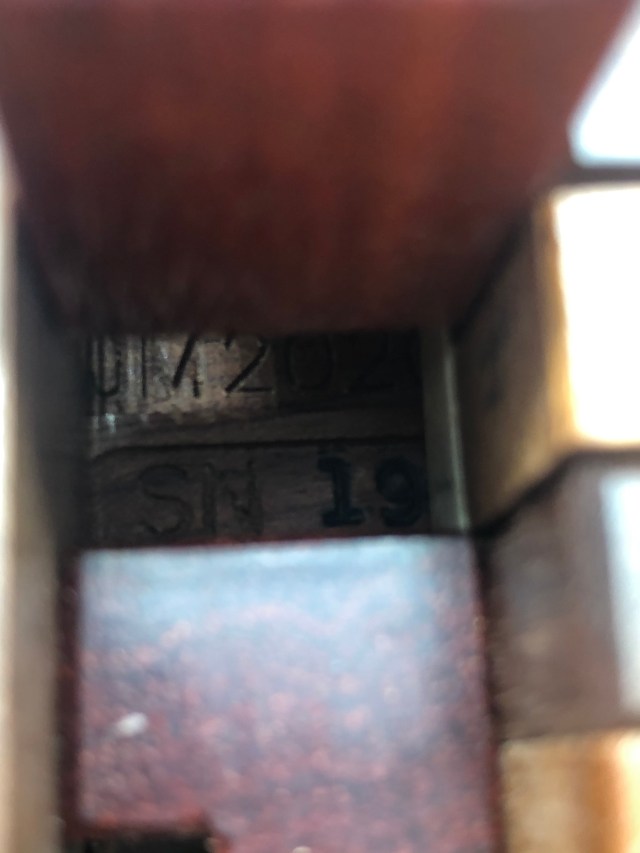
The key piece has the puzzle’s “signature,” the maker’s initials, year of creation, and serial number etched into perfectly matched frames (as seen above).

Note that this picture is also no spoiler, as Jerry designed the puzzle such that one can view the signature without having solved the puzzle – yet another unique detail that demands appreciation.

Reassembly is not overly difficult: Jerry has thoughtfully marked some of the pieces to aid with the proper orientation, allowing you to reassemble the puzzle with pleasure rather than frustration. Burrtools is unnecessary, good considering my strong suspicion that it would not provide much (or perhaps any) assistance.

As mentioned, the puzzle comes with instructions and notes: 5 pages that includes solution descriptions assembly instructions with pictures and illustrations, as well as the aforementioned notes and a general explanation of the puzzle (the latter being graciously printed on the first page to avoid any accidental and unwanted spoilers).

Fidget Burr will be entered in the 2020 IPP40 Design competition, where I would be surprised if it did not earn some significant recognition. While 2020 seems it will be a banner year for puzzling, Fidget Burr will no doubt be amongst its top designs; it is certainly amongst my puzzle favorites overall (assuming my judgment is at all reliable), not least considering its atypical replay value.


Awesome Sauce Grade: Five Sinatras

Let’s See What’s Behind Door #8!

Dark Fairy Door

Tracy Clemons

After cyberstalking Tracy Clemons for some time, in late 2019 I saw she had something available. As the cost was several times the cost of my next most expensive puzzle (until Secretum Cista comes, at least), l consulted my horrible, horrible wife, seeking convincing that not getting it was the right thing to do, and she, in all her horribleness, told me that I should get it because it would make me happy (such nerve!).

There are 8 copies of Dark Fairy Door (DFD), each with distinct aesthetics hiding the same mechanisms and additional puzzles within. From the pics one could see that there were two doors, on the top and bottom of the box, which, we were told, contained a pentominoes set, a second puzzle box, and a fairy treasure (different for each box). They were 10″ x 11″ x 5″, and would require a few dozen (!) moves involving about 60 pieces (22 of which constitute the pentomino set) to travel through to the end.

My DFD

As with any box from Tracy, these did not last long – I was fortunate that one of my 2 favorite designs was still available, although I would happily have taken any of the 8. So I sent the PayPal, and within a few days a large box was at my house.

I picked up said box and… dang! That thing is heavy, coming in at close to 7 lbs. Really I should say the puzzles, as we have the external doors, the pentomino set, and the final puzzle box (whose secrets shall yet remain a mystery, except to say that opening it is only one part of solving it).

More importantly, pictures are hard to really show the attractiveness of such a large, well-made wooden box. The contrast of its many woods and the whimsical, detailed designs featured on all 4 sides make for a very pretty piece of art. It was even permitted to remain downstairs, where non-puzzling people might see it (!), much to the chagrin of its tinier cousins upstairs.

I set about working on my new favorite thing and made some headway, discovering a couple tools (presumably), some moving thingies, some unmoving but potentially moving thingies, and the sounds of unseen moving thingies. However, I could not connect most of these thing(ie)s to one another, and certainly no door would open.

Fast forward several days and still not much progress. Clearly the puzzle was broken……. no? It’s not broken? Hm. Fine.

……after another couple weeks, I chatted with Tracy to get some direction. I had done a lot, but there was (at least) one thing I simply could not figure out. I knew what I needed to do, but not how to do it! Tracy benevolently (and with more than a little amusement at my bewildered state) led me to a place where I could get the first step, which turned out to be the first of a series of steps that would finally allow me do that thing I knew I needed to do.

There were certainly bumps and blocks between that moment and the final discovery of my treasure, but I had spent so much time exploring the box that it was mostly a matter of figuring out how everything worked together.

The pentomino set is beautiful: lovely, silky smooth pieces (probably 1/2″ – 3/4″), waiting somewhere inside; even more beautiful is the second puzzle box, which really isn’t a full description as it involves more than “merely” opening a puzzle box, although there is that too, of course. I left this displayed for a few days before setting about resetting the box.

A few days later, I was able to fully reset, re-solve, and re-reset everything in one sitting. It was then that I was really able to truly appreciate how beautifully the steps cascaded from start to finish, all the disparate pieces and movements coming together into a cohesive and flowing whole. All in all, there is a sum of parts that creates a puzzling experience that feels like more than “just” solving a puzzle – and I think that is the idea….. you are, after all, finding your way through a dark fairy door… and Lil’ Ms Fairy Pants will not be what’s waiting for you on the other side…

Deck of Cards for Scale

Grade: Four and a Half Sinatras