Push It Real Good: Salt & Pepper

Salt & Pepper

Designed by Robert & Norman Sandfield and Perry McDaniel
Originally Produced in Wood by Perry McDaniel
Produced in Metal by Tartarus Puzzles

When I first heard rumblings of a possible Salt & Pepper remake, I was thrilled. These go back to the 2002 IPP, when Robert and Norman Sandfield each presented one of them as their exchange gift. I don’t want to spoil anything, but they represented a new kind of trick for exchange recipients getting them separately (they made sure everyone who got one, got the other) – I suppose it’s obvious now to those buying these as a set but it makes for a great story. Reading some of the old IPP stories helped hook me into puzzling ever further, so google at your own risk.

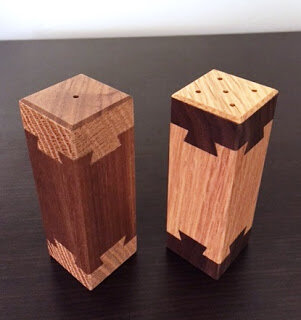
Originally produced in oak and walnut by Perry McDaniel and designed by the three of them, these are undoubtedly one of the best dovetail puzzles released by the team behind a number of them. Perry’s work is unquestionably badass and I have been drooling over these for years now. Finally getting my hands on them is a joy – I feel like I have a piece of IPP history that would otherwise cost an arm and a leg.

Some time back there was forged a new puzzle partnership called Tartarus Puzzles. They first released a metal version of Free Me 5 and are now releasing Salt & Pepper (also in metal). First, they look absolutely wonderful. I love the colors they chose and the letter font is perfect. Producing puzzles like this in metal is no easy task – in Perry’s words: “when they told me it would be an all metal construction I knew they were nuts… the difficult tolerances and razor sharp dovetail edges [meant] they were asking for trouble.” But Tartarus persevered, creating a custom made dovetail cutter to produce edges that will not shred your fingers, while looking exquisite. They even improved upon a step or two along the way, giving them more longevity. Perry contributed a solution sheet (with pictures) that is easy and clear (I checked it after solving, of course… mostly).

And the puzzling? This a sequential discovery experience with one section in particular that is just really really cool – I am still not sure how they accomplished it but it is sort of the heart of the puzzle. There are also compartments to find. which contain a rather amusing surprise for the finale.

Starting out, I futzed around, quickly finding that nothing does anything obvious. I suspected I knew what needed to be done and it took some doing but I doggone did it… and I was off. After moving through the next few steps, I got to the section referred to above, which took me a heckuva long time to solve. Finally making it through, I had a few tools and a suspicion of what needed to happen based on my earlier explorations.

When I finally got the last bit open, I was rewarded with a clear indication that I had solved the puzzle, an indication that was laugh out loud funny, always a great way to end a good puzzling experience. The reset was mostly straightforward: that one really tricky section took some trial and error to solve backwards and may help you better understand how this part works (I am still not sure 🙂
And so, Tartarus brings us a fun piece of IPP history without the need for a Thunderdome auction! Salt & Pepper is available at the time of this writing – you can reach Tartarus by emailing them at: tartaruspuzzles@gmail.com


Puzzlin’ on the Prairie: Wagon Trail Lock by Dylan Christopherson

Wagon Trail Lock

Dylan Christopherson, Pioneer Puzzles, 74 copies

And to think I almost missed this one! As a debut puzzle, new releases may sometimes fly under the radar (at least at first). Puzzlers are understandably less inclined to spend puzzle money on a complete unknown… I suppose all puzzles are unknown to some extent, of course, particularly boxes and locks, whose mechanisms are generally hidden from casual view. Wagon Trail Lock garnered some steam pretty quickly as being something worth collecting and I managed to snag one of the 74 copies produced by Dylan Christopherson of Pioneer Puzzles.
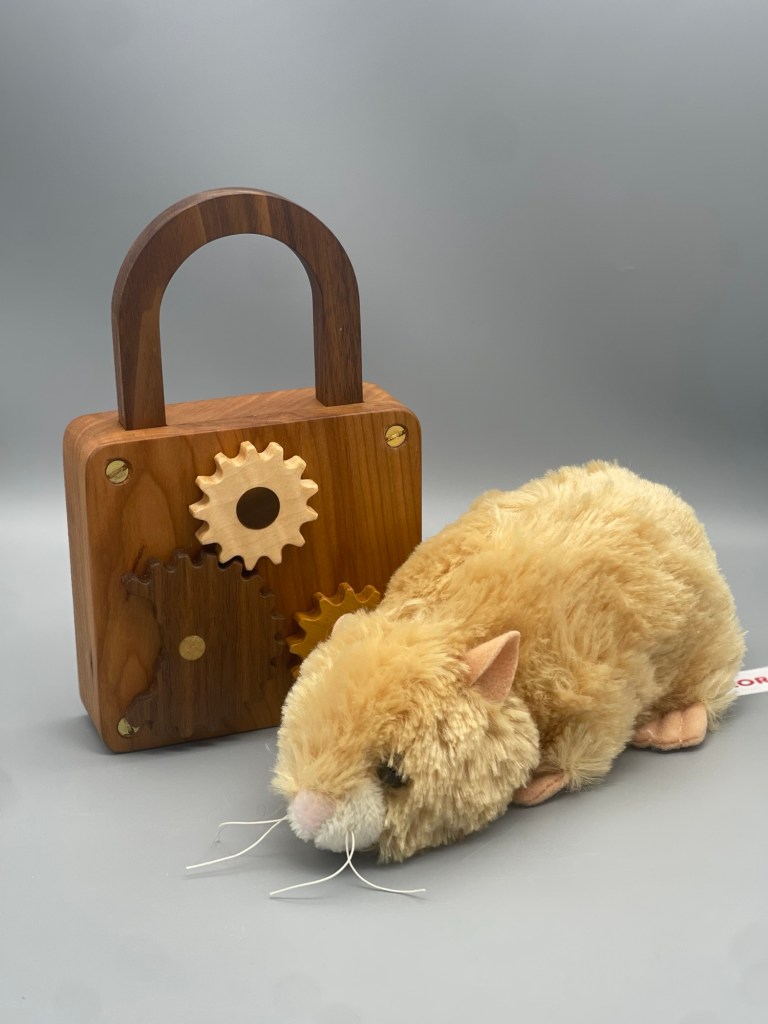
WT looks like an oversized wooden lock with three gears (well, two and a half) on its front, one with a large chunk bit off, the result of Little Johnny’s ill-fated attempt to open the lock (so we are told in WT’s narrative, a story of 19th century settlers who come across a mysterious chest you need to help open). Other than a small hole on the right side, there is nothing else to work with: one of the smaller gears spins freely while the other two are locked in place, separated from the spinning gear by a few mm gap.

The first step took me some time to discover but I had a good idea of how the puzzle might begin, which turned out to be (mostly) right (for once). This provided me with something to really work with, before hitting the first of several walls. Tricks are well hidden inside the wooden lock with its 3d printed mechanisms locked away from view. Well enough hidden that I needed a couple nudges along the way, as I smacked up against a couple walls.

WT has a lot more going on under the hood than I had initially suspected: the linear solve has a good rhythm, as I kept experimenting with what else might be possible, a surprising number of possibilities arising as the solve progressed. The solution relies on discrete steps, allowing you to clearly know when progress has been made, somehow avoiding blind tricks even when so much is hidden. It is a good example of how sequential discovery puzzles guide you along a journey through its various stages, various tools provided as you progress, steps and sections leading you along to the next.

SD puzzles are in high demand but not all sd puzzles are created equally – WT has got several great aha! moments as you work through it, eventually unlocking the shackle, giving Little Johnny and his family access to whatever treasures it locked away. For us, the pleasure is in the journey not the destination – but its ok, Johnny is young, he will learn.


Packing It In 5: A Good Day to Pack Hard

First, we had to 
Pack Hard.
Later, it was time to
Pack Harder.
The Puzzles resisted and we had to
Pack Hard with a Vengeance.
It still wasn’t enough and we asked ourselves if we should
Live Free or Park Hard
Finally, it’s a Good Day to Pack Hard

John McClane

Coin Wallet, Perfect Entrance, 3L x 2

Designed by Koichi Miura, Produced by Mine

Packing puzzles, as a genre, can be quite diverse. All the great artisans have produced great examples of this fact: Stephan Baumegger, Yavuz Demirhan, Tom Lensch, WoodWonders, PelikanPuzzleMaster has 173 tray and 3D packers right now and NothingYetDesigns is an excellent curator of both 2D and 3D packers. RobsPuzzlePage is still loading all of its numerous examples 🙂

There are a number of designers whose names have been or should be written on these pages – I think even Osanori Yamamoto may have somehow managed to completely evade me thus far (except for a great(?) moment in my parody of Baby Got Back). Another that seems to have escaped my serious gaze thus far is Koichi Miura. Most of my puzzles by him have been beautifully produced by Mineyuki Uyematsu (MINE) and an excellent trio of puzzles recently added to my collection serve as great examples.

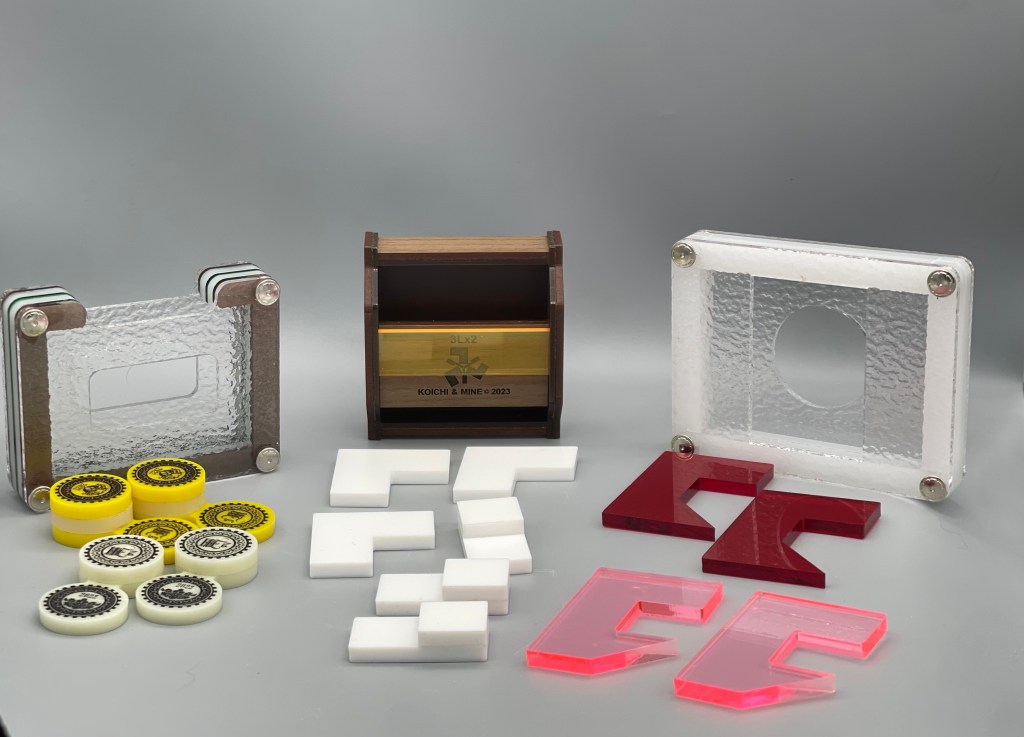
Coin Wallet, 3L x 2, and Perfect Entrance

Coin Wallet

Coin Wallet is a restricted entry 3D packer that consists of 5 multi-coin pieces and a “wallet” in which to place them with a restricted opening at the top. MINE has done an excellent job of producing the coins, apparently not such an easy job to do: there are three layers of “coins” inside and the yellow pieces are 3 and 1 vs. the white’s 2 and 1. Placing any three coins inside is trivial but that fourth one….. it seems like it should be easy but, as with many a good packing puzzle, it just isn’t.

After a good amount of trial and error, getting to know the pieces and what allows what, I began to get a sense of how these would fit together and what needs to happen to allow them to do it. Still, the temptation to try and force the pieces kept rearing its ugly head until I stepped back and really thought about how this will work. That’s a big part of a good packing design imo – logic and reason will ultimately win out over trial and error, getting you over the finish line after t&e gets you past almost all the hurdles.

There is something so satisfying about finding how that last piece goes in, ultimately smoothly and without any trouble or resistance, once it is done correctly, that is.

Perfect Entrance

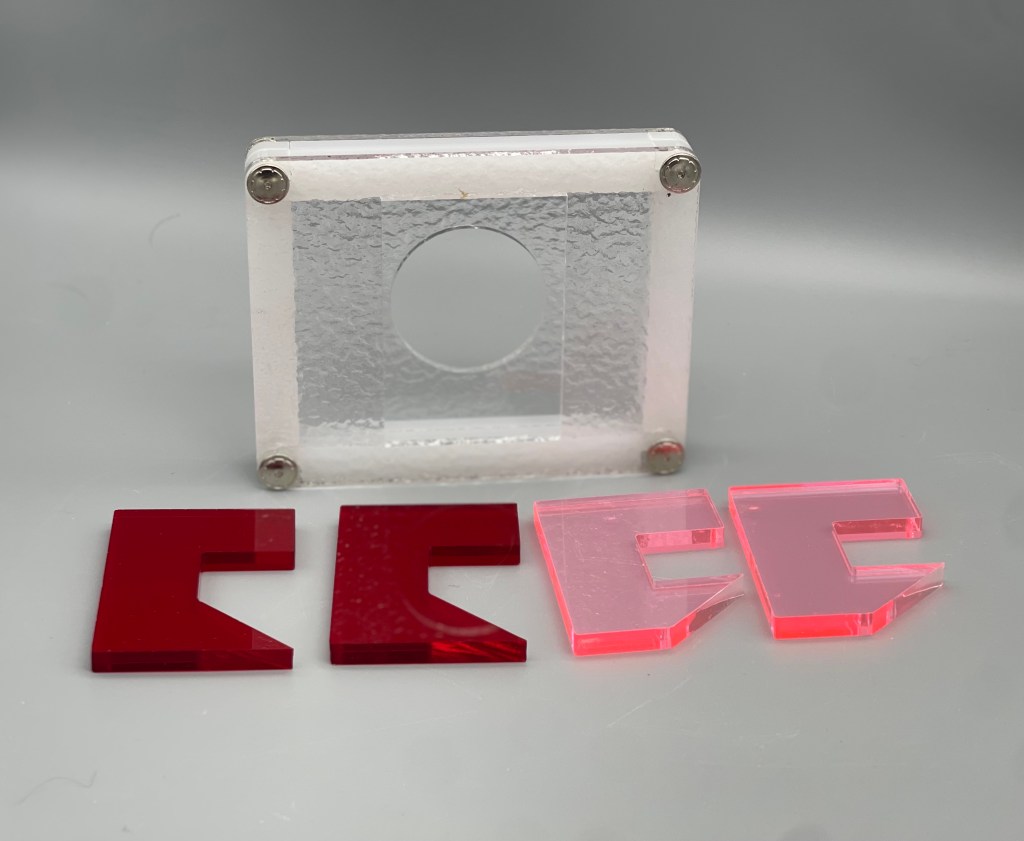
Perfect Entrance’s has two sets of identical pieces with a frame that will allow any single piece easy access in its front entry. A finger hole in the back helps with removing the pieces, which you will likely do many times before successfully solving it. Again, getting three of the four pieces is simple but that fourth one…

I had originally solved this one at IPP41, where it had been entered into the puzzle competition. It was in the top-10 for the Puzzlers’ Award, earning universal praise as far as I could tell. Fortunately, my terrible memory meant that re-solving it was a non-trivial exercise when my own copy arrived a few weeks later.

Although it might seem that PE could perhaps be solved just through trial and error (there are only so many permutations that are possible), there is more going on than just order. Any anyway, that is both time-consuming and not all that fun – rather, stepping back after some experimentation it is possible to see how the second layer of pieces might be permitted entry. With an aha!, I saw how it must work and lo and behold that last piece was no problem at all; everything fits perfectly when you know what needs to be done. So very satisfying to feel that aha! become reality.

3L x 2

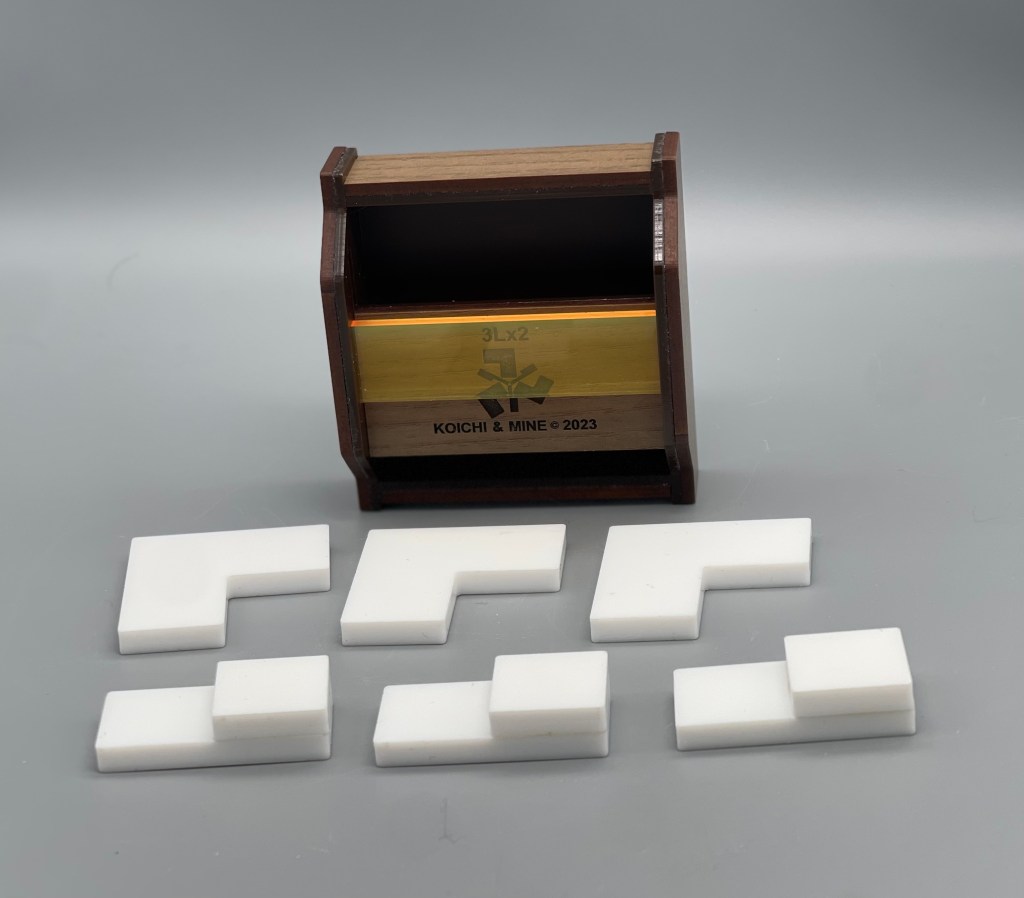
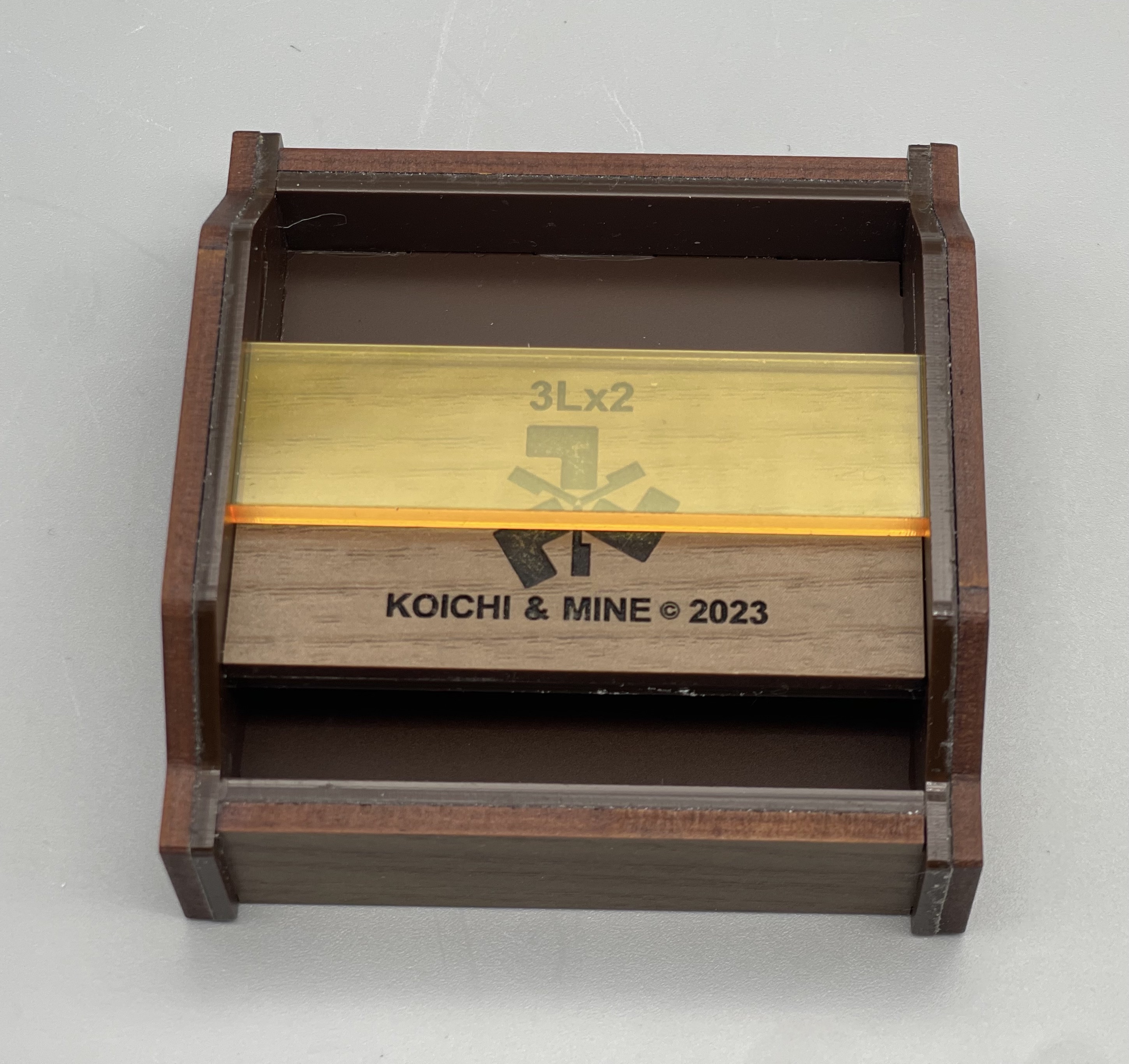
3L x 2 is another Miura/MINE puzzle, this time featuring two sets of three identical pieces that must fill a frame with a restricted entry – what really sets this apart is the moving panel that allows alternating entry into either side (but not both at the same time). This one took me much longer to solve; perhaps it was the extra pieces or the moving piece that slowed me down. Regardless, I would struggle with this one for quite a while, trying and failing a number of ideas after the experimentation phase ended.

I love packing puzzles with dynamic elements (see my still unsolved Everyday Holiday puzzles by Yavuz Demirhan) and 3L x 2’s sliding entry adds some intrigue to the puzzle, making for something particularly tricky. I spent a LOT of time on this one – there are a good number of possible builds but it becomes readily apparent that many of them will simply not be possible.

Dynamic Restricted Entry

Once I had a good sense of what would and wouldn’t work, I spent a long time trying different builds outside of the frame, attempting it inside when it seemed like I had a lead. Eventually one last aha! hit and I was able to get that last piece in! Huzzah!


Packing Puzzles are a great example of how something that seems so simple can pose a particularly problematic puzzling experience. Stay tuned as there might just be a day when we need to Pack Hardest (or something).


Apuzzle 13: Houston we had a problem here by Brian Young

Houston we had a problem here

Brian Young, 6″ x 3.25″ x 2.25″

Having (finally) made it to my first IPP this summer (after several years of hoping and waiting, I was overwhelmed by the wealth and general awesomeness of the puzzles showcased (as well as the puzzlers present). On the day of the party itself, I heard tell of a new Brian Young puzzle, possibly his last considering his announced retirement, and zipped on over, snagging one of the last copies of “Houston we had a problem here” from the legend himself (a welcoming and hilarious man).

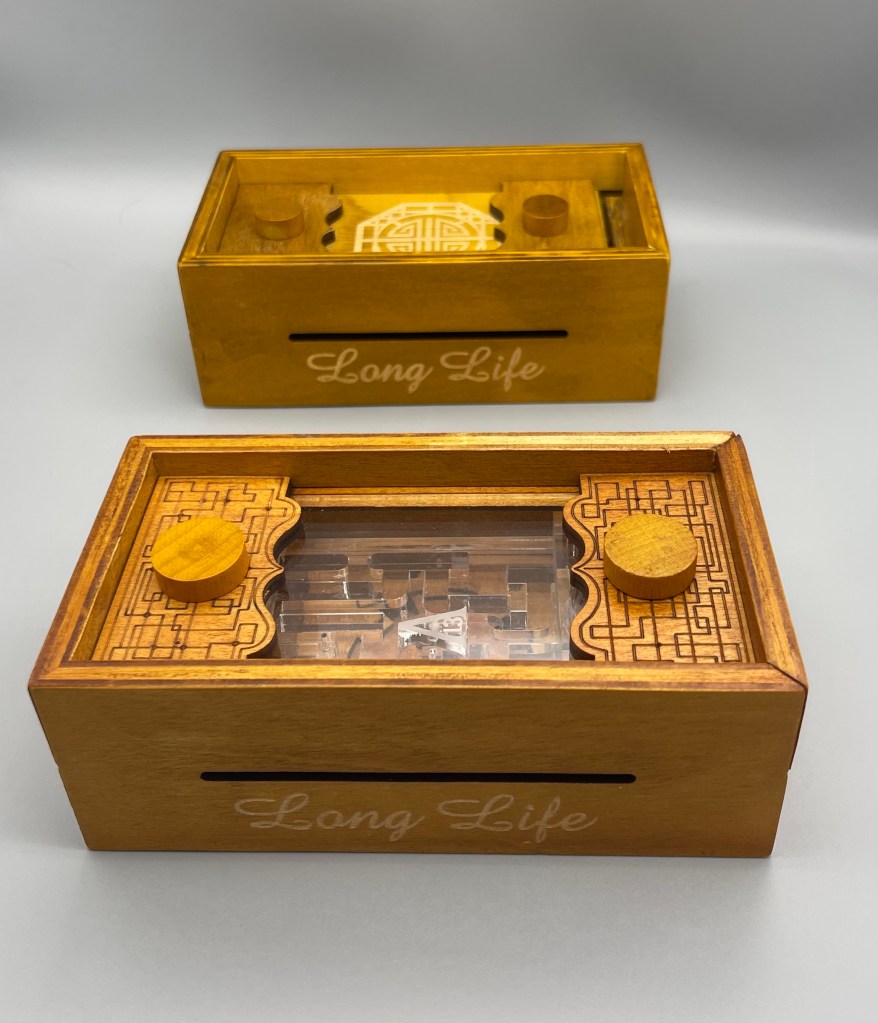
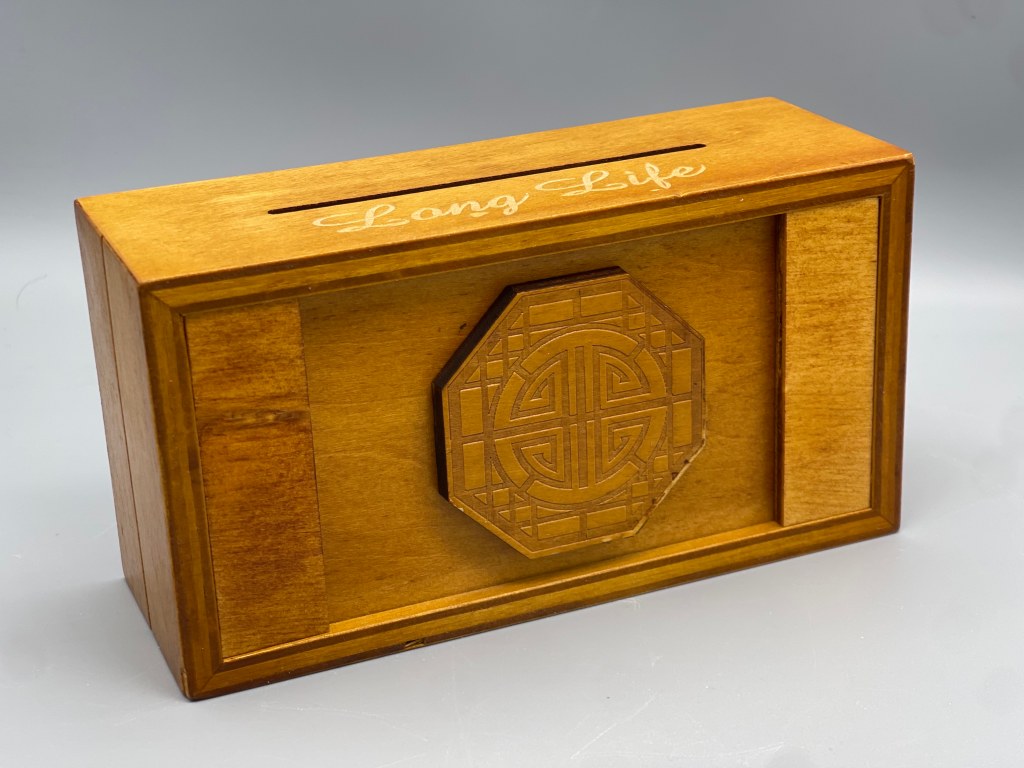
Houston is a very cool concept – Brian took the rather cheap, not so great “Long Life” puzzle box mass produced in China (I believe) by MiToys and modded it, turning it into an SD puzzle box! Yay! Needless to say, “WANT” was pounding in my head when I got to his table and picked up a copy. Houston takes the original puzzle and adds some engraving: the puzzle’s new name and some maze-like etchings are added to the original. The most obvious change is at the center of the box: an acrylic maze, at the center of which sits a ball bearing, stuck in place beneath an engraved “A 13” in honor of the infamous Apollo 13 mission from which the puzzle gets its name. The wood medallion on the bottom of the box rotates a few mm in either direction but does nothing helpful.

It did not take me long to find the first step but the next would elude me for far longer than I’d care to admit. Eventually, I realized I had not tried something and aha! more was revealed. This led to a few sequential discoveries of interacting parts that allowed me to access the centerpiece of the puzzle, where I would spend considerable time wandering around cluelessly, ideas being tried and discarded as I found none did what I had thought they might do.

Backing up, I thought about what had been discovered and amassed and wondered what else could be possible: lo and behold a couple somethings do some things that I had not yet realized: but why? and whatfor? Time to take stock and a closer look at things, leading me to see where (I think) I need to get and what I need to do when I get there. Getting there didn’t take me too long but the puzzle really threw me when I tried to do what I thought needed to be done; being a puzzle by Brian Young I should not think it would be easy. Finally accomplishing this task opened up new possibilities and allowed me to eventually get where I needed to be to solve the puzzle – Huzzah!

Houston is a novel concept with an excellent execution, turning something meh into something mexcellent. I would love to see someone else take up the mantle and mod others in the original series of puzzle boxes – even more, I would love to see Brian continue to make puzzles for us to enjoy! Whatever happens, I am grateful for the wealth of beautiful puzzles Brian has gifted us with and will continue to lust after and seek out those I have yet to solve or collect.

For more Brian Young action, check out my posts on Brian’s Big Baffling Bolt, Abraham’s Well, and Three Wise Bolts.


It’s A(nother) Karakuri Miracle Again (Again)! Holiday Boxes 2023

Well it is that time of year once again…. past it really but I’ve been slow to get my ducks in a row and sit down and provide what I hope is a helpful annual post: an overview of last year’s Karakuri Holiday Boxes! I’ve done similar posts for 2020, 2021, and 2022 and have heard they have come in handy for those who missed out on one, some, or all of the year’s boxes, so off we go yet again down Santa Sinatra’s rabbit hole of fun!

I’m gonna need a bigger lightbox…

Akio Kamei – Spinning Die

80×80×80mm; walnut & magnolia

Kamei’s box appears quite similar to another Karakuri box, Dice, which has a rather amusing solution that is perhaps a bit of a classic, the kind of thematic solution that you expect from KCG. Spinning Die is considerably more complex – I am not sure I would have ever solved it on my own without some help tbh. The solution complicates the theme so that it is more thematic but less intuitive, if that makes any sense at all (as if that’s ever been a requirement for these write-ups). Its complication makes for the trickiest of the year although perhaps not as high on the fun factor as some other, simpler releases. As always, it just depends on your priorities – regardless, it looks so nice next to its KCG cousin.


Daiki Arimura – Nanomedashi

83×50×76mm; cherry, walnut & magnolia

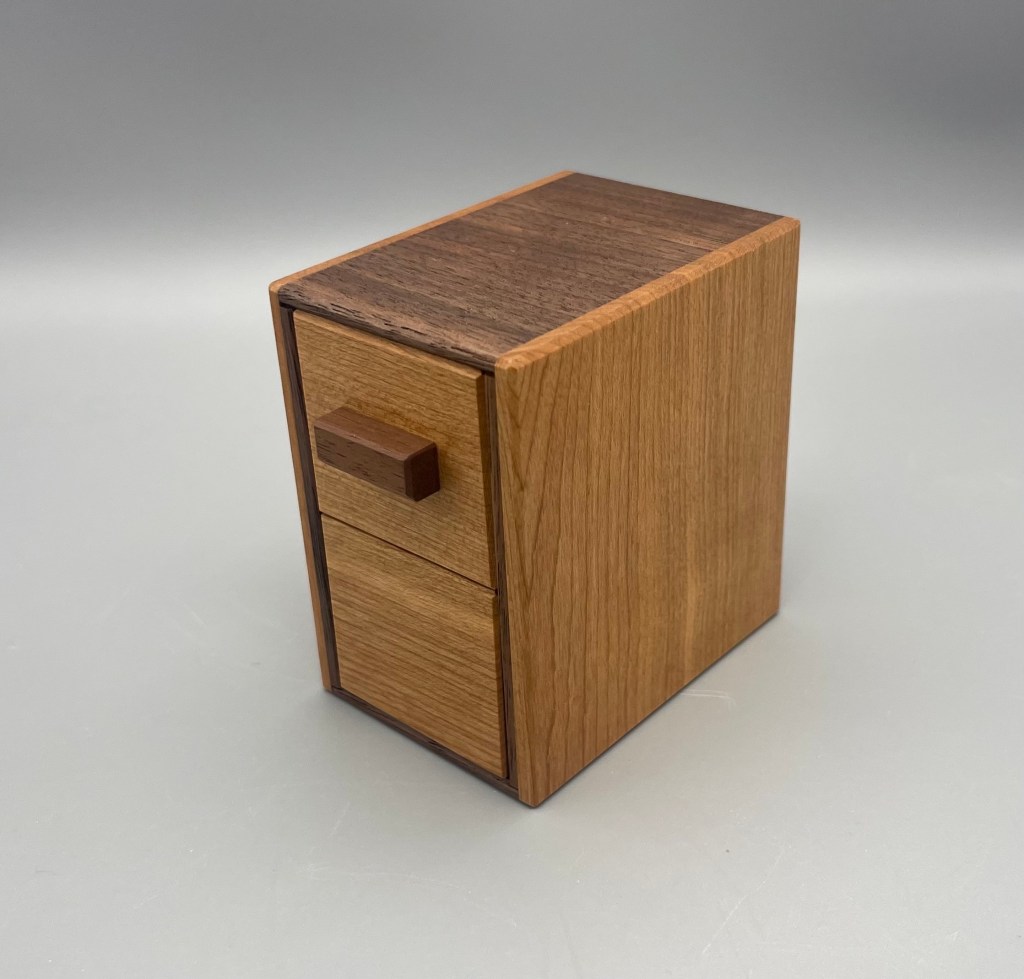
Nanomedashi’s simplicity and elegance makes it one of my favorites for the year, in some ways the opposite of Die: simple but fun. It looks like a small file cabinet (readers may know of my office-themed puzzle fetish) with matching drawers on either side. It was one of the first I was able to solve and required no help (I’m a big boy!) so don’t go for it expecting overly complicated mechanisms. It is the one I have probably re-solved the most, appreciating the way it plays on our assumptions with an opening move that has me grinning every time.

Hiroshi Iwahara – Box of Branch and Loophole

84×84×40mm; walnut, magnolia, padoauk & keyaki (zelkova)

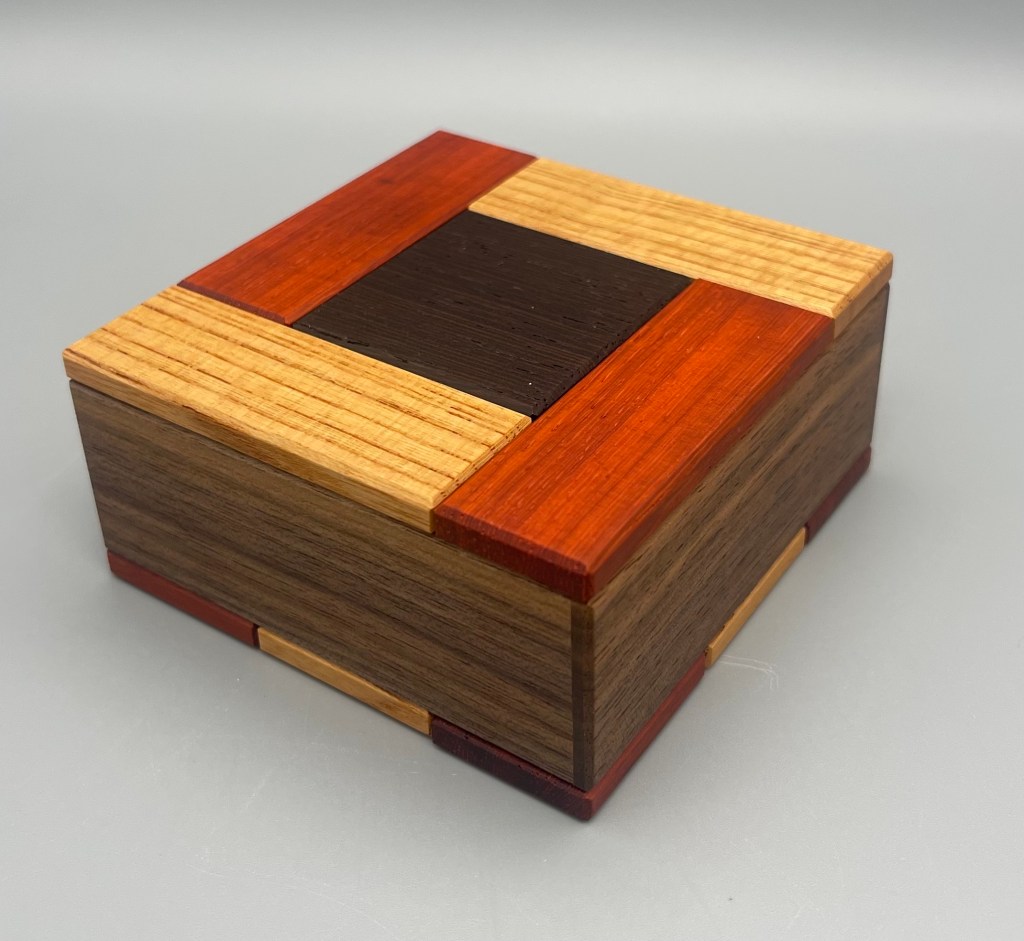
Iwahara’s box is a fun twist on a more traditional box in some ways while still managing to be wholly original. You can guess some of what you have to do but there will still be a struggle to get things to go your way, with moves “branch”ing off in unexpected sequences. Seasoned puzzlers will enjoy wandering around the box, getting lost and found while seeking the solution. I got lost many, many times and was happily surprised to learn that even after I thought I had finally solved it, more puzzling awaited.

You Kakuda – Thinking Bat

60×54×86mm; chanchin, magnolia, walnut & mizuki (dogwood) 

Hold on, Toad wasn’t by Kakuda?! Well, so long as there was an animal involved… Bat starts off easily enough before doing nothing at all. I was stuck going in circles on this for quite some time before a deviously simple aha! hit me, bringing me that subtle twist on the puzzle’s mechanisms required to finally open it. A smart and re-solvable box, indeed.

Osamu Kasho – Toad

84×84×45mm; Japanese walnut, mizuki (dogwood) & magnolia 

Another of this year’s favorites, Toad has a devilishly hidden step that eluded me for far longer than it probably should have. I played with it for quite some time before somewhat accidentally stumbling into a very well-hidden step that I almost didn’t even notice. Eventually I realized I had done something and was able to open the box. Fun to re-solve, it is a great example of how Karakuri boxes can mess with us.

Hideaki Kawashima – FS Cube

80×80×80mm; Japanese walnut, magnolia & cherry

Dude, FS Cube may take the cake this year – At first, I was pretty sure this puzzle was going to be a big letdown and was surprised when I eventually needed a big nudge to solve this one as it contains a step that is just oh so very, very clever. I want to say so many things about this mechanism but can’t find a way without letting slip at least some subtle spoiler; suffice it to say that when I finally figured out the central aha!, I laughed and still laugh when I re-solve it. It had me pondering how it was accomplished and surprised that I had not seen anything similar to it before.

Yasuaki Kikuchi – Clumsy Santa

66×66×110mm; chanchin, magnolia & maple

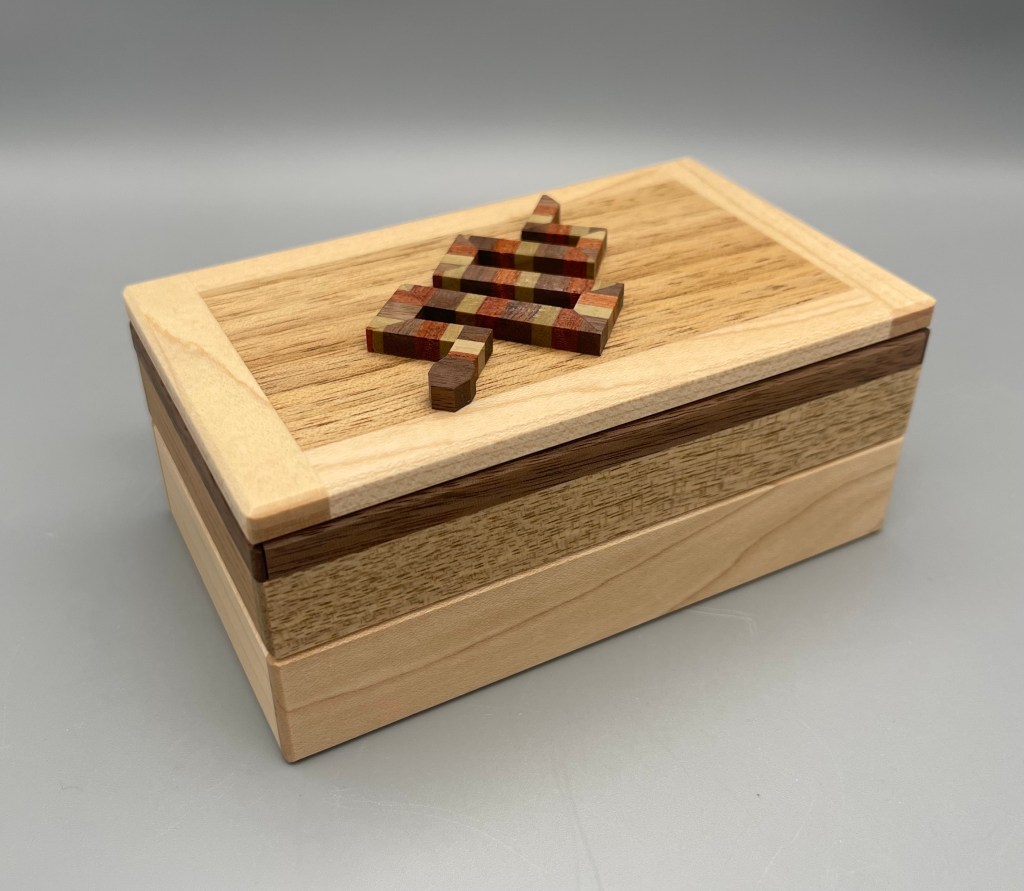
Another of my fav’s for the year, Clumsy Santa is the only holiday-themed box of 2023, unsurprising considering Kikuchi has brought us holiday-themed boxes for the last three years as well. This year we have an amusingly simple box with a well-hidden mechanism that is ever so fun to play with and re-solve. And like some previous years, you will find a nice surprise once solved!

Shou Sugimoto – Rattlesnake

119×70×53mm; Japanese walnut, magnolia, walnut, katsura & maple

Rattlesnake allows you to slither around rather freely, with a central mechanism that I would love to see uncovered, as it has me wondering how exactly Sugimoto accomplished it. Tricky and clicky this one has high fidget value with haptic feedback that is quite satisfying. I will admit I needed to check the solution to finally solve it; I knew what to do but could not get it right without some clearer guidance than the puzzle gives. I imagine many a puzzler might cringe at my casual cravenness but whatevs bruh.


And that’s our holiday boxes for 2023! Puzzlers will note that KCG has changed things up a bit for 2024 – now members must subscribe to their makers early (as in it is now too late for almost every maker) for fear of selling out. My stomach still drops at the fact that I was too late for several makers due to an in-hindsight-stupid procrastinationly ridden lack of puzzling awareness that I’ve been around far too long to have made (yes, my stomach actually drops… I repeat: whatevs bruh). Ah well, there is always the resale market (cringe).


That Funky Monkey – Brass Monkey Sixential Discovery

Brass Monkey Sixential Discovery

Two Brass Monkeys, 2 lbs, 2.75″

I’ve long been a fan of Two Brass Monkeys: Steve and Ali’s sense of humor is only outpaced by their sense of puzzling, with numerous metal locks and burrs having come our way over the years. I am in possession of all 6 of the Brass Monkey Burrs (along with a few of their other creations) and am now utterly compelled to write about them, having just solved BMSD, the sixth member of the burr series.

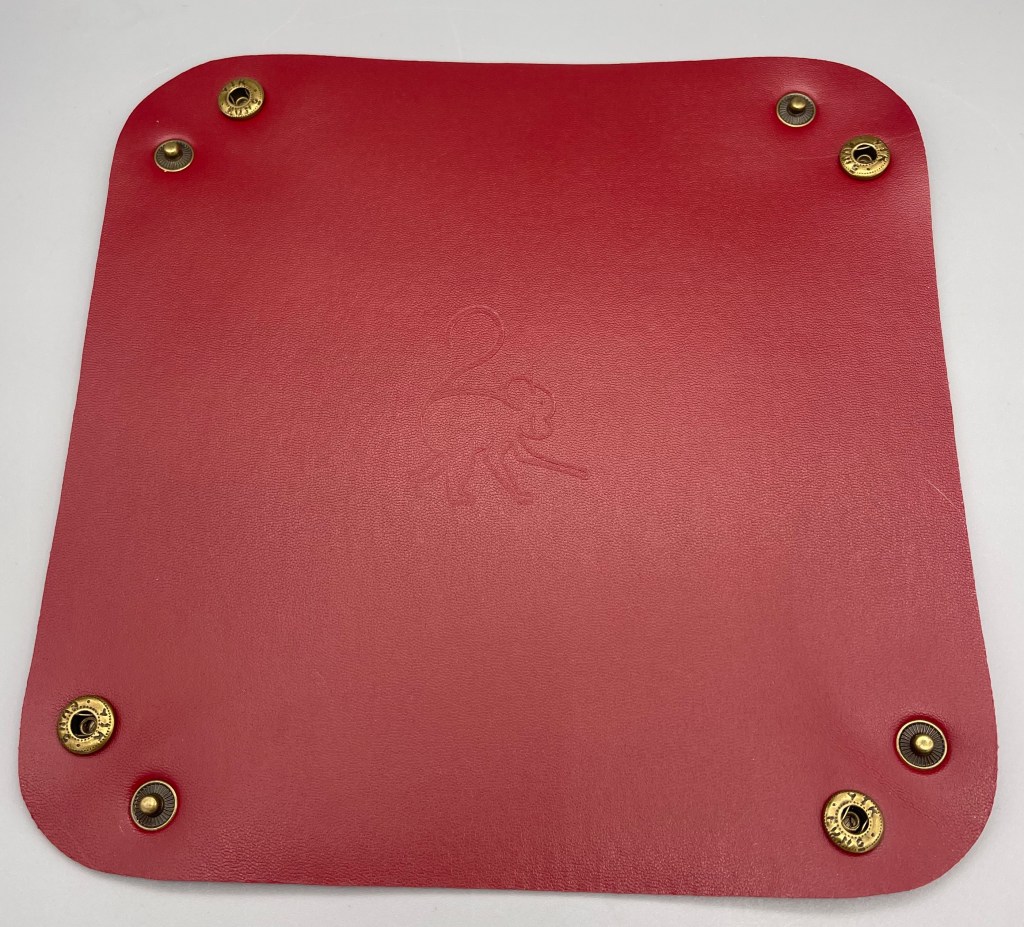
(I also want to call attention to the fittingly adorable TBM branded mat that generously came with BMSD – this is definitely going to come in handy!)

BM 1 – 6 appear almost identical, the only giveaway (aside from weight and, sometimes, a bit of noise) are on the tips of the sticks, with the number of concentric circles varying to designate which of the series you are currently looking at (some, including BMSD, also feature holes at the center of some stick tips). The series builds off of itself: the first is a classic, six piece burr, lovingly and perfectly crafted out of brass. From there, the series begins to add tricks, forcing you to think wildly outside the box at times as you uncover a way to unlock and disassemble the burr. The complexity of these trick openings increases as you progress through the ranks of the series, becoming ever more tricky and ingenious. If you like burrs and trick-opening take-apart puzzles (and who doesn’t?) then this is a series for you!

This, however, is not a comprehensive write-up of the series but rather a focus on the most recent, sixth entry. The sixth is something of a departure as it really starts to place a HEAVY emphasis on sequential discovery. This puzzle is not for the faint of heart – be prepared to build up a stack of doo-dads as you make your way through. That said, it is all highly logical and sensible; there is a clear flow and rhythm, even when I would hit walls I could typically tell (somewhat, more or less, kinda) where I was headed, even if it might take a nudge to get there (it did).

Starting on this 2 pound beast of an SD burr wasn’t so easy – I had to adjust myself to the fact that this is metal and I ain’t gonna hurt it and before too much longer I was on my way. This puzzle just keeps going and going – the goal is not to disassemble, or perhaps I should it is not just to disassemble. The first time I thought I was done was when I had the puzzle in a bazillion pieces; the second time was when I found… something; the final time was when I found the something else I still needed to find (totes adorbs). (I am being a bit cagey as I always like to err on the side of spoiler-free). Each time I basked in my own brilliance, alongside the many aha!s I had come across as I made my way there.

I was pretty sure that I was going to struggle with the reset – burrs are far from my strong suit and the bazillions bits and pieces didn’t encourage much confidence. But there is something so logical and clear about the complex design that I was able to backtrack my way without too much trouble (it helps a lot that I made myself solve it in one sitting – I cleared an afternoon and it took up all of it to do so – it was oh so worth it).

But what would a fivesinatras write-up be without some dumbassery – fear not reader, so sure was I that I had solved it early that I fully reset it before discovering the last several steps required to find the something else. Of course I dove right back in, pieces flying as I delved deep (more like pieces being placed carefully to the side but I am going for imagery here) reaching where I had previously reversed course and realizing where I needed to go (it took a while and a nudge or two to figure out how to get there, however, with this being one of the trickier parts of the whole shaboodle).

Suffice it to say I am a big lover of this puzzle – if you dig SD take-apart puzzles, then this is most definitely one for you. I suspect it will garner much love amongst the puzzle people puzzling around out there.

BMSD in its Natural Habitat, alongside its five siblings and cousins, Ali’s Bolt and Hokey Cokey Lock (and a number of other metal puzzling fun).

Leaning Tower of Puzzle: Fleur de Lis by Tracy Clemons

Fleur de Lis

Tracy Clemons, 11″ x 8″ x 7″5.5 lbs

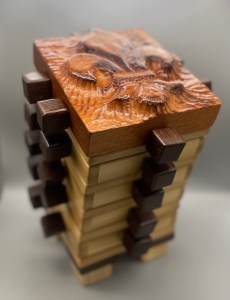
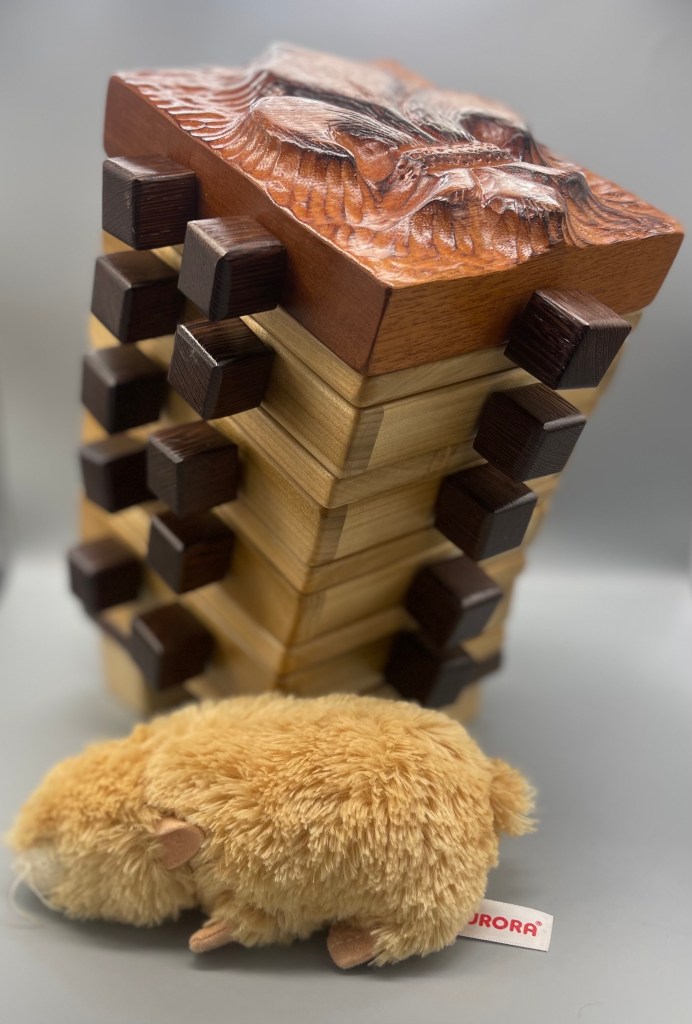
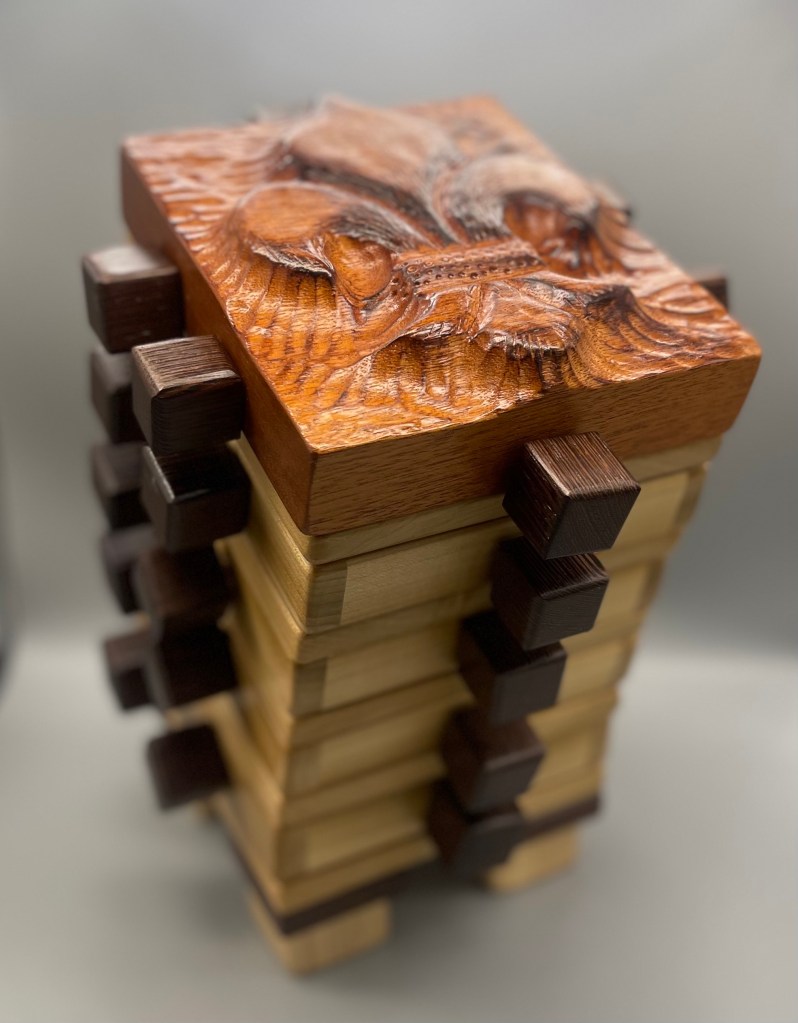
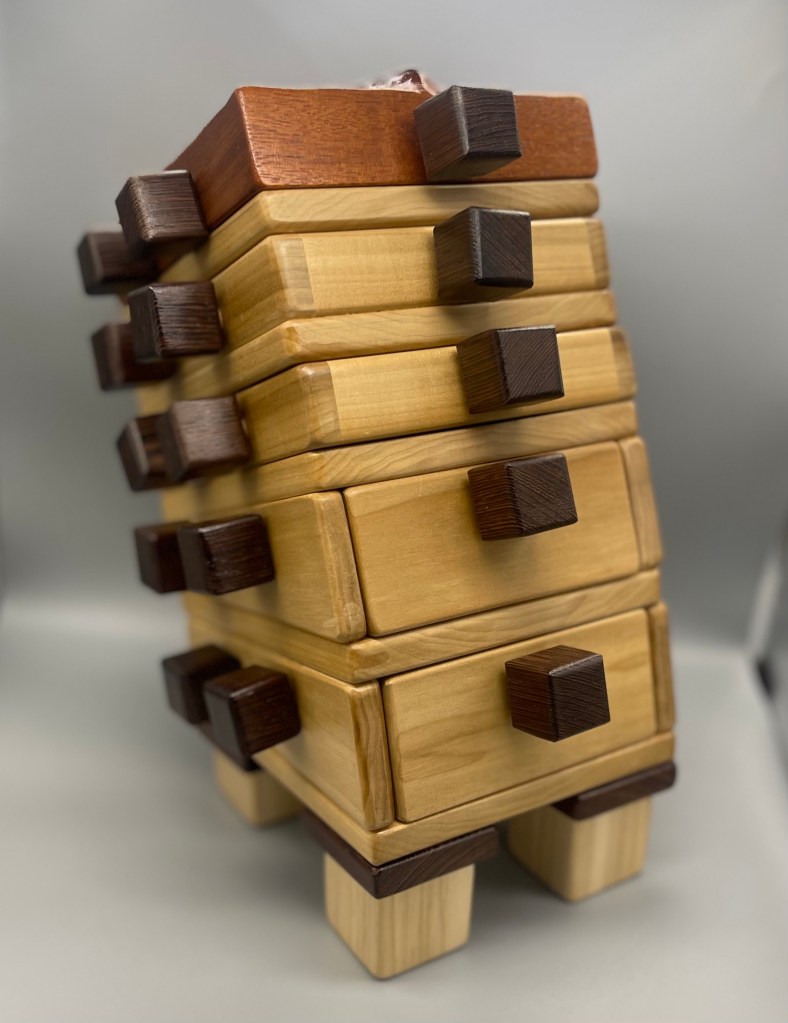
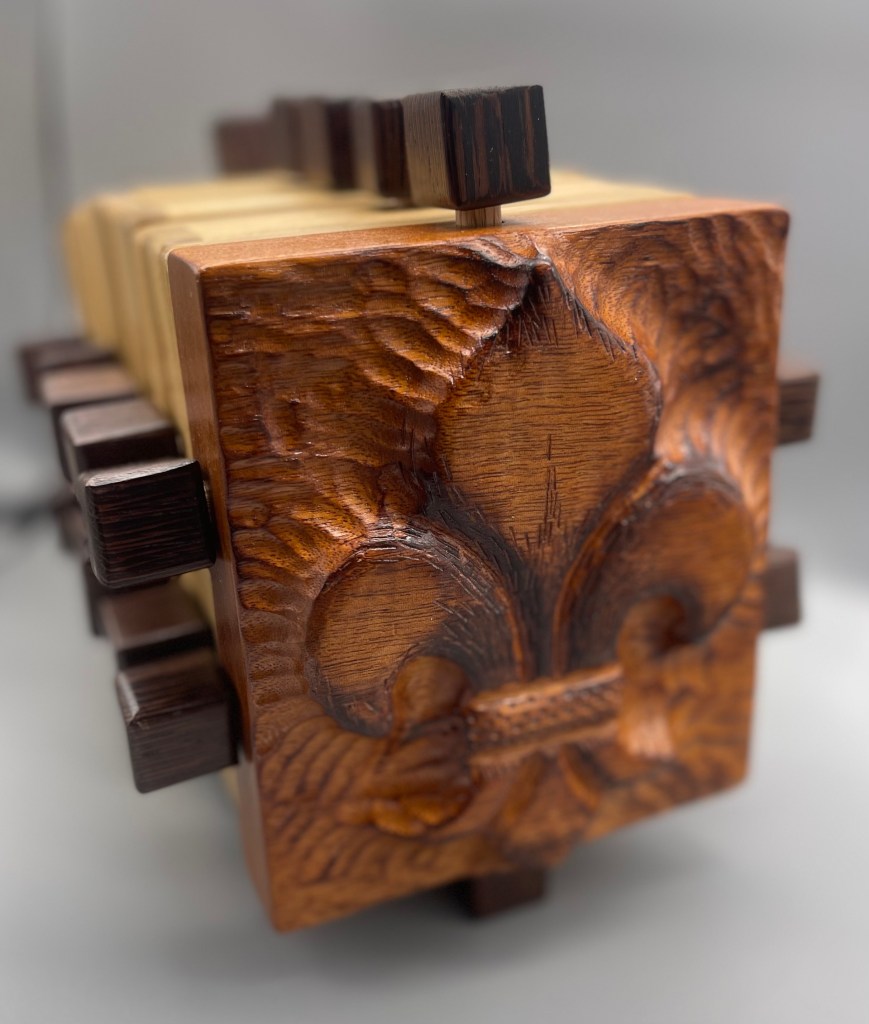
I’ve been wanting to write about Fleur de Lis for some time: this is a rather massive sequential discovery puzzle by Tracy Clemons, maker of another massive sd classic, Dark Fairy Door. At close to 5.5 lbs, Fleur de Lis towers over most other puzzles, tilting to one side as if threatening to fall over (it doesn’t). With a beautiful Fleur de Lis on its top, the namesake is clear. It resembles a precarious stack of many-knobbed drawers whose odd stature belies the odd movements to come.

Entering into Fleur, you will rapidly build up a lot of pieces serving a variety of purposes; whether tools or locks or red herrings, there is plenty to work with. In the meantime, you get yourself into some strange positions, with multiple laugh out loud movements that had me smiling as I solved. Meanwhile, there is what is inside the drawers! In classic Tracy form there’s a meta-puzzle waiting to be discovered and solved as you make your way through numerous hidden compartments.

Approaching the puzzle it is an open question as to where one should begin. This is not really a linear puzzler with a single path to the solution, which makes it easy to get lost (as I would soon find out). Building up a stack of pieces, it becomes clear that a patient and careful approach will be necessary if one has any hope of resetting the puzzle (which would prove to be a major struggle for me, a series of puzzles in its own right). This is not a puzzle for the light of heart! Take caution ye who hope to enter into its wacky dimensions.

I would need a LOT of help resetting the puzzle – I had left it in a state of undress for so long that I’d forgotten where too much went, as I struggled with solving the meta-puzzle hidden within. I am loathe to admit that I actually had to send it to Tracy for some help, so sure was I that something had gone wrong (which was completely my fault, rather unsurprisingly). A better puzzler than I (of which there are many) would surely not need such desperate steps but if you’ve read this blog you know my affection for puzzles tends to outstrip my abilities.

If you dig complexity, this is a great puzzle for you to take on. I was scared to approach it once more for the writing of this blog and only let myself get so far before backtracking in fear (coward!). However, I only wanted to remind myself of some of its complexity before sitting down to write about it and felt my cowardice was excusable. Jokes aside, I just don’t have the hours needed to dedicate myself to solving and resetting in one sitting and feared my lack of abilities in setting the puzzle aside over time as I did before.

I may be laying it on a bit thick for the sake of (questionable) humor – speaking with other puzzlers who have taken this on, they did not have the trouble I had resetting but…. again…. who’s got two thumbs and is kind of an idiot? (and apparently seems to think you can see what he is doing through the screen?)… this guy.

It Takes a Village: Oleg’s Wardrobe by Dee Dixon

Oleg’s Wardrobe

Dee Dixon

The Village was happy. For years its people celebrated nothing in particular, joyously throwing small objects into the sky and jumping up and down. Their kindness was so real, so tangible, that the Orb of Prosperity formed, giving the people something around which to dance in a rather silly, but quite happy, fashion.

King Oleg the Horrible, however, hated the happy hamlet – in fact, he hated everything: the sound of grass growing, the smell of fresh snow, and the tiny hats the people liked to wear. The King was cruel to the people in his kingdom, silencing laughter and kicking toddlers. For years he would grumble and mumble incoherently to himself, but the dancing…. Oh, the dancing was the last straw for Oleg. He stole the Orb from the Village and now things that were once thrown into the air are placed sadly on the floor.


Oleg has locked the Orb away in a secret compartment in a wardrobe he uses for small things like his fingernails and sense of self-worth. Knight Nyte the Sleepy Soldier has stolen Oleg’s Wardrobe but he can’t find the Orb! The cabinet opens but the drawers are empty! Alas, without freeing the Orb the people’s prosperity will forever be out of reach. It is up to you to find the Orb so that its magic may be released and the people saved, to laugh and dance and wear their tiny hats once more.

From: Tiny Hats and the Ogre that Hated Them, a Record of the Village that Prospers Once More

Dee never ceases to surprise – I still haven’t managed to solve Burner and he has something more complex coming out!

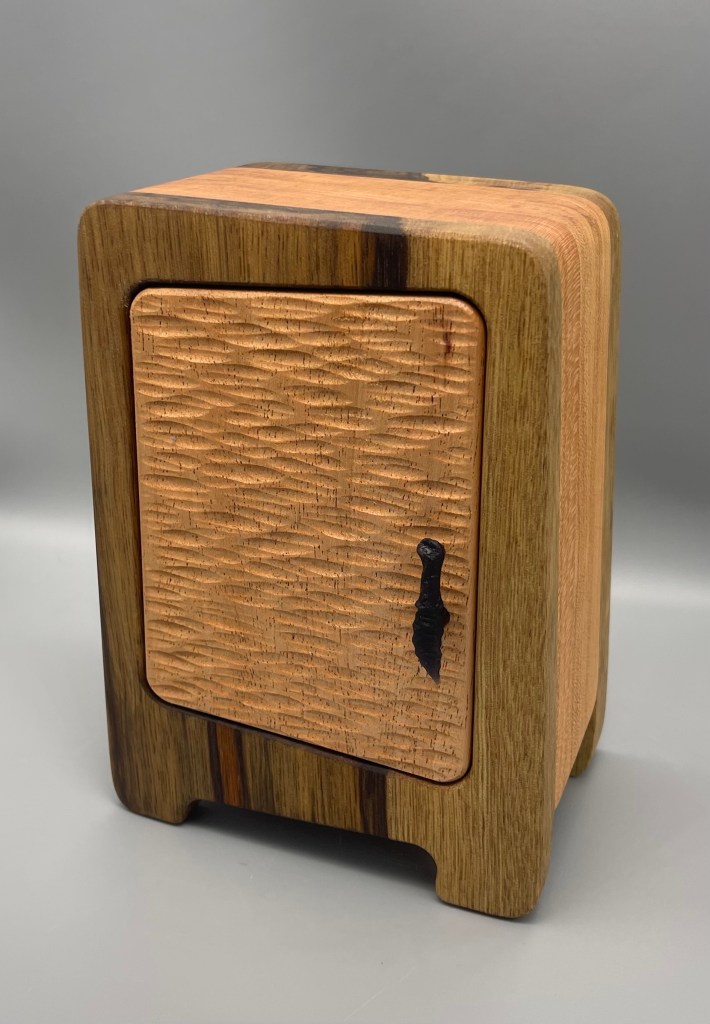
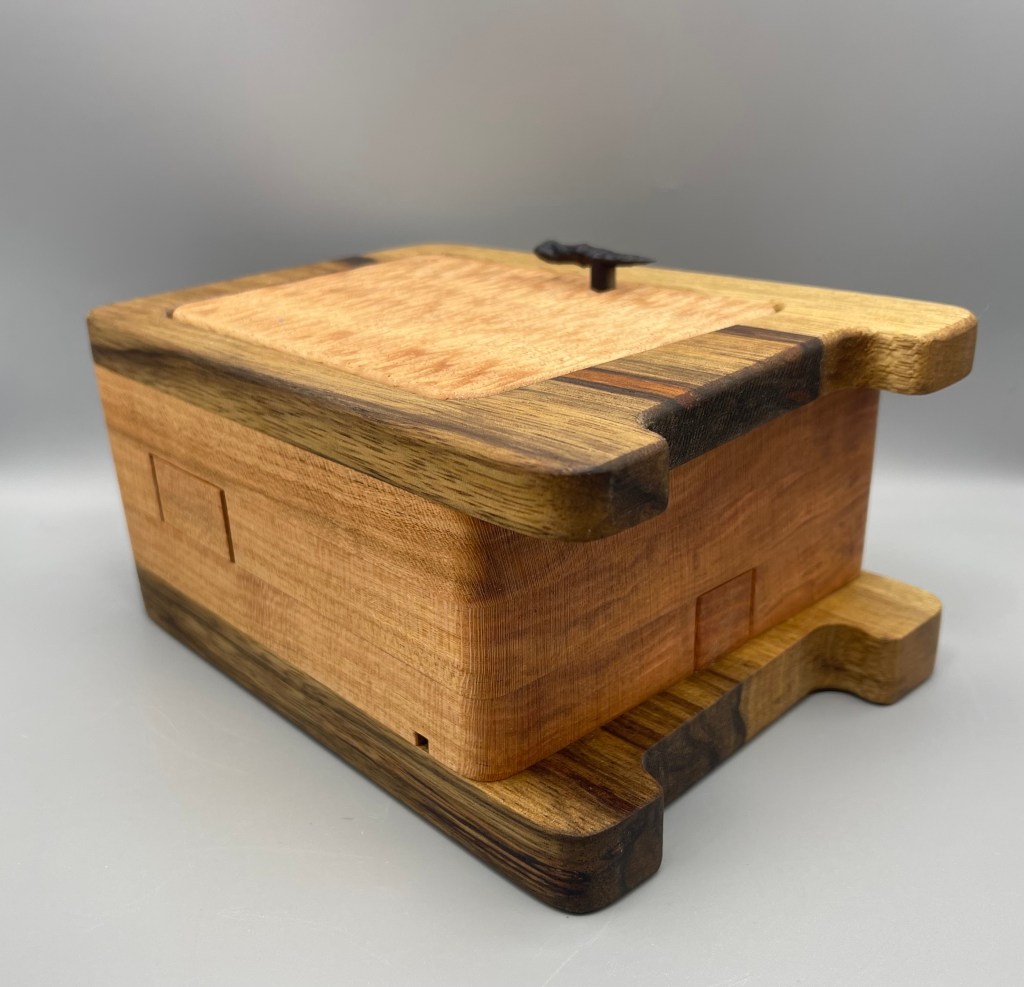
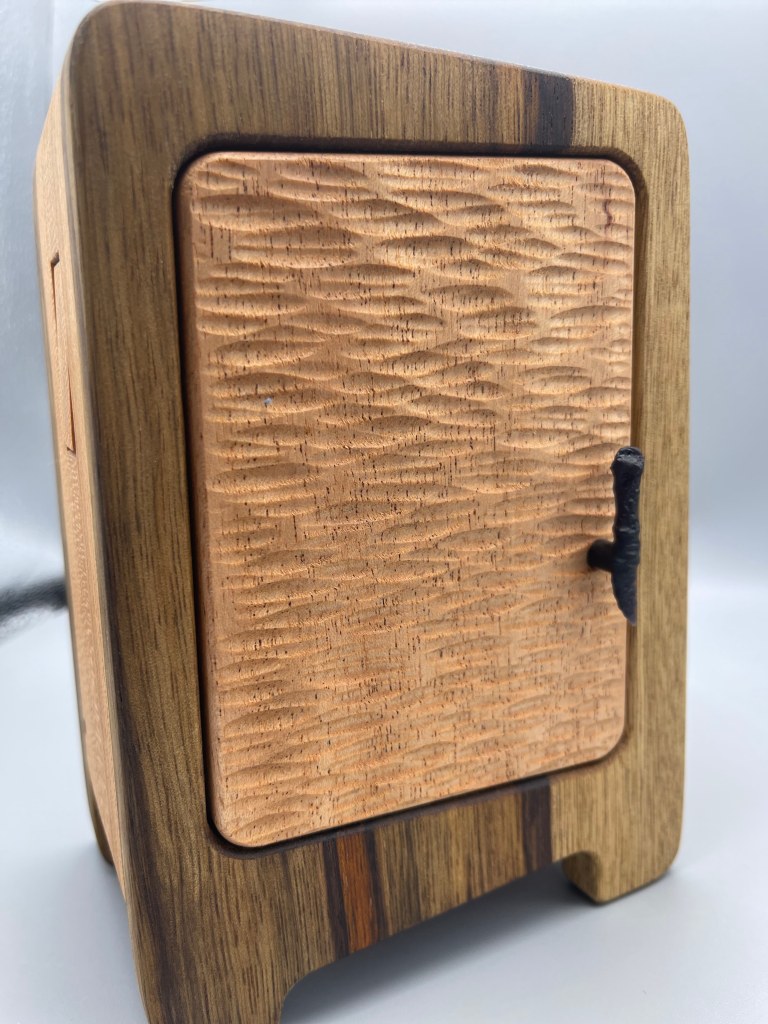
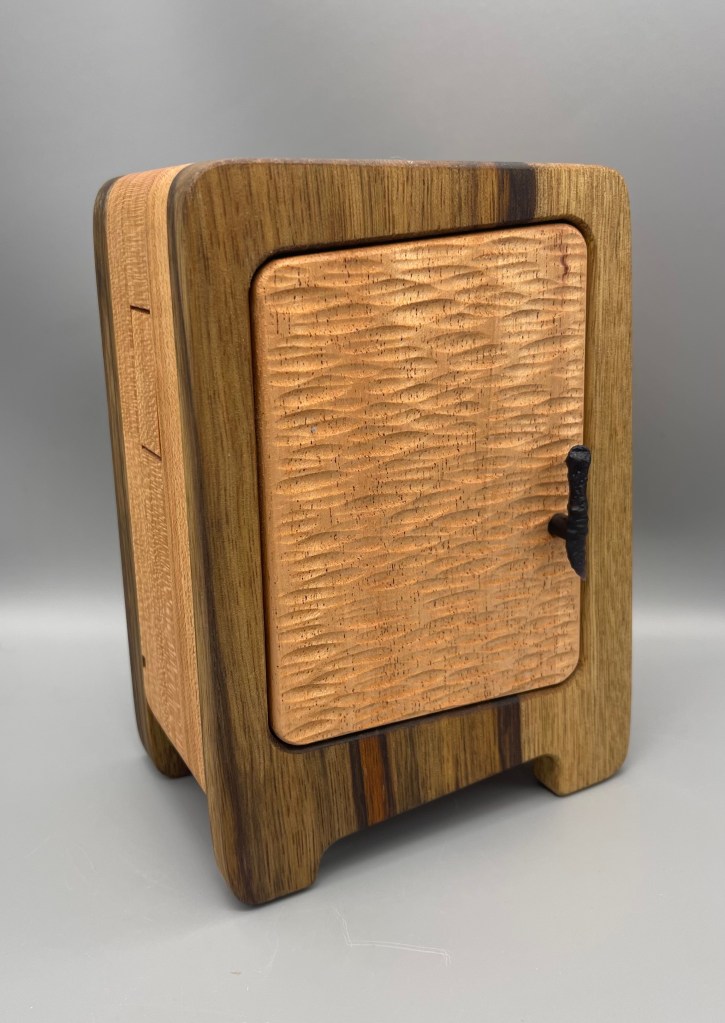
Oleg’s Wardrobe is a beautiful little cabinet with a door (maybe an Armoire?) in a weighty package (close to 2.5 lbs!). Mine is Black Limba and African Mahogany and the final version will be Peruvian Walnut and African Striped Mahogany (sure to be at least as pretty as the one I solved). The goal is to retrieve the Orb of Prosperity, which is hidden somewhere inside the wardrobe. After appreciating the little dagger doorknob, the door opens readily (with a reveal that made me laugh) but upon opening it up, there seemed to be little to work with. A rotating semi-circle on one side, a hole beneath it, and something that might be a button (that doesn’t press) on the bottom of the box. And that’s it (other than the drawers and door)! Shaking it a bit you can hear a bit of rattling… the Orb? Something else?

I stared at it for a while, asking it to share its secrets with me as I did everything I could think of to do… something. Before too long it did! Aaaaaaand now what? The main mechanism eluded me for quite some time before my aha! and even then I didn’t get very far. Some playing around and thinking(!) got me moving again, going in circles while I wondered what I was missing that could break me out of going back and forth through the few steps I had discovered.

With a little luck and a lot of patience, aha! I found what I was looking for. But still this something didn’t seem to actually do anything, not at first. Some more thinking and experimentation and I got it, only to find that I still had a ways to go. I was pretty sure I understood the basics but it took close observation, logic, luck and more than a little faith until…. the Orb! yay! Bask in my brilliance all ye doubters!

My brilliance soon faded when I realized I had reset the puzzle without returning the orb to its rightful location… oops. Fortunately, this forced me to really and fully understand the puzzle before I could reset it properly, both of which I like to do before I consider a puzzle fully finished. Even without this mistake, the reset might have been a challenge at times, requiring pretty complete comprehension (not my strong suit cough cough) of the central mechanism, with some subtle steps that tripped me up during the reset, adding a bit of extra challenge to the experience.

I had initially solved a late stage prototype before getting my hands on a final copy, which added another tool and a few more steps, while complicating an existing one. These round out the puzzle, really ensuring it has a satisfying length and challenge.

Oleg’s Wardrobe is as lovely as it is tricky – I might put it alongside Bad Moon and Uplift in some ways (but more difficult than either), making it an excellent addition to my ever-expanding Dee collection. Oleg is perhaps a bit semi-blind at one or two points, but really everything you need is there, you just need to realize what that means as you carefully and closely explore. I really enjoyed the non-linear nature of the experience, with some discoveries occurring in a random order; eventually I had discovered everything I thought there was but had to figure out how to put what I had learned together, a fun and somewhat unique experience to have a puzzling journey that meanders and splits and wanders before bringing everything back together. The final additions only add to this, with things that might need to come early being found late and vice versa.

Oleg’s Wardrobe is a fun, non-linear tricky SD journey in a lovely and weighty package. I struggled with it, hitting multiple walls before putting everything together and making my way through to the end. The reset added a bit of an additional challenge for me, requiring a real understanding of the central mechanism at work. A worthwhile addition to any collection!


Going in Circles: Orbit and Uplift by Dee Dixon

Welp, Dee as done it twice more with his most recent releases, Orbit and Uplift: I got there eventually but it took me quite a while to do it, with a nudge or three needed along the way (although I suppose I find that just talking about what I am doing is sometimes the most helpful part – more often than not in the process of explaining where I am and what I’ve done I clarify what I haven’t done and aha!…. that or I am just trying to make myself feel better about frequently asking for help from other, better puzzlers).

Oddly, both of these totally different boxes feature a freely spinning center piece in a frame – but that is where the similarity ends (other than Dee’s excellent craftsmanship, as always). Both look and feel great, as with any of Dee’s work in my sometimes humble opinion; Uplift has received some aesthetic comparisons to Bad Moon, which I can see, but really they both have that Dee look you can’t quite put your finger on but can still readily see. Uplift is especially gorgeous and I suspect that producing it is particularly no easy task. Neither box is an overly long solve but both had me stuck for quite a while, so my experience with both was nonetheless quite long… and of course they look great alongside their ever-growing set of siblings – delightfully, Dee definitely didn’t disappoint.


Orbit

In the hours (and hours) I spent going in circles with Orbit, I will admit there were times I was certain the solution must be too blind… I was convinced I was going to be annoyed by the solution but in reality this was not at all the case once I actually figured things out. You are given plenty of information and just need to bring some patient observation to make sense of things. It is extremely unlikely to just randomly open this box, although there were times when I was sure I was close (and found out later how wrong I probably was). This is the kind of puzzle where you really need to work out what is happening to be able to reach the solution. There are many puzzlers out there better at this than I, who may well have had an easier time, but I really had to struggle to get there.

Eventually I made some sense of the box and was sure I could solve it only to be confronted with a problem I eventually worked out with a laugh. Again, the information was there if I stopped and thought about it (and I appreciated how Dee incorporated something that in another puzzle may have felt disappointing but still managed here to feel novel… it’s hard to say more without crossing the line into SpoilerLand (which I’d say is like CandyLand but that would give too much away)).

Having solved Orbit I can now get through the solve in a few minutes – a testament to how not-really-at-all-blind the puzzle is, once you’ve worked it out; in my experience, a truly blind puzzle can stump me even once I know how to do it. Here, there is no way to get lost once you know where you are going.


Uplift

Uplift goes back to Dee’s SD roots with an SD-lite solve in what is an absolutely stunning circular “box.” It had me stuck spinning myself nowhere on more than one occasion, with a particularly delightful aha! at the start. I had spent a few hours (yes, sigh) going in circles, doing everything I could think of… everything but the one thing that would actually do something. I found a bunch of feedback that did nothing more than to distract me from finding my way into the start of the solve and when that aha! hit… you just gotta love that dopamine, bruh.

From there, I got stuck one or two more times but was able to get through the rest of the solve in a couple focused sessions. Dee messes with us as the puzzles progresses, causing me to fall down a rabbit hole or two along the way. Fortunately, I was able to get back on track without help, all by my big boy self. Overall, it was not a super long trek to the end once I got past that first wall; I managed to hit that last step with a laugh when I saw where Dee goofs us once more.

I know of one rather vocal critic of Uplift, someone who I suppose solved the puzzle quickly and felt it should have been longer (not a Karakuri collector, I imagine). To me, this first leaves out the importance of respecting the difficulty and complexity of physically producing a beautiful box, which is much of where the value of a collectible puzzle is derived. If you only care about how long it takes you to solve something, than you may not appreciate puzzles like Karakuri’s, for example, which, to some, may be solved quickly – I care more about the elegance of a solve, the flow from step to step, how it integrates with a novel aesthetic built with immense care… although I suppose it may be easy for me to say, since I rarely solve anything quickly (I never claimed to be smart… just circumlocutory and loquacious 😉

But, really, I do not want to give the impression that Uplift is a short puzzle; I don’t like giving a step count unless asked but, by my count, the length of the solve is about average (in terms of steps) for Dee’s work. Most important to me, I was never disappointed with my experience solving it. At the end of the day, I may have spent more time on Uplift than on Walter’s Radio, which does feature more steps (and is one of my favorite Dee boxes) and seems to have stumped some puzzlers as being too complex. Radio is the harder puzzle I think, but Uplift really got me looking in the wrong direction on more than one occasion, which just goes to show you how random the puzzling experience can be and how subjective our perspectives inevitably are.


One of the great things about Dee’s work is that he gets a lot of feedback before releasing puzzles – between prototype testers and a few early releases, he gets a lot of information before calling anything done, oftentimes even giving the public a look into the puzzle from a blogger or two before public release (not that you should listen to anything those guys say, cough cough). It should be no surprise that his puzzles are rarely, if ever, the subject of controversy or contention (and oftentimes the subject of confusion).

Dee has brought us two more beautiful and tricky puzzles that hit different price points and scratch different itches, both leaving me with the lovely feeling of success that solving a good puzzle can provide. Somehow, Dee is apparently putting the final touches on yet another puzzle so I may be back soon… assuming I can solve the darn thing.

If My Words Did Glow: Ripple by Peter Canham

Nary a day goes by when no-one asks me: “Hey, 5S, where the heck ya been the last few months?” Well, life happens and writing fell to the back-burner for a time. But this is not to say that my puzzling itch went anywhere – I’ve still been FOMO’ing my way through my bank account and struggling with the (many) yet unsolved puzzles in my midst (I’m looking at you, Orbit… and you, pretty much every Osanori puzzle I own).

There has been some truly great stuff to come out since the Nashville Puzzle Party (I realize that I haven’t posted since then… Wtf?!) but my favorite (solved) puzzle since then has got to be Peter Canham’s Ripple. After patiently waiting a year or so, I got an email that it was my turn! Cut several weeks ahead past some USPS shenanigans (and absolute kindness from Peter in his quest to make sure the puzzle got in my hands) and it arrived, safely packed in some laser cut plywood.

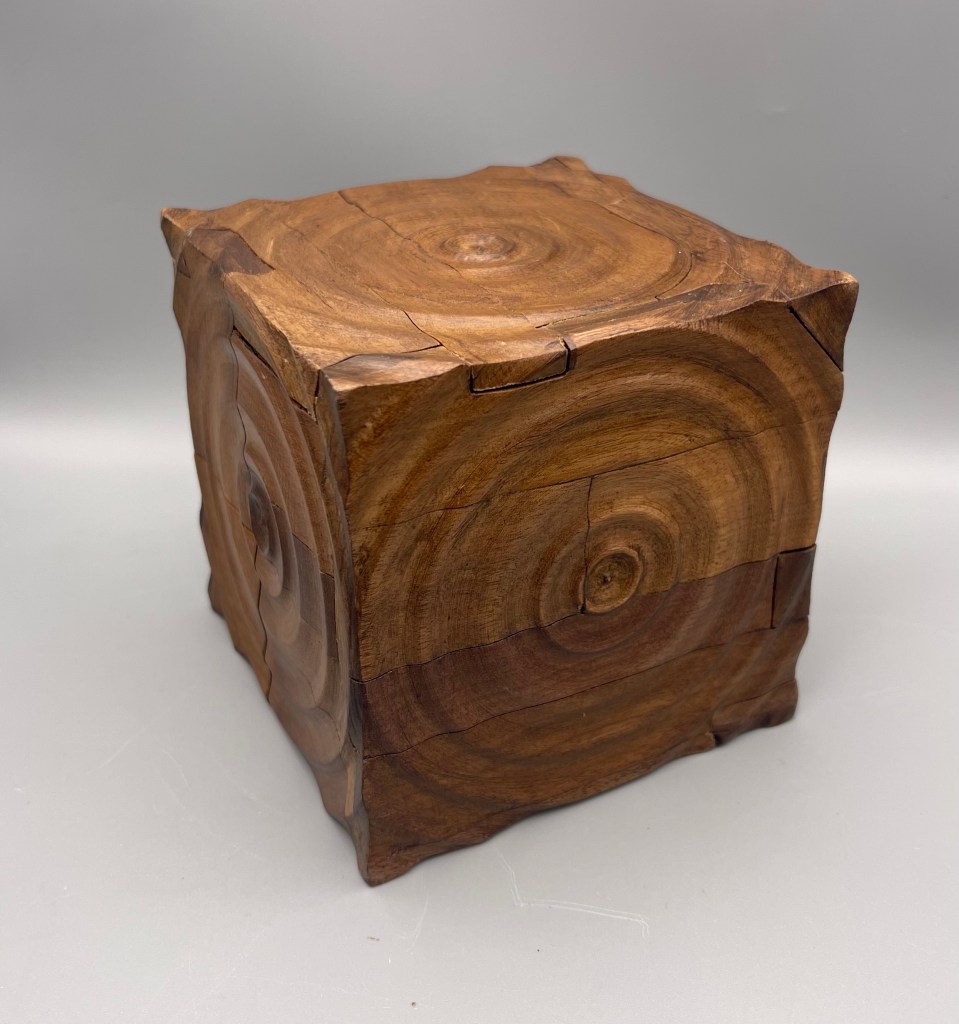
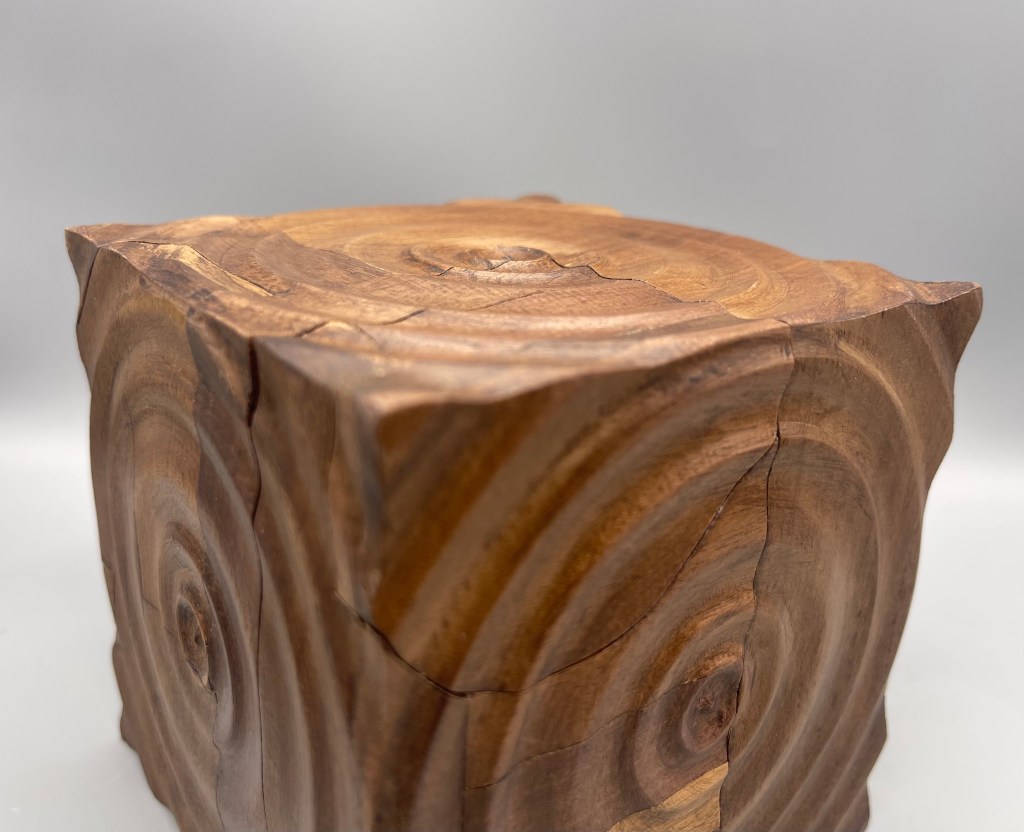
Ripple’s aesthetic mirrors its name with each face of the 4″ walnut cube featuring a series of rounded, concentric circles. These are broken by all sorts of strange and seemingly haphazard lines, giving you a hint of the complexity to come – at times these lines might prove helpful but they somehow still managed not to spoil some wildly unexpected moves. In Peter’s (comparatively succinct) words, it is “a box that was like a sequential puzzle but was non linear i.e. one move did not necessarily lead to another but possibly two or three. Like ripples in a pond interacting with each other. The biggest design challenge with the ripple box is that as the moves bifurcate the mechanisms start to interfere with each other,” resulting in a lovely cube that is seriously tricky.

After a moment appreciating the look and feel of the box, I was off: I was able to find something rather quickly but it seemed to lead nowhere, leaving me in circles that led to other not yet helpful discoveries, as I spent at least a couple hours over several days without making any real progress. Finally, after clarifying an assumption or two with Mr. Boxes and Booze, I found something odd and quite unexpected. And there I sat once more, staring into the next of what would be several walls that would lead to quite a few satisfying aha! moments. Eventually, I reached the solution and found Peter’s signature alongside the series and batch number. After basking in my brilliance for a bit, I reversed course, resetting the box and going back through the solution once again, appreciating how the moves lead into and around one another, moving through the maker’s vision to the end.

I suppose some might debate this, but I feel like it easily meets the crowdsourced Discord definition of sequential discovery, as it takes you “on a journey through a set of sequential and generally non-repeating challenges involving the discovery of hidden mechanisms” to reach the solution. SD has come to inspire some rather specific meanings that may or may not be met by this puzzle; regardless, the journey itself awards the puzzler with plenty of satisfying aha!’s. But, really, who cares: it’s a darn good puzzle, which is all that matters.

And now, what’s this? A new Dee Dixon puzzle adorns my doorstep? Ah, yes, you may yet hear from me again soon (sorry).