Dispatches from the Walter Wars: Iteration 23 by Dee Dixon

Iteration 23

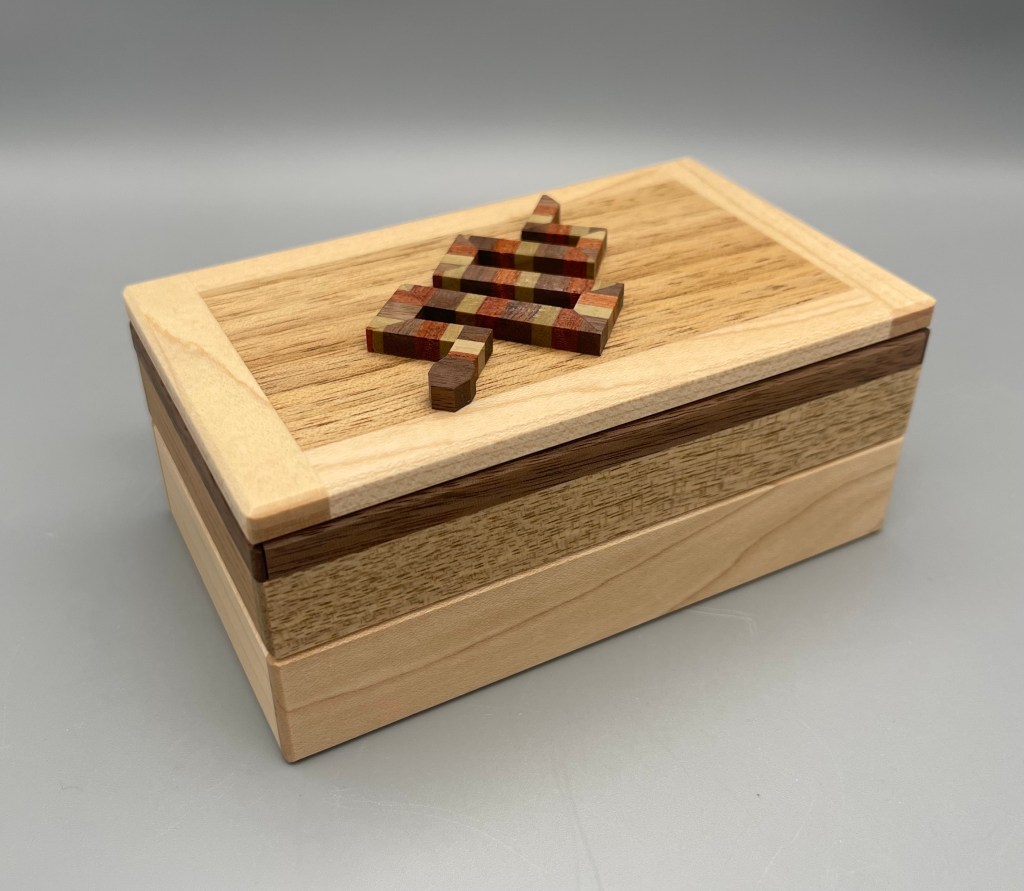
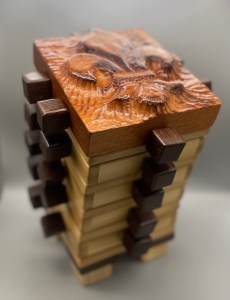
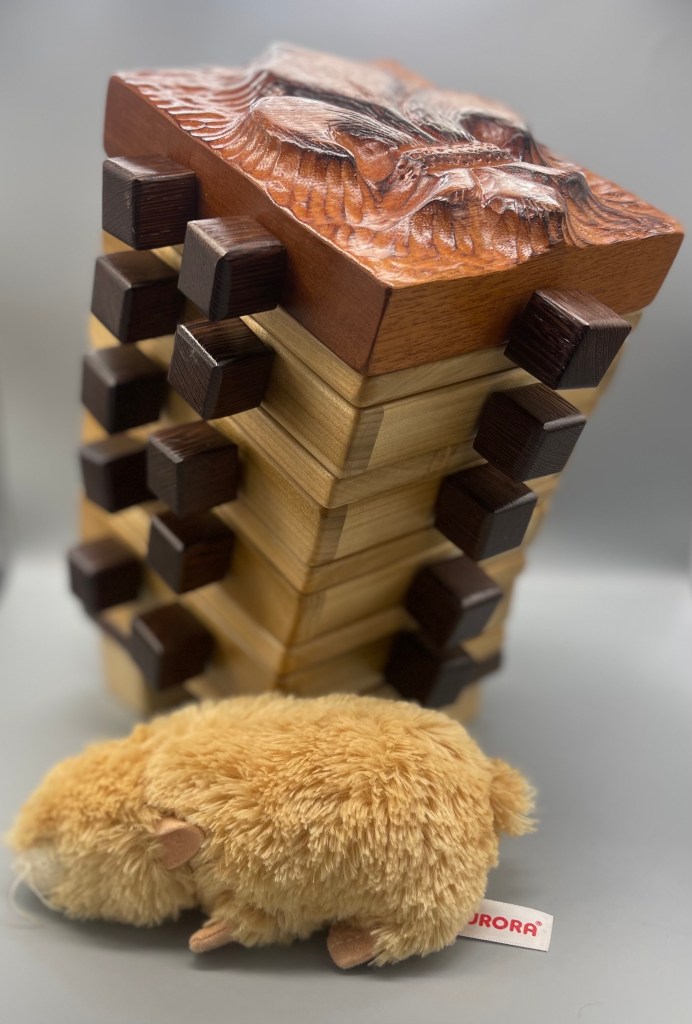
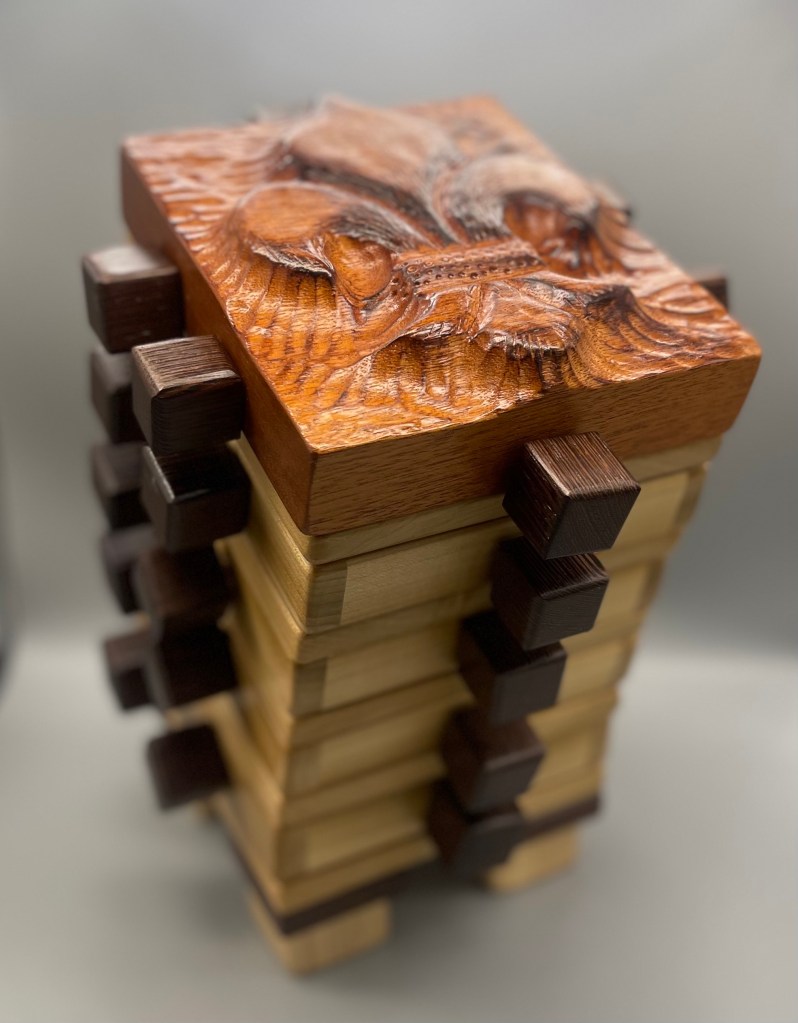
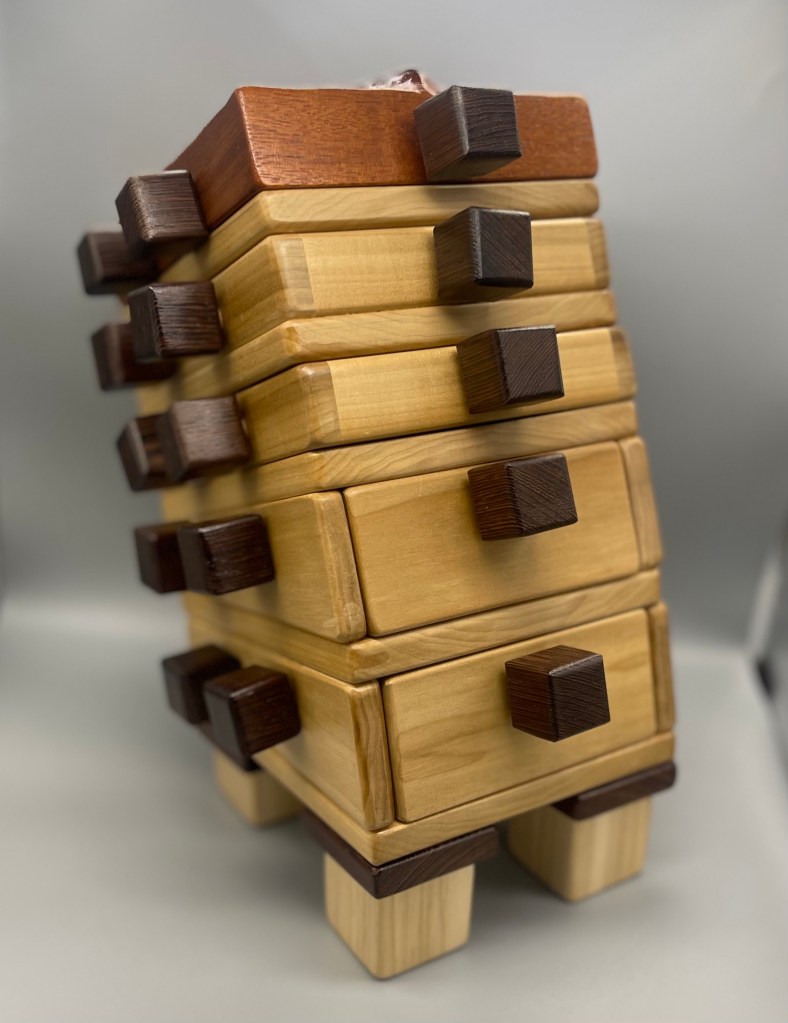
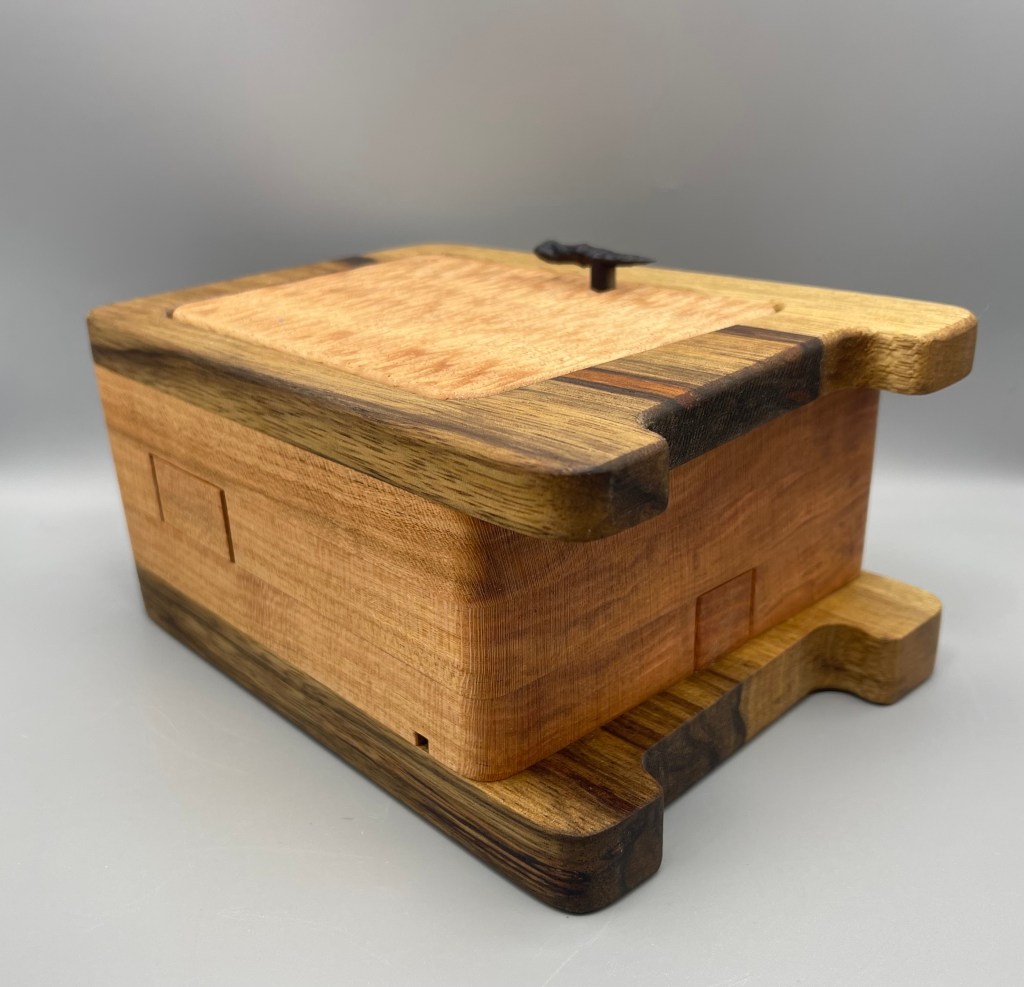
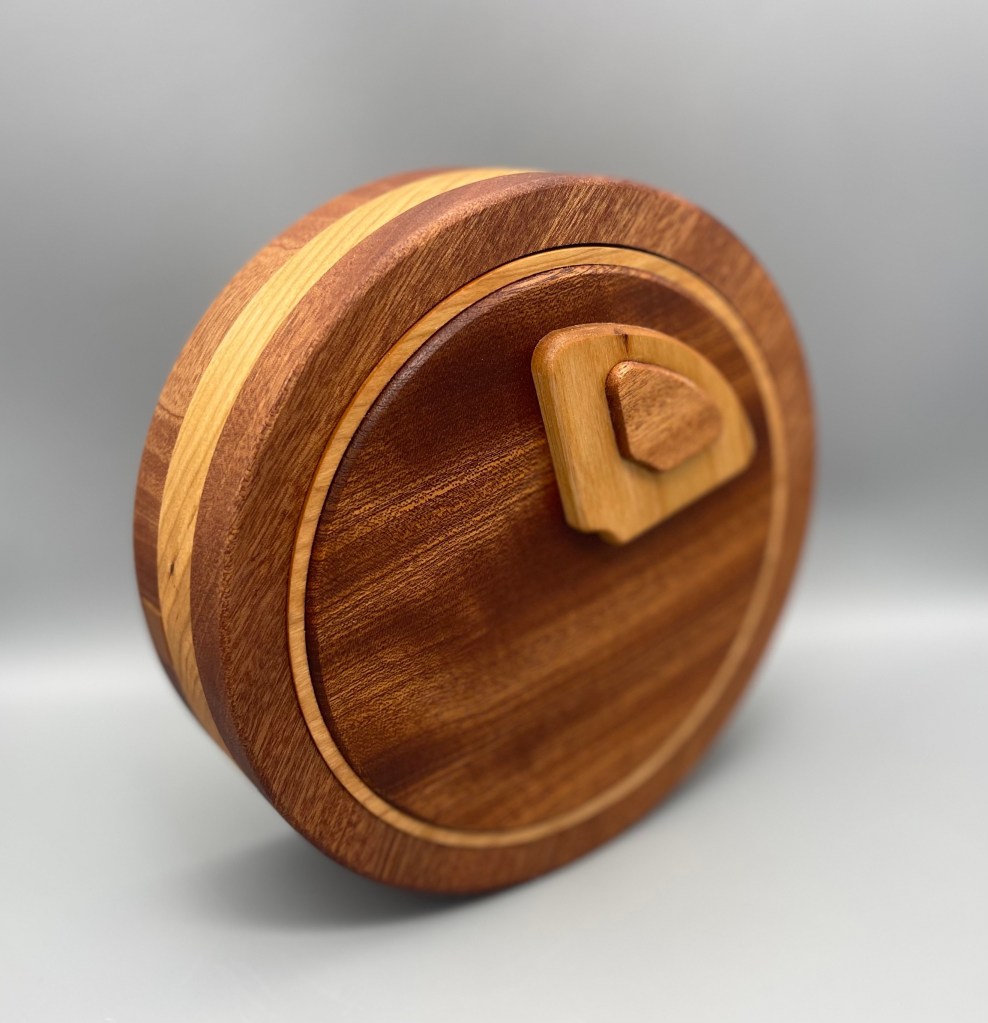
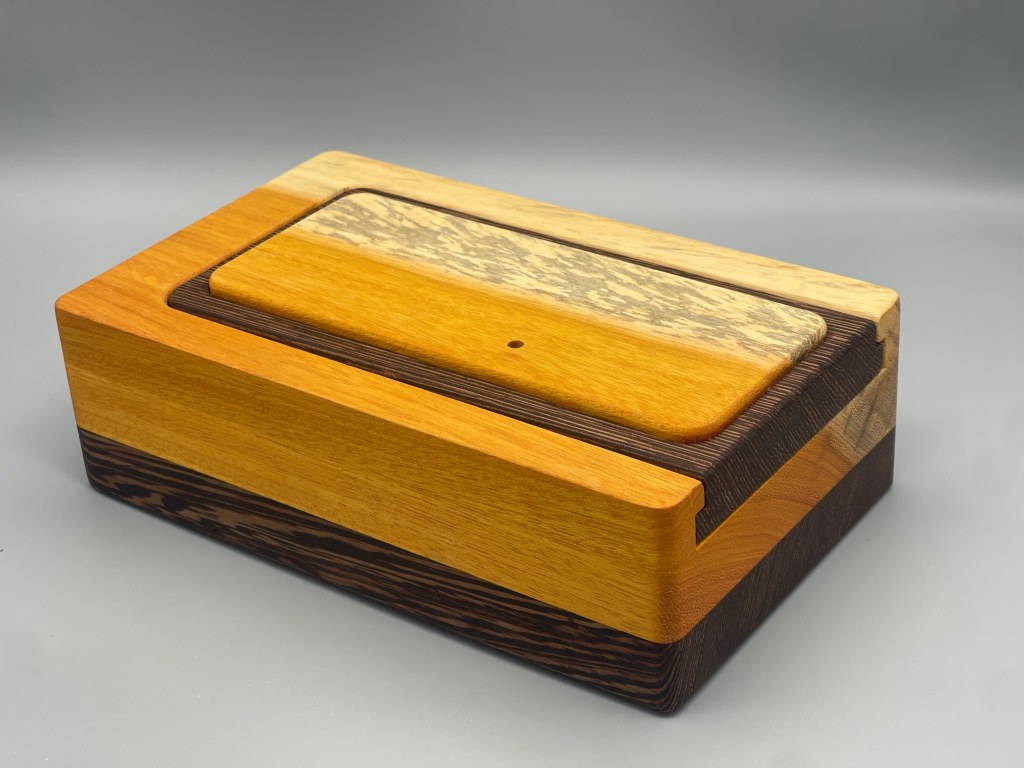
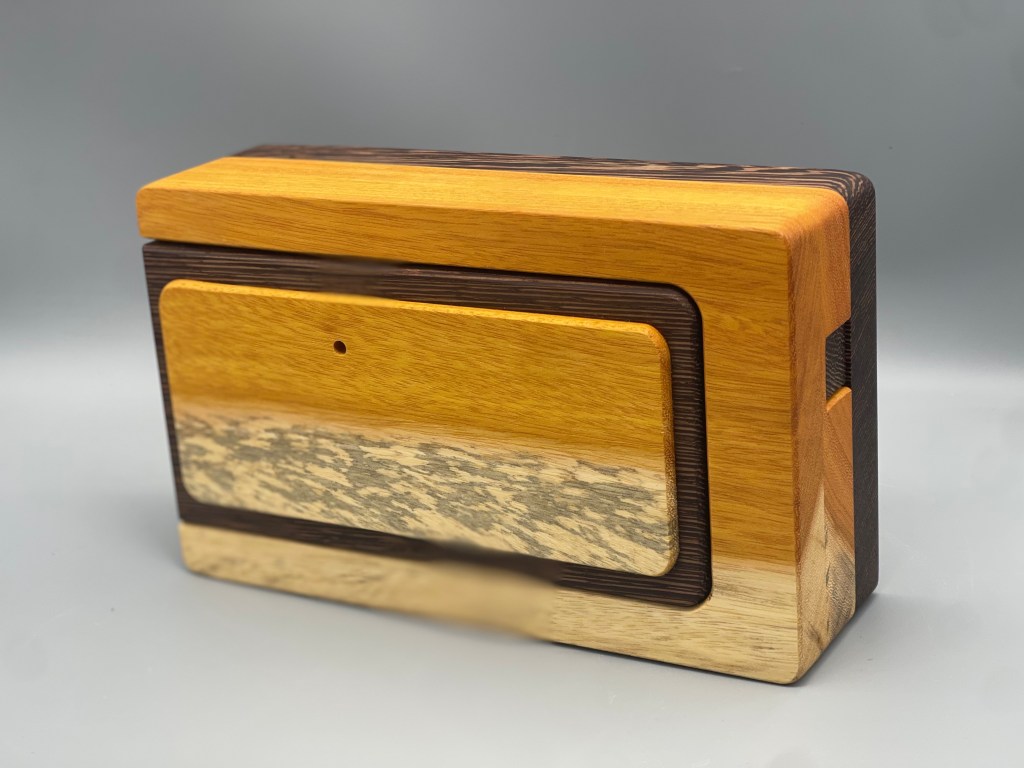
Dee Dixon, 7″ x 4.25″ x 2.25″, Osage Orange and Wenge (available in different woods)
And so, the Walter Wars waged on. The Walters’ dominance was shaken by the Human Resistance’s successful attacks on their radio communication devices as humanity chipped away at the Walters’ line of defense. But the Resistance had yet to develop a weapon that could resist Walter’s AI intrusions; the digital nature of all weaponized devices included a weakness that Walter would easily exploit. The Resistance instead looked back to human history, seeking to upgrade the weaponry of the 19th and 20th centuries. Hopefully this antiquated technology would help turn the tides of many a bitter battle, Walter being incapable of hacking into something from an analog era. Iteration after iteration was developed, each rooted in technology too old for Walter to comprehend. Still, the Resistance’s logistics were constantly interrupted by the Walters, forcing humanity to break this new weapon down into constituent parts. Using the Dynamic Element Downscaler or DED the weapon can then be hidden in a handheld device that could confuse and distract the Walters and when needed returned to its original size. Each individual fighter had little chance of defeating the robot horde, but together in a coordinated effort they could do great damage. One of many robot manufacturing facilities would be the new target. You are called upon once again. Go forth and help humanity gain the upper hand in its war against the Walters by gaining access to and assembling this essential piece of long forgotten technology. .

“……….you read this? Hello? If you can read this, you have accessed the Human Resistance darknet, supporting the fight against the Walters. Since their arrival, Angry Walter has expanded its rule, covering the globe with its robot kin. We humans, despite losing our cities and our nations, have fought back as best we can. We discovered a way to dismantle Walter’s fuel cell when a Walter could be captured. Then we developed a method of overcoming their communications network, removing the DED chip from copies of Walter’s Radio that could be rerouted by the resistance. Due to the Walters ability to infiltrate modern networks, our every weapon failed, leaving us always on the defense. Finally, we have learned that the use of pre-21st Century firepower could slip beneath the AI awareness, leaving the Walters exposed to the analog munitions we rediscovered.”
“Of course, we must hide these weapons from the Walters, breaking them down into various components and hiding them in wooden cases to be distributed across humanity’s last hope, wherever and whenever possible. These cases have separated the components across several compartments, which must be accessed using hidden tricks and tools contained within.”

“While I cannot give instructions to open the case, lest these communications be intercepted by the Walters, I felt it was important to share my experience with this copy in the hope that it could help others. At my count, about 20-25 steps stand between you and the components needed to build the weapon. At first, there is only a button on one side and a sliding lid that will only open about halfway before stopping. I experimented, listening closely to develop an idea as to what is going on – before too long, I had something that would help. It was clear to me where this should go but not why; I was stuck here for quite some time, going in circles as I sought my way out. I will admit that it would take some help to find my way out of this, earning me more assistance to progress. Before much longer, I had the lid off and, after a bit of exploration, the first piece of the weapon.”

“Stuck once more, I pulled out my headlamp to delve further into the puzzle. An excellent series of aha!s stood between me and the next weapon component. More exploration and more trial & error until I found the next step, which would lead me to the third component. I was stuck here for quite some time and would again require some assistance to progress further, despite having found at least part of this section’s solution.”
“Finally, I entered into the final sequence of steps that stood between me and the last component, hidden behind yet more aha!s; my success invigorated me and I was then able to construct the weapon, to be deployed at our next attack. With this, we finally go on the offensive, pushing back against the chaos and destruction wrought by the Walters.”

“It took the resistance iteration after iteration before finalizing the case, workable in this, its 23rd iteration. My copy consists of an Osage Orange base, with a Wenge outline. These colors are flipped for the final iteration, with Peruvian Walnut replacing the Wenge for the dark adornments. The case comes in three versions, using Padauk, Spalted Hackberry or the Osage Orange wood in addition to the lovely, dark Walnut. All are approximately 7″ x 4.25″ x 2.25″ and rely on the same secret steps to solve and access the munitions our resistance so desperately needs. We will be distributing them soon, in time for the holiday attacks we have planned.”

“These cases are unlikely to last long, lest this fight fall into the future. Keep an eye on the cover site we use to help get these cases into the appropriate hands. Go forth and construct these weapons so that we may push back against our robot overlords, perhaps turning the tides of our resistance.”


Push It Real Good: Salt & Pepper

Salt & Pepper

Designed by Robert & Norman Sandfield and Perry McDaniel
Originally Produced in Wood by Perry McDaniel
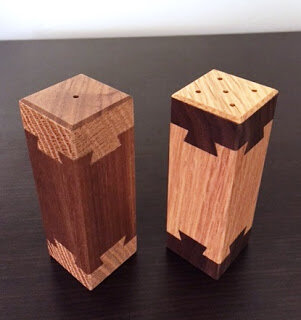
Produced in Metal by Tartarus Puzzles

When I first heard rumblings of a possible Salt & Pepper remake, I was thrilled. These go back to the 2002 IPP, when Robert and Norman Sandfield each presented one of them as their exchange gift. I don’t want to spoil anything, but they represented a new kind of trick for exchange recipients getting them separately (they made sure everyone who got one, got the other) – I suppose it’s obvious now to those buying these as a set but it makes for a great story. Reading some of the old IPP stories helped hook me into puzzling ever further, so google at your own risk.

Originally produced in oak and walnut by Perry McDaniel and designed by the three of them, these are undoubtedly one of the best dovetail puzzles released by the team behind a number of them. Perry’s work is unquestionably badass and I have been drooling over these for years now. Finally getting my hands on them is a joy – I feel like I have a piece of IPP history that would otherwise cost an arm and a leg.

Some time back there was forged a new puzzle partnership called Tartarus Puzzles. They first released a metal version of Free Me 5 and are now releasing Salt & Pepper (also in metal). First, they look absolutely wonderful. I love the colors they chose and the letter font is perfect. Producing puzzles like this in metal is no easy task – in Perry’s words: “when they told me it would be an all metal construction I knew they were nuts… the difficult tolerances and razor sharp dovetail edges [meant] they were asking for trouble.” But Tartarus persevered, creating a custom made dovetail cutter to produce edges that will not shred your fingers, while looking exquisite. They even improved upon a step or two along the way, giving them more longevity. Perry contributed a solution sheet (with pictures) that is easy and clear (I checked it after solving, of course… mostly).
And the puzzling? This a sequential discovery experience with one section in particular that is just really really cool – I am still not sure how they accomplished it but it is sort of the heart of the puzzle. There are also compartments to find. which contain a rather amusing surprise for the finale.

Starting out, I futzed around, quickly finding that nothing does anything obvious. I suspected I knew what needed to be done and it took some doing but I doggone did it… and I was off. After moving through the next few steps, I got to the section referred to above, which took me a heckuva long time to solve. Finally making it through, I had a few tools and a suspicion of what needed to happen based on my earlier explorations.

When I finally got the last bit open, I was rewarded with a clear indication that I had solved the puzzle, an indication that was laugh out loud funny, always a great way to end a good puzzling experience. The reset was mostly straightforward: that one really tricky section took some trial and error to solve backwards and may help you better understand how this part works (I am still not sure 🙂

And so, Tartarus brings us a fun piece of IPP history without the need for a Thunderdome auction! Salt & Pepper is available at the time of this writing – you can reach Tartarus by emailing them at: tartaruspuzzles@gmail.com


Apuzzle 13: Houston we had a problem here by Brian Young

Houston we had a problem here

Brian Young, 6″ x 3.25″ x 2.25″

Having (finally) made it to my first IPP this summer (after several years of hoping and waiting, I was overwhelmed by the wealth and general awesomeness of the puzzles showcased (as well as the puzzlers present). On the day of the party itself, I heard tell of a new Brian Young puzzle, possibly his last considering his announced retirement, and zipped on over, snagging one of the last copies of “Houston we had a problem here” from the legend himself (a welcoming and hilarious man).

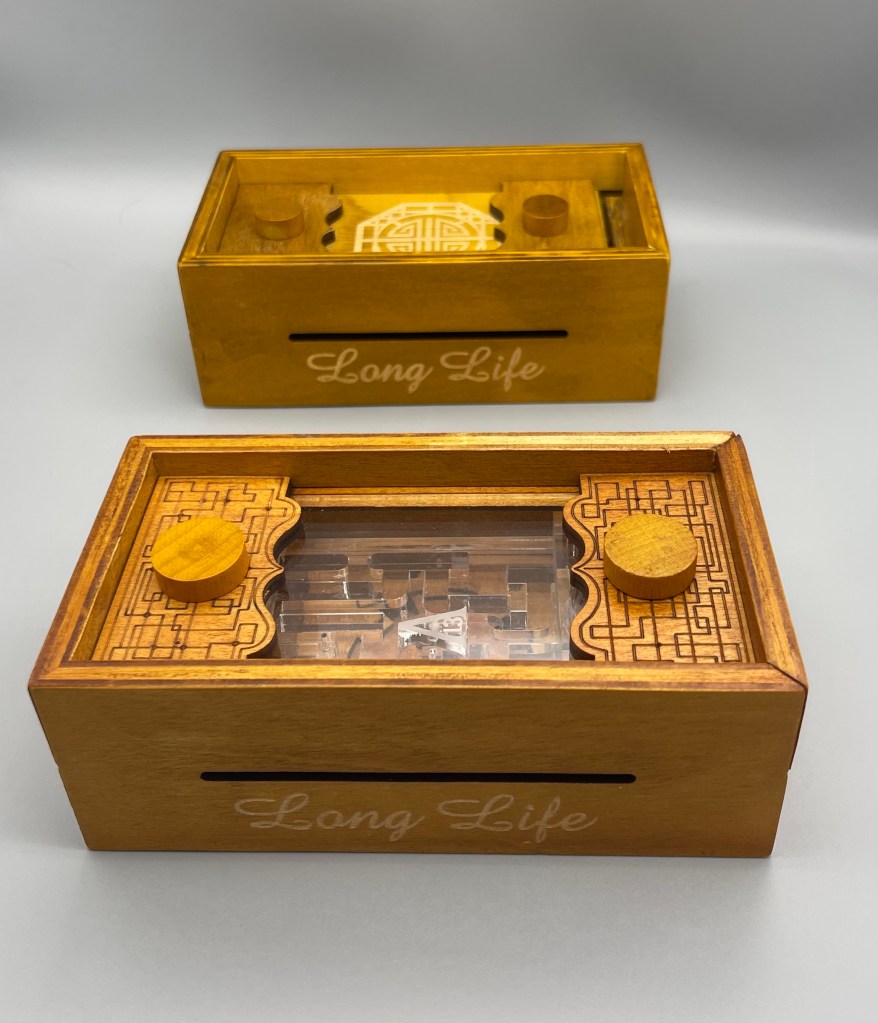
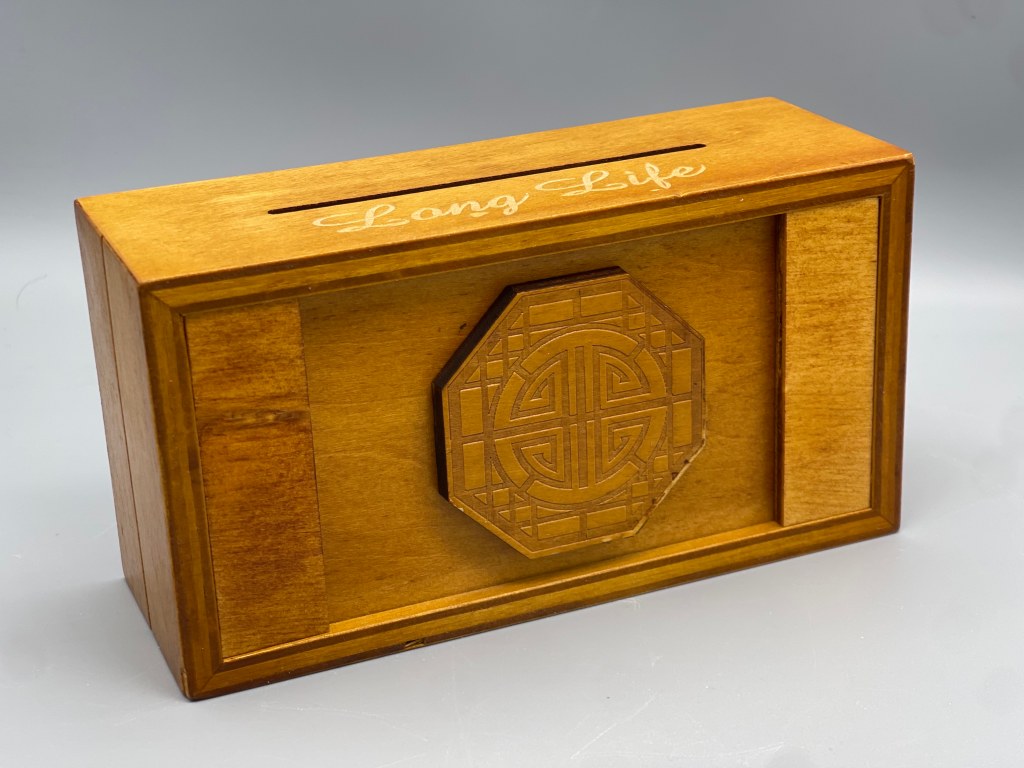
Houston is a very cool concept – Brian took the rather cheap, not so great “Long Life” puzzle box mass produced in China (I believe) by MiToys and modded it, turning it into an SD puzzle box! Yay! Needless to say, “WANT” was pounding in my head when I got to his table and picked up a copy. Houston takes the original puzzle and adds some engraving: the puzzle’s new name and some maze-like etchings are added to the original. The most obvious change is at the center of the box: an acrylic maze, at the center of which sits a ball bearing, stuck in place beneath an engraved “A 13” in honor of the infamous Apollo 13 mission from which the puzzle gets its name. The wood medallion on the bottom of the box rotates a few mm in either direction but does nothing helpful.

It did not take me long to find the first step but the next would elude me for far longer than I’d care to admit. Eventually, I realized I had not tried something and aha! more was revealed. This led to a few sequential discoveries of interacting parts that allowed me to access the centerpiece of the puzzle, where I would spend considerable time wandering around cluelessly, ideas being tried and discarded as I found none did what I had thought they might do.

Backing up, I thought about what had been discovered and amassed and wondered what else could be possible: lo and behold a couple somethings do some things that I had not yet realized: but why? and whatfor? Time to take stock and a closer look at things, leading me to see where (I think) I need to get and what I need to do when I get there. Getting there didn’t take me too long but the puzzle really threw me when I tried to do what I thought needed to be done; being a puzzle by Brian Young I should not think it would be easy. Finally accomplishing this task opened up new possibilities and allowed me to eventually get where I needed to be to solve the puzzle – Huzzah!

Houston is a novel concept with an excellent execution, turning something meh into something mexcellent. I would love to see someone else take up the mantle and mod others in the original series of puzzle boxes – even more, I would love to see Brian continue to make puzzles for us to enjoy! Whatever happens, I am grateful for the wealth of beautiful puzzles Brian has gifted us with and will continue to lust after and seek out those I have yet to solve or collect.

For more Brian Young action, check out my posts on Brian’s Big Baffling Bolt, Abraham’s Well, and Three Wise Bolts.


Puzzling With Myself: Jukebox by MoonTree Puzzles

Jukebox

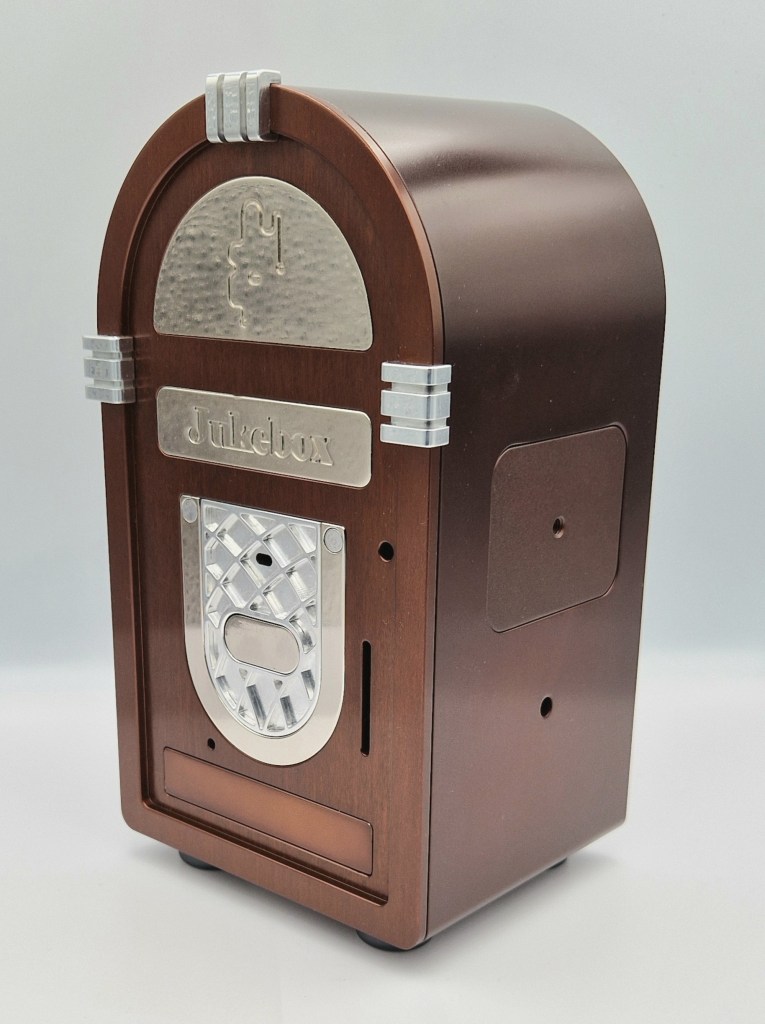
Daniel Czuriga and Tibor Folytan (MoonTree Puzzles), 4.75″ x 8.5″ x 4.1″, 6.5 lbs

In the puzzling world, a few years can go by quite quickly – I think it was back in 2020 that Daniel Czuriga first shared with me his idea for a new sequential discovery puzzle that would take the form of a jukebox. Daniel never stopped – periodically checking in with an update or a proto pic to share (I recall a prototype pic in laser cut wood that especially piqued my interest). Such interest was further undeterred as I know his taste in puzzles is quite similar to mine and so I suspected that whatever puzzle project was in the works would be something I wouldn’t want to miss out on. Still, a first puzzle from anyone could go either way, and I knew how ambitious this particular puzzle promised to be. When Daniel told me he had his two IPP copies ready to go, I was oh so grateful to have the chance to solve a copy before it went off for official IPP judgment. As he was submitting for judgment, he asked that I not post until after the party (go over to Boxes & Booze to check out his post as well). I should mention that it deservedly won Jury Grand Prize and as you will see below, I believe this was well deserved.

Going back to a few weeks ago: so it was that a large box arrived, containing an expertly packaged metal jukebox, with an absolutely lovely brown to offset its aluminum sheen. Frankly, it is gorgeous, resembling a classic jukebox, miniaturized to about 4.75″ x 8.5″ x 4.1″ from its place of honor in Ye Olde Soda Shoppe but still significantly substantial at close to 6.5 lbs. It stands on four small legs, with some holes and what-not adorning its sides. After admiring it for some time, turning it this way and that as I poked and prodded, I found something that did something, affording me a couple early steps before hitting my first of several walls. After playing around some more, I developed an idea of what needed to happen and set about accomplishing the task.

Eventually, after a fair amount of stops and starts (and stops and starts), I was able to get somewhere new; I was already working with some tools and the next step was fairly apparent, leading me to the first of several compartments. After examining the fruits of my success I stayed stuck for some time until an aha! hit – I jumped this wall, finding that a quite cleverly crafted clue contained yet more surprises. Yet again, success afforded me some fruits to enjoy, as another wall faced me. I was sure there must be something I was missing (there was) and it took a good amount of experimentation before I found the well-hidden secret needed to progress. This would continue through step after step and compartment after compartment until I found the “satisfying ending” to which the description refers, which does little to express the originality and joy of the puzzle’s finale. I not only laughed but ran to get my lovely and typically puzzle-indifferent NPSO to show her what I had accomplished: the finale is cool enough to elicit a smile from even the most jaded of non-puzzling partners.

Jukebox is most definitely sequential discovery, with tools and tricks that lead you on a journey that steers close to its theme; the jukebox is not just a concept but is integral to the puzzling itself. Puzzles that look like something do not always do this – sometimes the aesthetic is purely aesthetic but not here: Jukebox relies on multiple points of thematic reference that keep you close to its concept throughout the solve.

After solving, I set about the reset, which I found to be extremely intuitive. I would solve and reset the puzzle a few times before shipping it off to be judged by the lucky band of IPP-ers chosen for the task. I will be pretty surprised if it doesn’t elicit the same level of joy I was fortunate enough to experience (which it ultimately did).

Daniel and his partner, Tibor Folytan (together: MoonTree Puzzles) have made something that is fun and unique, with a complexity that challenges but never annoys. Any time a puzzle’s description contains the word “dexterity” I tend to get a bit suspicious – this is not at all my strong suit and I worry that such steps might frustrate me. But this never happened with Jukebox; that particular section had sufficient clues and feedback that I was able to enjoy progressing through it, never feeling compelled to smack my head (or the puzzle) against a wall.

I am excited for this puzzle to be released into the wild – Daniel has put so much into making this and we puzzlers are the fortunate beneficiaries of such care. He has worked hard to try and keep the cost down so that more puzzlers have the chance to enjoy it. Because that is really what sits at the base of this project: the desire to make something cool for us to enjoy. With the amount of hours put into designing and prototyping and tweaking over a period of several years, this is assuredly not the best way to make a buck; rather, this is a project that shows puzzlers’ love for the medium. I sincerely hope that these two designers find the time to bring us a follow-up (first they need to actually begin producing these for sale – I know I will be ready to pick up a copy despite having already solved it because this one is a keeper). Be sure to keep an eye on the #upcoming-Puzzles channel on Discord and/or on their website: http://moontreepuzzles.com.


It’s A(nother) Karakuri Miracle Again (Again)! Holiday Boxes 2023

Well it is that time of year once again…. past it really but I’ve been slow to get my ducks in a row and sit down and provide what I hope is a helpful annual post: an overview of last year’s Karakuri Holiday Boxes! I’ve done similar posts for 2020, 2021, and 2022 and have heard they have come in handy for those who missed out on one, some, or all of the year’s boxes, so off we go yet again down Santa Sinatra’s rabbit hole of fun!

I’m gonna need a bigger lightbox…

Akio Kamei – Spinning Die

80×80×80mm; walnut & magnolia

Kamei’s box appears quite similar to another Karakuri box, Dice, which has a rather amusing solution that is perhaps a bit of a classic, the kind of thematic solution that you expect from KCG. Spinning Die is considerably more complex – I am not sure I would have ever solved it on my own without some help tbh. The solution complicates the theme so that it is more thematic but less intuitive, if that makes any sense at all (as if that’s ever been a requirement for these write-ups). Its complication makes for the trickiest of the year although perhaps not as high on the fun factor as some other, simpler releases. As always, it just depends on your priorities – regardless, it looks so nice next to its KCG cousin.


Daiki Arimura – Nanomedashi

83×50×76mm; cherry, walnut & magnolia

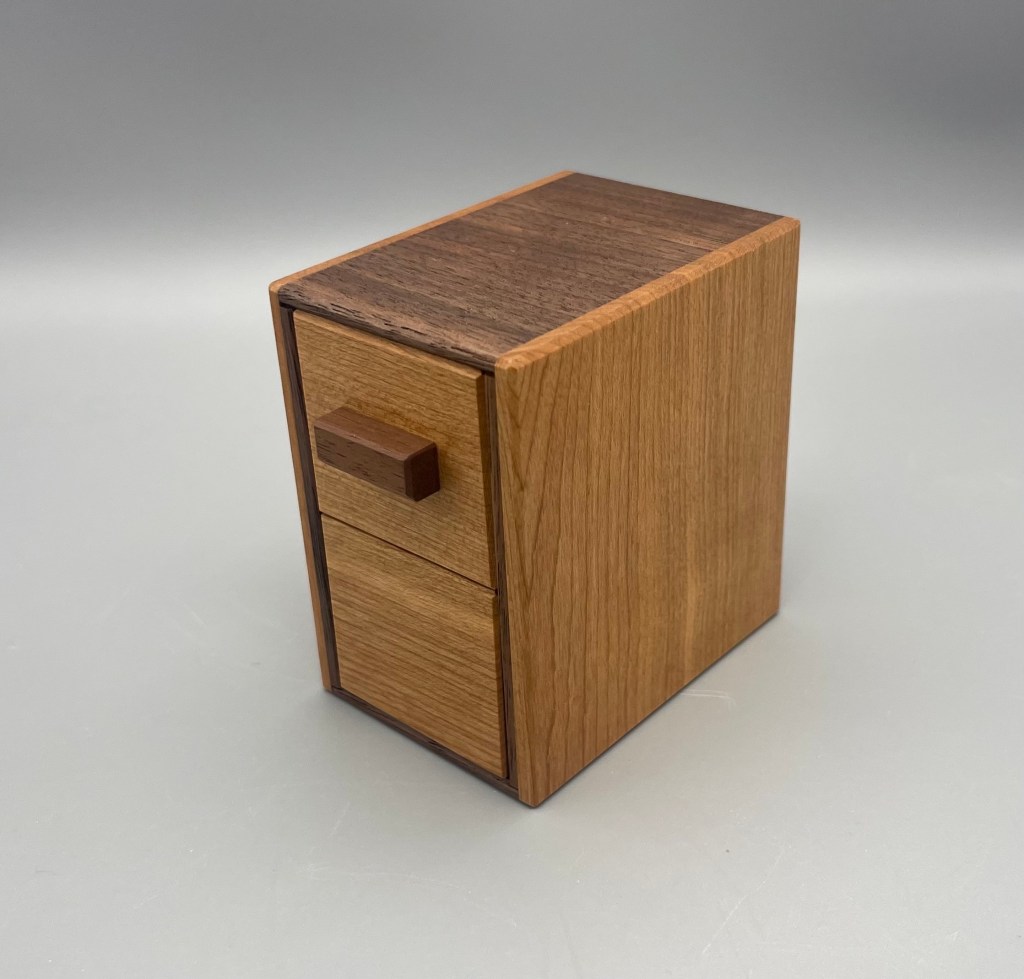
Nanomedashi’s simplicity and elegance makes it one of my favorites for the year, in some ways the opposite of Die: simple but fun. It looks like a small file cabinet (readers may know of my office-themed puzzle fetish) with matching drawers on either side. It was one of the first I was able to solve and required no help (I’m a big boy!) so don’t go for it expecting overly complicated mechanisms. It is the one I have probably re-solved the most, appreciating the way it plays on our assumptions with an opening move that has me grinning every time.

Hiroshi Iwahara – Box of Branch and Loophole

84×84×40mm; walnut, magnolia, padoauk & keyaki (zelkova)

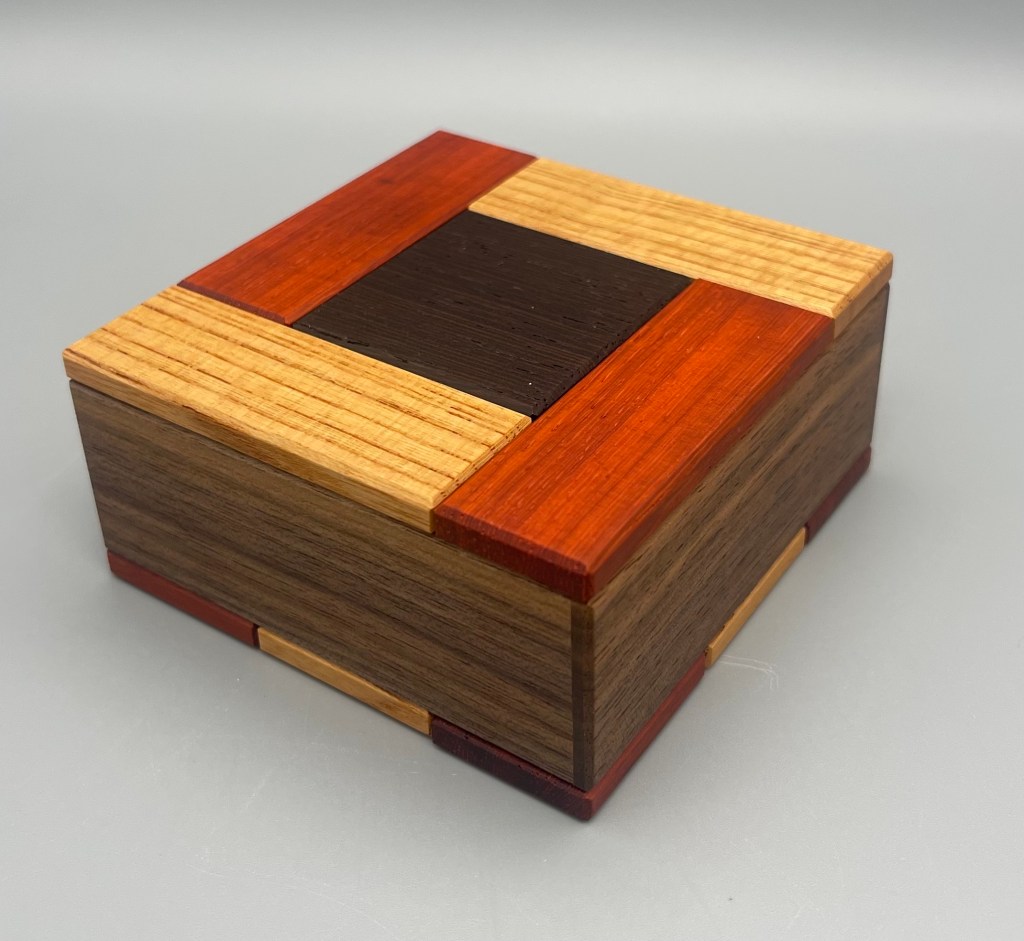
Iwahara’s box is a fun twist on a more traditional box in some ways while still managing to be wholly original. You can guess some of what you have to do but there will still be a struggle to get things to go your way, with moves “branch”ing off in unexpected sequences. Seasoned puzzlers will enjoy wandering around the box, getting lost and found while seeking the solution. I got lost many, many times and was happily surprised to learn that even after I thought I had finally solved it, more puzzling awaited.

You Kakuda – Thinking Bat

60×54×86mm; chanchin, magnolia, walnut & mizuki (dogwood) 

Hold on, Toad wasn’t by Kakuda?! Well, so long as there was an animal involved… Bat starts off easily enough before doing nothing at all. I was stuck going in circles on this for quite some time before a deviously simple aha! hit me, bringing me that subtle twist on the puzzle’s mechanisms required to finally open it. A smart and re-solvable box, indeed.

Osamu Kasho – Toad

84×84×45mm; Japanese walnut, mizuki (dogwood) & magnolia 

Another of this year’s favorites, Toad has a devilishly hidden step that eluded me for far longer than it probably should have. I played with it for quite some time before somewhat accidentally stumbling into a very well-hidden step that I almost didn’t even notice. Eventually I realized I had done something and was able to open the box. Fun to re-solve, it is a great example of how Karakuri boxes can mess with us.

Hideaki Kawashima – FS Cube

80×80×80mm; Japanese walnut, magnolia & cherry

Dude, FS Cube may take the cake this year – At first, I was pretty sure this puzzle was going to be a big letdown and was surprised when I eventually needed a big nudge to solve this one as it contains a step that is just oh so very, very clever. I want to say so many things about this mechanism but can’t find a way without letting slip at least some subtle spoiler; suffice it to say that when I finally figured out the central aha!, I laughed and still laugh when I re-solve it. It had me pondering how it was accomplished and surprised that I had not seen anything similar to it before.

Yasuaki Kikuchi – Clumsy Santa

66×66×110mm; chanchin, magnolia & maple

Another of my fav’s for the year, Clumsy Santa is the only holiday-themed box of 2023, unsurprising considering Kikuchi has brought us holiday-themed boxes for the last three years as well. This year we have an amusingly simple box with a well-hidden mechanism that is ever so fun to play with and re-solve. And like some previous years, you will find a nice surprise once solved!

Shou Sugimoto – Rattlesnake

119×70×53mm; Japanese walnut, magnolia, walnut, katsura & maple

Rattlesnake allows you to slither around rather freely, with a central mechanism that I would love to see uncovered, as it has me wondering how exactly Sugimoto accomplished it. Tricky and clicky this one has high fidget value with haptic feedback that is quite satisfying. I will admit I needed to check the solution to finally solve it; I knew what to do but could not get it right without some clearer guidance than the puzzle gives. I imagine many a puzzler might cringe at my casual cravenness but whatevs bruh.


And that’s our holiday boxes for 2023! Puzzlers will note that KCG has changed things up a bit for 2024 – now members must subscribe to their makers early (as in it is now too late for almost every maker) for fear of selling out. My stomach still drops at the fact that I was too late for several makers due to an in-hindsight-stupid procrastinationly ridden lack of puzzling awareness that I’ve been around far too long to have made (yes, my stomach actually drops… I repeat: whatevs bruh). Ah well, there is always the resale market (cringe).


Leaning Tower of Puzzle: Fleur de Lis by Tracy Clemons

Fleur de Lis

Tracy Clemons, 11″ x 8″ x 7″5.5 lbs

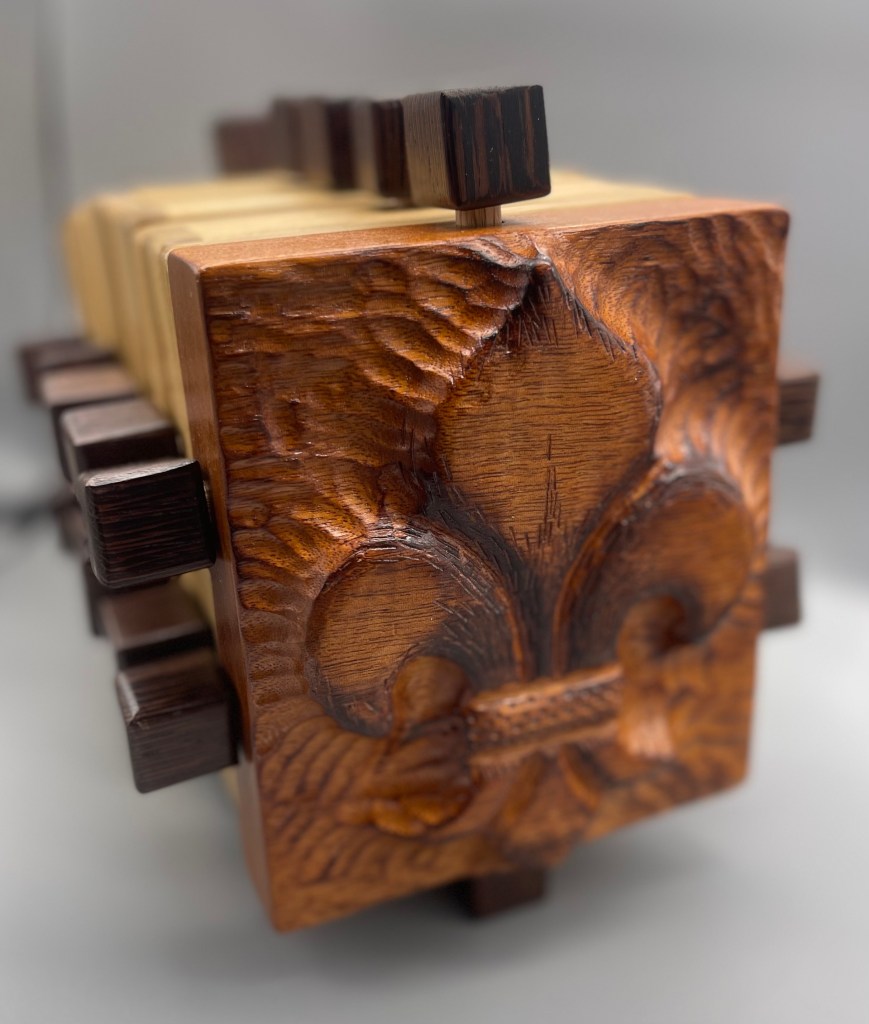
I’ve been wanting to write about Fleur de Lis for some time: this is a rather massive sequential discovery puzzle by Tracy Clemons, maker of another massive sd classic, Dark Fairy Door. At close to 5.5 lbs, Fleur de Lis towers over most other puzzles, tilting to one side as if threatening to fall over (it doesn’t). With a beautiful Fleur de Lis on its top, the namesake is clear. It resembles a precarious stack of many-knobbed drawers whose odd stature belies the odd movements to come.

Entering into Fleur, you will rapidly build up a lot of pieces serving a variety of purposes; whether tools or locks or red herrings, there is plenty to work with. In the meantime, you get yourself into some strange positions, with multiple laugh out loud movements that had me smiling as I solved. Meanwhile, there is what is inside the drawers! In classic Tracy form there’s a meta-puzzle waiting to be discovered and solved as you make your way through numerous hidden compartments.

Approaching the puzzle it is an open question as to where one should begin. This is not really a linear puzzler with a single path to the solution, which makes it easy to get lost (as I would soon find out). Building up a stack of pieces, it becomes clear that a patient and careful approach will be necessary if one has any hope of resetting the puzzle (which would prove to be a major struggle for me, a series of puzzles in its own right). This is not a puzzle for the light of heart! Take caution ye who hope to enter into its wacky dimensions.

I would need a LOT of help resetting the puzzle – I had left it in a state of undress for so long that I’d forgotten where too much went, as I struggled with solving the meta-puzzle hidden within. I am loathe to admit that I actually had to send it to Tracy for some help, so sure was I that something had gone wrong (which was completely my fault, rather unsurprisingly). A better puzzler than I (of which there are many) would surely not need such desperate steps but if you’ve read this blog you know my affection for puzzles tends to outstrip my abilities.

If you dig complexity, this is a great puzzle for you to take on. I was scared to approach it once more for the writing of this blog and only let myself get so far before backtracking in fear (coward!). However, I only wanted to remind myself of some of its complexity before sitting down to write about it and felt my cowardice was excusable. Jokes aside, I just don’t have the hours needed to dedicate myself to solving and resetting in one sitting and feared my lack of abilities in setting the puzzle aside over time as I did before.

I may be laying it on a bit thick for the sake of (questionable) humor – speaking with other puzzlers who have taken this on, they did not have the trouble I had resetting but…. again…. who’s got two thumbs and is kind of an idiot? (and apparently seems to think you can see what he is doing through the screen?)… this guy.

It Takes a Village: Oleg’s Wardrobe by Dee Dixon

Oleg’s Wardrobe

Dee Dixon

The Village was happy. For years its people celebrated nothing in particular, joyously throwing small objects into the sky and jumping up and down. Their kindness was so real, so tangible, that the Orb of Prosperity formed, giving the people something around which to dance in a rather silly, but quite happy, fashion.

King Oleg the Horrible, however, hated the happy hamlet – in fact, he hated everything: the sound of grass growing, the smell of fresh snow, and the tiny hats the people liked to wear. The King was cruel to the people in his kingdom, silencing laughter and kicking toddlers. For years he would grumble and mumble incoherently to himself, but the dancing…. Oh, the dancing was the last straw for Oleg. He stole the Orb from the Village and now things that were once thrown into the air are placed sadly on the floor.


Oleg has locked the Orb away in a secret compartment in a wardrobe he uses for small things like his fingernails and sense of self-worth. Knight Nyte the Sleepy Soldier has stolen Oleg’s Wardrobe but he can’t find the Orb! The cabinet opens but the drawers are empty! Alas, without freeing the Orb the people’s prosperity will forever be out of reach. It is up to you to find the Orb so that its magic may be released and the people saved, to laugh and dance and wear their tiny hats once more.

From: Tiny Hats and the Ogre that Hated Them, a Record of the Village that Prospers Once More

Dee never ceases to surprise – I still haven’t managed to solve Burner and he has something more complex coming out!

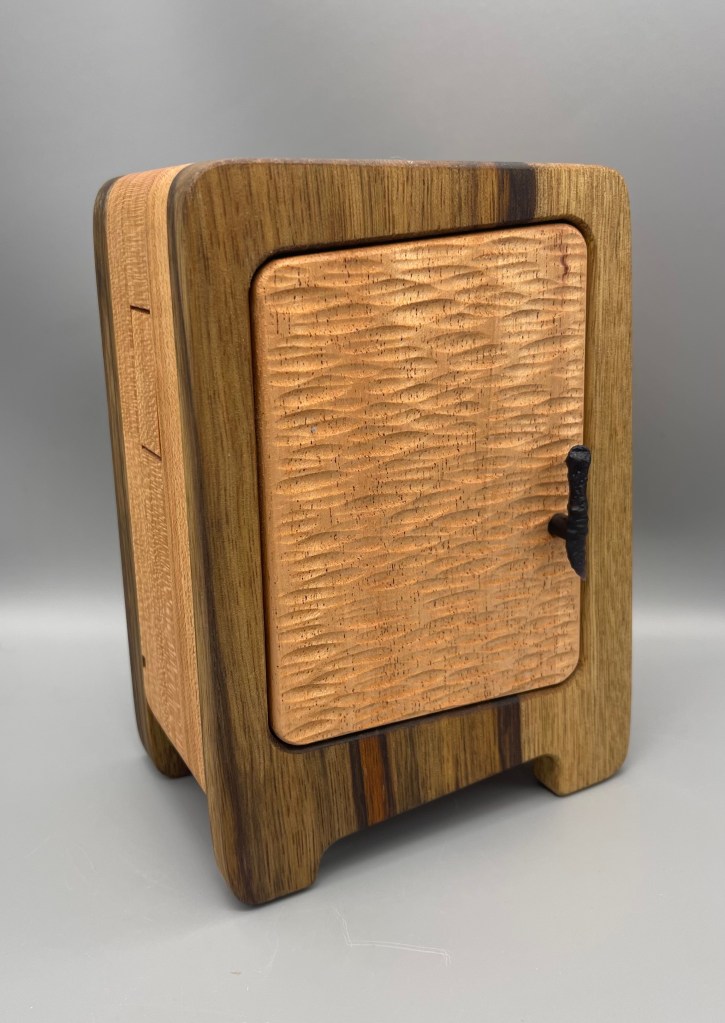
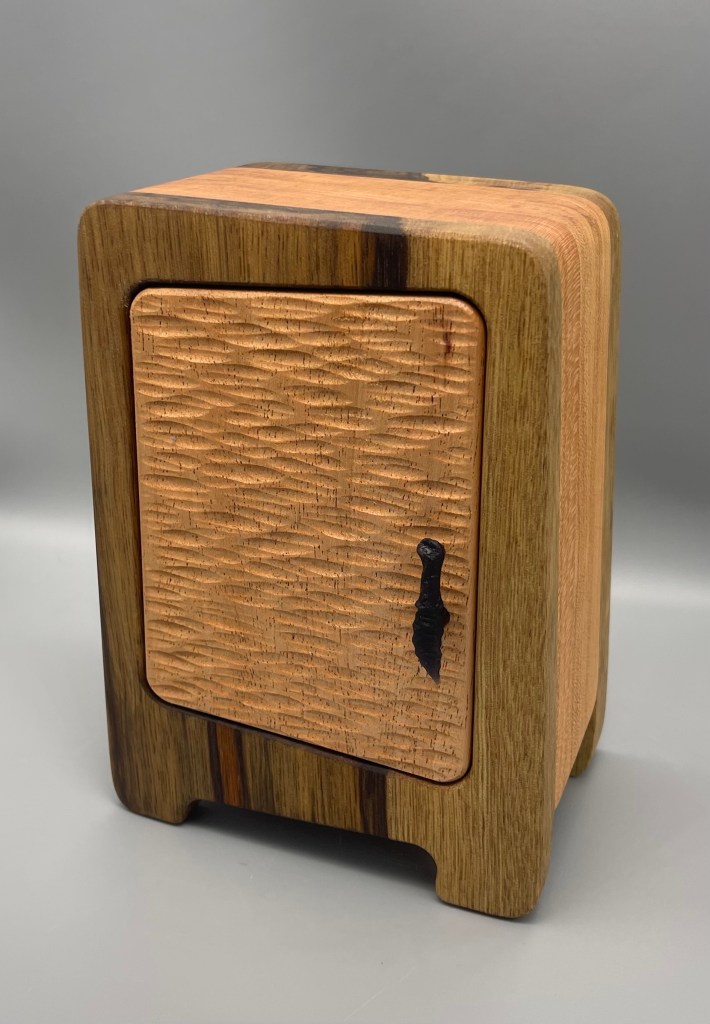
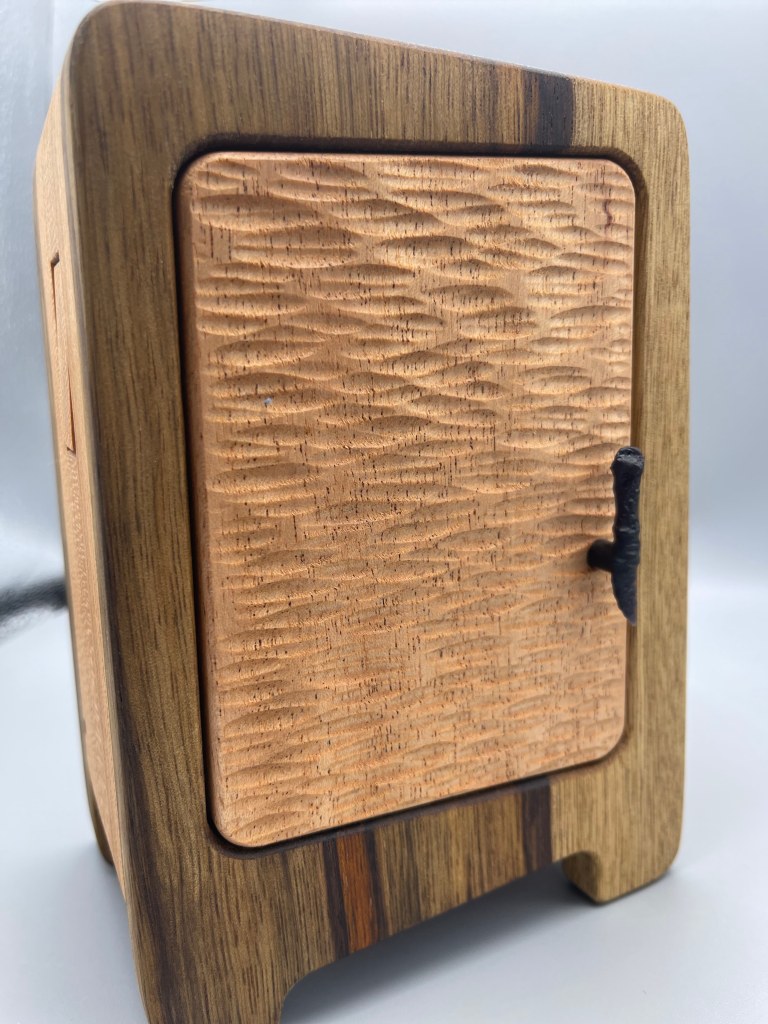
Oleg’s Wardrobe is a beautiful little cabinet with a door (maybe an Armoire?) in a weighty package (close to 2.5 lbs!). Mine is Black Limba and African Mahogany and the final version will be Peruvian Walnut and African Striped Mahogany (sure to be at least as pretty as the one I solved). The goal is to retrieve the Orb of Prosperity, which is hidden somewhere inside the wardrobe. After appreciating the little dagger doorknob, the door opens readily (with a reveal that made me laugh) but upon opening it up, there seemed to be little to work with. A rotating semi-circle on one side, a hole beneath it, and something that might be a button (that doesn’t press) on the bottom of the box. And that’s it (other than the drawers and door)! Shaking it a bit you can hear a bit of rattling… the Orb? Something else?

I stared at it for a while, asking it to share its secrets with me as I did everything I could think of to do… something. Before too long it did! Aaaaaaand now what? The main mechanism eluded me for quite some time before my aha! and even then I didn’t get very far. Some playing around and thinking(!) got me moving again, going in circles while I wondered what I was missing that could break me out of going back and forth through the few steps I had discovered.

With a little luck and a lot of patience, aha! I found what I was looking for. But still this something didn’t seem to actually do anything, not at first. Some more thinking and experimentation and I got it, only to find that I still had a ways to go. I was pretty sure I understood the basics but it took close observation, logic, luck and more than a little faith until…. the Orb! yay! Bask in my brilliance all ye doubters!

My brilliance soon faded when I realized I had reset the puzzle without returning the orb to its rightful location… oops. Fortunately, this forced me to really and fully understand the puzzle before I could reset it properly, both of which I like to do before I consider a puzzle fully finished. Even without this mistake, the reset might have been a challenge at times, requiring pretty complete comprehension (not my strong suit cough cough) of the central mechanism, with some subtle steps that tripped me up during the reset, adding a bit of extra challenge to the experience.

I had initially solved a late stage prototype before getting my hands on a final copy, which added another tool and a few more steps, while complicating an existing one. These round out the puzzle, really ensuring it has a satisfying length and challenge.

Oleg’s Wardrobe is as lovely as it is tricky – I might put it alongside Bad Moon and Uplift in some ways (but more difficult than either), making it an excellent addition to my ever-expanding Dee collection. Oleg is perhaps a bit semi-blind at one or two points, but really everything you need is there, you just need to realize what that means as you carefully and closely explore. I really enjoyed the non-linear nature of the experience, with some discoveries occurring in a random order; eventually I had discovered everything I thought there was but had to figure out how to put what I had learned together, a fun and somewhat unique experience to have a puzzling journey that meanders and splits and wanders before bringing everything back together. The final additions only add to this, with things that might need to come early being found late and vice versa.

Oleg’s Wardrobe is a fun, non-linear tricky SD journey in a lovely and weighty package. I struggled with it, hitting multiple walls before putting everything together and making my way through to the end. The reset added a bit of an additional challenge for me, requiring a real understanding of the central mechanism at work. A worthwhile addition to any collection!


B4: Brian’s Big Baffling Bolt

Brian’s Big Baffling Bolt

Brian Young (Mr. Puzzle)
Bolt: 65mm x 30mm, Brass
Box: 110mm x 50mm x 40mm, Papua New Guinean Ebony

I finally got done solving Brian’s Big Baffling Bolt (BBBB) from Brian Young of Mr. Puzzle and… just… wow! Mr. Puzzle announced the puzzle some months back and when my turn eventually came after several more months, I jumped on the chance to try Brian’s newest SD creation, following up on the interesting and uniquely broad challenges of Abraham’s Well.

In creating numerous, highly regarded SD puzzles, Brian has played with brass bolts in the past, having incorporating them into wooden designs: Three Wise Bolts, which I am fortunate enough to own, as well as his contribution to the amazing Lewis Carroll Project, Tweedledum and Tweedledee, which I was fortunate enough to try (but not fully solve) at the Puzzle Palace. This newest puzzle is meant as an homage to his 30 years of puzzlemaking, incorporating “hints” of tricks from some past designs in new ways, alongside novel mechanisms. Despite having solved several of his puzzles, I have to say that I did not recognize anything in particular, so I am not certain from whence these came but I do appreciate the sentiment: a cool way to share tricks that are now difficult to access due to the rarity of so many of his past SD designs.

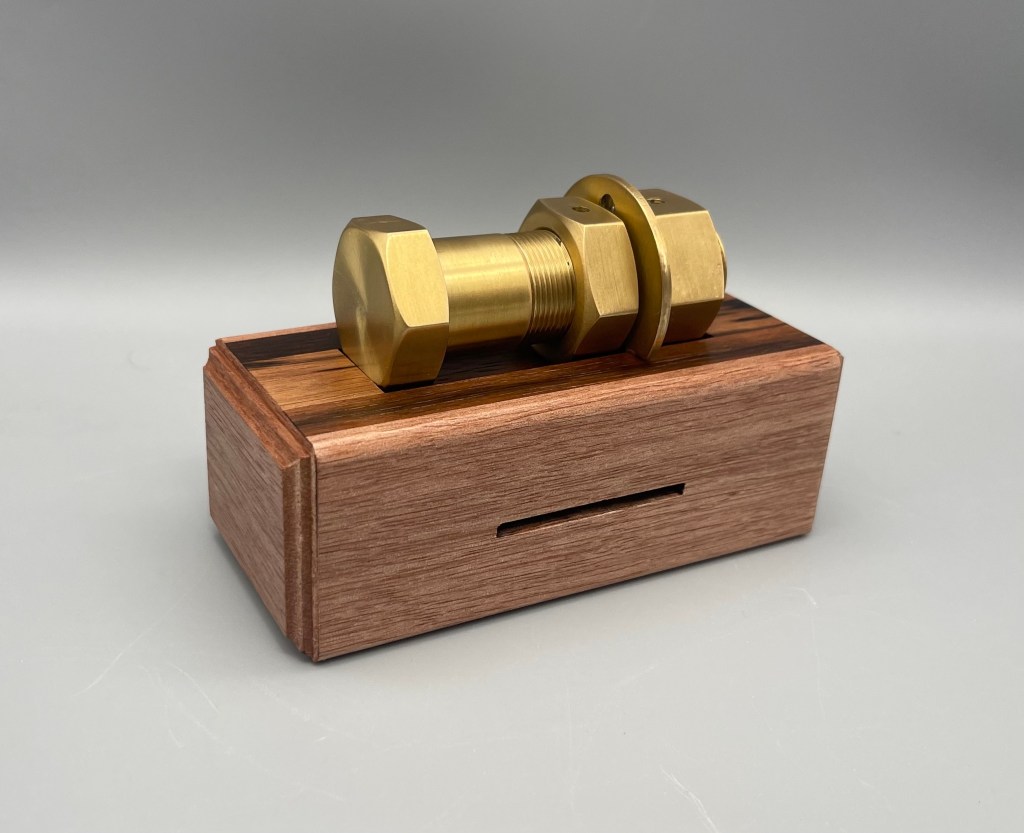
BBBB consists of a rather massive brass bolt along with a lovely wooden puzzle box made of Papua New Guinean Ebony. The box has slots on either side, a hole on the bottom (alongside the Mr. Puzzle logo) and a resting place atop fitted to the bolt. The bolt has a washer along with two nuts (each with a hole), one of which spins freely without screwing in either direction. I was able to make a bit of progress rather quickly, always a fun start and one which belies the difficulty to come.

This bolt was by far the trickiest bolt I’ve ever seen, with secrets galore. Through starts and stops, I worked my way through multiple aha!’s – so much so that if this puzzle consisted only of the bolt, I would have been satisfied with it as a solid puzzle (according to Allard’s blog, this was initially the case). But no! – there is a puzzle box as well, one that integrates well with the bolt before the finale may be reached. The end reveals a “30th anniversary plaque with [a] pearl” so it is quite clear that you’ve finally solved the puzzle.

I must admit that I needed more than a little help to get through some of BBBB’s multitude of aha!’s and tricky moments, in particular to get through some of the final steps; this did not take away from the experience in any way – the aha!’s keep coming and things I was sure wouldn’t do much worked in interesting ways. Some steps are a matter of exploring everything you have to be sure you know what everything can do, as you discover multiple tools to help along the way. I found myself exclaiming in surprise more than once as unexpected turns occurred, finally breaking through to the end in a final sequence that kept on giving after I was sure I was reaching the end.

The puzzle does not require hitting, spinning, or any force at all. Everything works smoothly; more than that, at one point I knew what needed to be done and was sure it would be difficult to accomplish. I found myself getting a bit disappointed, thinking getting through a section would require stabler hands than mine, only to realize that Brian had foreseen this and incorporated help into the design, such that this was its own aha! moment, in addition to the joys of discovering its mechanisms and tools. Although there is a bit that is somewhat blind, you are provided with sufficient information (if you take your time) to get through.

Despite it having taken me several weeks to solve (and in addition to my terrible memory), it was not difficult to reset: you will have come to fully understand, if not always see, everything such that you know what to do. After putting everything back where it goes and marveling at my own brilliance, I went back through the solve one more time, appreciating the rhythm and flow from section to section, refining my understanding of one section in particular as I worked back through.

BBBB is still being produced by Mr. Puzzle, with a promise that he “will definitely make more of these puzzles in the future.” If you do go to their site to contact them, be sure to browse the site as they have some great puzzles, including a number of IPP designs and the very unique Abraham’s Well (and an excellent Black Friday Sale going on now – no, I get nothing from the plug, I just think it’s a great site from a great puzzlemaker). Be warned that the site is closing towards the end of December, with Brian going into retirement (I do not know how this might affect the production of BBBB unfortunately). Hopefully we will still see puzzles coming out from time to time, as most certainly appreciate his work!


Going in Circles: Orbit and Uplift by Dee Dixon

Welp, Dee as done it twice more with his most recent releases, Orbit and Uplift: I got there eventually but it took me quite a while to do it, with a nudge or three needed along the way (although I suppose I find that just talking about what I am doing is sometimes the most helpful part – more often than not in the process of explaining where I am and what I’ve done I clarify what I haven’t done and aha!…. that or I am just trying to make myself feel better about frequently asking for help from other, better puzzlers).

Oddly, both of these totally different boxes feature a freely spinning center piece in a frame – but that is where the similarity ends (other than Dee’s excellent craftsmanship, as always). Both look and feel great, as with any of Dee’s work in my sometimes humble opinion; Uplift has received some aesthetic comparisons to Bad Moon, which I can see, but really they both have that Dee look you can’t quite put your finger on but can still readily see. Uplift is especially gorgeous and I suspect that producing it is particularly no easy task. Neither box is an overly long solve but both had me stuck for quite a while, so my experience with both was nonetheless quite long… and of course they look great alongside their ever-growing set of siblings – delightfully, Dee definitely didn’t disappoint.


Orbit

In the hours (and hours) I spent going in circles with Orbit, I will admit there were times I was certain the solution must be too blind… I was convinced I was going to be annoyed by the solution but in reality this was not at all the case once I actually figured things out. You are given plenty of information and just need to bring some patient observation to make sense of things. It is extremely unlikely to just randomly open this box, although there were times when I was sure I was close (and found out later how wrong I probably was). This is the kind of puzzle where you really need to work out what is happening to be able to reach the solution. There are many puzzlers out there better at this than I, who may well have had an easier time, but I really had to struggle to get there.

Eventually I made some sense of the box and was sure I could solve it only to be confronted with a problem I eventually worked out with a laugh. Again, the information was there if I stopped and thought about it (and I appreciated how Dee incorporated something that in another puzzle may have felt disappointing but still managed here to feel novel… it’s hard to say more without crossing the line into SpoilerLand (which I’d say is like CandyLand but that would give too much away)).

Having solved Orbit I can now get through the solve in a few minutes – a testament to how not-really-at-all-blind the puzzle is, once you’ve worked it out; in my experience, a truly blind puzzle can stump me even once I know how to do it. Here, there is no way to get lost once you know where you are going.


Uplift

Uplift goes back to Dee’s SD roots with an SD-lite solve in what is an absolutely stunning circular “box.” It had me stuck spinning myself nowhere on more than one occasion, with a particularly delightful aha! at the start. I had spent a few hours (yes, sigh) going in circles, doing everything I could think of… everything but the one thing that would actually do something. I found a bunch of feedback that did nothing more than to distract me from finding my way into the start of the solve and when that aha! hit… you just gotta love that dopamine, bruh.
From there, I got stuck one or two more times but was able to get through the rest of the solve in a couple focused sessions. Dee messes with us as the puzzles progresses, causing me to fall down a rabbit hole or two along the way. Fortunately, I was able to get back on track without help, all by my big boy self. Overall, it was not a super long trek to the end once I got past that first wall; I managed to hit that last step with a laugh when I saw where Dee goofs us once more.

I know of one rather vocal critic of Uplift, someone who I suppose solved the puzzle quickly and felt it should have been longer (not a Karakuri collector, I imagine). To me, this first leaves out the importance of respecting the difficulty and complexity of physically producing a beautiful box, which is much of where the value of a collectible puzzle is derived. If you only care about how long it takes you to solve something, than you may not appreciate puzzles like Karakuri’s, for example, which, to some, may be solved quickly – I care more about the elegance of a solve, the flow from step to step, how it integrates with a novel aesthetic built with immense care… although I suppose it may be easy for me to say, since I rarely solve anything quickly (I never claimed to be smart… just circumlocutory and loquacious 😉

But, really, I do not want to give the impression that Uplift is a short puzzle; I don’t like giving a step count unless asked but, by my count, the length of the solve is about average (in terms of steps) for Dee’s work. Most important to me, I was never disappointed with my experience solving it. At the end of the day, I may have spent more time on Uplift than on Walter’s Radio, which does feature more steps (and is one of my favorite Dee boxes) and seems to have stumped some puzzlers as being too complex. Radio is the harder puzzle I think, but Uplift really got me looking in the wrong direction on more than one occasion, which just goes to show you how random the puzzling experience can be and how subjective our perspectives inevitably are.


One of the great things about Dee’s work is that he gets a lot of feedback before releasing puzzles – between prototype testers and a few early releases, he gets a lot of information before calling anything done, oftentimes even giving the public a look into the puzzle from a blogger or two before public release (not that you should listen to anything those guys say, cough cough). It should be no surprise that his puzzles are rarely, if ever, the subject of controversy or contention (and oftentimes the subject of confusion).

Dee has brought us two more beautiful and tricky puzzles that hit different price points and scratch different itches, both leaving me with the lovely feeling of success that solving a good puzzle can provide. Somehow, Dee is apparently putting the final touches on yet another puzzle so I may be back soon… assuming I can solve the darn thing.

If My Words Did Glow: Ripple by Peter Canham

Nary a day goes by when no-one asks me: “Hey, 5S, where the heck ya been the last few months?” Well, life happens and writing fell to the back-burner for a time. But this is not to say that my puzzling itch went anywhere – I’ve still been FOMO’ing my way through my bank account and struggling with the (many) yet unsolved puzzles in my midst (I’m looking at you, Orbit… and you, pretty much every Osanori puzzle I own).

There has been some truly great stuff to come out since the Nashville Puzzle Party (I realize that I haven’t posted since then… Wtf?!) but my favorite (solved) puzzle since then has got to be Peter Canham’s Ripple. After patiently waiting a year or so, I got an email that it was my turn! Cut several weeks ahead past some USPS shenanigans (and absolute kindness from Peter in his quest to make sure the puzzle got in my hands) and it arrived, safely packed in some laser cut plywood.

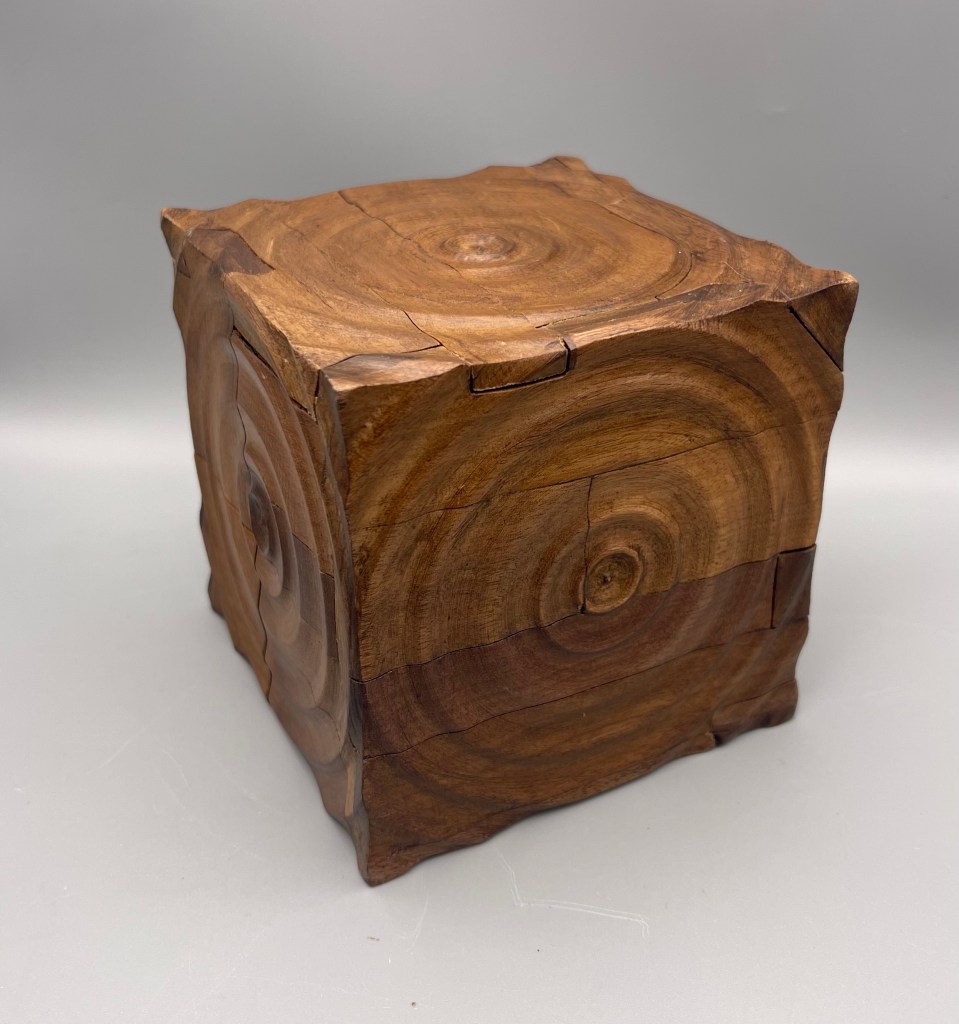
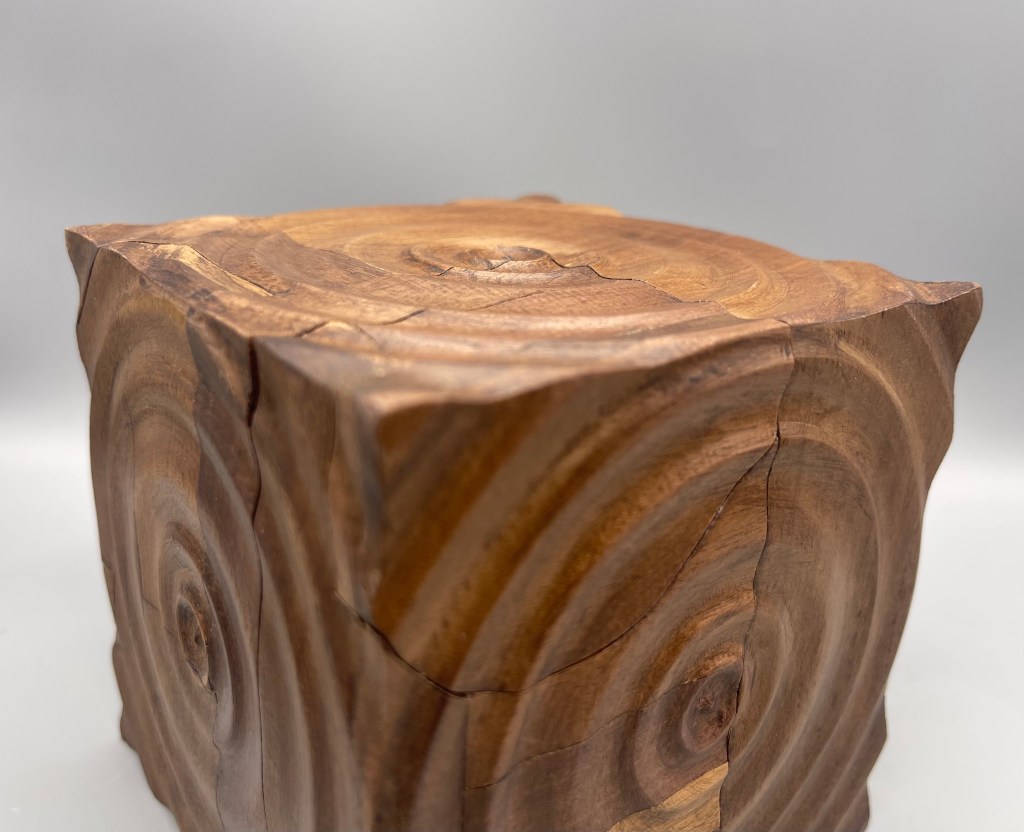
Ripple’s aesthetic mirrors its name with each face of the 4″ walnut cube featuring a series of rounded, concentric circles. These are broken by all sorts of strange and seemingly haphazard lines, giving you a hint of the complexity to come – at times these lines might prove helpful but they somehow still managed not to spoil some wildly unexpected moves. In Peter’s (comparatively succinct) words, it is “a box that was like a sequential puzzle but was non linear i.e. one move did not necessarily lead to another but possibly two or three. Like ripples in a pond interacting with each other. The biggest design challenge with the ripple box is that as the moves bifurcate the mechanisms start to interfere with each other,” resulting in a lovely cube that is seriously tricky.

After a moment appreciating the look and feel of the box, I was off: I was able to find something rather quickly but it seemed to lead nowhere, leaving me in circles that led to other not yet helpful discoveries, as I spent at least a couple hours over several days without making any real progress. Finally, after clarifying an assumption or two with Mr. Boxes and Booze, I found something odd and quite unexpected. And there I sat once more, staring into the next of what would be several walls that would lead to quite a few satisfying aha! moments. Eventually, I reached the solution and found Peter’s signature alongside the series and batch number. After basking in my brilliance for a bit, I reversed course, resetting the box and going back through the solution once again, appreciating how the moves lead into and around one another, moving through the maker’s vision to the end.

I suppose some might debate this, but I feel like it easily meets the crowdsourced Discord definition of sequential discovery, as it takes you “on a journey through a set of sequential and generally non-repeating challenges involving the discovery of hidden mechanisms” to reach the solution. SD has come to inspire some rather specific meanings that may or may not be met by this puzzle; regardless, the journey itself awards the puzzler with plenty of satisfying aha!’s. But, really, who cares: it’s a darn good puzzle, which is all that matters.

And now, what’s this? A new Dee Dixon puzzle adorns my doorstep? Ah, yes, you may yet hear from me again soon (sorry).