That Funky Monkey – Brass Monkey Sixential Discovery

Brass Monkey Sixential Discovery

Two Brass Monkeys, 2 lbs, 2.75″

I’ve long been a fan of Two Brass Monkeys: Steve and Ali’s sense of humor is only outpaced by their sense of puzzling, with numerous metal locks and burrs having come our way over the years. I am in possession of all 6 of the Brass Monkey Burrs (along with a few of their other creations) and am now utterly compelled to write about them, having just solved BMSD, the sixth member of the burr series.

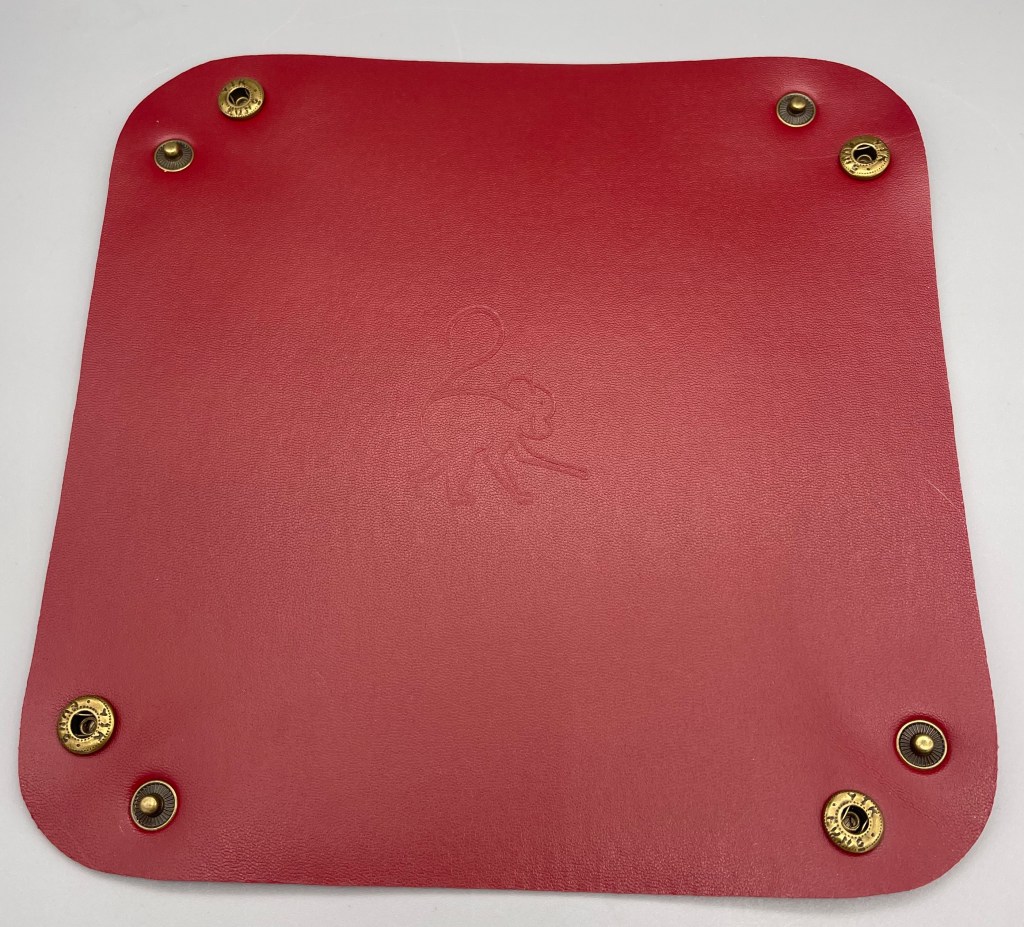
(I also want to call attention to the fittingly adorable TBM branded mat that generously came with BMSD – this is definitely going to come in handy!)
BM 1 – 6 appear almost identical, the only giveaway (aside from weight and, sometimes, a bit of noise) are on the tips of the sticks, with the number of concentric circles varying to designate which of the series you are currently looking at (some, including BMSD, also feature holes at the center of some stick tips). The series builds off of itself: the first is a classic, six piece burr, lovingly and perfectly crafted out of brass. From there, the series begins to add tricks, forcing you to think wildly outside the box at times as you uncover a way to unlock and disassemble the burr. The complexity of these trick openings increases as you progress through the ranks of the series, becoming ever more tricky and ingenious. If you like burrs and trick-opening take-apart puzzles (and who doesn’t?) then this is a series for you!

This, however, is not a comprehensive write-up of the series but rather a focus on the most recent, sixth entry. The sixth is something of a departure as it really starts to place a HEAVY emphasis on sequential discovery. This puzzle is not for the faint of heart – be prepared to build up a stack of doo-dads as you make your way through. That said, it is all highly logical and sensible; there is a clear flow and rhythm, even when I would hit walls I could typically tell (somewhat, more or less, kinda) where I was headed, even if it might take a nudge to get there (it did).

Starting on this 2 pound beast of an SD burr wasn’t so easy – I had to adjust myself to the fact that this is metal and I ain’t gonna hurt it and before too much longer I was on my way. This puzzle just keeps going and going – the goal is not to disassemble, or perhaps I should it is not just to disassemble. The first time I thought I was done was when I had the puzzle in a bazillion pieces; the second time was when I found… something; the final time was when I found the something else I still needed to find (totes adorbs). (I am being a bit cagey as I always like to err on the side of spoiler-free). Each time I basked in my own brilliance, alongside the many aha!s I had come across as I made my way there.

I was pretty sure that I was going to struggle with the reset – burrs are far from my strong suit and the bazillions bits and pieces didn’t encourage much confidence. But there is something so logical and clear about the complex design that I was able to backtrack my way without too much trouble (it helps a lot that I made myself solve it in one sitting – I cleared an afternoon and it took up all of it to do so – it was oh so worth it).

But what would a fivesinatras write-up be without some dumbassery – fear not reader, so sure was I that I had solved it early that I fully reset it before discovering the last several steps required to find the something else. Of course I dove right back in, pieces flying as I delved deep (more like pieces being placed carefully to the side but I am going for imagery here) reaching where I had previously reversed course and realizing where I needed to go (it took a while and a nudge or two to figure out how to get there, however, with this being one of the trickier parts of the whole shaboodle).

Suffice it to say I am a big lover of this puzzle – if you dig SD take-apart puzzles, then this is most definitely one for you. I suspect it will garner much love amongst the puzzle people puzzling around out there.

BMSD in its Natural Habitat, alongside its five siblings and cousins, Ali’s Bolt and Hokey Cokey Lock (and a number of other metal puzzling fun).

Hitting the Jackpot: Bandit by MW Puzzles

Bandit

MW Puzzles; 350 copies
2.5 lbs; 7.5″ x 3.75″ x 4.25″
Metal, Walnut, Acrylic

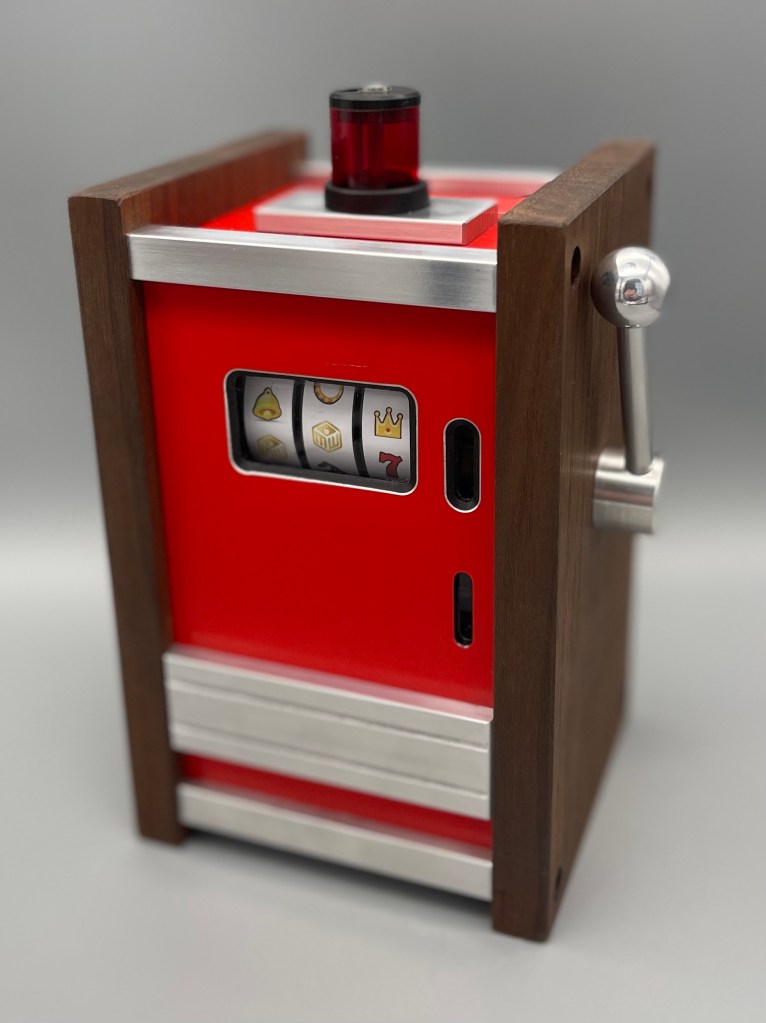
When I was a kid, I had a miniature slot machine with tiny tokens that would make the wheels spin; hitting a jackpot would release whatever tiny tokens had been inserted thus far. While entertaining to my nascent mind, there wasn’t all that much to it – pull the arm, spin the wheels, lose and repeat until you win.

MW Puzzles has taken the classic one-armed bandit and made something fun, tricky and unique, something instantly recognizable, such that the ultimate goal is clear from the start even as the path to it is not.

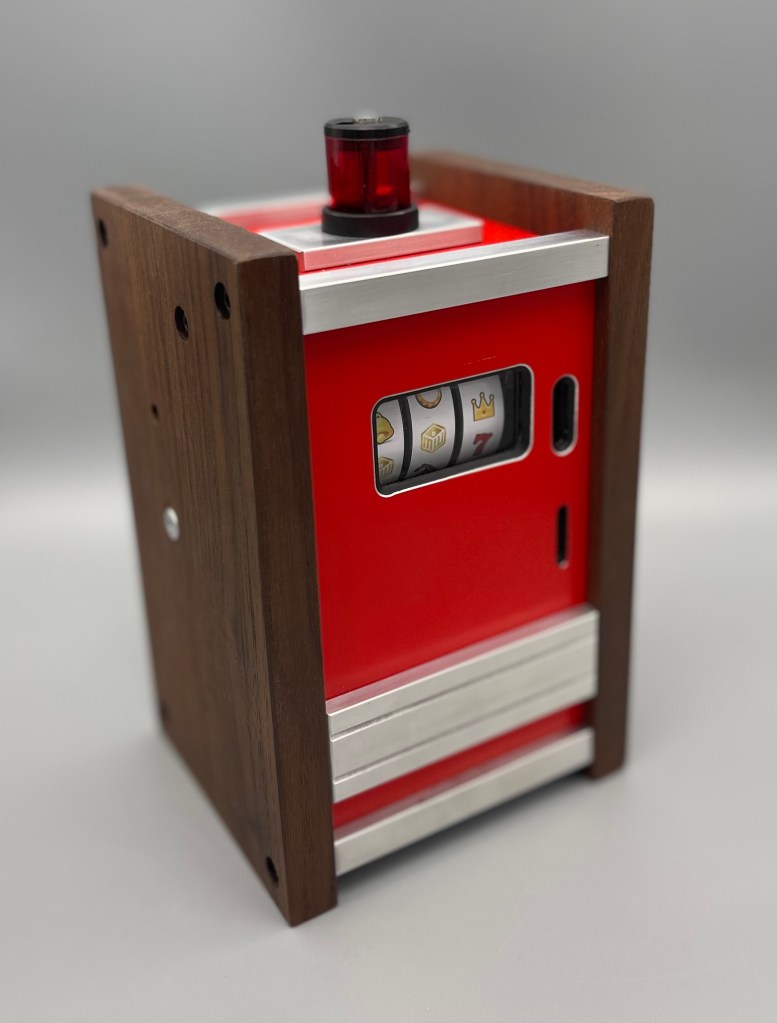
This makes for something that demands to be picked up, sure to catch the eye of puzzlers and non-puzzlers alike. It begs to be handled; at 7.5″ x 3.75″ x 4.25″ and 2.5 lbs (that’s just over 1 kilo for you metric weirdos), it fits perfectly in two hands, a necessity for all the exploration it will require.

When you first sit down with MW Puzzles’ Bandit, you will almost certainly do what comes most naturally: pull the Bandit’s one-arm… and you will find it does nothing but rotate freely: the wheels don’t spin and a jackpot is most definitely not in the cards. This is sure to reel you in and pique the puzzling mind in the way that a good puzzle does, spinning you around while sucking you in so you just want to try one more thing, just like the real thing catches you with just one more quarter; the difference is that you can actually win with Bandit, should you put in the thought and effort – the payoff is in the cards, to mix casino metaphors.

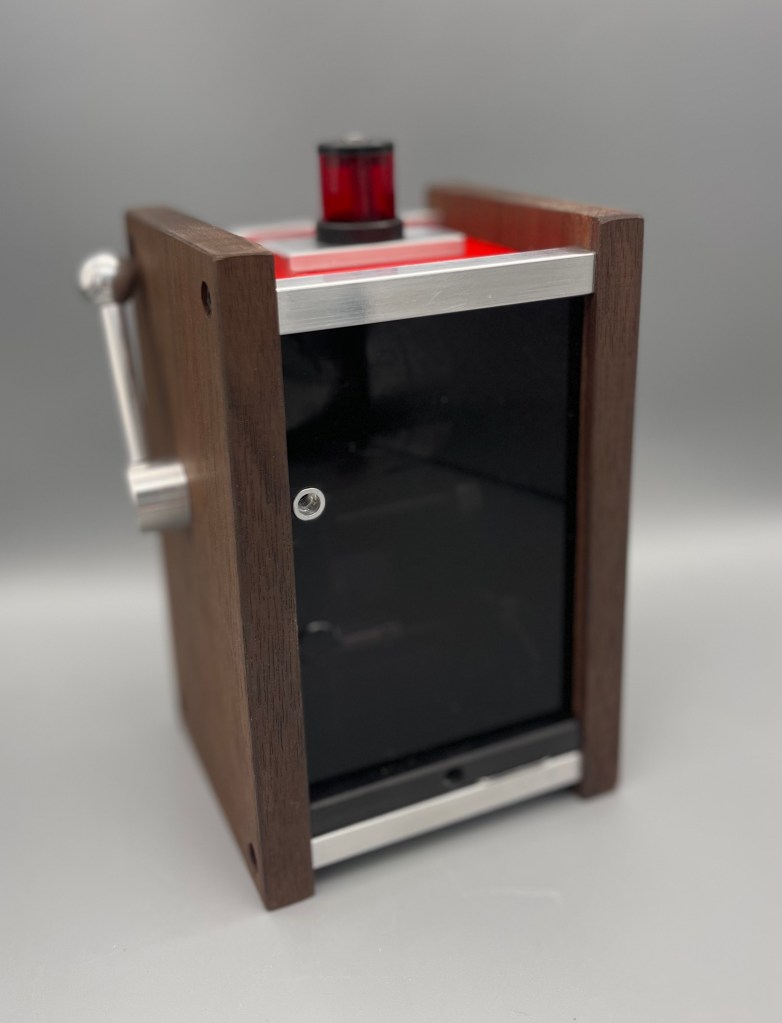
So begins a sequential discovery journey that rewards experimentation and patience, teasing you with a partial view of its inner workings through a semi-opaque acrylic back, framed by lovely walnut sides and a glistening metal frame that comes in one of four colors.

I had the welcome opportunity to test a late prototype and to compare it to the final version, getting a glimpse into the careful planning and patient meticulousness of the puzzle’s creator. This is not a hastily thrown together puzzle but is instead the result of ample thought and cast-aside proto’s – there were a few changes following even this late prototype that proved to me that MW is a puzzle maker who takes this art seriously; in seeking to entertain, it will be done with pride in a well-made product.

I shouldn’t be surprised after solving MW’s previous trilogy of metal puzzles, all reflecting their excellent craftsmanship and puzzling prowess; Bandit is a larger evolution of MW’s puzzle oeuvre that secures its place as a puzzlemaker to be followed.

Crafting a puzzle that actually looks like something is not all that easy – other than Karakuri, most makers shy away from the innate restrictions imposed by holding oneself to an existing aesthetic but MW leans into it, using the well-known game of chance to inform and obfuscate its puzzling mechanisms, with multiple tools (some quite well hidden) and a progressive puzzling journey whose finale provides the payoff one hopes for. MW has made something that is as aesthetically pleasing as it is recognizable, with puzzling that does not disappoint.

The goal is not so much to “fix” a “broken” slot machine but to discover how this strange cousin functions instead, achieving a jackpot through skill rather than stumbling upon it by luck: this is no game of chance but rather one that requires thought to understand and conquer.

MW began taking pre-orders for the initial run of Bandit a couple weeks ago; pre-orders appear to currently be closed at this time but I would reach out via discord or the website if interested, as interest seems to (unsurprisingly) be high. Bandit will be limited to 350 copies, 75 of each color with an initial run of 300 and plans for a final 50 down the line.


To every puzzler… Turn Turn Turn by Perplex Puzzles

Turn Turn Turn

Perplex Puzzles, 6 lbs, 7″ x 5″ x 2.5″

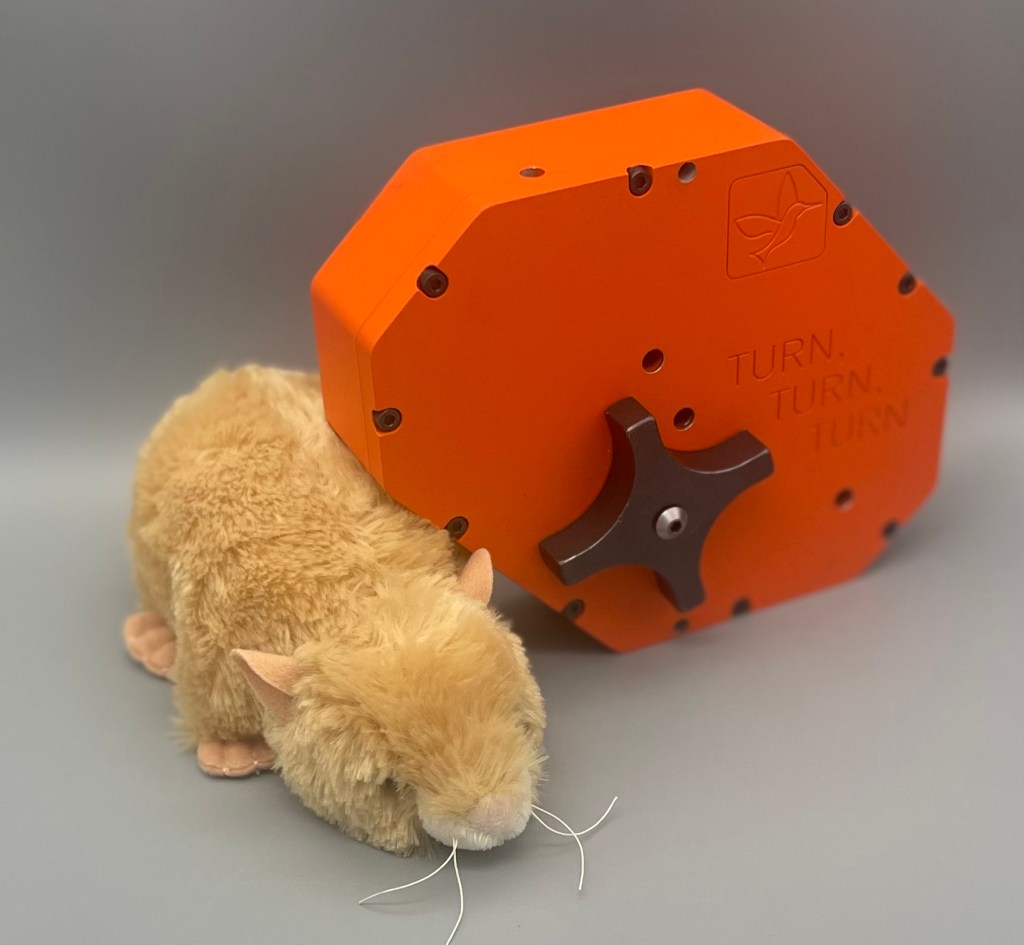
It has been a couple years since Perplex Puzzles released Wishing Well and the anticipation for his follow-up puzzle has not waned. Turn Turn Turn (found here) is bigger, heavier, sequentialier discoverier, and has the potential to drive you a bit mad. Bill B. from Perplex sent me a copy a while ago to try out and if you liked Wishing Well, I am pretty darn sure you are going to love Turn.

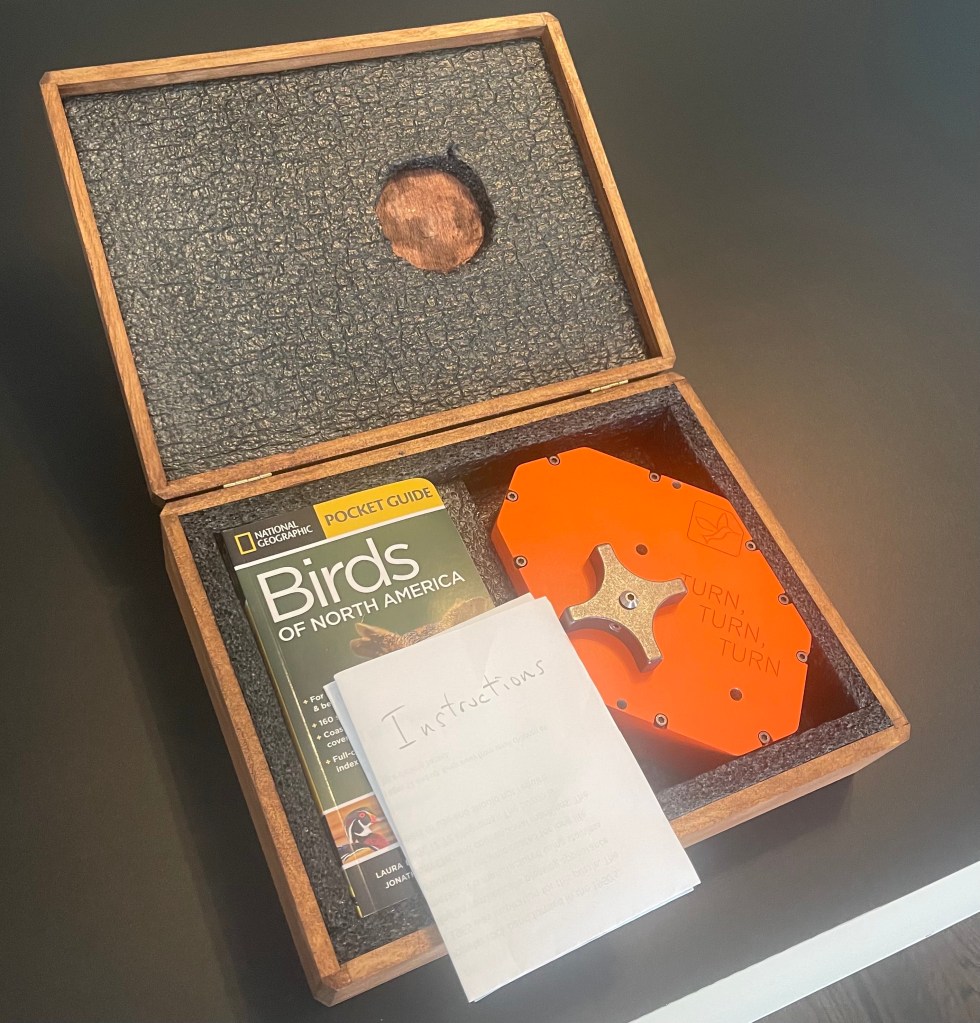
Bill has packed a lot of puzzling into this fat, orange parallelogram, which features a black handle on the front, a number of holes along the front and sides, and a protruding something emerging from its back. As with Wishing Well, Turn arrives in a large wooden box, with some instructions, a Bird guide 😉 and the aforementioned solution (in a separate manila envelope). This is 6 pounds of heavy metal puzzling and is not for the faint of heart – this is for puzzlers who want to be challenged with something that is going to take time to discover, understand and, ultimately, conquer. The enclosed laminated solution walks you through the solution and reset with fifteen pages (!) of steps (with pics!), which is to say this is neither a short, nor simple puzzling experience.

Bill is a retired machinist and his expertise is very much on display here, as well as his love of puzzles by designers such as Will Strijbos and Rainier Popp. Turn does not rely on magnets or force – it is truly and purely mechanical: discover tools, explore the various mechanisms that lay semi-hidden within the puzzle’s frame, experiment with the various moves and machinations possible while paying close (very close!) attention to the effects. This puzzle is absolutely solvable – it is not impossible as it is not blind: Bill gives you various ways to check on where you are, although it can be easy to get lost unless you are careful, developing a picture of what is going on through trial and error and close observation until you can begin to develop an understanding of how the mechanisms work, what needs to happen and how to get there.
I was able to make fast progress at first, discovering some initial tools that quickly begin to lead me into the puzzle. I would still be discovering tools and their uses over the next few hours as I progressed deeper into what can only be called a puzzle machine, slowly learning how it worked and how to manipulate it before I could zero in on how to reach the solution. Eventually I had a working understanding of the mechanisms and could orient myself towards the goal, which would take quite a bit longer to reach (along the way, I would need to decipher the included clues… and I may have asked my wife to check a thing or two against the solution for me, but I got there!).

Bill ends it with a flourish, a bit of a call-back in a moment of triumph that had me smiling – it was great to have something to clearly say: “you did it!” to acknowledge my efforts. I am confident that this is going to be a popular puzzle amongst fans of complicated metal hunks of puzzling that are difficult but solvable if you put in the time and brain power (this puzzle has an excellent ROI in terms of puzzling time, at least in my experience). The only downside: unlike some others, Turn’s shape will not lend itself towards being weaponized in a sock – Plant Cycle still earns the award for best puzzle in an apocalypse, in my opinion; otherwise, this is a novel, challenging and complicated puzzle machine to solve. They will be released in batches over the coming months, with Bill reaching out to those on his list. Pay attention as I bet they will go quickly!


Three Little Puzzle Cubes Are We: MW Puzzles

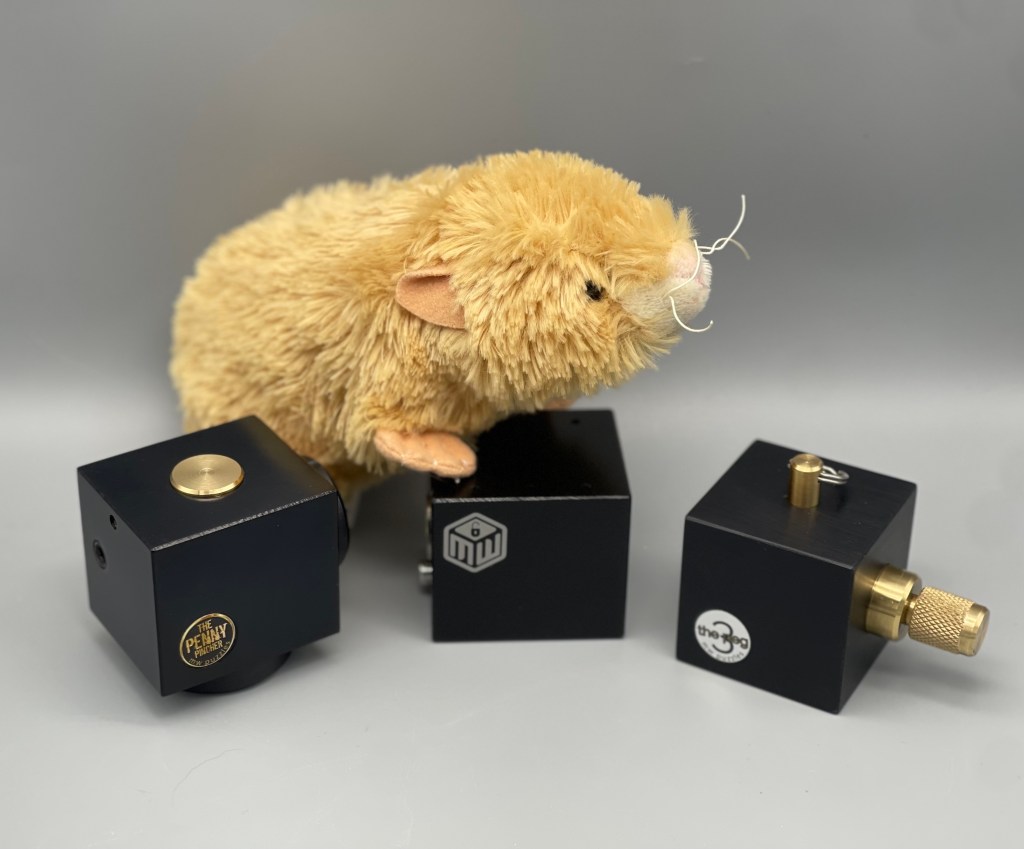
3 the Peg, Penny Pincher and Lib Orb Rate

MW Puzzles, Approx. 2″

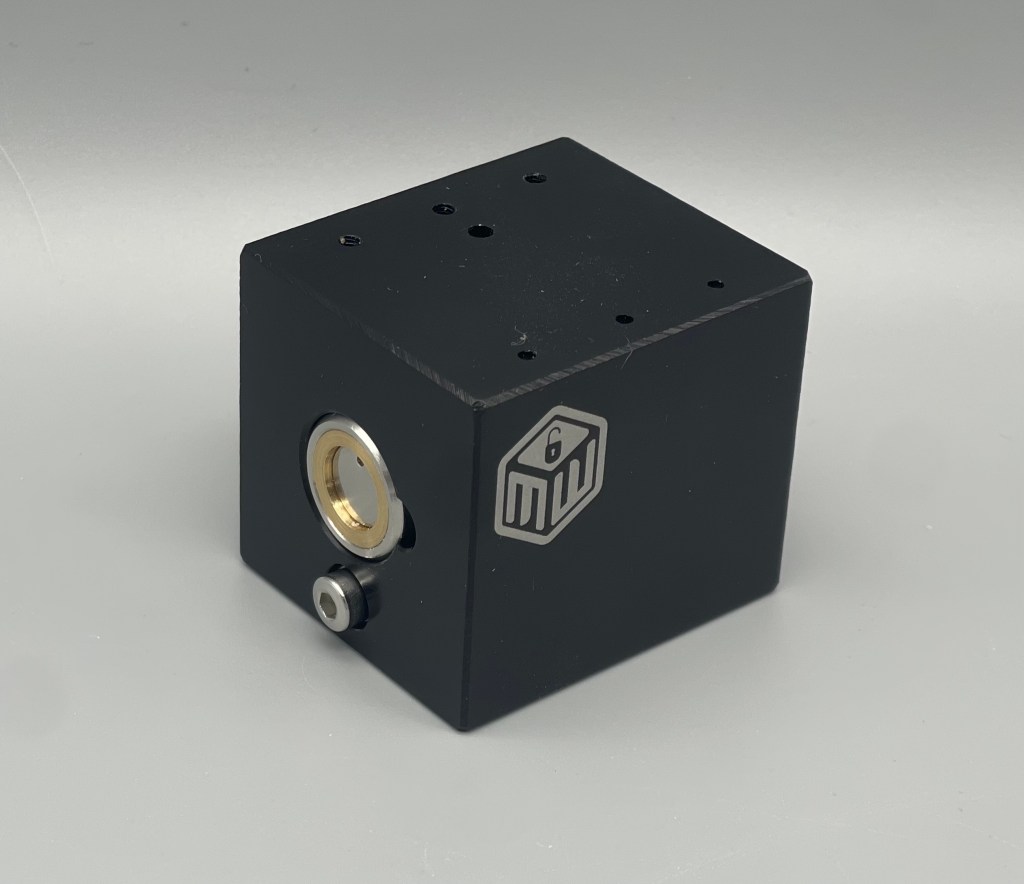
Some months ago, MW puzzles appeared on the scene with 3 the Peg, a smallish black metal cube with enough holes and protrusions to tempt most puzzlers. I didn’t know anything about the maker but when has that stopped me from trying a new puzzle…

Peg and its two siblings make for a trilogy of puzzles that share an aesthetic, making for an extremely collectible group – I do love puzzles in a series that manage to have a consistent style at the same time as containing distinct mechanisms. The black metal cubes have slightly varied dimensions (more or less 2″) and the distinct protrusions and holes across their faces send a clear signal that these are wholly different from one another. The amount of puzzling contained within these relatively small footprints (particularly in the second and third in the series) reminds me of the trio of printed puzzles by Alan Lunsford (aka Layer by Layer on Etsy): Unsafe Deposit, Bolt Action & Mighty Pin, all of which offer absolutely excellent puzzling at a particularly good value. A good designer can fit a lot of puzzling into a small frame and MW’s use of metal makes for a very high quality example of this puzzling axiom.

3 the Peg

When 3 the Peg arrived, I was first taken with the overall quality of the build – there is some serious machining skills on display, with every piece placed perfectly in prime puzzle position such that pretty much any puzzler can appreciate the sleek appearance and solid feel of the puzzle.

3 the Peg is the first and the simplest of the three puzzles released by MW – this is not to subtract from the elegance of the solve which relies on a well-hidden trick that could certainly keep a puzzler stuck. I managed to solve it fairly quickly but this could at least partly be due to luck (one of my early guesses proved correct), although I would venture to guess that more experienced solvers may have a similar experience. Having found the main trick, it was not terribly difficult for me to work out the remainder of the solve. I think this is a particularly great puzzle to hand to non-puzzlers as it it not too long a solve and can show how one’s basic assumptions about the workings of a puzzle must be discarded; further, the extremely well made parts will show any non-puzzler the level of craftsmanship we tend to expect from our makers.

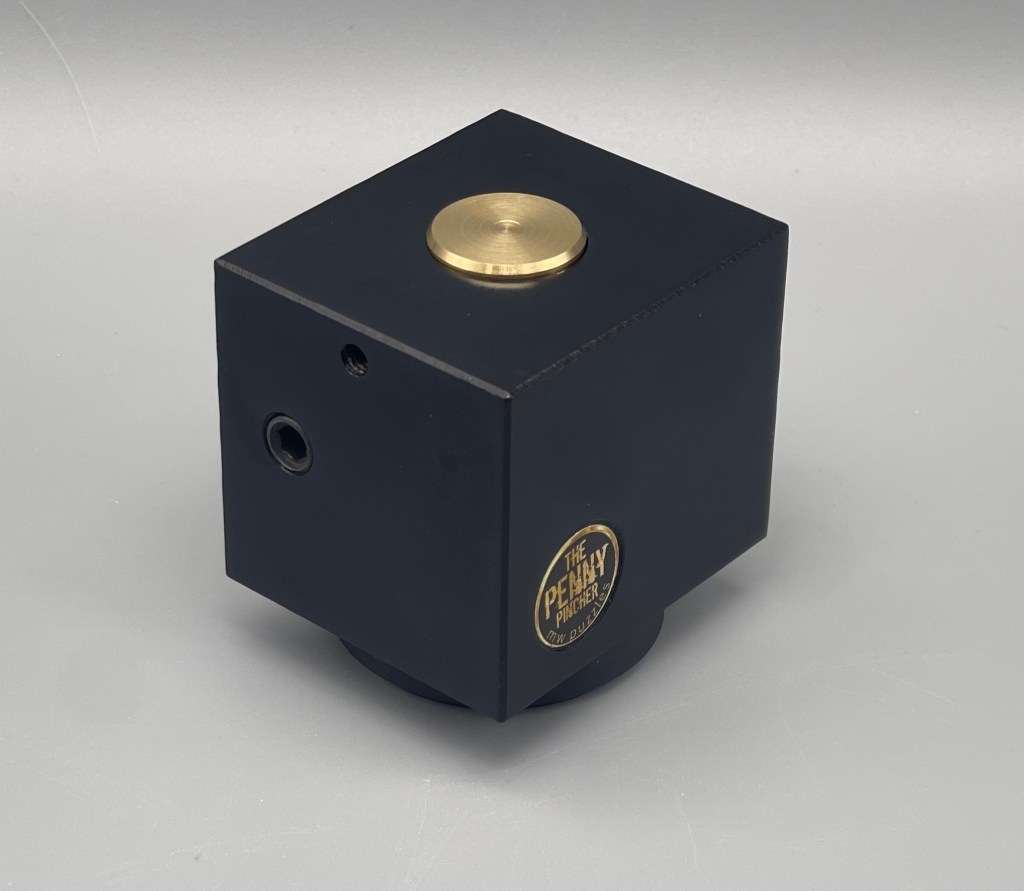
Penny Pincher

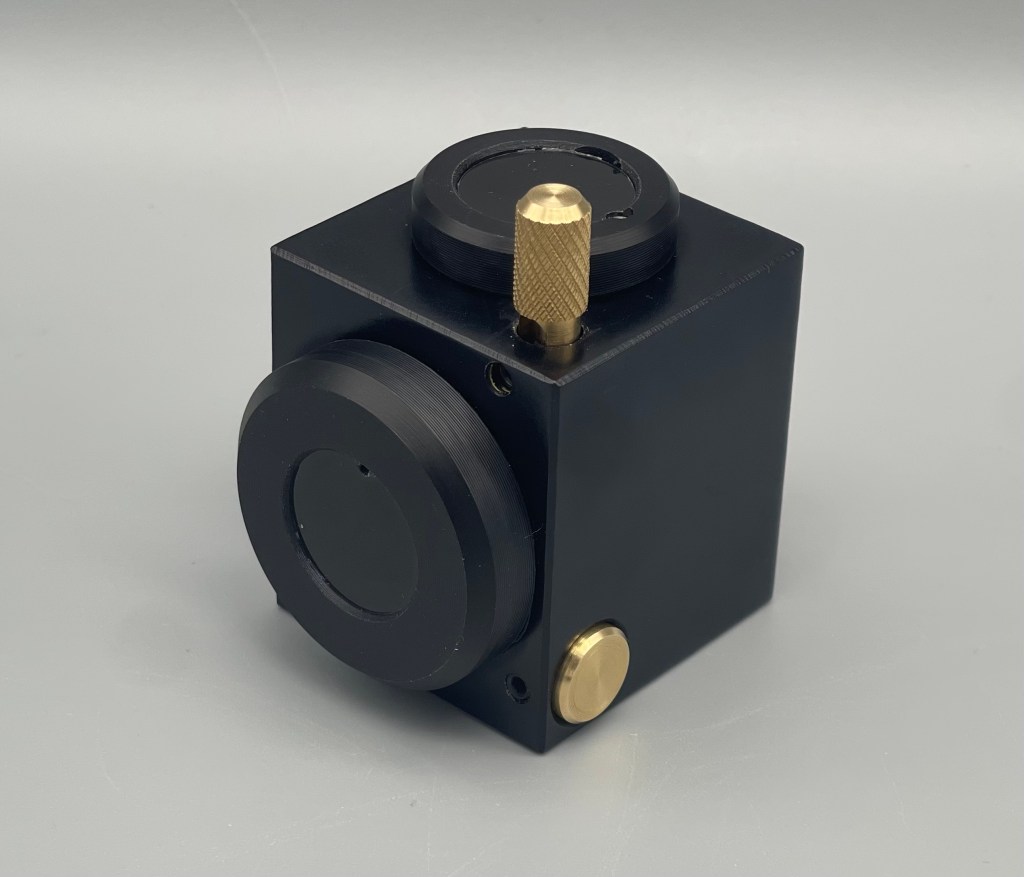
I missed out on buying this one on release and gratefully solved a loaner copy from a fellow Discord puzzler- and I am glad I did! This one really steps things up in terms of complexity and difficulty, with a pretty long and involved series of steps and discrete mechanisms to get through before the titular penny is released. Luck will not get you very far and even experimentation is somewhat limited as I needed to have a good sense of what I was trying to do to avoid going in circles. PP is a bit crazier looking, with plastic rings on two of its faces, almost resembling camera lenses. These bits help to create the impression that there is a lot to work with, helping to lead me down some rabbit holes at more than one point in the puzzle; one early section in particular had me smiling once I fully grokked how it works. Construction of the puzzle is still quite good, although I did have an issue with a couple bits falling off (easily fixed) but the instructions tell us that these don’t do anything, which was good to know.

Several legit aha! moments await you as you get through the sd solve, more than one of which is likely to earn a guffaw or two. While Penny may not be the prettiest of the three puzzles, it may be my favorite: the mechanisms are smart and tricky, making for a fun and satisfying challenge that rivals the next puzzle in this MW trilogy.

Lib Orb Rate

Lib Orb Rate is the newest of the three puzzles they have released and it really is a darn fine puzzle. They once again pack a lot of puzzling into a small footprint, for a multi-phase sd solve that poses a solid challenge and works smoothly. I hit a wall early on and got nudged in the right direction – I was sure that there was some blind muckery about and my own assumptions and faulty deductions were tempting frustration … until I realized everything I needed was there for me to work with. They don’t hold up a sign to focus on what that might be but the information is mostly available after some close observation and trial & error to see what’s what making it sometimes semi-blind (but totally fair).

Passing through this first phase, I moved on through the puzzle in a pretty clear, but not at all simple, progression: I never felt lost even when stuck and I eventually worked my way through the rest all by myself (golly gee). Stupidly, I forgot that the name of the puzzle tells you what you’re trying to do and briefly believed I may have solved it – it would have been an ok puzzle if it stopped at that point and I was pleased to find that it continues on to a cool mechanism that is executed quite well, with some small details that must be precisely followed, particularly on the reset. While this final section was perhaps not necessarily 100% new to me, the other puzzle that shares a somewhat similar section is rare enough that many if not most puzzlers playing today may well have missed out. Regardless, it is executed differently (and perhaps more reliably, if I’m being totally honest) and is as worthy an aha! as in that other solve, particularly as it adds additional subtle trickery. All in all, Lib is another great puzzle from MW with a solid challenge and satisfying solve.


These three quality builds from MW Puzzles has me eagerly anticipating whatever follow up they might have in store – they are a welcome designer to the puzzling world and well worth watching for whatever they will come up with next. According to the designer, it may be a while before these three are re-released, if at all but, perhaps more importantly, there will be a smaller “key ring puzzle” in time for the holidays and a major release coming in the New Year – I am looking forward to it!


Get Lost: FastMaze by Dan Fast

FastMaze 1

Designed by Dan Fast
Produced by CubicDissection
Aluminum & Brass, 3″ x 1″

I got the chance to try an early copy of one of FastMaze 1 (designed by Dan Fast and produced by CubicDissection), and “fast” is not one of the words I would use to describe it: smooth, yes; fun, certainly; challenging, absolutely; but fast? Nope. Not for me anyway.

Dan has designed many a high level burr, including the relatively recent Stir the Coffee produced by Pelikan; PWBP shows more than 100 puzzles designed by him, a level of prolificacy shared by few others, including the rather iconic Superman and Batman burrs (also produced by Pelikan). FastMaze 1 is one of a series of three new puzzles being produced by the excellent craftspeople at CubicDissection, whose recent equipment expansion allows them to create more affordable challenges that still meet Eric’s extremely high quality demands (perhaps the hallmark of CD creations).

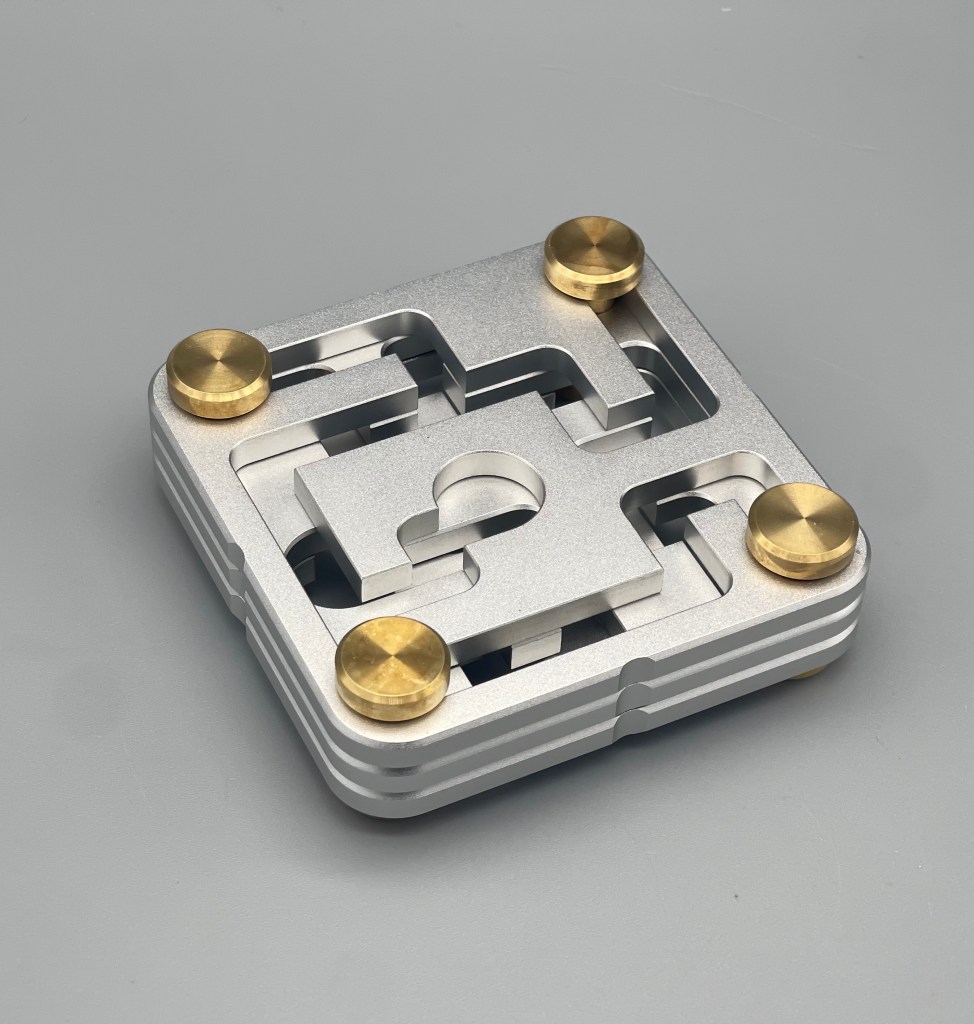
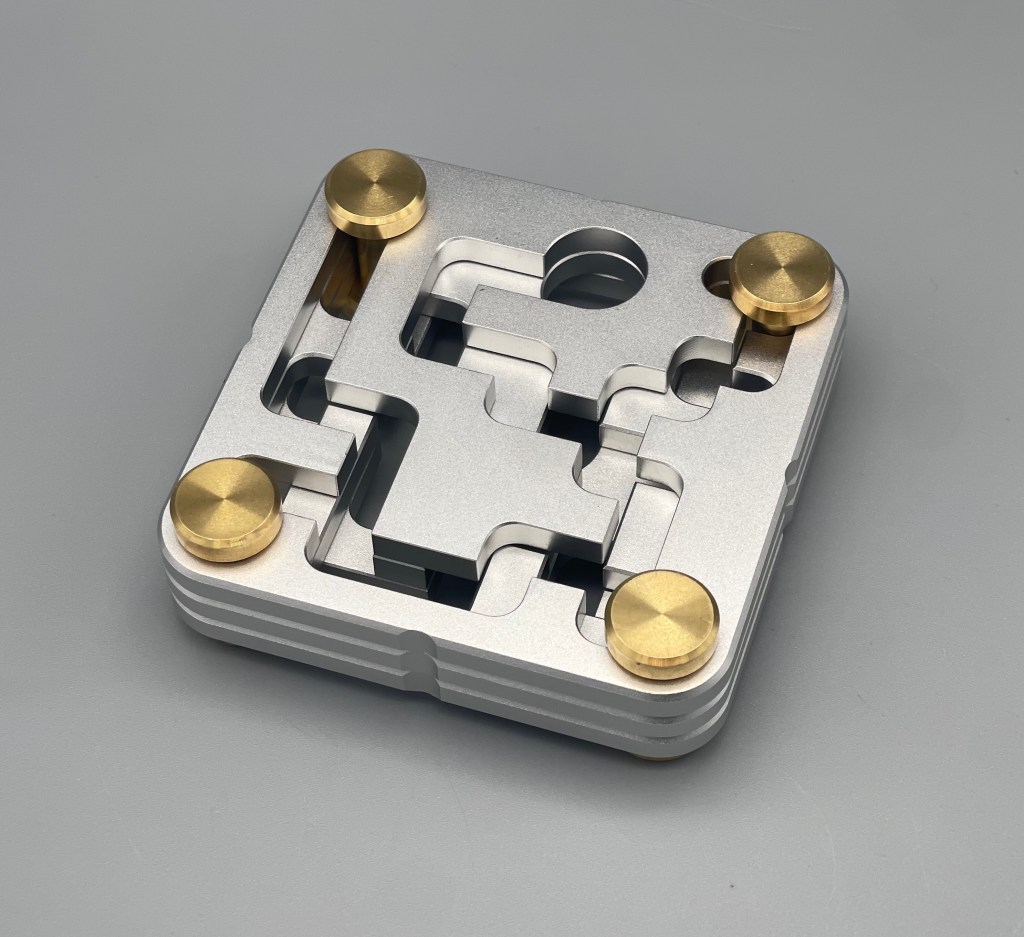
FastMazes 1 – 3 are three-level square mazes in which you must navigate pins in each of the four corners to a hole that will allow them to be removed one at a time; of course, this hole is in a totally different spot on each of the three levels so getting them to line up is no small feat. FastMaze 1 is the “easiest” of the three – I say this with my tongue firmly set into my cheek as its 137 moves is far from easy. Not only is that a lot of moves total, but once you have removed the first piece you still have another 83 moves to go for complete disassembly (the full solution is 54.28.24.28). FastMazes 2 and 3 are levels 160 and 196 respectively (#3 requires 121 moves just for the first piece!). This may sound intimidating but while it is most definitely a challenge, it is by no means unapproachable.

CD has produced the series of 3 puzzles in metal, with super smooth aluminum mazes navigated by four brass pins. The puzzles have been designed to easily come apart, allowing for a simple reset that makes the puzzle much less terrifying. The quality is apparent from the moment you pick it up: the metal is smooth to the touch, the pieces gliding over one another softly and easily. Notches marking the edition of the puzzle have been built into the center of each side, a nice aesthetic detail that helps you maintain control over the puzzle, especially once the levels start getting spread out as you progress through the solution. This happens quickly as the paths block one another unless you are able to have all pins situated such that the maze levels can shift. After a little while, it becomes possible to rotate one or more levels, something that I am still not sure whether it helped or hindered my progress. Apparently, the second of the three designs requires rotations, which I plan on confirming once they all become available. Regardless, the rotations are similarly smooth and, importantly, feel controlled – this is not like a burr that has become unmanageable with pieces rotating against your will. Its size fits perfectly into two hands (or your pocket for easy transport), allowing for easy control even as the pieces spread apart into its various contortionist configurations.

At first, I simply appreciated the construction and fit, the pins refusing to move until sliding smoothly and freely once a path becomes available. I began playing with it just to get to know its movements, finding it has a fun fidget friendly factor as an added bonus (it was also oddly satisfying to pinch one of the pins and swing the puzzle back and forth….. maybe that’s just me lol). It quickly became clear that such an approach was not going to afford me much progress: I was going to have to apply some brain power if I wanted to get anywhere as random fiddling isn’t going to get this little guy apart on its own (eventually, I suppose, but there might be a monkey Shakespeare by the time you get there). The exposed top and bottom levels allow you to work out a lot of where you need to go, but the center layer is largely hidden, confused by the paths above and below it through which you can try to make it out. As you work through the solution, of course, more of this layer is revealed and you must adjust your intentions and goals accordingly. Solving multiple mazes simultaneously with multiple moving restrictions is much more than the sum of its parts: dead ends exist in most any maze but here you must sometimes take advantage of these, working pins somewhere just so you can allow another to move elsewhere before backtracking once again. This makes for a great balance of experimentation and logic in working towards the solution, which will sometimes seem so close only to slide away once more. After finally releasing the first pin, I thought things would open up and become easy but in fact there was still plenty of puzzling left, the logic somewhat simplified but still significant in the strategy required to solve it.

FastMazes 1 -3 were released today, August 29th, 2022, available individually or as a set of three. I found that as soon as I had solved mine I wished I could reach for another, so I will definitely be picking up at least one more (who am I kidding, like my compulsive completionism will allow me to have just 2 of 3…). These are a fun challenge at an affordable price point with no sacrifice of quality (as we expect from our friends at CD), bringing excellent puzzling value to whatever puzzle shelves it will soon grace. You can find FastMaze 1 here and the others here.


The Other Best Blue Metal SD Puzzle Cube

Wishing Well

Perplex Puzzles, Stainless Steel, Aluminum, and Brass, 3.5″ x 3″ x 3″, Currently Available

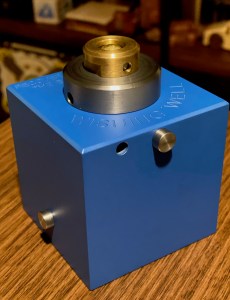
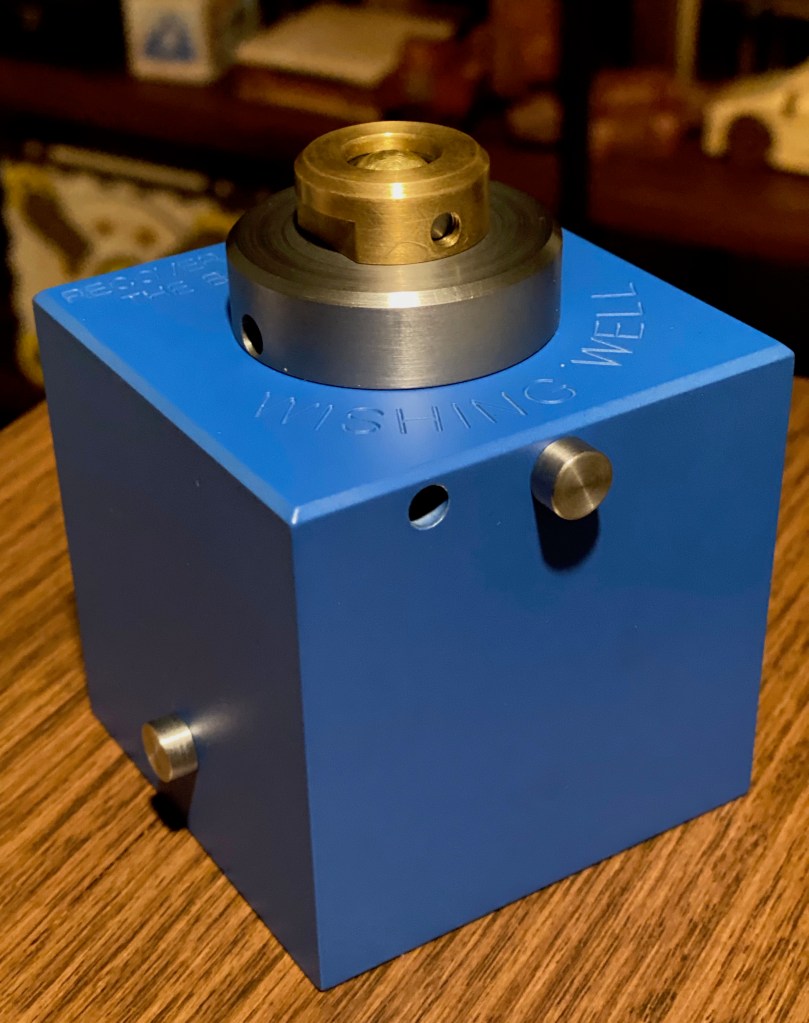
Recently, a puzzling friend of mine sent a pic of a metal puzzle box that had my puzzling parts tingling: Wishing Well is a new (currently available) puzzle from Perplex Puzzles; while seemingly a newcomer to the mechanical puzzle scene (afaik), the creator is a machinist with 39 years experience and the impeccable craftsmanship of the puzzle is definitely consistent with this expertise. At first glance, it seems somewhat similar to Will Strijbos’s First Box: it is a blue metal cube, with a cylindrical protrusion on its top. However, it is a bit bigger and significantly heavier than that puzzling classic; its blue surface is ceramic-coated “for long life,” and it has a number of holes and nubs and such located around its periphery.

Perhaps more importantly, this puzzle boasts an approximate number of 50 steps to solve(!) – this is made even more sweet by its instructions, informing us that there are no magnets, no need to spin or shake, and no smacking or excessive force needed. Described as “sequential mechanical,” after spending time with it, it most definitely falls squarely into the sequential discovery sub-genre of take-apart puzzles: it contains an “intricate assembly” of various metal parts that have been “precision machined on both CNC and conventional machines.” Presumably, this requires a lot of time and effort to make (a fact belied by its significant price tag); I took a bit of a leap of faith and bought it (who am I kidding – a brand new 50 step, SD puzzle box?! yes, please). As stated on the website, these are made in small batches: “[d]ue to the extremely close tolerances and tight fits, they are individually fit and assembled.” Yet again, music to my puzzling soul.

Made in the US, it arrived in just a couple days, arriving in a heavy wood crate with a dozen or so screws around its edges. This was obviously extremely cool and had me anticipating the puzzling experience all the more. Opening the crate, I found a wooden case with a metal clasp taking up about half its interior. Inside this unassuming (not a puzzle) box, lay Wishing Well, comfortably nestled in the foam-lined interior. Lifting it out of its perfectly-sized hole, the first thing I noticed is that it is heavy. Like really heavy. I mean, noticeably heavier than Pachinko, let alone First Box. Its ceramic coating feels smooth and softer than most metal puzzles had led me to expect, and the two-stage, two-toned protrusion on top immediately grabs my eye: a two inch metal circle (aluminum, presumably) topped by a one inch brass circle with what appears to be a brass ball nestled within. The primary directive has been etched into the surface of the box, just above the circles: “Recover the Coin from the Bottom of the” (and then, curving around the bottom of the circle) “Wishing Well.” There is something so practical about it that I like – almost like coming across an odd-looking lock box deep inside the guts of a factory.

Inside its wooden case were two folded sheets of paper: one were the instructions (see below), which included several points in addition to those listed above, instructing the puzzler to not only recover the coin, but to reassemble it completely before it can be considered solved. But the unassuming line that mechanical puzzlers will be likely to find most intriguing sits somewhere in the middle: “Disassembly and removal of the coin can be accomplished easily when taking the proper steps in the proper order.” Wunderbar! This is a puzzle that seems to follow a series of discrete steps – rather than vague movements blending into one another, I have found a tool-based mechanical progression that is by no means easy.

In addition to the instructions, there is a hint sheet – after spending a significant amount of time on the puzzle, I peeked at it, almost as much out of curiosity for the sheet’s contents as for the hint itself. Included hints are not a common occurrence with puzzles for some reason (many don’t even show up with instructions), and I found this to add to my enjoyment of the puzzle, especially as the hunts themselves are conceptual and do not really spoil anything: there are a couple quotes that provide as vague a nudge as any esoteric comment from a fellow puzzler might, as well as (wait for it) a crossword puzzle! Apparently, by solving the crossword, you can then put the words into the order provided to reveal an additional hint. The quotes were not anything particularly helpful – an experienced puzzler is likely to find them to be advice that is generally good to keep in mind when approaching a new, complicated take-apart puzzle, but I appreciate the vague nudges (and I think it is especially welcome to include something for those that may be relatively new to the puzzling world). I have not yet done the crossword, which I suspect may contain something a bit more concrete.

Along with the wooden case, there is a manila letter-sized envelope labelled “Solution.” Because of how heavy it is, I had to open it and at least peek in the top; careful not to reveal any of the actual content, I was able to see that it contains 10 laminated pages with printed text and pictures(!) – pretty awesome and likely quite thorough.

Finally, on to the puzzling experience. As I mentioned, I have not yet solved it fully (I suspect it will cause me to flounder and flail about for quite a while, which should come as no surprise if you know me at all); at this point, I have progressed through about dozen steps and I can confidently say that this thing is badass. As claimed, when you find a step, it is clearly a step; and yet, it is oftentimes totally unclear what to do – it seems like there is so much that you should be able to do, and yet at any given time it may take a while to find anything that you actually are able to do. The visible holes and nubs hide tools and inner working that change in nature as I work my way along – what did little, now does much; what was sticking out, is now sticking in; things move and potential pathways begin to open up, moving the puzzle along at a decent pace until I get to a point where I find myself yet again going in circles, able to do several things, but unsure which to do or in what way or order. Do I need to do this before I do that? Should this go here or should that go there? I am gathering intel on what lies inside the box, details emerging as I discover ways to make this or that happen. Each piece moves perfectly; this is a puzzle clearly made by an expert in the craft that knows how to get metal to do what he wants. Unlike some puzzles I have done, it does not feel like round pegs are being forced into square holes, where you are unsure whether you should do this or that – while it is by no means always clear what to do, I have found it very clear what not to do; this puzzle hides but it does not cheat.

I will end by saying this: it is very clear that this took a lot of thought to design and a lot of effort to make. The puzzling is very enjoyable, with well-concealed, discrete steps that incorporate tools and non-obvious movements that keep me interested and excited as I struggle to find my way through to the next wall. Perplex’s product page features a “Coming Soon” sign beneath Wishing Well; the new puzzle is named Turn, Turn, Turn and comes in at a slightly lower price tag. If it is anything like Wishing Well, the price is likely to be well worth it. I don’t know whether Perplex will continue to make Wishing Well after the new puzzle has been released, but I assume that once the puzzling world gets wind of these, they may start disappearing, so start saving or selling your solved stuff because this thing is seriously fun.


Craftsmanship: Five Sinatras

(No Terence Trent D’Arby jokes were made during the writing of this blog… until now)

Lost in the Weeds

Plant Cycle

Designed and Built by Christian Cormier

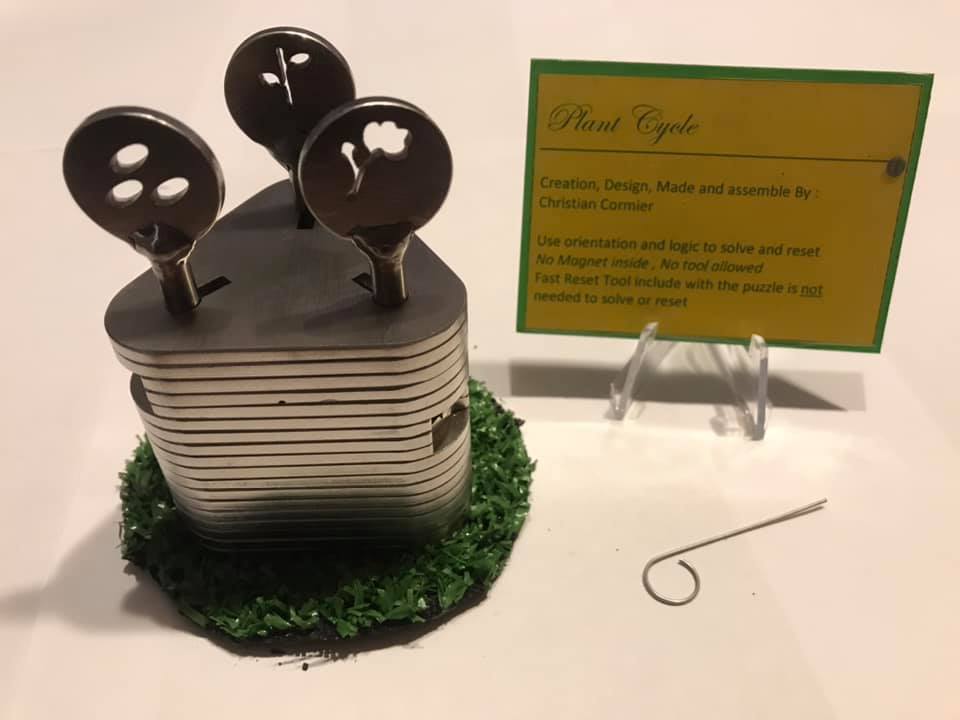
Plant Cycle is a limited run of 50 puzzles, designed and built by Christian Cormier as a follow-up to his Father & Son Dueling Keys. Plant features three custom keys (as opposed to Father’s two), which are protruding evenly from a BIG piece of layered metal, notched discs centered in recesses at different heights outside of each key. The top of each key has a different image cut out: seeds, stem, and flower (from where we get the name). The goal is to remove all three keys.

The first thing that you will notice should you be fortunate enough to get your hands on one, is that this thing is heavy. Like drop-it-in-a-sock-and-fight-your-way-through-hordes-of-zombies heavy. It comes with a circular piece of astroturf to thematically protect your table and shelves from this metal hulk (did I mention it was heavy?), a card with instructions, and a thin reset tool, which is not required to reset the puzzle but can certainly help. The instructions tell you that there are no magnets inside and no tools allowed (including the reset tool, obviously).

I ordered this from Christian a few months ago, and it arrived quickly, packed well and with care. It feels solid in your hands and looks very cool. And so I began turning keys. Unsurprisingly, they do not just come out, but each one can be turned this way and that, hitting obstacles and dead ends, allowing you to lift each one up and down (to some extent), but not to actually remove them from the base. I did most of my work on it with it at rest on a table, occasionally picking it up to turn it around and peer confusedly into its three faces, wondering what in the heck is going on inside. It would end up taking me many hours over several weeks (and a couple nudges from him) to fully solve it.

It is not a spoiler to say that working on this puzzles feels akin, to a limited extent, to manipulating three Revomazes that share the same base. Whether or not it can be solved in the same way is not something I will say (and considering the fact that I have never actually solved either of my Revos, I suppose I am hardly one to do so). Suffice it to say that this aspect of the puzzle is clear as soon as you start getting lost in each key’s journey up and down and all around.

I will say that there is more to the puzzle than “just” wandering through the three keyholes – Christian included a few tricks that made this puzzle stand out and be truly enjoyable. The solution had to be worked out through deduction, with a bit of help from some clues provided by the puzzle itself, in combination with trial and error and general fiddling about (and perhaps a bit of mapping).

On several occasions while working on it, I felt that I was just about to “solve” one or more keys, only to find that Christian was just messing with me. But I never felt frustrated, only mystified. And when that first, big a-ha hit, I was genuinely pleased: it made total sense and let me know, to some extent, what I needed to do, without actually knowing how to do it. This was something I had to work out intellectually before I could apply it, which to me is a hallmark of a great puzzle. And this disconnect between understanding at least this one trick and knowing how to fully implement it affords the puzzler even more quality puzzling.

Having figured out this aspect of the solve, I proceeded to make good progress, but I would still need a few more hours to fully solve this behemoth, getting lost and trapped many times, creating the need to backtrack and rethink my approach as I progressed through to the end. As I indicated, this main a-ha is not the only one, and there were other hidden features that I had to discover before I was able to get any one key out. This elicited a squawk of success, startling my sickeningly supportive spouse as I set this single key down with satisfaction, somewhat certain that I could now solve this sucker. However, Christian again seems to have planned for this, as I was not able to easily go on to remove the second and third key, and actually had to (reluctantly) re-insert the key, seemingly having overlooked something or needing to take a few steps back before I could continue forward.

Nonetheless, I was now able to find my way clear to the removal of the second key without too much trouble. But the third would elude me for quite some time, requiring more painful thinking as I tried to see what I was missing. Finally, eventually, all three keys were out, and, after the requisite happy dance, I snapped some pics for posterity and allowed it to rest peacefully before I would go on to tackle the reset. I chose to tackle this without the use of the provided tool, although I did use it at the end to make absolutely sure that all three keys were fully reset back to their starting positions.

Plant Cycle is an excellent puzzle from a relatively new creator who I am certain will bring us some new and exciting puzzles in the future – it is a unique puzzle that incorporates some mechanisms that I have not previously encountered with a novel goal. I also love this puzzle from a philosophical perspective, which may sound somewhat pedantic, but had to be said as it is not something one will generally find in a puzzle. Plant took the lessons Christian learned from Father & Son and applied the same concepts to create this apparently more difficult puzzle that will most assuredly delight and confound any puzzler and I genuinely look forward to seeing what he will come up with next.

Grade: Four and a Half Sinatras