Twisted: Box of the Celts by Matt M.

Box of the Celts

Matt M., Numbskull Puzzles, 5″ x 5″, PLA

Matt M. (FroodLoops on Discord & Reddit) teased an sd puzzle box on discord about a year ago – I’d been fortunate enough to see it right away (ok, “obsessive enough” might be more accurate) and politely began harassing him with the occasional friendly poke to make sure I was still on the list (yes, I may have forgotten whether I’d asked – in my defense, I believe that the design changed significantly at some point along the way and pretty much became an entirely new puzzle).

Anyhoo, a few weeks ago I got word that the puzzles would soon start rolling out; a couple weeks later and there it was: bigger and heavier than expected at about 18 oz. (Matt had forewarned of some significant puzzling being inbound, and I was nonetheless pleasantly surprised and more than a little impressed). Big and green, Box of the Celts is a cylindrical printed sd puzzle box that integrates a number of different puzzling types in ways that are, I believe, wholly unique. It managed to expand some of my puzzling horizons while posing a significant challenge, not to mention a helluva lot of fun and puzzling value.

This is the type of puzzle that just begs to be finished – it took me several hours over the course of a few days to make it through (with perhaps a nudge or three along the way). It has a great rhythm: several puzzling phases, each with distinct and varied puzzle mechanics that link and overlap through the transitions, all posing multiple challenges with legit aha’s to be discovered in order to progress.

These are a few of my favorite rules…

As I mentioned, this is a plastic print of a puzzle and I want to be clear that it is a quality plastic print of a puzzle. The print does not skimp in any way, with high density and layer height. I am sure this means a lot of time in the build process but it pays off (the biggest piece alone apparently takes about 36 hrs to print!).

Not only is there a lot going on in there, but there are some elements that were downright impressive in Matt’s ability to safely produce the needed parts in plastic: strong enough to comfortably withstand what needs to be done, sometimes to my surprise as the nature of some aspects would seem to pose a significant challenge to the maker – at no point did I actually need to worry as the print is dense and feels more than solid, and even the parts that seemed like they might be flimsy due to their comparatively slight appearance turned out to be quite strong.

At many points along the way I was also impressed by some of the nuanced design elements that were included – honestly, there are some small but signifcant choices that I found to be pretty sophisticated, especially considering this is his first design (afaik). I know some came as a result of play-testing, but still…. some small additions ensured that even the most challenging parts kept from ever feeling unfair or annoying (assuming you’re paying attention – I definitely spent some time hitting walls before realizing I’d missed a clue).

The first phase could easily be a standalone puzzle in itself and helped me to appreciate a type of puzzling I don’t have much experience with; I got lost on this early part for quite some time, thinking I’d be making progress only to end up in the same place (or backwards). It took a bit of thought and planning to make it out and was super satisfying along the way – lots of little ahas just in this first section of the puzzle.

Having made it through this section, I futzed around through a transition to the next: each phase has its own challenge(s), with at least one or two really great steps in each that lead to quality ahas. It feels like he started with a few broad ideas and kept falling onto more comparatively smaller ideas and found ways to integrate them organically. It packs in a lot of puzzling without ever feeling like there are any extraneous steps that are there just to stick something in (which I think is something that even a lot of really good puzzles may sometimes have).

The next phase proved to give me a LOT of trouble, to some extent physically but mostly because it is just really tricky. Eventually, I found a few things that helped as I struggled to find my way through this challenging section, oftentimes progressing and exposing more information, only to realize I would need to regroup and backtrack in order to go forward. Some is due to the mechanism itself and some due to the way information is provided bit by bit, cycling through trial & error and observable data.

Finally, I got through this section and could just feel that the puzzle was almost over: while the most difficult parts were behind me, the last section still proved tricky, the puzzle playing with some assumptions that required more thought and observation to recognize and overcome, with the puzzle once again including some subtle design elements that give you just enough info to avoid blindly flailing about. Finally, I discovered something that clearly told me I had reached the end of the twisted, puzzling journey and I basked in the glory of my brilliance 😉

After some moments of satisfied appreciation, I began the process of rebuilding and resetting the puzzle. By now, I had accrued quite a lot of plastic bits and bobs and the puzzle was more than a little lighter than when I had first begun. However, it was clear what went where, despite several days having passed since I had started working on it. This is not to say that it was always easy to go back – some parts were basically just as challenging in reverse, although having made it through once I was able to make comparatively short work of it (key word: comparatively). To me, this just speaks to the substantial puzzling value afforded by this novel creation, as the reset proved almost as satisfying as the solve.

Overall, the puzzle has phases that can be done while watching tv with an npso, fidgeting and wandering about, but then some parts must be done with full focus and close observation, the puzzle goggles having made several appearances to keep progressing.

So, yeah, Box of the Celts: get ’em while (when) you can. I am not sure how many there will be, so if you like what you read, I’d suggest reaching out sooner rather than later – as a great(?) puzzle parody songwriter once wrote: “the list is long, I want on, cyber-stalking you, now it’s on.”

For now I think a discord or Reddit DM is the primary way to find him: FroodLoops, you can also now email him: numbskullpuzzles at gmail.


Grade: Five Sinatras

(click here for more information on the Sinatra Scaling System, (c) John Maynard Keynes, 1944)
Waiting to Take You Away: The Tippenary Mystery Tour by Jack Krijnen

The Tippenary Mystery Tour

Jack Krijnen, 30 copies, 4.5″ x 5″ x 5.3″

Lalalalalalalalalalalaaaaaa…… The Tippenary Mystery Tour is coming to take you away… coming to take you away, take you awaaaaaaaaay!

I have been politely and patiently cyberstalking Jack Krijnen for some time now, particularly after learning that he had begun working on his second puzzle box; after some months of his newest creation being teased, I was happily surprised to get an email from him with the chance to get a copy of this new, limited box release of 30 copies. Needless to say, my answer was a resounding “yes, please!” and the package was soon on its way across land and sea and into my eager, puzzling hands.

TTMT is a truly fun and unique puzzling experience: the only negative is that it is so hard to talk about it without giving anything away as you are initially able to see only a very small portion of the puzzling the box ultimately contains. Jack described it by saying that it is “sequential (puzzle) discovery, it is riddle solving, it is n-ary, and in the end there is a challenge waiting.” This is, of course, all perfectly accurate, but the unique, genre-blending nature of its multi-tiered puzzle experience is hard to communicate; if only there were a puzzler capable of speaking at length without communicating much of anything at all.perhaps someone with a good (?) sense of humor and an arbitrary rating system….

The box is pretty sizable, and Jack puts the majority of its interior space to use. Looking at pics, you can discern how to first approach its initial puzzle, and such discernment is likely to yield results; however, the puzzle is going to subtly play with expectations before granting progress and this was true for me from the start. I’d soon descended deeper into the box, arriving at its next challenge, which is a really fun blend of riddling and multiple puzzle types that makes for a very original challenge.

There were several ways to approach this next section, and all of them were going to require some good, old-fashioned thinking (and more than a little note-taking) to make sense of it. Figuring out what means what and what needs to happen is only half the fun, as execution is at least as challenging. I’d found that while some of my puzzling had been correct, there were some things I had missed; going back to the drawing board, I’d found that I had been correct about one part, but for the wrong reason – it took more notes and thinking to make sense of this before I could re-execute a modified version of my puzzling plan and find I had successfully navigated through this next level of the puzzle. Some of my initial deductive leaps had paid off, but needed to be further corroborated by straight puzzling to break through this section.

The next section wasn’t too difficult for me, mostly as it is a puzzle type with which I have a decent amount of experience and knew how to tackle. Having passed through, I momentarily thought that I had completed the puzzle, having discovered….. something cool. However, after puzzling in circles for a time, I realized that the box is hiding even more interesting puzzle trickery! I spent quite a bit of time here, going around and around, wondering if I had missed anything and what it could have been, before semi-stumbling into a laugh out loud aha that had me figuring out yet another puzzling secret, which would lead me to yet another puzzling secret or two before I would finally have solved the box in its entirety. After several great puzzling moments, this finale was surprising and ensured that a really cool and original puzzle was something absolutely memorable and unique.

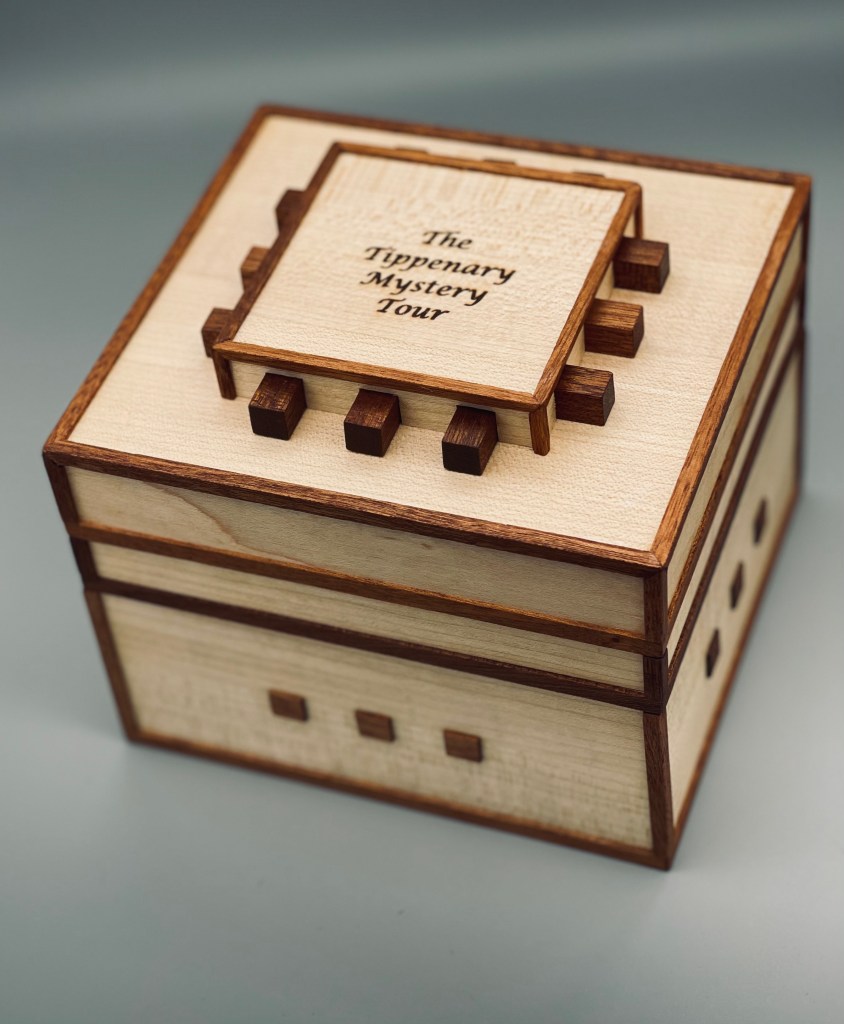
While the first rule of TTMT may well be to not talk about TTMT, I must say that it wonderfully manages to bring together so many different types of puzzles into one, cohesive whole: the various puzzles and challenges are distinct but interconnected and it almost feels like being taken on a tour of the various types of challenges mechanical puzzling can offer, wrapped up in a pretty box of maple and mahogany. The box connects well with some of Jack’s past work, which links past and present in a cool way; as someone who is still in his first decade of legit puzzling, this was a really nice feeling: he created the ability for us to connect to some puzzling history in a direct and tangible way that provides the box with a greater context, which I appreciated and enjoyed. Now if I could only get my hands on a Jack in the Box…….. 😉


Overall Grade: Five Sinatras


Butter’d and Fly’d: Butterfly Box by Kagen Sound

Butterfly Box

Kagen Sound, 98 copies, 23cm x 8cm
Bastogne Walnut, Quilted Pacific Maple, Madone, Wenge, Baltic Birch, Cocobolo, Paulowina, Alaskan and Western Red Cedar

It isn’t long before most tyro puzzle box aficionados will hear the name Kagen Sound. It will likely be much longer before said boxer can get their hands on one; the box abecedarian may then be an octogenarian but will nonetheless reach their arthritic hands towards their new acquisition with gleeful gratitude.

Overly (and unnecessarily) multi-syllabic ruminations aside, when I got an email from Kagen saying that my name had made it to the top of his list for the newly released Butterfly Box, this quadragenarian was more than happy to take a copy off his hands.

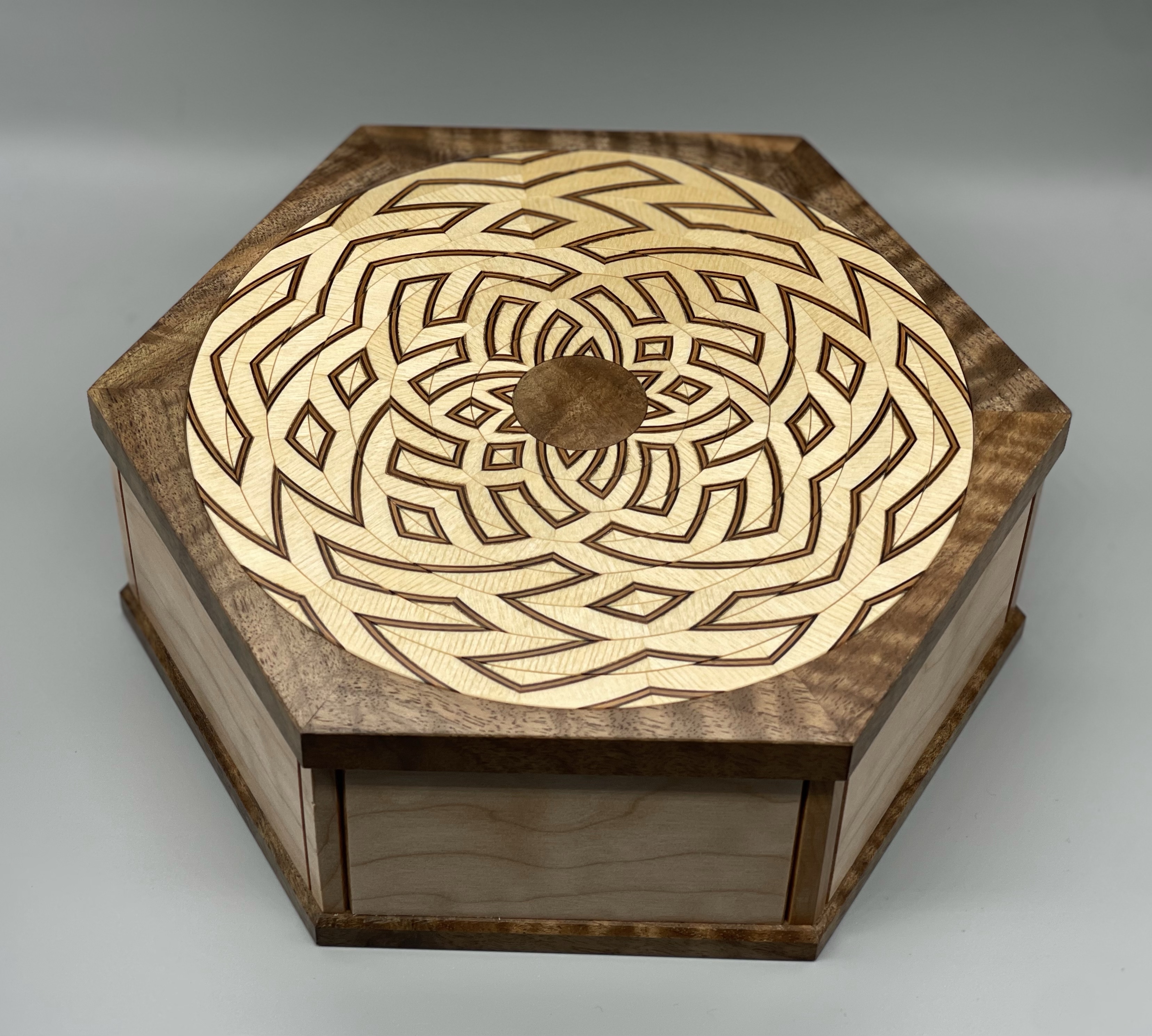
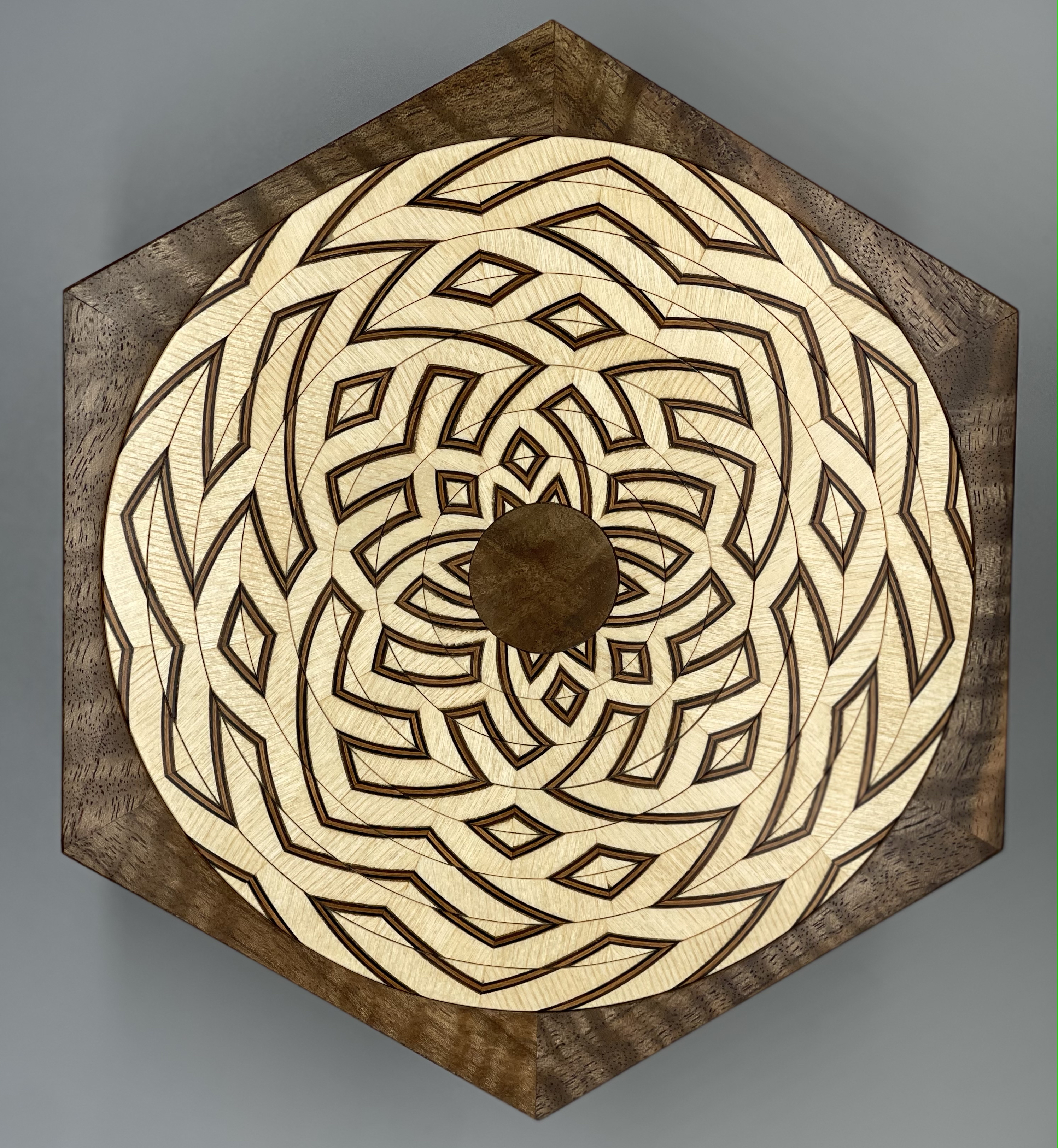
Butterfly Box is the third and final entry in his Lotus Trilogy, following the Caterpillar and Lotus Boxes some years prior. The series is an evolution of earlier puzzle projects and took him nine years to complete. All three boxes have certain similarities: each has eight concentric rings atop a hexagonal box, the narrow rings featuring a number of lines cross-crossing this way and that, a chaotic tease of its potential symmetries. Turning the various rings, you create and abandon all sorts of pretty shapes and patterns, searching for those that will offer you access to the four compartments contained within its base.

I had wondered how much of a challenge this could really be, and was happily surprised to learn that the answer is: a whole heckuva lot (to put it science-y); in fact, I still haven’t opened all of the compartments!

Each of the earlier entries in the series culminated in a final drawer that contained a partial hint to this final puzzle; these hints combhine to provide the Butterfly puzzler with some much-needed guidance in getting started. Kagen kindly includes a quality booklet that includes a pic of the combined hint from the previous boxes. The hint was most certainly welcome, as it seems as though the potential patterns presented atop this beautiful box is bordering on a crap-ton (I should really start using lay terms here).

This is a large source of my surprise: I had foolishly thought that finding the right patterns would be cake; it is instead bananas. With eight concentric rings containing numerous and varied lines going this way and that, it only take a few degrees in either direction for one or more rings to create entirely new patterns, some subtly and some significantly different, the majority of which will permit no progress.

Significant and Subtle differences allow for a LOT of variation: some patterns are immediately recognizable as being extremely distinct, others (such as those above) are more nuanced

Finding the correct ring placements isn’t quite all you need to do; some subtle requirements throughout the solution add another level of complexity to this Search for the Elusive Pattern(s). Kagen comes once more to the rescue with hints to be discovered as you progress, some well-hidden, others more obvious, but all crafted in unique ways that further highlight Kagen’s skills as a craftsman. And there are other surprises hidden with, reserved for those watchful puzzlers able to find their way through to the end.

Instead of being a beautiful breeze, blowing briefly by, Butterfly had become a devilishly deep and drawn out dive into an undoubtedly deep design – all brought together in an absolutely beautiful hex-box, perfect for collectors and solvers alike. Of course, in addition to its aesthetic attraction, its substantial size of 23cm x 8cm presents it as a perfectly prominent piece of any puzzle collection.

And surpassing this surprisingly challenging series of discoveries is the look and feel of the box, which is just freakin’ awesome sauce (scientificaliciously speaking, once again). All three boxes in the series are made of different types of walnut and maple, showing off the aesthetic range these woods offer, with an array of woods that have such different tones and figuring as to seem to be wholly different species: Butterfly pairs Bastogne Walnut with a lovely Quilted Maple, for elegantly contrasting woods with a buttery feel. And the patterns themselves are skillfully comprised of four layers of thin veneer made of Wenge and Madrone inset into each of the concentric rings, with Baltic Birch in between. Such a high level of skill is what earned Kagen the honor of being the only non-Japanese crasftperson to be a member of the Karakuri Creation Group.

An interesting note about Bastogne Walnut: this is an “accidental” tree that occurs in about 1% of walnut trees, resulting from a cross-pollination of European and US species. Bastogne trees are sterile, which contributes to their rarity as they cannot reproduce.

Butterfly Box puts Kagen’s fantastic skills as both a craftsman and a puzzle designer on full display, using subtle differences in woods to maximum effect and relying on expert methods to produce a box that is deceptively complex in multiple and unexpected ways and beautiful in all the right ones.


Excellence Grade: Five Sinatras

(click here for more information on the Sinatra Scaling System, (c) John Maynard Keynes, 1944)
Stuck on Stickman: One Hand Puzzlebox (#35)

One Hand Puzzlebox (Stickman #35)

Robert Yarger, walnut & various exotic woods, 6″ x 3″ x 3″ (160 copies)

One of the best things to happen to a puzzler is to open an email from a great designer and unexpectedly learn that not only have they produced a new puzzle, but that you can get a copy! I knew Rob was working on a new puzzle (pretty sure this is pretty much always the case), but had not known the what or the when. And so it was with a hearty “yes please!” that the box was ordered. Within a week, it arrived at my door: work was cast aside, chores forgotten (which I guess isn’t really all that unique), dogs and cat ignored (I don’t think the cat noticed), mail cast aside, wife…… politely informed that I would like a few minutes, if that’s ok, and so the box was opened and the villagers rejoiced (yayyy).

But you likely care little for my inner life (rude) and instead want to know about the dang puzzle.

(note: all the information below is limited to what is included in the puzzle’s original description and instructions, including the shapes of the pieces which was shown in the accompanying photo; the rest is my personal puzzling experience and is very unlikely to spoil the experience for others)

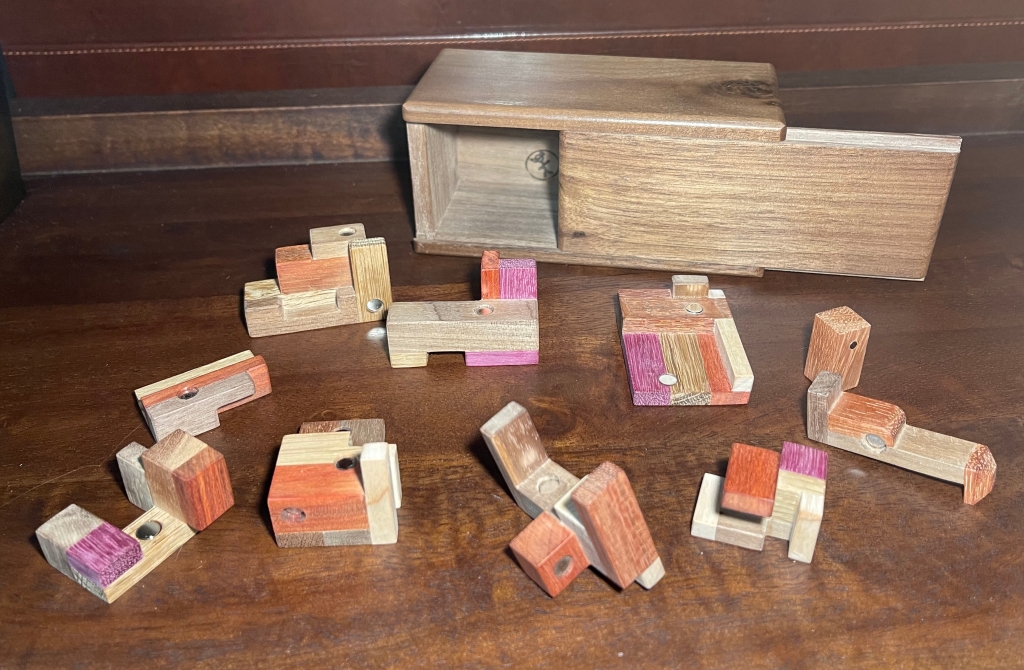
One Hand Puzzlebox is is based on a concept by puzzler Asher Simon, and is Robert Yarger’s “tribute to the genera of packing puzzles.” Burrtools is unlikely to be of much use, however, as the pieces are oddly shaped, magnets strewn about, seemingly haphazardly but of course we know that is not the case.

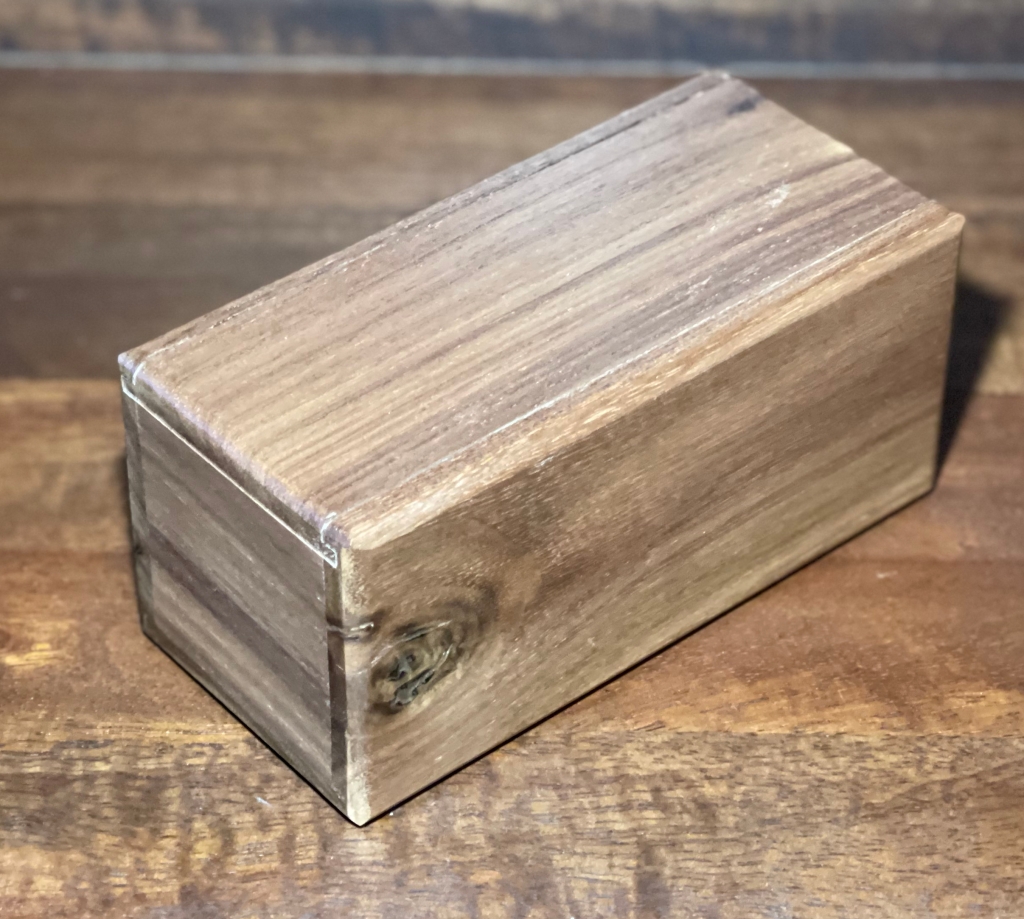
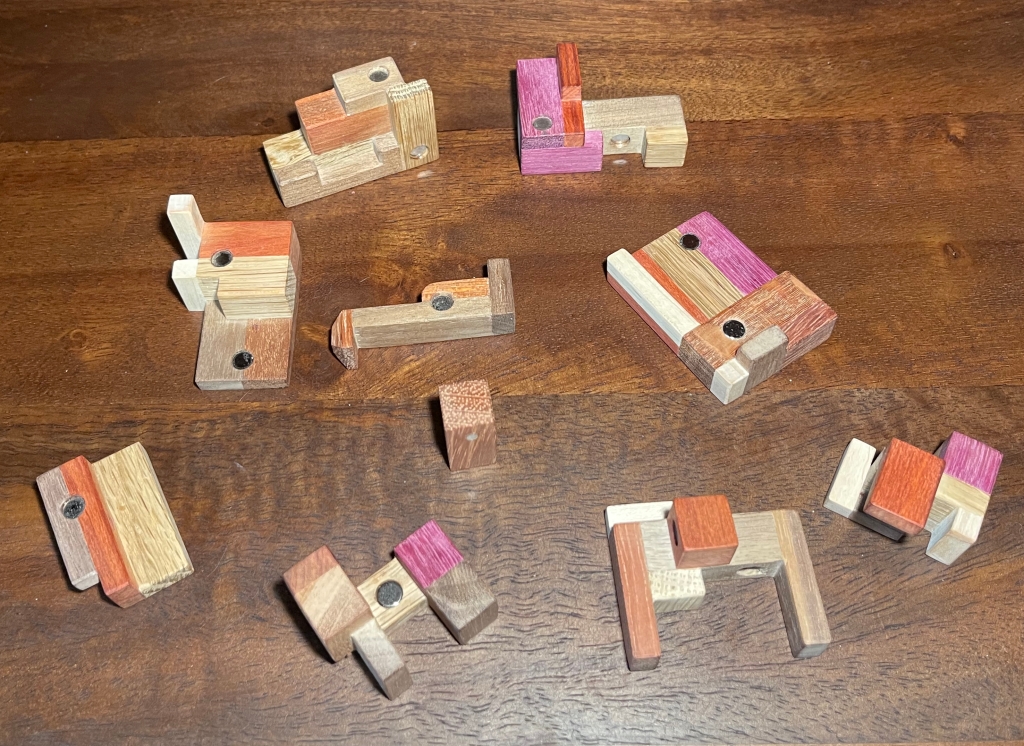
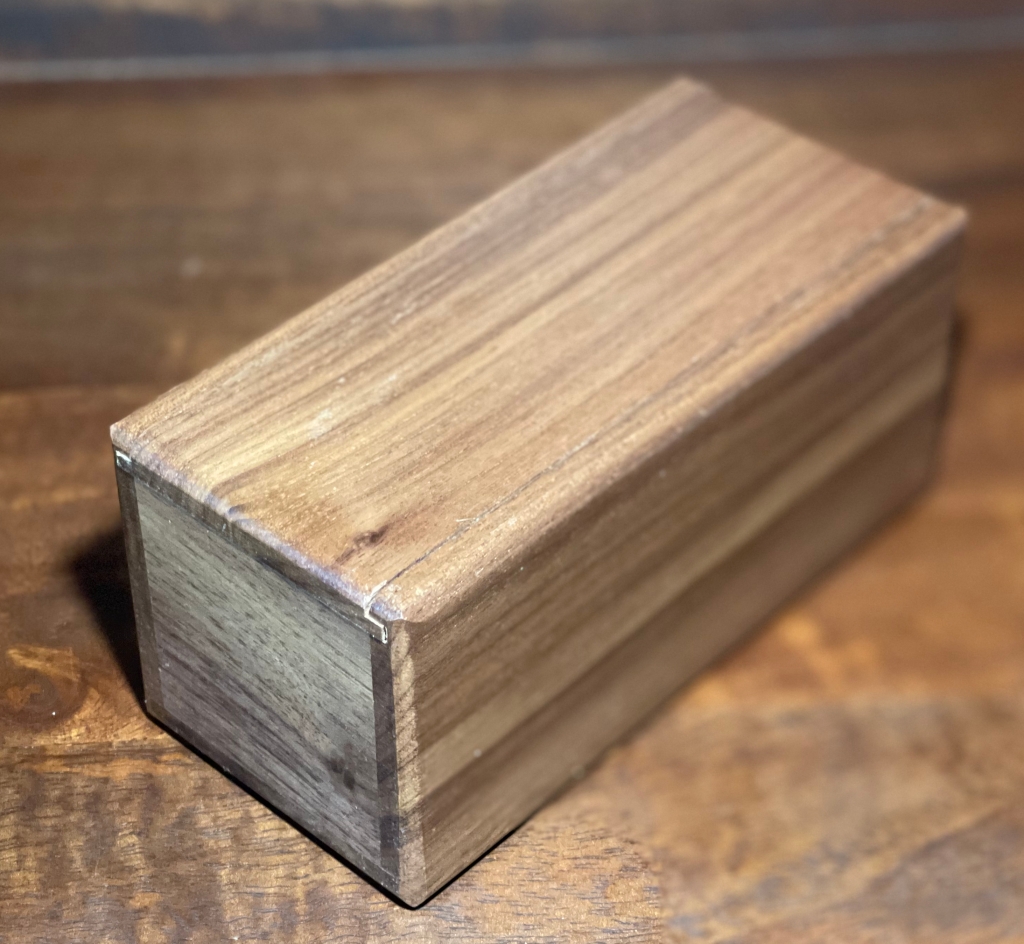
The box is 6″ x 3″ x 3″ and is made of a walnut that feels and looks great (which is not surprising, considering its pedigree); my pics really do not do it justice. The lid will only slide in one direction (I might prefer it to slide NKOTB-style, but hey, I don’t judge); sliding it back, you find a compartment approximately half the length of the box before the lid stops, unable to move any further. Exotic woods of various shapes and sizes fill the cubed space (albeit with some gaps present, if i remember correctly – I have yet to find the original configuration ;-). In the center, a piece shaped sort of like a Mayan temple pops up, begging to be pulled. Rob refers to this as a “grenade pin,” which is a pretty accurate description considering what happens next.

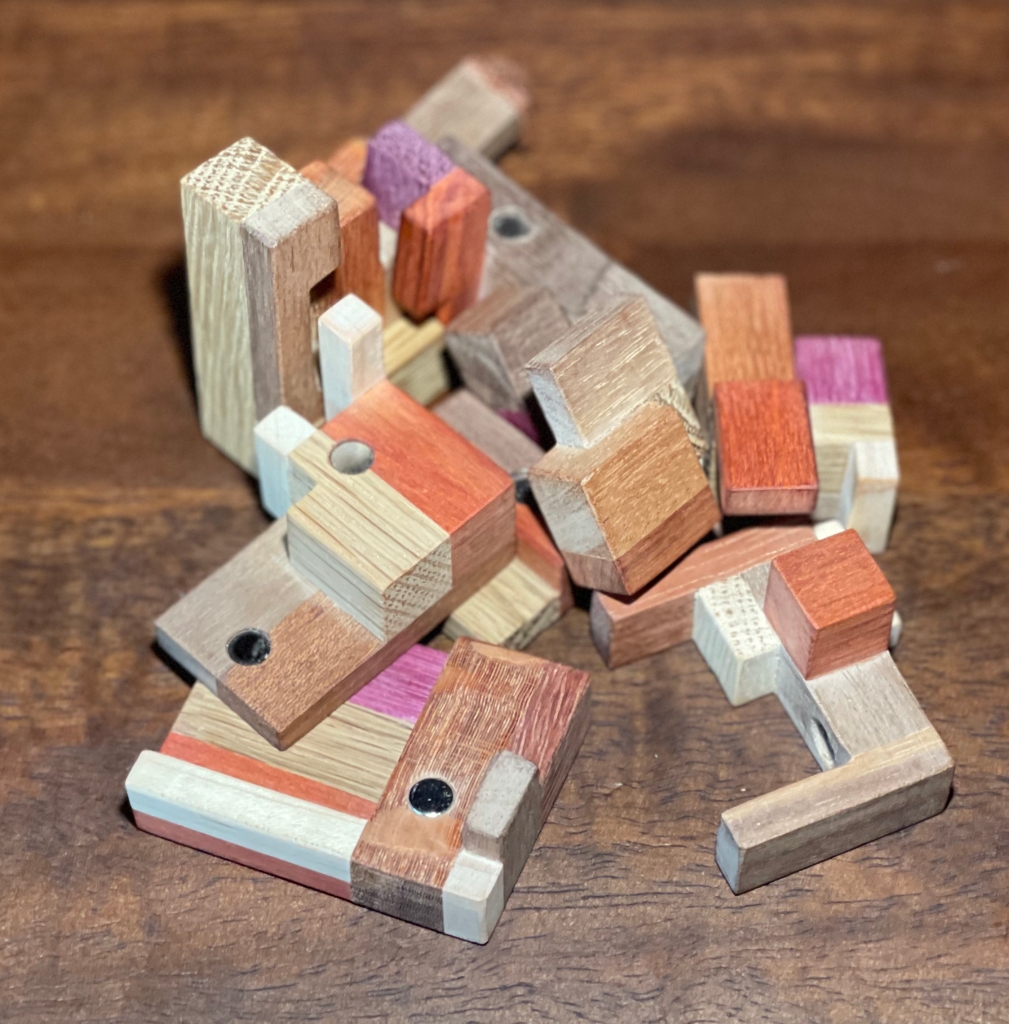
As Rob wrote in his description, the pieces will “flip around like a transformer robot” upon being removed; the mini-explosion of pieces that have been straining for release is super satisfying and more than a little intimidating. These are not the typical voxels of a packing puzzle and the apparent randomness of the shapes indicates the difficulty of getting them back in.

The puzzle’s name stems from the recommended method of using one hand to place the pieces “back into the compartment, one at a time, and in a particular order.” The description goes on to say that “combined pieces [will] have to slide around with a satisfying ‘snap into place feel’ to fit the others in.” A minimum of 18 steps later (if you can do it in 18 steps your first time you shall be exalted and known throughout the puzzling world for your giant brain), you will have re-inserted the pieces, thereby unlocking the second compartment (neat!).

Rob rates the puzzle as “‘very difficult’ to solve correctly” and from the hours I have spent on it thus far, I’d say that is a conservative description, if anything. I will readily admit that I am not so great at packing puzzles: my spatial reasoning falls far short of my ability think critically (which is itself eclipsed by my ability to ramble far beyond what is necessary or likely even desired).

I have spent a good amount of time on this puzzle already, and have not lost interest – even really great puzzles that pose a challenge big enough to require multiple sessions generally tend to join the rest of my “in progress” (read: unsolved) puzzles well before this point. This only goes to show the extent to which the struggle to solve is legitimately fun. I can burn out on some packing puzzles after a while, feeling like I am going in circles and need to set it aside to later return with fresh eyes; but One Hand offers so many new and interesting and strange and unlikely combinations and configurations that I find myself stuck in a Civilization feedback loop (named after one of my first all-night gaming sessions from grade school, the lure of “just one more turn” causing hours to go by before we noticed the sun coming up). I have found partial assemblies that I think must be correct, only to be cast aside as I see no way that the rest can fit; attractions and repulsions of magnets alternately helping and hurting my progression, as I wonder whether they are there to help or to mislead (or, more likely, both).

Suffice it to say, when (if) I do eventually find the perfect positioning of pieces that puts me on track to unlocking the box’s second compartment, the happiest of happy dances will undoubtedly ensue as I try to follow Rob’s intended method, using one hand to place them in piece by piece, until I can slide that lid back all the way, allowing me to proudly share my achievement with my not particularly interested wife (“look! look! I moved this piece of wood a couple inches that way!!!”), and bask in the glory of my success. And the villagers shall once more rejoice (yayy).

…and then I will remember that I need to find the original combination to reset the box.

The puzzling value on this one is quite high and is already filled with smaller aha moments as I find my way closer to that final Aha! moment (hopefully, eventually…. maybe); I will also admit that I have spent more than a little time attempting to construct a robot – the pieces just demand to be experimented and played with, the time spent helping me to get to know the pieces and see how they might eventually combine in that one, perfect arrangement.

Grade: Five Sinatras


Inaccurate Monikers and Inappropriate Sobriquets: Blah Box by Eric Fuller

Blah Box

Eric Fuller, Zebrawood and Maple, 2.875″ x 2.875″ x 4.25″

When Eric Fuller (of CubicDissection for any puzzling noobs out there) was working on his DDD Burr Set, he had initially planned on the pieces being stored in a puzzle box, akin to the Penultimate Burr Box Set whose instructions were hidden away inside a locked compartment. Obviously, this would have been super cool, but Eric decided to separate these two ideas into separate puzzles to keep costs down, especially with some complex boxes set to come out later this year with appropriately higher price tags.

The DDD Burr Set is an excellent piece of craftsmanship; the box is so well constructed that it took some searching for many of us to open it, despite it lacking any kind of puzzle mechanism. Fortunately for us, Eric did not eschew the box ideas he had developed. The perceived “failure” led him to name the box as he did, using nomenclature that is not at all indicative of the excellent puzzling offered by Blah Box but is instead intended to capture the maker’s disappointment with keeping such trickery out of DDD.

I would easily put it among the best of Eric’s boxes that I have had the pleasure of solving. And yet, for some odd reason, I feel that Blah has kind of slipped under the radar, not garnering the attention and adulation that it most definitely deserves. There was a bit of an issue early on, with Eric issuing a semi-sort-of-recall (essentially consisting of providing a replacement piece that would help avoid an “unintended solution path” found by some early solvers). Fortunately, I had been unable to find the first step before the announcement, so I was able to wait before proceeding. Once the replacement piece arrived, my wife was able to follow the video instruction to reset the puzzle in just a few minutes – as a true NPSO, this helps show that the change was relatively straightforward. I say all this as I wonder if this contributed to Blah’s somewhat quiet release.

Blah Box is a beautiful puzzle, offered in multiple wood options (Iroko/Holly and Black Limba/Maple, in addition to the Zebrawood/Maple of my copy). It is a decent size, taller and a bit narrower than Improved Cam and Topless. The lighter ends set off the lovely frame, two holes of various diameters located on one side and one more on one end of the box. With a bit of inspection, you can find a single seam; pulling on it affords no success, as nothing seems to move or do anything at all anywhere on the box. As with many of his boxes, some rattling can be heard inside the puzzle (which may or may not indicate much of anything – Eric loves to mess with us puzzlers’ expectations, and I have learned to take nothing for granted when approaching his boxes).

As alluded to above, the first step took me quite a long time; this is one of those puzzles that starts at a seemingly insurmountable wall, requiring ample exploration and trial and error before you can find the precise step that works perfectly and wonderfully once you have found it and is seemingly non-existent otherwise. Finding it is an absolutely excellent aha moment and I have found it to be super satisfying to repeat, a fidget-friendly move if ever there was one.

After oohing and aahing over the first step, I proceeded to seek out any avenues that it may have opened up; the step seems to lead you somewhere, but you will instead hit another wall as your reward. It didn’t take me as long to surmount this next obstacle and I was rewarded with another aha moment – two in a row would be enough to make this a great box and yet there is still ample puzzling left before success can be claimed. 

I was able to move through the remaining steps without as much trouble as the first two, but they were no less satisfying for it. Seemingly obvious moves led to confused head-scratching before I would notice something I had overlooked or realize this might also do that and that might get me to there… 

As a true sd box, the steps flow fantastically along, sweeping you up in a rhythm that builds from its early struggles into a nice, smooth conclusion that includes another solid aha or two before you can open the box. The puzzle teases you a bit before letting you finish, a bit of tantric puzzle play to make the end that much more satisfying. 

Blah Box really is a fun puzzle – while not as difficult (or perhaps as original) as Lock Box (at least in some ways), it might just be more fun, perhaps even more so than the excellent Lift and Nope Boxes (and certainly more complex than these, which were intended to be more wallet-friendly); it is certainly on par with both. Blah is playful and highlights Eric’s devious tendency to confront our assumptions in ways that are as hidden as they are obvious. The sd elements are integral to the puzzle, and necessarily flow from the mechanisms that must be discovered and overcome before sweet, sweet success might be claimed.

Blah was sold in two waves and several copies are being offered in the current CDM; as with many CD puzzles, a few were held back to be listed at one penny. If you have not obtained a copy, I highly recommend duking it out with some other hopefuls as this is a super fun solve and an essential addition to any Fuller box collection.


Overall Grade: Four and a Half Sinatras (Five for fun and Four for difficulty)


Email me at: quantifiedcool (at) fivesinatras (dot) com

You can also find me on Discord @fivesinatras or Reddit @fivesinatras23

Gateway to Puzzledom: Dee’s Portal to SD Fun

Portal

Dee Dixon, Mahogany body, Peruvian Walnut top, Cherry knobs with Wenge Center, 3″ x 6.25″ x 5.5″

Dee done doggone did it again, with the upcoming release of his fifth puzzle box to much anticipated fanfare and excitement (check out my reviews of his earlier boxes here). I had the good fortune to be a tester, receiving a copy that represents a (likely) final prototype of its puzzle mechanisms, although some changes may yet be in store (including a possible fourth knob of unknown purpose). Dee has had a bit of trouble settling on a name, prompting me to suggest the name “Indecisive” (get it? In-Dee-Cisive? Cue the ensuing of hilarity.) However, in the end the puzzle’s aesthetic earned it the probably more appropriate name “Portal.”

Dee has an excellent track record of puzzles that look great while presenting a solid, fun challenge. Space Case was perhaps his most difficult release, and this newest creation moves away from some of Space’s more blind aspects, providing ample direction and feedback from start to finish while preserving some of the best aspects of such semi-hidden mechanisms. The box’s aesthetic shares some similarities with Space Case, featuring shapes on its sides whose possible purpose must be determined. However, its puzzling is quite different and, I think, more playful, even if perhaps posing somewhat less of a challenge (than Space) – this is not at all to say the puzzle is easy, especially when just getting started may confound the average puzzle aspirant. While Where’s My Hammer? will always win warm fuzzies and a special place in my puzzled soul, Portal features some really cool design details that had me smiling appreciatively after I reached the end and realized the nature of the path he takes us on; the puzzle gives WMH a run for its money in the opinion of this humble puzzler, landing in the middle of his puzzles in terms of difficulty and towards the top for fun.

The box starts with a wall that can take quite a while to overcome; it took me longer than I may care to admit to find that first step (other testers I’ve spoken with had similar experiences), and when I did, I had an excellent aha moment: that kind of slap yourself in the head while laughing at the designer’s deviousness that makes me want to repeat a step a few times before moving on. The box does a great job of funneling you through the puzzle’s mostly logical progression through to the end. The puzzling rewards both exploration and careful consideration and is fun from start to finish; it feels like more of a return to the discrete steps of WMH in some ways, while evolving aspects of Space Case with a clear sense of progress and direction as you proceed through a mix of sd trickery and internal obstacles.

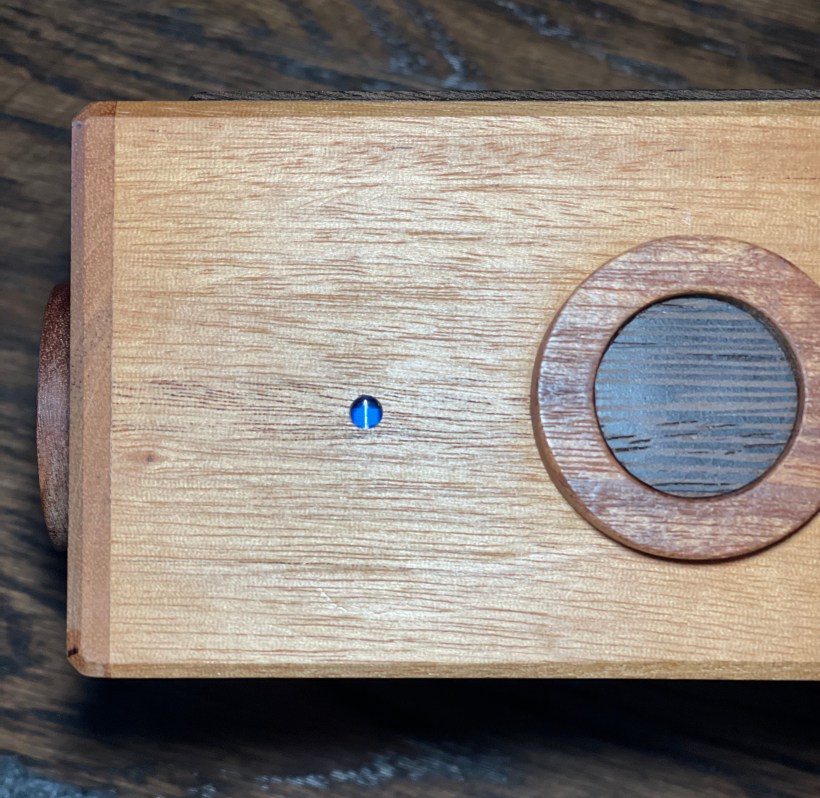
Looking closely, you will notice that the puzzle introduces a touch of color, with a bit of blue acrylic peeking out of the small hole at its front; Dee has said the final puzzles may feature different color options. The final version will feature different woods: a Maple body with a Cherry top and Cherry knobs with a Wenge center; it will also be a bit narrower, at about 3″ x 6″ x 4″. Some prototypes featured differing knob layouts, and the final version may well feature a layout somewhat different from mine, including the aforementioned fourth knob.

After solving and resetting the puzzle a couple times, I realized just how fun and unique the path Dee laid out really is – while I can’t say too much without spoiling anything, I could see Dee laughing at us poor puzzling folk as he makes us travel a meandering path to its end; opening the box reveals some rather unexpected mechanisms and resetting the puzzle made it clear to me that this puzzle comes with a sense of humor, betraying our expectations in a delightful and fun way that I think most puzzlers will appreciate.

Portal is both tricky and fun and is an excellent addition to Dee’s already excellent oeuvre – Portal should be available on CubicDissection sometime in its April 2021 release.


Grade: Four and a Half Sinatras


Poll:

It’s a Karakuri Miracle! Holiday Boxes 2020

Karakuri Holiday Boxes 2020

It’s that time of year again: families gathering around blahblahblah……. we know what really matters: Karakuri Holiday Boxes! (If you don’t know about how the holiday boxes work, you can learn more here).

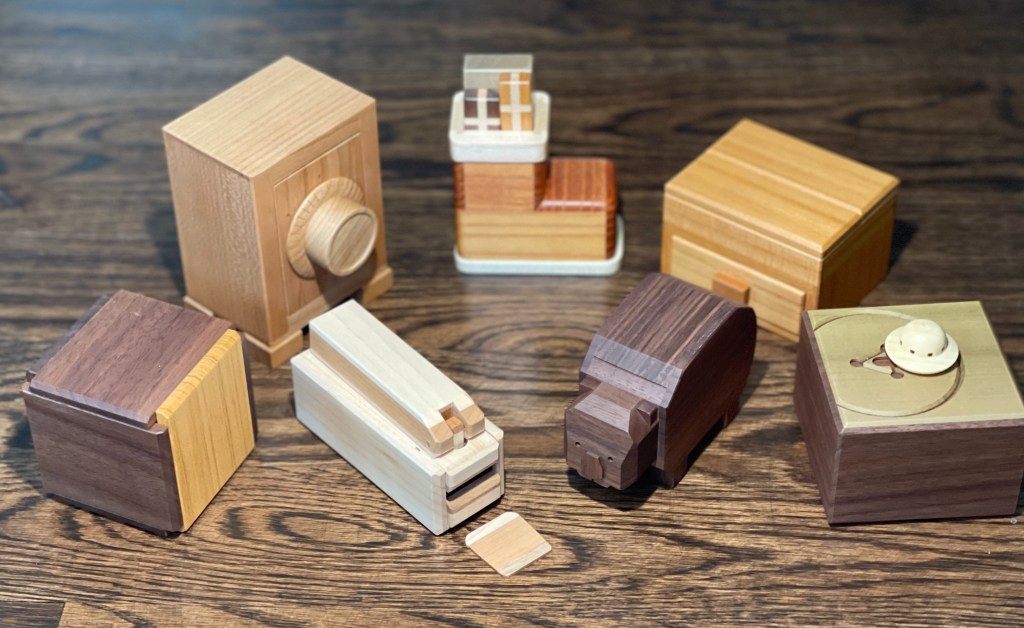
Back Row (Left to Right): Kawashima, Kamei, Kikuchi, Iwahara, Kasho; Front Row: Sugimoto, Kakuda

At the end of a strange year, I felt like Jimmy Stewart at the end of It’s a Wonderful Life when a big box of smaller boxes containing my new puzzle boxes arrived sometime in mid-December: “Merry Christmas Movie House! Merry Christmas you wonderful Building & Loan!” Merry Christmas Karakuri Puzzle Boxes! Now Dasher! Now Dancer! Now Prancer and Vixen! Now Kamei! Now Iwahara, Kawashima and Kakuda!

Over the course of the last year, I added more and more of the craftspeople at the KCG until I was on the list for 7 of the 8 boxes (sorry Fumio, I really did mean to add yours as well……). As in the past, I chose to resist the temptation of opening the boxes upon arrival, opting instead to hold out for Christmas morning. My mother-in-law always gets a kick out of seeing them, and it is one of the rare times when I can get my teenage son to look at something I like for a moment or two. Most importantly, the anticipation is fun and this year’s boxes did not disappoint! As is to be expected, all puzzles reflect the brilliant standards of Karakuri puzzles, working smoothly and looking even more striking upon close examination.

Pics of the boxes have been making the rounds on social media, and I wanted to break my too-long blogging hiatus with a review of (most of) this year’s boxes. For those who are not aware, the names of most of the boxes have not yet been released and can be expected in January.

Akio Kamei

Kamei’s box resembles a classic safe (3.5″ x 3″ x 4.5″): four tiny legs beneath an upright, rectangle, complete with notched dial that seems to spin freely. Picking it up, you can hear one or more somethings moving around inside. Kamei’s hanko is on the back of the box; it is pretty clear when you have solved the box and seeing the hanko on its outside helps to confirm that you are not missing anything once it is open. Finding the right approach took a bit of creative cat burgling – of all the boxes, this is the one that gave me the most trouble. I was pretty sure I knew what to do at the outset, at least to some extent, and while it turned out to be correct, executing it still takes a bit of focus. I’ve heard from other puzzles who are similarly confounded by how specifically it works, in some ways feeling similar to other boxes of Kamei’s that rely on mechanisms that make little sense, until they make total sense – while you may yet continue to struggle to understand how the concept is realized, you can at least understand what is happening. Of this year’s boxes, this is the one whose internal layout most confounds me.


Hideaki Kawashima

Kawashima’s box was one of my personal favorites (even if I do feel like there is one small change that could have made it even better in my mind). It is the only puzzle this year to resemble a classic box (albeit a small one at slightly less than 3″). One panel is light colored, calling your attention to what will presumably be your goal. Kawashima may be guiding us a bit here, as it is pretty simple to make initial success, leading you through a few productive steps until you hit a wall hiding a couple added tricks that block you from further progress. Kawashima’s hanko awaits you when you reach the final compartment, after a nice, progressive solution. The box displays well with Iwahara’s 2019 holiday gift: Aquarius Box, which is slightly larger but features a similar aesthetic.


Hiroshi Iwahara

Iwahara’s Drawer (3.5″ x 3.5″ x 2.5″) is the box that offers the most puzzling, with an appearance that resembles this year’s Drawer with a Tree but features puzzling that is quite different. The hanko is important with this puzzle, as I briefly thought I had solved it after finding a fun series of steps to open and close it, before realizing I had not yet seen his mark. Some further exploration led to a happy, second aha as the fun-to-do mechanism is expressed in yet another step. The concept is well-executed, and it is the type of mechanism that I find fun to pick up and solve here and there; I have little doubt that this box will join the ranks of other fidget-friendly karakuri boxes that currently sit on my shelves. The puzzle has the added bonus of smelling particularly good, only increasing its re-solve value.


Osamu Kasho

Kasho’s box features a UFO that spins elliptically above the whimsical crop circles adorning a flattened cube (approx. 2.5″ x 3″). At first glance, I thought it was a safari hat atop a button, which made decidedly less sense. It is pretty clear what to do at first, and opening the box is rather straightforward. However, the brilliance of this puzzle really takes a bit of imagination – this is the box that has perhaps grown on me the most, as I have stepped back to observe the solution and the kind of scene the craftsman was perhaps imagining. Basically, I have come to see that the entire experience encapsulates a story and I hope this is something that has occurred to other puzzlers, because, to me, it is what really makes this unique (happy to share this with anyone who wants to know, but I don’t want to give any spoilers here). There is one particular design detail that I especially like, and which perfectly finished the concept at play in the puzzle’s solution. I had high expectations for his box this year as his was my favorite of 2019; to be honest, I was a bit let down at first but, as I said, this is the puzzle that has most grown on me as I have (I think) gotten into the maker’s head a bit more, discovering the story the puzzle is (I think) intended to tell.

Kasho’s 2020 and 2019 Holiday Boxes

Shou Sugimoto

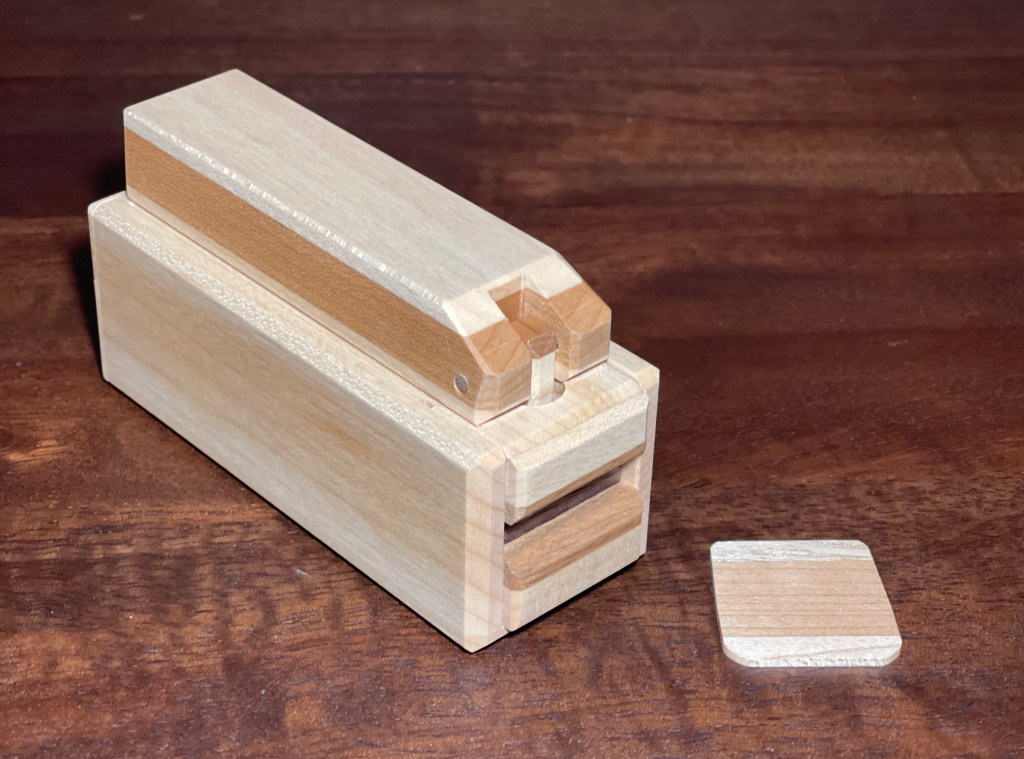
Once again, I had some wildly incorrect initial impressions, thinking this was an odd-looking snake-train thing (4″ x 1.5″ x 2.25″) whose tongue had fallen out. I don’t know where my mind is sometimes but once I was able to break through my dumbassery, I realized what was what and actually laughed out loud (rolling on the floor with a puzzle seems foolhardy and excessive). Realizing what it is, the way forward is pretty clear while being no less enjoyable for it. This is another fidget-friendly box that should not be overlooked; I think it requires some precise craftsmanship that may bely its playful appearance.


Yasuaki Kikuchi

Kikuchi’s is the only box to directly reference the Christmas season; last year’s box featured a Christmas tree and this year’s box is a stocking (3.25″ x 1.75″ x 4.25″) stuffed full of presents! It is decidedly adorable and has a multi-step solution that is simple but fun and, once again, quite fidget-friendly. Kikuchi is the least prolific of the KCG members and this is the first puzzle of his to make its way into my collection. I didn’t realize it, but he has the most punk of the KCG hankos, eschewing traditional Japanese characters for a more stylized signature.

This could well be upside-down and/or sideways but is pretty cool from any angle.

Yoh Kakuda

Yoh delivers on our animalistic expectations, with an adorable Wombat (3″ x 4″ x 1.75″) that is not only entertaining, but educational! I don’t want to give anything away, but after a couple straightforward steps, you are rewarded with a funny (and perhaps questionably desirable) reward. A conversation about the puzzle led me to google a particular fact about the Wombat, which has led me to be surprised that no other designer (to my knowledge) has taken advantage of this fun mammalian fact. Yoh’s hanko is displayed on the bottom of the puzzle, which led to a bit of confusion in more than one puzzler, as I heard a few folks may have thought they had solved the puzzle prematurely (which is pretty cool, as it features fair more fun than one first figured). Kakuda’s Wombat is adorable and smart, and packs an excellent punchline.


Overall Grade for Holiday Puzzles: Five Sinatras


Now that 2020 is done, we can start gearing up for next year (Fumio, I won’t forget you this time):

Happy New Year my tens of imaginary friends and readers! Thank you for reading and believing my opinion is worth a damn!

2020 was a weird year but oddly enough, it was an excellent year for puzzles – so many new releases from great designers, and great puzzles from new ones. I finally got rid of all those paper things that were cluttering up my puzzle shelves and installed a secret door leading to my puzzle room (well, home office, but you know where my priorities lie).

May 2021 be better generally, that puzzle parties might once more resume (and other social stuff as well…. I guess…. I mostly just care about the puzzle parties).

2020 Grade: A Bishop and a Lawrence (ugh)

It’s Electric! Boogie Woogie Woogie: Detective Box by Joe Guarini

Detective Box

Joe Guarini, 2020

Just a few days ago, some fellow puzzlers and I were discussing how there are not many puzzles that truly integrate electronics into their puzzling; there are a few great puzzles that feature electronics (I’m looking at you Turtle Trip and Snack Brake), but not necessarily as a part of the solution itself. This, however, is no longer the case: Detective Box wonderfully integrates electronic elements into the puzzling, creating a imaginatively unique and fun experience that I think of as an SD escape-room-in-a-puzzle-box.

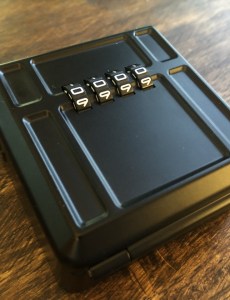
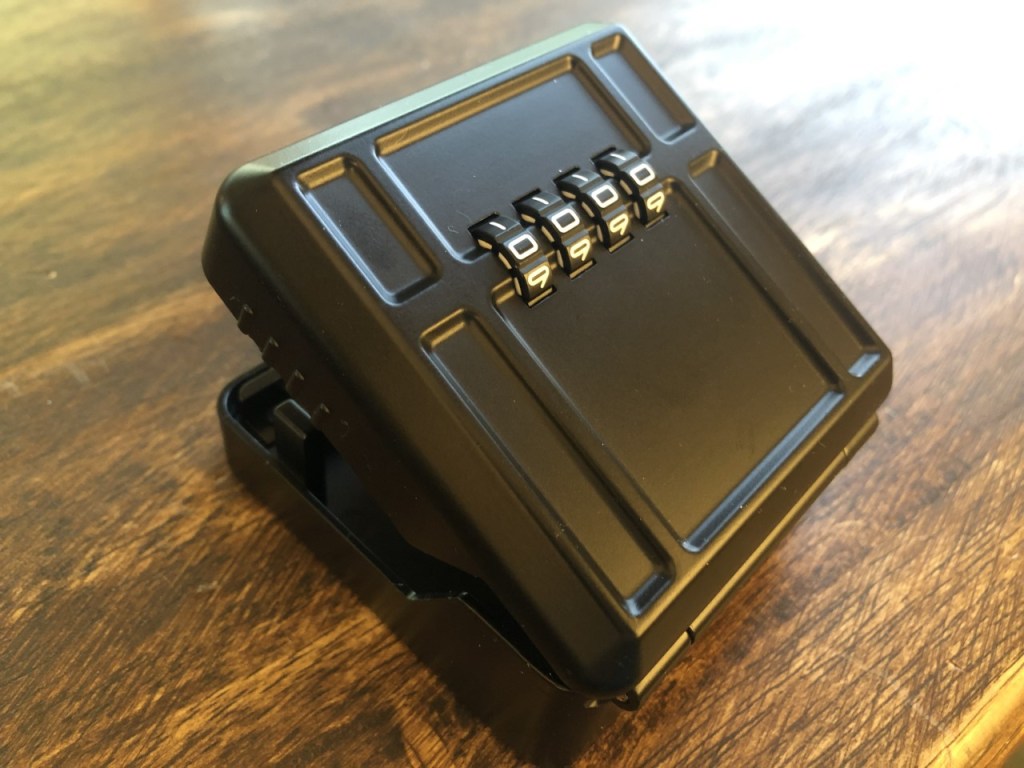
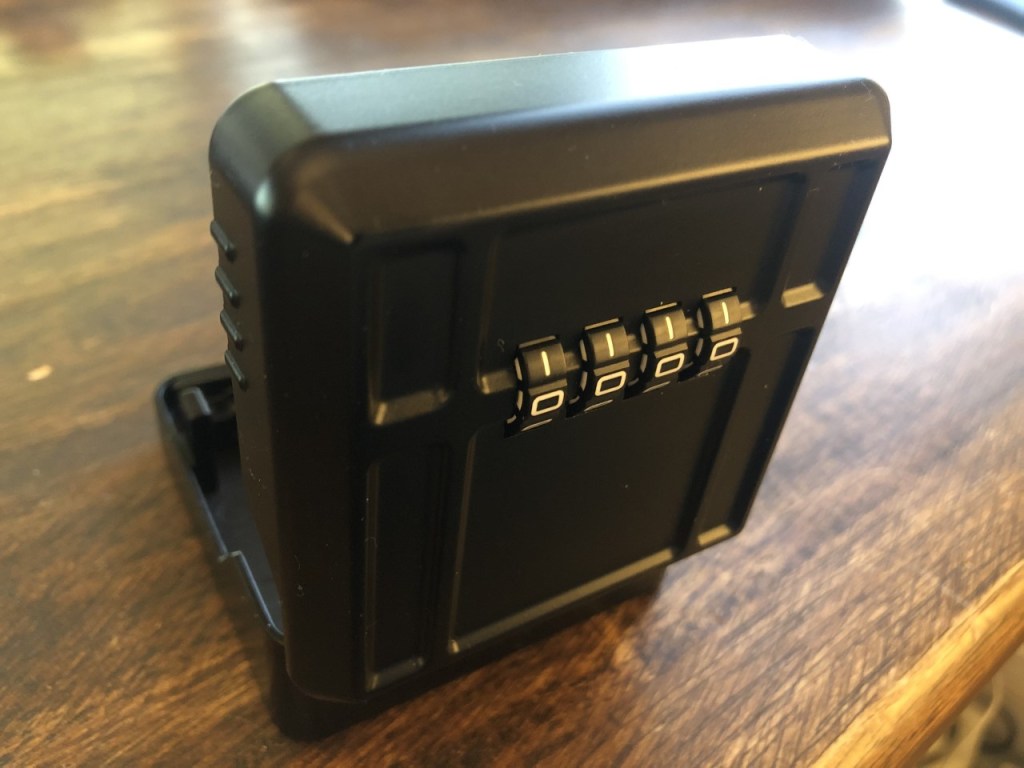
Detective Box is a seemingly unassuming 3″ x 3″ x 1.5″ metal lock box with a four number dial-lock on its face. The back shows four small holes, one of which belies its electrical nature by giving you a peek at some red wires that can be seen inside. Along with the box, there is an instruction sheet which includes our favorite rules, “no banging” and “no spinning”, along with “no gravity required” and a surprising early indicator of the puzzle’s distinctive nature, “no external tools except….” The instructions go on to explain that our goal is, essentially, to open the box and then “???…” Opening the box, we are told, requires that we “follow the clue” written on an accompanying letter and “find the box’s signal” (?!). Ultimately, the solution is not just to open the box, but to solve what is inside it (the aforementioned “???”).

After reading these instructions, I was extremely intrigued: its strange goals and reference to “a computer for your detective research” had me wholly hooked.

There is also a letter accompanying the puzzle, which gets you started (as per the instructions) and helps set the stage for the puzzle’s theme (which carefully and vaguely alludes, more or less indirectly, but probably not in any right-infringing way, to a certain flying-mammal-loving detective). The letter features a clue that will lead you to your computer (this is stated in the instructions, so no spoiler) – and, at that point, I was pretty clueless. The site does…. things…. but what could that have to do with the box? After spinning my computer availed me nothing (oddly enough), so began the electro-mechanical puzzling! After a couple cool aha moments, I managed to find the code needed to open the box. But this is by no means the end of the puzzle! Not at all – it is just the beginning.

I want to be careful not to give away too much: this really is a puzzling experience like no other I have ever had and one which I would not want to ruin. Suffice it to say that inside the box are some more electrical components that must somehow be used to solve a cypher, which will then lead you to the ultimate solution. Along the way, you will find a few more great aha moments, before you reach the puzzle’s end.

Joe clearly has some skills that are being put on display here – the functionality of its various electrical components must require a working knowledge of….. stuff….. that he is putting to good use. Although it was not necessarily an overly difficult box (for me, anyway), it is, even more importantly, a really really fun one. Sometimes puzzles seem to forego a full focus on facilitating fun in favor of bang-your-head-against-the-wall levels of difficulty (which can also be fun, of course, but sort of scratches a different itch than this novel, entertaining experience).

I am quite happy to have had the opportunity to try this puzzle out – Joe will be making them available for sale relatively soon and will likely be selling them directly, so keep an eye out on your favorite online puzzling haunt (i.e. Discord and Reddit). If you’re on Discord, he is @JHoag – you may want to hit him up with ye old LIST!!! emoji.

Originality Grade: 5 Sinatras

(click here for more information on the Sinatra Scaling System, (c) John Maynard Keynes, 1944)


Puzzle Parrrrrr-ty: Sea Chest by Jesse Born

Sea Chest

Jesse Born, 2020,
Wenge, Holly, Katalox, Bocote, Mahogany, Bloodwood and Copper

Avast ye mine puzzlers, thar be fine puzzlin’ on the horizon for those that be wantin’ of it… Dragons there may be, but the risk be worth takin’ for such a fine piece o’ work as this here box!

Captain Woodbeard of the Puzzler’s Revenge

A few days ago I got notice from Jesse that my copy of Sea Chest was ready – as one of the first to be lucky enough to get on the list, I soon received what is number 6 of an overall release of 100 copies. Sea Chest is the first in the three-box “Voyager” series; the next (named SunDial) has apparently been mostly designed (in collaboration with a certain other amazing puzzle designer), and I expect we shall learn more in a few months, once the other 94 Sea Chests have all made it to their various X-marks-the-spots. The third and final box in the series is named Alien and is fittingly otherwise unidentified.

Here There Be Puzzlin’

My copy arrived quickly, as is typically the case when crossing the state or two between me and Jesse’s workshop. I dug through the brown wrapping paper as I unearthed my newest acquisition. The box is a great size: about 8″ x 4.5″ x 3.5″ and somewhere between Slammed Car and SDBBM (or First Box and Pachinko) in weight, making it feel good and solid in your hands.

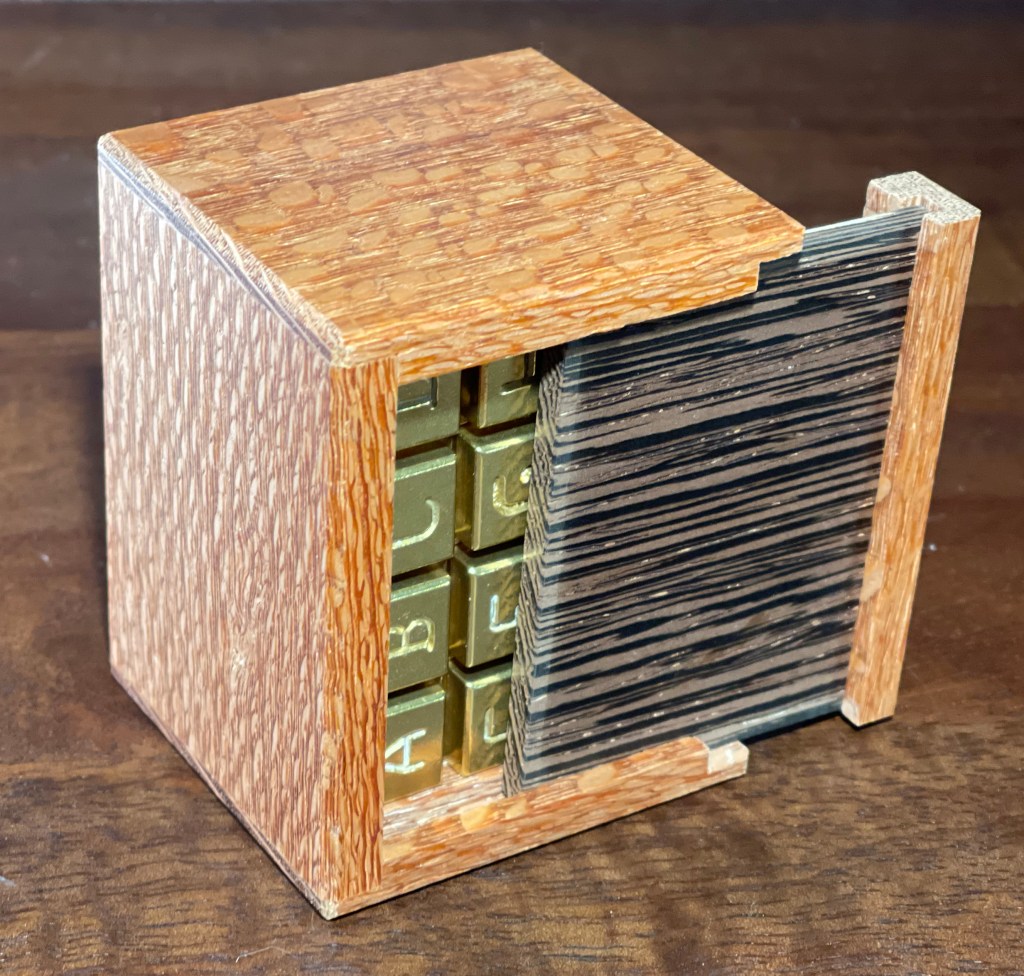
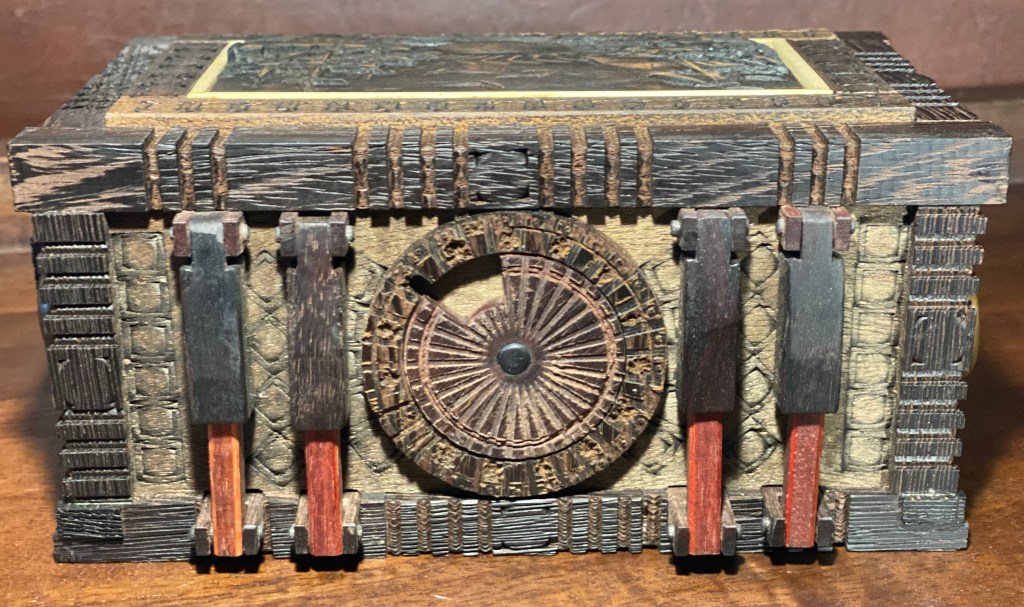
The box is both meticulously detailed and delightfully distressed: the top is a precise carving of two ships at sea, while the back features a medallion that rotates in a frame that appears to have been worn down in its time buried underground. Copper handles are affixed to the sides and a copper compass rose adorns its front. On either side of the compass/medallion, there are a total of 4 wooden pistons that pass through the body of the box. These are quite amazing when examined closely: the red wood moving in and out of the darker frame as they are pushed and pulled, held together with wooden pins at their base. There’s an unexpected feature to the bar that connects the pistons passing through the box, with gilded numbers appearing and disappearing as the pistons are moved.

Every aspect of the box is thematically consistent, down to the ample serifs used to make the numbers recognizable to the puzzle pirate inside all of us. Numerous details adorn the design, some surely there to serve as clues, implying that perhaps this puzzle is both treasure map and chest in one (as I’ve not yet solved it, this may well not be the case – just speculating here, so no spoilers my seafaring friend). It even comes with a folded sheet of “parchment”, with a wax seal identifying it as the solution.

The overall look is pretty awesome – the pistons remind me of the rows of oars of an ancient ship, emerging from port and starboard as your crew struggles to make your way to your final destination. While I do not think we will see sirens or cyclops on this journey, the Argonauts on board may yet be waiting a while to reach dryland as the solution is most definitely not obvious (to me, anyway).

Which leads us to why we are really on this journey: the puzzling. First off, it is not entirely clear what our destination will be – I know the puzzle will open, but my initial assumptions on where and how may well be incorrect. I have already had a great aha moment and have made additional discoveries that tell me what likely needs to happen, without showing me how how to actually do it. This is that type of box where the journey is at least as good as the destination, allowing me to be in no great hurry to get there. I couldn’t wait to solve this before sharing it, as it is just too darn pretty.

Captain SPH Sits Atop His Treasure

Jesse has once again produced a puzzle that is both striking and fun: Sea Chest has a thematically distressed aesthetic that seamlessly blends potential clues and red herrings with meticulously designed details, hiding whatever puzzling intricacies lay buried within.

(Past reviews of Jesse’s Jack in the Box and Secretum Cista)
Sealed Solution Sheet and Certificate of Authenticity

Captain’s Grade: Ye Olde 5 Sinatras


Check out Jesse’s Website and his Facebook page!

Lucky Number 13

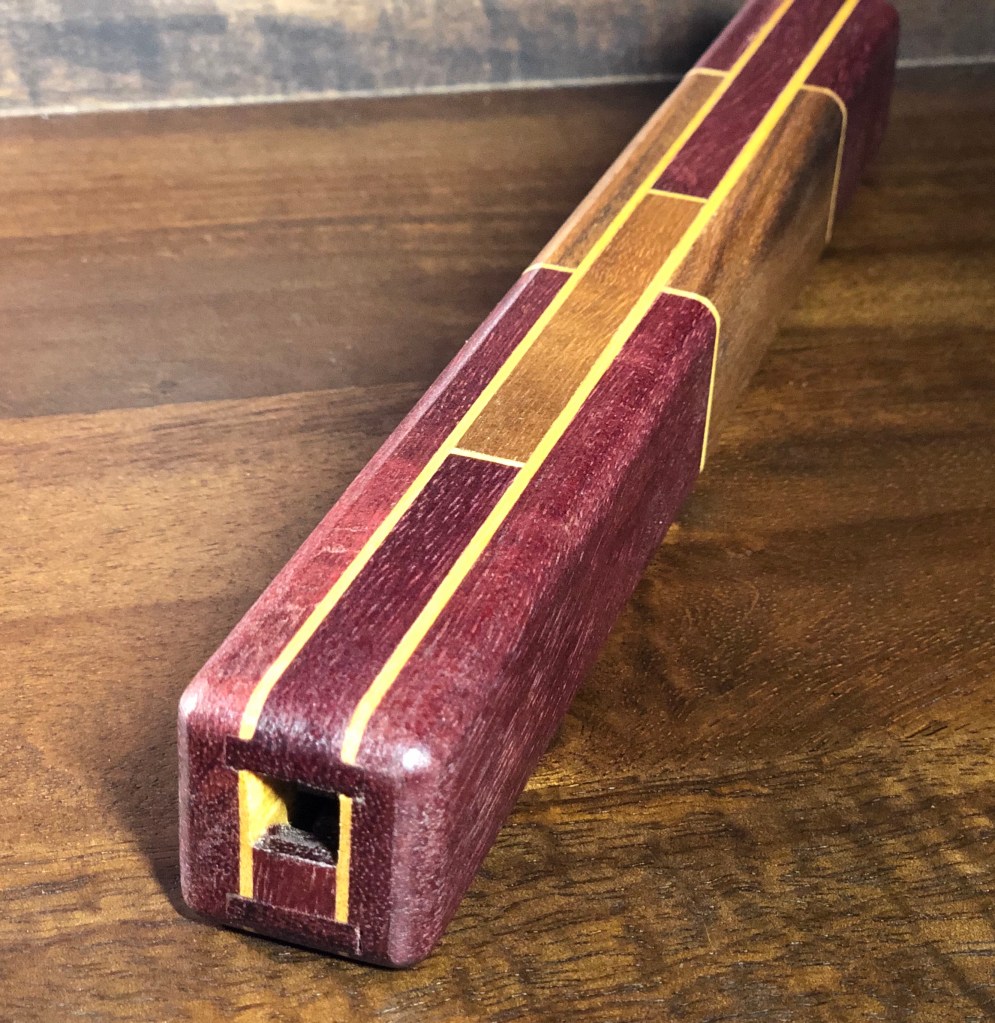
Stickman #13: Chopsticks

Robert Yarger, 2007

Robert Yarger’s 13th puzzle box is as fun as it is pretty. After re-solving it today, it occurred to me that some folks might want to know more about it, and so here I am: telling some folks more about it, in case you might want to know.

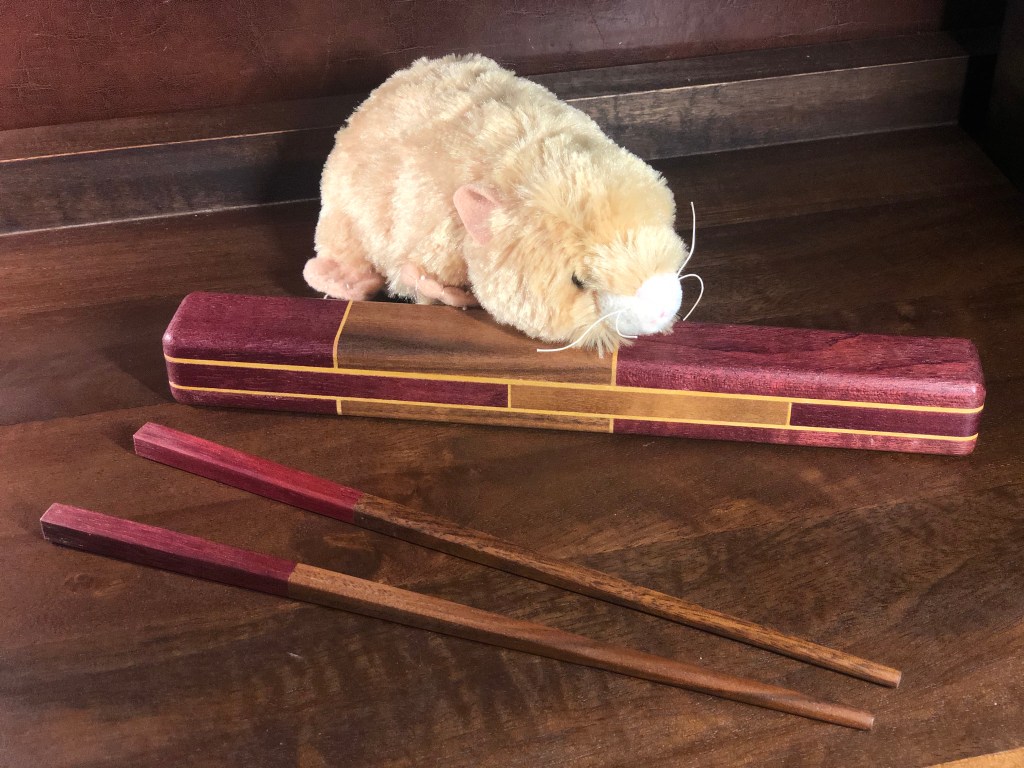
This is one of the rare puzzle boxes with a practical use: in addition to being a fun puzzle, it is a case for a lovely pair of chopsticks. Now, I wouldn’t personally carry this around to eat with, because I don’t typically put hard-to-come-by puzzles in my mouth (I don’t put easy-to-come-by puzzles in my mouth either, but you get the point). However, it would be pretty cool to bust these out at dinner, nonchalantly puzzling my way to dinner…. ok perhaps most people would not think this was cool, but those people are probably not reading this, so who cares what they think…

The box is smaller than most of Robert’s puzzles at 10″ x 1″ x 1” and uses puzzle box tricks to solve what is, in some ways, a 4×3 voxel packing puzzle. The steps are wonderfully smooth, and there are some really cool movements that I suppose are spoilery enough that I won’t share them (feel free to ask, though, if you’re curious) – apparently, Robert had been playing with the mechanism and realized it would make for a great puzzle (which it does).

Interestingly, there were two runs of the puzzle, using slightly different woods; the first was in 2007, with the second not too long after, in collaboration with excellent OG puzzle-maker, John Devost (the biggest upgrade: they are no longer lacquered bloodwood, but rather waxed purpleheart and leopardwood (I think), lending them their practical edge).

I got my copy about two years ago: as the first box by Mr. Yarger to come my way, I suppose it may have some added sentimentality, but this is truly a beautiful and fun box. The movements are wonderfully smooth; the puzzling is ingenious, even if not terribly difficult, with the chopsticks themselves integrated into the mechanism. The box feels solid in your hands; while narrow, its overall size is nonetheless substantial. More importantly, it has a look that is memorable, a cool mix of contrasting wood that demands to be picked up and handled. Its shape adds something special to the puzzle, standing apart from other boxes, making you wonder just what is inside (assuming you didn’t already know the name).

Needless to say, if you have a chance to pick up a copy, I do not think that you will be disappointed. And if you ever see me grabbing some sushi, perhaps you’ll get a chance to try it for yourself.

The 13th Stickman puzzle is a totally unique and oddly practical box, with a lovely mix of woods and chopsticks so perfectly balanced that I am tempted to use them; normally, I wouldn’t seriously consider it, but I suppose I can make an exception for Hiroshi Iwahara’s Sushi…
My Stickman logo has unfortunately faded a bit due to numerous and frequent solves – the box nonetheless works perfectly.

Overall Grade: 5 Sinatras