Packing it in 3: Pack Hard with a Vengeance

First, there was Packing It In: Pack Hard.

Then. there was Packing It In 2: Pack Harder.

Now, it’s time for Vengeance.


(The order of these posts do not indicate relative levels of difficulty. Please puzzle accordingly).

Squary Packs, Quadro, Snake Pit, Mushkila

Yavuz Demirhan (check out his Etsy store)

In case you haven’t noticed, there are a lot of puzzles out there. A lot. Within the various subgenres of mechanical puzzle-dom, therein lies nearly infinite possibilities – who would have thought that even “just” a 4×4 cube could contain so many possibilities as to continuously bring us more TICs and Somas and so on…

Squary Packs
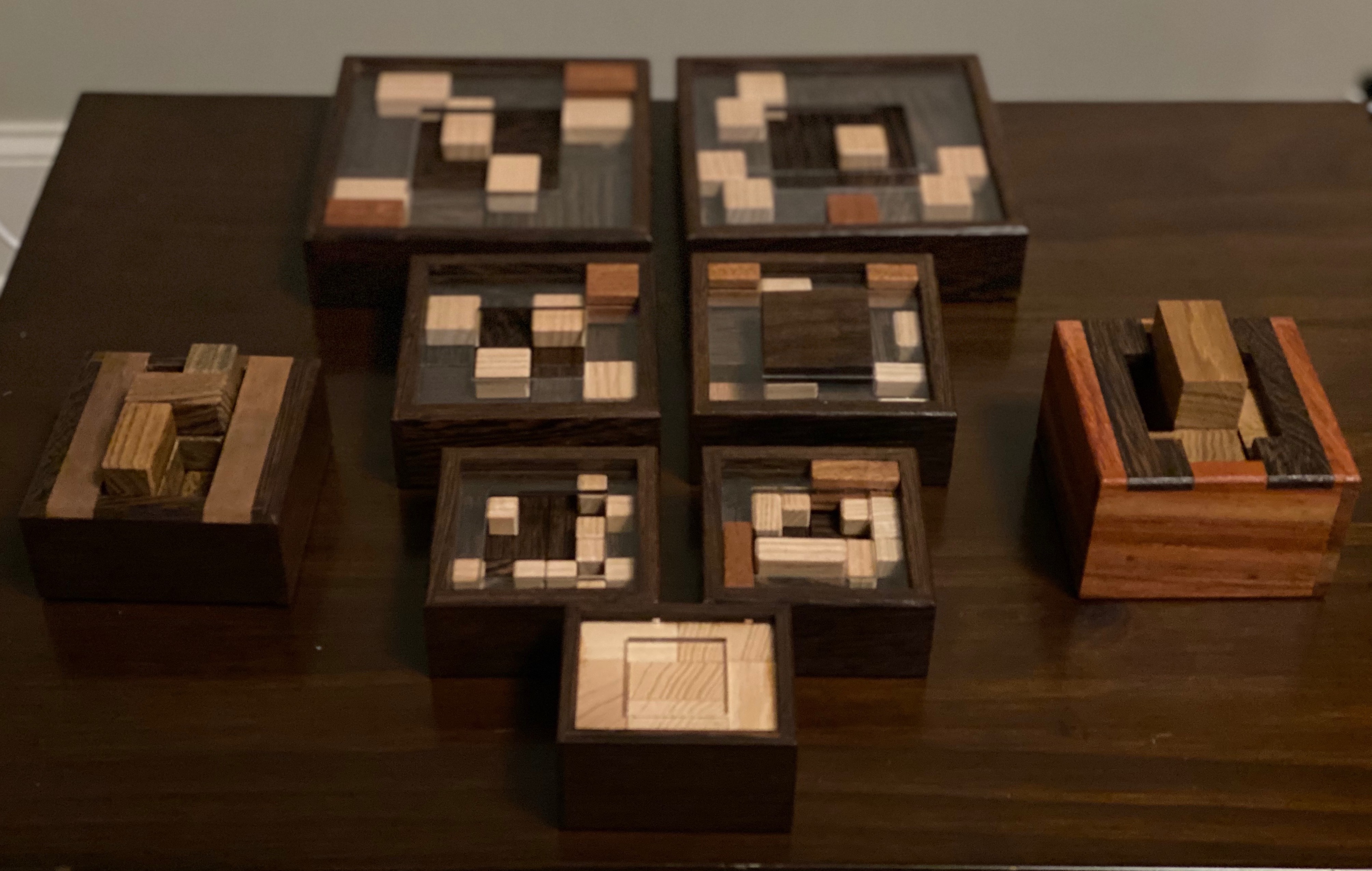
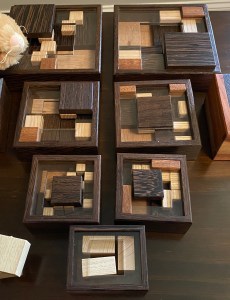
Some puzzles push out into their own territory, their movements and solution sitting somewhere amidst or between those that already exist. Yavuz Demirhan’s Squary Pack series is a great example of such a design: they are 2D/3D packing sliders that require you to navigate four dual-leveled pieces through a restricted one-piece-size opening at the center of the space to cover the bottom of the square box. The pieces are all flat-bottomed, with various voxels of different dimensions further complicating the solution, requiring you to slide your pieces around as you attempt to find a way to insert whichever piece needs to go in last; some of the series are further encumbered by blocks affixed to the box. You need to get all pieces in with the blocks facing up and you will find varying degrees of difficulty identifying where and when in the dance of pieces you can insert the final pieces.

The result can be quite tricky and is most definitely fun. I initially got #2 and 4 (knowing as I did that I would almost certainly end up wishing I had just gotten them all – my recent delivery of #1, 5, 7, and 8 shows I was most definitely right in thinking I had been wrong). My first impression was that they are quite attractive looking puzzles: his work is always wonderful looking and these are no exception. Dark wenge boxes with a reddish sappeli for those with blocks attached, which cover one of the two levels and protrude above the acrylic top for half that height. The pieces match the boxes with the same wenge contrasted by light ash blocks atop them. On the bottom of the box he has his logo/initials engraved above the name and # of the puzzle. Interestingly, they range considerably in the square’s dimensions (while all sharing a height of 3.5 cm): 1 & 2 are 7.5 cm, 3-5 are 9.5 cm, 6 is 11.5 cm, and 7 & 8 are 13.5 cm (ranging in price for a reasonable $30 – $50 depending on size). I’m happy to say that Yavuz is designing additional Packs, extending the series to (at least, I believe) 15.

Sitting down with the Packs, it took a minute to orient myself to what exactly I needed to do – initially, I solved my first two incorrectly by placing one of the pieces upside down (which was itself a non-trivial solve). I later learned that this was not correct and proceeded to attempt to (re)solve them correctly. It is necessary to find a way to get three of the pieces into the Pack such that there remains room for the 4th to be inserted and slid into the existing space – oftentimes requiring that the remaining pieces dance around before this becomes possible. This is complicated further in those Packs that contain internal pieces blocking the way. Each solution is unique and while these puzzles share a pleasantly consistent aesthetic, they are quite diverse. They range in difficulty: all the feedback I have heard from our fellow puzzlers has been most definitely positive, although some have felt that a couple of them were a bit easy. Regardless, I found them all to be challenging, with some being quite difficult (particularly #2 & 4). The coming versions are apparently a further step up in difficulty, and I look forward to getting them once available.

Yavuz has been making puzzles for a while and has a LOT more interlocking and packing puzzle designs out there (he has a few hundred on PWBP); while he produces his own works from time to time, it is not at all uncommon to find his works included in the puzzle releases of others (including one design set to come out in this week’s CubicDissection release). While I have a few of his designs that were made by other puzzle-makers, I also have the pleasure of owning a few more that he made himself – also 3D packing puzzles with restricted openings. His work is all wonderfully precise, using quality woods that look and feel great.

Quadro
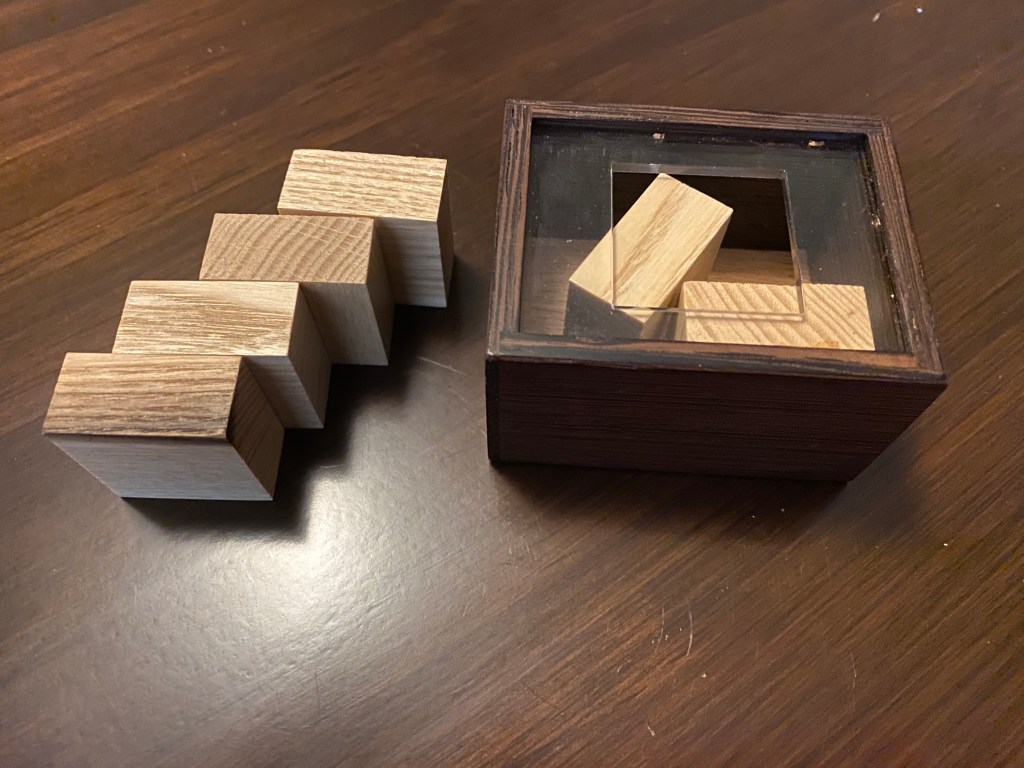
Quadro is a small-ish puzzle whose wooden box and acrylic top share an aesthetic with the Squary Packs (the puzzle’s name also etched into the bottom). It consists of 6 identical squares that must fill a rectangular box – while not interlocking, the solution will require a rather delicate dance to allow you the chance to drop that last block in with the satisfaction the comes with finally filling this up with those. This is one of those puzzles that is more complicated than it looks without being something insurmountable – I still managed to go in circles for quite a while, even asking other puzzlers if perhaps there was a “trick” that I was missing. Eventually I actually stopped and tried that thinking thing I’ve heard so much about, soon managing to find the right moves (leaving me wondering how I had managed to do everything but the one thing that would work).

Snake Pit
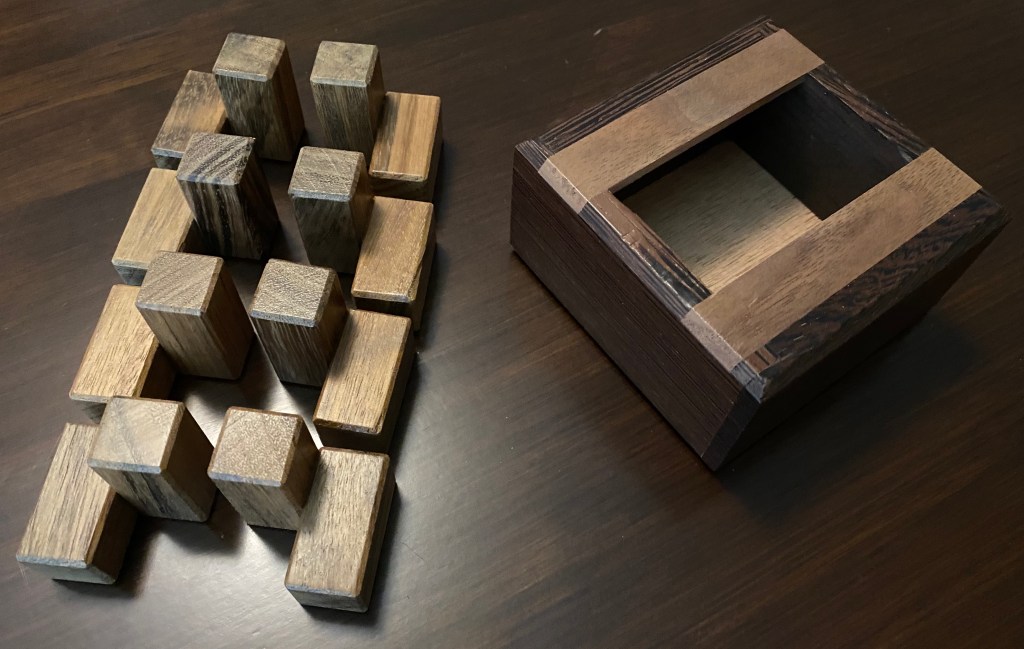
Snake Pit eschews the acrylic top for an attractive mix of light and dark woods with an opening that runs the length of the puzzle and is 1/2 as wide, leaving one voxel on either side. There are 4 pairs of mirrored pieces that must find their way inside for a fun solution that was just the right level of difficulty for me.

Mushkila
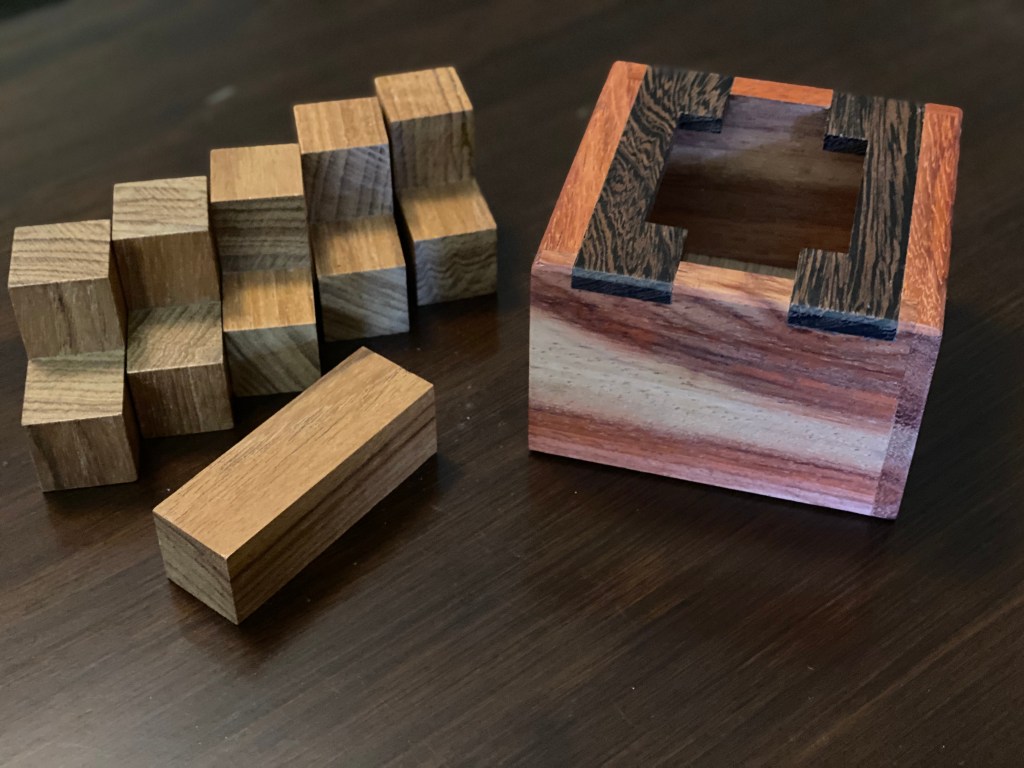
Mushkila is my newest acquisition, having received it along with my second order of Squary Packs. It uses a beautiful mix of woods with lovely grain patterns that play nicely with the mix of red and dark and light brown. Interestingly, the opening is not a regular shape: it runs the length of the box (similar to Snake Pit) to allow the single rectangular piece to go in and also adds a square cut-out to allow the five angled pieces to go in at any orientation. This gives it a bit of a deco look, which meshes well with his choice of woods. I have yet to solve it, but having spent a little bit of time on it, it is clearly a non-trivial solution that should provide a fun solve while looking great on my shelf.

All of these packing puzzles share a simplicity and elegance, both in terms of their aesthetic as well as their movement – I highly recommend following Yavuz’s Etsy page as I know that any time Yavuz has something available, I will happily say “yes, please” to whatever it is, sight unseen


Fun Grade: 5 Sinatras

Difficulty Grade: 3 to 4 Sinatras

Another Day, Not Just Another Drawer

Unlocked Drawer

Kathleen Malcolmson and Perry McDaniel, 2.5″ x 2.5″ x 1.6″

A few weeks ago, I reached out to a fellow puzzler on the social media site that shall not be named who, so I had heard, might be looking to let go of a few puzzles from his rather immense collection. After a bit of back and forth in which I listed out a number of names of makers and designers whose works are generally a bit difficult to find, he let me know that he did indeed have a couple boxes by none other than Kathleen Malcolmson. I have admired her boxes from afar but never before had the chance to get one (at least not for anything resembling a reasonable price). Not only was this a box made by her, but it was designed in collaboration with another hard-to-obtain designer, Perry McDaniel. The story goes that she had been working on the design for some years, unable to get it just right until Perry chimed in with a needed final touch that would allow her to produce it as envisioned.

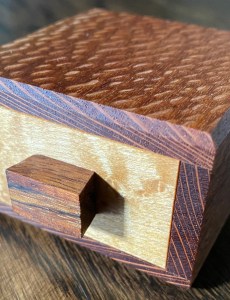
Unlocked Drawer is a relatively small box, consisting of just a drawer in a frame. It is beautifully made of contrasting lacewood and primavera, an aesthetic that is pretty consistent across her creations, at least as far as I can tell. Upon receiving it, I quickly found that its secrets were well-hidden: other than a bit of noise to be heard when shaken (presumably the Texas quarter to be found inside), the seams visible from the front do not permit any movement and no other breaks could be seen.

And that’s it! Fabulously frustrating in its simplicity and elegance, it would take me quite a bit of poking prodding pushing and pulling over the course of several days before a genuine aha that startled me with its sudden appearance. I love a moment like this: it is the reason many of us puzzle and we spend quite a bit of time chasing the feeling which is well represented in this little box. Closing it, there remains no indication of the solution, which I of course had to repeat several times since solving solely to revel in its gracefully hidden presence. A close relative of the box (Three-Layered Dovetail) was recently available at a Haubrich Auction, and was claimed by a puzzling French friend of mine, with whom I would not wish to engage in a bidding war – hopefully, I will be able to find a copy of my own, and/or any other Malcolmson boxes (particularly perhaps its predecessor, Locked Drawer, designed by Robert Sandfield). It more than lived up to the hype in its beauty, craftsmanship, and deviousness.


Elegance Grade: 5 Sinatras

Difficulty Grade: 4.5 Sinatras

Locked Out: Lock Box by Eric Fuller

Lock Box

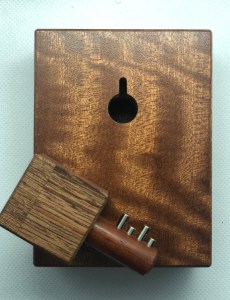
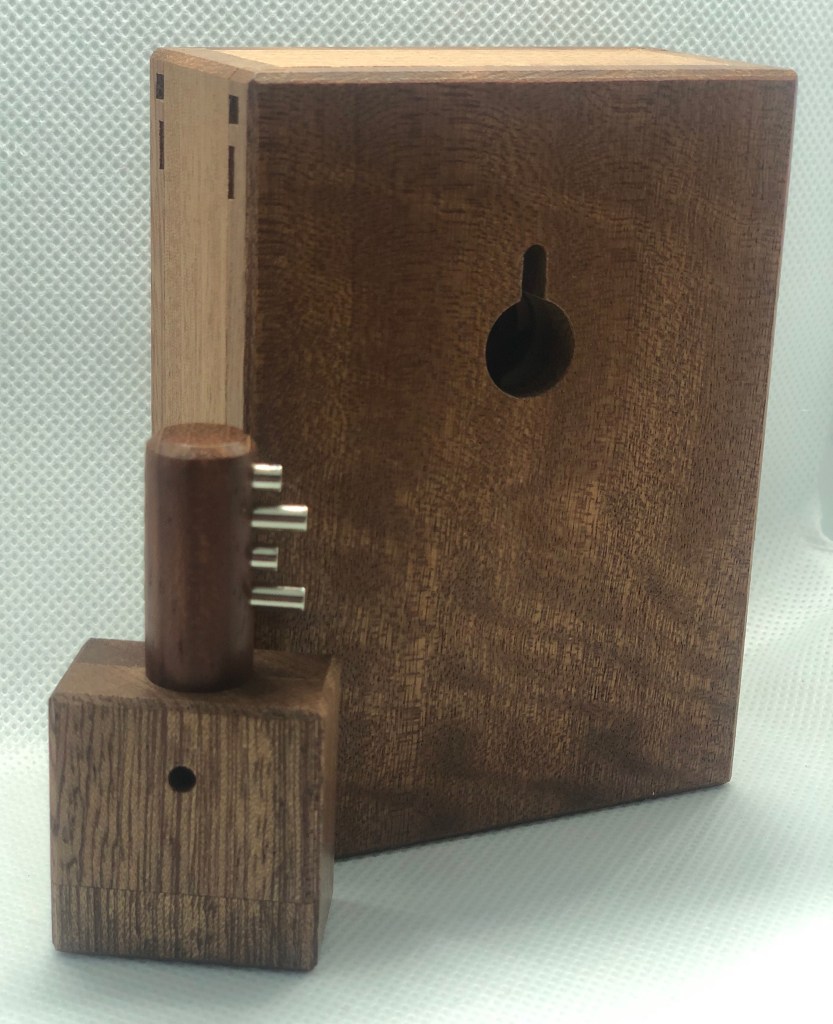
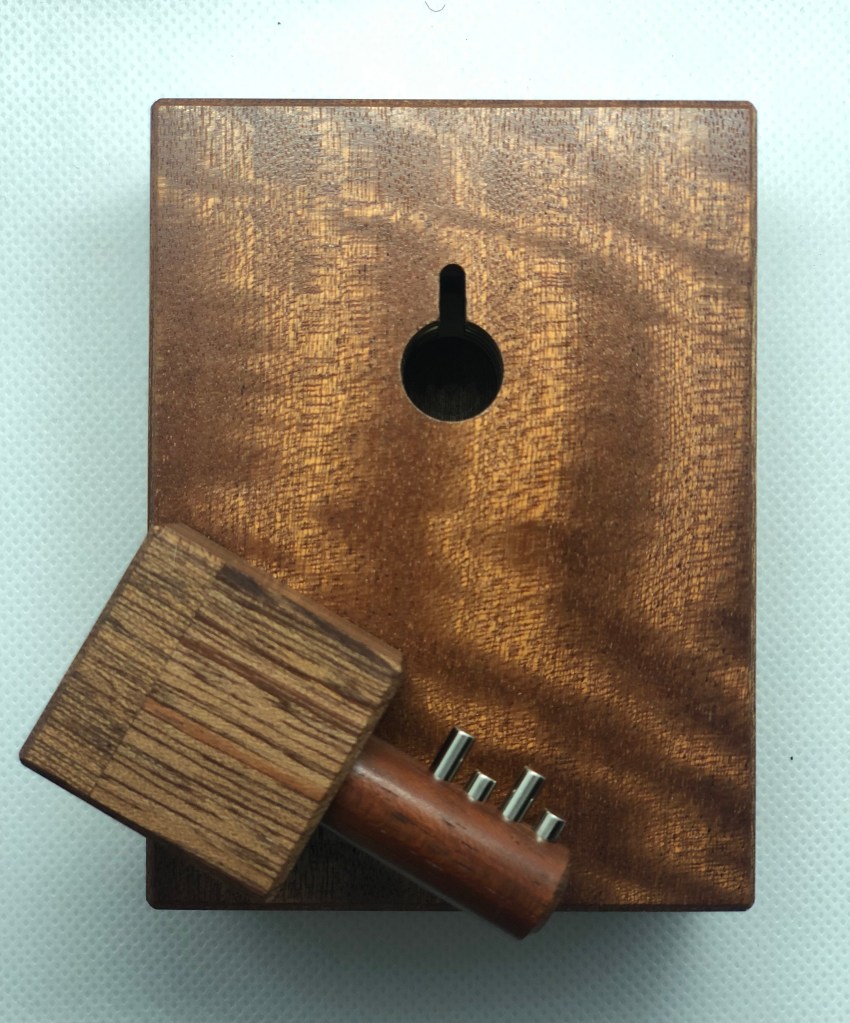
Eric Fuller, Figured Quartersawn Sapele 3″ x 4″ x 1.45″ Box, 2.45″ x 1.25″ x 0.75″ Key 133 Copies

I have a tendency to write about puzzles that may not be easy to obtain – I enjoy reading about such pieces, that I might live vicariously through the vague reminiscences of puzzlers more fortunate than I, adding to my ever-expanding list of unicorns and future lost auctions.

This is also due to the simple fact that great puzzles sell quickly. In a bout of good fortune, Eric Fuller’s Lock Box will again be available in limited quantities on CubicDissection.com in late July (2020). Personally, I need only hear Eric Fuller + Puzzle Box to anxiously wait to give him my money, but if you are unsure, my suggestion is: buy it. If you cannot afford it (at $450 it ain’t cheap), sell some other puzzles and then buy it. In the unlikely event you do not like it, there will be plenty of people happy to take it off your hands; I believe it is destined to be yet another unicorn with auction prices that get bonkers fast.

At first glance, we have a key and a box with a keyhole; so far we have more to go on than the T12 initially shows. Unsurprisingly, after dutifully inserting the key (because you’ve got to try, right?), you will find it will not get you very far. And that’s it.

Before too long, I had my first aha. Followed by a few more. Followed by a wall. And more wall. Then another aha. More wall. Aha. Wall. Wall. Think, plan, take notes. Wall. Aha? Hm, no: Wall……… and here I am: a pretty good understanding of the wall I am facing, with no idea how to get past it. I have made good progress, with the end somewhere in sight and I can confidently say this will be very satisfying when that final aha has been found.

The puzzle has so many of the things I love in a box (some of which I will not say): things that look they should work that don’t; a bit of progress that may not come right away, but before too long; a series of stops and gos, extending the pleasure of solving across a spread of mini-solves; the ability to make progress during my first, focused session; the inability to fully solve it during that same session; the need for both trial and error as well as actual thinking; pretty, pretty wood; and while it has some similarities with other great puzzles, it is mostly very unique.

Everything works well and consistently, which is always nice (and is not always the case even with some excellent puzzles). And did I say that it is pretty? The instructions do warn that this will not stand up to humidity well – we are advised to keep it between 40% and 60% lest it be ruined (!), so some folks may be facing a dilemma (I’m looking at you my Hawaiian puzzling friends).

I expect that the final step (or steps) will be something quite different from what has worked thus far: this is something many of Eric’s puzzles feature; were it not the case, I probably would have found it (them?) already, after all. It took me a while to determine how to get to my current stopping point reliably and with full comprehension but this final wall may be staring me in the face for some time.

But man, this reminds me of why I love puzzle boxes.


Puzzle Oddity: Anti-Gravity Box by Frederic Boucher

Anti-Gravity Box

Frederic Boucher, 3D Packing Puzzle, 2.25″ x 2.25″ x 1.5″

A few months ago, I wrote to Frederic in the hopes that he might happen to have a few puzzles that were seemingly unavailable. Most were, but he did happen to have a last copy of Anti-Gravity Box, which I happily requested, along with a few other new puzzles that he had on hand.

March 2022 Update: CubicDissection will be releasing a new version of AGB (titled: “Anti-Gravity Box+”) in it’s upcoming March 21, 2022 release – not only will this feature the ever-awesome craftsmanship and woods CD is deservedly known for, but, according to Frederic: “This new version includes a 2nd set of pieces with a solution that includes a trick that I think has never been seen in any other design yet…” This presumably constitutes the + in CD’s AGB+. So get your clicky finger ready as I don’t expect that these will last long: (EF + FB)CD = Awesome Sauce!

I have solved several of Frederic’s puzzles in the past – 3D and 2D packing puzzles that offer a serious challenge, comparable to pieces by Osanori Yamamoto, Koichi Miura, and Volker Latussek, and featuring elements such as interlocking elements and restricted openings.

Anti-Gravity, however, adds new mechanics by introducing a number of magnets into the mix. This makes for a unique and novel puzzling experience; it is no longer “just” about finding a way to get the pieces into their frame, as the magnets throw one’s general approach out the window.

The box is a 3×2 voxel frame that features a removable, acrylic top, allowing you to easily reset the puzzle and view your progress. The box has two, single voxel openings at 90 degrees to one another; both are in the middle of the bottom level, allowing you to enter each axis, but offering no room for angles of any kind. You must fill it with 6 identical rectangular 3×1 blocks; 2 have two magnets on one side, 3 have magnets on one end, and one block has none.

There are rules, of course: you need to place it on a flat surface and you are not meant to pick it up or tilt it (of course, you may hold it while you insert other pieces); you cannot poke your finger into either of the openings to push the pieces; it goes without saying that you cannot just lift off the top and place them in. The removable top is a kind addition, as it avoids the need to struggle to remove pieces when you have eventually found you had made a mistake. The puzzle arrived with the pieces stacked neatly inside. It is kind of cool to have a puzzle so confident in its structure, that it can come fully solved without having spoiled anything.

While by no means simple, neither is it an overly difficult puzzle – in my experience, one of his other packing puzzles was more challenge than I could meet (I am admittedly not so great at packing or interlocking puzzles generally – my interest far exceeds my ability when it comes to these types of puzzles).

More importantly, this is a very fun puzzle, and one with which trial and error will not get you very far; knowing the pieces you can eventually figure your way through it.. After spending a few minutes playing with it, experimenting to get to know the pieces and what they can and can’t easily do, I had to stop and think. This led to the first big aha moment of a series of such moments, leading to the full solution. Each step is its own planned approach, each piece requires forethought once a workable order has been determined. Apparently, this has two approaches that lead to similar solutions; I have found one and will undoubtedly spend some more time to find the second.

TL;DR: Anti-Gravity Box by Frederic Boucher is an original approach to a 3D packing puzzle, with magnetic pieces needing to be stacked using entries that allow for little margin of error. While not Boucher’s hardest puzzle, each move must be planned and purposeful through thoughtful approach and not just trial and error. It features a convenient removable top to reset after you inevitably make a mistake, and is so confident in its own puzzling, that it can arrive solved without lessening its challenge.


Originality / Fun Grade: 4 and a Half Sinatras

Difficulty Grade: 3 and a Half Sinatras

Instructions Included

Dr. PinkLady, or How I Learned to Stop Fidgeting and Solve the Burr

Fidget Burr (a/k/a Dollar Burr, a/k/a Chin Burr)

Jerry McFarland, 3.28″ x 3.28″ x 2.92″

Recently, I was lucky enough to get a copy of Jerry McFarland’s Fidget Burr (not to be confused with the puzzle of the same name designed by Tim Alkema and recently produced by Eric. Fuller of CubicDissection). It has quickly become one of my all-time favorite puzzles, with an extremely original design replete with fun and challenging nuances.

First off, the puzzle is beautiful, consisting of 23 wood pieces crafted from walnut, maple, mahogany, and bloodwood (with the keypiece possibly made in a different exotic wood, such as Bubinga, Santos Rosewood or Cocobolo), for a interestingly contrasting aesthetic. It feels soft, presumably waxed into a delightful sheen that allows the puzzle to stand out, adding to the temptation to play and fidget beyond one’s attempts at finding the solution.

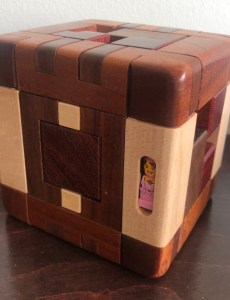
But what really makes it stand out is the addition of 22 magnets integrated into the puzzle, adding layers of novelty, difficulty, and stability that makes it stand out from its (still excellent) burr cube brethren. And last but not least, a Lego minifig can be seen, trapped within a window on one piece of the puzzle’s frame, lending the puzzle a hint of puzzle box / take-apart puzzling.


NOTE: The following paragraph reveals details of the puzzle’s first move – I feel comfortable writing about it as this has been blogged about before and is not really a hidden feature of the puzzle, but for those purists out there who want to know absolutely nothing about a puzzle, I thought I would give you fair warning – it has been formatted to make it easy enough to skip:

iIt is readily apparent which piece offers the first move (being the only piece that can move) and, when you press it, you are rewarded with a chain of clacking, automatic movements as 4 pieces are released, magnets forcing them out. This chain will most certainly be repeated again and again, both in the search of its solution, as well as the sheer entertainment value.


Following this first step, I immediately hit a wall. Fortunately, this first step is more than fun enough to play with absent any further progress. However, after numerous attempts at exploring possibilities through trial and error, I explored that other method of puzzle solving: thought. With this, I was able to narrow down the possible next steps, more quickly finding my way past this wall. Soon, it is possible to remove some pieces of the puzzle.

However, this is not the end as one must deal with some (possibly less difficult, but still non-trivial) additional steps, revealing the reason for at least one of the puzzle’s aliases. As you continue through the puzzle, you find a number of added details, magnets, chamfers, clips, and pins that really show off Jerry’s expertise, as they allow for a more consistent and stable puzzling experience (these are detailed in the included instructions in a series of notes, which would be spoilers if shared). One such detail does double duty, causing me several minutes of confusion as I lost all momentum just as I thought I was about to free my Pink Lady. Moving past this, the lovely lady can be freed (and even her window frame reveals evidence of Jerry’s thoughtful and precise approach to puzzle-making, as it is designed in such a way as to make her intended orientation obvious when looking to cruelly force her back into her wooden prison).

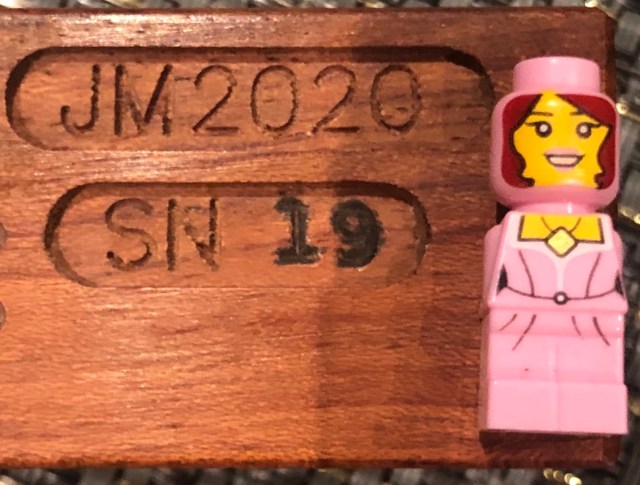
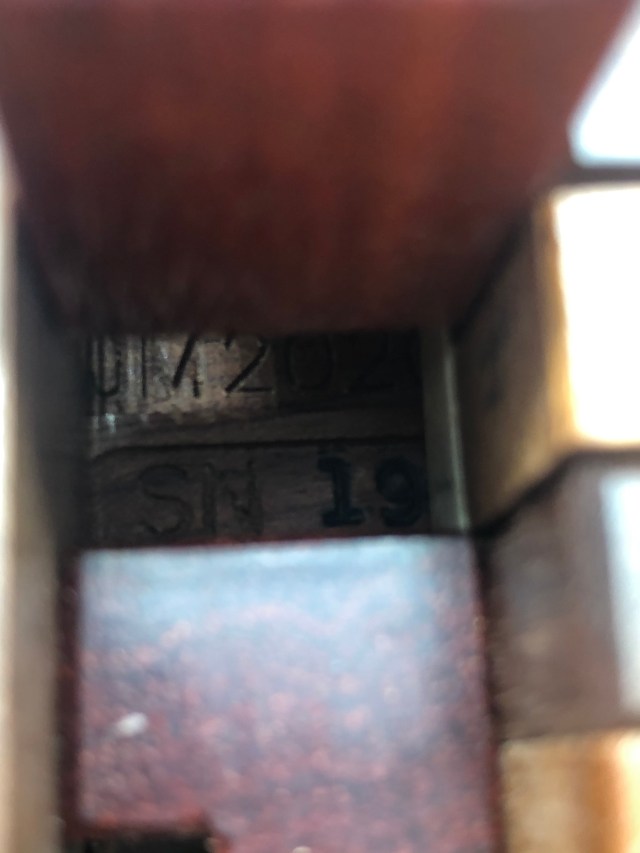
The key piece has the puzzle’s “signature,” the maker’s initials, year of creation, and serial number etched into perfectly matched frames (as seen above).

Note that this picture is also no spoiler, as Jerry designed the puzzle such that one can view the signature without having solved the puzzle – yet another unique detail that demands appreciation.

Reassembly is not overly difficult: Jerry has thoughtfully marked some of the pieces to aid with the proper orientation, allowing you to reassemble the puzzle with pleasure rather than frustration. Burrtools is unnecessary, good considering my strong suspicion that it would not provide much (or perhaps any) assistance.

As mentioned, the puzzle comes with instructions and notes: 5 pages that includes solution descriptions assembly instructions with pictures and illustrations, as well as the aforementioned notes and a general explanation of the puzzle (the latter being graciously printed on the first page to avoid any accidental and unwanted spoilers).

Fidget Burr will be entered in the 2020 IPP40 Design competition, where I would be surprised if it did not earn some significant recognition. While 2020 seems it will be a banner year for puzzling, Fidget Burr will no doubt be amongst its top designs; it is certainly amongst my puzzle favorites overall (assuming my judgment is at all reliable), not least considering its atypical replay value.


Awesome Sauce Grade: Five Sinatras

Breakdown

Slammed Car

Junichi (Juno) Yananose, Pluredro, 2019
Not Available
  • Puzzle Details:
    • Sequential Discovery Box: 15 to 20 Steps
    • Woods: Koto, Blackbean, Jarrah, PNG Rosewood
    • Number Made: 100 (not available)
  • Dimensions:
    • Overall Size: 7.1″ x 3.1″ x 3″
    • Compartment Size: 1.8″ x 1.5″ x 1.5″
    • Weight: 14.5 oz

The first impression I have of Juno’s second sequential discovery puzzle is that it is no small affair: it feels solid and significant in my hands, larger and heavier than most quality wood puzzles. Its wheels move, and separate pieces are readily apparent, distinct from the carved doors on its sides. It is clear that the goal will be to remove the front, rear, and top of the car, in order to gain access to the concealed compartment(s).

Unlike many themed puzzles, Slammed Car is unique in that the theme is maintained as one progresses: the tools discovered are clearly intended to encourage the feeling that one is opening and disassembling a car. This playful take on the puzzle box does not mean that the steps are simple, however; while the initial steps may be somewhat apparent upon initial inspection, the difficulty quickly ramps up, leaving you with several tools with no clear purpose. Personally, I enjoy the ability to quickly become immersed in a puzzle, only to find myself suddenly adrift, with only a hazy view of the opposite shore.

As I write this, I have still not reached my destination: I have tools and direction, with some of the mechanics worked out after having been granted a view of some further inner workings and thereby developing a notion of how to proceed. I anticipate larger “a-ha” moments when I return to experiment and explore further, likely following extended bouts of confusion and delighted frustration.

Slammed Car has already introduced some unique mechanisms, presented in a thematic approach that feels more practical than some of the more whimsical Karakuri pieces. The woods are lightly aromatic and exceedingly smooth, their hues contrasting nicely with one another, encouraging the feeling of heading to the beach in the iconic, California Woodie of the early 20th Century. Although I have yet to fully solve this puzzle, I can confidently say that it is a trip worth taking, whether or not I may wipeout along the way – that is, after all, part of the fun.


Grade: Four and a Half Sinatras