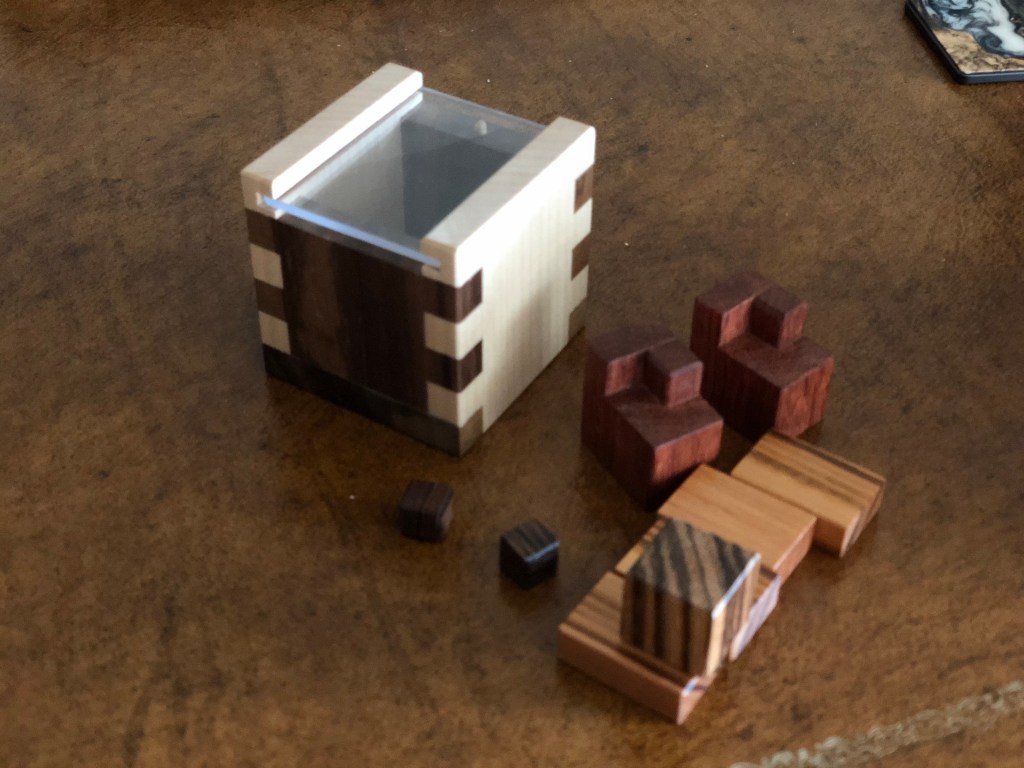
My latest (meaning second) video takes a look at Schrat by Stephan Baumegger, an interlocking solid puzzle featuring 6 burr sticks in a wood cage. It is a beautiful puzzle of the high quality one should expect from Stephan’s work.
I have only started disassembling this piece and it is proving to be an accessible and fun solve. I have been getting better at these types of puzzles, having mostly collected boxes and other take apart puzzles in the past.
I generally find reassembling interlocking solids to be quite challenging. With practice (and some small, colored stickers), I am improving as I gain experience. In this case, I think I may have a chance at reassembly without resorting to burrtools (file to be begged off some other puzzler, because I am lazy and only semi-computer-literate).
This is a good-sized puzzle and it looks and feels great. I could say what woods are used, but I would be guessing and that is unlikely to be fair to the puzzle or to the maker. However, it is definitely a piece that shows well, with its corner joints an off-white color that plays well with the darker woods of the burr sticks, set within a frame that features lovely wood striations.
As with most of Stephan’s works, I think it is a great addition to my collection aesthetically, with a solve that feels fun (although I have only begun working on it).
Snack Brake from Daniel Alterman (DanielScottWoodworks on Etsy) hit the puzzling scene from out of nowhere. It helped that a certain famous youtuber did a vid on it (you know, where someone manages to solve IMPOSSIBLE puzzles all the time – somewhat counter-intuitive, but I digress) – but mostly, it is just a unique looking puzzle with a fun design that just makes it stand out from the crowd.
First off, it’s fun to have a puzzle box (which I’d say this is, more than anything else) with a bit of a story: it’s a vending machine, and you got to get your snack out, right? But alas no coin slot! What shall I do? Well, it took me quite a while to figure out how to get my wooden snacks to drop down to the vending slot. Even then, more surprises await, a welcome double solve!
Snack Brake is a pretty big piece – it weighs a good amount, and comes with a viewing window on the front, behind which you can see your wooden snack, colorful tubes extending upwards; the panel is locked and you can see a key in a little vial on the same shelf as your snack.
The whole thing is pretty colorful, and has a good, nostalgic and playful feel to it; especially when you plug it in and use the handy remote to, that’s right, light up the back! Puzzle Party over heeere!
Like I said, the puzzle has some good challenges – the opening sequence of moves was something I’ve never seen before. I especially appreciated getting a good look at the build (eventually), which was even more original than I’d thought.
It’s also rare to have a puzzle with some electronics built in, and it made for a nice aesthetic addition to my collection.
Finally, Dan is a super nice guy – easy to get in touch with, and happy to provide some direction or just chat about the experience. He has since released his Toasted puzzle, which also looks fun and keeps with the theme of eating one’s wooden puzzle solutions, and who doesn’t love the thematic consistency of tongue splinters!
Seriously though, I think Dan is someone to watch, as he brings something of an outsider mindset to his puzzles, leading to mechanisms and themes that are unexpected and deviate significantly from many other emerging works.
Make sure to follow his shop on Etsy as his puzzles seem to fly off the cyber shelf…. maybe I shouldn’t say that as it only means more competition, but he’s just that nice! Besides, Ramsay may have already driven one or two more people than this blog.
While Gretel remained unsolved (the first time), I became aware of how many excellent packing puzzles there are out there – and, unsurprisingly, Cubic Dissection held several excellent examples of my newfound delight.
I decided to take a few steps back, opting for a couple “easier” packers; mostly, I think, so I could show myself that, yes, I am actually capable of putting things into something else.
Pin Block Case is wonderfully made, as one would expect from anything from CubicDissection, with perfect dimensions that allow its pieces to juuuuust fit. True, it is not perhaps as challenging as some of its noteworthy cousins, but it does not change the fact that the solution is elegant and satisfying. Designed by Hajime Katsumoto, CubicDissection had released it as a part of their (unfortunately discontinued) Artisan series.
It is a pretty straightforward puzzle: 4 blocks with small metal pins on one side and a slot running down another must fit into a cube with one corner open. This is made much more difficult by the fact that the slots do not run the length of the block; the perfect fit into the cube creates a challenge in fitting them in despite the pins’ best efforts to the contrary.
I think that this is an excellent introduction to packing puzzles, and to wood puzzling generally; it shows how something that seems simple is not necessarily easy. What’s more, trial and error may help you to see what not to do, but the solution is best found by stepping back and, well, thinking.
Suddenly, the necessary angles and orders became clear, and they slipped in perfectly and elegantly, as though I should have known all along that is how they were meant to go. And an excellent final detail: unlike many packing puzzles, Pin Block may be displayed and shared solved without spoiling anything – all one sees are 4, apparently plain, same-sized blocks resting comfortably behind the quarter cut hole. Removing them offers the same challenge in reverse, although it should of course first be approached unsolved, as with packing puzzles generally.
Not being the most difficult puzzle is an attribute of this lovely piece; the satisfaction of the graceful solve is not lost in such relative simplicity, quickly adding packing puzzles to my addiction while putting a happily stupid grin on my face.
I’m sure they’ll all go right back in – yeah, sure they will….
First off, I’ve decided to dispense with some of the bells and whistles to my posts, as I’ve found it prevents me from sitting down and writing. And I know my one (imaginary) follower is just salivating for more of my puzzling narratives.
Recently I began exploring packing puzzles; as one who had come to puzzles with a fascination with boxes and locks, the elusive, hidden “trick” being the main attraction, packing initially seemed a bit…. meh.
Once again, I was quite wrong! I began with Baumegger’s Gretel, quickly becoming disappointed I had not also bought her brother at the same time. First off, it is a truly lovely puzzle. The various woods are smooth and the colors play wonderfully with one another. Perhaps my favorite detail is the tiny nub at the top that secures the clear, acrylic cover (assuming you can solve it of course).
Stephen was easy to contact and talk with, and the puzzle arrived soon. For such a small, straightforward task, this thing was HARD. Maybe it is the ancient Tetris player within, but I took to it immediately. Solving it would take much longer, and in the meantime I would go on to collect several more packing puzzles.
Eventually, it just…. worked. Such satisfaction. I gleefully showed my wife, who glanced briefly over (“that’s nice, babe”), before returning her attention to the show I’d forgotten we were way supposed to be watching. My focus was all on my perfectly packed puzzle, grinning proudly (me, not the puzzle). My little cover slipped on, perfectly held in place, and off she went to join my small collection of solved packing puzzles.
Fast forward a couple weeks, and I was taking a pic to show a fellow puzzler how pretty she is: hold on…. I can’t take the pic of it solved lest too much be revealed. I’ll just dump it out; surely I can repack it, no prob.
Yes, it remains unsolved. Yes, I swear it was packed. Yes, she got moved back to her evil, unfriendly and unsolved cousins. Maybe she’s mad I didnt get her brother? Well, guess I have no choice. What’s one more puzzle? Right, it’s just one. One never hurt…… Sigh……
First, I would like to officially state that I solemnly swear not to make any more eggs-hausting puns (…starting now).
I think I should start by saying that these are the first 3D-printed puzzles I have bought; I think many of us assume that only wood and metal-workers can bring quality fun to us puzzlers, or at least I think maybe I did. However, I am far from disappointed with the colorful assortment of trickiness that arrived today, the noise of small things shaking around betraying its contents. In fact, I think the 3D print may be a benefit in this particular case (and not just in terms of helping to keep the cost within the bounds of reason).
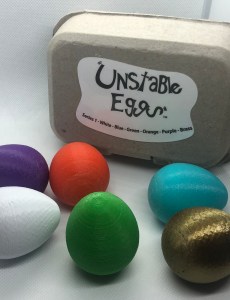
My initial reaction was to smile; the whimsical font on the front of a half-dozen cardboard egg crate was a good start. Opening the box, there is a sticker warning me not to expose the eggs to magnets – a good precaution to know considering the plethora of magnets hiding within the puzzles on my shelves. Thanks for the heads up.
The eggs are all brightly colored and they bear the marks of their pedigree; CoreMods tells us on his Etsy page that we should expect the texture of 3D printed materials. Honestly, I can’t really see these being made any other way: I like the weight of them and the sound comes through clearly, essential should I have any hope of ever getting these bad boys to stand at attention. The movement of whatever mechanisms hide within can be felt and heard through the 3D mold. Further, it provides for a good texture with which to grip the eggs. Perhaps most significant is the fact that, in trying to solve them, they will definitely be rolling around, sliding, dancing, and generally making merry upon my desk; I would hate to watch a wooden puzzle of this ilk go spinning around my desk. The 3D print allows me not to worry about rocking and rolling and just generally experimenting with movements that may (and so far mostly don’t) work..
The purpose / goal of these eggs, if not already apparent, is to get the eggs to stand up. Unlike Weebles, these definitely wobble and fall down. I had been wondering how many different things one could put into an egg to make such a concept difficult, without them feeling repetitive or boring. The answer is at least 6. Judging from the fact that the sticker says this is Series 1, I suspect CoreMods knows of even more.
I had also been thinking of some obvious (to me) moves that might solve such a puzzle; I worried that I would get 6 centrifugal pieces of plastic with which I would be done in a moment. This is (thankfully) NOT what I got: of the 6, I was able to get 1 to stand up with any amount of ease (admittedly using one of the methods I expected to find, the rest of which have yet to bear any fruit… or yolk, perhaps – not a pun, mind you…).
Whatever is going on inside of these guys is unclear, but I can tell that they will all require different approaches; the noise and feel of each individual egg allows me to begin to develop an image of diverse mechanisms waiting to be solved.
And, at the end of the day, that is really what this is about: we want to find a puzzle we have never seen before, executed in a new way, which is uniquely solvable. I feel that this is what I got (and at a very reasonable price, I might add – another benefit of the 3D printed puzzle). Although this may not be true for everyone, I have not seen puzzles with this same goal (I may have heard of a couple, but this is certainly not a common puzzle-type). It is a combination of dexterity and the type of lateral thinking required to open a puzzle box, as one works to understand what is happening through trial and error (and error and error) and keen observation (again, this is where the 3D form comes in handy).
Suffice it to say that I am very happy with what I got – CoreMods has come up with a novel concept that displays with fun and humor, while requiring more than a little head-scratching to make progress. Which means I will be ordering his Screwball as soon as I have all my little eggs standing in a row (so it may be a while).
Update: a couple months later and…. I did it! I got them all to stand! Well. Not bronze, of course. I mean that ones impossible. But the others just began making sense to me, for the most part. I still not 100% clear what’s going on inside of purple, but if I can ever get bronze to stabilize, I’d told myself is crack open the included solution sheets that CoreMods has said contains images of what lies within. Maybe I’ll actually get to take a look one day and see how closely my understanding matches the reality.
Grade:Four Sinatras
Updated Update: Bronze! Wow. I’m genuinely surprised I got it lol. I immediately grabbed the solutions and, as suspected, I was still way off on purple (bronze is much more complicated and a very cool mechanism that I’d probably never have dreamed up). The other four were very close to what I pictured, having built up a mental model over weeks of light shaking, ear pressed to the teeny plastic eggs, mouth screwed up in concentration (I may have looked like a crazy person, but who cares? I got my eggs to stand!). It was very satisfying to compare this schematic to the reality, and even more satisfying to get these guys to stand. I didn’t dare touch my desk for a day for fear of falling, but now I’m able to get them all to reliably stand with a bit of practice. Well, maybe not bronze. Not yet, at least.
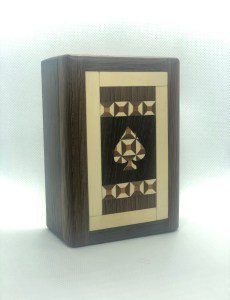
A few months ago, I received the Jack in the Box puzzle from Jesse Born. Jack is a cool concept, blending puzzle boxes with one of my other favorite collectibles, playing cards! The box allows most decks of cards to sit snugly within, allowing only the slightest feel of movement when holding the unsolved puzzle.
It arrived unsolved (duh) and the quality was immediately apparent: the wood is smooth and feels solid and weighty in your hands. The Yosegi design on the top is excellent; except for four seams that are part of the design, the breaks are not immediately noticeable by eye or hand – a difficult achievement, I am sure, and I think it is as good as any Karakuri I have.
With some inspection it becomes relatively clear where the opening will be; I could figure out where the final step would likely take place, but that was it. Nothing moves, nothing slides… like some of my favorite puzzles, it is essentially a Wonka factory (“nobody ever goes in and nobody ever comes out”).
I find it very satisfying to get a solid puzzle with no clear first step. It can of course be fun to know how to start a new puzzle before hitting a wall, but there is something about a puzzle with no indication of how one should begin. I tried all the usual stuff (spinning it, holding it at different angles, sneaking up on it to catch it unawares, etc.), before putting it back on its shelf to glare derisively at me.
I may have done this a couple more times than I like to admit; with some exceptions, I do not typically manage to solve a good puzzle right away, although I suppose this is changing as my puzzling experience levels up. I am probably just trying to make myself feel better by implying that it was before I became the esteemed Solver that I am today. Of course, that is about as likely as my inability to solve a new puzzle actually being due to the always suspected, rarely existent design defect that we oftentimes seek to blame when nothing else seems to work (typically, this occurs a few minutes before being solved, for maximum shaming effect).
Eventually I hit upon that first move, which I find to be a very satisfying move to make even now, months later. After that, it is not a hard path to find the next 4 steps before it opens. Inside, Jesse included a classic red Bicycle deck. I replaced the deck with my Red Labyrinth Cards from King’s Wild; thematic consistency is fun, and what is better to find tucked away inside a puzzle but another puzzle?
Jack in the Box is an excellent addition to my collection, and one that looks great while serving as an ambassador between these two great nations (the world-weary puzzle boxes and the upstart playing cards, like an extra-nerdy West Side Story without the singing, dancing, or blatant Romeo and Juliet rip-off….. and if it was made out of wood, metal, and paper and was sitting on my shelf…).
Jesse is currently working on the wonderfully elaborate Secretum Cista puzzle chest, which will be crazy cool, I am sure, and will be worth not much less than my entire current collection does, but he was kind enough to allow me to pay over time while he works. I will most assuredly share this with the 2 imaginary people reading this (thanks Bob Dobbs and Zaphod! I couldn’t do it without you).
I am telling myself that I will blog on here more frequently, but I’ve learned the hard way that I can’t be trusted, so we’ll see.
Akio Kamei and Shou Sugimoto, 11th Annual Idea Contest Winner, June 2019 Designed by Ichiro Sato
Unboxing Puzzle Boxes with fivesinatras
The newest puzzle box from Karakuri master Akio Kamei and Shou Sugimoto is based on a winning design of the 11th Annual Karakuri Idea Contest from Ichiro Sato. This trick box is made of Oak and Magnolia, and is a whimsical take on waiting for a train to pass, and the secrets that lurk beneath the surface, a comment on the underlying depravity of urban life and the innate search for escape…. well, maybe not, but the wood and whimsy are correct.
Not the hardest puzzle box from the Karakuri Group, as some of the more fun creations tend to be, but it still requires some creative thinking to make the few steps required to open the compartment beneath the tracks. It is pretty big and heavy, a puzzle box with some mass and heft to it, and one that looks great on my shelf, amongst its wooden friends.
And how fun it must have been for my wife to see her grown husband sitting on the floor playing train! I may have even allowed a choo-choo or two to escape my lips as I tried and failed and tried again, before showing my wife with glee the solution, complete with an imagined scene for full effect (“picture yourself in your car, the bells ringing to warn of the approaching train, searching for the correct steps that will allow you to gain access to the safety of the hidden compartment beneath your feet…..” – super cool, I know).
If you manage to get your hands on one, enjoy its weight and the light-hearted fun it carries. And let yourself play for a minute.
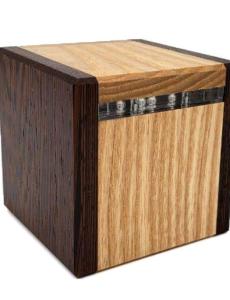
It is almost immediately apparent upon holding Eric Fuller’s what one must do in order to open it: get the stainless steel ball bearings out of the way so the panel can slide out. Easy, right? If you are familiar with Fuller’s work, you should know the answer to that already.
The panel moves slightly, showing you enough of a gap to confirm that this is the way out, and a plastic window teases you with a view of the obstacles rolling in your way. This is part of the fun of Multiball – as you turn it this way and that, first carefully, then perhaps more abruptly, then veeerrrrry slowly, then all these repeated with the box inverted, sideways, and diagonal, then perched upon one’s open palm while you perform your most graceful whirling dervish, and then clenched tightly in your fist while you glare at it scanners-style. All to no avail.
I rather quickly figured out how to will the first ball bearing out of the way, slipping sneakily into some secret recess, then the second soon after, only to have them burst back in, after having gone just a bit too far, like a drunk Uncle regaling your family with Dad’s early sexual escapades over thanksgiving dinner. Rinse and repeat: one ball, two ball, do the hokey pokey and shake it all about, ok there goes the third again, and…. and…. annnnnnnd…… damnit.
After hours of this, the noise of the ball bearings earning quite a few annoyed glances from my wife as we Netflix away our evening, suddenly: it opens! Can you believe it?! Check it out, it’s open! (“that’s nice, babe.”) Yeah, all I did was…. was….. waaaaasssss…. damnit. Still waiting on figuring out what exactly I did right. But I did see that the internal compartment was sizable, maybe not loaf of bread sizable, but more than big enough to fit your Uncle’s next white chip.
The box is beautiful, dark and light woods focusing your eyes on its window, inside of which you can manage to see just enough mirrored mechanisms to further frustrate, but not enough to know for sure what exactly you are looking at – maybe I will have a better sense once I manage to open it…. again.
The first impression I have of Juno’s second sequential discovery puzzle is that it is no small affair: it feels solid and significant in my hands, larger and heavier than most quality wood puzzles. Its wheels move, and separate pieces are readily apparent, distinct from the carved doors on its sides. It is clear that the goal will be to remove the front, rear, and top of the car, in order to gain access to the concealed compartment(s).
Unlike many themed puzzles, Slammed Car is unique in that the theme is maintained as one progresses: the tools discovered are clearly intended to encourage the feeling that one is opening and disassembling a car. This playful take on the puzzle box does not mean that the steps are simple, however; while the initial steps may be somewhat apparent upon initial inspection, the difficulty quickly ramps up, leaving you with several tools with no clear purpose. Personally, I enjoy the ability to quickly become immersed in a puzzle, only to find myself suddenly adrift, with only a hazy view of the opposite shore.
As I write this, I have still not reached my destination: I have tools and direction, with some of the mechanics worked out after having been granted a view of some further inner workings and thereby developing a notion of how to proceed. I anticipate larger “a-ha” moments when I return to experiment and explore further, likely following extended bouts of confusion and delighted frustration.
Slammed Car has already introduced some unique mechanisms, presented in a thematic approach that feels more practical than some of the more whimsical Karakuri pieces. The woods are lightly aromatic and exceedingly smooth, their hues contrasting nicely with one another, encouraging the feeling of heading to the beach in the iconic, California Woodie of the early 20th Century. Although I have yet to fully solve this puzzle, I can confidently say that it is a trip worth taking, whether or not I may wipeout along the way – that is, after all, part of the fun.
“…to produce a consistent, reliable methodology for the determination of the coolness quotient of any particular idea or product, it must be evaluated in contrast with an ideal representation of cool: therefore, any such measurement will be quantified with the most precision by calculating the number of Sinatras it contains and the quality to which it applies.”
Quantified Cool, John Maynard Keynes, Chairman of the World Bank Commission, 1944
Quantified Cool
Quantified Cool
John Maynard Keynes, 1944
Quantified Cool, is a non-existent book not-written in 1944 and attributed to renowned economist John Maynard Keynes by the author of the present blog; any quote claimed to have been contained therein is, by definition, not-written by John Maynard Keynes, and was drafted purely for the purposes of satire, parody, humiliation, cruelty, and the scientific mockery of economists, and of humanity as a whole.
You should probably have figured out that it was not, in fact, written by John Maynard Keynes, because that would be ridiculous: John Maynard Keynes had notoriously terrible taste in music and was an unabashed fan of Andy Williams. As such, John Maynard Keynes would not have been able to construct a reliable method for the quantification of cool as he was, in point of fact, a total dork. That may be why he became an economist.
Simply put, I made it up. It is funny because it sounds like something one might think John Maynard Keynes (or any comparable dead economist) may have written. But John Maynard Keynes, in fact, did not write it. I know this because I wrote it. Recently (i.e. not in 1944).
This may come as a shock, but there’s no such thing as the Sinatra Scaling System….. I know I try to maintain a spoiler-free zone, but that’s only for puzzles and my secret identity and, I felt I owed it to you, that rare reader to click on this teeny link.
Keynes was an economist, true, but Frank Sinatra was 11 when he died, so only Frankie’s mom knew how great he was at the time.
The name “fivesinatras” was something I spontaneously came up with when choosing my first online name as a teenager – a random and impulsive joke of the vaguely ironic “what’s cooler than one Frank Sinatra?……” Yes I do think Ol’ Blue Eyes is cool, but no, there are things cooler than he (as evidenced by my review of Secretum Cista, to which I gave the coveted Presley). Obviously, puzzles are cooler, or else I might be writing a blog called Five Puzzle Boxes, in which I used a puzzle-based rating system to talk about various Sinatra songs.
Eventually, I got into mechanical puzzles, and began seriously collecting them a couple years ago, relying frequently on the excellent puzzle blogs that have been around for years (particularly as there were far fewer puzzle YouTube channels at the time). Since I already spent so much time reading about them and working on them and had no one to talk to about them, beyond the occasional, “that’s nice, babe,” from my wife, I thought it might be fun to write about them. As I was already familiar with the name, “fivesinatras” seemed like an obvious choice (and now millions of puzzle collectors throughout the world regularly use the rating system).
So, basically, the name was a bit of an inside joke with myself, impulsively invented and used to create a blog; I’ve kept writing because it is fun and because I’ve had a person or two tell me that they found it useful, which I think is pretty cool.
You may have noticed that the “rating” system is a bit random. That is by design. If I didn’t think a puzzle was great, I wouldn’t write about it. I have not written about the majority of great puzzles I have done, as I select them randomly and impulsively, but these are some of them.
I will generally change whatever aspect of a puzzle I am specifically rating to focus on whatever it is I find compelling about that specific puzzle; a few times, I think I forgot to include a rating at all. Quite possibly, I could now look back and feel like some don’t really make sense, as I have applied it totally inconsistently (especially earlier posts). Please don’t compare one rating to another and take it to mean that I think any particular puzzle is better than any other; the rating is intended to humorously praise and acknowledge great aspects of a puzzle and not to seriously critique or condemn.
Since it has been around for a while now, I figure I should throw some sort of standard at it, so I will continue to use it as an extremely brief TL;DR, with the real knowledge being conveyed by what is being graded, more than the grade itself; rarely, a truly and utterly amazing puzzle may perhaps receive the rare Presley. If ever a puzzle disappoints me so terribly that I cannot bear to keep it a secret, it might then have bestowed upon it the dreaded Lawford (we shan’t even mention the shameful Bishop). Hopefully, this clears up the ongoing debates about the nature and scope of the rating system currently taking place in numerous town hall meetings and University classrooms across the globe.
Thank you to my tens of imaginary readers, to the excellent puzzle-bloggers whose writings have inspired and directed me, and of course to the amazing and ingenious puzzle designers and creators whose work makes it all possible. And thank you most of all to the large, fiery ball at the center of the solar system whose ongoing existence allows us to enjoy puzzles: we couldn’t do it with you. And, finally….. I’ll miss you most of all Scarecrow!
Overall Existence Grade: Four and a Half Sinatras
Notes on the Presley Standard (excerpt)
“[D]espite the justified reliance on the Sinatra as the coolness quotient upon which said methodology is based, there must simultaneously exist an indicator to be used should a commodity’s value be calculated such that the Sinatra be rendered insufficient; in this event, the Presley is the more apparent and precise control to represent the coolness being commodified insofar as it exists in excess of the standardized Sinatra metric.”






 Puzzle Ramblings