Packing It In 2: Pack Harder

While Gretel remained unsolved (the first time), I became aware of how many excellent packing puzzles there are out there – and, unsurprisingly, Cubic Dissection held several excellent examples of my newfound delight.

I decided to take a few steps back, opting for a couple “easier” packers; mostly, I think, so I could show myself that, yes, I am actually capable of putting things into something else.

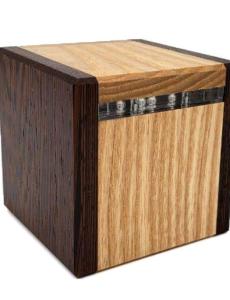
Pin Block Case is wonderfully made, as one would expect from anything from CubicDissection, with perfect dimensions that allow its pieces to juuuuust fit. True, it is not perhaps as challenging as some of its noteworthy cousins, but it does not change the fact that the solution is elegant and satisfying. Designed by Hajime Katsumoto, CubicDissection had released it as a part of their (unfortunately discontinued) Artisan series.

It is a pretty straightforward puzzle: 4 blocks with small metal pins on one side and a slot running down another must fit into a cube with one corner open. This is made much more difficult by the fact that the slots do not run the length of the block; the perfect fit into the cube creates a challenge in fitting them in despite the pins’ best efforts to the contrary.

I think that this is an excellent introduction to packing puzzles, and to wood puzzling generally; it shows how something that seems simple is not necessarily easy. What’s more, trial and error may help you to see what not to do, but the solution is best found by stepping back and, well, thinking.

Suddenly, the necessary angles and orders became clear, and they slipped in perfectly and elegantly, as though I should have known all along that is how they were meant to go. And an excellent final detail: unlike many packing puzzles, Pin Block may be displayed and shared solved without spoiling anything – all one sees are 4, apparently plain, same-sized blocks resting comfortably behind the quarter cut hole. Removing them offers the same challenge in reverse, although it should of course first be approached unsolved, as with packing puzzles generally.

Not being the most difficult puzzle is an attribute of this lovely piece; the satisfaction of the graceful solve is not lost in such relative simplicity, quickly adding packing puzzles to my addiction while putting a happily stupid grin on my face.
Packing It In: Pack Hard

I’m sure they’ll all go right back in – yeah, sure they will….

First off, I’ve decided to dispense with some of the bells and whistles to my posts, as I’ve found it prevents me from sitting down and writing. And I know my one (imaginary) follower is just salivating for more of my puzzling narratives.

Recently I began exploring packing puzzles; as one who had come to puzzles with a fascination with boxes and locks, the elusive, hidden “trick” being the main attraction, packing initially seemed a bit…. meh.

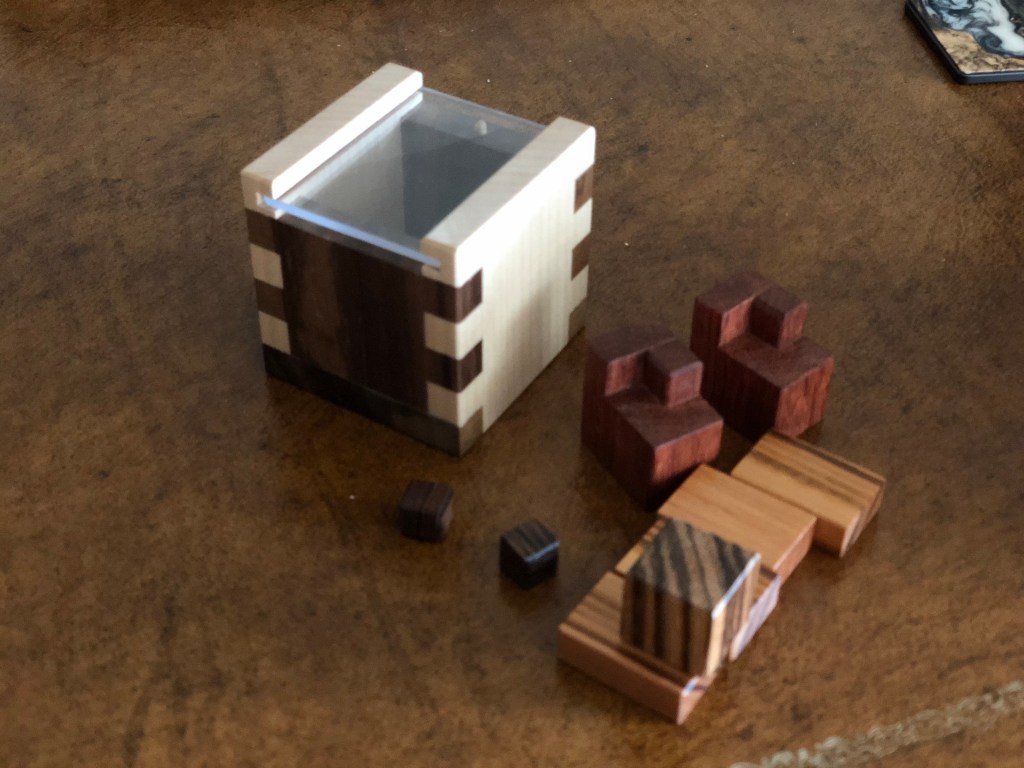
Once again, I was quite wrong! I began with Baumegger’s Gretel, quickly becoming disappointed I had not also bought her brother at the same time. First off, it is a truly lovely puzzle. The various woods are smooth and the colors play wonderfully with one another. Perhaps my favorite detail is the tiny nub at the top that secures the clear, acrylic cover (assuming you can solve it of course).

Stephen was easy to contact and talk with, and the puzzle arrived soon. For such a small, straightforward task, this thing was HARD. Maybe it is the ancient Tetris player within, but I took to it immediately. Solving it would take much longer, and in the meantime I would go on to collect several more packing puzzles.

Eventually, it just…. worked. Such satisfaction. I gleefully showed my wife, who glanced briefly over (“that’s nice, babe”), before returning her attention to the show I’d forgotten we were way supposed to be watching. My focus was all on my perfectly packed puzzle, grinning proudly (me, not the puzzle). My little cover slipped on, perfectly held in place, and off she went to join my small collection of solved packing puzzles.

Fast forward a couple weeks, and I was taking a pic to show a fellow puzzler how pretty she is: hold on…. I can’t take the pic of it solved lest too much be revealed. I’ll just dump it out; surely I can repack it, no prob.

Yes, it remains unsolved. Yes, I swear it was packed. Yes, she got moved back to her evil, unfriendly and unsolved cousins. Maybe she’s mad I didnt get her brother? Well, guess I have no choice. What’s one more puzzle? Right, it’s just one. One never hurt…… Sigh……

Puzzle Box Train(ing)

Railroad Crossing, Karakuri Puzzle Box

Akio Kamei and Shou Sugimoto,
11th Annual Idea Contest Winner, June 2019
Designed by Ichiro Sato
Unboxing Puzzle Boxes with fivesinatras

The newest puzzle box from Karakuri master Akio Kamei and Shou Sugimoto is based on a winning design of the 11th Annual Karakuri Idea Contest from Ichiro Sato. This trick box is made of Oak and Magnolia, and is a whimsical take on waiting for a train to pass, and the secrets that lurk beneath the surface, a comment on the underlying depravity of urban life and the innate search for escape…. well, maybe not, but the wood and whimsy are correct.

Not the hardest puzzle box from the Karakuri Group, as some of the more fun creations tend to be, but it still requires some creative thinking to make the few steps required to open the compartment beneath the tracks. It is pretty big and heavy, a puzzle box with some mass and heft to it, and one that looks great on my shelf, amongst its wooden friends.

And how fun it must have been for my wife to see her grown husband sitting on the floor playing train! I may have even allowed a choo-choo or two to escape my lips as I tried and failed and tried again, before showing my wife with glee the solution, complete with an imagined scene for full effect (“picture yourself in your car, the bells ringing to warn of the approaching train, searching for the correct steps that will allow you to gain access to the safety of the hidden compartment beneath your feet…..” – super cool, I know).

If you manage to get your hands on one, enjoy its weight and the light-hearted fun it carries. And let yourself play for a minute.

Ballin’

Multiball

Eric Fuller, CubicDissection, 2019
Sold Out
  • Puzzle Details:
    • Puzzle Box: 2 Steps
    • Woods: Ash, Wenge, Walnut
    • Number Made: 99 (signed and dated)
  • Dimensions:
    • Overall Size: 3″ Cube

It is almost immediately apparent upon holding Eric Fuller’s what one must do in order to open it: get the stainless steel ball bearings out of the way so the panel can slide out. Easy, right? If you are familiar with Fuller’s work, you should know the answer to that already.

The panel moves slightly, showing you enough of a gap to confirm that this is the way out, and a plastic window teases you with a view of the obstacles rolling in your way. This is part of the fun of Multiball – as you turn it this way and that, first carefully, then perhaps more abruptly, then veeerrrrry slowly, then all these repeated with the box inverted, sideways, and diagonal, then perched upon one’s open palm while you perform your most graceful whirling dervish, and then clenched tightly in your fist while you glare at it scanners-style. All to no avail.

I rather quickly figured out how to will the first ball bearing out of the way, slipping sneakily into some secret recess, then the second soon after, only to have them burst back in, after having gone just a bit too far, like a drunk Uncle regaling your family with Dad’s early sexual escapades over thanksgiving dinner. Rinse and repeat: one ball, two ball, do the hokey pokey and shake it all about, ok there goes the third again, and…. and…. annnnnnnd…… damnit.

After hours of this, the noise of the ball bearings earning quite a few annoyed glances from my wife as we Netflix away our evening, suddenly: it opens! Can you believe it?! Check it out, it’s open! (“that’s nice, babe.”) Yeah, all I did was…. was….. waaaaasssss…. damnit. Still waiting on figuring out what exactly I did right. But I did see that the internal compartment was sizable, maybe not loaf of bread sizable, but more than big enough to fit your Uncle’s next white chip.

The box is beautiful, dark and light woods focusing your eyes on its window, inside of which you can manage to see just enough mirrored mechanisms to further frustrate, but not enough to know for sure what exactly you are looking at – maybe I will have a better sense once I manage to open it…. again.

Grade: Four Sinatras

Breakdown

Slammed Car

Junichi (Juno) Yananose, Pluredro, 2019
Not Available
  • Puzzle Details:
    • Sequential Discovery Box: 15 to 20 Steps
    • Woods: Koto, Blackbean, Jarrah, PNG Rosewood
    • Number Made: 100 (not available)
  • Dimensions:
    • Overall Size: 7.1″ x 3.1″ x 3″
    • Compartment Size: 1.8″ x 1.5″ x 1.5″
    • Weight: 14.5 oz

The first impression I have of Juno’s second sequential discovery puzzle is that it is no small affair: it feels solid and significant in my hands, larger and heavier than most quality wood puzzles. Its wheels move, and separate pieces are readily apparent, distinct from the carved doors on its sides. It is clear that the goal will be to remove the front, rear, and top of the car, in order to gain access to the concealed compartment(s).

Unlike many themed puzzles, Slammed Car is unique in that the theme is maintained as one progresses: the tools discovered are clearly intended to encourage the feeling that one is opening and disassembling a car. This playful take on the puzzle box does not mean that the steps are simple, however; while the initial steps may be somewhat apparent upon initial inspection, the difficulty quickly ramps up, leaving you with several tools with no clear purpose. Personally, I enjoy the ability to quickly become immersed in a puzzle, only to find myself suddenly adrift, with only a hazy view of the opposite shore.

As I write this, I have still not reached my destination: I have tools and direction, with some of the mechanics worked out after having been granted a view of some further inner workings and thereby developing a notion of how to proceed. I anticipate larger “a-ha” moments when I return to experiment and explore further, likely following extended bouts of confusion and delighted frustration.

Slammed Car has already introduced some unique mechanisms, presented in a thematic approach that feels more practical than some of the more whimsical Karakuri pieces. The woods are lightly aromatic and exceedingly smooth, their hues contrasting nicely with one another, encouraging the feeling of heading to the beach in the iconic, California Woodie of the early 20th Century. Although I have yet to fully solve this puzzle, I can confidently say that it is a trip worth taking, whether or not I may wipeout along the way – that is, after all, part of the fun.


Grade: Four and a Half Sinatras