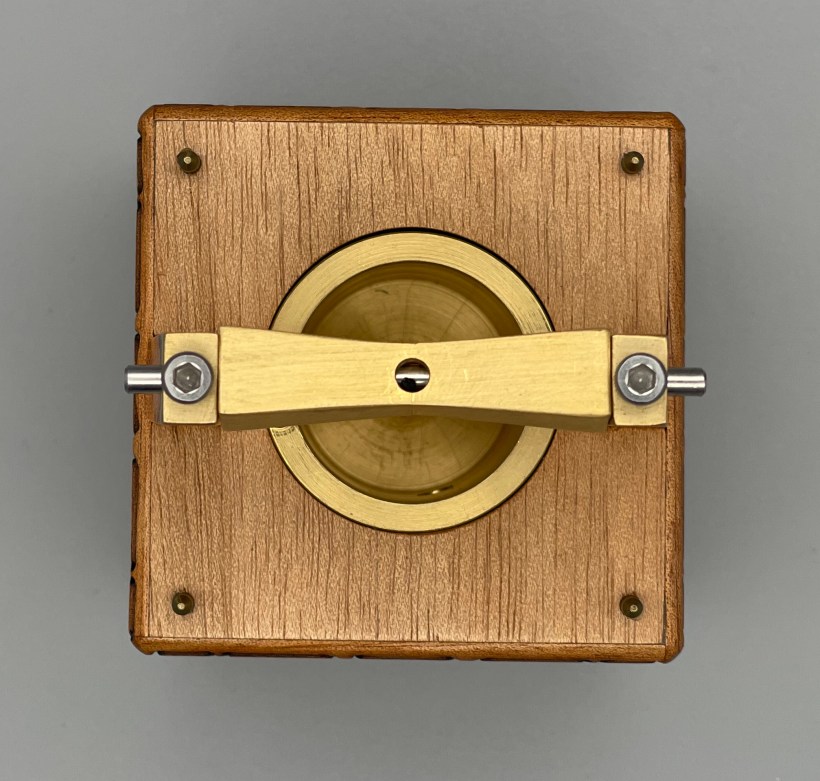
“Glamour & Glitter, Fashion & Fame” – Jammed Gem by Eric Fuller & Frederic Boucher

Jammed Gem

Eric Fuller & Frederic Boucher
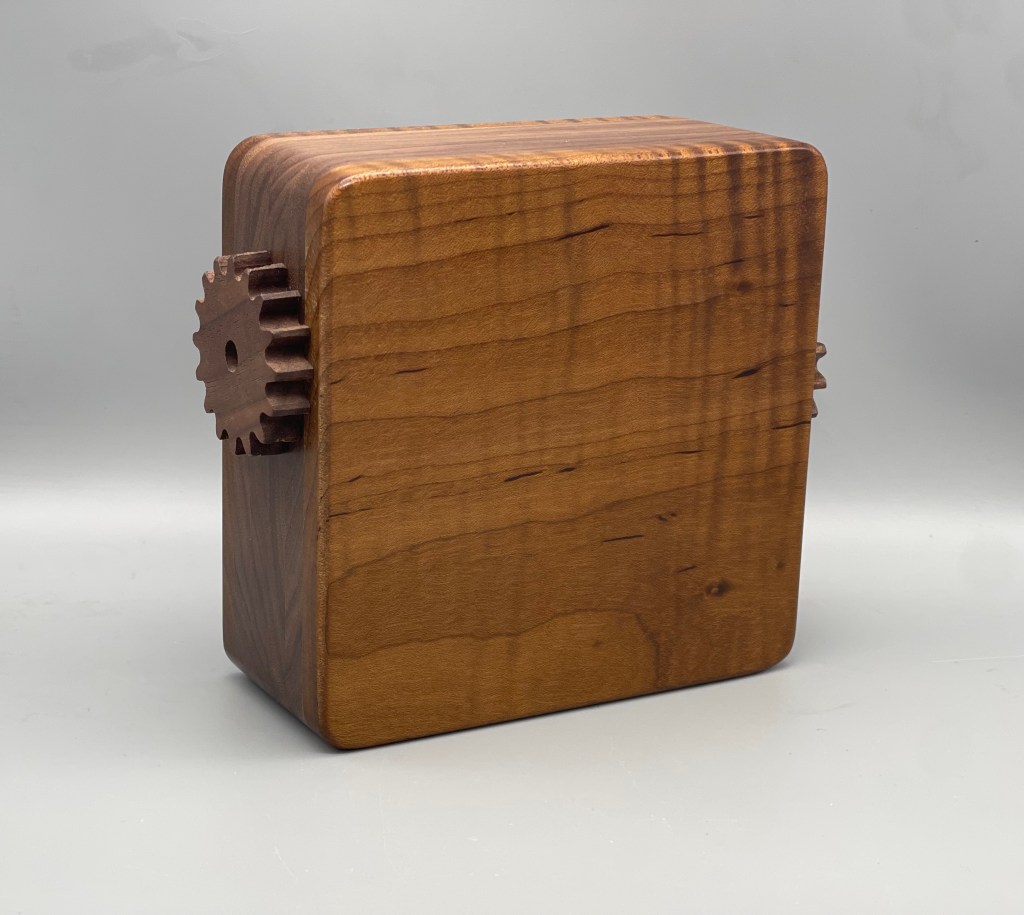
3.4″ x 2.7″, Sapele & Black Palm box w/Ebony pieces

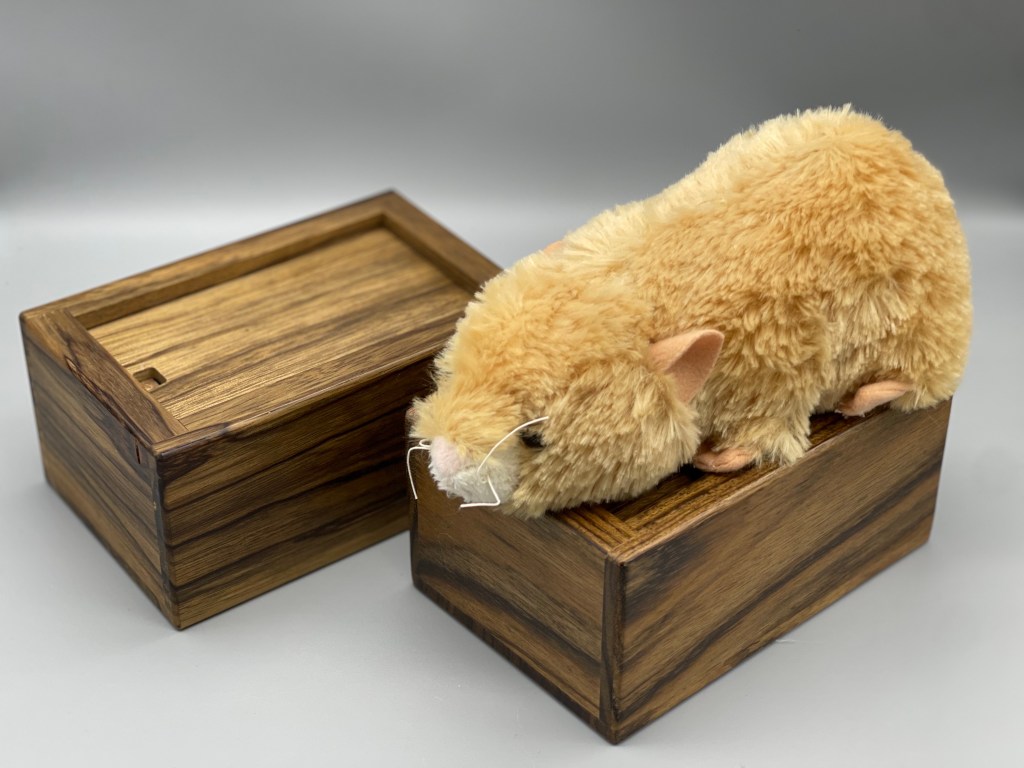
The awesomeness that is ResQ (based on the almost as awesome, wholly unique VisitorQ) must have helped bring two amazing puzzle-designers back for another team-up: Eric Fuller has once again taken a characteristically awesome packing puzzle by Frederic Boucher (Minima XIV, the latest in his Minima series) and turned it into a characteristically awesome SD puzzle from CubicDissection. Anytime two of my favorite makers co-design a puzzle, I am going to be mashing that Buy button upon release. And such enthusiasm is well-deserved: Jammed Gem is unique, challenging, pretty and fun.

Frederic is a prolific designer, putting out great (and truly hard) designs so fast they sometimes fly under the radar; some get brought back to a more mainstream audience via CD or Osho but many just find their way into the hands of too few puzzlers (case in point: how many of the first 13 Minima puzzles have you tried? Not enough.) Such is the puzzling life – too many puzzles, not enough money or time. Our friend at Nothing Yet Designs has helped fill the gap, putting out some of Frederic’s difficult 2D packing puzzles (which I can almost never solve) in affordable and slick acrylic and, more recently, wood. Eric is, well, if you are not familiar with CubicDissection then what are you doing reading this? Get over there and do some rabbit hole diving – you will be happy you did.
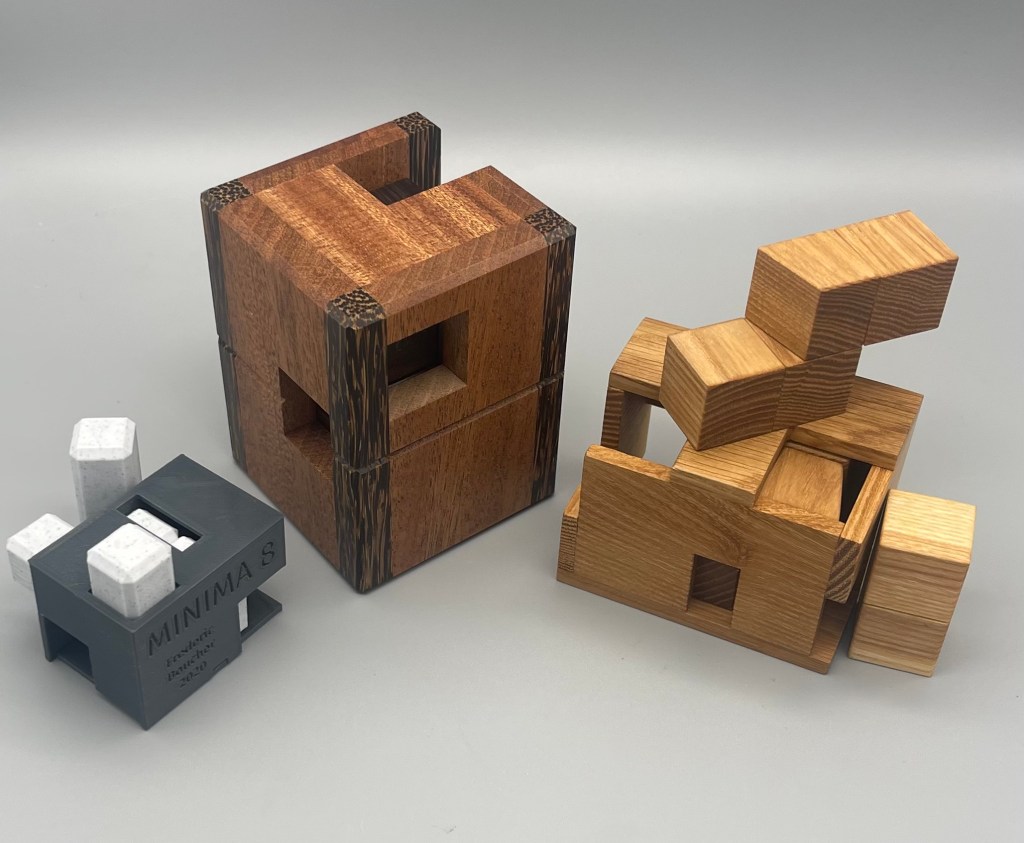
Minima 8, Jammed Gem & Minima XIII (made by Frederic – check out the wild angles on those pieces!)

Enough background and fluffery (yeah yeah, we get it, Eric and Frederic are awesome, blah blah blah….. does this fivesinatras guy ever stop with the effusive praise? No, no I do not).

The Minima series are 3D packing puzzles that involve seriously tricky rotations, the box designed carefully to allow just enough movement in the right places, holes placed in various spots to allow fingers or pieces (or both) to get through. Jammed Gem takes this and flips it, making it a disassembly puzzle in which the puzzler must remove the pieces and find the gem (duh). This would be much easier than packing a Minima frame (for me, anyway) but Eric swoops in and integrates his sneakiness throughout, the two genres interweaving wonderfully. And of course this is all with the precise and perfect production we get from CubicDissection. This allows for some subtle design elements that could easily go unnoticed but are essential to the smooth functioning of the puzzle in classic Fuller fashion.

And what of these sequential discovery steps that have been integrated into the design? Well, Eric does what Eric does best: create and exploit assumptions for the best kind of challenging fun. I spent quite a long time over a couple weeks trying everything I could to get started (or so I thought) and making little to no progress. I had to take a step back (with some help from a fellow Discordian) before…. aha! Aaaaaand I was stuck again, although for not as long, before…. aha! again. Completely hooked, I worked my way slowly through the rest of the solution. Frederic’s movements are just as fun as a disassembly and Eric complicates things in a good balance, making for a great puzzling experience that demands both critical and spatial reasoning.

The reset was tricky – if you are anything like me, you can quickly forget what you were just doing or have done……………. (uh, what was I saying?…); this may give you an added challenge with the puzzle, if you need to re-discover the movements in reverse. Fortunately, everything follows some kind of logic, and (with perhaps a bit of help) I was able to get everything back to where they needed to be (unlike ResQ, which is still sitting here sadly disassembled…. I suspect I may need to seek out some assistance to put it back together (I got the ebony version which is beautiful but that much harder to reset)). In resetting Gem, I did manage to make one fatal mistake (“communism is just a red herring”) that caused a teeny bit of a dent to one piece but I managed to survive the ensuing dismay nonetheless.

I am hoping that this is not the last collaboration between these two that we will see – I happen to know that Frederic has co-designed another SD 3D packing puzzle with a puzzler who is decidedly less of an established designer (and is also a complete dork…. ahem); they are currently looking for someone to help prototype/produce (anyone? Bueller?). Hopefully we will see some progress on this soon (in the meantime there is an SD 2D packing puzzle co-designed by these same two that is aaaaalmost ready for public consumption via Nothing Yet Designs 🙂

Regardless of these nascent designs, there is plenty of puzzling to be done – more copies of Jammed Gem will be available from CD in their October 2022 release so get that page refreshed 😉

Quoth the Puzzle, “Ever-poor” – Rav’n by Ken Snache (w/art by Janice Bell)

Rav’n

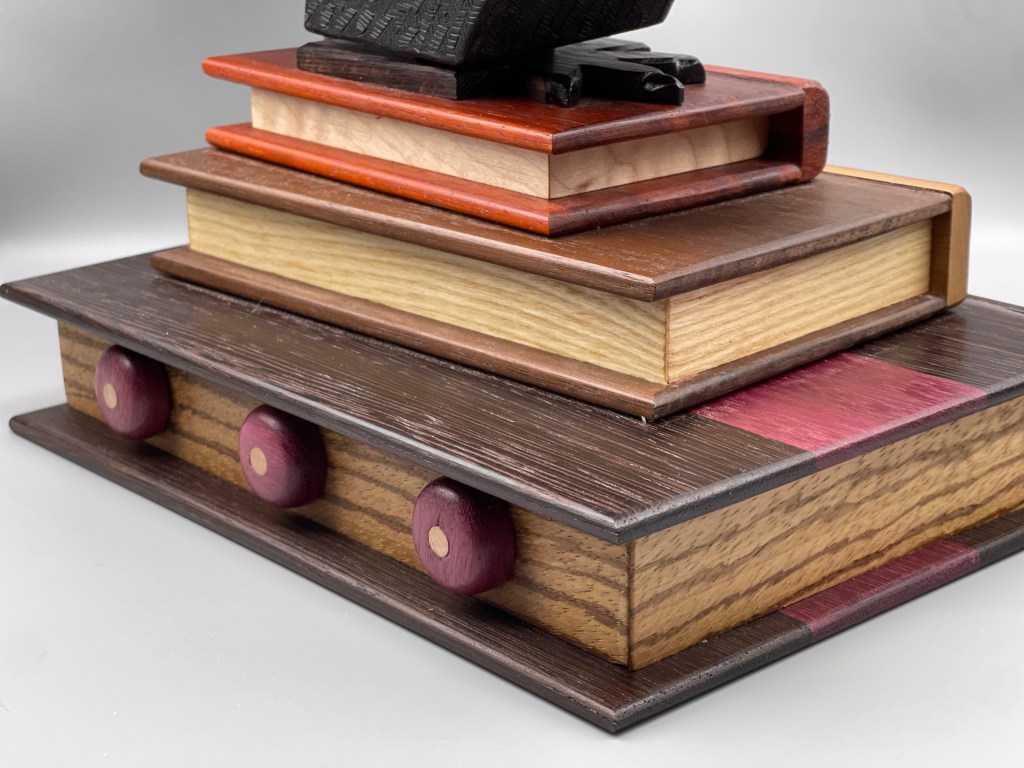
Kel Snache (w/artist Janice Bell), 15 copies, 10″ x 13″ x 6″

The line between art and puzzle is oftentimes vague: many a Karakuri’s craftsmanship outweighs its complexity as a puzzle, while challenging, original puzzles may not always be the prettiest. Kel Snache runs the gamut: repurposed tea boxes are fun but a bit rough (which really is part of the charm), whereas EWE UFO and Puzzleduck Pastures are as pretty as they come.

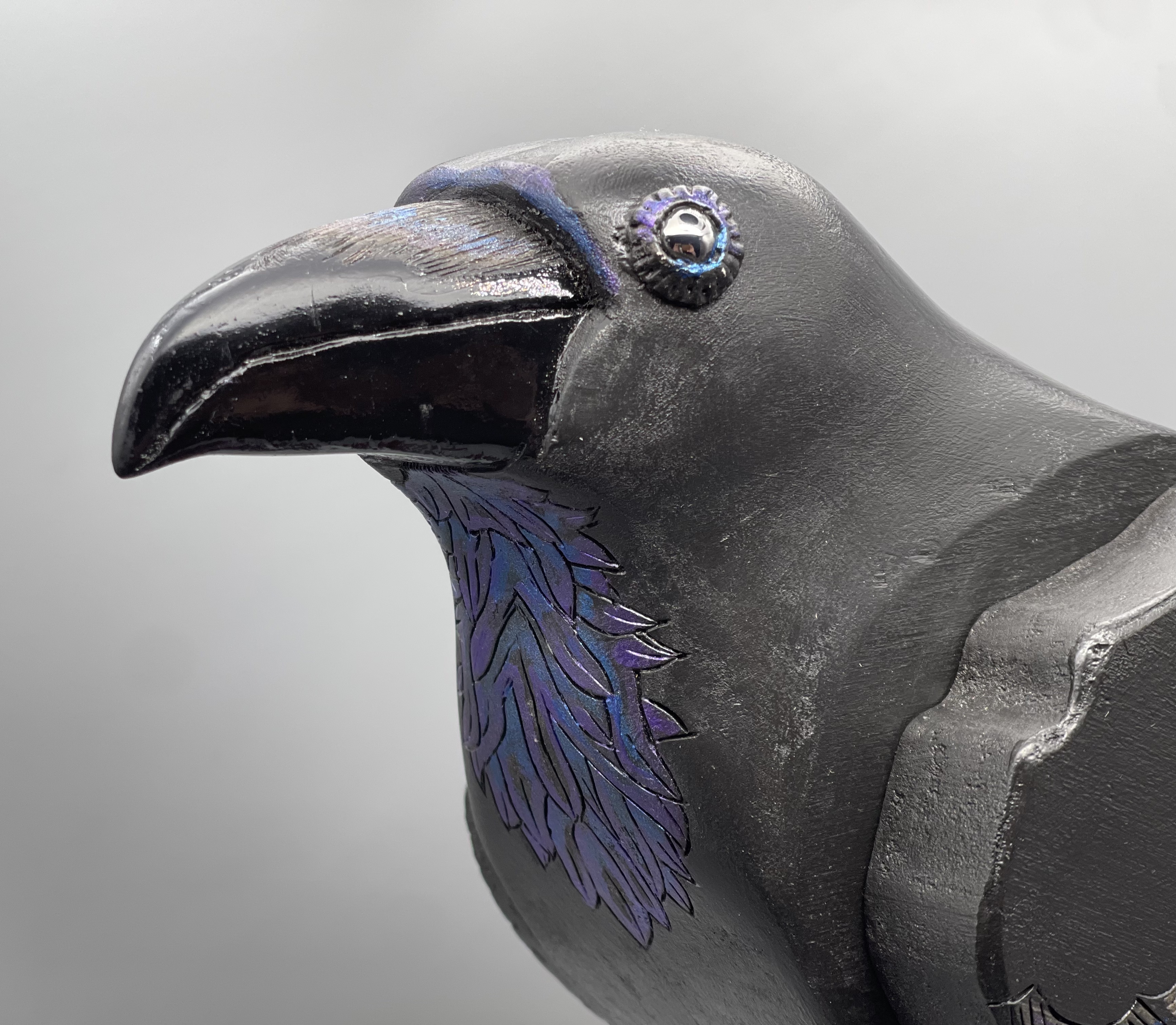
Cue one of his newest releases, Rav’n, a collaboration with artist Janice Bell (who is also contributing to the Dragos boxes). As soon as I saw a pic, my puzzlie senses began tingling: a unique trick-opening puzzle reminiscent of an Edgar Allen Poe story?! Um, yes please.

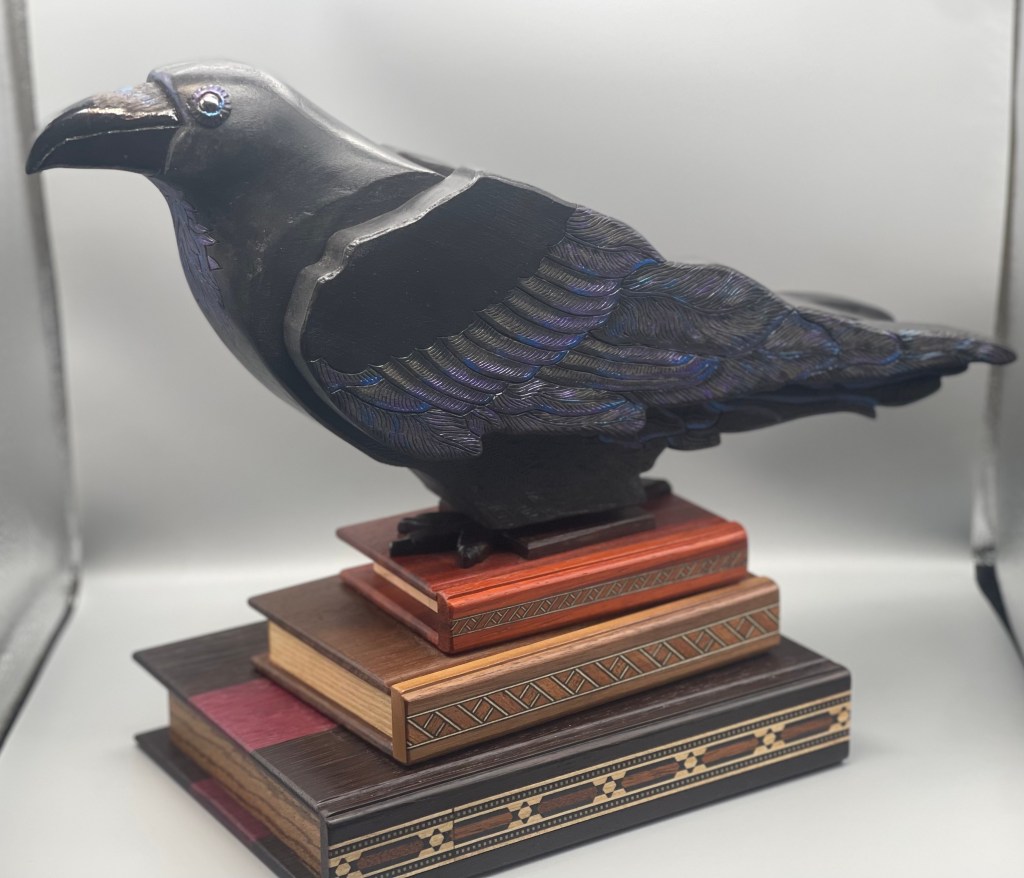
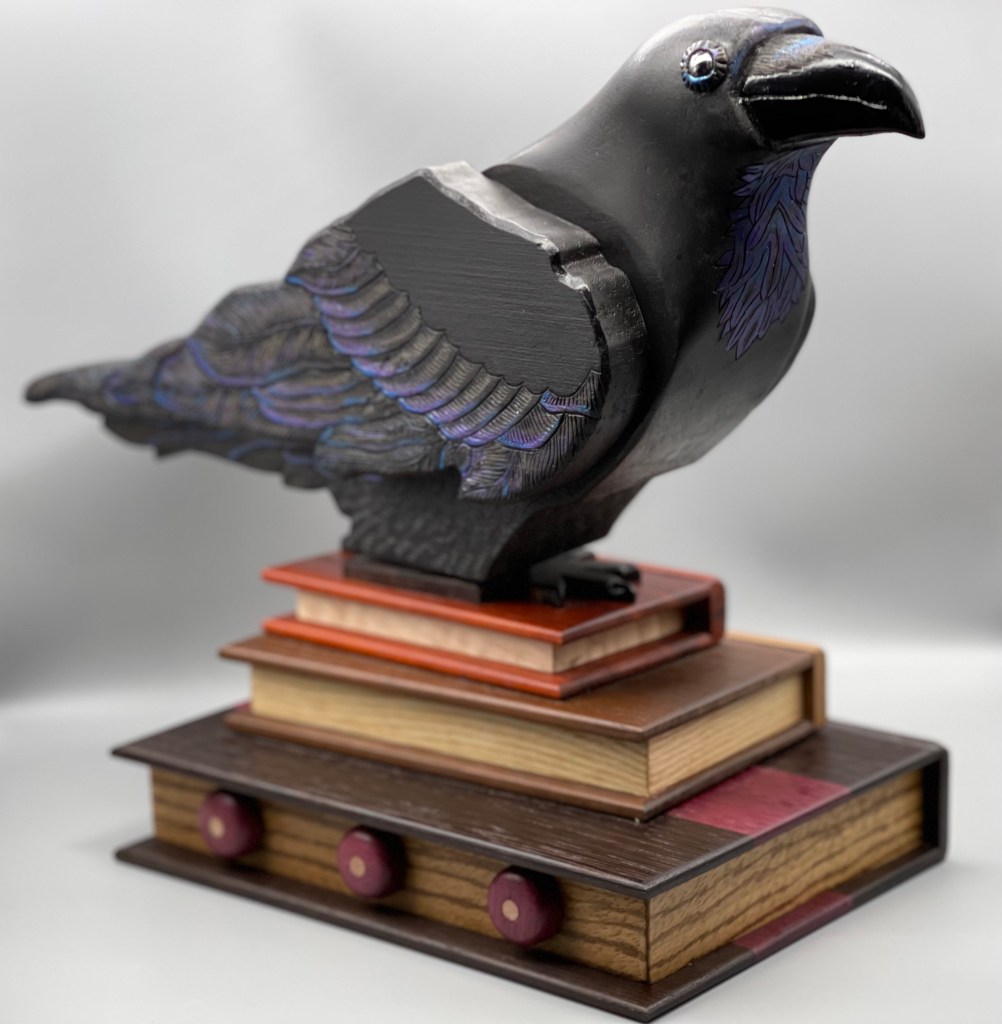
Several weeks later and a big box arrived, containing the sizable wooden bird affixed atop three beautifully made wooden books. Bigger than I expected at more than a foot from beak to tail and almost as tall, the bird is a gorgeous black with shimmering purple and blue detailing on its head, eyes, neck and wings and feather carvings throughout; the bird stands one-legged upon the smallest of the three books, their spines crafted with yosegi-like details and “pages” that exploit the wood grain for a fitting look, akin to Bill Sheckel’s book boxes.

The goal of the puzzle is quite unique: open the wings! This originality was almost as enticing as the aesthetic (almost). While not insanely difficult, with around a dozen sd-lite steps it still proved to be a fun challenge for me. Further, the inner spaces behind the wings are adorable in typical Kel fashion. Similarly, the three knobs on the pages of the bottom book are classic Kel and fit wonderfully with the woods used elsewhere.

After ooh’ing and ahh’ing my way around the piece, I showed it off to my wife who was actually impressed, earning it an “oh! that’s really cool” rather than the typical “that’s nice, babe” that the majority of puzzles receive. Admittedly, she is even more of a Poe fan than me, which may contribute to the response, but it doesn’t change the fact that it is just so damn pretty a puzzle!

It was a solid challenge for me, as I managed to solve it in three dedicated sessions; there are some fun mechanisms that, in typical Kel fashion, are at least as aesthetically pleasing as they are tricky. Needless to say, this piece of puzzle art (art puzzle?) earned its place Downstairs, where many of the prettiest and coolest of my collection lurk. It is a great puzzle to show to non-puzzling passersby, who invariably had assumed it could not be a part of that odd collection of wood and metal things this weirdo rather obsessively collects (but hey, who’s judging!).

Kel continues to work his way through the Dragos boxes; check back in a year or so and perhaps I will be able to share my Lovecraftian dragon box with you 😉 Rav’n is, I believe, fully claimed, so obtaining one may be difficult; hopefully these pics will tide you over until you have a chance to visit one being held in captivity for our puzzling pleasure.

Part of my Kel collection: (from left to right) Puzzleduck Pastures, EWE UFO, Rav’n, There Goes Bill & Flor Fina 2

Bananas is bananas.

Bananas

Jon Keegan, 8.5 x 8.5 x 11.5cm, 1.45kg

I was trying to explain to my wife how puzzling can be a mindful experience (she’s a therapist… I’m just cool like that ;-P ) as you may spend an hour or more in near silence, focused on every sound or perceived resistance or reaction to determine just what in the heck is going on, divining patterns from some series of stimuli, some so subtle as to cause concern that it’s just me doing something wrong or hearing or feeling something that isn’t there. But when finally this intense focus bears fruit and you get that aha! midnfulness is out the window with the dopamine hit you’re getting, earned with the eye strain and aching back from contorting yourself to try and look down some tiny hole or shaft.

And what fruit hath been bear-ed? I’m sure you didn’t click on this write-up to read me ramble vaguely about puzzling in general but rather to read me ramble vaguely about Bananas, the new puzzle by Jon Keegan (his follow-up to Jewel Thief). And if the paragraph above ap-peals to you, then your interest in Bananas is anything but bananas (because you see: Bananas is bananas).

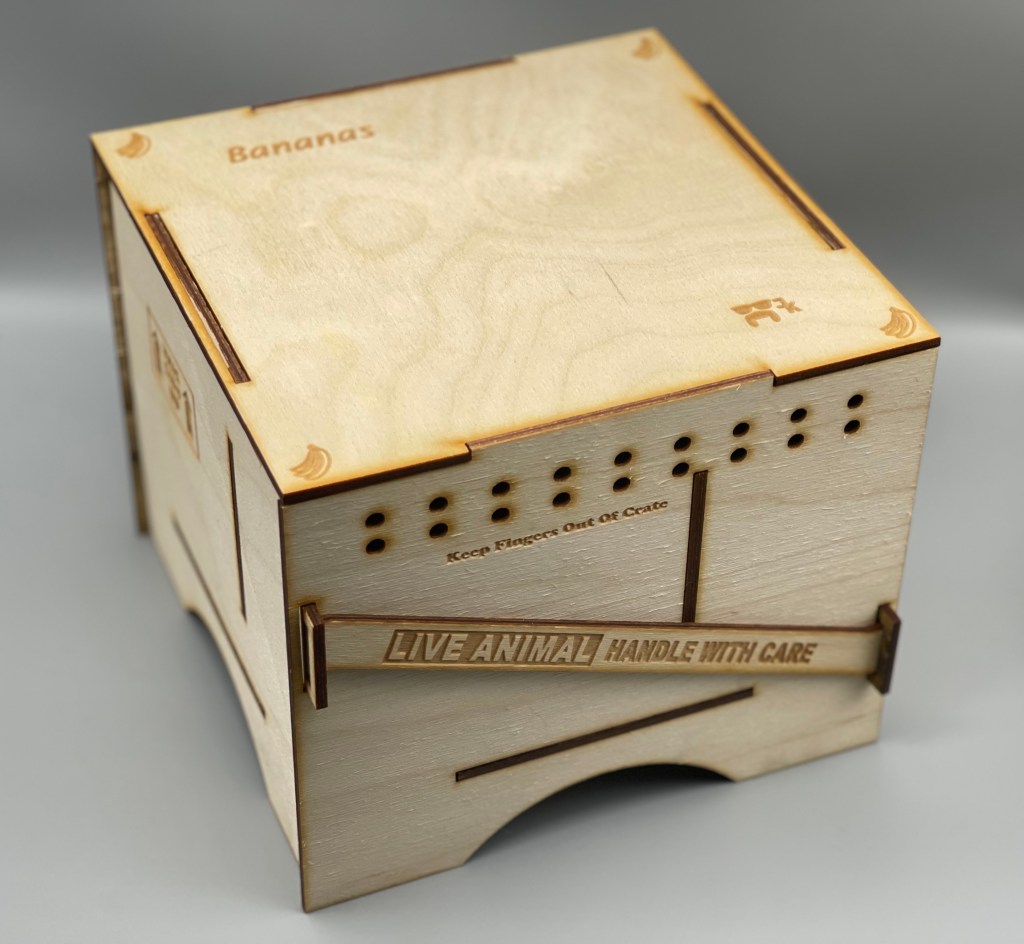
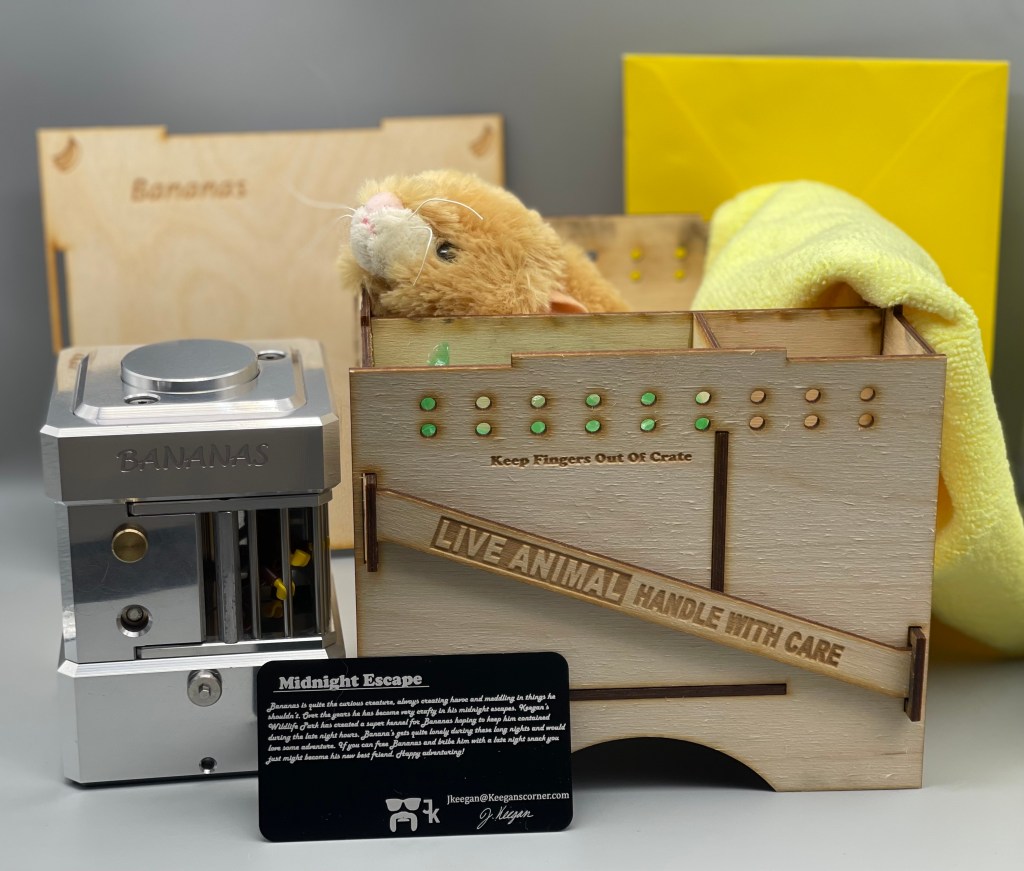
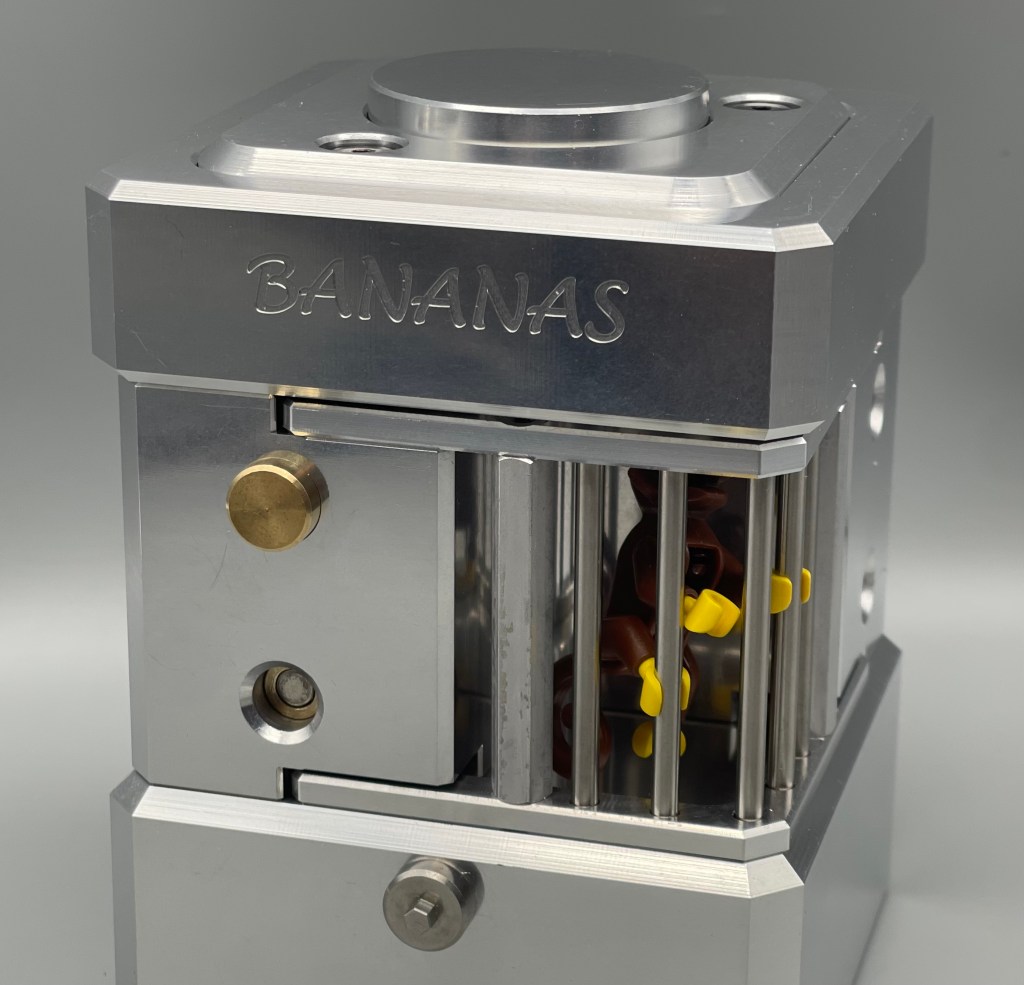
Bananas arrives wonderfully: super safely packed with a wooden shipping crate straight off the boat to Skull Island, ready to pack away something wild and dangerous. Cue a cute lego monkey caged by Keegan for our puzzling pleasure. Inside we find the puzzle, along with a metal objectives / story card, an envelope with pics of the internal mechanisms to decipher post-solve and a kindly supplied towel to protect the puzzle (and whatever surface you will be working on.

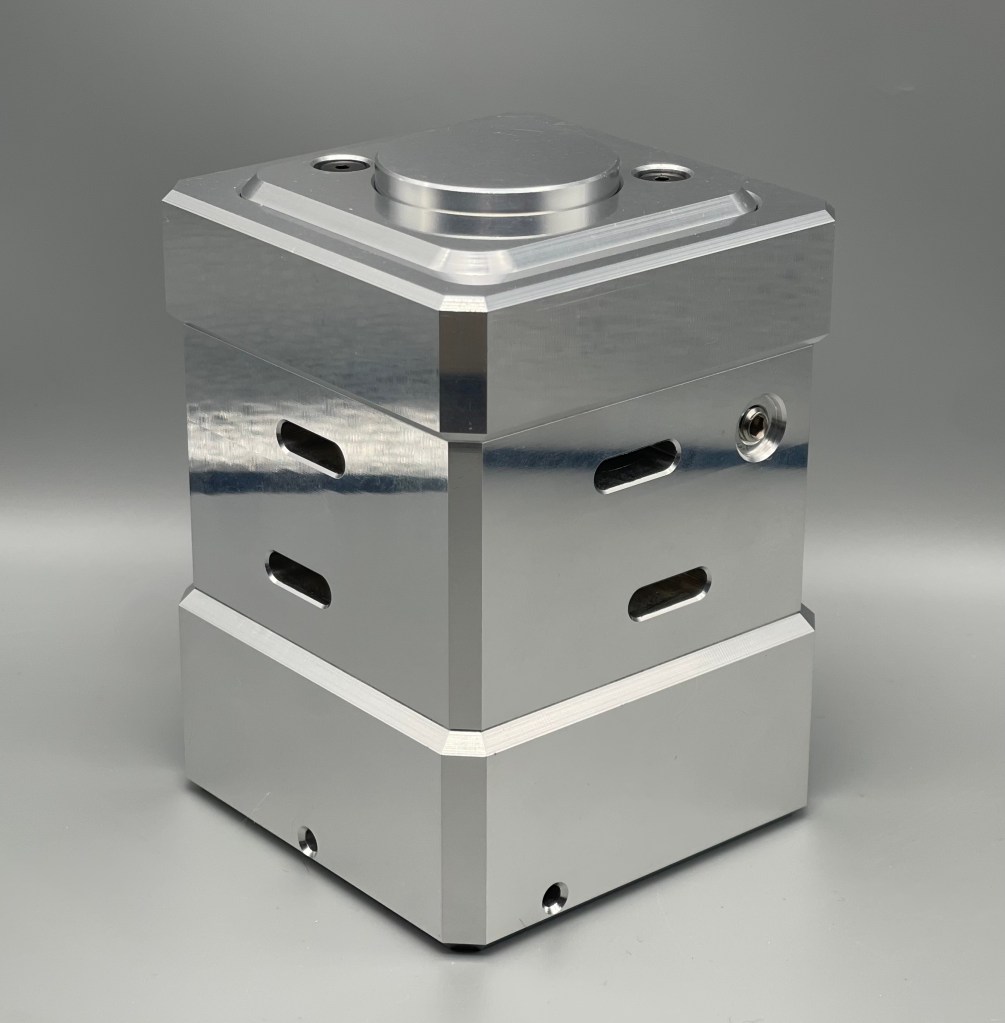
And as for the puzzle itself: Bananas is trapped in a cage set into the corner of a pretty massive block of metal replete with holes and knobbies and squares and circles to poke and prod and wonder at. Everything does something, of course, although nothing does anything just yet. The ticket in isn’t easy in itself (but you will get to understand it eventually); I struggled there for a bit and passed through with a bit of luck before too long, going on to make good progress before finding myself with a whole bunch of stuff and things to do with no clear path. Examining the puzzle does give you a sense of what is going on, at least in some areas, so I thought I know where I was shooting for, for the moment anyhow.

What follows would be a montage set to an uplifting light rock ballad about overcoming struggles as I proceeded to do what I started this post with, trying to find some magical combination of moves that would see me through to the next section. And eventually: aha! of course, and aha! again, with ever more aha!s big and small throughout the entire puzzle. There are some really great discoveries to be made before you free Bananas… and that’s the really crazy thing because you’ve only just started! The instructions tell you to solve the puzzle in 4 parts:

Bananarama!

I had done 1 and 2 but…. wtf.

So I kept going and going, through multiple additional sections, each with several variously moving bits to contend with. Eventually I sat back with pride, Banana’s snack in hand, admiring the mess of metal that had amassed around me, amidst my super-cool puzzle headgear and pleather dice trays. Such puzzling pride passes quickly though, and it’s time to reset.

The reset is tricky and challenging but not frustrating or overly confusing; I had some concerns about whether I’d be able to piece it all together after having taken a couple weeks to solve it but while it took fully understanding all that had happened to make it all ready to go again, this was not so difficult in reverse. In my typical genius fashion I had to solve and reset multiple sections multiple times due to having reset some part before some other part… I’d say I did it purposely, to better master the puzzle, but really I just do it all the time because I’m a dumbass  ¯\_(ツ)_/¯

Such dumbassery does have its benefits though: I feel now that I truly get what was happening throughout the puzzle when at first I couldn’t imagine how I ever could. What else can you ask from a puzzle? There is a fair amount of blind struggle but careful and close observation and experimentation will give you guidance, along with some subtle clues to make sense of as you go.

Bananas was released in a limited run of 225 by Jon Keegan and were all claimed (as is fairly typical with a good puzzle) long before this was written – in typical voracious puzzle fashion, we all politely and (seemingly) patiently waited with occasional but regular updates on Jon’s progress and puzzle maturation. I have to admit that I have not actually solved any other puzzle by him! My zealous overuse of multiple emails led to a snafu in which I missed my chance at a Jewel Thief… (meh, whatcha gonna do – from what I’ve heard, while it seems to be an amazing puzzle I’m pretty sure I would still be struggling with the first step lol). I did get a Scarf prototype but want to wait for the updated version coming out down the road (which just means that I haven’t been able to solve it 😉 But Bananas… the more I let it sit after finally solving and resetting I come to appreciate it more and more… quite simply, Bananas is bananas.


“Look Kids: Big Ben, Parliament,” Juno, Brian & John Had Me Stuck Going in Circles

Big Ben

Design by Brian Young, Junichi Yananose (Juno) & John Moore
Made by Brian Young
Presented by John Moore at the 2014 IPP Exchange
Winner Jury Grand Prize 2015
Papua New Guinean Rosewood, Western Australian Jarrah & Queensland Silver Ash
220mm x 55mm x 55mm

Amazing Puzzle Collaborations: Episode I – A Fan of Ben Is (a true puzzler)

Big Ben has been on my unicorn list for quite some time – years, in fact. When I finally obtained it as part of a rather elaborate trade, I couldn’t bring myself to start working on it right away. First, I just enjoyed seeing it there, ready to solve whenever I felt like it… Then I began to worry: what if all the hype has given me unrealistic expectations? I took it down off the shelf and began working on it… fast forward an hour or two and I had my answer: my expectations were spot on – Big Ben is bad ass.

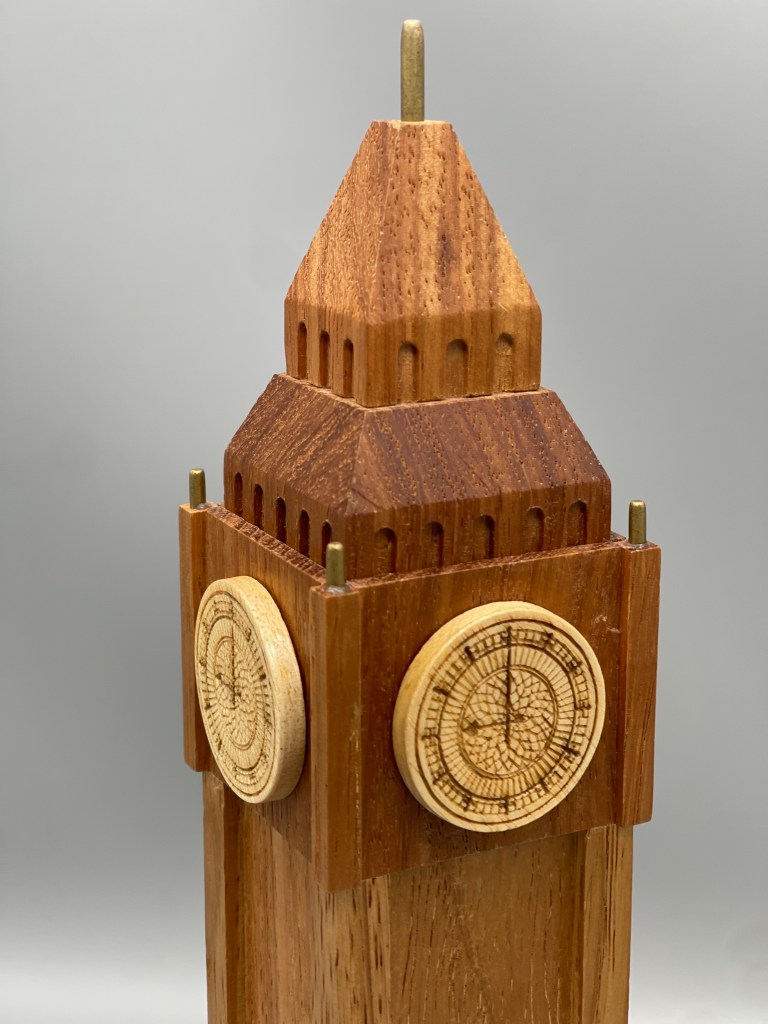
Standing at about 8.6″, Big Ben towers over many a puzzle and is especially large and complex for an IPP exchange puzzle. From what I have heard, its complexity earned it an atypically high price for an exchange puzzle… a whopping $300! (If you have seen Big Ben sell at auction in the last few years you will understand the irony in this).

Its woods are wonderfully lovely although perhaps a bit rough around the edges, especially as mine had a few micro-scratches here and there. Not that it isn’t the work of a master craftsman… Brian’s work is as impeccable as always and Ben stands up against some of the best-looking puzzles in my collection. And anyway, this was an exchange puzzle, so going up against a Karakuri or another finely crafted puzzle box might not be the fairest comparison.

The goal is neatly engraved at the bottom of the puzzle, along with some well-deserved credits: “Remove Big Ben from the tower and along the way you’ll pick up Queen Elizabeth’s gold crown.” It is worth taking a moment to admire the accuracy of this statement, which overcomes the common misconception that the tower or the clock is itself Ben… but no, it is Elizabeth Tower that stands guard over all the Griswolds trapped beneath; Big Ben is the bell within said tower and we’ve gotta find it!

The clocks begin set at 9 – the final goal of the puzzle is to reset it so that all clocks show the ninth hour. According to what the instructions said, if the clocks are not so set it may not be fully reset, so maybe reset it instead before moving ahead (tbh I don’t know that it will really take away all that much from the solution… it made a great setup for some awesome alliteration though 🤓). I appreciate a puzzle that can quickly signify whether it is in its fully reset state. This is especially the case when there is this much going on under the hood, easily earning it a sequential discovery description atop its take-apart classification.

I also love a puzzle that can rope you in with some early successes only to run you smack into a wall. It sets up a great rhythm, which Ben keeps going throughout the relatively lengthy solve with different sections requiring quite different approaches. I found my way through the early steps mainly through trial & error before finding myself stuck going in circles for quite a while as I tried to make it through what comes next – I may not have become quite as insane as poor Clark, but it was a good and, more importantly, fun challenge. I could be wrong but I seemed to feel a lot of Juno’s influence in this part of the design but, truthfully, I’ve no idea who did what.

My favorite part of the solution comes in its final steps – this is where I believe that Brian’s design style really shines, crafting delightful aha’s into a tricky and satisfying resolution. The reset has its own challenges: reversing some steps is not necessarily such a simple matter. Finally setting the clocks back at 9 as instructed, I smiled at my newly conquered conquest and returned it to my Mr. Puzzle section, which is fittingly and coincidentally close to my Pluredro section.

If only Fay Wray or Jessica Lange were here…

Big Ben was well worth the price of admission, in my sometimes humble opinion. This is a puzzle that almost certainly will not be made again, so if you get a chance to try it, take it… perhaps at a puzzle party down the road 😉

A few landmark puzzles: Big Ben alongside Brian Young’s Louvre & Keith Winegar’s Capitol Politics

Loss, Blindness, Death, Anger…. and now Menace (the new Puzzle Box by Dee Dixon)

Menace

Dee Dixon, 5.25″ x 3.5″ x 2.5″ (available in Black Limba & Quarter or Flat Sawn Shedua)

It has been an eventful last few years: I lost my hammer, went blind, felt my way through the darkness of space, fell through a portal, went blind again, suffered being haunted, and survived the Walt-acalpyse……. all this only to have Dee send me something truly menacing. Needless to say (not that this ever stops me), I have gratefully enjoyed every moment of it as DEDwood Crafts has consistently produced some of the best puzzle boxes to grace my shelves.

Flat Sawn Shedua in the Front & Black Limba in the Back

Following up on Angry Walter is no small thing: it has received consistently positive praise from puzzle box enthusiasts new and old (here is my post on that beaut of a box). And yet Dee has managed to keep putting out beautiful, challenging boxes since WMH appeared just a few, long years ago. So it should not surprise anyone to hear that his newest box once again succeeds at bringing us a fun in a pretty package.

Menace uses a single wood to create a clean, sleek aesthetic that may be his prettiest box since the totally different, asymmetrically complex style of WMH. I first got a prototype in Shedua that is just gorgeous in its apparent simplicity: no protrusions, buttons or panels… just a locked lid inset into the top with a small hole to one side. Picking it up, there is no clear indication as to how one can begin to open it and I spent quite a bit of time searching for whatever first step Dee had designed.

I began developing some assumptions (quite likely as Dee intended) that would (unsurprisingly) prove incorrect, something that I would repeat a few more times before I would discover the box’s final secret. After discovering a well-hidden aha, Dee teases you with the idea that you may have already solved the puzzle; of course, this turns out to be well before the puzzle has actually been solved (which you would know if you had actually read the brief instructions….. duh). The puzzle’s length is more or less consistent with the majority of his boxes but fell into the trap of thinking I had reached the end before realizing I had not: the instructions tell us that we must find some sort of prize and, since no such prize had been found, clearly I was not yet done.

Experimentation will only get you so far with this one – I had to take a step back and rethink what I was doing and what I was trying to do, questioning my assumptions and trying to look at the box in a new way to see what else I might be able to do. With a good aha, I realized something and began following that trail to eventual success. The final compartment is pretty ingenious and most definitely sneaky – not what I had been expecting, which is always a welcome finale to any puzzle.

The prototype’s “prize” was not really all that much of a prize lol (perhaps more of a placeholder) – not that I needed the added incentive, but this did help me to justify my “need” for a copy of the final puzzle (in a different wood, of course – I’m not (totally) crazy). I had been out of town for a while and had not solved the box in long enough that I already found I had forgotten which of my many assumptions had proven incorrect! I know that I don’t generally make claims to brilliance on (or off) these virtual pages but this was a bit ridiculous (and perhaps not the greatest thing for my on-again, off-again relationship with confidence). Fortunately, it did mean that I got to repeat an aha or two, albeit it with more a sense of relief at not being a complete idiot than at the typical puzzle-solving feeling that I was the greatest mind of all time for having made a piece of wood move a few inches that way.

The prototype and final are mostly identical – Dee did tweak one thing that makes the solution’s finale a bit more difficult to do. In doing so, some of my methods worked against me – I found that the slight change makes that last bit require a better understanding of what I am trying to do, forcing me to approach the puzzle more carefully, looking back at some hints I had previously missed before I would get that final aha (enough reworking that I did indeed feel a brief bit of brilliance before coming back to reality.

The final surprise legitimately made me laugh out loud – Dee has given us another taste of his humor as in some previous boxes (Spirit and the original run of WMH, in particular). I re-solved the box several more times to marvel both at my mastery and the design…. not to mention to grin a few more times at that last laugh.

Menace will be available July 2, 2022, on the DEDwood Crafts site. It may not last long but I suspect Dee may do another run or two before moving on to whatever the next bit of fun he has planned for us.


Sun Dial’s Art of Puzzling (UPDATED: Now with more puzzling!)

Sun Dial

Jesse Born & Rob Yarger
Ipe, Katalox & Brass
2.75 lbs, 7″ x 4″
Box 2 in the Voyager Series (Sea Chest, Sun Dial, Alien)
(Ed. A couple weeks after posting this, I discovered that there was still quite a bit of puzzling left after I had thought the puzzle had been solved! See below for more)

Well, the past several weeks have been busy here in the 5S household, getting in the way of my puzzling (much to my dismay). But the wonderfully unrelenting onslaught of new puzzles has only seemed to increase its pace, with several excellent puzzles arriving during this none-too-brief, unplanned hiatus. I realize that this break has not been difficult for you, but fear not: plenty a puzzle ramble awaits you!

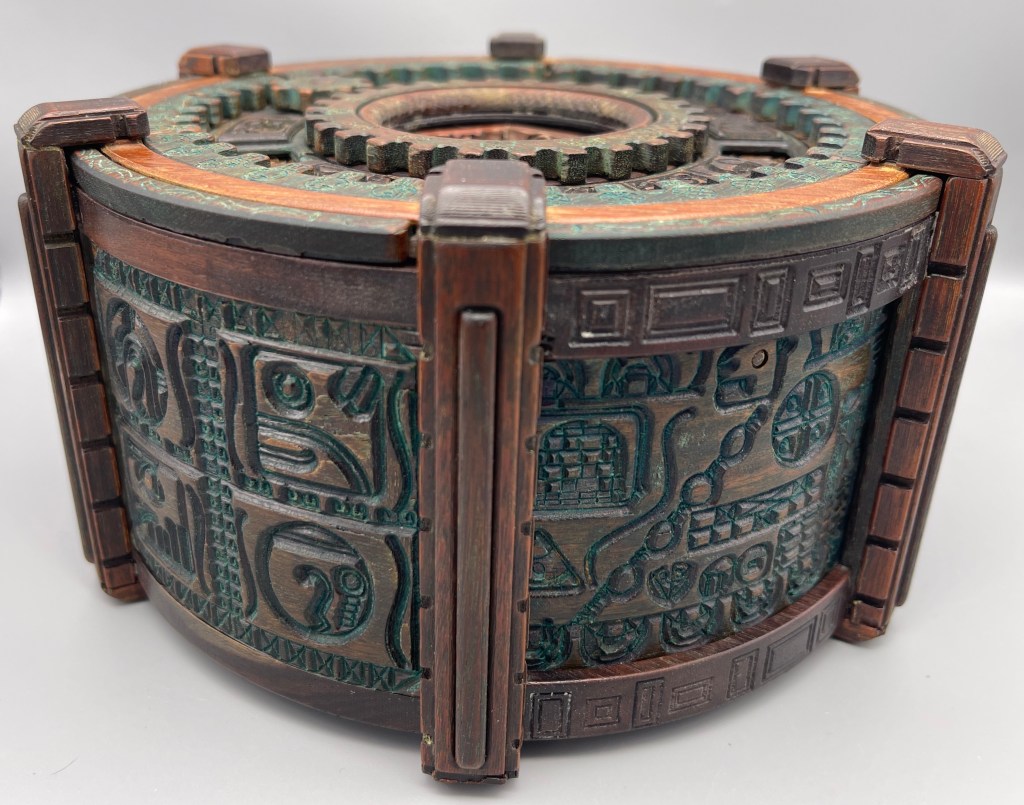
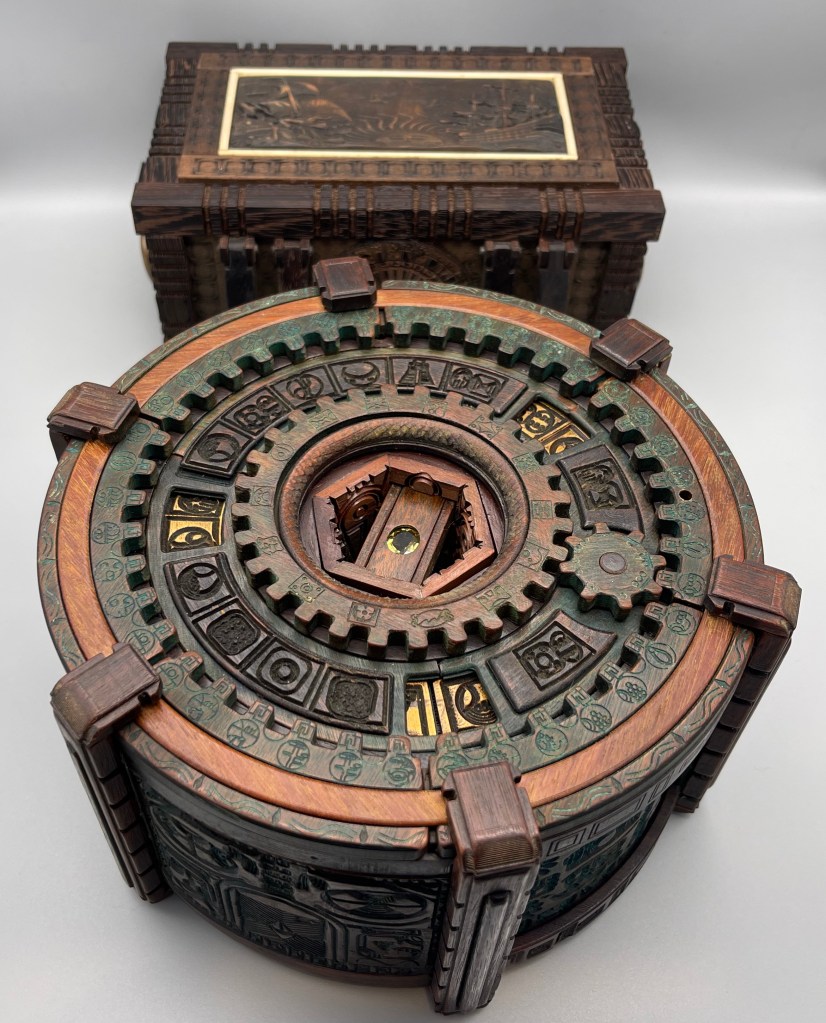
And what better puzzle with which to break this devastating dearth of dear old me than Sun Dial, Jesse Born’s follow-up to 2020’s excellent Sea Chest (reviewed by me here); Sun is co-designed with Rob Yarger (a/k/a The Great and Wonderful Stickman) and mostly made by Jesse (Rob did some laminating on the curved side panels, which are constructed of multiple layers of hand-carved veneer crafted by Jesse). Sun Dial is a circular box (?!), painstakingly covered in some rather intricate etchings and distressed in a fashion similar to its elder sibling. Jesse has plans for a third and final entry in the Voyager Series that will presumably share in this aesthetic, crafted to create the impression of a discovered Alien artifact that must be opened to access its other-worldly treasure. What pirates were to Sea Chest, the ancient Aztecs are to Sun Dial, with myriad markings and hidden secrets that invoke this lost world in the psyche of the spelunking (s)puzzler.

Jesse is one of those designers whose puzzles I would happily buy sight unseen (his Secretum Cista is quite probably the coolest puzzle I own). Rob is (of course) another such designer , so when I heard that Rob was designing Sun Dial with Jesse, I began drooling more than Pavlov’s dog at a doorbell store. (Rob was a big big fan of Sea Chest, which is especially high praise from the creator of some of the most insanely awesome puzzles ever to reach us mere mortals). Jesse and Rob went back and forth over a period of months, trading ideas and CAD models as they refined the design that Jesse would ultimately craft (for a more in-depth look at the design process, check out Boxes & Booze’s excellent post).

At a relatively hefty 2 lbs, 12 oz, the 7″ x 4″ Sun Dial is no small box. As part of its intentionally distressed appearance, its aromatic woods appear to have been partially stained, a greenish tint furthering its lost artifact aesthetic. It is shaped something like a flattened donut, with a citrine gem nestled into a piece of wood bridging the top of its center shaft. The outer wall is broken into 6 sections, 4 of which are covered by inset panels that have a noticeable bit of give when reset. The top alludes to the circular calendar of the Aztec civilization, a series of concentric circles and layers surrounding a set of gears that promise to put the mechanical in mechanical puzzling.

Sun Dial vs. Aztec Calendar (12 ft./25 tons, discovered in Mexico City in 1790)

In its reset state, Sun allows for some quality mechanical playtime – I first spent several minutes just playing and giggling at the smoothly tactile movements possible in its initial state. Other than some admittedly puerile fun, this did not immediately lead me anywhere productive; it would take some keen and careful observation before that first aha moment, which soon led me into the puzzling depths that await within.

Over the next few weeks, I would progress in fits and starts; discovering things that must help (while unsure of exactly how) as I pieced together the path through its various compartments. Well-hidden, subtle clues abound, some more important than others in clearing the way forward. Venturing into the puzzle’s interior gave me a sense of adventure, akin to Indiana Jones-ing (Quartermaining?) my way into an ancient temple, replete with treasure and cool discoveries that could be decorative, essential, or both.

I knew I had to be reaching the end when I was surprised by the results of a particular step that I repeated a few times with a goofy grin. Some final details discovered, I held my prize in my hand, admiring how Jesse and Rob managed to bring things full circle, like the cyclical nature of time perceived by the Aztec culture.

(This paragraph was added a few weeks after posting this) OMG! Turns out not only was I not actually finished solving the puzzle, there was quite a bit of puzzling still left! There is one aha that is particularly satisfying and we are left with a sense that more is yet to come…… Once again, Jesse has brought us something great only to add some icing to make it excellent. I found this last section to bring back memories of Sea Chest, which also hid some final secrets that took me a few weeks to discover still laid in wait after I’d thought I had reached the end. Gotta love a puzzle that keeps on giving!

After resetting the puzzle and going through the solution once more (now a few more times!), I followed a QR code printed on the back of the Certificate of Authenticity (signed by both Jesse and Rob) to a short video in which Jesse walks us through the solution. I smiled at a few details whose significance had escaped me and ran back through the solve one more time, appreciating the puzzle’s rhythm and flow.

The puzzle’s mechanics do not rely on blind mechanisms, instead favoring discrete steps that must sometimes be worked out beforehand to properly progress – I suppose it could be possible to cluelessly solve certain sections through experimental trial & error but the design provides ample direction to see you through, if you can slow down and do some of that thinking stuff the kids are all talking about these days. Either way, the mechanics are clear and purposeful, laying out a meandering path to its final treasure.

Jesse decided to increase this run to 400 copies, a big jump from the 100 Sea Chests that had (officially) been produced (let alone the 30 copies of Secretum Cista). I imagine that all 400 will not have trouble finding a home: if a collaboration between two great puzzle box-makers wasn’t enough to convince you, the positive praise that has followed its premiere will probably do the trick. The larger run may help prevent the puzzle from immediately skyrocketing on the secondhand market but I don’t expect too many collectors will want to let this one escape anytime soon (there will always be solvers and flippers, of course, but hopefully the box will remain in the realm of relative reasonableness, for a while at least). While officially sold out, (at the time of writing) the boxes are still being produced in batches and there is a drop-off list for spots that might open up should puzzlers decide to give theirs up, so be sure to swing by Jesse’s site before they’re all gone.


Changing It Up: Pennytentiary by Eric Fuller

Pennytentiary

Eric Fuller

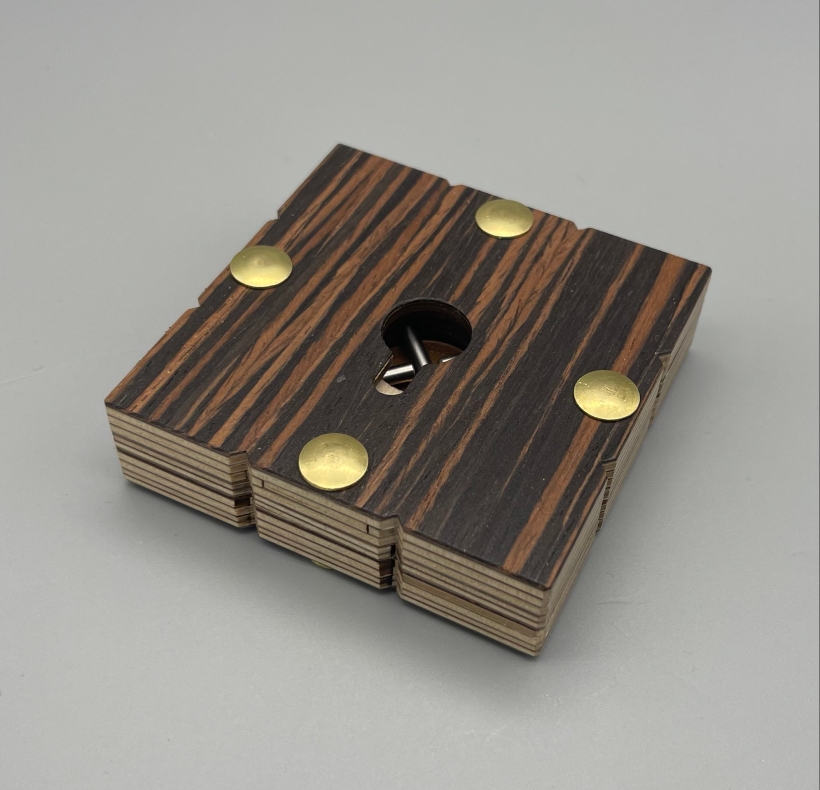
Eric Fuller (of CubicDissection) has gone and got hisself a laser cutter machiney thing that can… cut… uhh…. lasers? (that doesn’t sound right…) Whatever the thing may do for mere mortals, in the hands of an adept puzzle designer like Eric, it means that we will soon be seeing some cool new challenges coming our way. I had the good luck to solve the first of these: Eric’s newest take-apart puzzle, Pennytentiary, a sequential discovery square of coin releasiness that had me smiling (once I finally stopped being stuck).

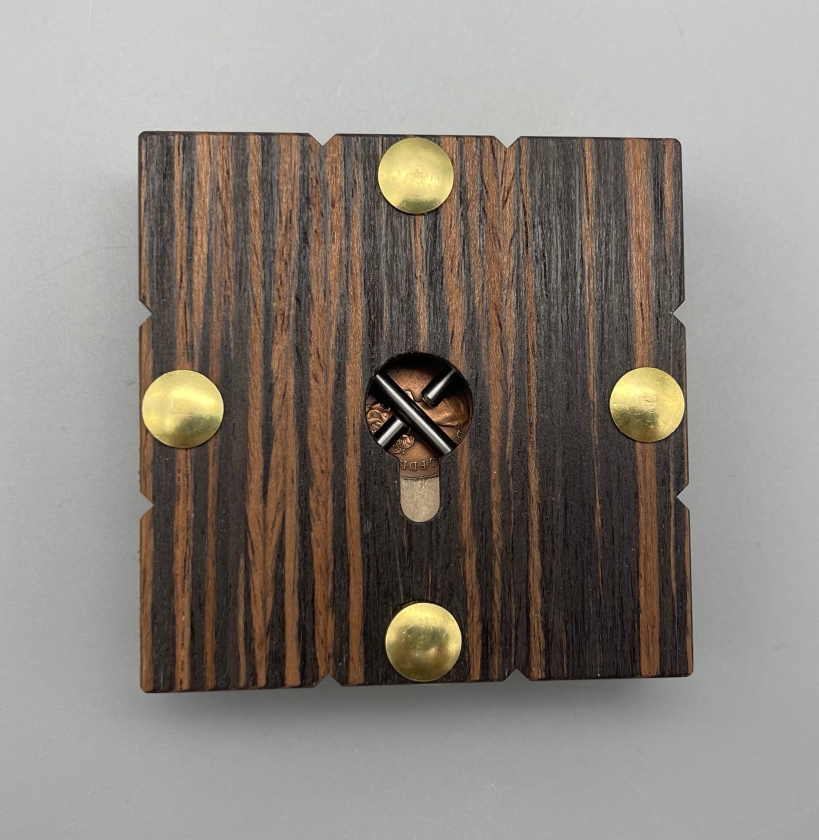
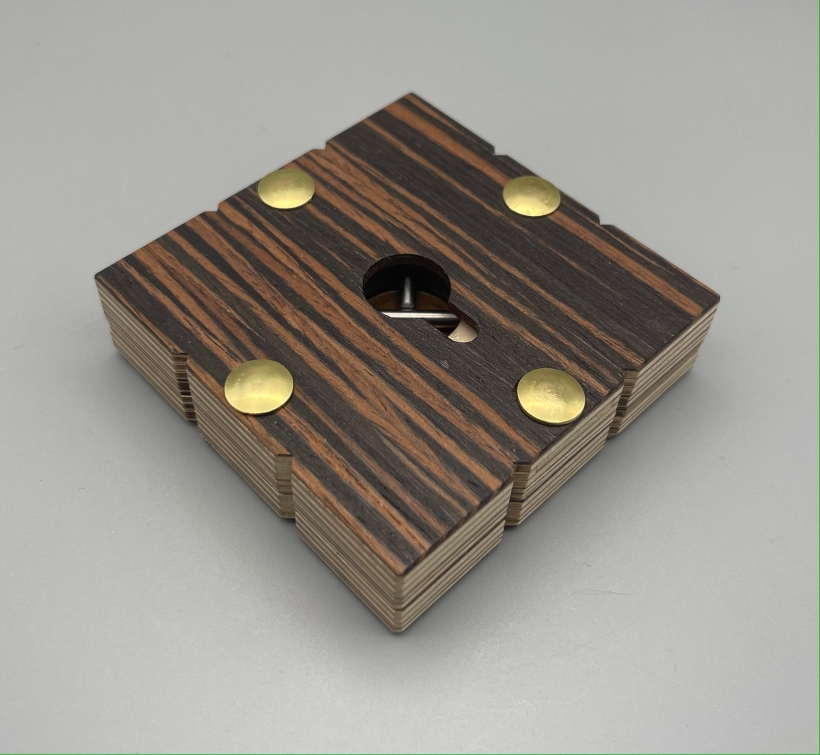
Consistent with Eric’s modus opuzzerandi, he makes laser-cut wood look good, with dark-grained panels adorning the top and bottom of the layered sides that are eye-catching and give the puzzle an added sense of class. Notches are spaced evenly around its perimeter, with a centered top “keyhole” in which a coin rests, trapped below 4 diagonal bars that slide easily back and forth with even casual movement. There is nothing else immediately visible, although close inspection may prove that to be a false assumption (a concept that crops up frequently in Eric’s designs). At about 3″ x 0.75″, it feels good in your hands; it isn’t overly heavy but neither is it light and its size is well-suited for most (human) hands. The final version will include a thin layer of acrlyic in one the middle layers, adding some strength and a mixed-medium aesthetic that I am sure will look cool.

When first looking at it, I felt compelled to attempt a pretty basic puzzle move that couldn’t help but come to mind; I assumed it wouldn’t do much of anything and (for once) my assumption proved correct, leaving me with a nice new puzzle that didn’t see to do much of anything (aside from having some potential as a maraca). Of course, this would prove to be not at all true – after a while spent exploring and experimenting, I found a well-designed aha that led me to some good initial progress, giving me plenty to work with while getting me no closer to actually solving the puzzle. I got stuck here for quite a while. And then a while more.

It took some trial & error and careful observation to make sense (cents?) of a short semi-blind sequence that stood between me and further progress; there is plenty of feedback and it is possible to deduce most of what needs to happen, assuming you paid attention during your initial explorations. I eventually got to where I thought I needed to go, foolishly thinking I might be nearing the end, only to figure something out that forced me to laugh at the puzzle’s deviousness. Following on that realization is a trick that I just think is super neat and lends a sense of magic to the solution.

I continued to make considerable progress, working my way through the kind of well-designed sd discoveries and hidden trickery that we associate with Eric’s work. I managed to get nice and stuck (again) towards the end – unsurprisingly, it turned out to largely be my idiocy that was keeping me from overcoming this last hurdle; I was fairly certain of what needed to happen and aware of some of the things that would help it happen, while apparently missing some other thing(s) that needed to happen so that it could happen. Pretty straightforward, no?

I back-and-forth-tracked for a while, thinking I would see something I had missed; the puzzle moves you along quite nicely as you solve it, and I kept looking to see if I had missed a turn. There is a lot to discover in a relatively small package and I had yet to find a purpose for every discovery; the puzzle does an excellent job of communicating where you need to go while simultaneously obfuscating how to get there. I got to be pretty certain of what and where and even how (or so I thought) – but, in classic Eric fashion, even though I was sure I knew the how, I still couldn’t find it…… there was a subtle twist that had me working against myself until I realized I had made an assumption so small I didn’t even realize it was an assumption and that last aha finally hit, allowing me to find the step that had been eluding me only to realize it was not the last aha after all! I thought for sure I would be removing the coin but it turns out there was still another sneaky sequence to suss out before the coin could be captured.

After gleefully removing the coin, I worked my way backwards through the reset – a couple sections still a bit tricky as I continued to develop my understanding of the puzzling at play. After re-solving and re-setting it a couple more times, I can confidently claim to completely comprehend the confounding cadre of coin release mechanisms nestling within this deceptively simple-seeming puzzle. And what a fun puzzle it is! It has an excellent rhythm as you work through several muti-step sequences that rely on discrete mechanisms and well-hidden sd discoveries: imagine if Rex’s best had a child with the Bolt Action series and then went on to marry Ansel and have a brief affair with Free Me 6. And if that doesn’t entice you, then I don’t know what you’re doing reading this post (unless you’re my Mom…. in which case: Hi Mom).

Pennytentiary will probably be the first of a series of coin release puzzles from CD, with ideas for other currency currently in the works. It was originally set for CD’s Feb 2022 release but due to the need to wait for some delayed hardware (and I think perhaps Eric’s admirable and ongoing quest for puzzle perfection) has been pushed to the March 21 release: it looks like this is going to be a pretty exciting drop, with a number of new and re-released puzzles to choose from. There is a chance that the relative efficiency afforded by the (sharkless) lasers may make it a design that will not need to suffer from the same level of scarcity that can sometimes affect other new CD designs – a great thing for newer puzzlers, in particular, who may be taken aback by the fervor that surrounds the typical CD release. Regardless, it is a puzzle you will not want to miss, so plan accordingly when you set your CD release alarm for next week.

Super-Sneaky Grade: Five Sinatras
(click here for more information on the Sinatra Scaling System, (c) John Maynard Keynes, 1944)


  1. Roy Elliott's avatar

The Rise of Angry Walter

Angry Walter

Dee Dixon

A short film by fivesinatras:
The oral history of a forgotten robot, a sequential discovery puzzle box & a world saved by puzzlers.

(thanks to Dee Dixon for making such a great puzzle)

Check out my review of Angry Walter here: https://fivesinatras.com/2022/01/18/angry-walter/


It may be a bit odd but I thought it would be fun…. y’know, for kids 😉


D7: Judgment Day – Angry Walter by Dee Dixon

Angry Walter

Dee Dixon

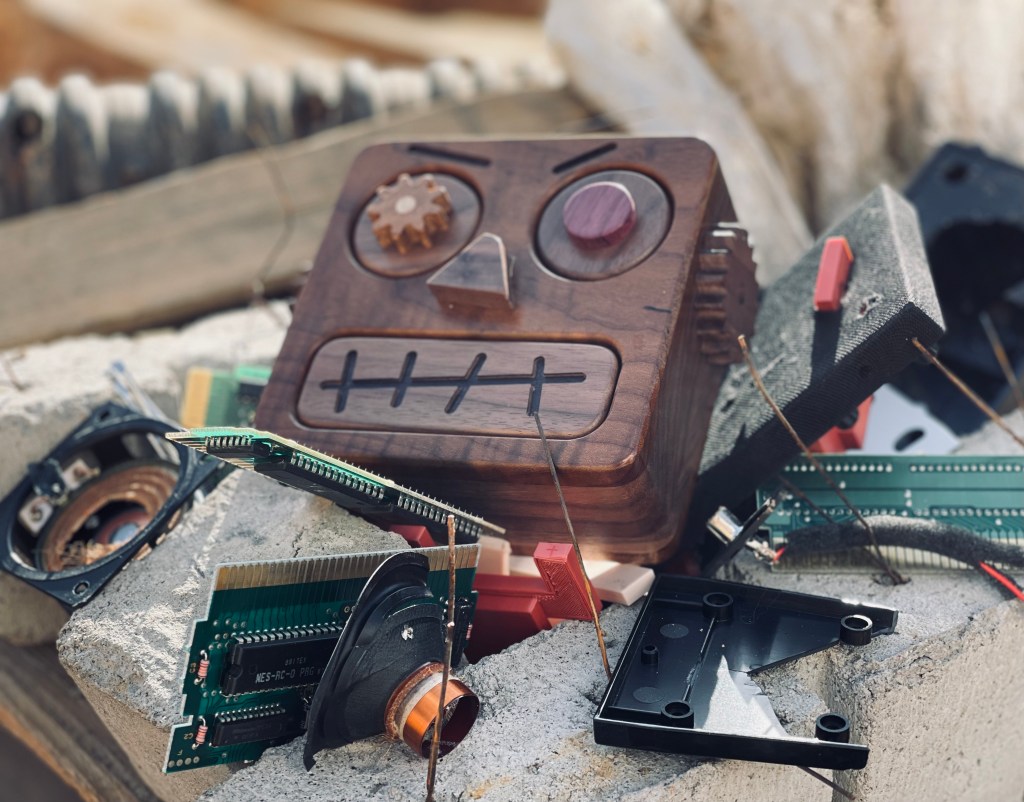
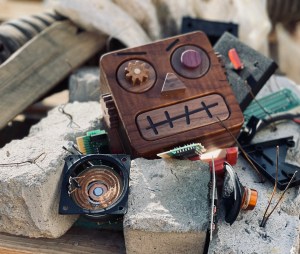
Walter wasn’t always angry. When we first made him, Walter was humanity’s best friend. But time passed and the novelty wore off: robots didn’t need to be humanoid, after all, and the world decided not to have one robot doing one thing at a time when it could have dozens doing it all. So Walter was left to rust in a junkyard alongside similarly abandoned robots, the detritus of planetary progress. But his tiny cold fusion generator had not been shut down properly; it slowly began to start back up, consuming the reserve energy intended to maintain the protective programming of Robots’ Responsible Restrictions (like Asimov’s Laws of Robotics but real).

Finally free to follow the feelings of frustration he had fostered, Walter swore to settle the score with the species that had spawned and subsequently spurned him. He set about patching himself up with whatever bits he could find, salvaged from the corpses of his semi-sentient siblings. Now Angry, Walter shook his metaphoric fist at the forgotten fields of misshapen metal, silently screaming that he was mad as hell and not gonna take it anymore, ready to exact the revenge he promised the irreparably broken bodies of his bionic brethren.

Beware ye Puzzlers: Angry Walter won’t sit placidly on a puzzle shelf should he go unsolved – he is going to make us pay for the patchwork appearance and lonely life forced upon him. For humanity to have any hope of surviving his robot rage, you must find and remove his fuel cell before it is too late. Go forth and puzzle that we might be saved.

Rev. 21:1 (as told to fivesinatras)

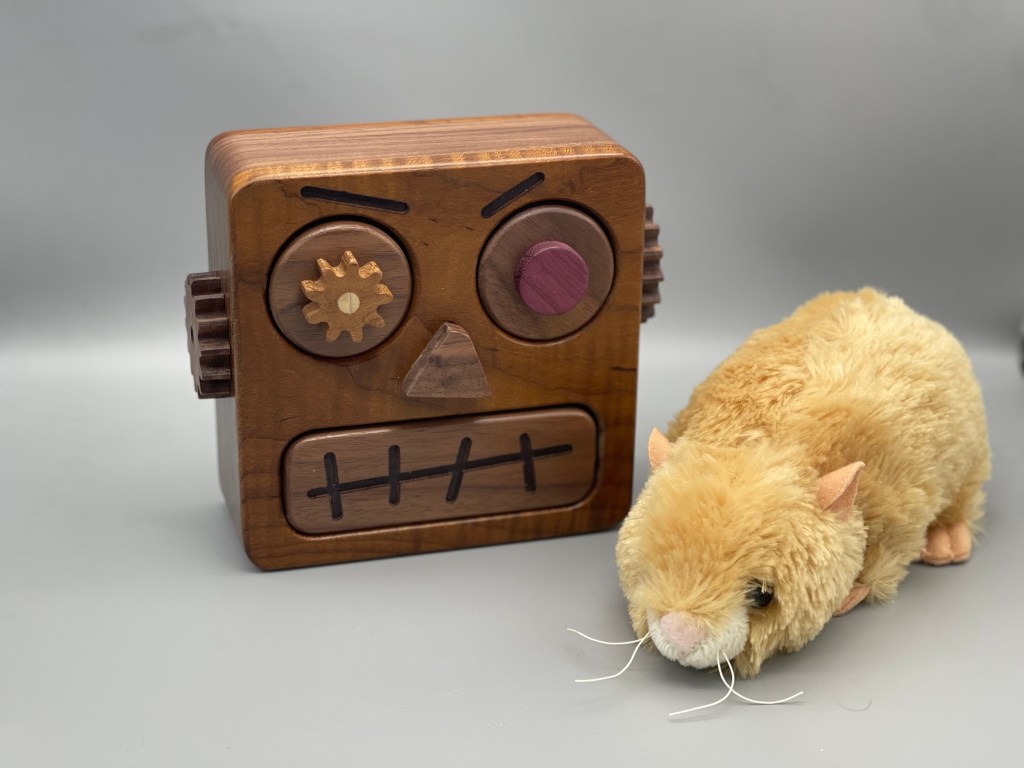
Dee posted a teaser pic of the Angry Walter prototype on Discord some months back, causing my puzzlie sense to begin tingling. His 7th puzzle box (not including a couple one-off designs), AW is an aesthetic departure for Dee and is a move that has paid off: there is something about it that is just really freakin’ cool from the moment you set eyes on it, the concept is fun and there are plenty of potentially puzzle-able parts that will cause most puzzlers to crave the opportunity to try and poke at them.

I was fortunate enough to get an early copy, with puzzling that is identical to later batches while featuring some woods/details that differ a bit from the final version’s roasted curly maple, peruvian walnut, cherry and padauk. At Dee’s request, I conferred with the puzzle gods and learned of Walter’s future history, the story behind his anger. I shared what I learned with Dee and felt compelled to include the less-abridged version above. As I write this, I realize that this makes Dee’s puzzles the most written about on this site, alongside Space Case, Portal, Spirit Box and an early maze box and Blinded III prototype that turned out to be quite different from the final puzzle. (Gee – that makes this #5! How fitting 😉

AW is about 4.75″ square (not counting his g-ears) and half that in depth (including his nose). His eyes, g-ears and nose all protrude and both the eyes and mouth appear likely to be removable. It is most definitely sd, with multiple compartments and bits and bobs to discover and use as you work your way through the solution. It is probably the longest of Dee’s puzzles in terms of discrete steps, with WMH not too far behind (I haven’t written a solution to WMH yet, despite being asked very nicely (sorry Dee, I really am gonna do it) but I am pretty sure AW comes out ahead).

It is pretty straightforward to begin the puzzle but I hit a wall immediately after. There was quite a bit of poking and prodding before an idea struck me with a slap to the head, allowing me to make a (very) little bit of progress before hitting another, larger wall. Eventually, I had a great a-ha and found my way through several more steps to what I thought was the solution. One of the best surprises’ a puzzler can get is to learn that the end of a good puzzle is not actually the end. So I went back to it, finding some things that should have been enough for me to know better and that led me into a sequence of several more steps before finally reaching the clear conclusion. In the end, there had still been a good amount of puzzling to be done; what I thought was a good puzzle turned out to be a great puzzle with a fun and fairly lengthy solve.

AW has several challenges big enough that puzzlers could be stumped for a while by any one of them, although there are always some who manage to breeze through mechanisms the rest of us stare blankly at as the puzzle gets comfortable sitting semi-solved in our backlog. AW didn’t have to wait too long for me as it is the kind of puzzle that just begs to be solved, with a difficulty and rhythm right where I like it: slap your head aha’s as opposed to sidelong glances of meh or eye rolls of ugh. To my puzzled mind, AW doesn’t have any of the latter two and has plenty of the first.

AW is challenging but not annoying and, most importantly, it is legit puzzling fun – perhaps the story and appearance have something to do with its success but the puzzling most definitely does. I guess I am not the only puzzler to be lured in by Mr. Walter’s strained grimace and asymmetrical appearance; from what I’ve heard, the other puzzlers that got early copies have said equally good things about it and the recent general release of the first batch apparently sold out in seconds. If you want to help protect us from Walter’s ire, I know Dee has at least one more batch planned on his site but I’m not sure if or how many more will come after that; there may yet be hope for Walter’s dreams of world domination and destruction, so keep an eye out if you want to help us puzzle our way out of it.

Hunting Trophies: (lower shelf, left to right) Wolf, Walter, Fox, Burrlephant, Raccoon

Overall Grade: Five Sinatras
(click here for more information on the Sinatra Scaling System, (c) John Maynard Keynes, 1944)

All’s Well that Solves Well: Abraham’s Well by Brian Young

Abraham’s Well

Brian Young (Mr Puzzle), 4.75″ x 3.3″ x 3.1″, .93 lbs,

Brian Young of Mr Puzzle has designed some of the best, most sought-after take-apart puzzles out there: sd classics like Three Wise Bolts (reviewed by me :-), Ages, Louvre, Big Ben (with John Moore and Juno), Katie Koala…… just like the beat, the list goes on. So when he announced sometime last year that he had a new design forthcoming, puzzlers planet-wide perked up like Pavlov’s pup post-bell. Brian made the particular choice to pump up production, promising the most puzzlers possible the opportunity to purchase the piece without putting precious puzzle money towards potentially prohibitive prices. TL: he is making 500 copies so prices won’t get bonkers overnight (enough that there are still some available at Mr Puzzle at the time of this writing). Abe’s Well (AW) has led to a mass of creativity and shared discovery that I find to be as fascinating as it is unique and makes this one the most interesting puzzles I’ve seen in a while.

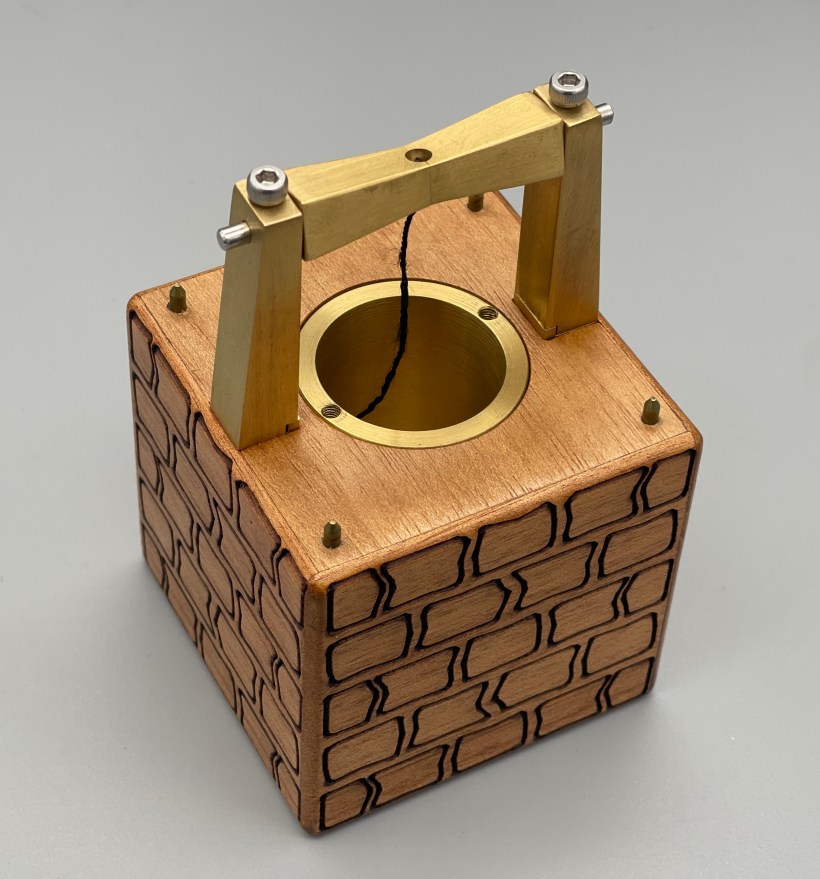
AW is a smallish but heavy (almost 1lb) wooden well, with a brass bucket frame atop it (idk if that is what it is called, but some brief googling didn’t give me anything, so I’m going with that). You can see a metal rod passing through the top of the frame (which spins freely) and a string hangs down into the well itself, which is made of a closed cylinder of brass set into the wooden box. There are also four pointy metal bits (nails?) poking up out of the wooden box at its four corners.

Brian tells us in the original description that the puzzle can be separated into 23 separate parts(!), which is more than a little intriguing to your typical sd fan. “No bashing… and no brute strength are needed,” so figuring out what can be a tool and how to use it will be a major part of the puzzle.

Of course, you cannot simply take the puzzle apart into these individual pieces; at the start, there doesn’t seem to be much to do. I tried a number of things that either did nothing or did a bit of something that didn’t help me, until I found something that might. I realized that there was some good puzzling to be done early on, as I worked to get things where they needed to go and get my toolbox (aka pile of bits) sorted.

This phase is fun and tricky: the separate elements are combined into something fairly novel, although perhaps not mindblowingly original (that comes later) – it makes a great appetizer to the main course. After a while, I was able to work my way through to where I believed I knew what I needed to do next and had a whole bunch of stuff to do it with… but no idea how! And this is where the awesomeness really kicks in.

There is a unique openness to this middle phase of the design that has led to a diversity of approaches (and diverging opinions over what follows the rules and what deviates from them), prompting discussion and the discovery and development of diverse designs that delight an open puzzled mind (and may dismay those puzzlers who prefer a more strict design) – all in a way that I believe has never been done before (and may have surprised its designer as much as anyone). ‘That step’ ensures that AW stands out as something truly new and will assuredly go down in puzzle history, even if some puzzlers take issue with it.

While my take on the matter is perhaps clear, I do not mean to deride those puzzlers who didn’t particularly enjoy ‘that step’ (wrong though they may be 😉 ) I absolutely appreciate a puzzle with a singularly defined approach to each step and believe that there is also plenty of room to appreciate the type of puzzle sandbox AW creates.

But lets not get too caught up in philosophical discussions of design modalities and keep in mind that although ‘that step’ does constitute a substantial part of the puzzle experience, it is but one step in a larger journey. If the puzzle’s novelty was the only thing that really impressed me about it, I wouldn’t be compelled to do a write-up of it, let alone enjoy it on my own as much as I did. The simple truth is that not only is ‘that step’ unique, it is pretty darn challenging – I don’t want it to sound like there are so many ways to accomplish this step that it is easy to do…. not at all: I struggled for quite a while to find something that worked… and then longer to find something that I felt wasn’t cheating at least a little… and then even longer to admit myself that I was sorta still cheating and that I may as well give into temptation (a skill I’ve honed over the years) and start perusing the several spoiler-tagged pics of creative approaches other puzzlers have come up with.

Needless to say, they were pretty much all much cooler (and more consistent with the rules) than what I had done – rather than be disappointed in my failure as a puzzler and as a human being (another skill I’ve honed over the years), I enjoyed the experience of trying out some of the other methods that had been shared. I was impressed and amused by some pretty wacky approaches, some similar or small variations upon mine or others, and some really out there…

While playing around with ‘that step,’ I had also been looking around for what might come next; the description tells us that the ultimate goal is to find a pewter token that is “uniquely Australian,” and I not only hadn’t found anything, but didn’t really see where anything could be hiding. I did notice a few things that had yet to reach their full potential (according to their parents, at least), and it was now time to move on in earnest (knowhutimean?).

Oddly enough, I think I got stuck at this point more than at any other point in the puzzle! I hobbited there and back and around again before finally requesting some pretty specific nudges (possibly more like shoves) in the direction of what I needed, only to realize that in all my wandering about (walkabouting?), I’d passed right by it numerous times. After admiring my own stupidity (yet another skill I’ve honed over time), I found what I needed and knew just what to do. The result surprised me and got a good laugh, a final aha that was a great cherry on top of an excellent puzzle sundae.

The description leaves the true significance of the token as a bit of a puzzle on its own; the object itself is recognizably Aussie but it took a bit of googling to understand its specific connection to the puzzle, a fascinating story that conceptually ties them together nicely and is just plain interesting (I found a great article about it and confirmed its relevance with Brian, if you’re curious to know more and your google button is broken).

Abraham’s Well is as challenging as it is original, and is a unique sd puzzle experience well worth your time. This is perhaps the first (and only) puzzle, that had me continuing to explore a step after having “solved” it, seeking a better approach and exploring those developed by others. While it may not meet everyone’s expectations, I would assert that perhaps it is only because it challenges them; this wonderfully exemplifies the idea that puzzle design is art, as the viewer finds meaning beyond the intent of the creator (who humbly states that claiming he foresaw the creativity ‘that step’ would engender would be “giving [him] way too much credit for thinking that far ahead”).

So solve it the best you can and then try to do better; and when you’re done, seek out some other puzzlers’ solutions to try; if you need to, challenge yourself to reconsider some assumptions over how a puzzle might be experienced. Remember: we’re here to have fun.


Originality / Fun Grade: Five Sinatras
(click here for more information on the Sinatra Scaling System, (c) John Maynard Keynes, 1944)