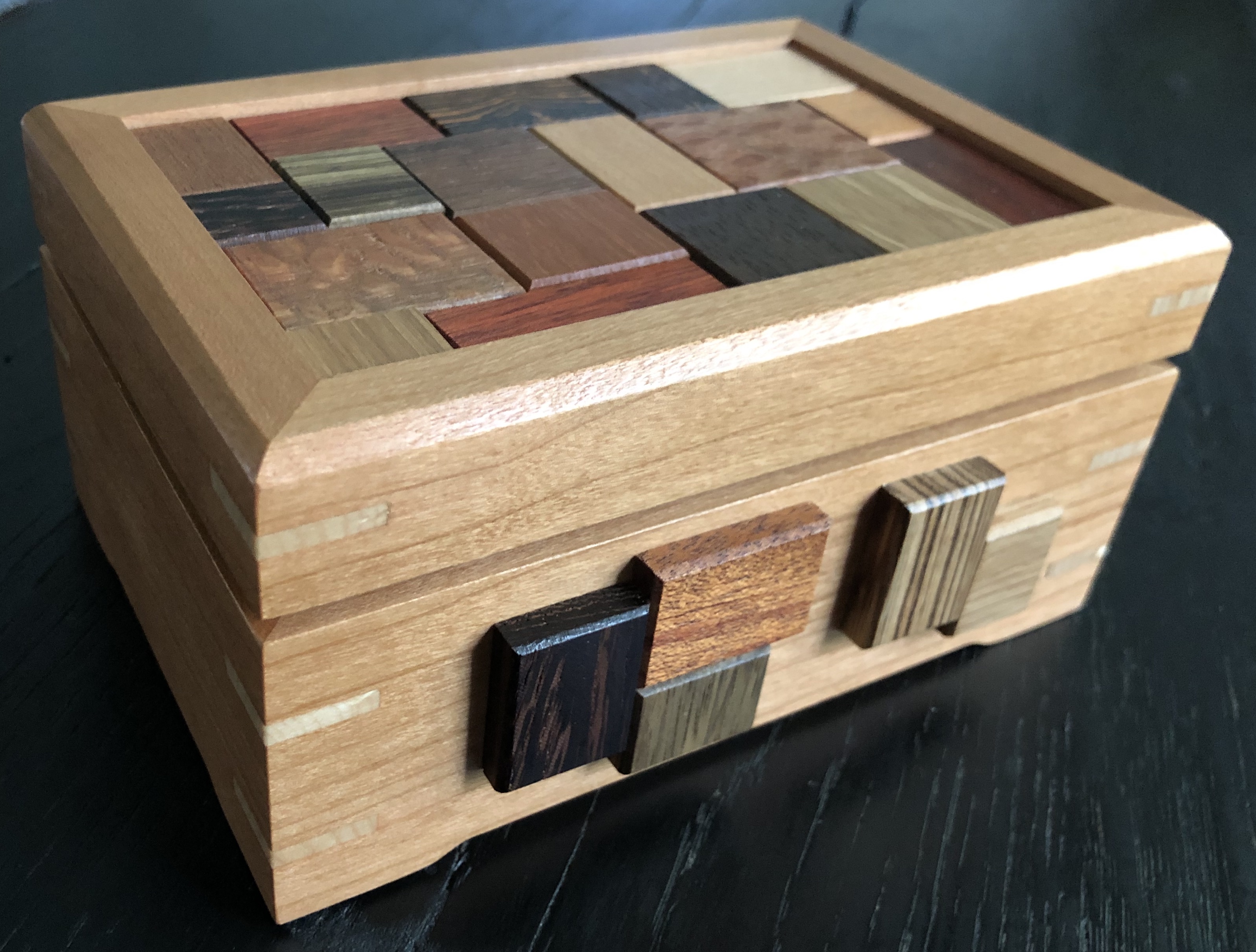
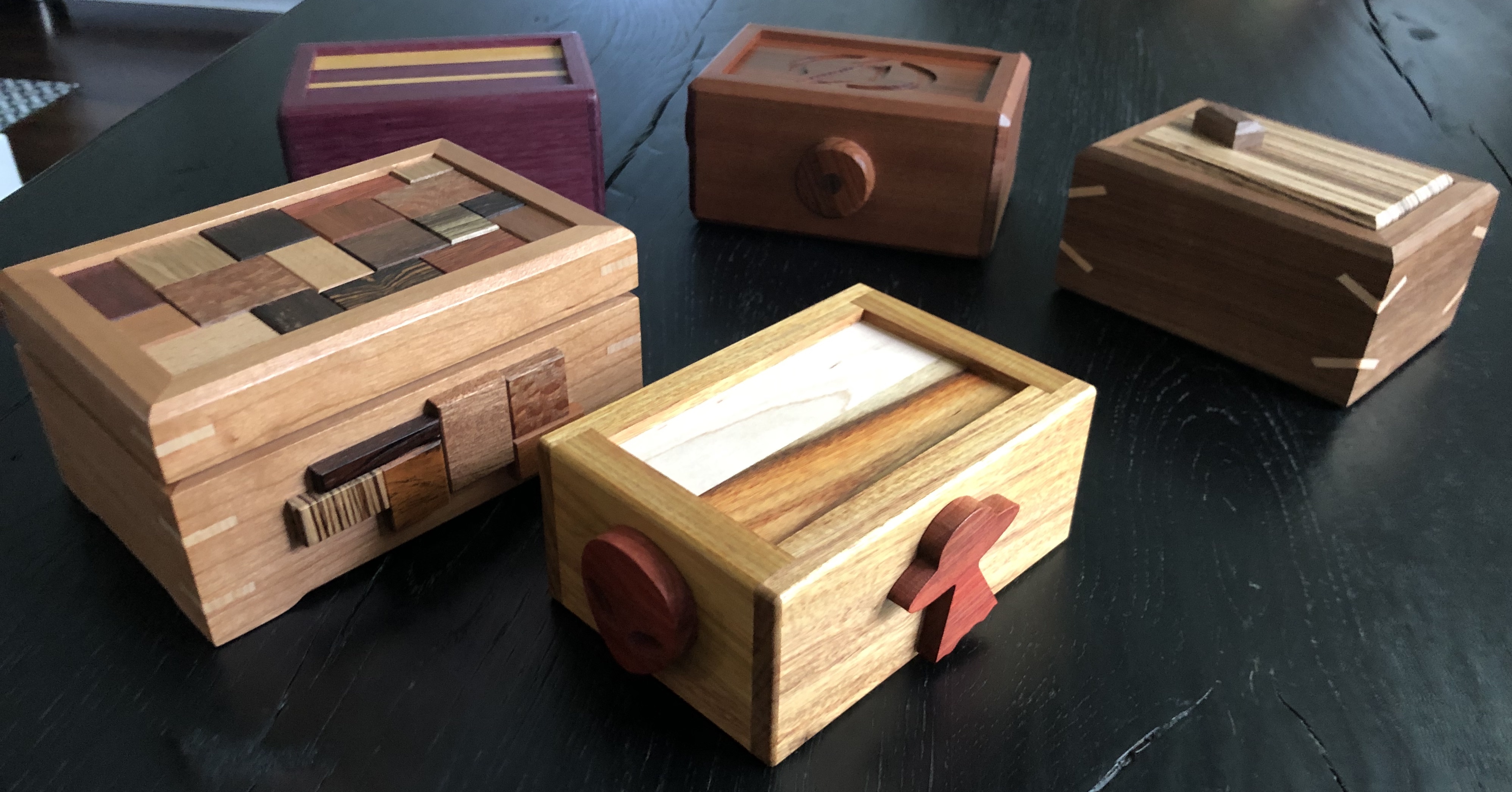
The (not really) Definitive Guide to the Karakuri Creation Group: A Brief History, Puzzle Box Reviews, and a Word on Club Membership

Small Box 1-8, Cube Box 1-4, New Secret Box 1-4, Double Box, Trick Door & Expansion

Karakuri Creation Group (KCG)
(scroll down for the puzzle box reviews if you do not want to hear my partially-informed mini-history lesson)

Why Puzzle Boxes?

“Solving the IMPOSSIBLE COFFEE CUP Box!”

“Opening the AMAZING ANTIQUE RADIO Puzzle!”

There is a reason these lures work, and it is not just the excessive use of capitalization and exclamation: to most, if not all, of us self-proclaimed puzzlers, the seemingly inaccessible compartment is a silent promise, a tacit seduction through the placid excitement of discovery, the inevitable and elusive “a-ha” both its premise and its resolution. It is the youthful desire to reach the cupboard within which lie cookies, the ancient drive to see beyond where there be dragons, the adolescent fascination with spy-craft and Goonie gadgetry, the absurd adult illusion of control and reason. Regardless of who or what we are, of what we have or where we come from, the Solution has become the mature repose that awaits us if only we can understand How It Works, if we can grok the secret simplicity lying behind an elegantly explicit deception, if we can build the mechanical bridges that lead us there.

To put it plainly: puzzle boxes are cool.

And just as the history of the modern puzzle box can be traced to Japan, so too can many of the coolest be found there, from a collective of Japanese artisans known as the Karakuri Creation Group (KCG): their works are beautifully made, with exquisite craftsmanship belying their ingenious mechanisms, ranging from whimsical and playful, to challenging and mystifying.

Several years ago, as I was obsessively compiling Pinterest tomes of hidden rooms and secret passageways, I stumbled upon somewhat similar clickbait to that mentioned above; the screamingly bothersome caps ignored, my eyes fell upon the exquisite woods of objects, some clearly shaped like a box, others far from it, all of which promised the recently ranted poetry of puzzling. My inner Indiana awakened, my submerged Data drawn from the depths (the spelunking child, not the cyborg), until what was a shallow swim into other people’s excessive home improvement projects became a deep dive into a previously unknown world of challenges and frustrations: I was forever Puzzled.

One of the best decisions I have made, a list which is rather depressingly short, was to avoid solution vids early on; in a rare feat of self-control and precognitive consideration, I rightly held off in the hopes that some of these might one day make their way into my hands. Many and most have yet to do so, but the wait is surely worth it if only for those few that have or will because, for me, puzzling will forever be inextricably linked with Karakuri. Not just because they were some of the first I found, and not just because they are the direct evolution of the bulk of the puzzle box’s history, but simply because they are, to once again emphasize perhaps the most important takeaway of this rather rambly article, forking cool.

A Brief History

(please know that any mistakes, should they exist, are mine alone)

The Samurai of Edo Japan could not guarantee safe passage for all those making their way along the well-worn roads between Tokyo and Osaka. As horses drew their precious belongings through the Hakone mountains, merchants, nobility and commoners alike feared the presence of the Highwaymen preying upon unwary travelers seeking safe passage through the embrace of Mt. Fuji. 

Inspired by the diverse variety of trees in the region, artisans responded to this need for secrecy by applying the ingenuity of the neo-Confucianist intellectual rigor alive at the time. Newly developed architectural principles used to enable buildings to withstand the frequent earthquakes of the country were scaled down and integrated into small, personal items. In the middle of the 19th Century, markets began to sell Shikake-Bako, or trick boxes, where workers could hide valuable tools and property in compartments hidden within otherwise ordinary boxes and small, Tansu chests. The novelty of the Shikake-Bako reached the ears of merchants and nobility and, eventually, Japan’s newly developed leisure class turned its hungry gaze upon them, leading to the development of increasingly difficult mechanisms. In the 1870’s, Takagoro Okawa (and others) began integrating the Yosegi marquetry and Zougan art popular at the time, creating the Himitsu-Bako, or personal secret box. These traditional puzzle boxes use a series of sliding panels to unlock one or more compartments and continue to be produced today.

Fast forward a century or so, and the KCG is created, helping to evolve the traditional puzzle box into the post-modern era, bringing craftsmen and women together to make ever more unique and tricky mechanisms, pushing the definition of what constitutes a “box” and playing upon the assumptions we make when thinking of the comparative simplicity of the traditional Himitsu-Bako’s sliding panels. The word Karakuri, literally mechanism, was the term used to describe the mechanical automatons that date as far back as the 17th Century; the word is now synonymous with the mechanical puzzle box and has helped birth the strange and wonderful works of makers across the globe.

The KCG has grown to include 10 Japanese craftsmen and women (as well as six “friends,” including a single non-Japanese puzzle-maker, the talented Kagen Sound). These creators all bring their own unique style and perspective to puzzle-box-making, continuing to challenge our assumptions and experiences, crafting boxes that range from whimsical pieces solved with a single, sometimes somewhat simple, yet oftentimes elusive, step, to boxes using challenging and mystifying mechanisms that unlock multiple compartments, some requiring hundreds of steps to fully solve.

To me, as to many puzzlers, Karakuri constitute many of the most sought-after puzzle boxes, among the unicorniest of unicorns; and yet, from time to time, I will hear a puzzler or two express doubt that their boxes can be challenging or unique when they “just” use moving panels. I hear this and think that the same could be said for burrs, which “just” use sticks with pieces missing. I am fully aware of the fact that, at one time, I wondered what was so interesting about packing puzzles, when it is a matter of “just” putting these into that. To such a skeptic, I can say with certainty that it is only a matter of finding the right box by the right craftsman to make you into a believer.

Karakuri are not “just” anything: even at their least compelling, they are beautiful examples of woodworking, even if only relying on one or two simple, yet elegant, movements to open. Starting from this foundation, their boxes grow ever more complex and unique, integrating concepts derived from physics and math, utilizing complex woodworking skills to challenge puzzlers with magnets and dead ends, using our own assumptions against us. They are continuously evolving the craft with new concepts and principles, pushing the puzzle-maker to break new ground and, when they have run out of ground, to meticulously make more so that it, too, can be broken.

KCG Puzzle Box Reviews

It seems like every day someone new is not asking me about the boxes made by the Karakuri Creation Group: Which small box is best? What are the New Secret Boxes (NSB)? Are these worth getting? Who are you talking to? Is anyone actually still reading this? Well, it is about time that someone sit down and talk about the different boxes – and, if I have learned anything over the last 40+ years, it is that I am someone, so why not be that someone.

I will start by clarifying that while the boxes I am reviewing here are based on the designs of the KCG members (Kamei more than any other), they are not actually made by them – they are instead crafted by apprentices under the direction and oversight of KCG members (afaik). This allows them to be produced more regularly while still maintaining the high quality we expect from KCG creations – as they are not limited releases, they are easier to find and cheaper to buy, making them an excellent introduction to the KCG. Hopefully, this guide will help you to determine which of these creations you are interested in. I am not going to give away any solutions and will focus on the puzzling experience; I will walk carefully so as to reveal as little as possible and err on the side of caution:

Small Boxes 1 – 8:

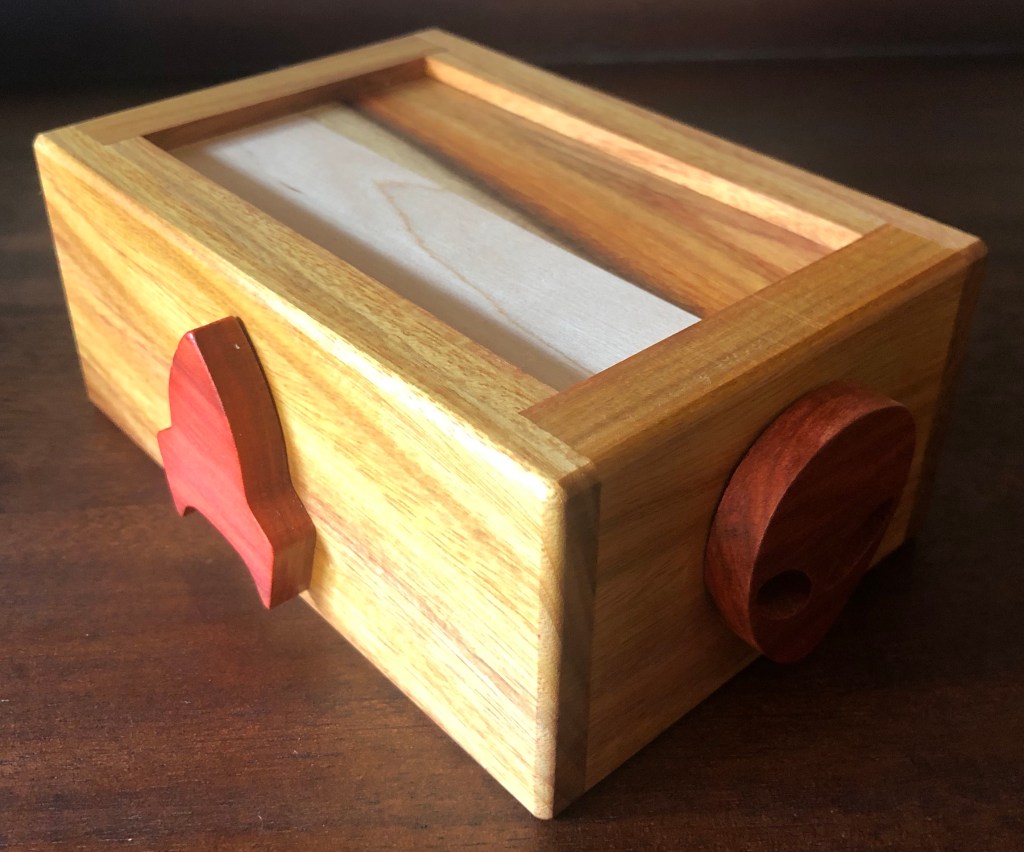
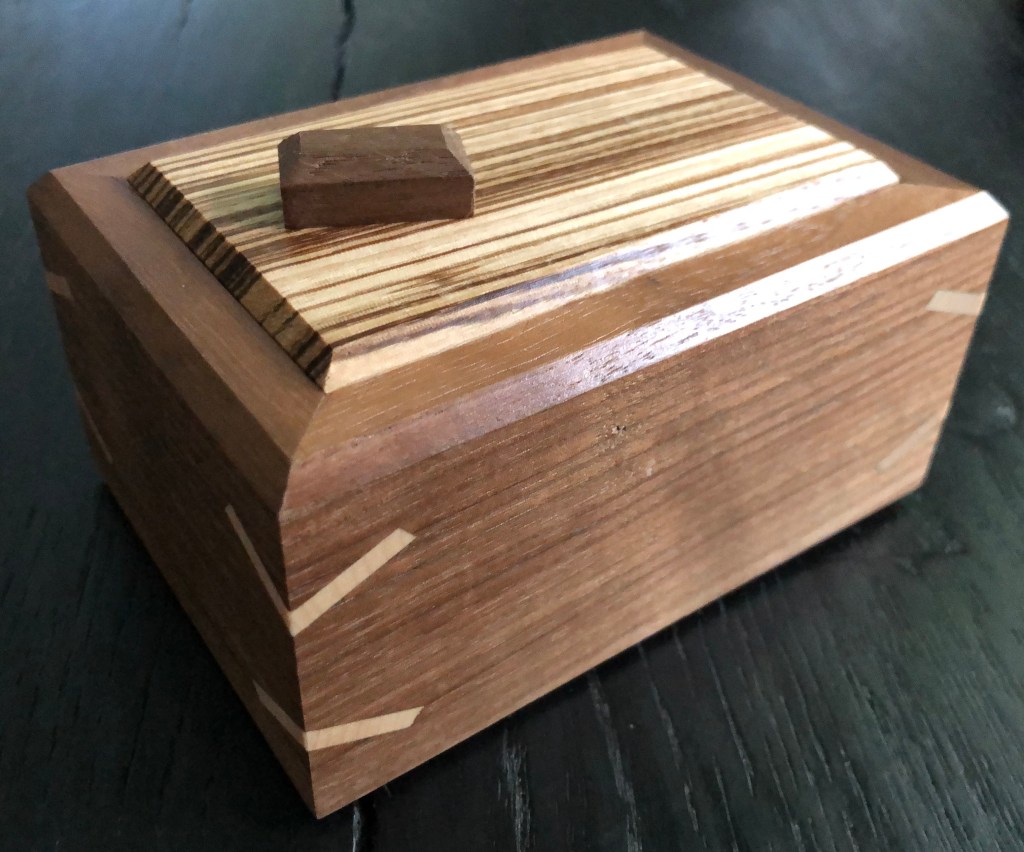
Small Box 1 (walnut & magnolia, 47mm, 3 steps): Excellent introduction to modern Japanese puzzle boxes, as it uses a modern take on somewhat traditional movements. Once you find the first, well-hidden step, the next steps have a way of going against your assumptions. It still amazes me how difficult it can be to find something that will move, whether by touch or by sight.

Small Box 2 (cherry & magnolia, 42mm x 47mm x 60mm, 2 steps): Another great box, the first step is quite different from Small Box 1, and hides itself well. You will need a different approach to be able to make progress, although the second step is a bit straightforward. Some may find it a bit similar to a box made by a well-known American puzzle-maker.

Small Box 3 (walnut & magnolia, 42mm x 47mm x 60mm, 3 steps): Also great, its well-hidden start is followed by an unexpected second move that requires some out of the box thinking. Somewhat similar to Small Box 1, while taking you along a very different path.

Small Box 4 (zelkova, 48mm, x 42mm, 1 step): Based on Akio Kamei’s Box with a Ribbon (P-27, 1996), this relies on a mechanism that is rather unloved by many puzzlers. Nonetheless, it is well-executed and quite satisfying when done correctly. Unlike boxes 1-3, it is not solidly smooth all the way around, and resembles a box within a box from the bottom.

(scroll down to see a pic of the bottom of the box)

Small Box 5 (maple, 48mm, x 42mm, 2-3 steps): Based on Akio Kamei’s Cosmox (M-17, 1990), this is the only small box that makes noise due to some (intentionally) loose internal parts. Its mechanism is quite different from the rest of the series and is a good example of how some boxes must be experimented with a bit to fully understand how it works, even after it has been solved. From the bottom, it resembles a box within a box (similar to 4).

(scroll down to see a pic of the bottom of the box)

Small Box 6 (walnut, 47mm x 42mm, 2 steps): Based on Akio Kamei’s Top Box 1 (M-5-1, 1983), this uses a mechanism that is perhaps even more maligned than that used in box 4. Nonetheless, its walnut construction is quite lovely. From the bottom, it resembles a box within a box (similar to 4 & 5).

(scroll down to see a pic of the bottom of the box)

Small Box 7 (cherry & magnolia, 50mm x 40mm, 3 steps): Based on Akio Kamei’s Small Box 3 (M-24-3, 2002), this was the first Karakuri box I got and is still perhaps my favorite of the small box series. Its first step is a great example of how a puzzle box can hide something right in front of you. The final step is rather unexpected and is simultaneously unique and common.
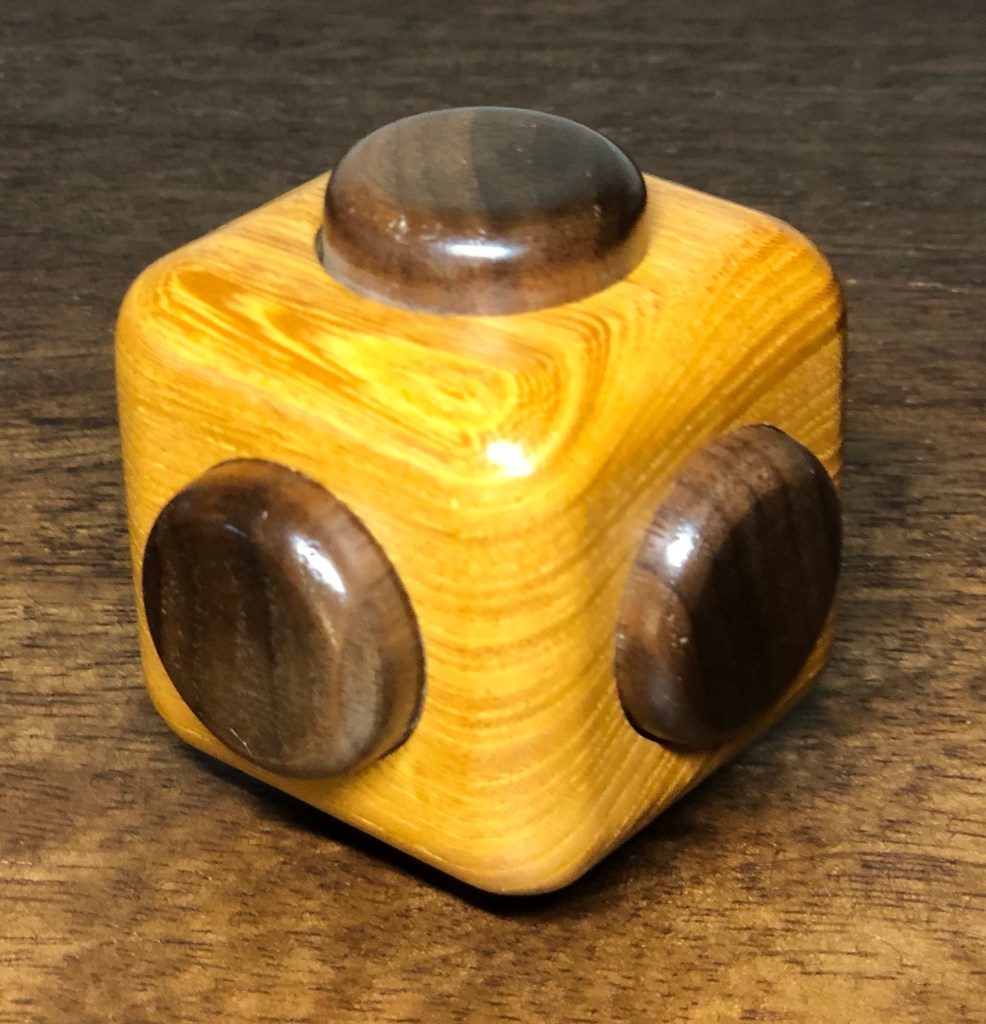
Small Box 8 (zelkova & walnut, 58mm, 2 steps): Based on Akio Kamei’s 3D Box (K-20, 1996), this is otherwise known as “the small box that looks totally different from the other small boxes.” Unsurprisingly, its solution is quite different from the rest of the series; as you may have guessed, the burr-like sticks must be manipulated in coordination in order to find and open its hidden compartment. This is definitely one of the best of the series and unfortunately does not seem to be remade as often (at the time of this writing, it is available at Mr. Puzzle).

Cube Boxes 1-4:

Cube Box 1 (zelkova, maple & katsura, 60mm, 3 steps): The Cube Boxes are perhaps a bit less diverse and more consistent than the small boxes, incorporating visual clues into fun solutions that are somewhat more traditional. Box 1 is an excellent example of the close tolerances KCG can create, with the final step moving so smoothly as to be almost vacuum-sealed (mine actually makes a nice “pop” sound when it opens).

Cube Box 2 (wenge, maple & katsura, 60mm, 5 steps): Similar to Cube 1, this also has satisfyingly close tolerances. The solution is a bit more complex as the steps must follow a more defined path.

Cube Box 3 (walnut, maple & katsura, 60mm, 2 steps): This solution is quite different from the rest of the series, with a final state that I find to be aesthetically pleasing. This is one of my favorites of the series, as I find it oddly pleasurable to open and close.

Cube Box 4 (chanchin, maple & katsura, 60mm, 4 steps): This is probably my favorite of the series: the first steps are similar to Cube 1 but the final step is pretty neat, taking an approach to accessing the internal compartment that is different from the rest of the series. The final state is kind of cool and the final movement itself is fairly counter-intuitive.

New Secret Boxes 1-4:

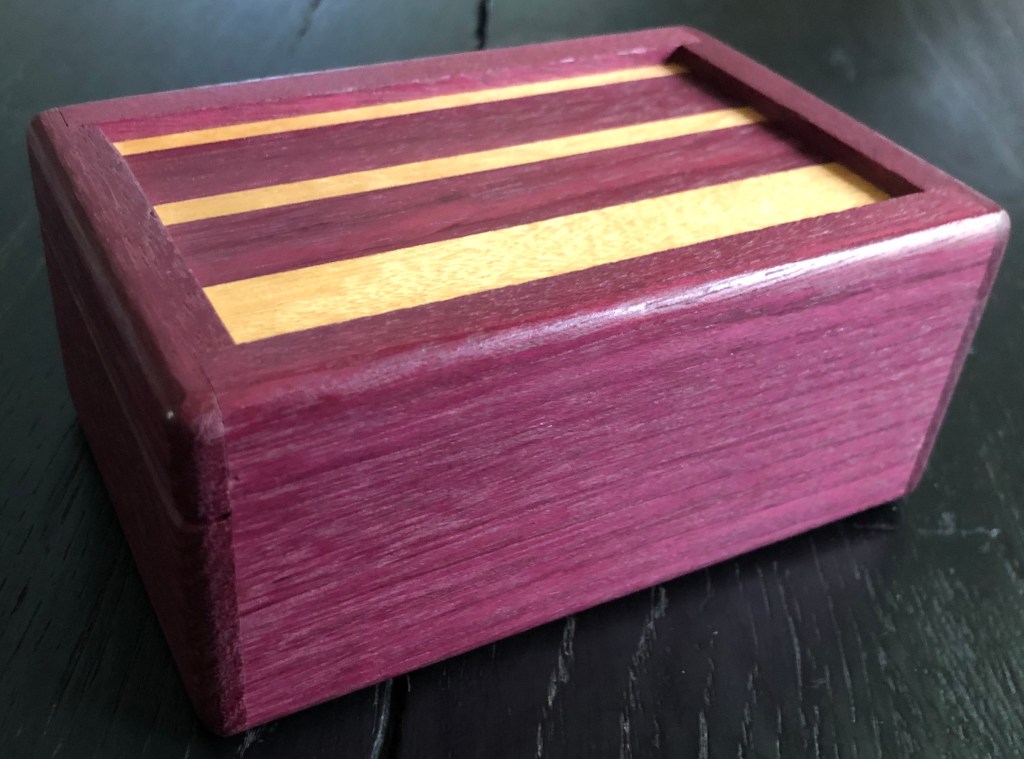
Unlike the series described above, the New Secret Boxes all share similar solutions: the difference is one of complexity: the first box has 6 steps, the second has 12 steps, the third has 18 steps, and the fourth has 32 steps (note that each requires that many steps to open and then again to close, albeit in reverse order). These are perhaps the closest to traditional boxes, except that all six panels move (as opposed to only four panels in traditional boxes). Boxes 1-3 are more or less straightforward, following a fairly direct route from start to end. Box 4 is significantly more complicated, its moves following a binary pattern that must be discovered and which has been described by many as being a fun challenge (full disclosure: I have not actually tried it). The boxes are all the same size (80mm) and share an aesthetic, with the number of stripes on its exterior indicating which of the series it is. All are well made and the interior allows you to see the types of complex wood cuts that are needed to create the sliding panels on which the puzzle is based.

Standalones: Double Box, Trick Door, and Expansion

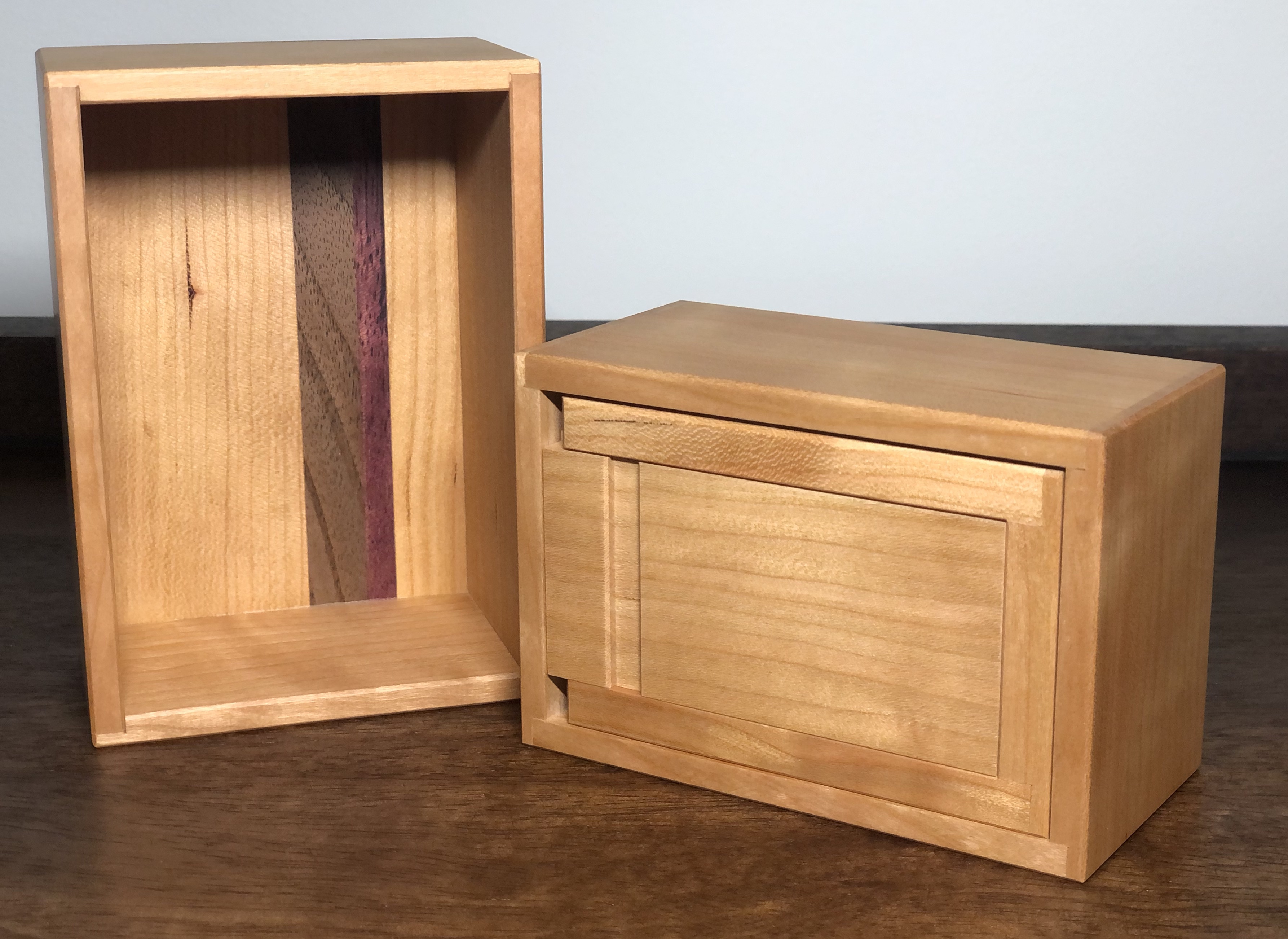
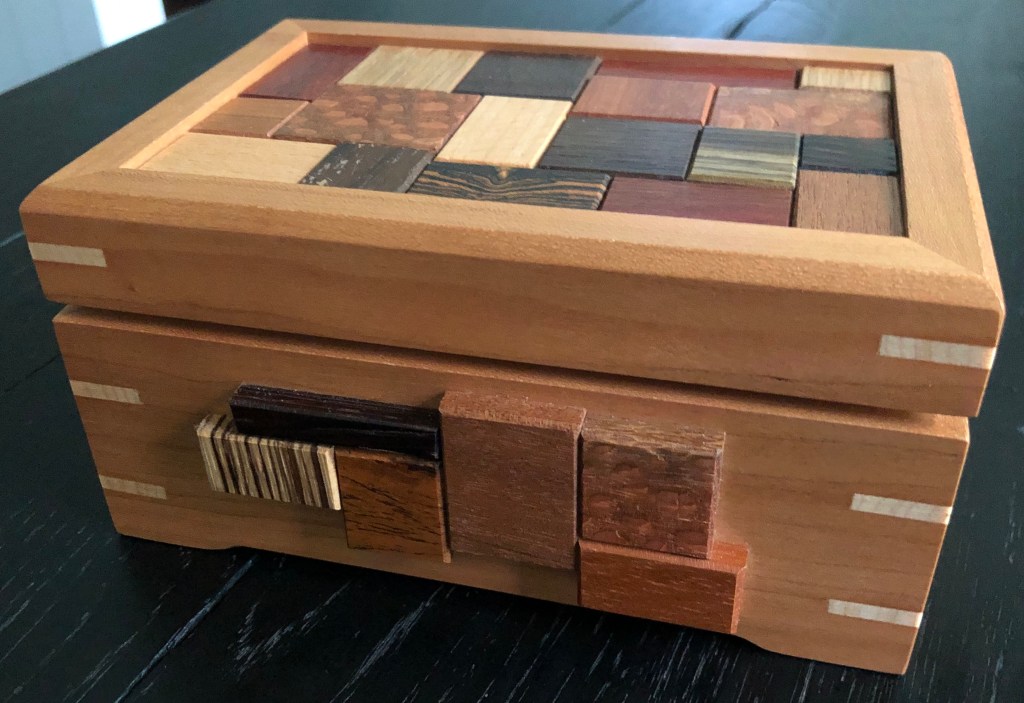
Double Box (cherry & walnut, 4 steps): Based on Akio Kamei’s Double Box (M-47, 2016), this uses a simplified version of the mechanism used in the classic Pentagon Box (M-8, orig. 1984); like Pentagon, it features a lid that can be freely removed (no tricks). Although it is not particularly complex, it is an example of how Karakuri boxes can be playful, messing with our ideas of what defines a box. While this is not one of my favorite KCG creations, I appreciate how you must use something generally intended to close a box in order to open it (or, as Kamei said in his description of Pentagon, “When you cover the lid, you can open the box. But when you take off the lid, you can close the box”).

(scroll down to see pics of Double Box without the removable lid)

Trick Door (walnut, 1 step): This recreates a full-size trick door that stands at the entrance to the Karakuri museum in Hakone; a digital version was used to access the old Karakuri website. It can take an embarrassingly long time to figure out the way to open the door, particularly for those unaccustomed to trick boxes. It is a classic example of using our expectations against us. It is not only fun, but great to hand to non-puzzlers, as it is sure to elicit in them the famed self-smacking of foreheads once shown the simple solution they likely failed to find.

(scroll down to see pics of the “real” Trick Door at the Karakuri Museum)

Expansion (maple, zelkova, walnut & black cherry, 4 steps): I saved the best for last! This 2020 release is based on Akio Kamei’s Expansion I (M-44-1, 2012), which is the first of a series of expansion boxes with different mechanisms based on the same concept. First, this is a beautiful box; I generally prefer darker woods, but the contrasting colors used are striking. More importantly, the main step is just plain fun – the first time I did it, I actually giggled – I have Kamei’s Expansion IV and, honestly, I may enjoy this one even more! Beyond that first step, the solution takes an interesting step or two before you can find and open the hidden compartment; it is possible to go back and forth on the first step without finding the direction you need to take. While not necessarily difficult, it has an added layer of complexity that adds more depth to the box, as the puzzle forces you to look more closely to better understand it before you can fully solve it. This is still available (at the time of this writing).

Conclusion and a Word about Club Membership

Hopefully this post will help someone decide whether or not they want to try Karakuri puzzles and orient them towards those boxes that might be more to their liking. I wanted to write something that could be especially helpful to newer puzzlers and, to that end, this (already too long) post would not be complete without a bit about club membership: the KCG site can be confusing and I have heard a lot of misunderstanding about how membership works and why one would join. To me, joining is a no-brainer: you will never get KCG member-made boxes at a better price and it is super fun to get some surprises come the holidays.

Each year, the active Karakuri members (currently all but Miyamoto and Ninomiya) create a puzzle box for the holidays; we do not know what it is until it arrives. Puzzlers try to maintain a strict post-no-pictures rule until after the holidays, as some of us like to leave them unopened for a surprise come present-time (assuming you’re into that). As an added mini-puzzle, we do not even know which member made what until a month or so later, so it can be fun trying to guess which box is from which maker – this is sometimes obvious, but oftentimes not (unless you check the maker’s hanko, which is their Japanese “signature” found once you have fully solved the puzzle, particularly helpful if a box has more than one compartment).

There is an annual fee of 12,500 yen (approx. $120), which gets you a box from a single member of your choosing. Some of the boxes may be available after the holidays have passed, but many will never be made again. You can also add boxes from other members for an additional 10,000 yen (approx. $95). The first year there is an additional one-time fee of 6,250 yen (approx. $60); new members receive a copy of the “Karakuri Art Works” book with high quality pictures and descriptions of all Karakuri creations since 1999 in English and Japanese; it will come with supplementary pages for works created after 2017 (additional annual supplements are sent to members once the holidays have passed). This one-time fee is basically the cost of the book, which retails for 5,625 yen (approx. $50).

In addition, membership includes free shipping (worldwide, afaik) on all purchases; amazingly, their boxes will usually be delivered to the US only 2 or 3 days after ordering (even now, amidst Covid, it generally takes less than a week). Perhaps more importantly, membership grants you access to the lotteries for new releases, which come out a few times a year and are generally more complex than the holiday boxes. As they are limited releases (many will never be made again), there is oftentimes more demand than supply; the lottery allows members to order one or more of the new boxes, with payment to be automatically processed if and when they win the lottery (no, these are not free boxes – you are winning the chance to buy them). If there are any copies left over, they will be made publicly available.

As you can probably tell, I love Karakuri boxes. As a collector, their beauty and elegance amazes me and I enjoy re-solving them: sometimes I may not remember exactly how to solve it, but more often I know how it works and am just enjoying the mechanisms. Some puzzlers are less inclined to collect, and are primarily Solvers – to them, Karakuri may not always be satisfying. While some Karakuri are certainly challenging, some Solvers may balk at what they see as poor time per $ puzzling value; you can certainly find less expensive puzzles that will sometimes take longer to solve (Hanamayas are a great example). However, some of the “easiest” Karakuri rely on truly amazing and inspired tricks that will delight most any puzzle fan, even if it doesn’t take hours to figure out. Regardless, I think that everyone will recognize that Karakuri boxes are of amazing quality, their value found not only as puzzles but as works of art. Hopefully this post may have helped the one or two people who actually made it all the way to the end to decide whether or which works appeal to their puzzling sensibilities – if not, it was probably a terrible use of my time, which could therefore have been better spent trying to finally finish solving Turtle Trip, Wishing Well, or Secretum Cista, or even doing that other thing, what’s it called… the thing that actually makes money so I can buy puzzles and keep my family living indoors… you know what I mean. Word? No, thats not it…. Ummmm… work! Yeah, that.

Trick Door & the “Real” Door at the Karakuri Museum

Front of Small Boxes 1-8 and the Bottoms of Small Boxes 4-6

Double Box’s Lid is Removable (no tricks)

The Other Best Blue Metal SD Puzzle Cube

Wishing Well

Perplex Puzzles, Stainless Steel, Aluminum, and Brass, 3.5″ x 3″ x 3″, Currently Available

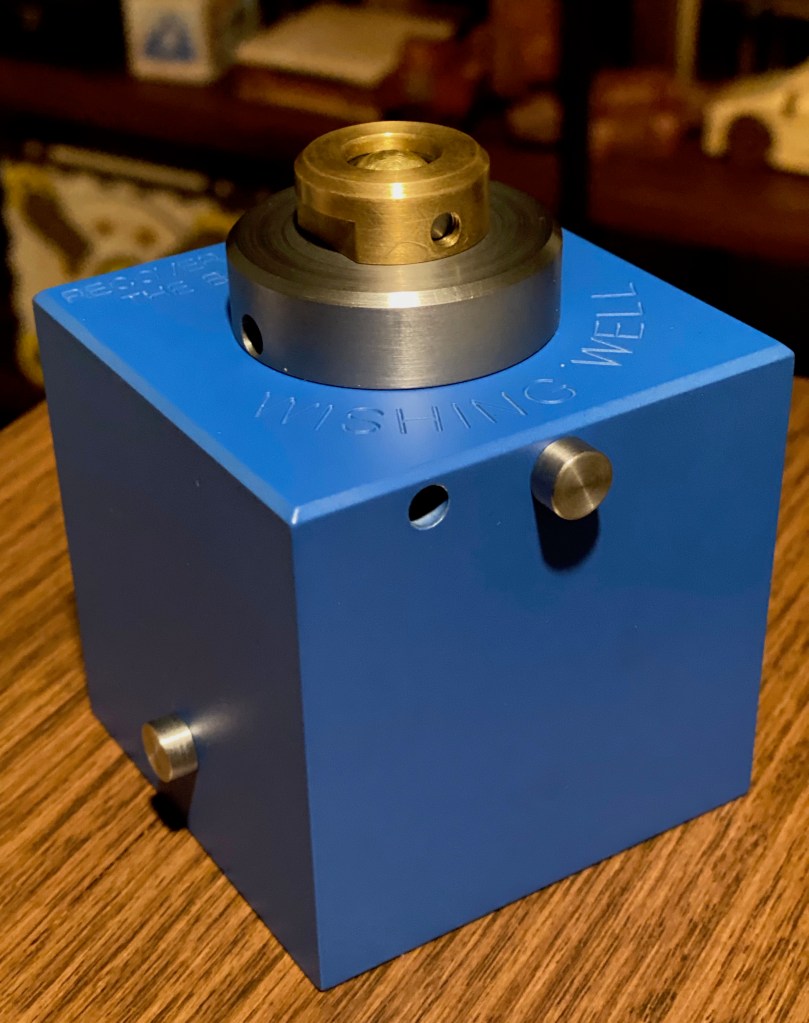
Recently, a puzzling friend of mine sent a pic of a metal puzzle box that had my puzzling parts tingling: Wishing Well is a new (currently available) puzzle from Perplex Puzzles; while seemingly a newcomer to the mechanical puzzle scene (afaik), the creator is a machinist with 39 years experience and the impeccable craftsmanship of the puzzle is definitely consistent with this expertise. At first glance, it seems somewhat similar to Will Strijbos’s First Box: it is a blue metal cube, with a cylindrical protrusion on its top. However, it is a bit bigger and significantly heavier than that puzzling classic; its blue surface is ceramic-coated “for long life,” and it has a number of holes and nubs and such located around its periphery.

Perhaps more importantly, this puzzle boasts an approximate number of 50 steps to solve(!) – this is made even more sweet by its instructions, informing us that there are no magnets, no need to spin or shake, and no smacking or excessive force needed. Described as “sequential mechanical,” after spending time with it, it most definitely falls squarely into the sequential discovery sub-genre of take-apart puzzles: it contains an “intricate assembly” of various metal parts that have been “precision machined on both CNC and conventional machines.” Presumably, this requires a lot of time and effort to make (a fact belied by its significant price tag); I took a bit of a leap of faith and bought it (who am I kidding – a brand new 50 step, SD puzzle box?! yes, please). As stated on the website, these are made in small batches: “[d]ue to the extremely close tolerances and tight fits, they are individually fit and assembled.” Yet again, music to my puzzling soul.

Made in the US, it arrived in just a couple days, arriving in a heavy wood crate with a dozen or so screws around its edges. This was obviously extremely cool and had me anticipating the puzzling experience all the more. Opening the crate, I found a wooden case with a metal clasp taking up about half its interior. Inside this unassuming (not a puzzle) box, lay Wishing Well, comfortably nestled in the foam-lined interior. Lifting it out of its perfectly-sized hole, the first thing I noticed is that it is heavy. Like really heavy. I mean, noticeably heavier than Pachinko, let alone First Box. Its ceramic coating feels smooth and softer than most metal puzzles had led me to expect, and the two-stage, two-toned protrusion on top immediately grabs my eye: a two inch metal circle (aluminum, presumably) topped by a one inch brass circle with what appears to be a brass ball nestled within. The primary directive has been etched into the surface of the box, just above the circles: “Recover the Coin from the Bottom of the” (and then, curving around the bottom of the circle) “Wishing Well.” There is something so practical about it that I like – almost like coming across an odd-looking lock box deep inside the guts of a factory.

Inside its wooden case were two folded sheets of paper: one were the instructions (see below), which included several points in addition to those listed above, instructing the puzzler to not only recover the coin, but to reassemble it completely before it can be considered solved. But the unassuming line that mechanical puzzlers will be likely to find most intriguing sits somewhere in the middle: “Disassembly and removal of the coin can be accomplished easily when taking the proper steps in the proper order.” Wunderbar! This is a puzzle that seems to follow a series of discrete steps – rather than vague movements blending into one another, I have found a tool-based mechanical progression that is by no means easy.

In addition to the instructions, there is a hint sheet – after spending a significant amount of time on the puzzle, I peeked at it, almost as much out of curiosity for the sheet’s contents as for the hint itself. Included hints are not a common occurrence with puzzles for some reason (many don’t even show up with instructions), and I found this to add to my enjoyment of the puzzle, especially as the hunts themselves are conceptual and do not really spoil anything: there are a couple quotes that provide as vague a nudge as any esoteric comment from a fellow puzzler might, as well as (wait for it) a crossword puzzle! Apparently, by solving the crossword, you can then put the words into the order provided to reveal an additional hint. The quotes were not anything particularly helpful – an experienced puzzler is likely to find them to be advice that is generally good to keep in mind when approaching a new, complicated take-apart puzzle, but I appreciate the vague nudges (and I think it is especially welcome to include something for those that may be relatively new to the puzzling world). I have not yet done the crossword, which I suspect may contain something a bit more concrete.

Along with the wooden case, there is a manila letter-sized envelope labelled “Solution.” Because of how heavy it is, I had to open it and at least peek in the top; careful not to reveal any of the actual content, I was able to see that it contains 10 laminated pages with printed text and pictures(!) – pretty awesome and likely quite thorough.

Finally, on to the puzzling experience. As I mentioned, I have not yet solved it fully (I suspect it will cause me to flounder and flail about for quite a while, which should come as no surprise if you know me at all); at this point, I have progressed through about dozen steps and I can confidently say that this thing is badass. As claimed, when you find a step, it is clearly a step; and yet, it is oftentimes totally unclear what to do – it seems like there is so much that you should be able to do, and yet at any given time it may take a while to find anything that you actually are able to do. The visible holes and nubs hide tools and inner working that change in nature as I work my way along – what did little, now does much; what was sticking out, is now sticking in; things move and potential pathways begin to open up, moving the puzzle along at a decent pace until I get to a point where I find myself yet again going in circles, able to do several things, but unsure which to do or in what way or order. Do I need to do this before I do that? Should this go here or should that go there? I am gathering intel on what lies inside the box, details emerging as I discover ways to make this or that happen. Each piece moves perfectly; this is a puzzle clearly made by an expert in the craft that knows how to get metal to do what he wants. Unlike some puzzles I have done, it does not feel like round pegs are being forced into square holes, where you are unsure whether you should do this or that – while it is by no means always clear what to do, I have found it very clear what not to do; this puzzle hides but it does not cheat.

I will end by saying this: it is very clear that this took a lot of thought to design and a lot of effort to make. The puzzling is very enjoyable, with well-concealed, discrete steps that incorporate tools and non-obvious movements that keep me interested and excited as I struggle to find my way through to the next wall. Perplex’s product page features a “Coming Soon” sign beneath Wishing Well; the new puzzle is named Turn, Turn, Turn and comes in at a slightly lower price tag. If it is anything like Wishing Well, the price is likely to be well worth it. I don’t know whether Perplex will continue to make Wishing Well after the new puzzle has been released, but I assume that once the puzzling world gets wind of these, they may start disappearing, so start saving or selling your solved stuff because this thing is seriously fun.

Craftsmanship: Five Sinatras

(No Terence Trent D’Arby jokes were made during the writing of this blog… until now)

Holy Forking Shirt – is that Chest made of 18 Puzzle Drawers?!

Secretum Cista

Jesse Born, 13.5″ x 20.5″ x 11.5″

It’s here! Jesse Born‘s beautiful Puzzle Chest, Secretum Cista, arrived this week and it is amazing!

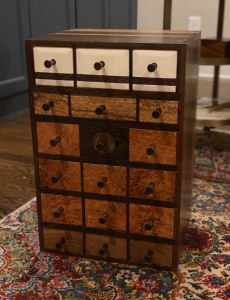
Check out this video showing the arrival and unboxing of this mighty chest – featuring several woods, including Wenge, Paduak, Purpleheart, Katalox, Figured Mango, and more, this chest consists of 18 drawers that hide an interconnected series of SD puzzles. This is basically like getting a big chest filled with puzzle boxes!

Stay Tuned for more posts as I continue to explore this excellent piece of puzzle wizardry!


Overall Grade: One Presley (!!!)

Regarding the exchange rate of quantified cool: The Tiger Man Elvis is of course the pinnacle of cool – too out of reach to justify common usage. And we try not to speak of the lesser quantifications (the Davis, Martin, Lawford, and (shudder) the Bishop).

Packing it in 3: Pack Hard with a Vengeance

First, there was Packing It In: Pack Hard.

Then. there was Packing It In 2: Pack Harder.

Now, it’s time for Vengeance.


(The order of these posts do not indicate relative levels of difficulty. Please puzzle accordingly).

Squary Packs, Quadro, Snake Pit, Mushkila

Yavuz Demirhan (check out his Etsy store)

In case you haven’t noticed, there are a lot of puzzles out there. A lot. Within the various subgenres of mechanical puzzle-dom, therein lies nearly infinite possibilities – who would have thought that even “just” a 4×4 cube could contain so many possibilities as to continuously bring us more TICs and Somas and so on…

Squary Packs

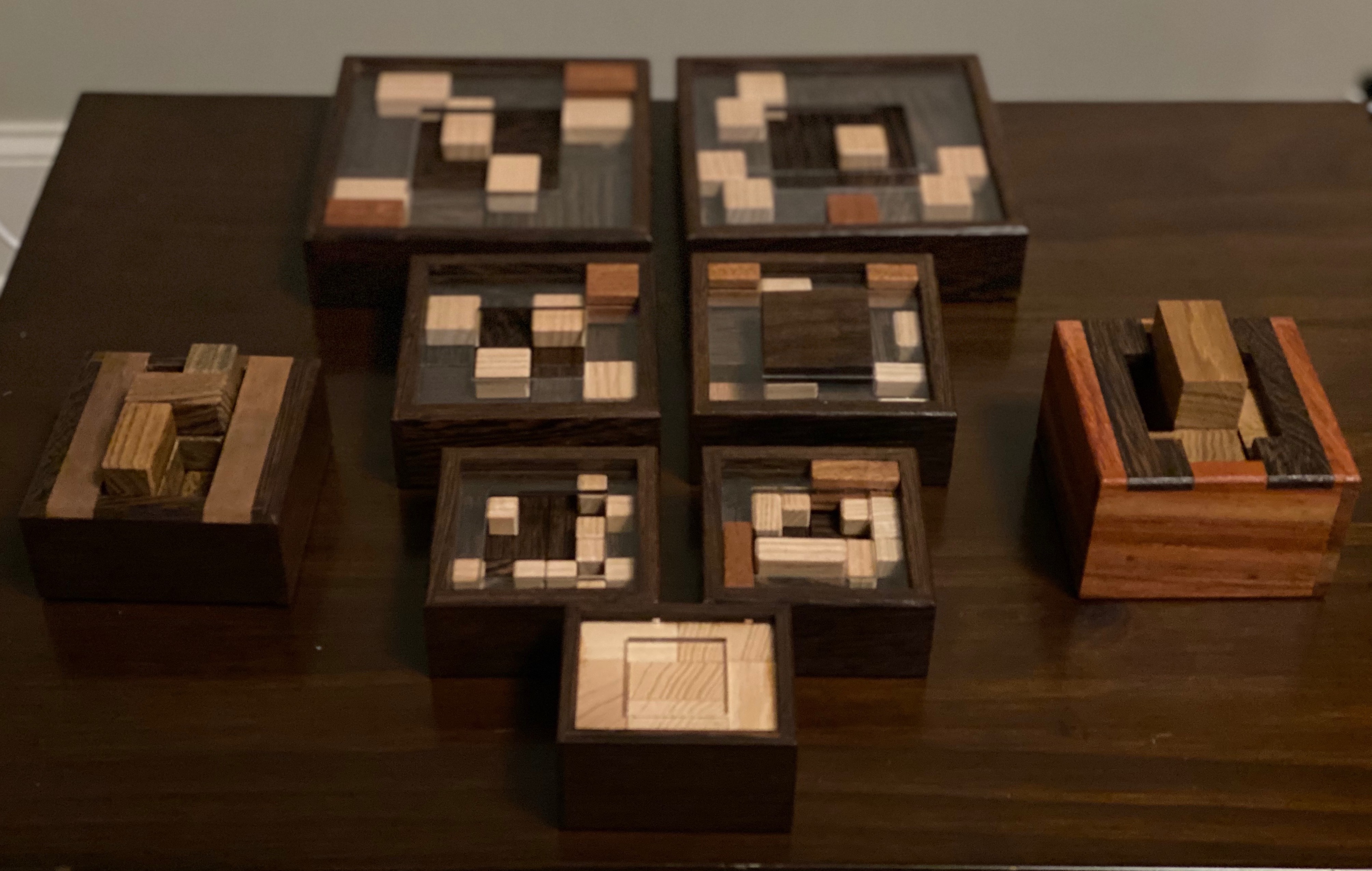
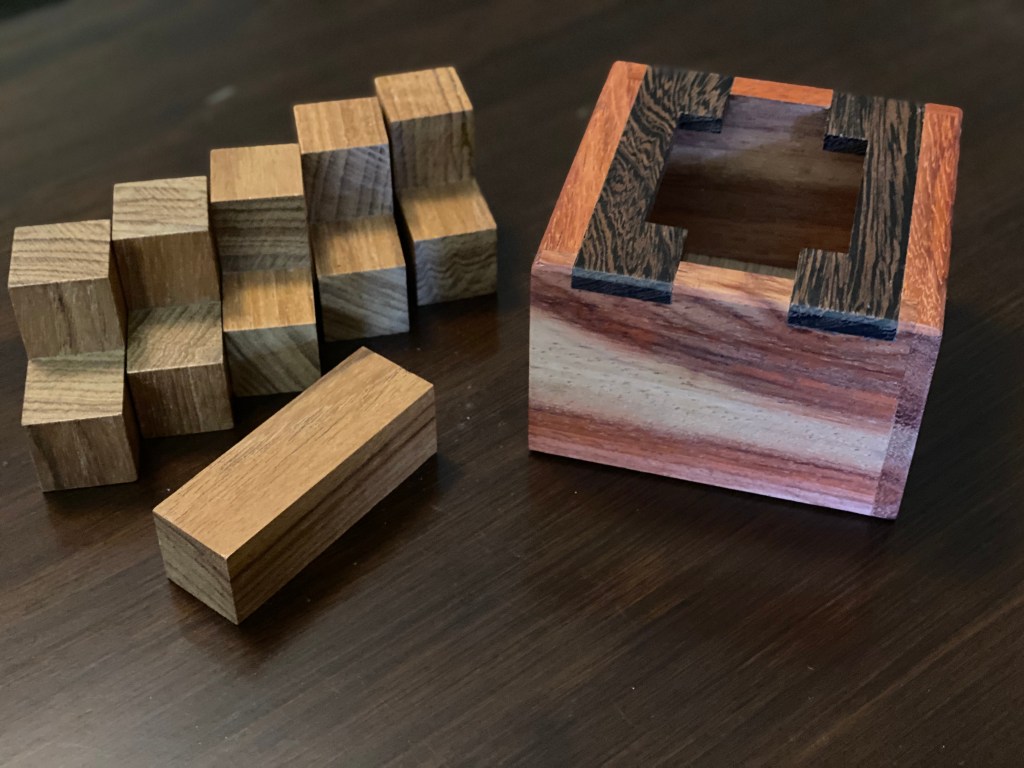
Some puzzles push out into their own territory, their movements and solution sitting somewhere amidst or between those that already exist. Yavuz Demirhan’s Squary Pack series is a great example of such a design: they are 2D/3D packing sliders that require you to navigate four dual-leveled pieces through a restricted one-piece-size opening at the center of the space to cover the bottom of the square box. The pieces are all flat-bottomed, with various voxels of different dimensions further complicating the solution, requiring you to slide your pieces around as you attempt to find a way to insert whichever piece needs to go in last; some of the series are further encumbered by blocks affixed to the box. You need to get all pieces in with the blocks facing up and you will find varying degrees of difficulty identifying where and when in the dance of pieces you can insert the final pieces.

The result can be quite tricky and is most definitely fun. I initially got #2 and 4 (knowing as I did that I would almost certainly end up wishing I had just gotten them all – my recent delivery of #1, 5, 7, and 8 shows I was most definitely right in thinking I had been wrong). My first impression was that they are quite attractive looking puzzles: his work is always wonderful looking and these are no exception. Dark wenge boxes with a reddish sappeli for those with blocks attached, which cover one of the two levels and protrude above the acrylic top for half that height. The pieces match the boxes with the same wenge contrasted by light ash blocks atop them. On the bottom of the box he has his logo/initials engraved above the name and # of the puzzle. Interestingly, they range considerably in the square’s dimensions (while all sharing a height of 3.5 cm): 1 & 2 are 7.5 cm, 3-5 are 9.5 cm, 6 is 11.5 cm, and 7 & 8 are 13.5 cm (ranging in price for a reasonable $30 – $50 depending on size). I’m happy to say that Yavuz is designing additional Packs, extending the series to (at least, I believe) 15.

Sitting down with the Packs, it took a minute to orient myself to what exactly I needed to do – initially, I solved my first two incorrectly by placing one of the pieces upside down (which was itself a non-trivial solve). I later learned that this was not correct and proceeded to attempt to (re)solve them correctly. It is necessary to find a way to get three of the pieces into the Pack such that there remains room for the 4th to be inserted and slid into the existing space – oftentimes requiring that the remaining pieces dance around before this becomes possible. This is complicated further in those Packs that contain internal pieces blocking the way. Each solution is unique and while these puzzles share a pleasantly consistent aesthetic, they are quite diverse. They range in difficulty: all the feedback I have heard from our fellow puzzlers has been most definitely positive, although some have felt that a couple of them were a bit easy. Regardless, I found them all to be challenging, with some being quite difficult (particularly #2 & 4). The coming versions are apparently a further step up in difficulty, and I look forward to getting them once available.

Yavuz has been making puzzles for a while and has a LOT more interlocking and packing puzzle designs out there (he has a few hundred on PWBP); while he produces his own works from time to time, it is not at all uncommon to find his works included in the puzzle releases of others (including one design set to come out in this week’s CubicDissection release). While I have a few of his designs that were made by other puzzle-makers, I also have the pleasure of owning a few more that he made himself – also 3D packing puzzles with restricted openings. His work is all wonderfully precise, using quality woods that look and feel great.

Quadro

Quadro is a small-ish puzzle whose wooden box and acrylic top share an aesthetic with the Squary Packs (the puzzle’s name also etched into the bottom). It consists of 6 identical squares that must fill a rectangular box – while not interlocking, the solution will require a rather delicate dance to allow you the chance to drop that last block in with the satisfaction the comes with finally filling this up with those. This is one of those puzzles that is more complicated than it looks without being something insurmountable – I still managed to go in circles for quite a while, even asking other puzzlers if perhaps there was a “trick” that I was missing. Eventually I actually stopped and tried that thinking thing I’ve heard so much about, soon managing to find the right moves (leaving me wondering how I had managed to do everything but the one thing that would work).

Snake Pit

Snake Pit eschews the acrylic top for an attractive mix of light and dark woods with an opening that runs the length of the puzzle and is 1/2 as wide, leaving one voxel on either side. There are 4 pairs of mirrored pieces that must find their way inside for a fun solution that was just the right level of difficulty for me.

Mushkila

Mushkila is my newest acquisition, having received it along with my second order of Squary Packs. It uses a beautiful mix of woods with lovely grain patterns that play nicely with the mix of red and dark and light brown. Interestingly, the opening is not a regular shape: it runs the length of the box (similar to Snake Pit) to allow the single rectangular piece to go in and also adds a square cut-out to allow the five angled pieces to go in at any orientation. This gives it a bit of a deco look, which meshes well with his choice of woods. I have yet to solve it, but having spent a little bit of time on it, it is clearly a non-trivial solution that should provide a fun solve while looking great on my shelf.

All of these packing puzzles share a simplicity and elegance, both in terms of their aesthetic as well as their movement – I highly recommend following Yavuz’s Etsy page as I know that any time Yavuz has something available, I will happily say “yes, please” to whatever it is, sight unseen


Fun Grade: 5 Sinatras

Difficulty Grade: 3 to 4 Sinatras

Another Day, Not Just Another Drawer

Unlocked Drawer

Kathleen Malcolmson and Perry McDaniel, 2.5″ x 2.5″ x 1.6″

A few weeks ago, I reached out to a fellow puzzler on the social media site that shall not be named who, so I had heard, might be looking to let go of a few puzzles from his rather immense collection. After a bit of back and forth in which I listed out a number of names of makers and designers whose works are generally a bit difficult to find, he let me know that he did indeed have a couple boxes by none other than Kathleen Malcolmson. I have admired her boxes from afar but never before had the chance to get one (at least not for anything resembling a reasonable price). Not only was this a box made by her, but it was designed in collaboration with another hard-to-obtain designer, Perry McDaniel. The story goes that she had been working on the design for some years, unable to get it just right until Perry chimed in with a needed final touch that would allow her to produce it as envisioned.

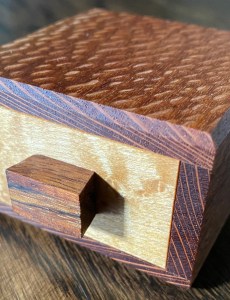
Unlocked Drawer is a relatively small box, consisting of just a drawer in a frame. It is beautifully made of contrasting lacewood and primavera, an aesthetic that is pretty consistent across her creations, at least as far as I can tell. Upon receiving it, I quickly found that its secrets were well-hidden: other than a bit of noise to be heard when shaken (presumably the Texas quarter to be found inside), the seams visible from the front do not permit any movement and no other breaks could be seen.

And that’s it! Fabulously frustrating in its simplicity and elegance, it would take me quite a bit of poking prodding pushing and pulling over the course of several days before a genuine aha that startled me with its sudden appearance. I love a moment like this: it is the reason many of us puzzle and we spend quite a bit of time chasing the feeling which is well represented in this little box. Closing it, there remains no indication of the solution, which I of course had to repeat several times since solving solely to revel in its gracefully hidden presence. A close relative of the box (Three-Layered Dovetail) was recently available at a Haubrich Auction, and was claimed by a puzzling French friend of mine, with whom I would not wish to engage in a bidding war – hopefully, I will be able to find a copy of my own, and/or any other Malcolmson boxes (particularly perhaps its predecessor, Locked Drawer, designed by Robert Sandfield). It more than lived up to the hype in its beauty, craftsmanship, and deviousness.


Elegance Grade: 5 Sinatras

Difficulty Grade: 4.5 Sinatras

A Puzzle with a View

Ansel

PuzzledWolf, Walnut

The Silver Age of Puzzling is surely upon us; perhaps Puzzle Renaissance is more accurate. The Golden Age would be that time a decade or two in the past when mechanical puzzles began showing up more and more, with amazing makers making amazing puzzles, almost all of which are now unicorns. However, the puzzle world was perhaps more limited: fewer makers, fewer collectors, fewer puzzles, fewer dollars……

With YouTubers encouraging a growing awareness of mechanical puzzles, an increasing number of people are being drawn into the puzzling world – the initial interest fostered by the growing presence on Reddit and (of course) Discord (go team!). This has brought more makers out of the woodwork (sorry) as the demand for new and unique puzzles grows:

Cue PuzzledWolf, busting out with Ansel: The List (LIST!!!) was born in May with shipping and public sale soon starting in June (2020). (There are plans for additional releases at the time of this writing, with a likely hiatus to allow for the development of future puzzles)

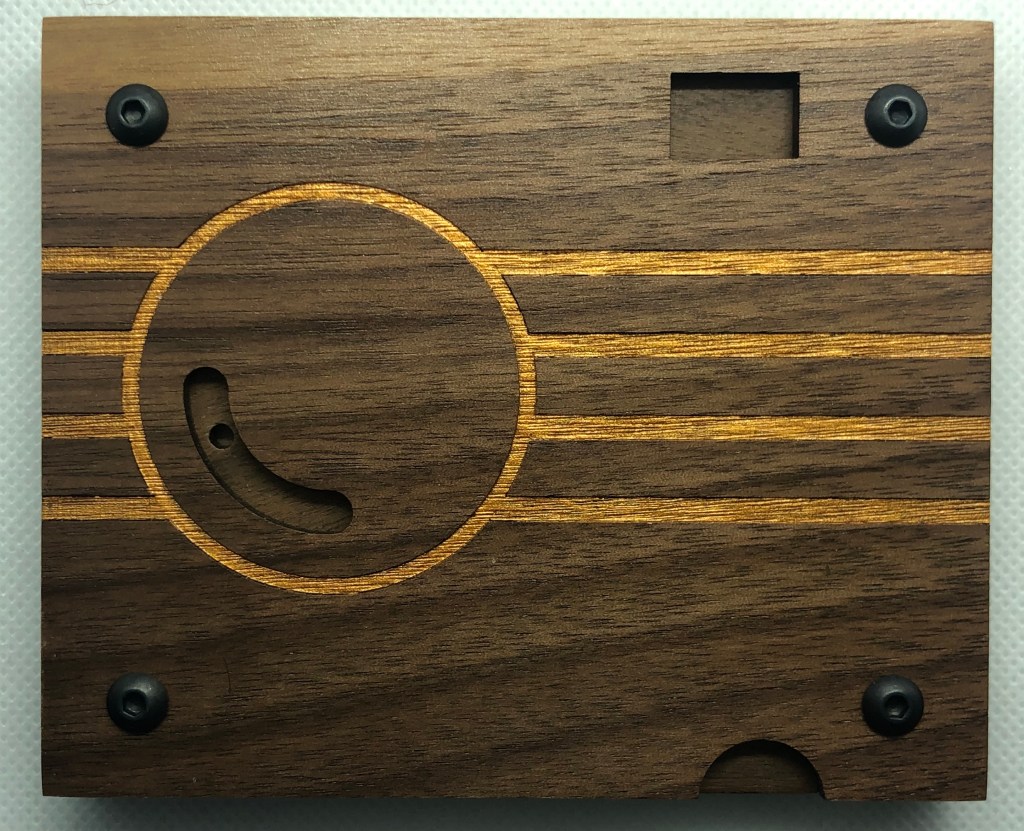
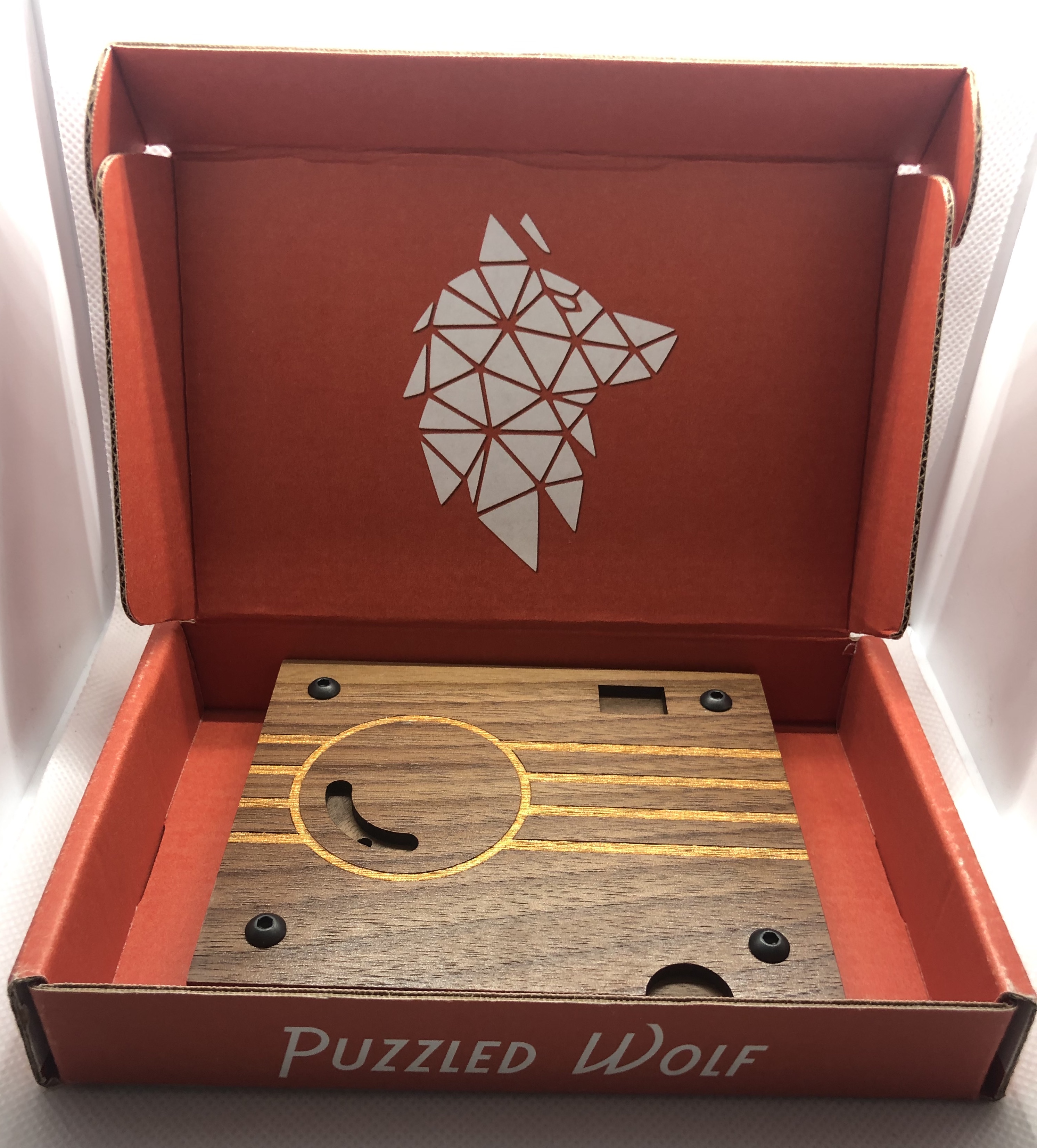
Ansel itself is a wooden rectangle with a relatively slight depth, its appearance a line-drawing take on a classic camera (and we can now understand its name). The puzzle’s goal is extremely unique: the camera’s view-finder is stuck and we need to open it. This makes classifying it a bit tricky: its thematic journey has the feel of an SD take-apart but really the goal is the most puzzle-y of puzzle goals: move this bit of wood here to just a little bit over there! (A Puzzler can most definitely appreciate the joy of figuring out how to move a piece of wood a couple inches and doing so here is extremely satisfying)

I would be remiss if I did not reflect momentarily upon the puzzle’s presentation: PW pulled out all the stops, branded by an eye-catching color and distinct wolf mark adorning a custom box intentionally made with Ansel in mind.

Pretty much everyone I’ve heard speak of Ansel got stuck right off the bat, taking some time to find what is one of my favorite first steps in a while: I thought it was one thing or another and it turned out to be a totally different thing and even though I generally like being able to make a little bit of progress before getting stuck, the sneakiness of it makes me smile. The early struggle satisfyingly resolved, one can move on to a bit of study: patient observation mixed with trial and error as you work your way through the puzzle, which still has some surprises up its lens.

Resetting Ansel is relatively straightforward (following the obligatory photo of a pet or puzzle through its now-open viewfinder). I found myself fidgeting with it after solving it and have picked it up several times since to enjoy one moment in particular.

Ansel is quite original, very well-made, and offers really good puzzling at a great price point. It’s thematic and has an aesthetic that is readily recognizable as a puzzle while also being totally different from pretty much anything I’ve seen before. I look forward to PuzzledWolf’s (hopefully relatively imminent) follow-up to Ansel – a Washing Machine puzzle currently in development, which seems to maintain some aesthetic consistency with Ansel while also appearing totally unique, which is itself pretty cool (perhaps to be called the Alva after none other than Alva Fisher, the man sometimes considered to be the inventor of the electric washing machine, apparently unjustly but it sounds cool as a name and is quite wonderfully alliterative….. and yes, I had to look that up).


Originality and Presentation: Five Sinatras

Difficulty: Four Sinatras

Midcentury American Photography Signification: One Adams


Deez (boxes are) Nuts

Space Case

Dee Dixon, Canarywood and Bloodwood, 5.5″ x 4.25″ x 2.25″

Dee Dixon burst onto the puzzle scene in 2019, and his 4th box, Space Case, is set to be released on CubicDissection in August. He made a huge splash with Where’s My Hammer? (WMH), a great puzzle box that has been pretty much loved by everyone who has gotten their hands on one, and proved he was no one-hit-wonder with his follow-up box, Blinded II.

I am fortunate enough to have an early (Etsy) copy of both WMH and Blinded, the woods or designs of which are a bit different from what was ultimately released on CD (WMH in particular had a few more rectangular bits of exotic wood on top and were made out of different woods for a unique, semi-custom appearance). Fortunately, their amply attractive aesthetics could well accommodate the slight concessions made for the sake of getting them into the hands of more puzzlers.

Dee’s first box, Slideways, was made in 2019 – there are not many established makers who can come out with four solid puzzle box designs in less than two years. With this kind of prolificity, it makes sense that he was able to start working on puzzles full-time, much to our collective benefit. There were only 8 copies of Slideways released (one of which sits happily among its siblings on my shelf) – it is a beautiful box, purple with some asymmetric strips of yellow wood (canarywood, maybe?) on top. While the simplest of his designs (just 2 or 3 steps), the concept is well-executed and shows Dee’s nascent puzzle-designing chops.

WMH is an especially excellent puzzle: it has plenty of misdirection, tools, and a tempo that I love to find in a box, with some relatively quick success at first, followed by fits and starts until you have found everything there is to find at which point you must actually think before you can hope to solve! The last step took me a few weeks of letting my subconscious work on it before I awoke one morning and somehow just knew the solution (admittedly following some conversations about it that had helped me eliminate some wrong moves) – I went upstairs, grabbed it, and bam! it worked! Super satisfying and very fun to re-solve. All in all one of my favorite puzzles boxes (although it does have one middle step that uses a mechanism I don’t love and may cause some puzzlers to need a nudge to find).

Blinded II is another excellent and attractive box and shares some similarities with WMH: there are misdirections that left me spinning my wheels for longer than I’d care to admit. With the first two or three steps finally found, it was not too much longer until I worked out the last half of the solution.

However, this is (supposed to be) about his newest release, Space Case, a canarywood box with a bloodwood figure on three of its sides: an alien head, a rocket, and a flying saucer with a tractor beam. Some of these figures will move off the bat; I don’t think I am giving anything away by saying that some will spin freely….. at first (in fact, this is the state in which I believe you can know it is fully reset).

I managed to get an early copy prior to its upcoming release – it is a 10-12 step puzzle box that requires close and careful observation to solve. You will need to develop an understanding of what is happening inside before you will have much hope of opening it.

Trial and error will help at first – if you’re not paying attention you may start to think that this is a blind solve but there is plenty of feedback inside and outside the box to let you know when things are happening. It quickly becomes apparent that manically shaking the box isn’t going to get it open. Instead, with some patience and focus, you will begin to get a picture of what is happening, helping you to build up a mental blueprint of each successive step until you can finally get it open.

Once open you will be rewarded with some clarity and it may yet take several resets to fully grok how it all works. This only adds to the fun as you can continue to work on the puzzle even after opening it – the full solution means making sure that each step is understood in detail, allowing you to open it quickly thereafter. Space is quite different from his previous boxes and highlights Dee’s ability to approach a puzzle box in different ways – while it is different in its mechanisms, it still features the practical attention to detail that makes his puzzles work reliably. As with all his designs, it has a wonderful aesthetic, using contrasting woods to create an excellent look. It also adds a bit of whimsy and fun to your collection that looks great on display.

I should add that I have the pleasure of possessing a copy of a metal prototype of Space Case (I pun – it has the Metallica “M” etched into its wonderfully dark wood). As it remains unsolved, I am not yet certain as to how it differs from the final version – I am not sure of whatever steps diverge from its improved offspring, but as a completist I’m grateful to have lucked out to get it from a fellow puzzler.

I look forward to whatever Dee comes up with next – we are fortunate that the appetite we puzzlers share has allowed him to eschew his workaday life to focus on what is really important: giving me more puzzles (us, I meant us: giving US more puzzles).


Space Case Difficulty Grade: Four Sinatras

Complete Oeuvre Grade: Five Sinatras

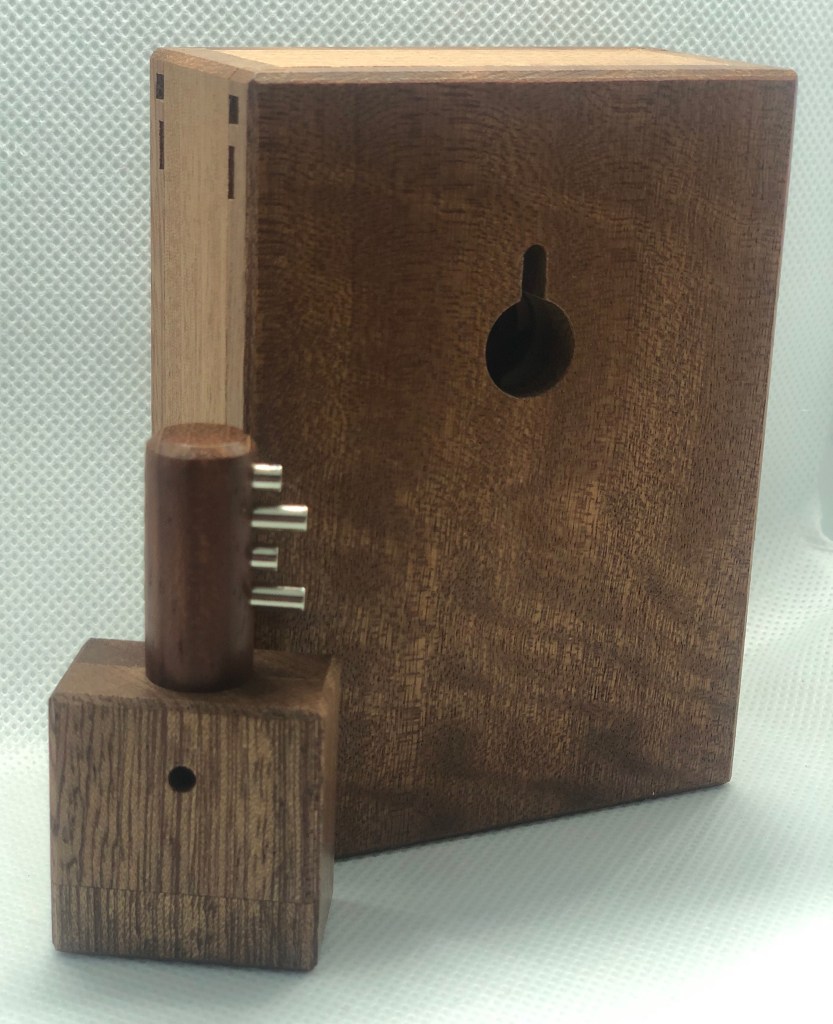
Locked Out: Lock Box by Eric Fuller

Lock Box

Eric Fuller, Figured Quartersawn Sapele 3″ x 4″ x 1.45″ Box, 2.45″ x 1.25″ x 0.75″ Key 133 Copies

I have a tendency to write about puzzles that may not be easy to obtain – I enjoy reading about such pieces, that I might live vicariously through the vague reminiscences of puzzlers more fortunate than I, adding to my ever-expanding list of unicorns and future lost auctions.

This is also due to the simple fact that great puzzles sell quickly. In a bout of good fortune, Eric Fuller’s Lock Box will again be available in limited quantities on CubicDissection.com in late July (2020). Personally, I need only hear Eric Fuller + Puzzle Box to anxiously wait to give him my money, but if you are unsure, my suggestion is: buy it. If you cannot afford it (at $450 it ain’t cheap), sell some other puzzles and then buy it. In the unlikely event you do not like it, there will be plenty of people happy to take it off your hands; I believe it is destined to be yet another unicorn with auction prices that get bonkers fast.

At first glance, we have a key and a box with a keyhole; so far we have more to go on than the T12 initially shows. Unsurprisingly, after dutifully inserting the key (because you’ve got to try, right?), you will find it will not get you very far. And that’s it.

Before too long, I had my first aha. Followed by a few more. Followed by a wall. And more wall. Then another aha. More wall. Aha. Wall. Wall. Think, plan, take notes. Wall. Aha? Hm, no: Wall……… and here I am: a pretty good understanding of the wall I am facing, with no idea how to get past it. I have made good progress, with the end somewhere in sight and I can confidently say this will be very satisfying when that final aha has been found.

The puzzle has so many of the things I love in a box (some of which I will not say): things that look they should work that don’t; a bit of progress that may not come right away, but before too long; a series of stops and gos, extending the pleasure of solving across a spread of mini-solves; the ability to make progress during my first, focused session; the inability to fully solve it during that same session; the need for both trial and error as well as actual thinking; pretty, pretty wood; and while it has some similarities with other great puzzles, it is mostly very unique.

Everything works well and consistently, which is always nice (and is not always the case even with some excellent puzzles). And did I say that it is pretty? The instructions do warn that this will not stand up to humidity well – we are advised to keep it between 40% and 60% lest it be ruined (!), so some folks may be facing a dilemma (I’m looking at you my Hawaiian puzzling friends).

I expect that the final step (or steps) will be something quite different from what has worked thus far: this is something many of Eric’s puzzles feature; were it not the case, I probably would have found it (them?) already, after all. It took me a while to determine how to get to my current stopping point reliably and with full comprehension but this final wall may be staring me in the face for some time.

But man, this reminds me of why I love puzzle boxes.


Puzzle Oddity: Anti-Gravity Box by Frederic Boucher

Anti-Gravity Box

Frederic Boucher, 3D Packing Puzzle, 2.25″ x 2.25″ x 1.5″

A few months ago, I wrote to Frederic in the hopes that he might happen to have a few puzzles that were seemingly unavailable. Most were, but he did happen to have a last copy of Anti-Gravity Box, which I happily requested, along with a few other new puzzles that he had on hand.

March 2022 Update: CubicDissection will be releasing a new version of AGB (titled: “Anti-Gravity Box+”) in it’s upcoming March 21, 2022 release – not only will this feature the ever-awesome craftsmanship and woods CD is deservedly known for, but, according to Frederic: “This new version includes a 2nd set of pieces with a solution that includes a trick that I think has never been seen in any other design yet…” This presumably constitutes the + in CD’s AGB+. So get your clicky finger ready as I don’t expect that these will last long: (EF + FB)CD = Awesome Sauce!

I have solved several of Frederic’s puzzles in the past – 3D and 2D packing puzzles that offer a serious challenge, comparable to pieces by Osanori Yamamoto, Koichi Miura, and Volker Latussek, and featuring elements such as interlocking elements and restricted openings.

Anti-Gravity, however, adds new mechanics by introducing a number of magnets into the mix. This makes for a unique and novel puzzling experience; it is no longer “just” about finding a way to get the pieces into their frame, as the magnets throw one’s general approach out the window.

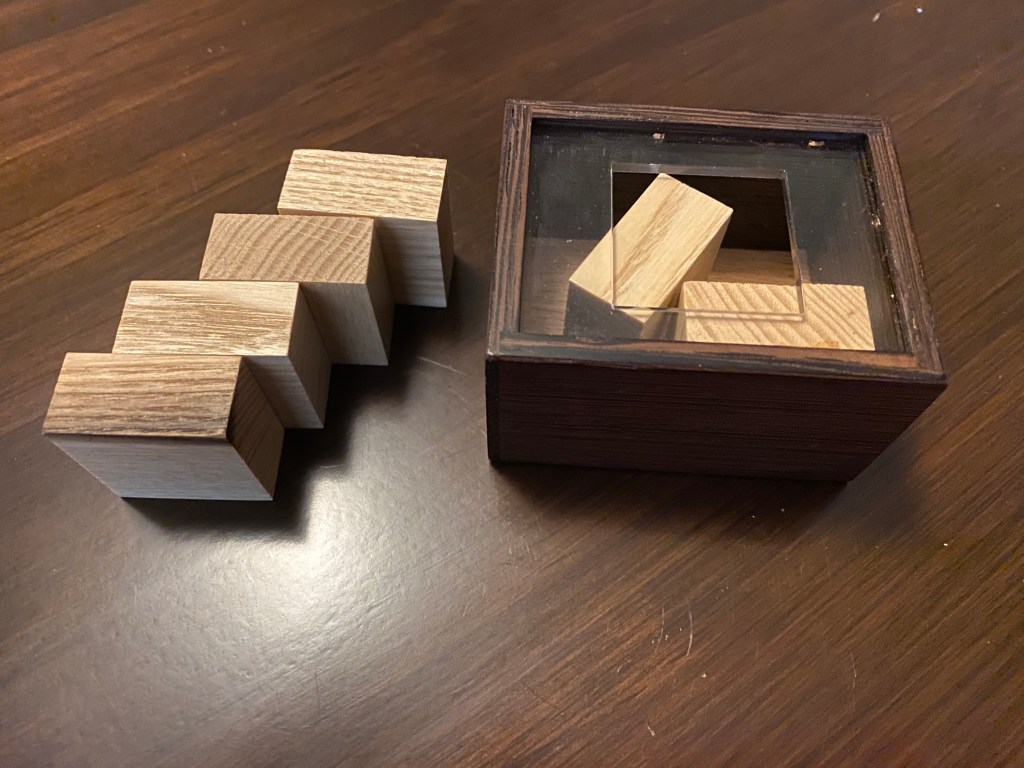
The box is a 3×2 voxel frame that features a removable, acrylic top, allowing you to easily reset the puzzle and view your progress. The box has two, single voxel openings at 90 degrees to one another; both are in the middle of the bottom level, allowing you to enter each axis, but offering no room for angles of any kind. You must fill it with 6 identical rectangular 3×1 blocks; 2 have two magnets on one side, 3 have magnets on one end, and one block has none.

There are rules, of course: you need to place it on a flat surface and you are not meant to pick it up or tilt it (of course, you may hold it while you insert other pieces); you cannot poke your finger into either of the openings to push the pieces; it goes without saying that you cannot just lift off the top and place them in. The removable top is a kind addition, as it avoids the need to struggle to remove pieces when you have eventually found you had made a mistake. The puzzle arrived with the pieces stacked neatly inside. It is kind of cool to have a puzzle so confident in its structure, that it can come fully solved without having spoiled anything.

While by no means simple, neither is it an overly difficult puzzle – in my experience, one of his other packing puzzles was more challenge than I could meet (I am admittedly not so great at packing or interlocking puzzles generally – my interest far exceeds my ability when it comes to these types of puzzles).

More importantly, this is a very fun puzzle, and one with which trial and error will not get you very far; knowing the pieces you can eventually figure your way through it.. After spending a few minutes playing with it, experimenting to get to know the pieces and what they can and can’t easily do, I had to stop and think. This led to the first big aha moment of a series of such moments, leading to the full solution. Each step is its own planned approach, each piece requires forethought once a workable order has been determined. Apparently, this has two approaches that lead to similar solutions; I have found one and will undoubtedly spend some more time to find the second.

TL;DR: Anti-Gravity Box by Frederic Boucher is an original approach to a 3D packing puzzle, with magnetic pieces needing to be stacked using entries that allow for little margin of error. While not Boucher’s hardest puzzle, each move must be planned and purposeful through thoughtful approach and not just trial and error. It features a convenient removable top to reset after you inevitably make a mistake, and is so confident in its own puzzling, that it can arrive solved without lessening its challenge.


Originality / Fun Grade: 4 and a Half Sinatras

Difficulty Grade: 3 and a Half Sinatras

Instructions Included

Dr. PinkLady, or How I Learned to Stop Fidgeting and Solve the Burr

Fidget Burr (a/k/a Dollar Burr, a/k/a Chin Burr)

Jerry McFarland, 3.28″ x 3.28″ x 2.92″

Recently, I was lucky enough to get a copy of Jerry McFarland’s Fidget Burr (not to be confused with the puzzle of the same name designed by Tim Alkema and recently produced by Eric. Fuller of CubicDissection). It has quickly become one of my all-time favorite puzzles, with an extremely original design replete with fun and challenging nuances.

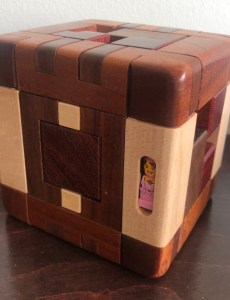
First off, the puzzle is beautiful, consisting of 23 wood pieces crafted from walnut, maple, mahogany, and bloodwood (with the keypiece possibly made in a different exotic wood, such as Bubinga, Santos Rosewood or Cocobolo), for a interestingly contrasting aesthetic. It feels soft, presumably waxed into a delightful sheen that allows the puzzle to stand out, adding to the temptation to play and fidget beyond one’s attempts at finding the solution.

But what really makes it stand out is the addition of 22 magnets integrated into the puzzle, adding layers of novelty, difficulty, and stability that makes it stand out from its (still excellent) burr cube brethren. And last but not least, a Lego minifig can be seen, trapped within a window on one piece of the puzzle’s frame, lending the puzzle a hint of puzzle box / take-apart puzzling.


NOTE: The following paragraph reveals details of the puzzle’s first move – I feel comfortable writing about it as this has been blogged about before and is not really a hidden feature of the puzzle, but for those purists out there who want to know absolutely nothing about a puzzle, I thought I would give you fair warning – it has been formatted to make it easy enough to skip:

iIt is readily apparent which piece offers the first move (being the only piece that can move) and, when you press it, you are rewarded with a chain of clacking, automatic movements as 4 pieces are released, magnets forcing them out. This chain will most certainly be repeated again and again, both in the search of its solution, as well as the sheer entertainment value.


Following this first step, I immediately hit a wall. Fortunately, this first step is more than fun enough to play with absent any further progress. However, after numerous attempts at exploring possibilities through trial and error, I explored that other method of puzzle solving: thought. With this, I was able to narrow down the possible next steps, more quickly finding my way past this wall. Soon, it is possible to remove some pieces of the puzzle.

However, this is not the end as one must deal with some (possibly less difficult, but still non-trivial) additional steps, revealing the reason for at least one of the puzzle’s aliases. As you continue through the puzzle, you find a number of added details, magnets, chamfers, clips, and pins that really show off Jerry’s expertise, as they allow for a more consistent and stable puzzling experience (these are detailed in the included instructions in a series of notes, which would be spoilers if shared). One such detail does double duty, causing me several minutes of confusion as I lost all momentum just as I thought I was about to free my Pink Lady. Moving past this, the lovely lady can be freed (and even her window frame reveals evidence of Jerry’s thoughtful and precise approach to puzzle-making, as it is designed in such a way as to make her intended orientation obvious when looking to cruelly force her back into her wooden prison).

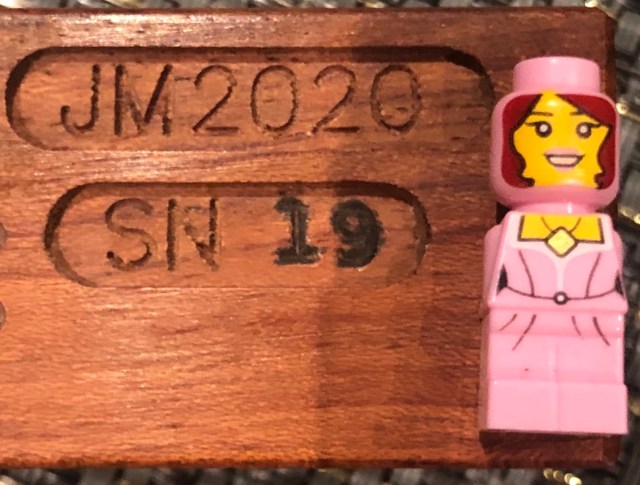
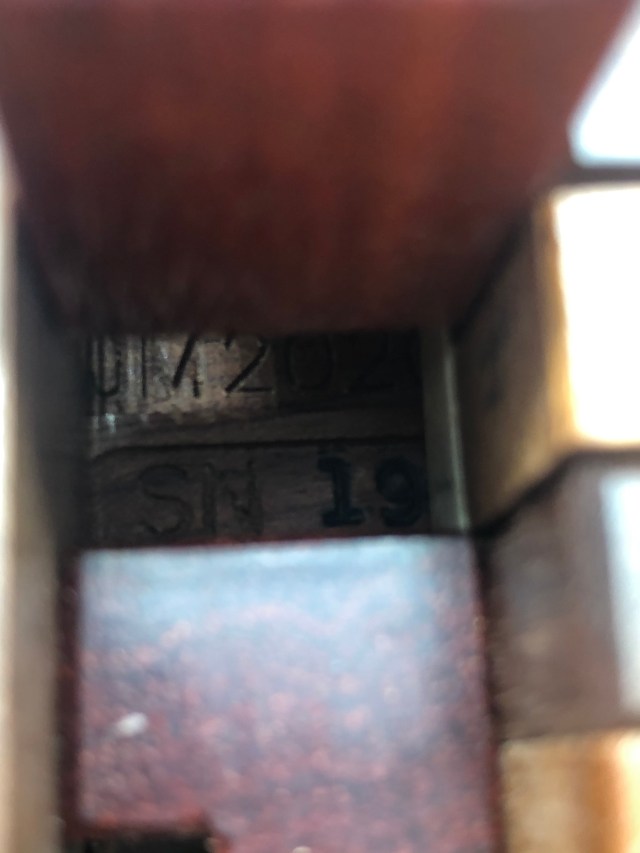
The key piece has the puzzle’s “signature,” the maker’s initials, year of creation, and serial number etched into perfectly matched frames (as seen above).

Note that this picture is also no spoiler, as Jerry designed the puzzle such that one can view the signature without having solved the puzzle – yet another unique detail that demands appreciation.

Reassembly is not overly difficult: Jerry has thoughtfully marked some of the pieces to aid with the proper orientation, allowing you to reassemble the puzzle with pleasure rather than frustration. Burrtools is unnecessary, good considering my strong suspicion that it would not provide much (or perhaps any) assistance.

As mentioned, the puzzle comes with instructions and notes: 5 pages that includes solution descriptions assembly instructions with pictures and illustrations, as well as the aforementioned notes and a general explanation of the puzzle (the latter being graciously printed on the first page to avoid any accidental and unwanted spoilers).

Fidget Burr will be entered in the 2020 IPP40 Design competition, where I would be surprised if it did not earn some significant recognition. While 2020 seems it will be a banner year for puzzling, Fidget Burr will no doubt be amongst its top designs; it is certainly amongst my puzzle favorites overall (assuming my judgment is at all reliable), not least considering its atypical replay value.


Awesome Sauce Grade: Five Sinatras