Push It Real Good: Salt & Pepper

Salt & Pepper

Designed by Robert & Norman Sandfield and Perry McDaniel
Originally Produced in Wood by Perry McDaniel
Produced in Metal by Tartarus Puzzles

When I first heard rumblings of a possible Salt & Pepper remake, I was thrilled. These go back to the 2002 IPP, when Robert and Norman Sandfield each presented one of them as their exchange gift. I don’t want to spoil anything, but they represented a new kind of trick for exchange recipients getting them separately (they made sure everyone who got one, got the other) – I suppose it’s obvious now to those buying these as a set but it makes for a great story. Reading some of the old IPP stories helped hook me into puzzling ever further, so google at your own risk.

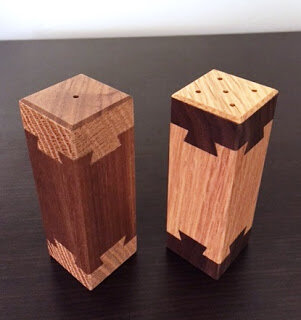
Originally produced in oak and walnut by Perry McDaniel and designed by the three of them, these are undoubtedly one of the best dovetail puzzles released by the team behind a number of them. Perry’s work is unquestionably badass and I have been drooling over these for years now. Finally getting my hands on them is a joy – I feel like I have a piece of IPP history that would otherwise cost an arm and a leg.

Some time back there was forged a new puzzle partnership called Tartarus Puzzles. They first released a metal version of Free Me 5 and are now releasing Salt & Pepper (also in metal). First, they look absolutely wonderful. I love the colors they chose and the letter font is perfect. Producing puzzles like this in metal is no easy task – in Perry’s words: “when they told me it would be an all metal construction I knew they were nuts… the difficult tolerances and razor sharp dovetail edges [meant] they were asking for trouble.” But Tartarus persevered, creating a custom made dovetail cutter to produce edges that will not shred your fingers, while looking exquisite. They even improved upon a step or two along the way, giving them more longevity. Perry contributed a solution sheet (with pictures) that is easy and clear (I checked it after solving, of course… mostly).

And the puzzling? This a sequential discovery experience with one section in particular that is just really really cool – I am still not sure how they accomplished it but it is sort of the heart of the puzzle. There are also compartments to find. which contain a rather amusing surprise for the finale.

Starting out, I futzed around, quickly finding that nothing does anything obvious. I suspected I knew what needed to be done and it took some doing but I doggone did it… and I was off. After moving through the next few steps, I got to the section referred to above, which took me a heckuva long time to solve. Finally making it through, I had a few tools and a suspicion of what needed to happen based on my earlier explorations.

When I finally got the last bit open, I was rewarded with a clear indication that I had solved the puzzle, an indication that was laugh out loud funny, always a great way to end a good puzzling experience. The reset was mostly straightforward: that one really tricky section took some trial and error to solve backwards and may help you better understand how this part works (I am still not sure 🙂
And so, Tartarus brings us a fun piece of IPP history without the need for a Thunderdome auction! Salt & Pepper is available at the time of this writing – you can reach Tartarus by emailing them at: tartaruspuzzles@gmail.com
Packing It In 5: A Good Day to Pack Hard

First, we had to 
Pack Hard.
Later, it was time to
Pack Harder.
The Puzzles resisted and we had to
Pack Hard with a Vengeance.
It still wasn’t enough and we asked ourselves if we should
Live Free or Park Hard
Finally, it’s a Good Day to Pack Hard

John McClane

Coin Wallet, Perfect Entrance, 3L x 2

Designed by Koichi Miura, Produced by Mine

Packing puzzles, as a genre, can be quite diverse. All the great artisans have produced great examples of this fact: Stephan Baumegger, Yavuz Demirhan, Tom Lensch, WoodWonders, PelikanPuzzleMaster has 173 tray and 3D packers right now and NothingYetDesigns is an excellent curator of both 2D and 3D packers. RobsPuzzlePage is still loading all of its numerous examples 🙂

There are a number of designers whose names have been or should be written on these pages – I think even Osanori Yamamoto may have somehow managed to completely evade me thus far (except for a great(?) moment in my parody of Baby Got Back). Another that seems to have escaped my serious gaze thus far is Koichi Miura. Most of my puzzles by him have been beautifully produced by Mineyuki Uyematsu (MINE) and an excellent trio of puzzles recently added to my collection serve as great examples.

Coin Wallet, 3L x 2, and Perfect Entrance

Coin Wallet

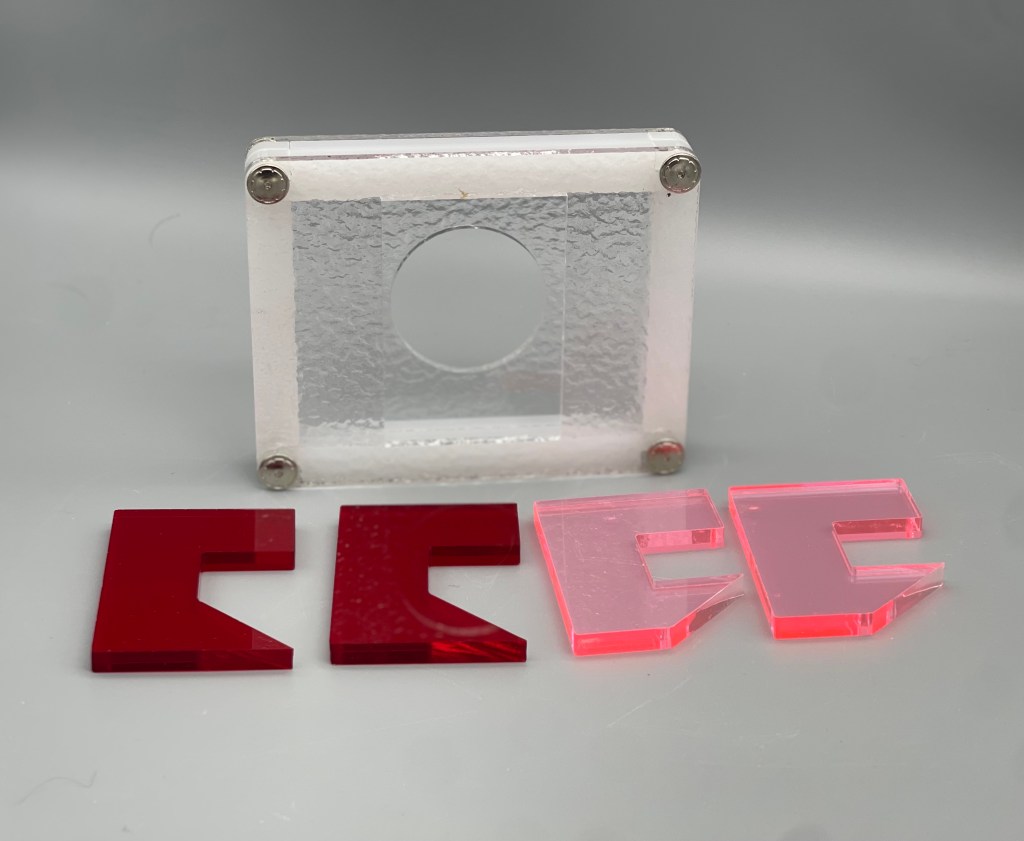
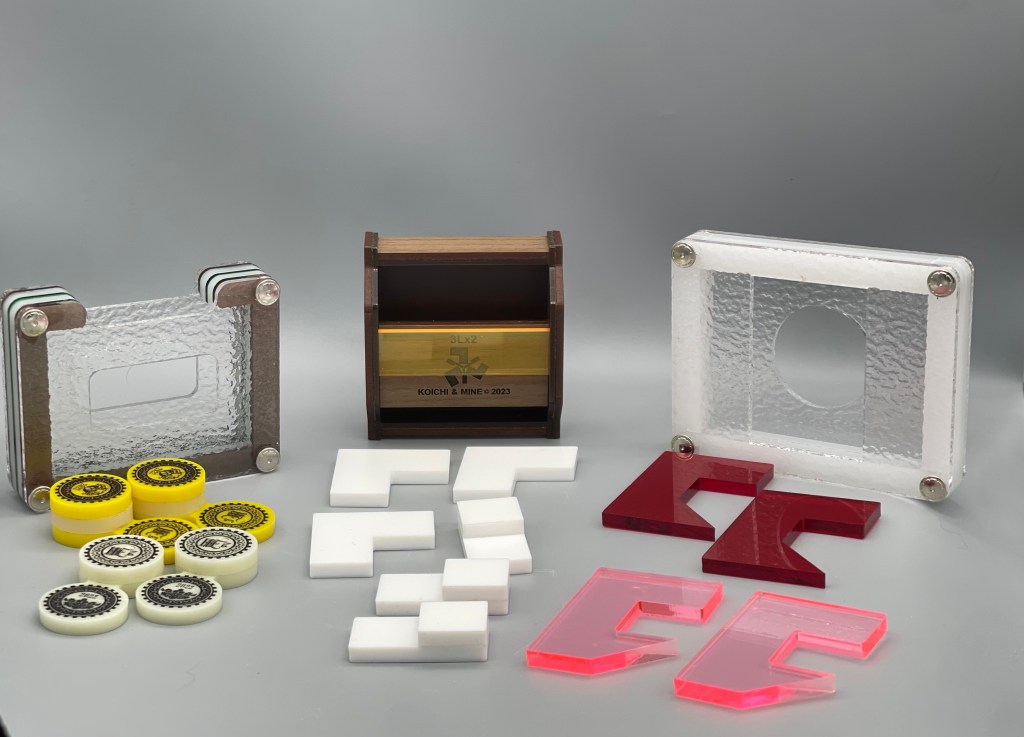
Coin Wallet is a restricted entry 3D packer that consists of 5 multi-coin pieces and a “wallet” in which to place them with a restricted opening at the top. MINE has done an excellent job of producing the coins, apparently not such an easy job to do: there are three layers of “coins” inside and the yellow pieces are 3 and 1 vs. the white’s 2 and 1. Placing any three coins inside is trivial but that fourth one….. it seems like it should be easy but, as with many a good packing puzzle, it just isn’t.

After a good amount of trial and error, getting to know the pieces and what allows what, I began to get a sense of how these would fit together and what needs to happen to allow them to do it. Still, the temptation to try and force the pieces kept rearing its ugly head until I stepped back and really thought about how this will work. That’s a big part of a good packing design imo – logic and reason will ultimately win out over trial and error, getting you over the finish line after t&e gets you past almost all the hurdles.

There is something so satisfying about finding how that last piece goes in, ultimately smoothly and without any trouble or resistance, once it is done correctly, that is.

Perfect Entrance

Perfect Entrance’s has two sets of identical pieces with a frame that will allow any single piece easy access in its front entry. A finger hole in the back helps with removing the pieces, which you will likely do many times before successfully solving it. Again, getting three of the four pieces is simple but that fourth one…

I had originally solved this one at IPP41, where it had been entered into the puzzle competition. It was in the top-10 for the Puzzlers’ Award, earning universal praise as far as I could tell. Fortunately, my terrible memory meant that re-solving it was a non-trivial exercise when my own copy arrived a few weeks later.

Although it might seem that PE could perhaps be solved just through trial and error (there are only so many permutations that are possible), there is more going on than just order. Any anyway, that is both time-consuming and not all that fun – rather, stepping back after some experimentation it is possible to see how the second layer of pieces might be permitted entry. With an aha!, I saw how it must work and lo and behold that last piece was no problem at all; everything fits perfectly when you know what needs to be done. So very satisfying to feel that aha! become reality.

3L x 2

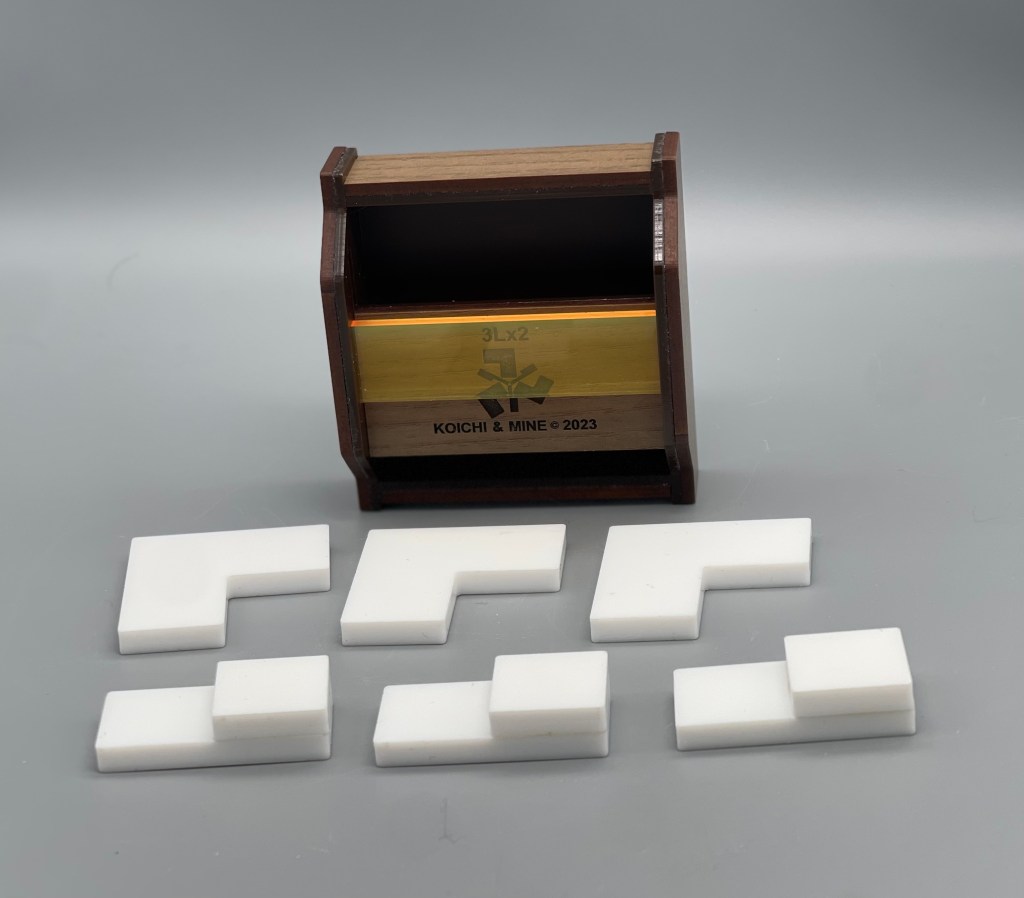
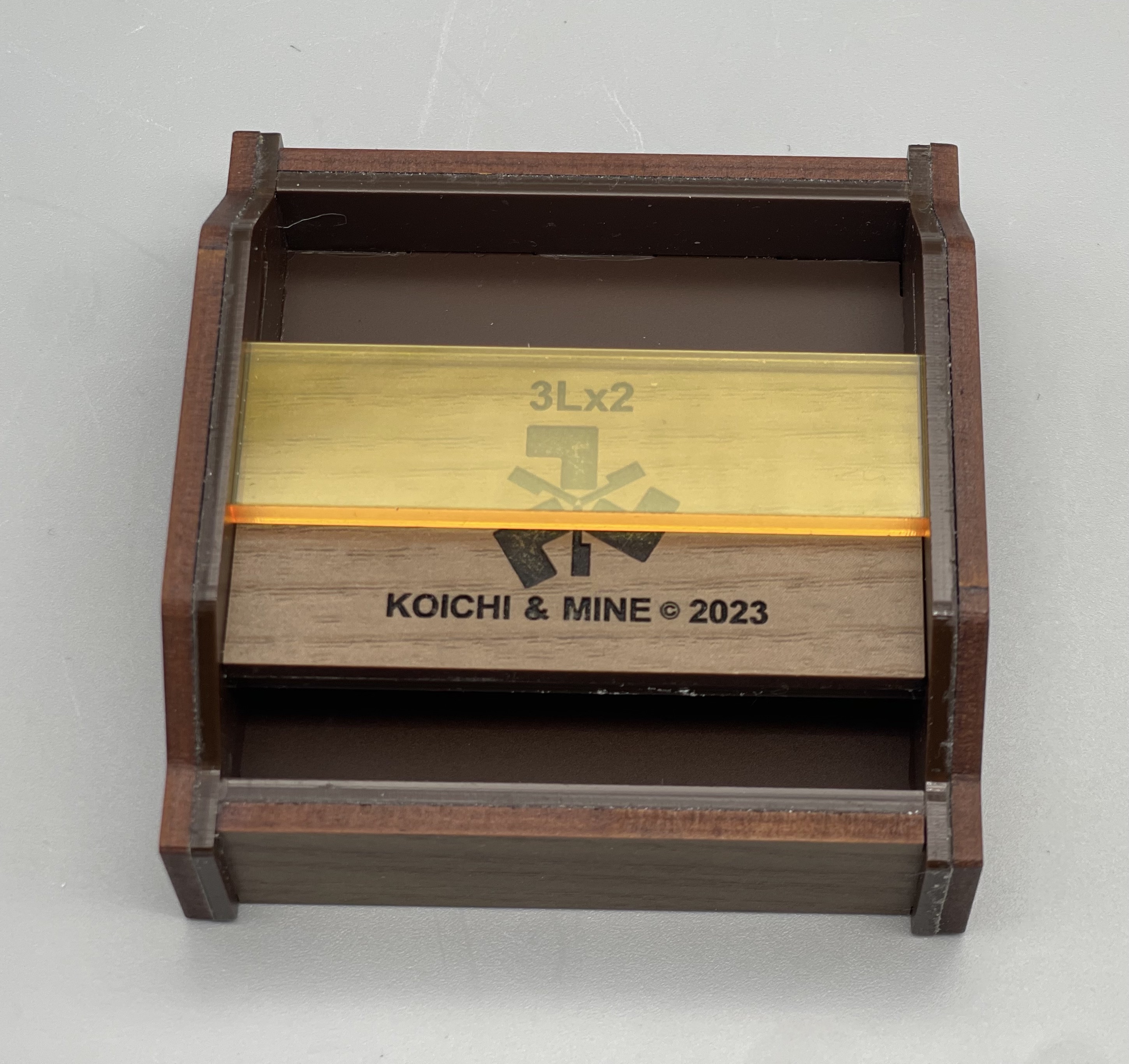
3L x 2 is another Miura/MINE puzzle, this time featuring two sets of three identical pieces that must fill a frame with a restricted entry – what really sets this apart is the moving panel that allows alternating entry into either side (but not both at the same time). This one took me much longer to solve; perhaps it was the extra pieces or the moving piece that slowed me down. Regardless, I would struggle with this one for quite a while, trying and failing a number of ideas after the experimentation phase ended.

I love packing puzzles with dynamic elements (see my still unsolved Everyday Holiday puzzles by Yavuz Demirhan) and 3L x 2’s sliding entry adds some intrigue to the puzzle, making for something particularly tricky. I spent a LOT of time on this one – there are a good number of possible builds but it becomes readily apparent that many of them will simply not be possible.

Dynamic Restricted Entry

Once I had a good sense of what would and wouldn’t work, I spent a long time trying different builds outside of the frame, attempting it inside when it seemed like I had a lead. Eventually one last aha! hit and I was able to get that last piece in! Huzzah!


Packing Puzzles are a great example of how something that seems so simple can pose a particularly problematic puzzling experience. Stay tuned as there might just be a day when we need to Pack Hardest (or something).


Apuzzle 13: Houston we had a problem here by Brian Young

Houston we had a problem here

Brian Young, 6″ x 3.25″ x 2.25″

Having (finally) made it to my first IPP this summer (after several years of hoping and waiting, I was overwhelmed by the wealth and general awesomeness of the puzzles showcased (as well as the puzzlers present). On the day of the party itself, I heard tell of a new Brian Young puzzle, possibly his last considering his announced retirement, and zipped on over, snagging one of the last copies of “Houston we had a problem here” from the legend himself (a welcoming and hilarious man).

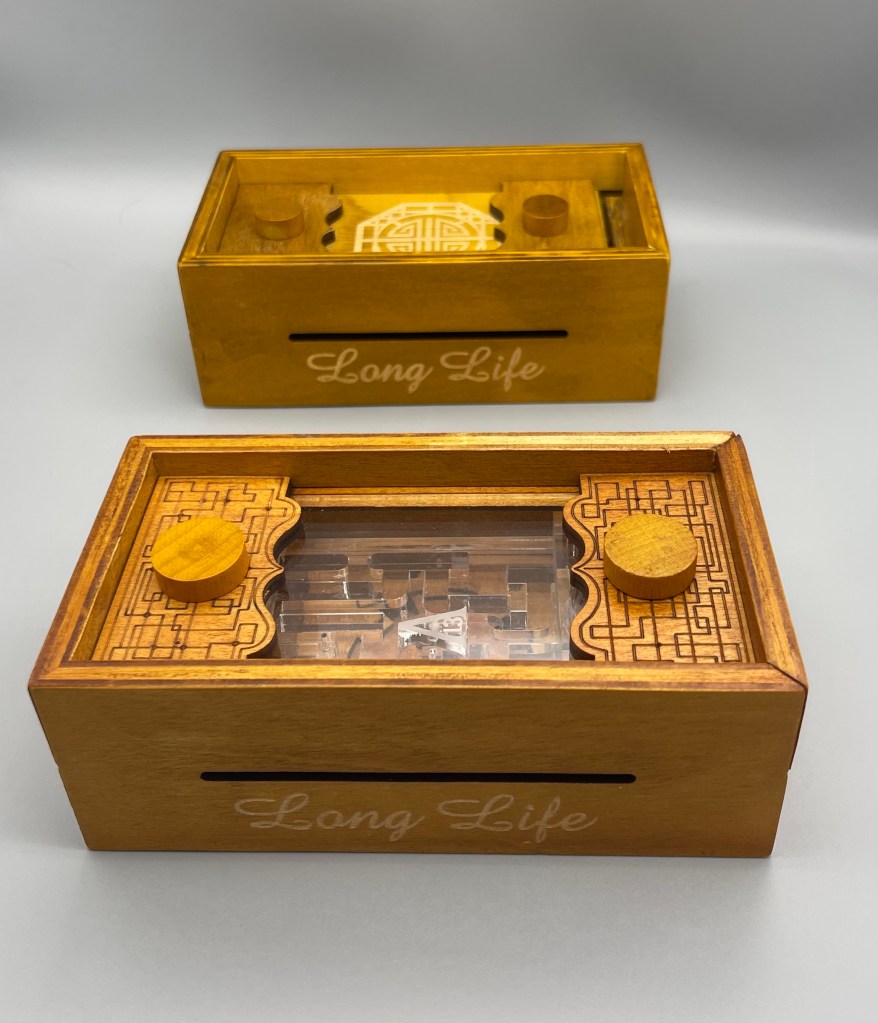
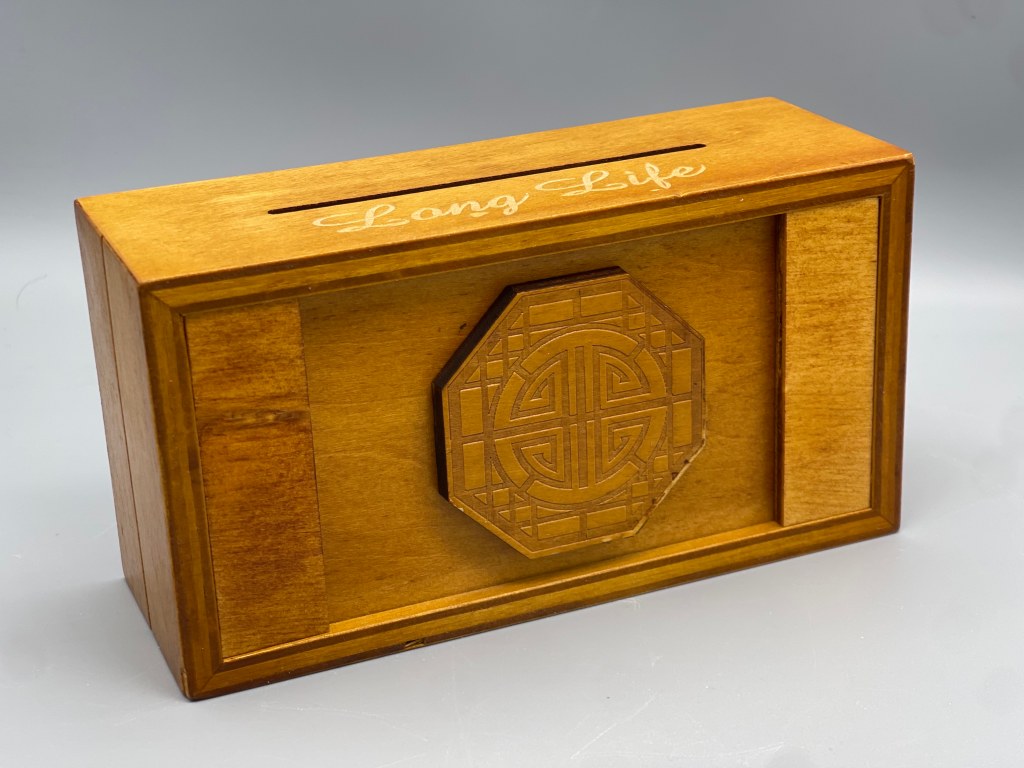
Houston is a very cool concept – Brian took the rather cheap, not so great “Long Life” puzzle box mass produced in China (I believe) by MiToys and modded it, turning it into an SD puzzle box! Yay! Needless to say, “WANT” was pounding in my head when I got to his table and picked up a copy. Houston takes the original puzzle and adds some engraving: the puzzle’s new name and some maze-like etchings are added to the original. The most obvious change is at the center of the box: an acrylic maze, at the center of which sits a ball bearing, stuck in place beneath an engraved “A 13” in honor of the infamous Apollo 13 mission from which the puzzle gets its name. The wood medallion on the bottom of the box rotates a few mm in either direction but does nothing helpful.

It did not take me long to find the first step but the next would elude me for far longer than I’d care to admit. Eventually, I realized I had not tried something and aha! more was revealed. This led to a few sequential discoveries of interacting parts that allowed me to access the centerpiece of the puzzle, where I would spend considerable time wandering around cluelessly, ideas being tried and discarded as I found none did what I had thought they might do.

Backing up, I thought about what had been discovered and amassed and wondered what else could be possible: lo and behold a couple somethings do some things that I had not yet realized: but why? and whatfor? Time to take stock and a closer look at things, leading me to see where (I think) I need to get and what I need to do when I get there. Getting there didn’t take me too long but the puzzle really threw me when I tried to do what I thought needed to be done; being a puzzle by Brian Young I should not think it would be easy. Finally accomplishing this task opened up new possibilities and allowed me to eventually get where I needed to be to solve the puzzle – Huzzah!

Houston is a novel concept with an excellent execution, turning something meh into something mexcellent. I would love to see someone else take up the mantle and mod others in the original series of puzzle boxes – even more, I would love to see Brian continue to make puzzles for us to enjoy! Whatever happens, I am grateful for the wealth of beautiful puzzles Brian has gifted us with and will continue to lust after and seek out those I have yet to solve or collect.

For more Brian Young action, check out my posts on Brian’s Big Baffling Bolt, Abraham’s Well, and Three Wise Bolts.


Puzzling With Myself: Jukebox by MoonTree Puzzles

Jukebox

Daniel Czuriga and Tibor Folytan (MoonTree Puzzles), 4.75″ x 8.5″ x 4.1″, 6.5 lbs

In the puzzling world, a few years can go by quite quickly – I think it was back in 2020 that Daniel Czuriga first shared with me his idea for a new sequential discovery puzzle that would take the form of a jukebox. Daniel never stopped – periodically checking in with an update or a proto pic to share (I recall a prototype pic in laser cut wood that especially piqued my interest). Such interest was further undeterred as I know his taste in puzzles is quite similar to mine and so I suspected that whatever puzzle project was in the works would be something I wouldn’t want to miss out on. Still, a first puzzle from anyone could go either way, and I knew how ambitious this particular puzzle promised to be. When Daniel told me he had his two IPP copies ready to go, I was oh so grateful to have the chance to solve a copy before it went off for official IPP judgment. As he was submitting for judgment, he asked that I not post until after the party (go over to Boxes & Booze to check out his post as well). I should mention that it deservedly won Jury Grand Prize and as you will see below, I believe this was well deserved.

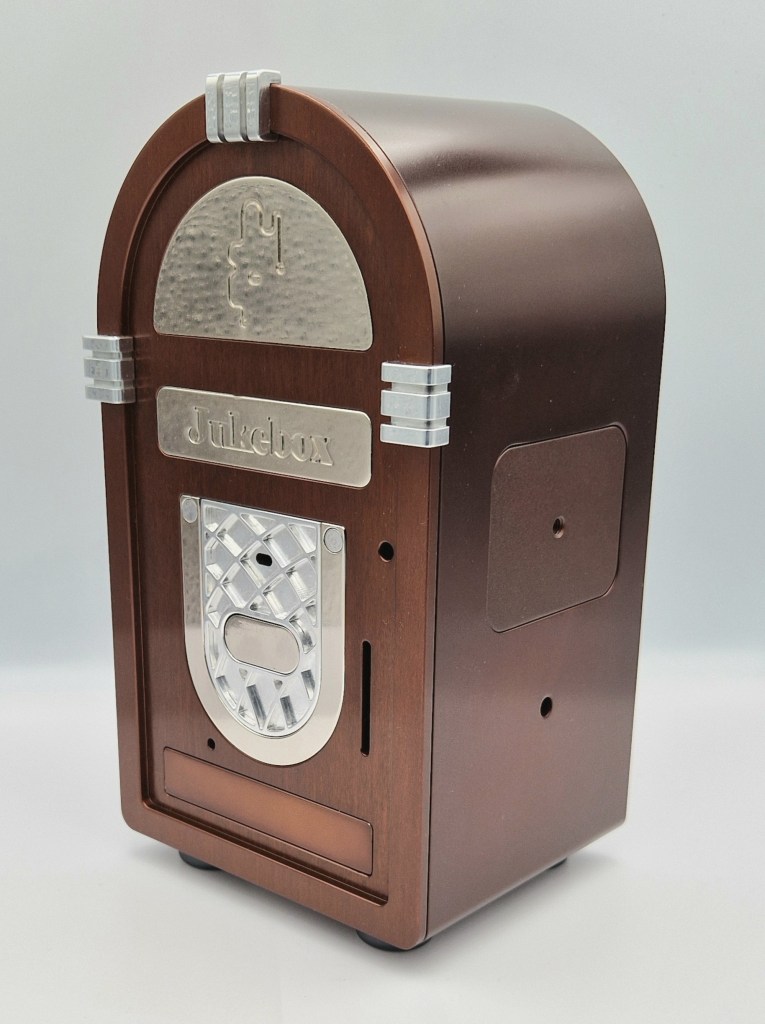
Going back to a few weeks ago: so it was that a large box arrived, containing an expertly packaged metal jukebox, with an absolutely lovely brown to offset its aluminum sheen. Frankly, it is gorgeous, resembling a classic jukebox, miniaturized to about 4.75″ x 8.5″ x 4.1″ from its place of honor in Ye Olde Soda Shoppe but still significantly substantial at close to 6.5 lbs. It stands on four small legs, with some holes and what-not adorning its sides. After admiring it for some time, turning it this way and that as I poked and prodded, I found something that did something, affording me a couple early steps before hitting my first of several walls. After playing around some more, I developed an idea of what needed to happen and set about accomplishing the task.

Eventually, after a fair amount of stops and starts (and stops and starts), I was able to get somewhere new; I was already working with some tools and the next step was fairly apparent, leading me to the first of several compartments. After examining the fruits of my success I stayed stuck for some time until an aha! hit – I jumped this wall, finding that a quite cleverly crafted clue contained yet more surprises. Yet again, success afforded me some fruits to enjoy, as another wall faced me. I was sure there must be something I was missing (there was) and it took a good amount of experimentation before I found the well-hidden secret needed to progress. This would continue through step after step and compartment after compartment until I found the “satisfying ending” to which the description refers, which does little to express the originality and joy of the puzzle’s finale. I not only laughed but ran to get my lovely and typically puzzle-indifferent NPSO to show her what I had accomplished: the finale is cool enough to elicit a smile from even the most jaded of non-puzzling partners.

Jukebox is most definitely sequential discovery, with tools and tricks that lead you on a journey that steers close to its theme; the jukebox is not just a concept but is integral to the puzzling itself. Puzzles that look like something do not always do this – sometimes the aesthetic is purely aesthetic but not here: Jukebox relies on multiple points of thematic reference that keep you close to its concept throughout the solve.

After solving, I set about the reset, which I found to be extremely intuitive. I would solve and reset the puzzle a few times before shipping it off to be judged by the lucky band of IPP-ers chosen for the task. I will be pretty surprised if it doesn’t elicit the same level of joy I was fortunate enough to experience (which it ultimately did).

Daniel and his partner, Tibor Folytan (together: MoonTree Puzzles) have made something that is fun and unique, with a complexity that challenges but never annoys. Any time a puzzle’s description contains the word “dexterity” I tend to get a bit suspicious – this is not at all my strong suit and I worry that such steps might frustrate me. But this never happened with Jukebox; that particular section had sufficient clues and feedback that I was able to enjoy progressing through it, never feeling compelled to smack my head (or the puzzle) against a wall.

I am excited for this puzzle to be released into the wild – Daniel has put so much into making this and we puzzlers are the fortunate beneficiaries of such care. He has worked hard to try and keep the cost down so that more puzzlers have the chance to enjoy it. Because that is really what sits at the base of this project: the desire to make something cool for us to enjoy. With the amount of hours put into designing and prototyping and tweaking over a period of several years, this is assuredly not the best way to make a buck; rather, this is a project that shows puzzlers’ love for the medium. I sincerely hope that these two designers find the time to bring us a follow-up (first they need to actually begin producing these for sale – I know I will be ready to pick up a copy despite having already solved it because this one is a keeper). Be sure to keep an eye on the #upcoming-Puzzles channel on Discord and/or on their website: http://moontreepuzzles.com.


If My Words Did Glow: Ripple by Peter Canham

Nary a day goes by when no-one asks me: “Hey, 5S, where the heck ya been the last few months?” Well, life happens and writing fell to the back-burner for a time. But this is not to say that my puzzling itch went anywhere – I’ve still been FOMO’ing my way through my bank account and struggling with the (many) yet unsolved puzzles in my midst (I’m looking at you, Orbit… and you, pretty much every Osanori puzzle I own).

There has been some truly great stuff to come out since the Nashville Puzzle Party (I realize that I haven’t posted since then… Wtf?!) but my favorite (solved) puzzle since then has got to be Peter Canham’s Ripple. After patiently waiting a year or so, I got an email that it was my turn! Cut several weeks ahead past some USPS shenanigans (and absolute kindness from Peter in his quest to make sure the puzzle got in my hands) and it arrived, safely packed in some laser cut plywood.

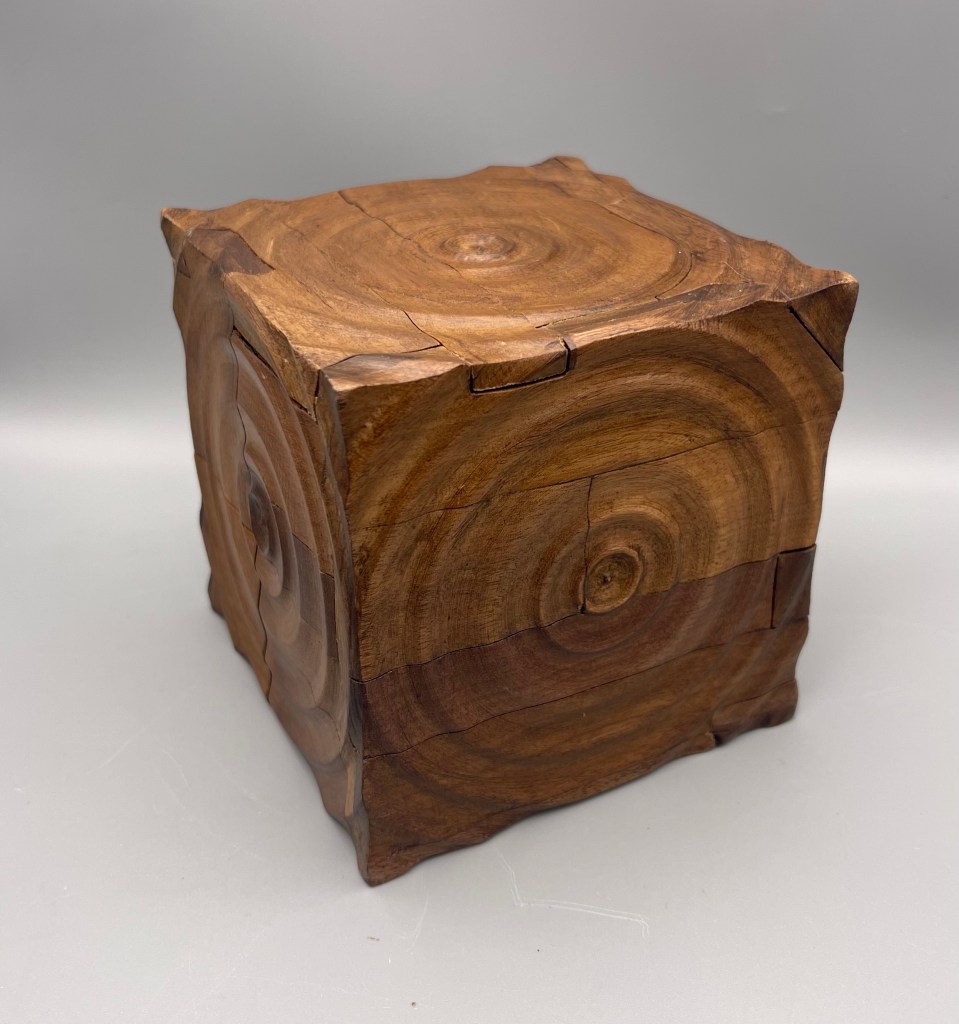
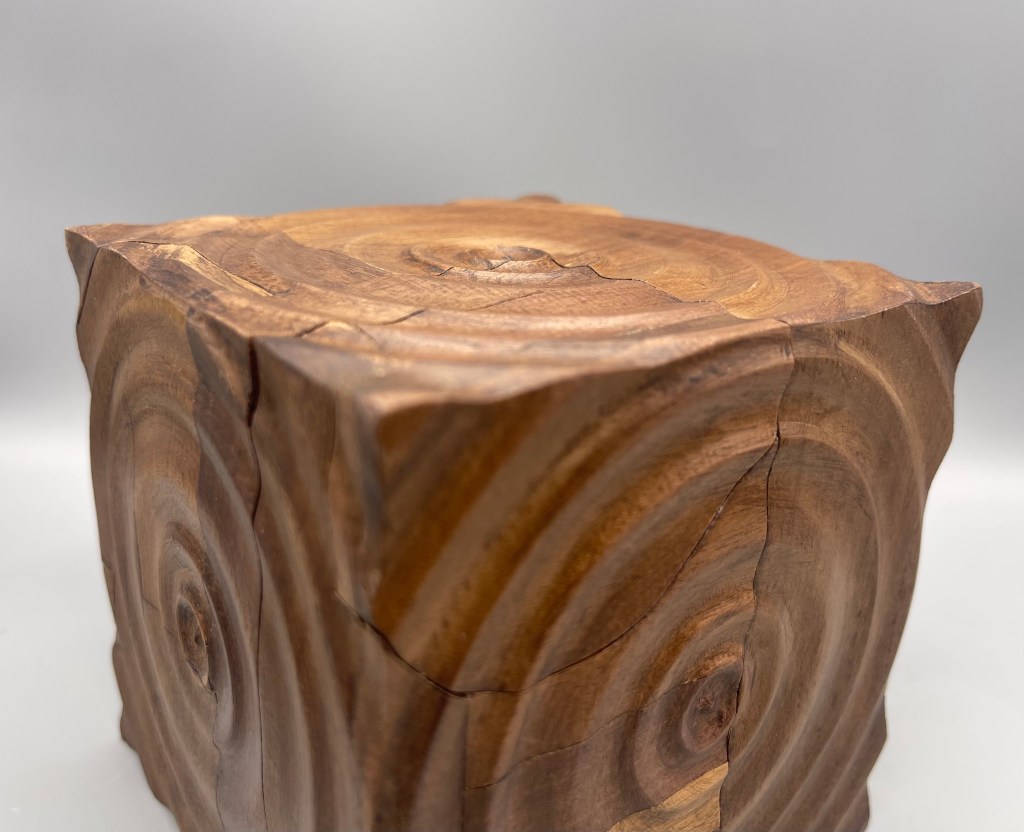
Ripple’s aesthetic mirrors its name with each face of the 4″ walnut cube featuring a series of rounded, concentric circles. These are broken by all sorts of strange and seemingly haphazard lines, giving you a hint of the complexity to come – at times these lines might prove helpful but they somehow still managed not to spoil some wildly unexpected moves. In Peter’s (comparatively succinct) words, it is “a box that was like a sequential puzzle but was non linear i.e. one move did not necessarily lead to another but possibly two or three. Like ripples in a pond interacting with each other. The biggest design challenge with the ripple box is that as the moves bifurcate the mechanisms start to interfere with each other,” resulting in a lovely cube that is seriously tricky.

After a moment appreciating the look and feel of the box, I was off: I was able to find something rather quickly but it seemed to lead nowhere, leaving me in circles that led to other not yet helpful discoveries, as I spent at least a couple hours over several days without making any real progress. Finally, after clarifying an assumption or two with Mr. Boxes and Booze, I found something odd and quite unexpected. And there I sat once more, staring into the next of what would be several walls that would lead to quite a few satisfying aha! moments. Eventually, I reached the solution and found Peter’s signature alongside the series and batch number. After basking in my brilliance for a bit, I reversed course, resetting the box and going back through the solution once again, appreciating how the moves lead into and around one another, moving through the maker’s vision to the end.

I suppose some might debate this, but I feel like it easily meets the crowdsourced Discord definition of sequential discovery, as it takes you “on a journey through a set of sequential and generally non-repeating challenges involving the discovery of hidden mechanisms” to reach the solution. SD has come to inspire some rather specific meanings that may or may not be met by this puzzle; regardless, the journey itself awards the puzzler with plenty of satisfying aha!’s. But, really, who cares: it’s a darn good puzzle, which is all that matters.

And now, what’s this? A new Dee Dixon puzzle adorns my doorstep? Ah, yes, you may yet hear from me again soon (sorry).


When is a Door not a Door? When it’s Puzzleduck Pastures by Kel Snache

Puzzleduck Pastures

Kel Snache; 36 copies

In a land far away, under the old Sycamore tree is where you will find the cheery little fairy community of Duckbill.

These puzzle loving fairies have an obsession with all things mechanical and have nothing to do with ducks. One fairy named Lil’ Ms Fairy Pants had her tiny home newly outfitted with the crafty creations from one particular wizard named Kel Snake.

Sadly, Lil’ Ms Fairy Pants has a poor memory and has gotten herself locked out of her home, again.

Save the lovely fairy and be the gallant young knight by helping her to open her front door. She will repay you with a tiny tour of her home.

Duckbill Times

It may not be new but it is still worth writing about: I got my copy of Puzzleduck Pastures upon release way back in ye olden days of 2019. Back then, my blog was still pretty new, my tens of readers a mere fives of readers. I was writing less frequently than I am now (which really is still not as frequently as I’d like) and simply never sat down and wrote about this gem of a sequential discovery take-apart puzzle.

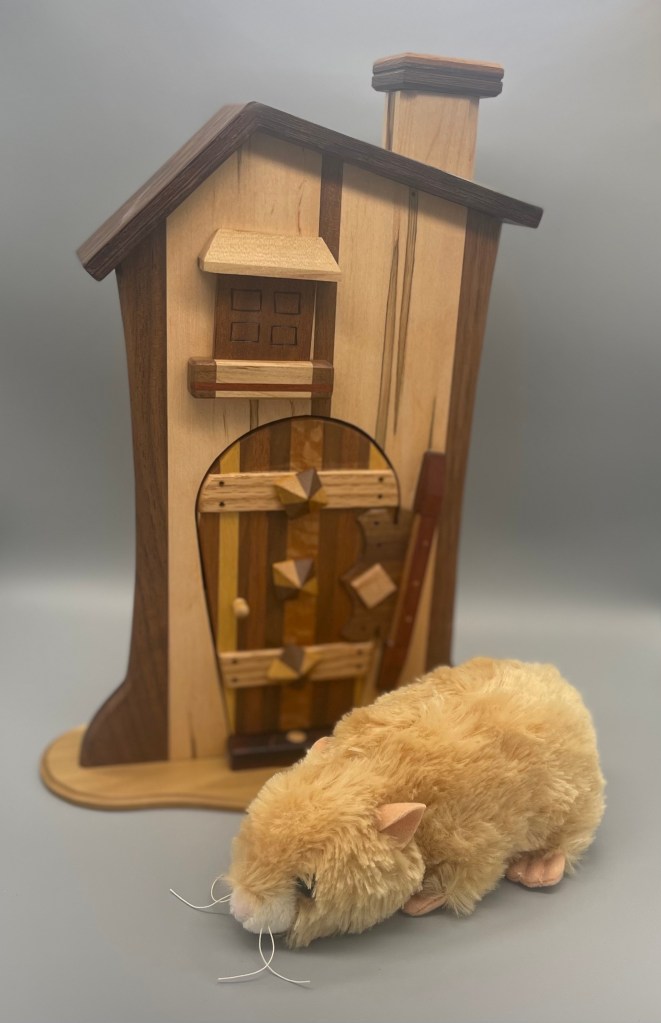
Puzzleduck Pastures is Kel’s “response” to Michael Toulouzas’ Fairy Door (and, in turn, precedes Tracy Clemons’ take: Dark Fairy Door). The puzzle looks like the facade of a playful, cartoonish home, the roof slightly askew, a bulbous door, sketched windows, and so on. The puzzle is a sizable 12″ tall and 8.5″ at its widest point on the base; at 3.5″ at its deepest, it evokes a sense of a theatrical facade from which one might expect Puck to dramatically emerge (“And those things do best please me, That befall prepost’rously.”)

And this is just part of its appeal: it’s playfulness is a manifestation of Kel’s good nature and reminds us that we are here to have fun – belying this intentionally imperfect aesthetic are the internal mechanisms that interact in varied ways, locking Lil Ms Fairy Pants’ door and tempting the puzzler with a number of holes across multiple sides.

The door is quite firmly locked: two of the three square central “locks” on the door move just a few mm, with the bottom one spinning freely. But don’t think that the rest of the puzzle can be ignored! In typical Kel fashion, you will find a number of interacting internal mechanisms keeping you from solving the puzzle and opening the door, although only the chimney appears to have any give when reset. It is quite typical of Kel’s style: multiple misdirections as you embark on a semi-linear sequential discovery journey with very few blind spots. Re-solving the puzzle after a few years, I was pleased by how well everything worked, even as I was sure something was wrong at one or two points (nope: it was me). And I was super pleased with myself when the door finally pulled open once again!

At the end of the journey you are rewarded with a view of some of the internal mechanisms as well as, even more delightfully, some lovely art of Lil Ms Fairy Pants’ home created by artist Nicole Lees for the project. (This is not a spoiler as it is stated in the description)

I love this kind of finale, bringing the story full circle and rewarding the puzzler with a good, satisfied laugh. By no means will you wonder if it is solved: it is quite clear that you’ve helped Lil Ms Fairy Pants home and you can sleep soundly knowing you’ve done a good deed for an imaginary person.

Puzzleduck is fun and tricky, Kel’s deviousness abounding throughout the puzzle’s playful frame. While not as long a solve as Kel’s EWE UFO, it is similarly smartly silly and delightful to behold (and they look adorable next to each other). Now if I could just get myself a copy of Toulouzas’ Fairy Door, I would have the trifecta, thereby opening a portal into the world of the fae!


Sound’s Flex: Hex Flex by Kagen Sound

Hex Flex

Kagen Sound, 2022; 55 copies;
Ziricote, Pacific Maple Burl, Curly English Sycamore, Hard Maple;
6.2″ x 5.4″ x 2.8″

At the close of 2022, Kagen Sound announced the release of Hex Flex, a new box that sounded entirely too intense to pass on (not like it is ever easy with the beautiful boxes he creates): the description states that it has “the most unusual opening” of any box he has ever made! Um……. I am but human.

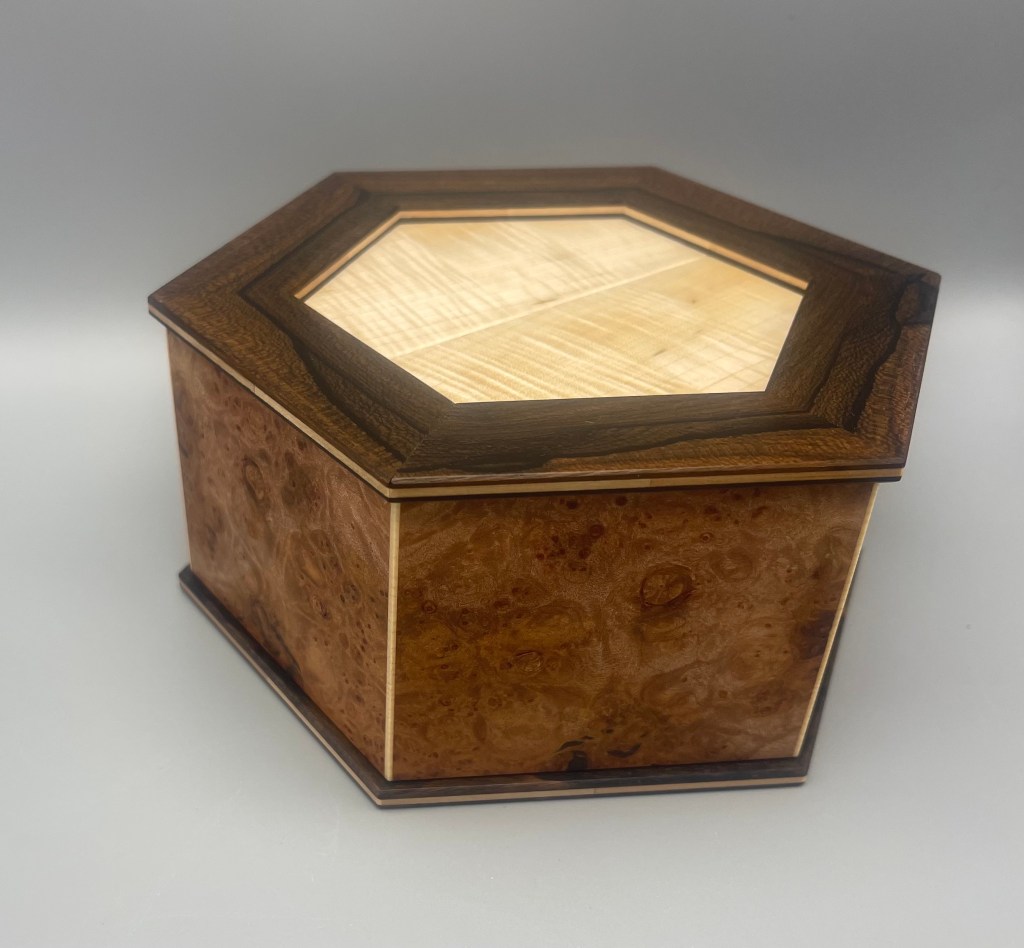
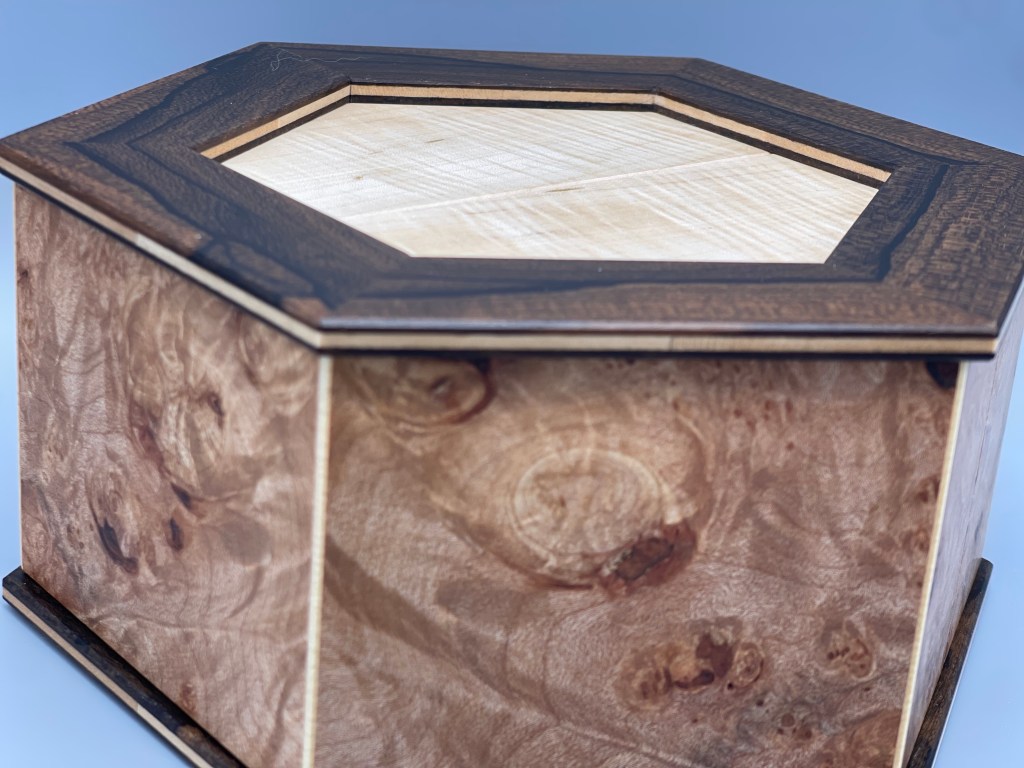
A few weeks later and an absolutely gorgeous box arrived: dark Ziricote contrasting with Pacific Maple Burl and Curly English Sycamore, the burl wood’s tones shifting between light brown and pink, and a slight trim to the lids that is a subtle nod to his skills. This is a box to drool over (as with many of his creations). Its size is similar to Plus Box, smaller than the Lotus/Caterpillar/Butterfly boxes; a perfect fit for two hands. The sides feel like butter and the box has an overall feel of solidity that helps with what comes next, for Kagen warns us that we “will need to take a leap of faith and overcome [our] worst fear about the box.”

Settling into the solve, I was able to manipulate a few things on the box, which allowed me to reason out what it seems like it should maaaaybe do…. but…. no way, that’s crazy…. it can’t…. should I? Kagen’s warning/advice is helpful as I try something no box should do and it works! Beautifully and perfectly! Wow…. but the box is not yet open. I needed to continue stepping out over the puzzle abyss, my faith in Kagen’s work taking me even further from what my cautious collector’s conscience is commonly comfortable with.

Having worked another bit of logic, I find my way to the finale and realize that Kagen has made a box that manages to do something truly amazing, executing a concept that most woodworkers would surely run from and doing it in a way that the solver realizes that it’s ok, there’s nothing to worry about. Kagen accomplishes what he set out to do, creating something stunning and shocking for us to enjoy.

Shades of pink

Solving and re-solving it multiple times, I have to shake my head in awe at the craftsmanship and ingenuity represented by the work. Kagen continues to astound and push the boundaries of the craft… it may not be a singing desk but it is still one of the best boxes I’ve had the pleasure to solve, not to mention one of the prettiest, and quite certainly the most daring.

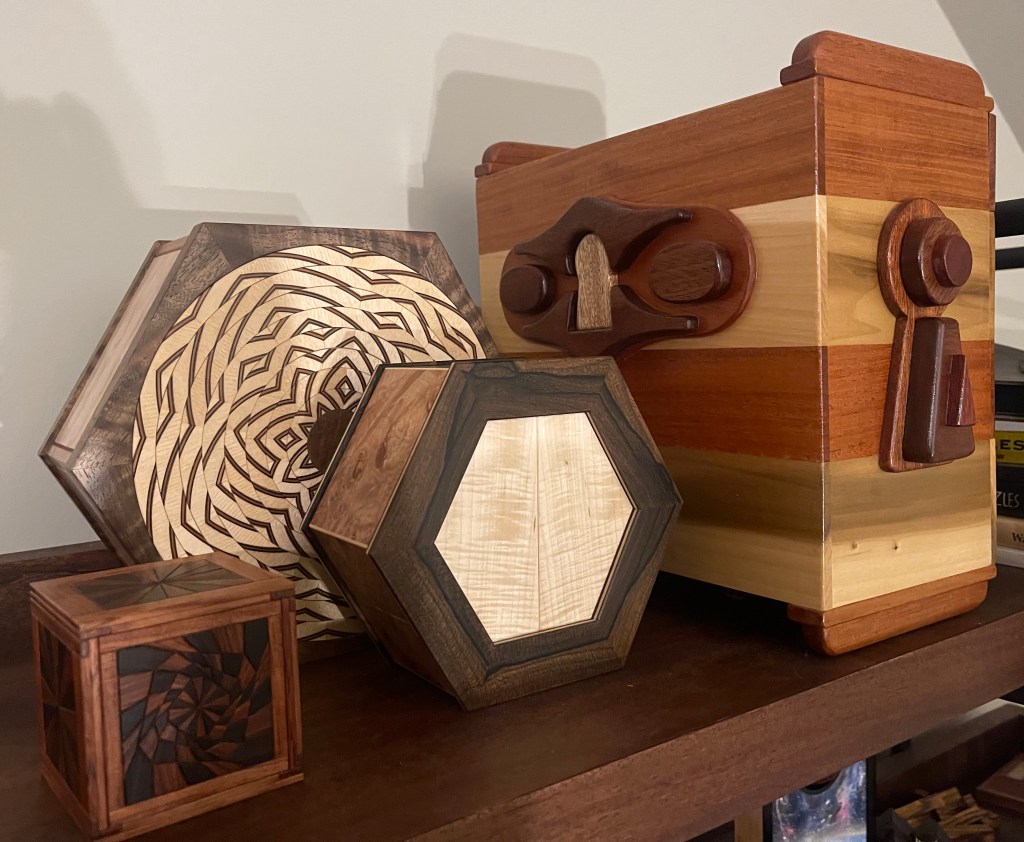
Left to Right: Clutch Box, Butterfly Box, Hex Flex, Dark Fairy Door

Rising to the Endless Occasion: Bad Moon & Apeiron Box by Dee Dixon

Bad Moon & Apeiron Box

Dee Dixon

You may have noticed by now that I am a fan of puzzle boxes by Dee Dixon… with six separate previous posts (plus an apocalyptic video), I have had the pleasure to write about the majority of the puzzles he has released (Space Case & WMH, Portal, Spirit, his first box as well as a Blinded III prototype, Angry Walter, and Menace, in case you were wondering and don’t mind a little self-promotist synergictivism).

And in the last few weeks I had the good fortune to try two new Dee Boxes: Bad Moon & Apeiron Box! Hells to the yeah!

Bad Moon

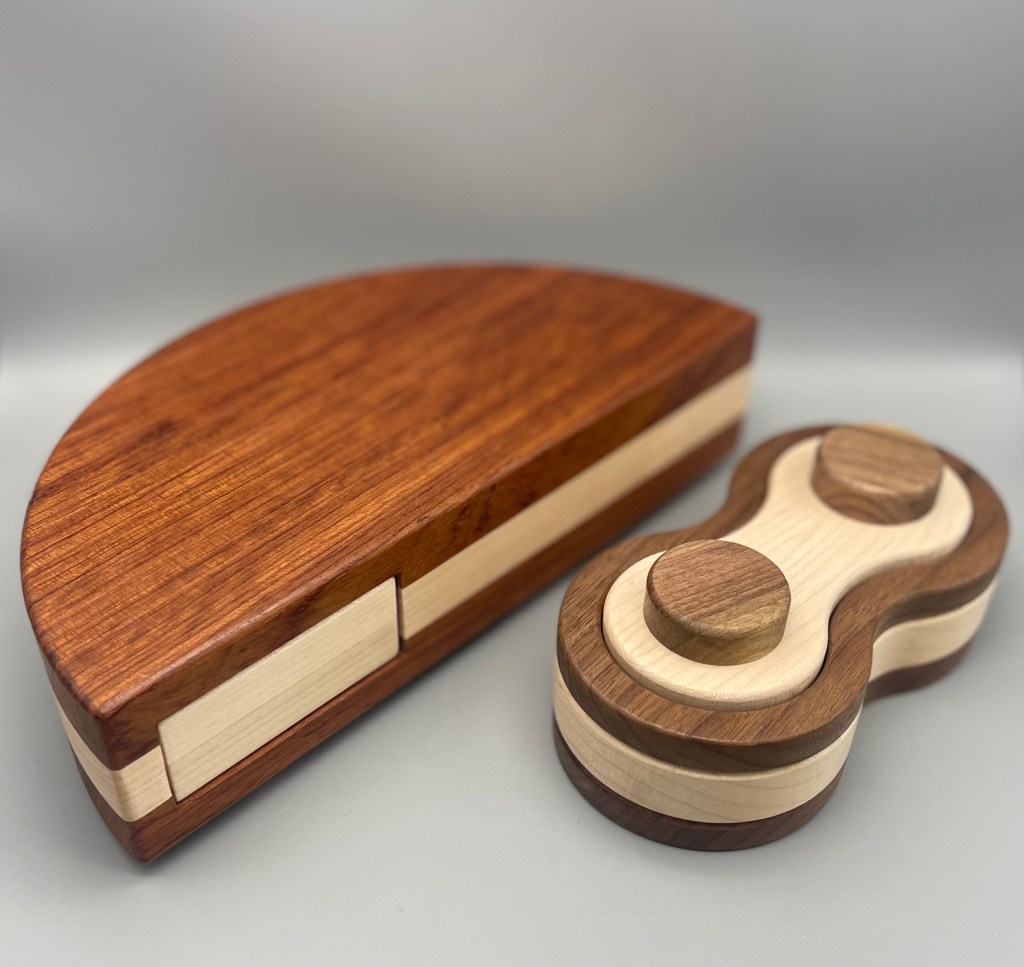
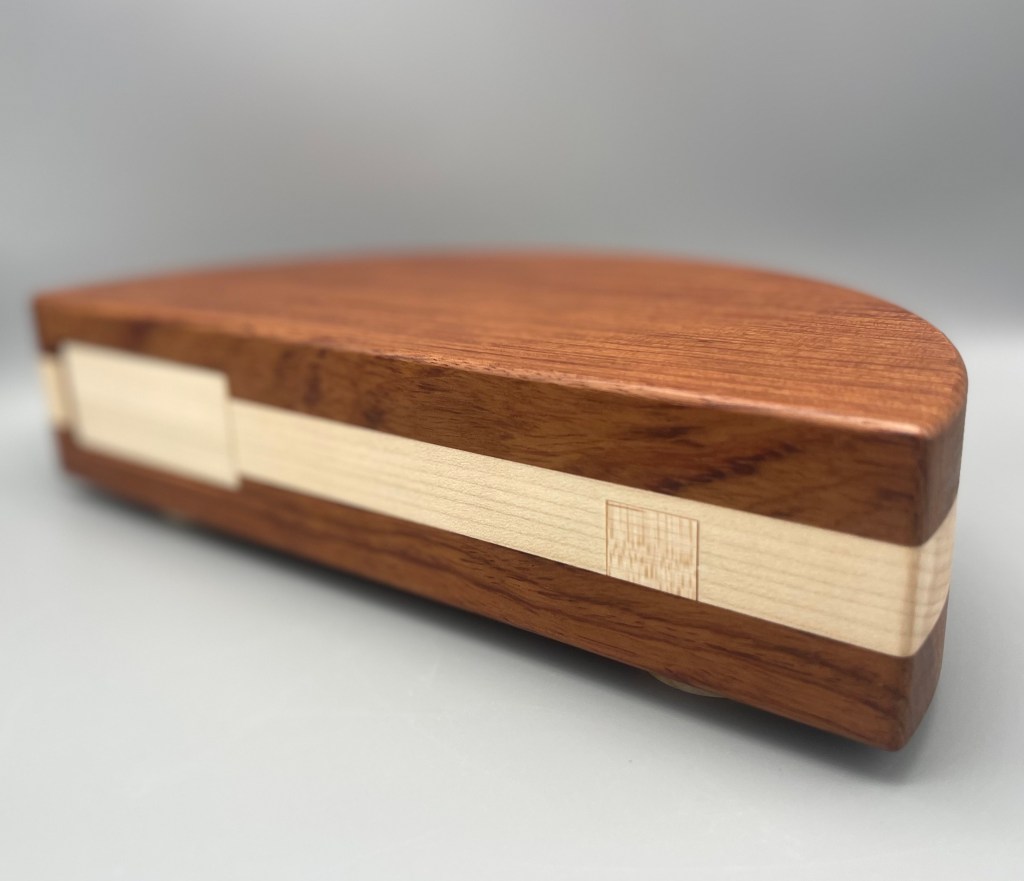
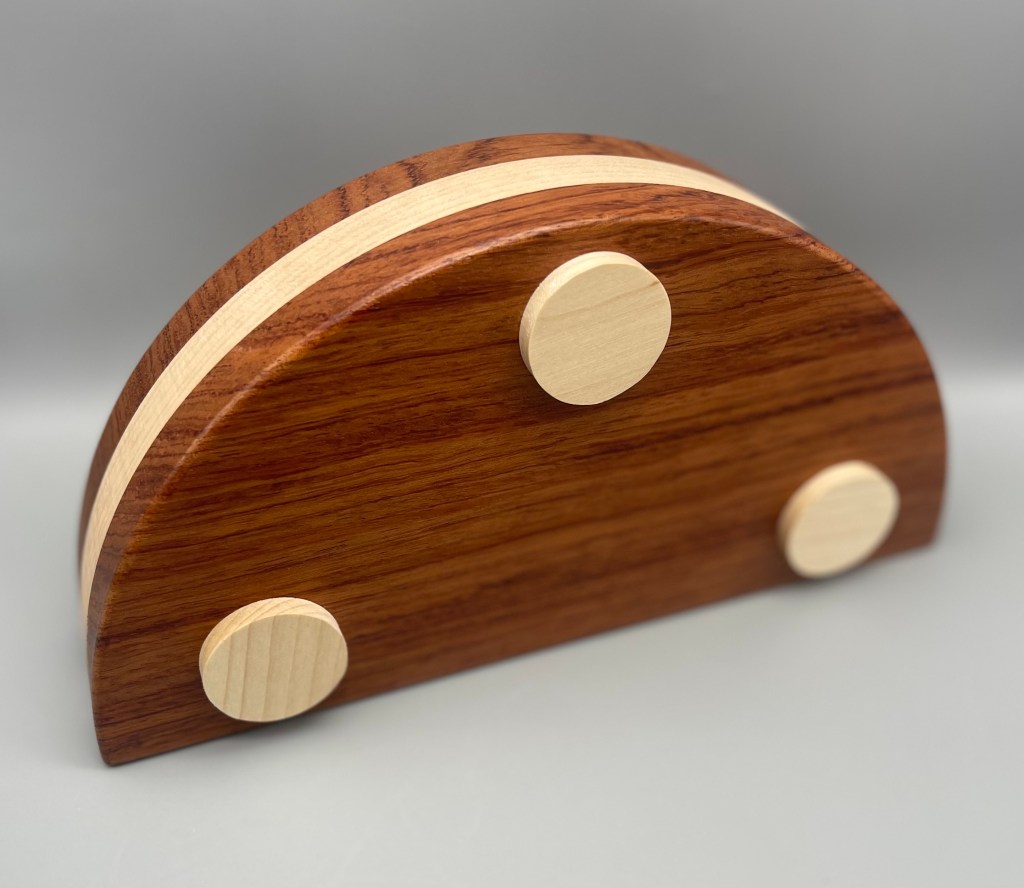
One of Dee’s two recent releases is a lovely and rather !large half-circle, sort of like a half eaten cookie with a creamy puzzle filling, the light tones of the center offsetting the darker top and bottom beautifully. This is perhaps Dee’s most beautiful box yet – it’s size (at a rather impressive 10″ x 2.5″) and distinctive shape allow it to stand out, and it is as soft and buttery as any a Dee box can be. So loathe to scratch this new addition to my Dee collection was I that I was amply pleased to find three circular feet on the bottom of the puzzle, perfect for protecting my pretty pretty precious. The only other obvious things at first are a rectangle and square on the front face, both grabbing my attention as likely targets for puzzling without giving any indication as to how to begin.

Dee doesn’t make it too difficult to get started, however, and before long I had made some progress. Bad Moon has some truly delightful mechanics and an oh so smooth series of movements overall that make opening it a delight. While it is not always clear how to proceed, you mostly know where to focus; and yet, I found myself stuck more than once as I navigated myself through the numerous, discrete steps to the end.

At one point, I found I had perhaps partly progressed through a section with at least a bit of luck – I backtracked to be sure I understood and was duly impressed by the mechanism at hand. Dee has focused this design on fun; while it is by no means easy, nor will you be banging your head against the wall in frustration as you find your way through (that said, I did notice that some well-seasoned puzzlers at a recent puzzle party struggled mightily with the puzzle, so it is most definitely not simple…). Dee tends to give you notice that you have reached the end and it is very clear when you have reached the end – even if there were no logo to find, the culmination of steps into the finale is well executed and kinda sums up the overall flow.

And the reset! This is one of those rare puzzles that contains puzzling steps that are unique to the reset (I’m looking at you, Dabbit Invasion). While resetting most boxes is simply a matter of reversing the order of the solution, I found myself needing to logic out one part of the reset after discovering something that is only put to use after having solved the puzzle (of course, no box is fully solved until it has been reset but the presence of unique puzzling makes me particularly appreciative of this puzzle). With a combination of experimentation and some of that thinking stuff, I managed to work my way through the reset, to where it flowed easily back to the starting point.

Dee’s Bad Moon is an excellent addition to an already excellent collection of boxes – I am not one to question a Dee box but, if I were, this would make it onto my list of “must-haves” (which, admittedly, I would have a hard time whittling down – not liking puzzle boxes is not my strong suit).

Apeiron Box

The second of Dee’s new puzzle boxes, Apeiron, presents a substantially different challenge – forgoing the sequential discovery chops of Bad Moon (and others), Dee turns back to some of the more blind mechanisms he has wonderfully created in the past – as someone who doesn’t generally prefer blind solves, I can say that Dee manages to walk the line between frustrating and fun extremely well – put another way, if I enjoy solving a demanding box like Space Case, whose mechanisms are hidden behind subtle cues and clues, then most any puzzler may as well.

Apeiron is not as hard as Space Case but is much trickier than Spirit – I spent a good hour or two just going in circles, which the design and name would seem to anticipate (Apeiron resembles an infinity sign (or perhaps a peanut) and its name means as much). This is how long it took for me to explore and understand all the subtle clues and feedback available, which is more than enough to develop working theories on the box’s mechanism(s). Its 6″ x 2.5″ size allows it to fit perfectly in two hands, the smooth curves begging to be explored and handled.

I took a break for a day or two and let my subconscious go to work (my brain surprises me sometimes – WMH had me stuck for weeks until I woke up one morning with a clear and correct understanding of what I was missing). Returning to the box, I found that I had developed sufficient context such that experimenting with the box now led to success: with a great aha! the box came open, allowing me to examine the inner mech as with most of Dee’s boxes (a trait which is just another reason why I love his work).

Having solved it, I opened and closed the box for a while, enjoying my newfound knowledge and hard-earned understanding and appreciating Dee’s ability to develop an idea into an entertaining reality. Dee’s skills as a puzzle designer continues to develop, his penchant for tricky but doable puzzles boxes leading to the creation of yet another box of devious trickery whose mastery had me smiling. Apeiron does not rely on random fiddling or dextrous fickleness – its solution is easily executed once understood but getting there may not be so simple (as some readers may know, my passion for puzzles sometimes outstrips my ability with them but I would not expect Apeiron to open for you without some degree of difficulty).

Bad Moon and Apeiron share an aesthetic to some extent, and look wonderful paired together amidst whatever other of Dee’s boxes you’ve had the good fortune or forethought to obtain. Both boxes should have additional releases in the near future, so keep an eye on Dee’s website for updates.


Three Little Puzzle Cubes Are We: MW Puzzles

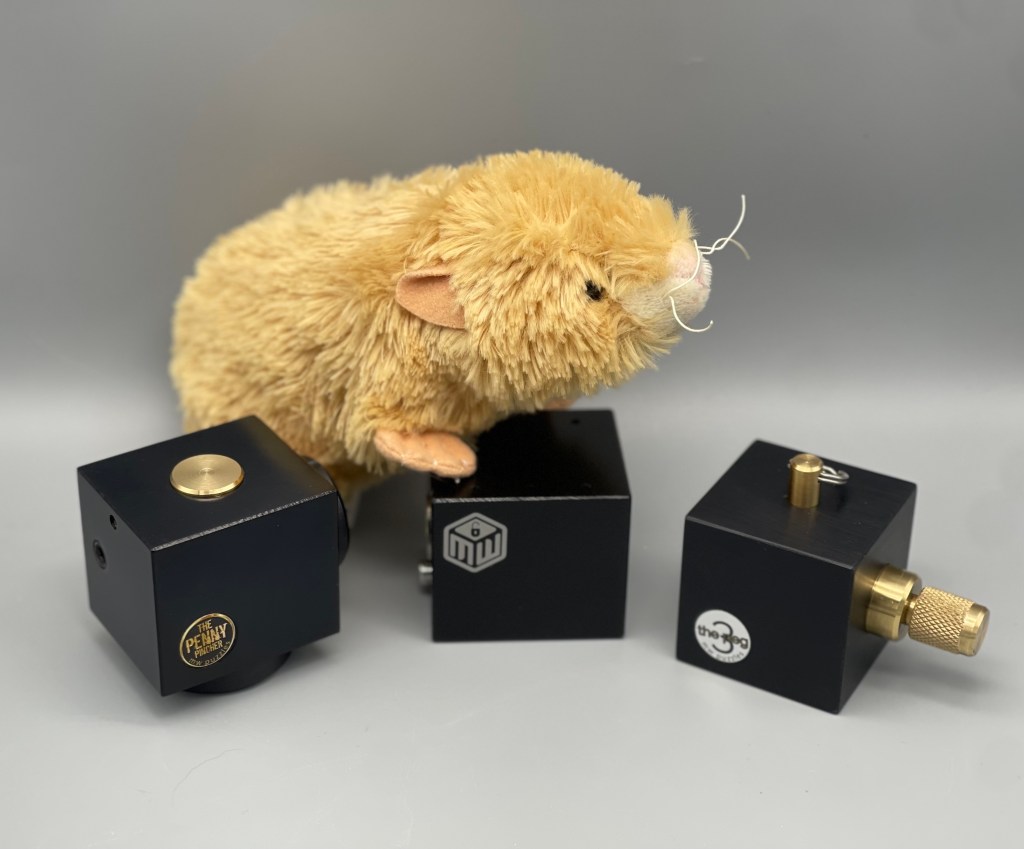
3 the Peg, Penny Pincher and Lib Orb Rate

MW Puzzles, Approx. 2″

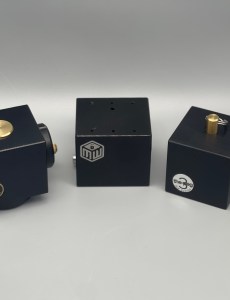
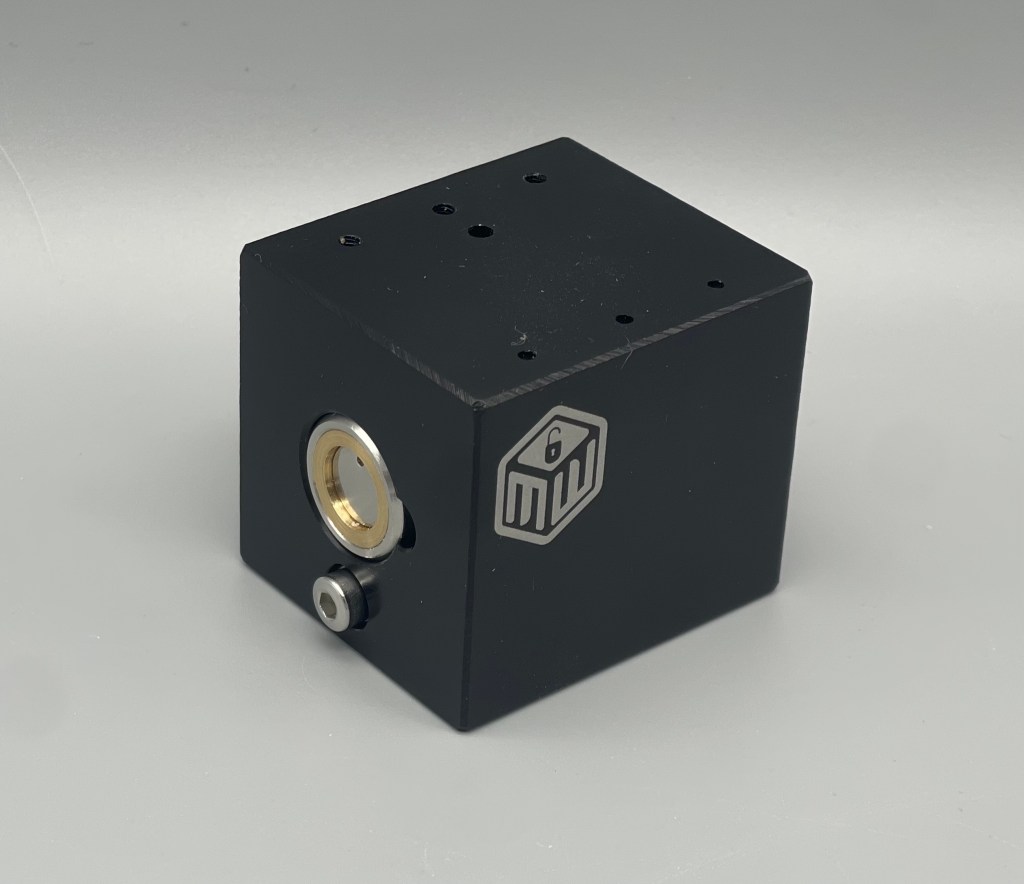
Some months ago, MW puzzles appeared on the scene with 3 the Peg, a smallish black metal cube with enough holes and protrusions to tempt most puzzlers. I didn’t know anything about the maker but when has that stopped me from trying a new puzzle…

Peg and its two siblings make for a trilogy of puzzles that share an aesthetic, making for an extremely collectible group – I do love puzzles in a series that manage to have a consistent style at the same time as containing distinct mechanisms. The black metal cubes have slightly varied dimensions (more or less 2″) and the distinct protrusions and holes across their faces send a clear signal that these are wholly different from one another. The amount of puzzling contained within these relatively small footprints (particularly in the second and third in the series) reminds me of the trio of printed puzzles by Alan Lunsford (aka Layer by Layer on Etsy): Unsafe Deposit, Bolt Action & Mighty Pin, all of which offer absolutely excellent puzzling at a particularly good value. A good designer can fit a lot of puzzling into a small frame and MW’s use of metal makes for a very high quality example of this puzzling axiom.

3 the Peg

When 3 the Peg arrived, I was first taken with the overall quality of the build – there is some serious machining skills on display, with every piece placed perfectly in prime puzzle position such that pretty much any puzzler can appreciate the sleek appearance and solid feel of the puzzle.

3 the Peg is the first and the simplest of the three puzzles released by MW – this is not to subtract from the elegance of the solve which relies on a well-hidden trick that could certainly keep a puzzler stuck. I managed to solve it fairly quickly but this could at least partly be due to luck (one of my early guesses proved correct), although I would venture to guess that more experienced solvers may have a similar experience. Having found the main trick, it was not terribly difficult for me to work out the remainder of the solve. I think this is a particularly great puzzle to hand to non-puzzlers as it it not too long a solve and can show how one’s basic assumptions about the workings of a puzzle must be discarded; further, the extremely well made parts will show any non-puzzler the level of craftsmanship we tend to expect from our makers.

Penny Pincher

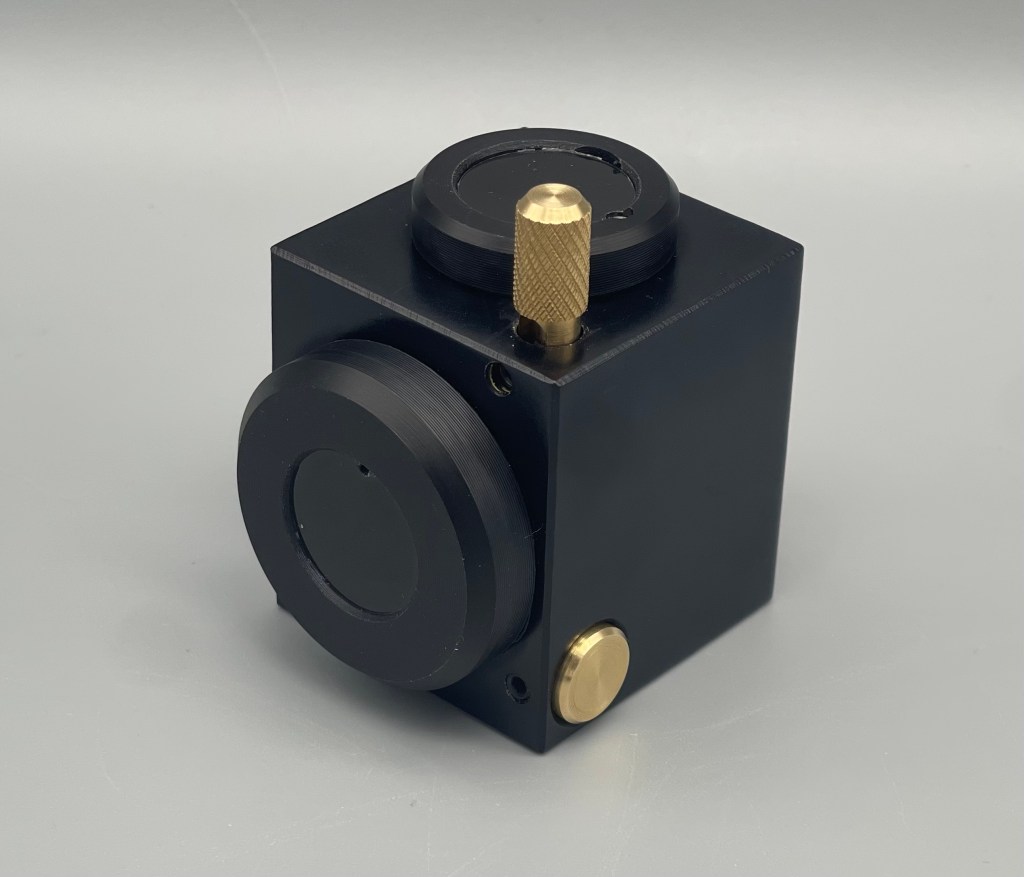
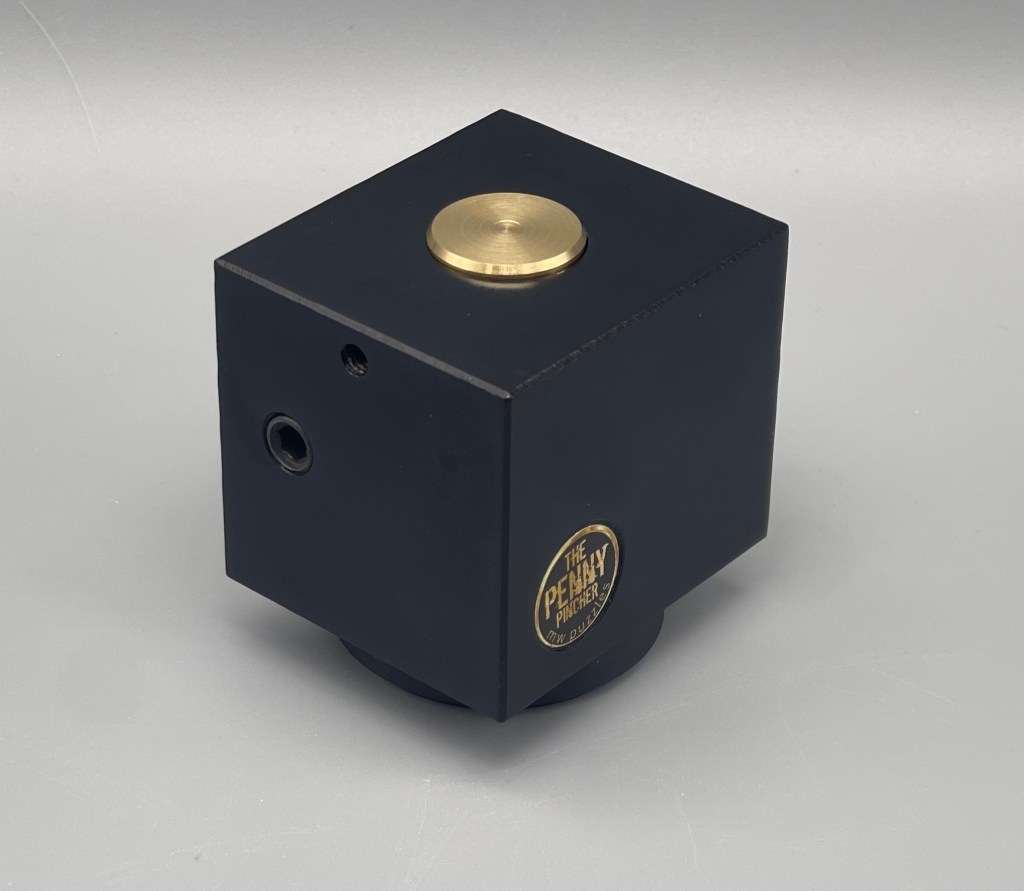
I missed out on buying this one on release and gratefully solved a loaner copy from a fellow Discord puzzler- and I am glad I did! This one really steps things up in terms of complexity and difficulty, with a pretty long and involved series of steps and discrete mechanisms to get through before the titular penny is released. Luck will not get you very far and even experimentation is somewhat limited as I needed to have a good sense of what I was trying to do to avoid going in circles. PP is a bit crazier looking, with plastic rings on two of its faces, almost resembling camera lenses. These bits help to create the impression that there is a lot to work with, helping to lead me down some rabbit holes at more than one point in the puzzle; one early section in particular had me smiling once I fully grokked how it works. Construction of the puzzle is still quite good, although I did have an issue with a couple bits falling off (easily fixed) but the instructions tell us that these don’t do anything, which was good to know.

Several legit aha! moments await you as you get through the sd solve, more than one of which is likely to earn a guffaw or two. While Penny may not be the prettiest of the three puzzles, it may be my favorite: the mechanisms are smart and tricky, making for a fun and satisfying challenge that rivals the next puzzle in this MW trilogy.

Lib Orb Rate

Lib Orb Rate is the newest of the three puzzles they have released and it really is a darn fine puzzle. They once again pack a lot of puzzling into a small footprint, for a multi-phase sd solve that poses a solid challenge and works smoothly. I hit a wall early on and got nudged in the right direction – I was sure that there was some blind muckery about and my own assumptions and faulty deductions were tempting frustration … until I realized everything I needed was there for me to work with. They don’t hold up a sign to focus on what that might be but the information is mostly available after some close observation and trial & error to see what’s what making it sometimes semi-blind (but totally fair).

Passing through this first phase, I moved on through the puzzle in a pretty clear, but not at all simple, progression: I never felt lost even when stuck and I eventually worked my way through the rest all by myself (golly gee). Stupidly, I forgot that the name of the puzzle tells you what you’re trying to do and briefly believed I may have solved it – it would have been an ok puzzle if it stopped at that point and I was pleased to find that it continues on to a cool mechanism that is executed quite well, with some small details that must be precisely followed, particularly on the reset. While this final section was perhaps not necessarily 100% new to me, the other puzzle that shares a somewhat similar section is rare enough that many if not most puzzlers playing today may well have missed out. Regardless, it is executed differently (and perhaps more reliably, if I’m being totally honest) and is as worthy an aha! as in that other solve, particularly as it adds additional subtle trickery. All in all, Lib is another great puzzle from MW with a solid challenge and satisfying solve.


These three quality builds from MW Puzzles has me eagerly anticipating whatever follow up they might have in store – they are a welcome designer to the puzzling world and well worth watching for whatever they will come up with next. According to the designer, it may be a while before these three are re-released, if at all but, perhaps more importantly, there will be a smaller “key ring puzzle” in time for the holidays and a major release coming in the New Year – I am looking forward to it!


Lost All Over: Red Herring Box by Doog

Red Herring Box

Doog from DoogalooGames, 8.5″ x 6.5″, 3.75 lbs.

Making its way around the world is a puzzle box by Doog from DoogalooGames, a puzzle-maker (and super yacht engineer, which is also way cool) whose puzzles have been popping up on Instagram and elsewhere over the last few months (such as the Precision Box, seen on Mr. Puzzle). One of my oldest MPD friends, Josh, asked me if I wanted to try a box that Doog had given to the community to share and solve… as if he had to ask!

(Ironically, although I’ve spoken and DM’ed with Doog a few times, I had not heard about the puzzle until Josh let me know, much to Doog and my amusement – it really is a small puzzling world!)

The idea is to have the box go from puzzler to puzzler, asking solvers to add their initials/name to the bottom of the box and take a pic in their city or town before sending it off to its next puzzling location.

Not since Amelie‘s gnome has an inanimate object’s world travels been as compelling and interesting, already making it from France to the southern parts of the US (soon to travel West, if memory serves).

There are a couple neat little surprises inside that I won’t ruin, suffice it to say that I absolutely love the whole thing! It generously brings puzzlers together into a shared puzzle experience for nothing more than the cost of shipping it on to whoever is next in line. (There’s no specific way to get in line, each person is just sort of asking whomever is next… I know the next two stops have been determined but beyond that…. this is a slow, friendly travel from stop to stop – if you do get it, make sure to solve it quickly and pass it on!) If you’re hoping to be a stop on its world tour, I’d suggest popping onto the various puzzling social media vortices from time to time and asking around – I suspect we will see and hear more of its travels as time goes on.

But what of the puzzle? The concept is cool but if the puzzle isn’t…. well, fortunately this is not an issue as the box is rife with misdirection and trickery, including a mechanism that I have simply never seen before! I set aside other puzzles (and responsibilities, ahem) to focus on the aptly named Red Herring Box. Sturdy and simple in its sizable appearance (and weight at 3.75 lbs), there are numerous screws of various sizes adorning 5 sides (yay)just calling to be harassed. Thus begins the process of poking and prodding and pushing and pulling and sliding and staring and sneaking up on it, hoping to catch it unaware.

I made some progress before hitting a few walls, proceedings in starts and stops along the way until I had several bits and pieces to play with. And that is where I stayed for a few hours before I asked Josh a few clarification questions to climb out of some rabbit holes down which I had begun to descend. I find that sometimes the best help is just to talk through what I am doing: by sharing and describing what I have done, it may show me what I have not, revealing something by verbalizing the thinking process.

One aha! in particular was a darn fine puzzling moment, getting me past a wall through which I had previously seen no way. The puzzle manages to be really sneaky in a way that shows Doog is a maker to watch. Far from unfair, the box exploits our assumptions in the best way possible – I had begun to think things that were so far from correct, imagining complicated blind whatevers that surely must be there, otherwise I would have solved it already! Nope! Elegant in its simplicity, Red Herring deceives and distracts you before giving up its secrets and treasures.

I took a few pics and sent it back on the road.

(My only sadness: had I realized I was the fourth solver, I’d have asked Josh to send it to one more person before me…. y’know, because of the whole 5 thing. You know what I’m sayin’…)

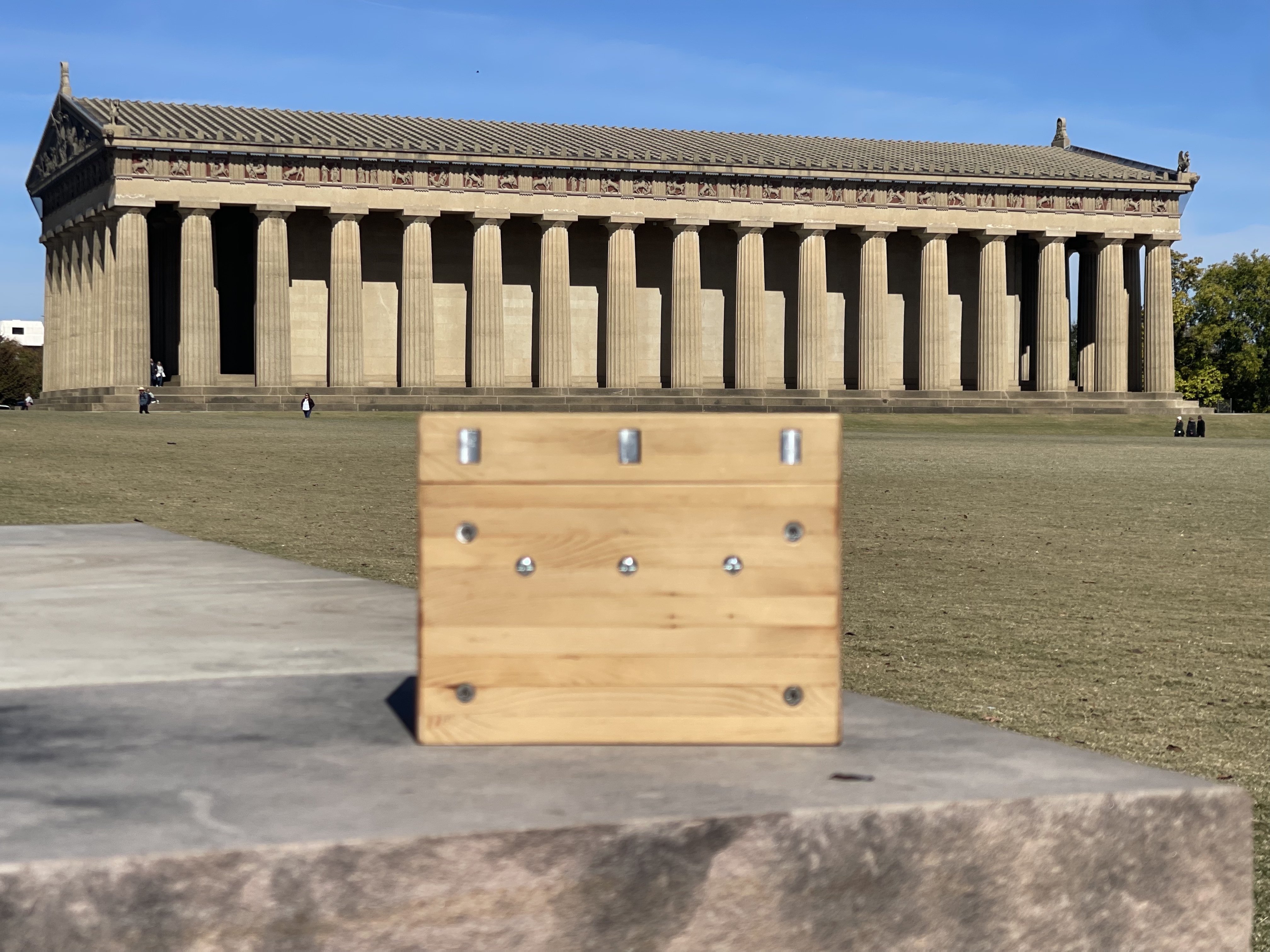
Red Herring Comes to Nashville (note: one of these images is photo-shopped)