Eggs-celling at Eggs-cellence

Unstable Eggs

CoreMods, 2019 (Available on Etsy)

First, I would like to officially state that I solemnly swear not to make any more eggs-hausting puns (…starting now).

I think I should start by saying that these are the first 3D-printed puzzles I have bought; I think many of us assume that only wood and metal-workers can bring quality fun to us puzzlers, or at least I think maybe I did. However, I am far from disappointed with the colorful assortment of trickiness that arrived today, the noise of small things shaking around betraying its contents. In fact, I think the 3D print may be a benefit in this particular case (and not just in terms of helping to keep the cost within the bounds of reason).

My initial reaction was to smile; the whimsical font on the front of a half-dozen cardboard egg crate was a good start. Opening the box, there is a sticker warning me not to expose the eggs to magnets – a good precaution to know considering the plethora of magnets hiding within the puzzles on my shelves. Thanks for the heads up.

The eggs are all brightly colored and they bear the marks of their pedigree; CoreMods tells us on his Etsy page that we should expect the texture of 3D printed materials. Honestly, I can’t really see these being made any other way: I like the weight of them and the sound comes through clearly, essential should I have any hope of ever getting these bad boys to stand at attention. The movement of whatever mechanisms hide within can be felt and heard through the 3D mold. Further, it provides for a good texture with which to grip the eggs. Perhaps most significant is the fact that, in trying to solve them, they will definitely be rolling around, sliding, dancing, and generally making merry upon my desk; I would hate to watch a wooden puzzle of this ilk go spinning around my desk. The 3D print allows me not to worry about rocking and rolling and just generally experimenting with movements that may (and so far mostly don’t) work..

The purpose / goal of these eggs, if not already apparent, is to get the eggs to stand up. Unlike Weebles, these definitely wobble and fall down. I had been wondering how many different things one could put into an egg to make such a concept difficult, without them feeling repetitive or boring. The answer is at least 6. Judging from the fact that the sticker says this is Series 1, I suspect CoreMods knows of even more.

I had also been thinking of some obvious (to me) moves that might solve such a puzzle; I worried that I would get 6 centrifugal pieces of plastic with which I would be done in a moment. This is (thankfully) NOT what I got: of the 6, I was able to get 1 to stand up with any amount of ease (admittedly using one of the methods I expected to find, the rest of which have yet to bear any fruit… or yolk, perhaps – not a pun, mind you…).

Whatever is going on inside of these guys is unclear, but I can tell that they will all require different approaches; the noise and feel of each individual egg allows me to begin to develop an image of diverse mechanisms waiting to be solved.

And, at the end of the day, that is really what this is about: we want to find a puzzle we have never seen before, executed in a new way, which is uniquely solvable. I feel that this is what I got (and at a very reasonable price, I might add – another benefit of the 3D printed puzzle). Although this may not be true for everyone, I have not seen puzzles with this same goal (I may have heard of a couple, but this is certainly not a common puzzle-type). It is a combination of dexterity and the type of lateral thinking required to open a puzzle box, as one works to understand what is happening through trial and error (and error and error) and keen observation (again, this is where the 3D form comes in handy).

Suffice it to say that I am very happy with what I got – CoreMods has come up with a novel concept that displays with fun and humor, while requiring more than a little head-scratching to make progress. Which means I will be ordering his Screwball as soon as I have all my little eggs standing in a row (so it may be a while).

Update: a couple months later and…. I did it! I got them all to stand! Well. Not bronze, of course. I mean that ones impossible. But the others just began making sense to me, for the most part. I still not 100% clear what’s going on inside of purple, but if I can ever get bronze to stabilize, I’d told myself is crack open the included solution sheets that CoreMods has said contains images of what lies within. Maybe I’ll actually get to take a look one day and see how closely my understanding matches the reality.

Grade: Four Sinatras

Updated Update: Bronze! Wow. I’m genuinely surprised I got it lol. I immediately grabbed the solutions and, as suspected, I was still way off on purple (bronze is much more complicated and a very cool mechanism that I’d probably never have dreamed up). The other four were very close to what I pictured, having built up a mental model over weeks of light shaking, ear pressed to the teeny plastic eggs, mouth screwed up in concentration (I may have looked like a crazy person, but who cares? I got my eggs to stand!). It was very satisfying to compare this schematic to the reality, and even more satisfying to get these guys to stand. I didn’t dare touch my desk for a day for fear of falling, but now I’m able to get them all to reliably stand with a bit of practice. Well, maybe not bronze. Not yet, at least.
Cards go in the Box. Box goes on the Shelf. Puzzles are on the Shelf. My Puzzles.

Jack in the Box,

Jesse Born, 2019 (Sold Out)

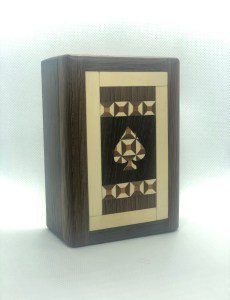
A few months ago, I received the Jack in the Box puzzle from Jesse Born. Jack is a cool concept, blending puzzle boxes with one of my other favorite collectibles, playing cards! The box allows most decks of cards to sit snugly within, allowing only the slightest feel of movement when holding the unsolved puzzle.

It arrived unsolved (duh) and the quality was immediately apparent: the wood is smooth and feels solid and weighty in your hands. The Yosegi design on the top is excellent; except for four seams that are part of the design, the breaks are not immediately noticeable by eye or hand – a difficult achievement, I am sure, and I think it is as good as any Karakuri I have.

With some inspection it becomes relatively clear where the opening will be; I could figure out where the final step would likely take place, but that was it. Nothing moves, nothing slides… like some of my favorite puzzles, it is essentially a Wonka factory (“nobody ever goes in and nobody ever comes out”).

I find it very satisfying to get a solid puzzle with no clear first step. It can of course be fun to know how to start a new puzzle before hitting a wall, but there is something about a puzzle with no indication of how one should begin. I tried all the usual stuff (spinning it, holding it at different angles, sneaking up on it to catch it unawares, etc.), before putting it back on its shelf to glare derisively at me.

I may have done this a couple more times than I like to admit; with some exceptions, I do not typically manage to solve a good puzzle right away, although I suppose this is changing as my puzzling experience levels up. I am probably just trying to make myself feel better by implying that it was before I became the esteemed Solver that I am today. Of course, that is about as likely as my inability to solve a new puzzle actually being due to the always suspected, rarely existent design defect that we oftentimes seek to blame when nothing else seems to work (typically, this occurs a few minutes before being solved, for maximum shaming effect).

Eventually I hit upon that first move, which I find to be a very satisfying move to make even now, months later. After that, it is not a hard path to find the next 4 steps before it opens. Inside, Jesse included a classic red Bicycle deck. I replaced the deck with my Red Labyrinth Cards from King’s Wild; thematic consistency is fun, and what is better to find tucked away inside a puzzle but another puzzle?

Jack in the Box is an excellent addition to my collection, and one that looks great while serving as an ambassador between these two great nations (the world-weary puzzle boxes and the upstart playing cards, like an extra-nerdy West Side Story without the singing, dancing, or blatant Romeo and Juliet rip-off….. and if it was made out of wood, metal, and paper and was sitting on my shelf…).

Jesse is currently working on the wonderfully elaborate Secretum Cista puzzle chest, which will be crazy cool, I am sure, and will be worth not much less than my entire current collection does, but he was kind enough to allow me to pay over time while he works. I will most assuredly share this with the 2 imaginary people reading this (thanks Bob Dobbs and Zaphod! I couldn’t do it without you).

I am telling myself that I will blog on here more frequently, but I’ve learned the hard way that I can’t be trusted, so we’ll see.

Grade: Four Sinatras

Puzzle Box Train(ing)

Railroad Crossing, Karakuri Puzzle Box

Akio Kamei and Shou Sugimoto,
11th Annual Idea Contest Winner, June 2019
Designed by Ichiro Sato
Unboxing Puzzle Boxes with fivesinatras

The newest puzzle box from Karakuri master Akio Kamei and Shou Sugimoto is based on a winning design of the 11th Annual Karakuri Idea Contest from Ichiro Sato. This trick box is made of Oak and Magnolia, and is a whimsical take on waiting for a train to pass, and the secrets that lurk beneath the surface, a comment on the underlying depravity of urban life and the innate search for escape…. well, maybe not, but the wood and whimsy are correct.

Not the hardest puzzle box from the Karakuri Group, as some of the more fun creations tend to be, but it still requires some creative thinking to make the few steps required to open the compartment beneath the tracks. It is pretty big and heavy, a puzzle box with some mass and heft to it, and one that looks great on my shelf, amongst its wooden friends.

And how fun it must have been for my wife to see her grown husband sitting on the floor playing train! I may have even allowed a choo-choo or two to escape my lips as I tried and failed and tried again, before showing my wife with glee the solution, complete with an imagined scene for full effect (“picture yourself in your car, the bells ringing to warn of the approaching train, searching for the correct steps that will allow you to gain access to the safety of the hidden compartment beneath your feet…..” – super cool, I know).

If you manage to get your hands on one, enjoy its weight and the light-hearted fun it carries. And let yourself play for a minute.

Ballin’

Multiball

Eric Fuller, CubicDissection, 2019
Sold Out
  • Puzzle Details:
    • Puzzle Box: 2 Steps
    • Woods: Ash, Wenge, Walnut
    • Number Made: 99 (signed and dated)
  • Dimensions:
    • Overall Size: 3″ Cube

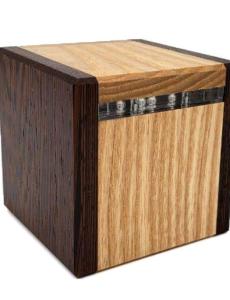
It is almost immediately apparent upon holding Eric Fuller’s what one must do in order to open it: get the stainless steel ball bearings out of the way so the panel can slide out. Easy, right? If you are familiar with Fuller’s work, you should know the answer to that already.

The panel moves slightly, showing you enough of a gap to confirm that this is the way out, and a plastic window teases you with a view of the obstacles rolling in your way. This is part of the fun of Multiball – as you turn it this way and that, first carefully, then perhaps more abruptly, then veeerrrrry slowly, then all these repeated with the box inverted, sideways, and diagonal, then perched upon one’s open palm while you perform your most graceful whirling dervish, and then clenched tightly in your fist while you glare at it scanners-style. All to no avail.

I rather quickly figured out how to will the first ball bearing out of the way, slipping sneakily into some secret recess, then the second soon after, only to have them burst back in, after having gone just a bit too far, like a drunk Uncle regaling your family with Dad’s early sexual escapades over thanksgiving dinner. Rinse and repeat: one ball, two ball, do the hokey pokey and shake it all about, ok there goes the third again, and…. and…. annnnnnnd…… damnit.

After hours of this, the noise of the ball bearings earning quite a few annoyed glances from my wife as we Netflix away our evening, suddenly: it opens! Can you believe it?! Check it out, it’s open! (“that’s nice, babe.”) Yeah, all I did was…. was….. waaaaasssss…. damnit. Still waiting on figuring out what exactly I did right. But I did see that the internal compartment was sizable, maybe not loaf of bread sizable, but more than big enough to fit your Uncle’s next white chip.

The box is beautiful, dark and light woods focusing your eyes on its window, inside of which you can manage to see just enough mirrored mechanisms to further frustrate, but not enough to know for sure what exactly you are looking at – maybe I will have a better sense once I manage to open it…. again.

Grade: Four Sinatras

Breakdown

Slammed Car

Junichi (Juno) Yananose, Pluredro, 2019
Not Available
  • Puzzle Details:
    • Sequential Discovery Box: 15 to 20 Steps
    • Woods: Koto, Blackbean, Jarrah, PNG Rosewood
    • Number Made: 100 (not available)
  • Dimensions:
    • Overall Size: 7.1″ x 3.1″ x 3″
    • Compartment Size: 1.8″ x 1.5″ x 1.5″
    • Weight: 14.5 oz

The first impression I have of Juno’s second sequential discovery puzzle is that it is no small affair: it feels solid and significant in my hands, larger and heavier than most quality wood puzzles. Its wheels move, and separate pieces are readily apparent, distinct from the carved doors on its sides. It is clear that the goal will be to remove the front, rear, and top of the car, in order to gain access to the concealed compartment(s).

Unlike many themed puzzles, Slammed Car is unique in that the theme is maintained as one progresses: the tools discovered are clearly intended to encourage the feeling that one is opening and disassembling a car. This playful take on the puzzle box does not mean that the steps are simple, however; while the initial steps may be somewhat apparent upon initial inspection, the difficulty quickly ramps up, leaving you with several tools with no clear purpose. Personally, I enjoy the ability to quickly become immersed in a puzzle, only to find myself suddenly adrift, with only a hazy view of the opposite shore.

As I write this, I have still not reached my destination: I have tools and direction, with some of the mechanics worked out after having been granted a view of some further inner workings and thereby developing a notion of how to proceed. I anticipate larger “a-ha” moments when I return to experiment and explore further, likely following extended bouts of confusion and delighted frustration.

Slammed Car has already introduced some unique mechanisms, presented in a thematic approach that feels more practical than some of the more whimsical Karakuri pieces. The woods are lightly aromatic and exceedingly smooth, their hues contrasting nicely with one another, encouraging the feeling of heading to the beach in the iconic, California Woodie of the early 20th Century. Although I have yet to fully solve this puzzle, I can confidently say that it is a trip worth taking, whether or not I may wipeout along the way – that is, after all, part of the fun.


Grade: Four and a Half Sinatras