Deez (boxes are) Nuts

Space Case

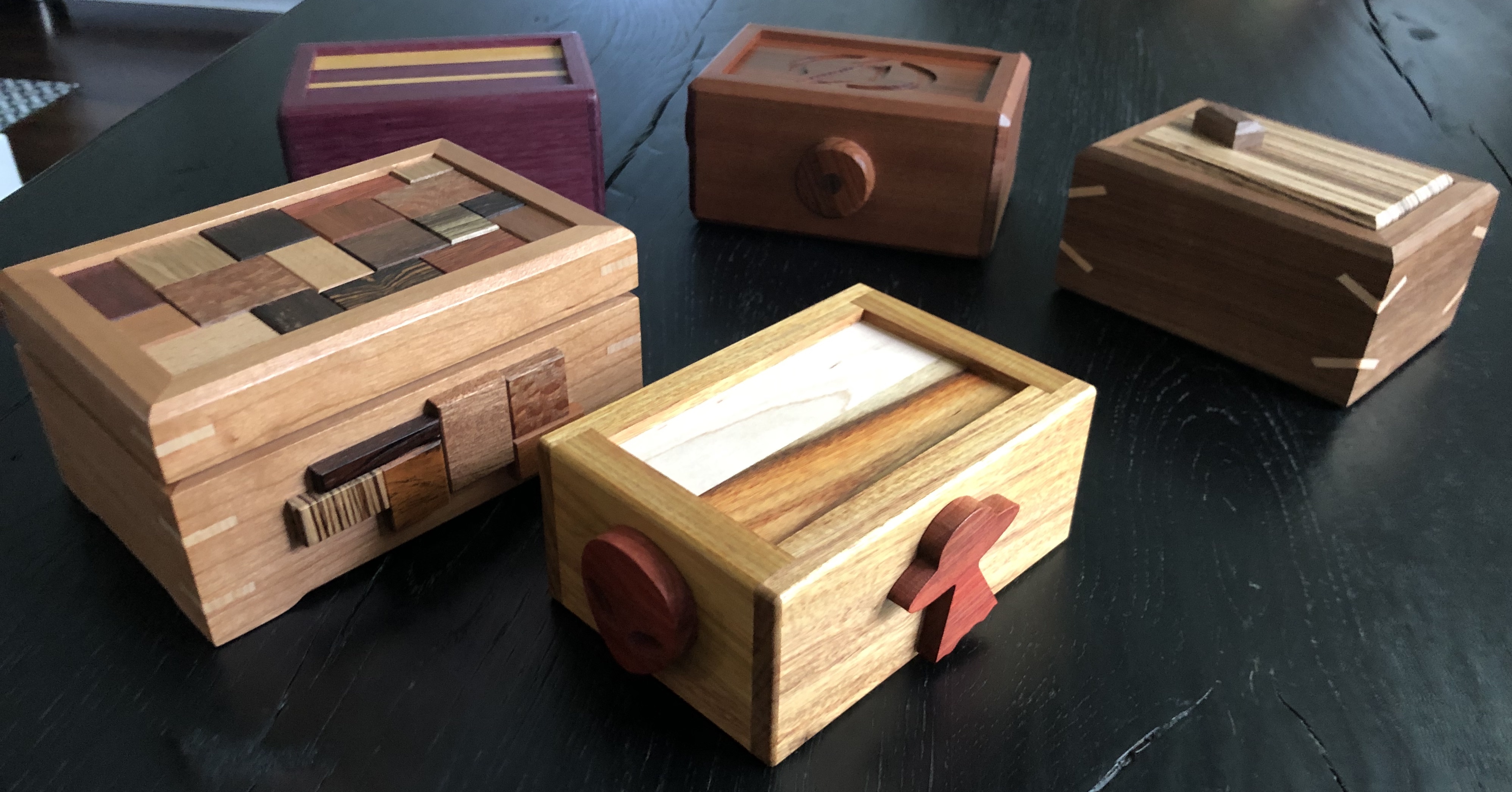
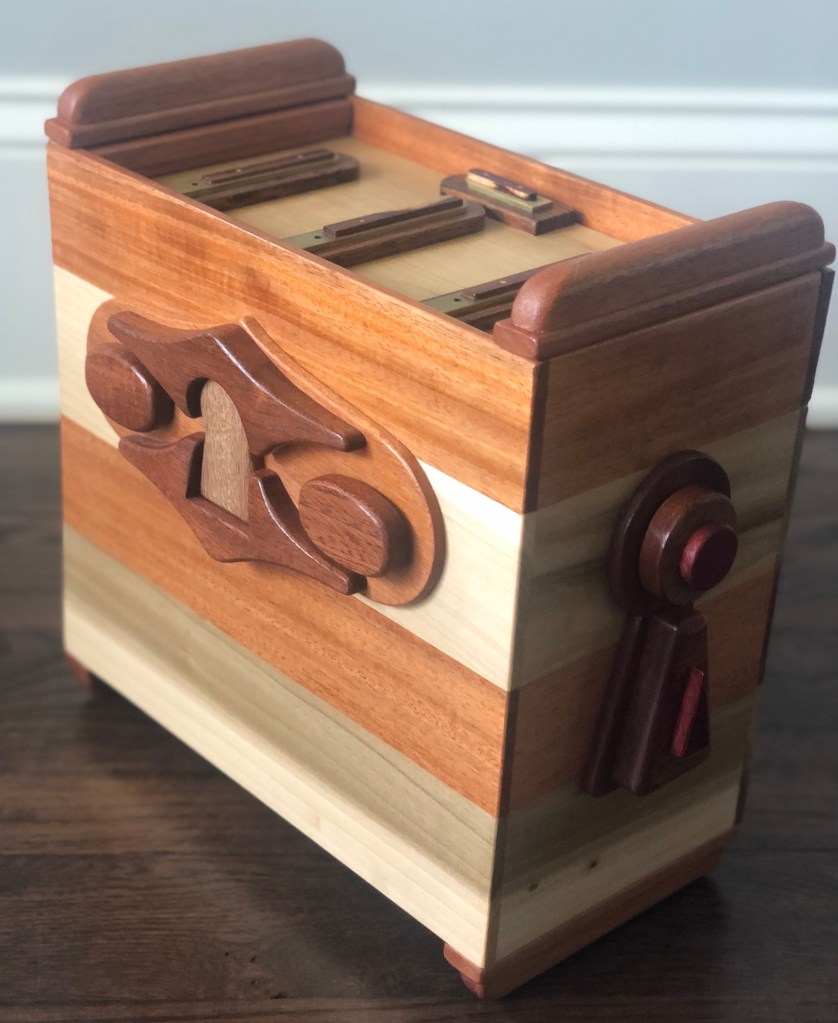
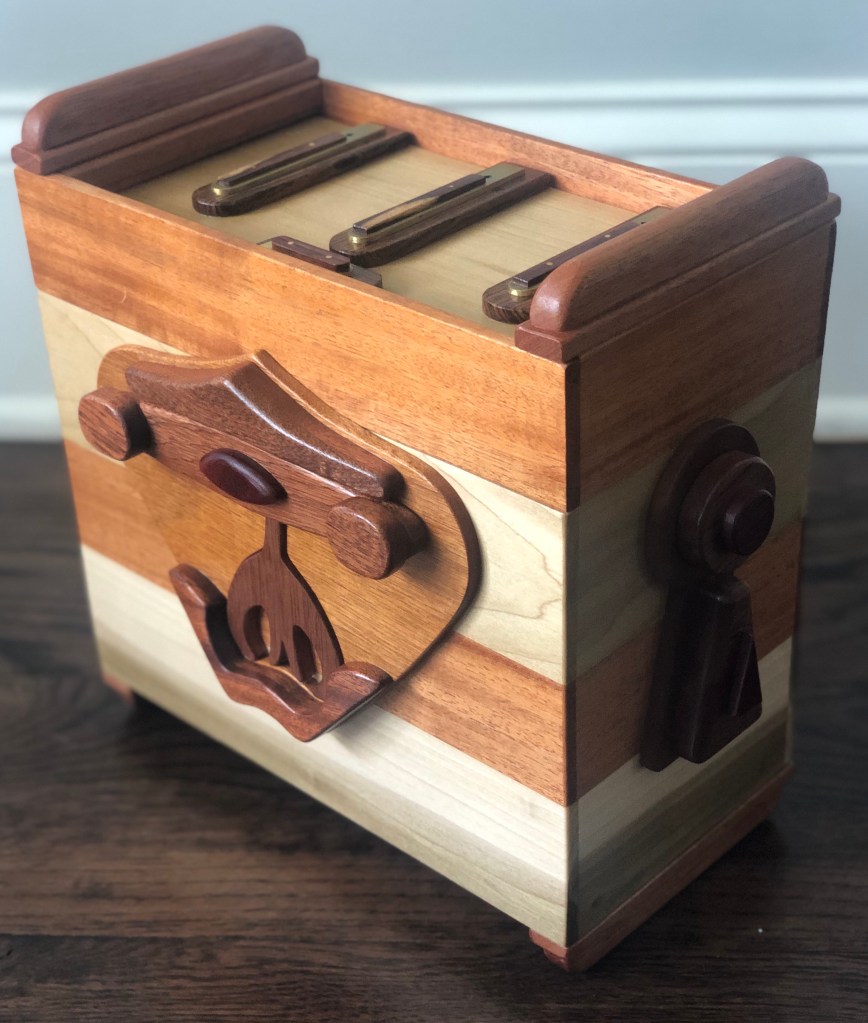
Dee Dixon, Canarywood and Bloodwood, 5.5″ x 4.25″ x 2.25″
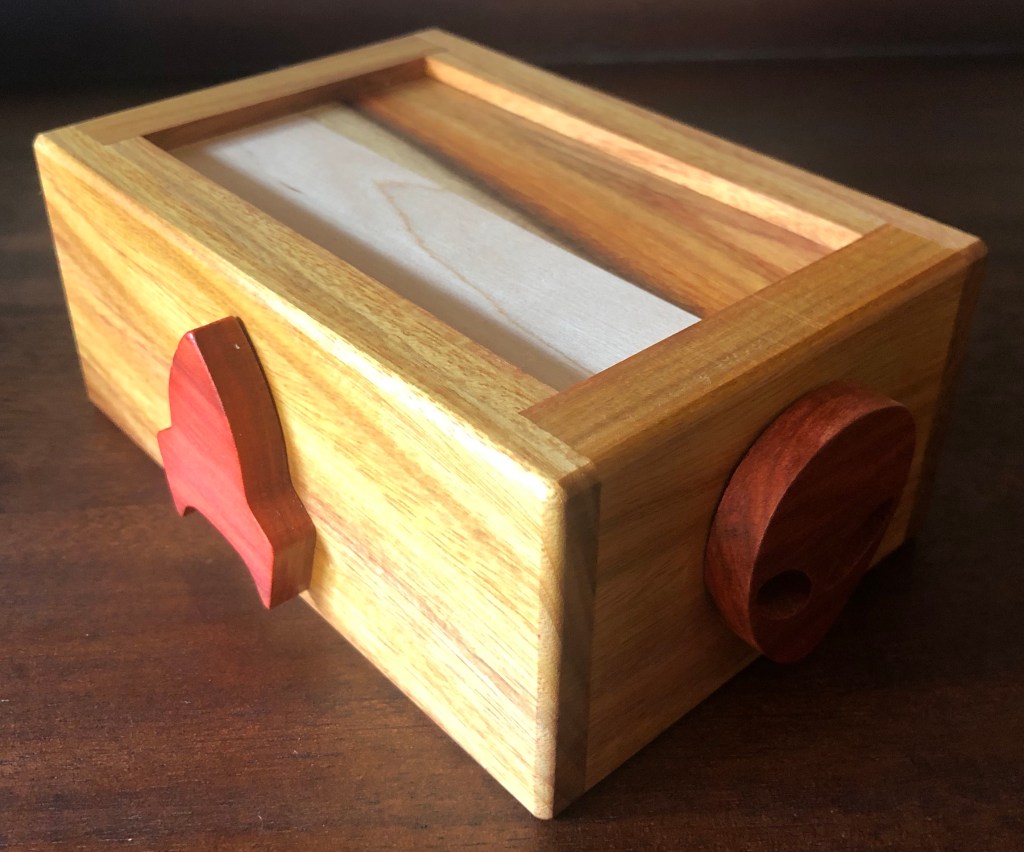
Dee Dixon burst onto the puzzle scene in 2019, and his 4th box, Space Case, is set to be released on CubicDissection in August. He made a huge splash with Where’s My Hammer? (WMH), a great puzzle box that has been pretty much loved by everyone who has gotten their hands on one, and proved he was no one-hit-wonder with his follow-up box, Blinded II.

I am fortunate enough to have an early (Etsy) copy of both WMH and Blinded, the woods or designs of which are a bit different from what was ultimately released on CD (WMH in particular had a few more rectangular bits of exotic wood on top and were made out of different woods for a unique, semi-custom appearance). Fortunately, their amply attractive aesthetics could well accommodate the slight concessions made for the sake of getting them into the hands of more puzzlers.
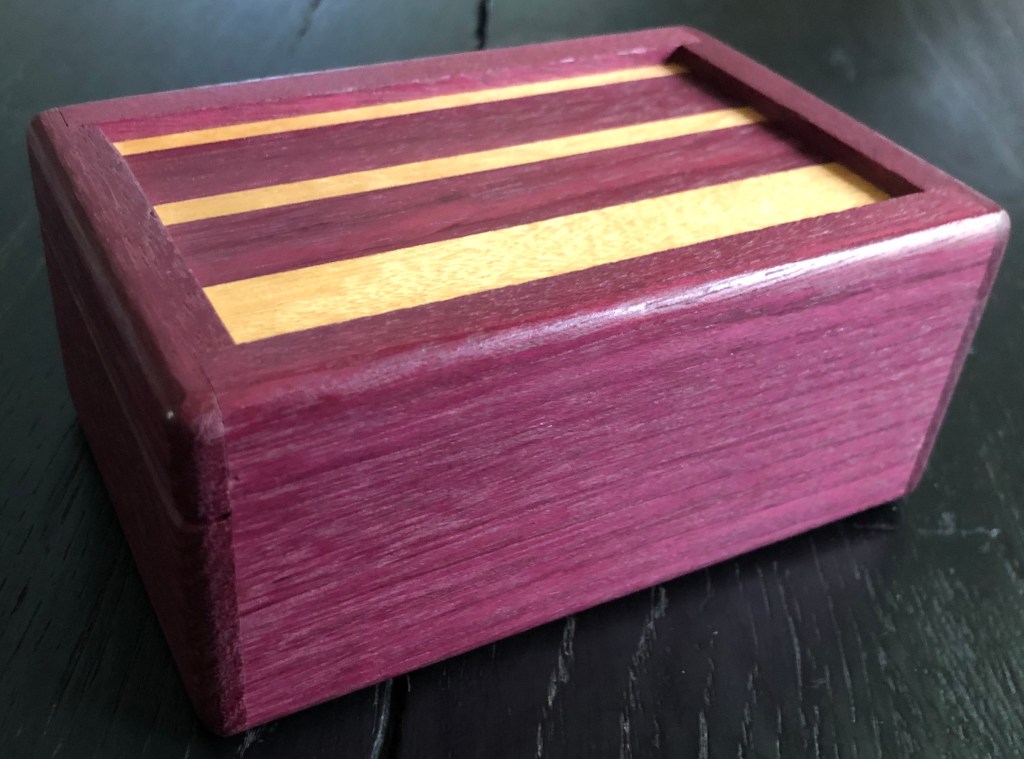
Dee’s first box, Slideways, was made in 2019 – there are not many established makers who can come out with four solid puzzle box designs in less than two years. With this kind of prolificity, it makes sense that he was able to start working on puzzles full-time, much to our collective benefit. There were only 8 copies of Slideways released (one of which sits happily among its siblings on my shelf) – it is a beautiful box, purple with some asymmetric strips of yellow wood (canarywood, maybe?) on top. While the simplest of his designs (just 2 or 3 steps), the concept is well-executed and shows Dee’s nascent puzzle-designing chops.
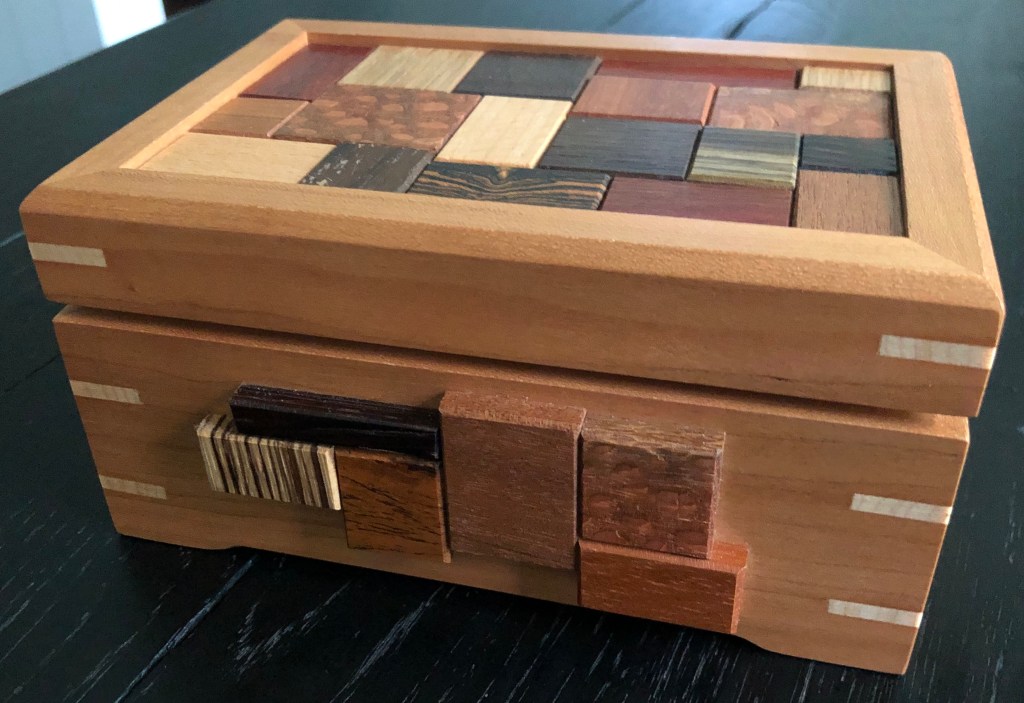
WMH is an especially excellent puzzle: it has plenty of misdirection, tools, and a tempo that I love to find in a box, with some relatively quick success at first, followed by fits and starts until you have found everything there is to find at which point you must actually think before you can hope to solve! The last step took me a few weeks of letting my subconscious work on it before I awoke one morning and somehow just knew the solution (admittedly following some conversations about it that had helped me eliminate some wrong moves) – I went upstairs, grabbed it, and bam! it worked! Super satisfying and very fun to re-solve. All in all one of my favorite puzzles boxes (although it does have one middle step that uses a mechanism I don’t love and may cause some puzzlers to need a nudge to find).
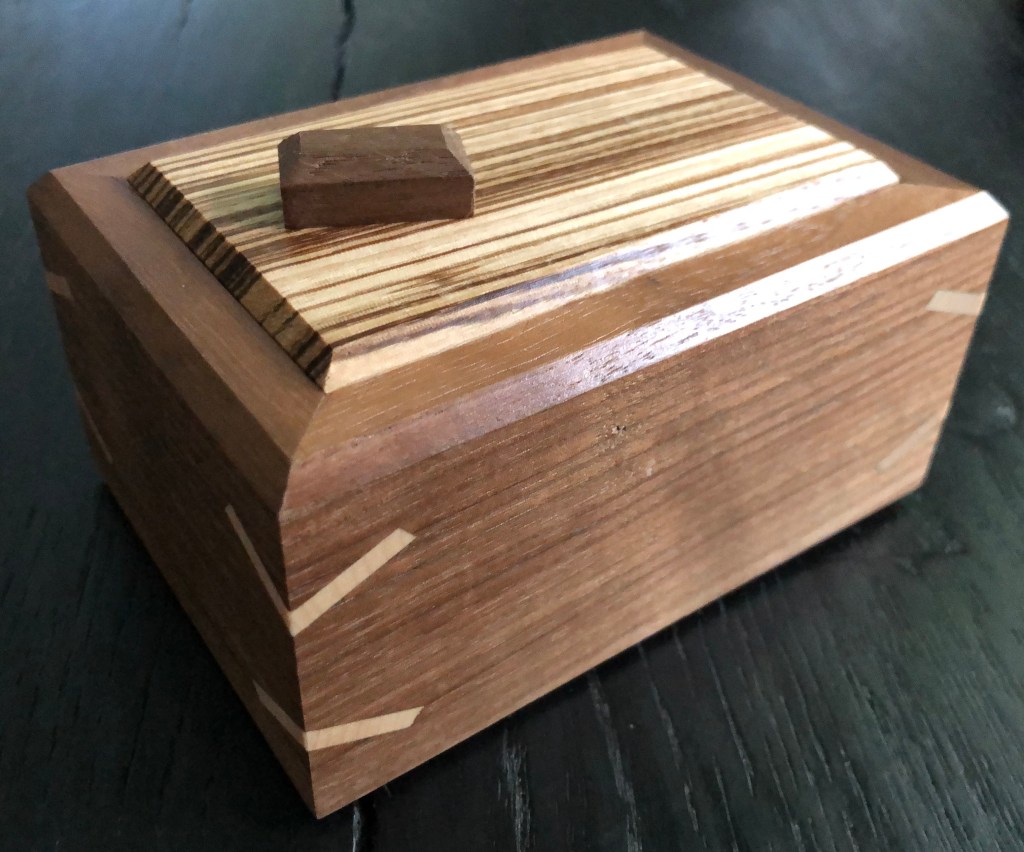
Blinded II is another excellent and attractive box and shares some similarities with WMH: there are misdirections that left me spinning my wheels for longer than I’d care to admit. With the first two or three steps finally found, it was not too much longer until I worked out the last half of the solution.

However, this is (supposed to be) about his newest release, Space Case, a canarywood box with a bloodwood figure on three of its sides: an alien head, a rocket, and a flying saucer with a tractor beam. Some of these figures will move off the bat; I don’t think I am giving anything away by saying that some will spin freely….. at first (in fact, this is the state in which I believe you can know it is fully reset).

I managed to get an early copy prior to its upcoming release – it is a 10-12 step puzzle box that requires close and careful observation to solve. You will need to develop an understanding of what is happening inside before you will have much hope of opening it.

Trial and error will help at first – if you’re not paying attention you may start to think that this is a blind solve but there is plenty of feedback inside and outside the box to let you know when things are happening. It quickly becomes apparent that manically shaking the box isn’t going to get it open. Instead, with some patience and focus, you will begin to get a picture of what is happening, helping you to build up a mental blueprint of each successive step until you can finally get it open.

Once open you will be rewarded with some clarity and it may yet take several resets to fully grok how it all works. This only adds to the fun as you can continue to work on the puzzle even after opening it – the full solution means making sure that each step is understood in detail, allowing you to open it quickly thereafter. Space is quite different from his previous boxes and highlights Dee’s ability to approach a puzzle box in different ways – while it is different in its mechanisms, it still features the practical attention to detail that makes his puzzles work reliably. As with all his designs, it has a wonderful aesthetic, using contrasting woods to create an excellent look. It also adds a bit of whimsy and fun to your collection that looks great on display.

I should add that I have the pleasure of possessing a copy of a metal prototype of Space Case (I pun – it has the Metallica “M” etched into its wonderfully dark wood). As it remains unsolved, I am not yet certain as to how it differs from the final version – I am not sure of whatever steps diverge from its improved offspring, but as a completist I’m grateful to have lucked out to get it from a fellow puzzler.

I look forward to whatever Dee comes up with next – we are fortunate that the appetite we puzzlers share has allowed him to eschew his workaday life to focus on what is really important: giving me more puzzles (us, I meant us: giving US more puzzles).
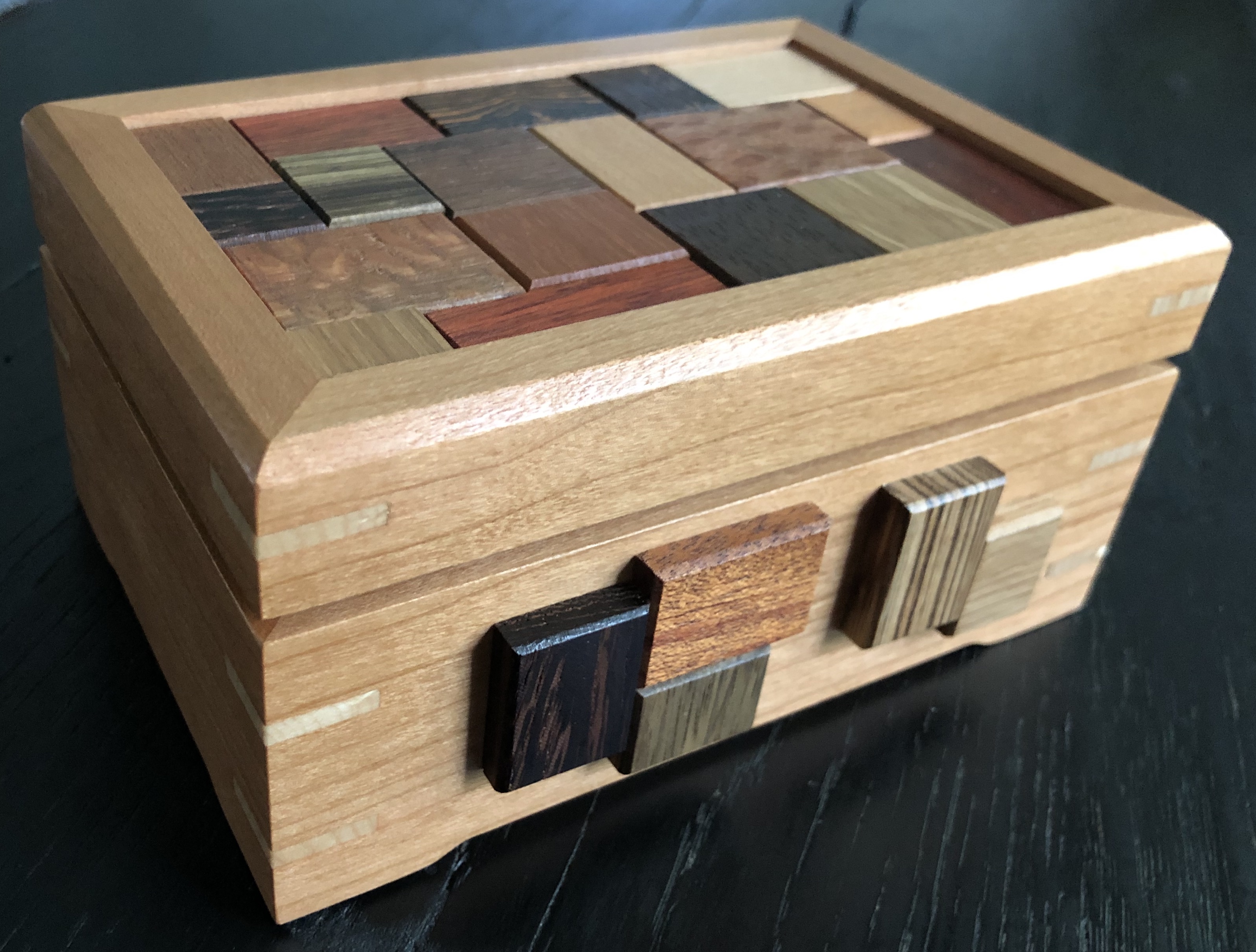

Space Case Difficulty Grade: Four Sinatras

Complete Oeuvre Grade: Five Sinatras

Locked Out: Lock Box by Eric Fuller

Lock Box

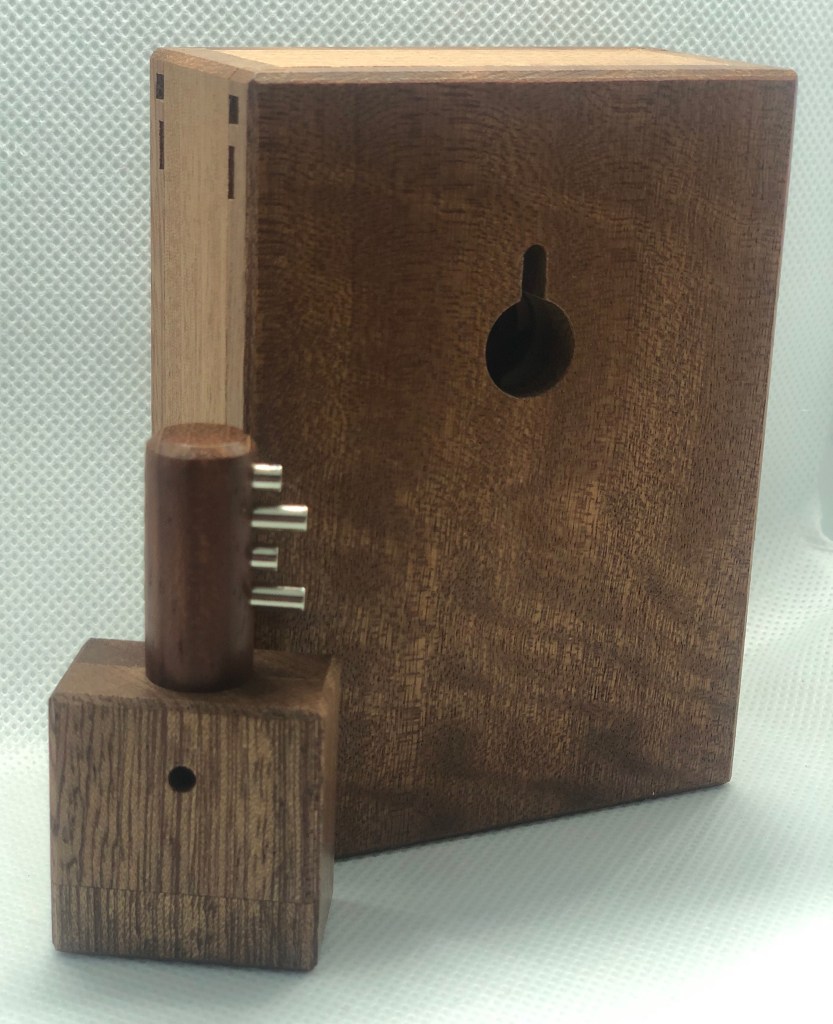
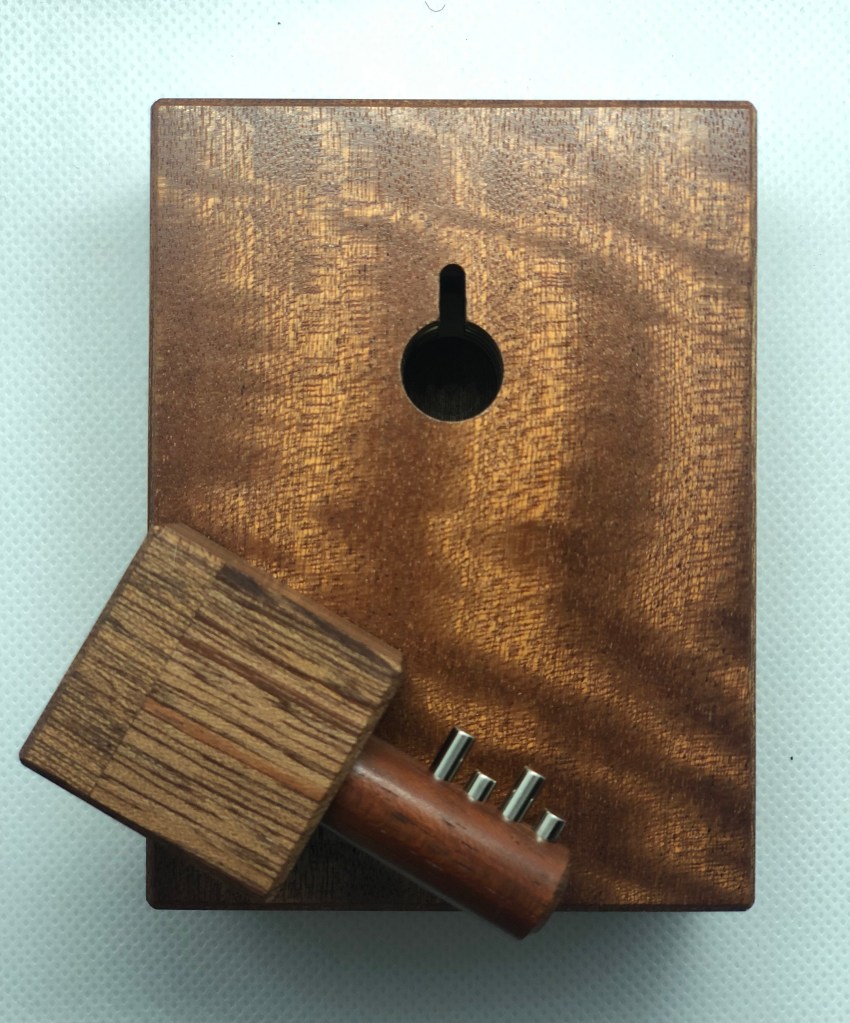
Eric Fuller, Figured Quartersawn Sapele 3″ x 4″ x 1.45″ Box, 2.45″ x 1.25″ x 0.75″ Key 133 Copies

I have a tendency to write about puzzles that may not be easy to obtain – I enjoy reading about such pieces, that I might live vicariously through the vague reminiscences of puzzlers more fortunate than I, adding to my ever-expanding list of unicorns and future lost auctions.

This is also due to the simple fact that great puzzles sell quickly. In a bout of good fortune, Eric Fuller’s Lock Box will again be available in limited quantities on CubicDissection.com in late July (2020). Personally, I need only hear Eric Fuller + Puzzle Box to anxiously wait to give him my money, but if you are unsure, my suggestion is: buy it. If you cannot afford it (at $450 it ain’t cheap), sell some other puzzles and then buy it. In the unlikely event you do not like it, there will be plenty of people happy to take it off your hands; I believe it is destined to be yet another unicorn with auction prices that get bonkers fast.

At first glance, we have a key and a box with a keyhole; so far we have more to go on than the T12 initially shows. Unsurprisingly, after dutifully inserting the key (because you’ve got to try, right?), you will find it will not get you very far. And that’s it.

Before too long, I had my first aha. Followed by a few more. Followed by a wall. And more wall. Then another aha. More wall. Aha. Wall. Wall. Think, plan, take notes. Wall. Aha? Hm, no: Wall……… and here I am: a pretty good understanding of the wall I am facing, with no idea how to get past it. I have made good progress, with the end somewhere in sight and I can confidently say this will be very satisfying when that final aha has been found.

The puzzle has so many of the things I love in a box (some of which I will not say): things that look they should work that don’t; a bit of progress that may not come right away, but before too long; a series of stops and gos, extending the pleasure of solving across a spread of mini-solves; the ability to make progress during my first, focused session; the inability to fully solve it during that same session; the need for both trial and error as well as actual thinking; pretty, pretty wood; and while it has some similarities with other great puzzles, it is mostly very unique.

Everything works well and consistently, which is always nice (and is not always the case even with some excellent puzzles). And did I say that it is pretty? The instructions do warn that this will not stand up to humidity well – we are advised to keep it between 40% and 60% lest it be ruined (!), so some folks may be facing a dilemma (I’m looking at you my Hawaiian puzzling friends).

I expect that the final step (or steps) will be something quite different from what has worked thus far: this is something many of Eric’s puzzles feature; were it not the case, I probably would have found it (them?) already, after all. It took me a while to determine how to get to my current stopping point reliably and with full comprehension but this final wall may be staring me in the face for some time.

But man, this reminds me of why I love puzzle boxes.


Puzzle Oddity: Anti-Gravity Box by Frederic Boucher

Anti-Gravity Box

Frederic Boucher, 3D Packing Puzzle, 2.25″ x 2.25″ x 1.5″

A few months ago, I wrote to Frederic in the hopes that he might happen to have a few puzzles that were seemingly unavailable. Most were, but he did happen to have a last copy of Anti-Gravity Box, which I happily requested, along with a few other new puzzles that he had on hand.

March 2022 Update: CubicDissection will be releasing a new version of AGB (titled: “Anti-Gravity Box+”) in it’s upcoming March 21, 2022 release – not only will this feature the ever-awesome craftsmanship and woods CD is deservedly known for, but, according to Frederic: “This new version includes a 2nd set of pieces with a solution that includes a trick that I think has never been seen in any other design yet…” This presumably constitutes the + in CD’s AGB+. So get your clicky finger ready as I don’t expect that these will last long: (EF + FB)CD = Awesome Sauce!

I have solved several of Frederic’s puzzles in the past – 3D and 2D packing puzzles that offer a serious challenge, comparable to pieces by Osanori Yamamoto, Koichi Miura, and Volker Latussek, and featuring elements such as interlocking elements and restricted openings.

Anti-Gravity, however, adds new mechanics by introducing a number of magnets into the mix. This makes for a unique and novel puzzling experience; it is no longer “just” about finding a way to get the pieces into their frame, as the magnets throw one’s general approach out the window.

The box is a 3×2 voxel frame that features a removable, acrylic top, allowing you to easily reset the puzzle and view your progress. The box has two, single voxel openings at 90 degrees to one another; both are in the middle of the bottom level, allowing you to enter each axis, but offering no room for angles of any kind. You must fill it with 6 identical rectangular 3×1 blocks; 2 have two magnets on one side, 3 have magnets on one end, and one block has none.

There are rules, of course: you need to place it on a flat surface and you are not meant to pick it up or tilt it (of course, you may hold it while you insert other pieces); you cannot poke your finger into either of the openings to push the pieces; it goes without saying that you cannot just lift off the top and place them in. The removable top is a kind addition, as it avoids the need to struggle to remove pieces when you have eventually found you had made a mistake. The puzzle arrived with the pieces stacked neatly inside. It is kind of cool to have a puzzle so confident in its structure, that it can come fully solved without having spoiled anything.

While by no means simple, neither is it an overly difficult puzzle – in my experience, one of his other packing puzzles was more challenge than I could meet (I am admittedly not so great at packing or interlocking puzzles generally – my interest far exceeds my ability when it comes to these types of puzzles).

More importantly, this is a very fun puzzle, and one with which trial and error will not get you very far; knowing the pieces you can eventually figure your way through it.. After spending a few minutes playing with it, experimenting to get to know the pieces and what they can and can’t easily do, I had to stop and think. This led to the first big aha moment of a series of such moments, leading to the full solution. Each step is its own planned approach, each piece requires forethought once a workable order has been determined. Apparently, this has two approaches that lead to similar solutions; I have found one and will undoubtedly spend some more time to find the second.

TL;DR: Anti-Gravity Box by Frederic Boucher is an original approach to a 3D packing puzzle, with magnetic pieces needing to be stacked using entries that allow for little margin of error. While not Boucher’s hardest puzzle, each move must be planned and purposeful through thoughtful approach and not just trial and error. It features a convenient removable top to reset after you inevitably make a mistake, and is so confident in its own puzzling, that it can arrive solved without lessening its challenge.


Originality / Fun Grade: 4 and a Half Sinatras

Difficulty Grade: 3 and a Half Sinatras

Instructions Included

Dr. PinkLady, or How I Learned to Stop Fidgeting and Solve the Burr

Fidget Burr (a/k/a Dollar Burr, a/k/a Chin Burr)

Jerry McFarland, 3.28″ x 3.28″ x 2.92″

Recently, I was lucky enough to get a copy of Jerry McFarland’s Fidget Burr (not to be confused with the puzzle of the same name designed by Tim Alkema and recently produced by Eric. Fuller of CubicDissection). It has quickly become one of my all-time favorite puzzles, with an extremely original design replete with fun and challenging nuances.

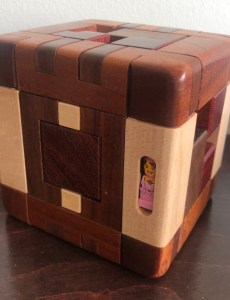
First off, the puzzle is beautiful, consisting of 23 wood pieces crafted from walnut, maple, mahogany, and bloodwood (with the keypiece possibly made in a different exotic wood, such as Bubinga, Santos Rosewood or Cocobolo), for a interestingly contrasting aesthetic. It feels soft, presumably waxed into a delightful sheen that allows the puzzle to stand out, adding to the temptation to play and fidget beyond one’s attempts at finding the solution.

But what really makes it stand out is the addition of 22 magnets integrated into the puzzle, adding layers of novelty, difficulty, and stability that makes it stand out from its (still excellent) burr cube brethren. And last but not least, a Lego minifig can be seen, trapped within a window on one piece of the puzzle’s frame, lending the puzzle a hint of puzzle box / take-apart puzzling.


NOTE: The following paragraph reveals details of the puzzle’s first move – I feel comfortable writing about it as this has been blogged about before and is not really a hidden feature of the puzzle, but for those purists out there who want to know absolutely nothing about a puzzle, I thought I would give you fair warning – it has been formatted to make it easy enough to skip:

iIt is readily apparent which piece offers the first move (being the only piece that can move) and, when you press it, you are rewarded with a chain of clacking, automatic movements as 4 pieces are released, magnets forcing them out. This chain will most certainly be repeated again and again, both in the search of its solution, as well as the sheer entertainment value.


Following this first step, I immediately hit a wall. Fortunately, this first step is more than fun enough to play with absent any further progress. However, after numerous attempts at exploring possibilities through trial and error, I explored that other method of puzzle solving: thought. With this, I was able to narrow down the possible next steps, more quickly finding my way past this wall. Soon, it is possible to remove some pieces of the puzzle.

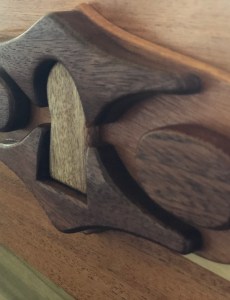
However, this is not the end as one must deal with some (possibly less difficult, but still non-trivial) additional steps, revealing the reason for at least one of the puzzle’s aliases. As you continue through the puzzle, you find a number of added details, magnets, chamfers, clips, and pins that really show off Jerry’s expertise, as they allow for a more consistent and stable puzzling experience (these are detailed in the included instructions in a series of notes, which would be spoilers if shared). One such detail does double duty, causing me several minutes of confusion as I lost all momentum just as I thought I was about to free my Pink Lady. Moving past this, the lovely lady can be freed (and even her window frame reveals evidence of Jerry’s thoughtful and precise approach to puzzle-making, as it is designed in such a way as to make her intended orientation obvious when looking to cruelly force her back into her wooden prison).

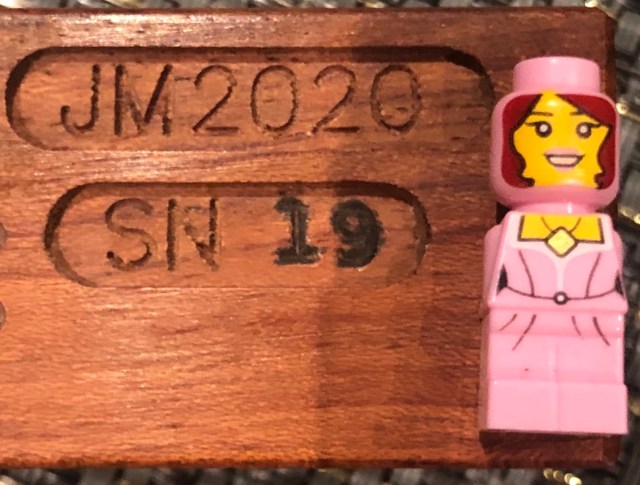
The key piece has the puzzle’s “signature,” the maker’s initials, year of creation, and serial number etched into perfectly matched frames (as seen above).

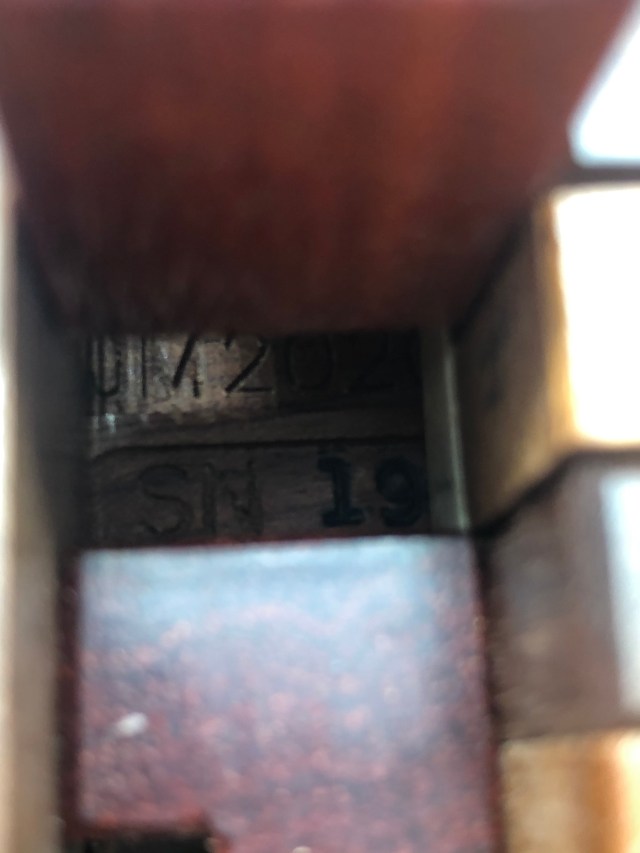
Note that this picture is also no spoiler, as Jerry designed the puzzle such that one can view the signature without having solved the puzzle – yet another unique detail that demands appreciation.

Reassembly is not overly difficult: Jerry has thoughtfully marked some of the pieces to aid with the proper orientation, allowing you to reassemble the puzzle with pleasure rather than frustration. Burrtools is unnecessary, good considering my strong suspicion that it would not provide much (or perhaps any) assistance.

As mentioned, the puzzle comes with instructions and notes: 5 pages that includes solution descriptions assembly instructions with pictures and illustrations, as well as the aforementioned notes and a general explanation of the puzzle (the latter being graciously printed on the first page to avoid any accidental and unwanted spoilers).
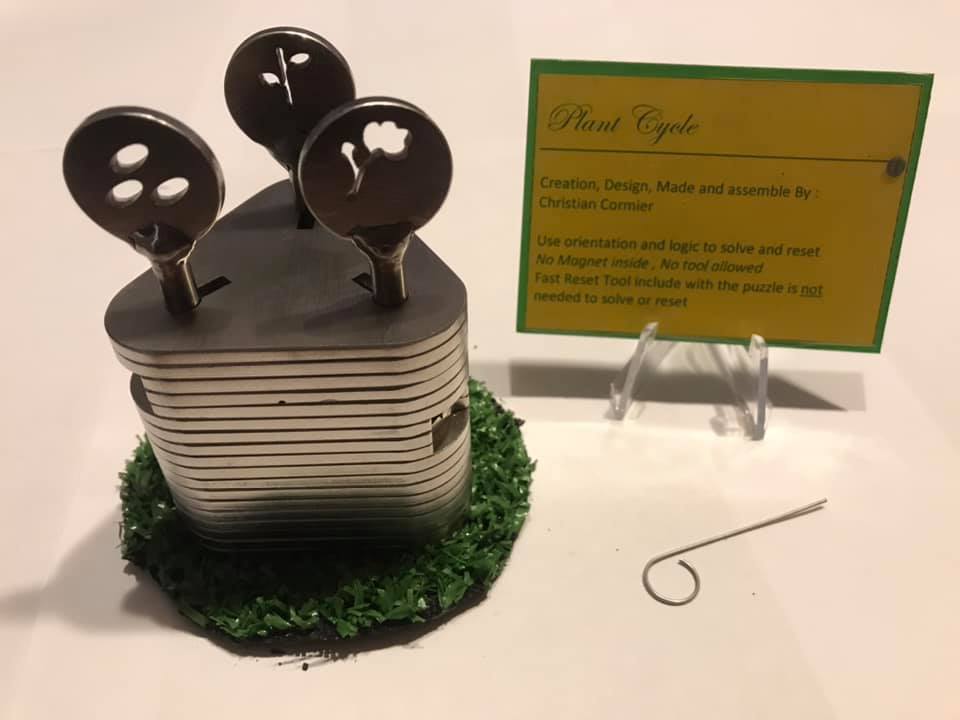
Fidget Burr will be entered in the 2020 IPP40 Design competition, where I would be surprised if it did not earn some significant recognition. While 2020 seems it will be a banner year for puzzling, Fidget Burr will no doubt be amongst its top designs; it is certainly amongst my puzzle favorites overall (assuming my judgment is at all reliable), not least considering its atypical replay value.


Awesome Sauce Grade: Five Sinatras

Let’s See What’s Behind Door #8!

Dark Fairy Door

Tracy Clemons

After cyberstalking Tracy Clemons for some time, in late 2019 I saw she had something available. As the cost was several times the cost of my next most expensive puzzle (until Secretum Cista comes, at least), l consulted my horrible, horrible wife, seeking convincing that not getting it was the right thing to do, and she, in all her horribleness, told me that I should get it because it would make me happy (such nerve!).

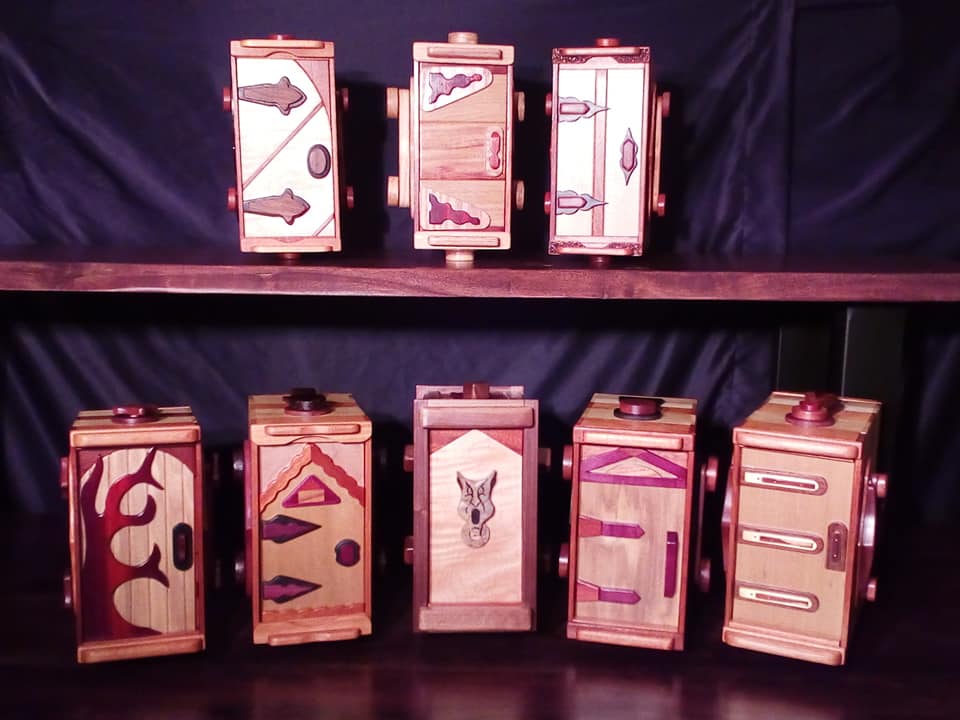
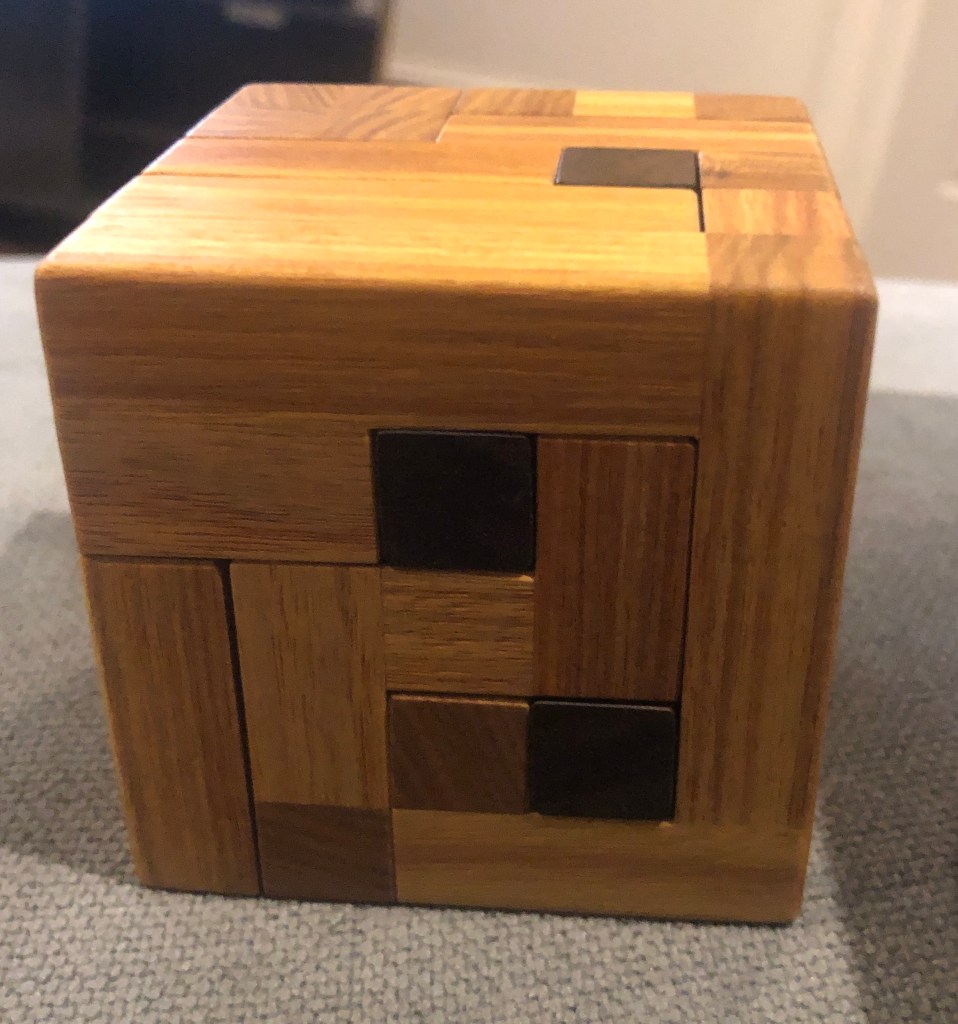
There are 8 copies of Dark Fairy Door (DFD), each with distinct aesthetics hiding the same mechanisms and additional puzzles within. From the pics one could see that there were two doors, on the top and bottom of the box, which, we were told, contained a pentominoes set, a second puzzle box, and a fairy treasure (different for each box). They were 10″ x 11″ x 5″, and would require a few dozen (!) moves involving about 60 pieces (22 of which constitute the pentomino set) to travel through to the end.
My DFD

As with any box from Tracy, these did not last long – I was fortunate that one of my 2 favorite designs was still available, although I would happily have taken any of the 8. So I sent the PayPal, and within a few days a large box was at my house.

I picked up said box and… dang! That thing is heavy, coming in at close to 7 lbs. Really I should say the puzzles, as we have the external doors, the pentomino set, and the final puzzle box (whose secrets shall yet remain a mystery, except to say that opening it is only one part of solving it).

More importantly, pictures are hard to really show the attractiveness of such a large, well-made wooden box. The contrast of its many woods and the whimsical, detailed designs featured on all 4 sides make for a very pretty piece of art. It was even permitted to remain downstairs, where non-puzzling people might see it (!), much to the chagrin of its tinier cousins upstairs.

I set about working on my new favorite thing and made some headway, discovering a couple tools (presumably), some moving thingies, some unmoving but potentially moving thingies, and the sounds of unseen moving thingies. However, I could not connect most of these thing(ie)s to one another, and certainly no door would open.

Fast forward several days and still not much progress. Clearly the puzzle was broken……. no? It’s not broken? Hm. Fine.

……after another couple weeks, I chatted with Tracy to get some direction. I had done a lot, but there was (at least) one thing I simply could not figure out. I knew what I needed to do, but not how to do it! Tracy benevolently (and with more than a little amusement at my bewildered state) led me to a place where I could get the first step, which turned out to be the first of a series of steps that would finally allow me do that thing I knew I needed to do.

There were certainly bumps and blocks between that moment and the final discovery of my treasure, but I had spent so much time exploring the box that it was mostly a matter of figuring out how everything worked together.

The pentomino set is beautiful: lovely, silky smooth pieces (probably 1/2″ – 3/4″), waiting somewhere inside; even more beautiful is the second puzzle box, which really isn’t a full description as it involves more than “merely” opening a puzzle box, although there is that too, of course. I left this displayed for a few days before setting about resetting the box.

A few days later, I was able to fully reset, re-solve, and re-reset everything in one sitting. It was then that I was really able to truly appreciate how beautifully the steps cascaded from start to finish, all the disparate pieces and movements coming together into a cohesive and flowing whole. All in all, there is a sum of parts that creates a puzzling experience that feels like more than “just” solving a puzzle – and I think that is the idea….. you are, after all, finding your way through a dark fairy door… and Lil’ Ms Fairy Pants will not be what’s waiting for you on the other side…

Deck of Cards for Scale

Grade: Four and a Half Sinatras

No, I Don’t Think He is Dead

He Can Not Get the Ball!

Yoh Kakuda and Yasuaki Kikuchi

He Can Not Get the Ball! is a winner of the 11th Annual Karakuri Idea Contest. This box was built by Yoh Kakuda and Yasuaki Kikuchi out of oak and cherry, based on an original idea by Masaki Ohnishi,

The puzzle depicts a moment in which most people have found themselves on at least one occasion – arm stretched out under a dresser, cheek pressed to the floor, face turned so you can get as far in as possible, fingers just brushing the elusive item, still just a bit too far out of reach. Fortunately, the artisans have left us an unattached baseball bat and broom to help us in our quest.

Perhaps the best detail in this puzzle is the tiny baseball that can be seen deep under the dresser – but only if you get your eyes level with the bottom of the dresser. This “hidden” feature really makes this puzzle for me, as it puts the puzzler in the place of the child.

You will notice that the child’s eyes are X’ed out. I am not sure why this is, except perhaps to imply that this poor child died while struggling to regain his lost ball. A tragic end to a common situation. But while we may be too late to save this tiny wooden person, we can at least get his ball! Well, no, actually we can’t…… but we can open his dresser! This is, after all, a puzzle box, albeit a rather simple one.

As with many Karakuri (but certainly not all), the solution is rather straightforward, fitting thematically into the concept of the puzzle, easily deduced from the situation being depicted. However, this collector’s piece is exquisitely made and is surprisingly fun to solve.

The video features the solution following a short spoiler break. As with my last post, this may not be a puzzle that will appeal to a pure solver, but it is one that looks wonderful in my collection – if you are a collector, I definitely recommend getting one of these, if you have the chance.

The Tail of the Uroboros Puzzle Box

Uroboros

Shiro Tajima

Check out the Uroboros box from Shiro Tajima of the Karakuri Creation Group, made in 2012. This is my first video that includes me solving the puzzle.

It is not an overly difficult box, but it has a couple tricky-ish steps that utilize some cool movements. As with many Karakuri boxes, the beauty of the piece itself is as important as the mechanisms, and this box does not disappoint.

The video includes a spoiler break halfway through, so if you do not want to see me solve it, make sure to close it out at the break.

I went back and forth on whether I should post videos of my solving puzzles – I generally do not watch solves unless it is a box I have already solved. Early on, I watched some videos of puzzles I thought I might never get, only to find myself with the opportunity to get it or to solve it. However, if you are purely a Solver focused on puzzling time per $ spent, then this may not be something that will appeal to you.

For collectors out there, on the other hand, this is a really nice box, and a welcome addition to my own collection.

The Uroboros is a snake that is forever eating its own tail – it is a symbol of regeneration and renewal that dates back to Ancient Egypt and was adopted by the Ancient Greeks and, eventually, the Gnostics and alchemists. Tajima made this when he was doing a series of puzzles to reflect the Chinese Zodiac – this was made ahead of 2013, the Year of the Snake, following up on his Dragon Wing box.

Hope you enjoy the video!

Lost in the Weeds

Plant Cycle

Designed and Built by Christian Cormier

Plant Cycle is a limited run of 50 puzzles, designed and built by Christian Cormier as a follow-up to his Father & Son Dueling Keys. Plant features three custom keys (as opposed to Father’s two), which are protruding evenly from a BIG piece of layered metal, notched discs centered in recesses at different heights outside of each key. The top of each key has a different image cut out: seeds, stem, and flower (from where we get the name). The goal is to remove all three keys.

The first thing that you will notice should you be fortunate enough to get your hands on one, is that this thing is heavy. Like drop-it-in-a-sock-and-fight-your-way-through-hordes-of-zombies heavy. It comes with a circular piece of astroturf to thematically protect your table and shelves from this metal hulk (did I mention it was heavy?), a card with instructions, and a thin reset tool, which is not required to reset the puzzle but can certainly help. The instructions tell you that there are no magnets inside and no tools allowed (including the reset tool, obviously).

I ordered this from Christian a few months ago, and it arrived quickly, packed well and with care. It feels solid in your hands and looks very cool. And so I began turning keys. Unsurprisingly, they do not just come out, but each one can be turned this way and that, hitting obstacles and dead ends, allowing you to lift each one up and down (to some extent), but not to actually remove them from the base. I did most of my work on it with it at rest on a table, occasionally picking it up to turn it around and peer confusedly into its three faces, wondering what in the heck is going on inside. It would end up taking me many hours over several weeks (and a couple nudges from him) to fully solve it.

It is not a spoiler to say that working on this puzzles feels akin, to a limited extent, to manipulating three Revomazes that share the same base. Whether or not it can be solved in the same way is not something I will say (and considering the fact that I have never actually solved either of my Revos, I suppose I am hardly one to do so). Suffice it to say that this aspect of the puzzle is clear as soon as you start getting lost in each key’s journey up and down and all around.

I will say that there is more to the puzzle than “just” wandering through the three keyholes – Christian included a few tricks that made this puzzle stand out and be truly enjoyable. The solution had to be worked out through deduction, with a bit of help from some clues provided by the puzzle itself, in combination with trial and error and general fiddling about (and perhaps a bit of mapping).

On several occasions while working on it, I felt that I was just about to “solve” one or more keys, only to find that Christian was just messing with me. But I never felt frustrated, only mystified. And when that first, big a-ha hit, I was genuinely pleased: it made total sense and let me know, to some extent, what I needed to do, without actually knowing how to do it. This was something I had to work out intellectually before I could apply it, which to me is a hallmark of a great puzzle. And this disconnect between understanding at least this one trick and knowing how to fully implement it affords the puzzler even more quality puzzling.

Having figured out this aspect of the solve, I proceeded to make good progress, but I would still need a few more hours to fully solve this behemoth, getting lost and trapped many times, creating the need to backtrack and rethink my approach as I progressed through to the end. As I indicated, this main a-ha is not the only one, and there were other hidden features that I had to discover before I was able to get any one key out. This elicited a squawk of success, startling my sickeningly supportive spouse as I set this single key down with satisfaction, somewhat certain that I could now solve this sucker. However, Christian again seems to have planned for this, as I was not able to easily go on to remove the second and third key, and actually had to (reluctantly) re-insert the key, seemingly having overlooked something or needing to take a few steps back before I could continue forward.

Nonetheless, I was now able to find my way clear to the removal of the second key without too much trouble. But the third would elude me for quite some time, requiring more painful thinking as I tried to see what I was missing. Finally, eventually, all three keys were out, and, after the requisite happy dance, I snapped some pics for posterity and allowed it to rest peacefully before I would go on to tackle the reset. I chose to tackle this without the use of the provided tool, although I did use it at the end to make absolutely sure that all three keys were fully reset back to their starting positions.

Plant Cycle is an excellent puzzle from a relatively new creator who I am certain will bring us some new and exciting puzzles in the future – it is a unique puzzle that incorporates some mechanisms that I have not previously encountered with a novel goal. I also love this puzzle from a philosophical perspective, which may sound somewhat pedantic, but had to be said as it is not something one will generally find in a puzzle. Plant took the lessons Christian learned from Father & Son and applied the same concepts to create this apparently more difficult puzzle that will most assuredly delight and confound any puzzler and I genuinely look forward to seeing what he will come up with next.

Grade: Four and a Half Sinatras


Pushing All the Right Buttons

Push Button Burr

Designed by Ken Irvine
Built by Tom Lensch

Let me start by saying that, historically, I am not particularly good at interlocking solids. It is only in the last few months that I have begun to expand my puzzling horizons beyond boxes, SD and locks. My first burrs had me running to fellow puzzlers that I have inter-met for burrtools files (thanks MrMark!). I at least felt vindicated by Mr. Eyckman congratulating me for having “solved” his puzzles when I returned to him, tail between my legs, for help reassembling a couple of his pieces (even worse: these were some of his simpler ones!).

I feel no shame in saying this – at least no more than general. I say it to provide some context to my imaginary readers…

Not so long ago, I ordered a few puzzles from Tom Lensch – if you do not know who he is, look him up and buy whatever he will sell you. They came quickly (and were packed amazingly well!). One of my new acquisitions was Push Button Burr, an interlocking burr cube (a puzzle-fluid identity). Designed by Ken Irvine and built by Mr. Lensch, it arrived, much to my initial dismay, unassembled!

Me of little faith, I looked at the pieces and thought that I may as well crawl into the dark hole of failure in which my meaner puzzles prowl. I had read of the joy of disassembling this puzzle – I thought that perhaps I would be able to reassemble it (with the help of some tiny colored stickers and a roll or super skinny post-it tape) after I finished taking it apart.

But when my package arrived with several more balls of bubble wrap than expected, I realized that my assumption did not match that of the master Mr. Lensch who puts interlocking burr cubes together for breakfast.

Instead of a solid cube with little brown buttons, I had a few twisted crazy pieces of varying strange Seussian shapes, and five identical brown sort-of Z’s. What to do? Do I first work on some of the other puzzles that had arrived? No! Do I immediately give up and ask for the solution? Maybe! Do I stare at it stupidly for longer than I care to admit? Probably!

But if I were to assemble it based on instructions, I would kill the fun of disassembly (this works better the other way). So you know what I did? I did another puzzle.

Later, after getting myself in the right mindspace by failing to solve something else, I sat down with my dysmorphic cube pieces and figure I will at least try before probably failing.

And try I did – it took me a while, but I was able to build the frame; it made more sense to me than many such spatially demanding puzzles do – perhaps the disorder saw something in me and decided to give me a break. Eventually, however, build it I did! I was pretty satisfied with myself, until I remembered the five buttons still sitting there outside my almost-cube. The nature of this puzzle is such that it looked close to finished – absent a few holes (10 if you have not guessed), the cube was complete.

Now here is one of the things that makes this such a great puzzle: building it had required trial and error, memory, and, yes, a bit of thought. But getting these buttons in? Well, that is going to take a lot of thought! Not my strong suit, but let’s see if any of those brain cells survived my adolescence.

And so I thought before trialing. And then I thought some more after erroring. Slowly, a dance began to form. These would require a very specific order, back and forth, cube and button, button and cube; the cage was there but must be rebuilt with its prisoners present. And, eventually, I saw it: the right order, in the right way, and piece after piece slid into place, leaving my buttons ready to be pushed (unpushed?).

Declaring myself the smartest man in the world (or at least the room), I gleefully showed by wife, who, true to herself, didn’t really care but did afford me a brief “That’s nice, dear, now shut up” look. But I was too busy admiring my utter and complete brilliance: clearly it goes Albert Einstein, David Byrne, me, and then whoever invented the pop tart.

After doing my happy dance for an acceptable amount of time, I proceeded to do it for an uncomfortably longer time. I went to discord and bragged about something so many others can do more easily than I. And then I went back to push buttons and let the dance play out in reverse, appreciating the creativity it took to design this mashup and the skill that went into making it.

High on my own utter and complete genius, I went back to Stumbling Blocks and was quickly and absolutely humbled.

Oh well, it was good while it lasted.

Grade: Four and a Half Sinatras

Oh Schrat

My latest (meaning second) video takes a look at Schrat by Stephan Baumegger, an interlocking solid puzzle featuring 6 burr sticks in a wood cage. It is a beautiful puzzle of the high quality one should expect from Stephan’s work.

I have only started disassembling this piece and it is proving to be an accessible and fun solve. I have been getting better at these types of puzzles, having mostly collected boxes and other take apart puzzles in the past.

I generally find reassembling interlocking solids to be quite challenging. With practice (and some small, colored stickers), I am improving as I gain experience. In this case, I think I may have a chance at reassembly without resorting to burrtools (file to be begged off some other puzzler, because I am lazy and only semi-computer-literate).

This is a good-sized puzzle and it looks and feels great. I could say what woods are used, but I would be guessing and that is unlikely to be fair to the puzzle or to the maker. However, it is definitely a piece that shows well, with its corner joints an off-white color that plays well with the darker woods of the burr sticks, set within a frame that features lovely wood striations.

As with most of Stephan’s works, I think it is a great addition to my collection aesthetically, with a solve that feels fun (although I have only begun working on it).


Grade: Four Sinatras