The (not really) Definitive Guide to the Karakuri Creation Group: A Brief History, Puzzle Box Reviews, and a Word on Club Membership

Small Box 1-8, Cube Box 1-4, New Secret Box 1-4, Double Box, Trick Door & Expansion

Karakuri Creation Group (KCG)
(scroll down for the puzzle box reviews if you do not want to hear my partially-informed mini-history lesson)

Why Puzzle Boxes?

“Solving the IMPOSSIBLE COFFEE CUP Box!”

“Opening the AMAZING ANTIQUE RADIO Puzzle!”

There is a reason these lures work, and it is not just the excessive use of capitalization and exclamation: to most, if not all, of us self-proclaimed puzzlers, the seemingly inaccessible compartment is a silent promise, a tacit seduction through the placid excitement of discovery, the inevitable and elusive “a-ha” both its premise and its resolution. It is the youthful desire to reach the cupboard within which lie cookies, the ancient drive to see beyond where there be dragons, the adolescent fascination with spy-craft and Goonie gadgetry, the absurd adult illusion of control and reason. Regardless of who or what we are, of what we have or where we come from, the Solution has become the mature repose that awaits us if only we can understand How It Works, if we can grok the secret simplicity lying behind an elegantly explicit deception, if we can build the mechanical bridges that lead us there.

To put it plainly: puzzle boxes are cool.

And just as the history of the modern puzzle box can be traced to Japan, so too can many of the coolest be found there, from a collective of Japanese artisans known as the Karakuri Creation Group (KCG): their works are beautifully made, with exquisite craftsmanship belying their ingenious mechanisms, ranging from whimsical and playful, to challenging and mystifying.

Several years ago, as I was obsessively compiling Pinterest tomes of hidden rooms and secret passageways, I stumbled upon somewhat similar clickbait to that mentioned above; the screamingly bothersome caps ignored, my eyes fell upon the exquisite woods of objects, some clearly shaped like a box, others far from it, all of which promised the recently ranted poetry of puzzling. My inner Indiana awakened, my submerged Data drawn from the depths (the spelunking child, not the cyborg), until what was a shallow swim into other people’s excessive home improvement projects became a deep dive into a previously unknown world of challenges and frustrations: I was forever Puzzled.

One of the best decisions I have made, a list which is rather depressingly short, was to avoid solution vids early on; in a rare feat of self-control and precognitive consideration, I rightly held off in the hopes that some of these might one day make their way into my hands. Many and most have yet to do so, but the wait is surely worth it if only for those few that have or will because, for me, puzzling will forever be inextricably linked with Karakuri. Not just because they were some of the first I found, and not just because they are the direct evolution of the bulk of the puzzle box’s history, but simply because they are, to once again emphasize perhaps the most important takeaway of this rather rambly article, forking cool.

A Brief History

(please know that any mistakes, should they exist, are mine alone)

The Samurai of Edo Japan could not guarantee safe passage for all those making their way along the well-worn roads between Tokyo and Osaka. As horses drew their precious belongings through the Hakone mountains, merchants, nobility and commoners alike feared the presence of the Highwaymen preying upon unwary travelers seeking safe passage through the embrace of Mt. Fuji. 

Inspired by the diverse variety of trees in the region, artisans responded to this need for secrecy by applying the ingenuity of the neo-Confucianist intellectual rigor alive at the time. Newly developed architectural principles used to enable buildings to withstand the frequent earthquakes of the country were scaled down and integrated into small, personal items. In the middle of the 19th Century, markets began to sell Shikake-Bako, or trick boxes, where workers could hide valuable tools and property in compartments hidden within otherwise ordinary boxes and small, Tansu chests. The novelty of the Shikake-Bako reached the ears of merchants and nobility and, eventually, Japan’s newly developed leisure class turned its hungry gaze upon them, leading to the development of increasingly difficult mechanisms. In the 1870’s, Takagoro Okawa (and others) began integrating the Yosegi marquetry and Zougan art popular at the time, creating the Himitsu-Bako, or personal secret box. These traditional puzzle boxes use a series of sliding panels to unlock one or more compartments and continue to be produced today.

Fast forward a century or so, and the KCG is created, helping to evolve the traditional puzzle box into the post-modern era, bringing craftsmen and women together to make ever more unique and tricky mechanisms, pushing the definition of what constitutes a “box” and playing upon the assumptions we make when thinking of the comparative simplicity of the traditional Himitsu-Bako’s sliding panels. The word Karakuri, literally mechanism, was the term used to describe the mechanical automatons that date as far back as the 17th Century; the word is now synonymous with the mechanical puzzle box and has helped birth the strange and wonderful works of makers across the globe.

The KCG has grown to include 10 Japanese craftsmen and women (as well as six “friends,” including a single non-Japanese puzzle-maker, the talented Kagen Sound). These creators all bring their own unique style and perspective to puzzle-box-making, continuing to challenge our assumptions and experiences, crafting boxes that range from whimsical pieces solved with a single, sometimes somewhat simple, yet oftentimes elusive, step, to boxes using challenging and mystifying mechanisms that unlock multiple compartments, some requiring hundreds of steps to fully solve.

To me, as to many puzzlers, Karakuri constitute many of the most sought-after puzzle boxes, among the unicorniest of unicorns; and yet, from time to time, I will hear a puzzler or two express doubt that their boxes can be challenging or unique when they “just” use moving panels. I hear this and think that the same could be said for burrs, which “just” use sticks with pieces missing. I am fully aware of the fact that, at one time, I wondered what was so interesting about packing puzzles, when it is a matter of “just” putting these into that. To such a skeptic, I can say with certainty that it is only a matter of finding the right box by the right craftsman to make you into a believer.

Karakuri are not “just” anything: even at their least compelling, they are beautiful examples of woodworking, even if only relying on one or two simple, yet elegant, movements to open. Starting from this foundation, their boxes grow ever more complex and unique, integrating concepts derived from physics and math, utilizing complex woodworking skills to challenge puzzlers with magnets and dead ends, using our own assumptions against us. They are continuously evolving the craft with new concepts and principles, pushing the puzzle-maker to break new ground and, when they have run out of ground, to meticulously make more so that it, too, can be broken.

KCG Puzzle Box Reviews

It seems like every day someone new is not asking me about the boxes made by the Karakuri Creation Group: Which small box is best? What are the New Secret Boxes (NSB)? Are these worth getting? Who are you talking to? Is anyone actually still reading this? Well, it is about time that someone sit down and talk about the different boxes – and, if I have learned anything over the last 40+ years, it is that I am someone, so why not be that someone.

I will start by clarifying that while the boxes I am reviewing here are based on the designs of the KCG members (Kamei more than any other), they are not actually made by them – they are instead crafted by apprentices under the direction and oversight of KCG members (afaik). This allows them to be produced more regularly while still maintaining the high quality we expect from KCG creations – as they are not limited releases, they are easier to find and cheaper to buy, making them an excellent introduction to the KCG. Hopefully, this guide will help you to determine which of these creations you are interested in. I am not going to give away any solutions and will focus on the puzzling experience; I will walk carefully so as to reveal as little as possible and err on the side of caution:

Small Boxes 1 – 8:

Small Box 1 (walnut & magnolia, 47mm, 3 steps): Excellent introduction to modern Japanese puzzle boxes, as it uses a modern take on somewhat traditional movements. Once you find the first, well-hidden step, the next steps have a way of going against your assumptions. It still amazes me how difficult it can be to find something that will move, whether by touch or by sight.

Small Box 2 (cherry & magnolia, 42mm x 47mm x 60mm, 2 steps): Another great box, the first step is quite different from Small Box 1, and hides itself well. You will need a different approach to be able to make progress, although the second step is a bit straightforward. Some may find it a bit similar to a box made by a well-known American puzzle-maker.

Small Box 3 (walnut & magnolia, 42mm x 47mm x 60mm, 3 steps): Also great, its well-hidden start is followed by an unexpected second move that requires some out of the box thinking. Somewhat similar to Small Box 1, while taking you along a very different path.

Small Box 4 (zelkova, 48mm, x 42mm, 1 step): Based on Akio Kamei’s Box with a Ribbon (P-27, 1996), this relies on a mechanism that is rather unloved by many puzzlers. Nonetheless, it is well-executed and quite satisfying when done correctly. Unlike boxes 1-3, it is not solidly smooth all the way around, and resembles a box within a box from the bottom.

(scroll down to see a pic of the bottom of the box)

Small Box 5 (maple, 48mm, x 42mm, 2-3 steps): Based on Akio Kamei’s Cosmox (M-17, 1990), this is the only small box that makes noise due to some (intentionally) loose internal parts. Its mechanism is quite different from the rest of the series and is a good example of how some boxes must be experimented with a bit to fully understand how it works, even after it has been solved. From the bottom, it resembles a box within a box (similar to 4).

(scroll down to see a pic of the bottom of the box)

Small Box 6 (walnut, 47mm x 42mm, 2 steps): Based on Akio Kamei’s Top Box 1 (M-5-1, 1983), this uses a mechanism that is perhaps even more maligned than that used in box 4. Nonetheless, its walnut construction is quite lovely. From the bottom, it resembles a box within a box (similar to 4 & 5).

(scroll down to see a pic of the bottom of the box)

Small Box 7 (cherry & magnolia, 50mm x 40mm, 3 steps): Based on Akio Kamei’s Small Box 3 (M-24-3, 2002), this was the first Karakuri box I got and is still perhaps my favorite of the small box series. Its first step is a great example of how a puzzle box can hide something right in front of you. The final step is rather unexpected and is simultaneously unique and common.
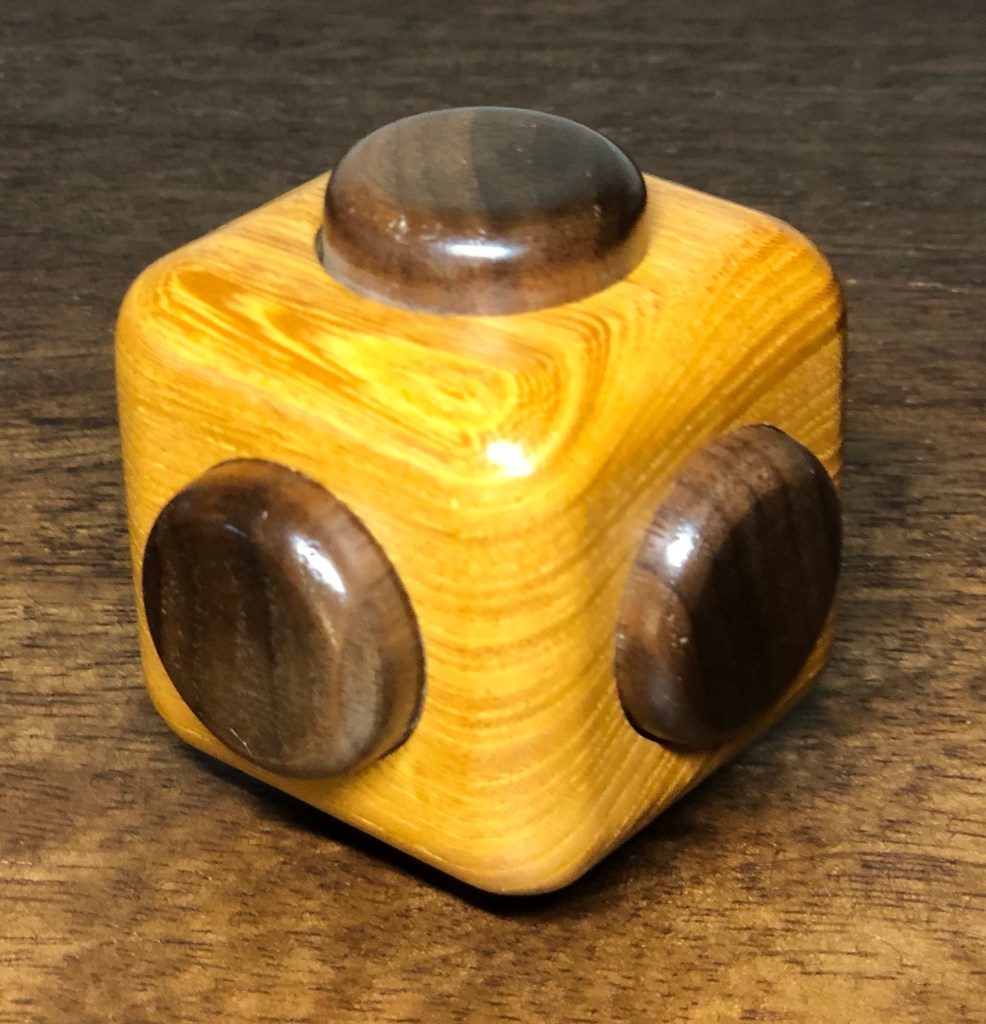
Small Box 8 (zelkova & walnut, 58mm, 2 steps): Based on Akio Kamei’s 3D Box (K-20, 1996), this is otherwise known as “the small box that looks totally different from the other small boxes.” Unsurprisingly, its solution is quite different from the rest of the series; as you may have guessed, the burr-like sticks must be manipulated in coordination in order to find and open its hidden compartment. This is definitely one of the best of the series and unfortunately does not seem to be remade as often (at the time of this writing, it is available at Mr. Puzzle).

Cube Boxes 1-4:

Cube Box 1 (zelkova, maple & katsura, 60mm, 3 steps): The Cube Boxes are perhaps a bit less diverse and more consistent than the small boxes, incorporating visual clues into fun solutions that are somewhat more traditional. Box 1 is an excellent example of the close tolerances KCG can create, with the final step moving so smoothly as to be almost vacuum-sealed (mine actually makes a nice “pop” sound when it opens).

Cube Box 2 (wenge, maple & katsura, 60mm, 5 steps): Similar to Cube 1, this also has satisfyingly close tolerances. The solution is a bit more complex as the steps must follow a more defined path.

Cube Box 3 (walnut, maple & katsura, 60mm, 2 steps): This solution is quite different from the rest of the series, with a final state that I find to be aesthetically pleasing. This is one of my favorites of the series, as I find it oddly pleasurable to open and close.

Cube Box 4 (chanchin, maple & katsura, 60mm, 4 steps): This is probably my favorite of the series: the first steps are similar to Cube 1 but the final step is pretty neat, taking an approach to accessing the internal compartment that is different from the rest of the series. The final state is kind of cool and the final movement itself is fairly counter-intuitive.

New Secret Boxes 1-4:

Unlike the series described above, the New Secret Boxes all share similar solutions: the difference is one of complexity: the first box has 6 steps, the second has 12 steps, the third has 18 steps, and the fourth has 32 steps (note that each requires that many steps to open and then again to close, albeit in reverse order). These are perhaps the closest to traditional boxes, except that all six panels move (as opposed to only four panels in traditional boxes). Boxes 1-3 are more or less straightforward, following a fairly direct route from start to end. Box 4 is significantly more complicated, its moves following a binary pattern that must be discovered and which has been described by many as being a fun challenge (full disclosure: I have not actually tried it). The boxes are all the same size (80mm) and share an aesthetic, with the number of stripes on its exterior indicating which of the series it is. All are well made and the interior allows you to see the types of complex wood cuts that are needed to create the sliding panels on which the puzzle is based.

Standalones: Double Box, Trick Door, and Expansion

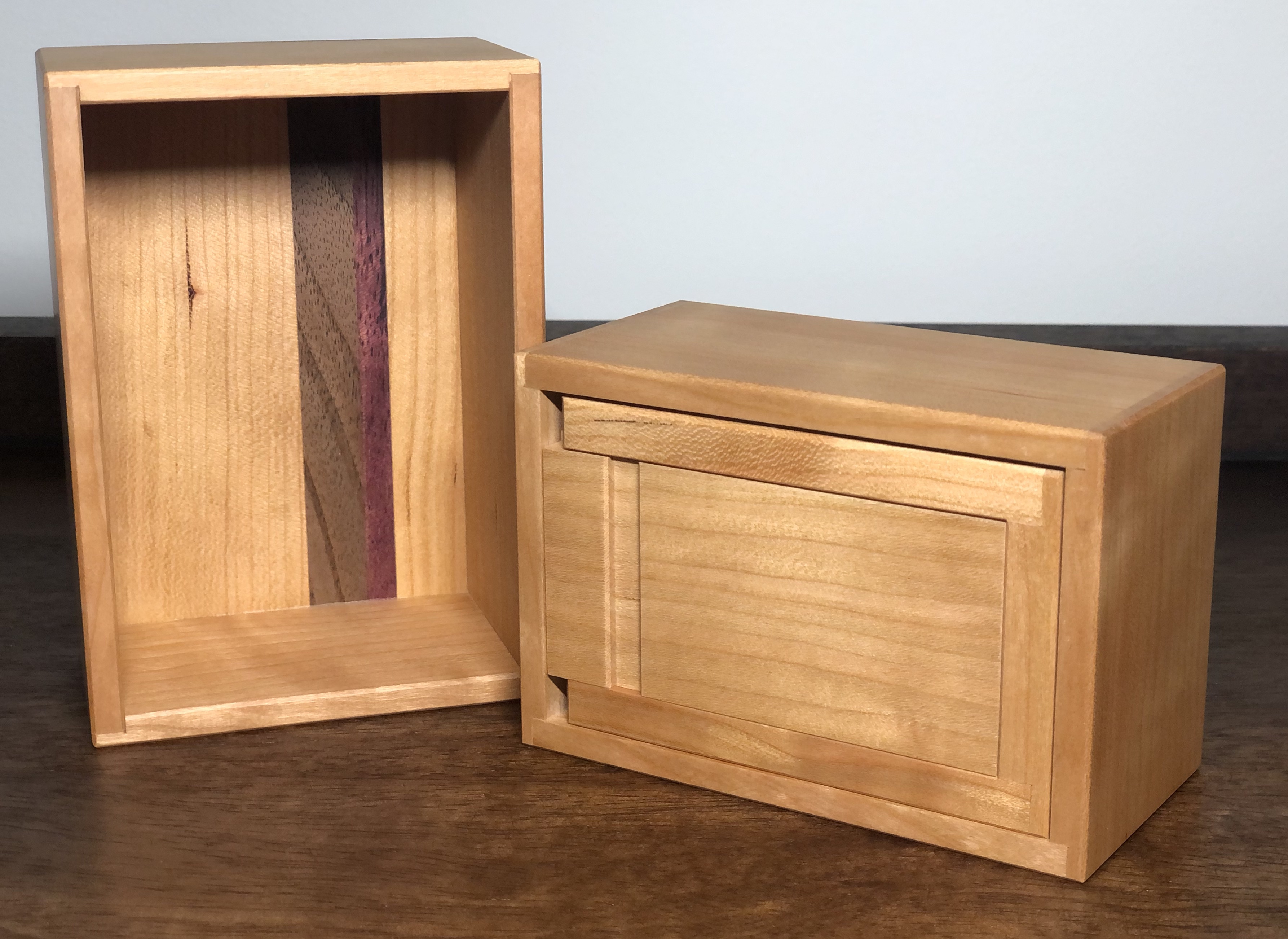
Double Box (cherry & walnut, 4 steps): Based on Akio Kamei’s Double Box (M-47, 2016), this uses a simplified version of the mechanism used in the classic Pentagon Box (M-8, orig. 1984); like Pentagon, it features a lid that can be freely removed (no tricks). Although it is not particularly complex, it is an example of how Karakuri boxes can be playful, messing with our ideas of what defines a box. While this is not one of my favorite KCG creations, I appreciate how you must use something generally intended to close a box in order to open it (or, as Kamei said in his description of Pentagon, “When you cover the lid, you can open the box. But when you take off the lid, you can close the box”).

(scroll down to see pics of Double Box without the removable lid)

Trick Door (walnut, 1 step): This recreates a full-size trick door that stands at the entrance to the Karakuri museum in Hakone; a digital version was used to access the old Karakuri website. It can take an embarrassingly long time to figure out the way to open the door, particularly for those unaccustomed to trick boxes. It is a classic example of using our expectations against us. It is not only fun, but great to hand to non-puzzlers, as it is sure to elicit in them the famed self-smacking of foreheads once shown the simple solution they likely failed to find.

(scroll down to see pics of the “real” Trick Door at the Karakuri Museum)

Expansion (maple, zelkova, walnut & black cherry, 4 steps): I saved the best for last! This 2020 release is based on Akio Kamei’s Expansion I (M-44-1, 2012), which is the first of a series of expansion boxes with different mechanisms based on the same concept. First, this is a beautiful box; I generally prefer darker woods, but the contrasting colors used are striking. More importantly, the main step is just plain fun – the first time I did it, I actually giggled – I have Kamei’s Expansion IV and, honestly, I may enjoy this one even more! Beyond that first step, the solution takes an interesting step or two before you can find and open the hidden compartment; it is possible to go back and forth on the first step without finding the direction you need to take. While not necessarily difficult, it has an added layer of complexity that adds more depth to the box, as the puzzle forces you to look more closely to better understand it before you can fully solve it. This is still available (at the time of this writing).

Conclusion and a Word about Club Membership

Hopefully this post will help someone decide whether or not they want to try Karakuri puzzles and orient them towards those boxes that might be more to their liking. I wanted to write something that could be especially helpful to newer puzzlers and, to that end, this (already too long) post would not be complete without a bit about club membership: the KCG site can be confusing and I have heard a lot of misunderstanding about how membership works and why one would join. To me, joining is a no-brainer: you will never get KCG member-made boxes at a better price and it is super fun to get some surprises come the holidays.

Each year, the active Karakuri members (currently all but Miyamoto and Ninomiya) create a puzzle box for the holidays; we do not know what it is until it arrives. Puzzlers try to maintain a strict post-no-pictures rule until after the holidays, as some of us like to leave them unopened for a surprise come present-time (assuming you’re into that). As an added mini-puzzle, we do not even know which member made what until a month or so later, so it can be fun trying to guess which box is from which maker – this is sometimes obvious, but oftentimes not (unless you check the maker’s hanko, which is their Japanese “signature” found once you have fully solved the puzzle, particularly helpful if a box has more than one compartment).

There is an annual fee of 12,500 yen (approx. $120), which gets you a box from a single member of your choosing. Some of the boxes may be available after the holidays have passed, but many will never be made again. You can also add boxes from other members for an additional 10,000 yen (approx. $95). The first year there is an additional one-time fee of 6,250 yen (approx. $60); new members receive a copy of the “Karakuri Art Works” book with high quality pictures and descriptions of all Karakuri creations since 1999 in English and Japanese; it will come with supplementary pages for works created after 2017 (additional annual supplements are sent to members once the holidays have passed). This one-time fee is basically the cost of the book, which retails for 5,625 yen (approx. $50).

In addition, membership includes free shipping (worldwide, afaik) on all purchases; amazingly, their boxes will usually be delivered to the US only 2 or 3 days after ordering (even now, amidst Covid, it generally takes less than a week). Perhaps more importantly, membership grants you access to the lotteries for new releases, which come out a few times a year and are generally more complex than the holiday boxes. As they are limited releases (many will never be made again), there is oftentimes more demand than supply; the lottery allows members to order one or more of the new boxes, with payment to be automatically processed if and when they win the lottery (no, these are not free boxes – you are winning the chance to buy them). If there are any copies left over, they will be made publicly available.

As you can probably tell, I love Karakuri boxes. As a collector, their beauty and elegance amazes me and I enjoy re-solving them: sometimes I may not remember exactly how to solve it, but more often I know how it works and am just enjoying the mechanisms. Some puzzlers are less inclined to collect, and are primarily Solvers – to them, Karakuri may not always be satisfying. While some Karakuri are certainly challenging, some Solvers may balk at what they see as poor time per $ puzzling value; you can certainly find less expensive puzzles that will sometimes take longer to solve (Hanamayas are a great example). However, some of the “easiest” Karakuri rely on truly amazing and inspired tricks that will delight most any puzzle fan, even if it doesn’t take hours to figure out. Regardless, I think that everyone will recognize that Karakuri boxes are of amazing quality, their value found not only as puzzles but as works of art. Hopefully this post may have helped the one or two people who actually made it all the way to the end to decide whether or which works appeal to their puzzling sensibilities – if not, it was probably a terrible use of my time, which could therefore have been better spent trying to finally finish solving Turtle Trip, Wishing Well, or Secretum Cista, or even doing that other thing, what’s it called… the thing that actually makes money so I can buy puzzles and keep my family living indoors… you know what I mean. Word? No, thats not it…. Ummmm… work! Yeah, that.

Trick Door & the “Real” Door at the Karakuri Museum

Front of Small Boxes 1-8 and the Bottoms of Small Boxes 4-6

Double Box’s Lid is Removable (no tricks)

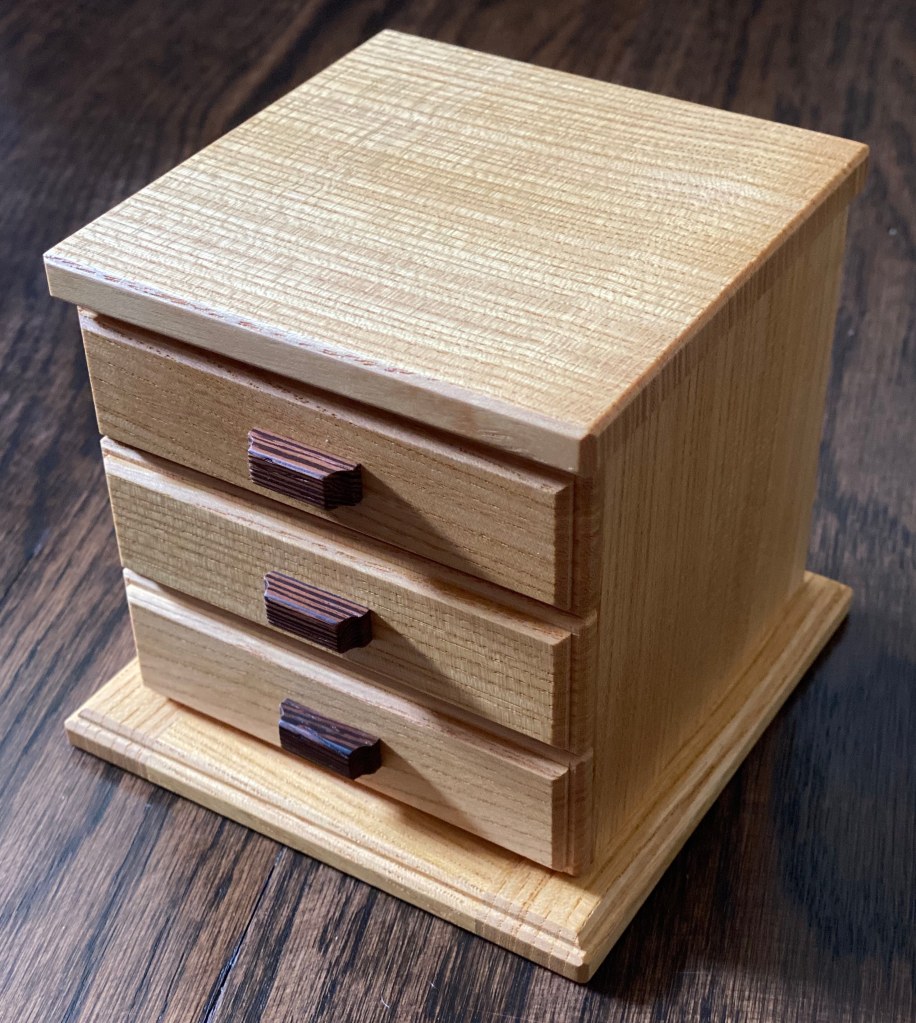
When is a Drawer not a Drawer? When it’s a Puzzle.

Surprising Drawer

Osamu Kasho, Keyaki (Zelkova), Magnolia, Wenge, 4.6″ x 4.6″ x 4.25″

Each year, the Karakuri Creation Group (KCG) has an Idea Contest, in which people (in Japan) are free to submit box ideas to the master craftspeople, who select a few to be produced and sold via lottery. Contest winners have a tendency to be comparatively simple, while telling a story or portraying something whimsical or odd. Some dork blogger (with a cool name) posted a video and review of last year’s He Can Not Get the Ball!, which backs this claim up (assuming he can be trusted).

This year, I was able to resist buying any of the Contest Winners; although some, including Osamu Kasho’s Surprising Drawers, certainly sounded intriguing, I did not initially succumb to temptation (shocking, I know – but 2020 is shaping up to be an especially expensive puzzling year and some lines must be drawn…. and redrawn…. and then moved back a bit). The KCG descriptions will sometimes contain clues to box solutions, at times to the point of giving too much away, but for Drawers it (mostly) just said: “I tried to express the joy of its movement more than the difficulty. This product might be one that you’ll want to open again and again.” This was a head-scratcher, for sure, but I somehow still managed to resist. On top of this, Kasho is fast becoming one of my preferred KCG members: his Bara Bara Box was my favorite of last year’s holiday gifts and my recently received Ripple Out turned out to be much much cooler than I had honestly thought it would be.

And so I waited. Patiently lurking about the puzzling fora, awaiting the imminent arrival of said boxes to the homes of unsuspecting collectors, whose opinion would soon be sought for the final determination of the satiation of my desire – which is to say, I waited until some people got theirs and asked what they thought of them to see if I should try to get some after all.

Haym H., puzzle designer, collector, and all around good guy, received his in short order and was especially taken by Surprising Drawers (or, at least, I was especially taken by what he said about them – he had good things to say about all the boxes, any of which is likely to be an excellent box). Due to my cyber-stalking of the KCG site, I was well aware that the boxes had not yet sold out (ed. although a couple other contest winners are still available at the time of this writing, all of which have also received praise, Drawers is now sold out), and jumped on it quickly. I had heard enough to know that the puzzle gods must be given their due, and I feared their wrath were they to be ignored (judging from the amount of unsolved puzzles around me, I may be feeling that wrath regardless).

As usual, the box arrived within a matter of days from Hakone. My first impression was that the box is bigger than I had expected. The Idea Contest winners I have had in the past have all been larger than most of their regular counterparts, but for some reason I had not expected this to be quite so massive. The craftsmanship is, as I expect from any KCG box, excellent – the wood feels satiny and solid and the drawers could easily pass as bedroom furniture for a very tiny person. There is a hole approximately the size of a quarter on the bottom of the box, through which a bit of magnolia can be seen and felt. The three drawers have handles made of wenge, whose darkness is a lovely contrast to the lighter Zelkova of which most of the box’s exterior is made. As one would expect from drawers, they all wiggle a bit, each moving independent of the others and feeling as though they should come right open. Of course, they do not….. as that would be, in the words of the Ancient Greeks, hella lame.

If you read any of my posts, you may come to the realization that my passion for puzzles far exceeds my skills with them – which is to say, wrath of the puzzle gods aside, I’m just not all that great at them sometimes. And while this box was said to not be difficult to open, I nonetheless struggled for longer than I should have, missing what now seems obvious and getting caught up in some misdirection stemming from my own assumptions. After wondering if it was broken for longer than I care to admit (a step that should be included in the solution of every good puzzle as surely as angrily resenting one’s decision to buy Ikea furniture should be included in the directions of every Skurpingdhenghenr nightstand sold), I soon found the first step, a relatively simple move that unlocks the solution, allowing me to…….. OMG!!!

I actually LOL’ed as it came open in a shockingly unexpected manner, looking around as if the ghosts of Christmas past might wish to share in my glee. I took the rare step of demanding that my NPSO watch me open it (if she wanted to, please and thank you), and even she thought it was pretty cool. Closing the box took a little bit of thought as the solution seems, in more ways than one, to be physically impossible at first glance. After reflecting for a moment and observing how the pieces work together in such a simple and ingenious manner, designed so as to appear both obvious and impossible at the same time, it was clear how to reset the puzzle. At which point, I immediately opened it again. And then one more time. And several times since then…. and one more just now.

I am not exaggerating when I say that this has quickly become one of my favorite Karakuri and that I am grateful to Haym for sharing his impressions with me (and that there were still copies left!). I just opened it again and it still makes me smile! I may have to delve into the wondrous inner working of wordpress to discover how to write and post pics using spoiler tags; regardless, I will be sure to bring this box with me if and when our regular scheduled puzzle parties resume so that we might all bask in its puzzling glory together.


Originality Grade: 5 Sinatras

No, I Don’t Think He is Dead

He Can Not Get the Ball!

Yoh Kakuda and Yasuaki Kikuchi

He Can Not Get the Ball! is a winner of the 11th Annual Karakuri Idea Contest. This box was built by Yoh Kakuda and Yasuaki Kikuchi out of oak and cherry, based on an original idea by Masaki Ohnishi,

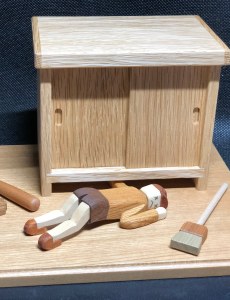
The puzzle depicts a moment in which most people have found themselves on at least one occasion – arm stretched out under a dresser, cheek pressed to the floor, face turned so you can get as far in as possible, fingers just brushing the elusive item, still just a bit too far out of reach. Fortunately, the artisans have left us an unattached baseball bat and broom to help us in our quest.

Perhaps the best detail in this puzzle is the tiny baseball that can be seen deep under the dresser – but only if you get your eyes level with the bottom of the dresser. This “hidden” feature really makes this puzzle for me, as it puts the puzzler in the place of the child.

You will notice that the child’s eyes are X’ed out. I am not sure why this is, except perhaps to imply that this poor child died while struggling to regain his lost ball. A tragic end to a common situation. But while we may be too late to save this tiny wooden person, we can at least get his ball! Well, no, actually we can’t…… but we can open his dresser! This is, after all, a puzzle box, albeit a rather simple one.

As with many Karakuri (but certainly not all), the solution is rather straightforward, fitting thematically into the concept of the puzzle, easily deduced from the situation being depicted. However, this collector’s piece is exquisitely made and is surprisingly fun to solve.

The video features the solution following a short spoiler break. As with my last post, this may not be a puzzle that will appeal to a pure solver, but it is one that looks wonderful in my collection – if you are a collector, I definitely recommend getting one of these, if you have the chance.

The Tail of the Uroboros Puzzle Box

Uroboros

Shiro Tajima

Check out the Uroboros box from Shiro Tajima of the Karakuri Creation Group, made in 2012. This is my first video that includes me solving the puzzle.

It is not an overly difficult box, but it has a couple tricky-ish steps that utilize some cool movements. As with many Karakuri boxes, the beauty of the piece itself is as important as the mechanisms, and this box does not disappoint.

The video includes a spoiler break halfway through, so if you do not want to see me solve it, make sure to close it out at the break.

I went back and forth on whether I should post videos of my solving puzzles – I generally do not watch solves unless it is a box I have already solved. Early on, I watched some videos of puzzles I thought I might never get, only to find myself with the opportunity to get it or to solve it. However, if you are purely a Solver focused on puzzling time per $ spent, then this may not be something that will appeal to you.

For collectors out there, on the other hand, this is a really nice box, and a welcome addition to my own collection.

The Uroboros is a snake that is forever eating its own tail – it is a symbol of regeneration and renewal that dates back to Ancient Egypt and was adopted by the Ancient Greeks and, eventually, the Gnostics and alchemists. Tajima made this when he was doing a series of puzzles to reflect the Chinese Zodiac – this was made ahead of 2013, the Year of the Snake, following up on his Dragon Wing box.

Hope you enjoy the video!

Packing It In: Pack Hard

I’m sure they’ll all go right back in – yeah, sure they will….

First off, I’ve decided to dispense with some of the bells and whistles to my posts, as I’ve found it prevents me from sitting down and writing. And I know my one (imaginary) follower is just salivating for more of my puzzling narratives.

Recently I began exploring packing puzzles; as one who had come to puzzles with a fascination with boxes and locks, the elusive, hidden “trick” being the main attraction, packing initially seemed a bit…. meh.

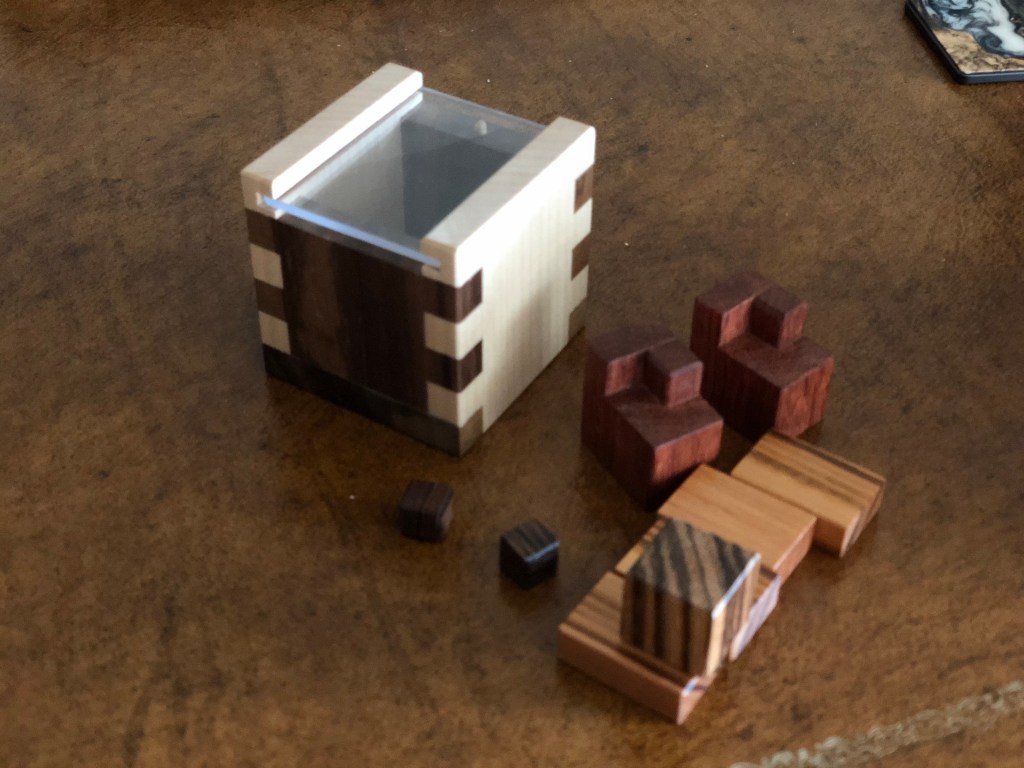
Once again, I was quite wrong! I began with Baumegger’s Gretel, quickly becoming disappointed I had not also bought her brother at the same time. First off, it is a truly lovely puzzle. The various woods are smooth and the colors play wonderfully with one another. Perhaps my favorite detail is the tiny nub at the top that secures the clear, acrylic cover (assuming you can solve it of course).

Stephen was easy to contact and talk with, and the puzzle arrived soon. For such a small, straightforward task, this thing was HARD. Maybe it is the ancient Tetris player within, but I took to it immediately. Solving it would take much longer, and in the meantime I would go on to collect several more packing puzzles.

Eventually, it just…. worked. Such satisfaction. I gleefully showed my wife, who glanced briefly over (“that’s nice, babe”), before returning her attention to the show I’d forgotten we were way supposed to be watching. My focus was all on my perfectly packed puzzle, grinning proudly (me, not the puzzle). My little cover slipped on, perfectly held in place, and off she went to join my small collection of solved packing puzzles.

Fast forward a couple weeks, and I was taking a pic to show a fellow puzzler how pretty she is: hold on…. I can’t take the pic of it solved lest too much be revealed. I’ll just dump it out; surely I can repack it, no prob.

Yes, it remains unsolved. Yes, I swear it was packed. Yes, she got moved back to her evil, unfriendly and unsolved cousins. Maybe she’s mad I didnt get her brother? Well, guess I have no choice. What’s one more puzzle? Right, it’s just one. One never hurt…… Sigh……

Cards go in the Box. Box goes on the Shelf. Puzzles are on the Shelf. My Puzzles.

Jack in the Box,

Jesse Born, 2019 (Sold Out)

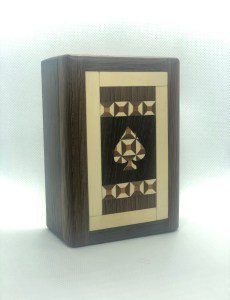
A few months ago, I received the Jack in the Box puzzle from Jesse Born. Jack is a cool concept, blending puzzle boxes with one of my other favorite collectibles, playing cards! The box allows most decks of cards to sit snugly within, allowing only the slightest feel of movement when holding the unsolved puzzle.

It arrived unsolved (duh) and the quality was immediately apparent: the wood is smooth and feels solid and weighty in your hands. The Yosegi design on the top is excellent; except for four seams that are part of the design, the breaks are not immediately noticeable by eye or hand – a difficult achievement, I am sure, and I think it is as good as any Karakuri I have.

With some inspection it becomes relatively clear where the opening will be; I could figure out where the final step would likely take place, but that was it. Nothing moves, nothing slides… like some of my favorite puzzles, it is essentially a Wonka factory (“nobody ever goes in and nobody ever comes out”).

I find it very satisfying to get a solid puzzle with no clear first step. It can of course be fun to know how to start a new puzzle before hitting a wall, but there is something about a puzzle with no indication of how one should begin. I tried all the usual stuff (spinning it, holding it at different angles, sneaking up on it to catch it unawares, etc.), before putting it back on its shelf to glare derisively at me.

I may have done this a couple more times than I like to admit; with some exceptions, I do not typically manage to solve a good puzzle right away, although I suppose this is changing as my puzzling experience levels up. I am probably just trying to make myself feel better by implying that it was before I became the esteemed Solver that I am today. Of course, that is about as likely as my inability to solve a new puzzle actually being due to the always suspected, rarely existent design defect that we oftentimes seek to blame when nothing else seems to work (typically, this occurs a few minutes before being solved, for maximum shaming effect).

Eventually I hit upon that first move, which I find to be a very satisfying move to make even now, months later. After that, it is not a hard path to find the next 4 steps before it opens. Inside, Jesse included a classic red Bicycle deck. I replaced the deck with my Red Labyrinth Cards from King’s Wild; thematic consistency is fun, and what is better to find tucked away inside a puzzle but another puzzle?

Jack in the Box is an excellent addition to my collection, and one that looks great while serving as an ambassador between these two great nations (the world-weary puzzle boxes and the upstart playing cards, like an extra-nerdy West Side Story without the singing, dancing, or blatant Romeo and Juliet rip-off….. and if it was made out of wood, metal, and paper and was sitting on my shelf…).

Jesse is currently working on the wonderfully elaborate Secretum Cista puzzle chest, which will be crazy cool, I am sure, and will be worth not much less than my entire current collection does, but he was kind enough to allow me to pay over time while he works. I will most assuredly share this with the 2 imaginary people reading this (thanks Bob Dobbs and Zaphod! I couldn’t do it without you).

I am telling myself that I will blog on here more frequently, but I’ve learned the hard way that I can’t be trusted, so we’ll see.

Grade: Four Sinatras

Puzzle Box Train(ing)

Railroad Crossing, Karakuri Puzzle Box

Akio Kamei and Shou Sugimoto,
11th Annual Idea Contest Winner, June 2019
Designed by Ichiro Sato
Unboxing Puzzle Boxes with fivesinatras

The newest puzzle box from Karakuri master Akio Kamei and Shou Sugimoto is based on a winning design of the 11th Annual Karakuri Idea Contest from Ichiro Sato. This trick box is made of Oak and Magnolia, and is a whimsical take on waiting for a train to pass, and the secrets that lurk beneath the surface, a comment on the underlying depravity of urban life and the innate search for escape…. well, maybe not, but the wood and whimsy are correct.

Not the hardest puzzle box from the Karakuri Group, as some of the more fun creations tend to be, but it still requires some creative thinking to make the few steps required to open the compartment beneath the tracks. It is pretty big and heavy, a puzzle box with some mass and heft to it, and one that looks great on my shelf, amongst its wooden friends.

And how fun it must have been for my wife to see her grown husband sitting on the floor playing train! I may have even allowed a choo-choo or two to escape my lips as I tried and failed and tried again, before showing my wife with glee the solution, complete with an imagined scene for full effect (“picture yourself in your car, the bells ringing to warn of the approaching train, searching for the correct steps that will allow you to gain access to the safety of the hidden compartment beneath your feet…..” – super cool, I know).

If you manage to get your hands on one, enjoy its weight and the light-hearted fun it carries. And let yourself play for a minute.

Ballin’

Multiball

Eric Fuller, CubicDissection, 2019
Sold Out
  • Puzzle Details:
    • Puzzle Box: 2 Steps
    • Woods: Ash, Wenge, Walnut
    • Number Made: 99 (signed and dated)
  • Dimensions:
    • Overall Size: 3″ Cube

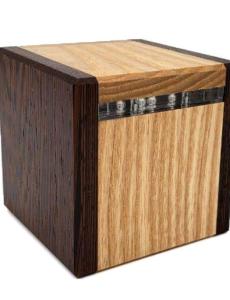
It is almost immediately apparent upon holding Eric Fuller’s what one must do in order to open it: get the stainless steel ball bearings out of the way so the panel can slide out. Easy, right? If you are familiar with Fuller’s work, you should know the answer to that already.

The panel moves slightly, showing you enough of a gap to confirm that this is the way out, and a plastic window teases you with a view of the obstacles rolling in your way. This is part of the fun of Multiball – as you turn it this way and that, first carefully, then perhaps more abruptly, then veeerrrrry slowly, then all these repeated with the box inverted, sideways, and diagonal, then perched upon one’s open palm while you perform your most graceful whirling dervish, and then clenched tightly in your fist while you glare at it scanners-style. All to no avail.

I rather quickly figured out how to will the first ball bearing out of the way, slipping sneakily into some secret recess, then the second soon after, only to have them burst back in, after having gone just a bit too far, like a drunk Uncle regaling your family with Dad’s early sexual escapades over thanksgiving dinner. Rinse and repeat: one ball, two ball, do the hokey pokey and shake it all about, ok there goes the third again, and…. and…. annnnnnnd…… damnit.

After hours of this, the noise of the ball bearings earning quite a few annoyed glances from my wife as we Netflix away our evening, suddenly: it opens! Can you believe it?! Check it out, it’s open! (“that’s nice, babe.”) Yeah, all I did was…. was….. waaaaasssss…. damnit. Still waiting on figuring out what exactly I did right. But I did see that the internal compartment was sizable, maybe not loaf of bread sizable, but more than big enough to fit your Uncle’s next white chip.

The box is beautiful, dark and light woods focusing your eyes on its window, inside of which you can manage to see just enough mirrored mechanisms to further frustrate, but not enough to know for sure what exactly you are looking at – maybe I will have a better sense once I manage to open it…. again.

Grade: Four Sinatras

Breakdown

Slammed Car

Junichi (Juno) Yananose, Pluredro, 2019
Not Available
  • Puzzle Details:
    • Sequential Discovery Box: 15 to 20 Steps
    • Woods: Koto, Blackbean, Jarrah, PNG Rosewood
    • Number Made: 100 (not available)
  • Dimensions:
    • Overall Size: 7.1″ x 3.1″ x 3″
    • Compartment Size: 1.8″ x 1.5″ x 1.5″
    • Weight: 14.5 oz

The first impression I have of Juno’s second sequential discovery puzzle is that it is no small affair: it feels solid and significant in my hands, larger and heavier than most quality wood puzzles. Its wheels move, and separate pieces are readily apparent, distinct from the carved doors on its sides. It is clear that the goal will be to remove the front, rear, and top of the car, in order to gain access to the concealed compartment(s).

Unlike many themed puzzles, Slammed Car is unique in that the theme is maintained as one progresses: the tools discovered are clearly intended to encourage the feeling that one is opening and disassembling a car. This playful take on the puzzle box does not mean that the steps are simple, however; while the initial steps may be somewhat apparent upon initial inspection, the difficulty quickly ramps up, leaving you with several tools with no clear purpose. Personally, I enjoy the ability to quickly become immersed in a puzzle, only to find myself suddenly adrift, with only a hazy view of the opposite shore.

As I write this, I have still not reached my destination: I have tools and direction, with some of the mechanics worked out after having been granted a view of some further inner workings and thereby developing a notion of how to proceed. I anticipate larger “a-ha” moments when I return to experiment and explore further, likely following extended bouts of confusion and delighted frustration.

Slammed Car has already introduced some unique mechanisms, presented in a thematic approach that feels more practical than some of the more whimsical Karakuri pieces. The woods are lightly aromatic and exceedingly smooth, their hues contrasting nicely with one another, encouraging the feeling of heading to the beach in the iconic, California Woodie of the early 20th Century. Although I have yet to fully solve this puzzle, I can confidently say that it is a trip worth taking, whether or not I may wipeout along the way – that is, after all, part of the fun.


Grade: Four and a Half Sinatras