Apuzzle 13: Houston we had a problem here by Brian Young

Houston we had a problem here

Brian Young, 6″ x 3.25″ x 2.25″

Having (finally) made it to my first IPP this summer (after several years of hoping and waiting, I was overwhelmed by the wealth and general awesomeness of the puzzles showcased (as well as the puzzlers present). On the day of the party itself, I heard tell of a new Brian Young puzzle, possibly his last considering his announced retirement, and zipped on over, snagging one of the last copies of “Houston we had a problem here” from the legend himself (a welcoming and hilarious man).

Houston is a very cool concept – Brian took the rather cheap, not so great “Long Life” puzzle box mass produced in China (I believe) by MiToys and modded it, turning it into an SD puzzle box! Yay! Needless to say, “WANT” was pounding in my head when I got to his table and picked up a copy. Houston takes the original puzzle and adds some engraving: the puzzle’s new name and some maze-like etchings are added to the original. The most obvious change is at the center of the box: an acrylic maze, at the center of which sits a ball bearing, stuck in place beneath an engraved “A 13” in honor of the infamous Apollo 13 mission from which the puzzle gets its name. The wood medallion on the bottom of the box rotates a few mm in either direction but does nothing helpful.
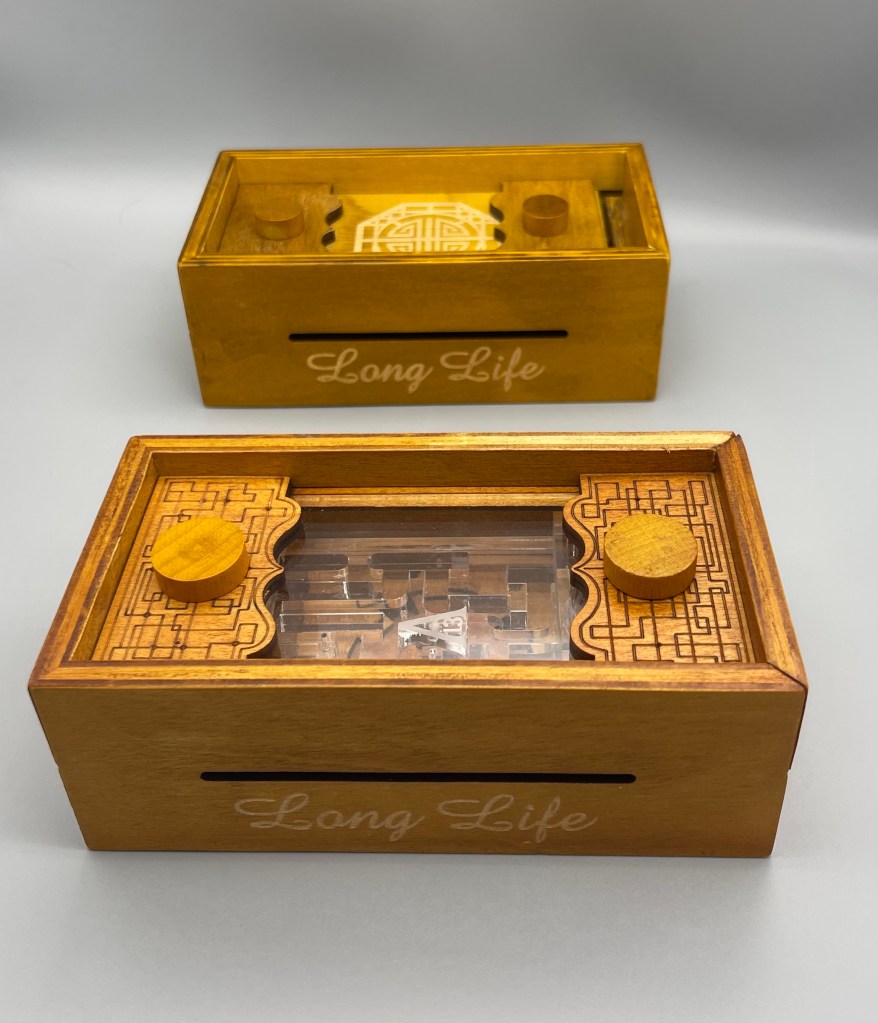
It did not take me long to find the first step but the next would elude me for far longer than I’d care to admit. Eventually, I realized I had not tried something and aha! more was revealed. This led to a few sequential discoveries of interacting parts that allowed me to access the centerpiece of the puzzle, where I would spend considerable time wandering around cluelessly, ideas being tried and discarded as I found none did what I had thought they might do.

Backing up, I thought about what had been discovered and amassed and wondered what else could be possible: lo and behold a couple somethings do some things that I had not yet realized: but why? and whatfor? Time to take stock and a closer look at things, leading me to see where (I think) I need to get and what I need to do when I get there. Getting there didn’t take me too long but the puzzle really threw me when I tried to do what I thought needed to be done; being a puzzle by Brian Young I should not think it would be easy. Finally accomplishing this task opened up new possibilities and allowed me to eventually get where I needed to be to solve the puzzle – Huzzah!
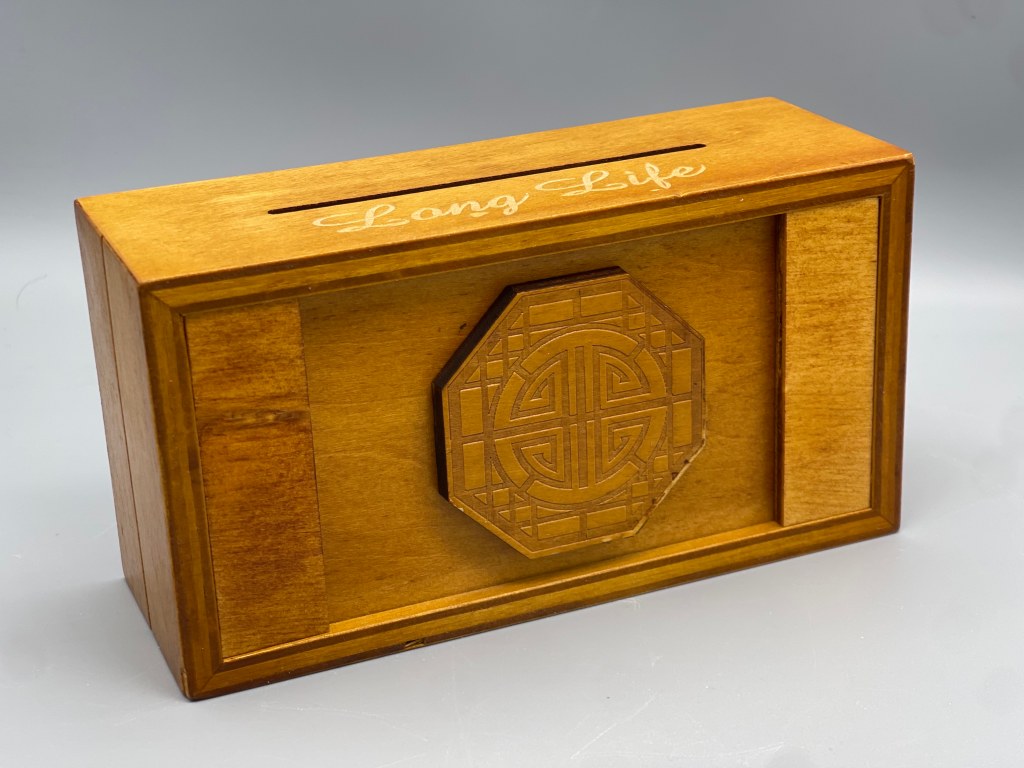
Houston is a novel concept with an excellent execution, turning something meh into something mexcellent. I would love to see someone else take up the mantle and mod others in the original series of puzzle boxes – even more, I would love to see Brian continue to make puzzles for us to enjoy! Whatever happens, I am grateful for the wealth of beautiful puzzles Brian has gifted us with and will continue to lust after and seek out those I have yet to solve or collect.

For more Brian Young action, check out my posts on Brian’s Big Baffling Bolt, Abraham’s Well, and Three Wise Bolts.

B4: Brian’s Big Baffling Bolt

Brian’s Big Baffling Bolt

Brian Young (Mr. Puzzle)
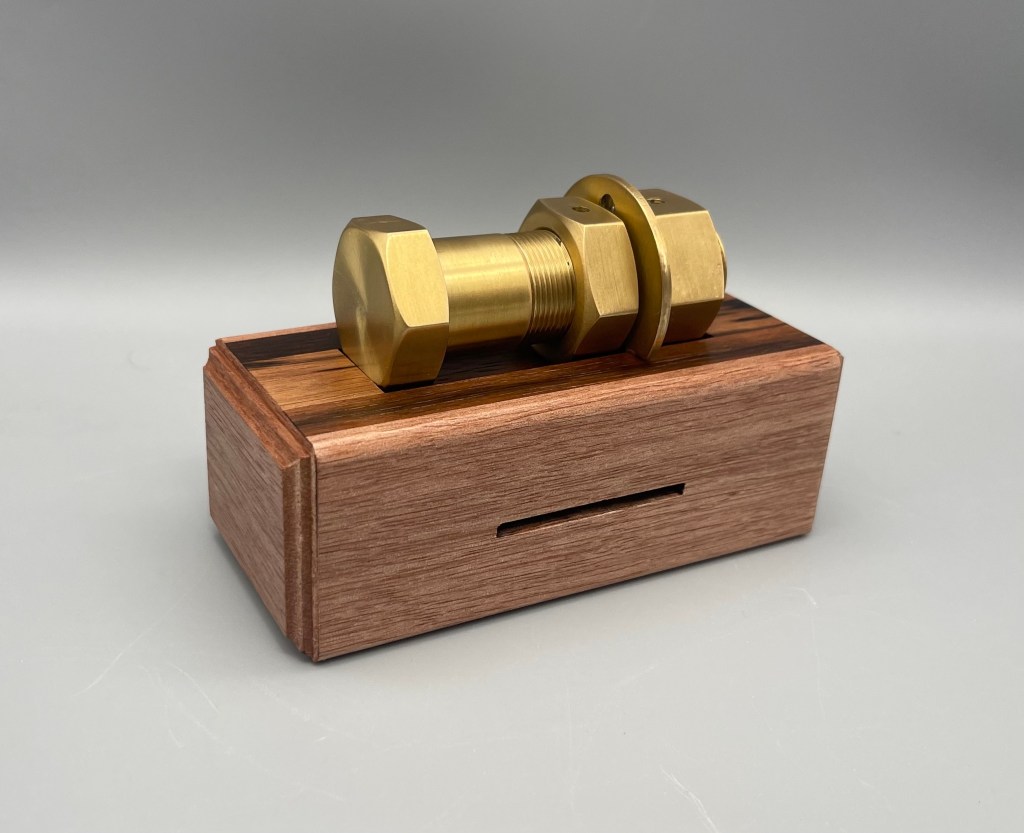
Bolt: 65mm x 30mm, Brass
Box: 110mm x 50mm x 40mm, Papua New Guinean Ebony

I finally got done solving Brian’s Big Baffling Bolt (BBBB) from Brian Young of Mr. Puzzle and… just… wow! Mr. Puzzle announced the puzzle some months back and when my turn eventually came after several more months, I jumped on the chance to try Brian’s newest SD creation, following up on the interesting and uniquely broad challenges of Abraham’s Well.

In creating numerous, highly regarded SD puzzles, Brian has played with brass bolts in the past, having incorporating them into wooden designs: Three Wise Bolts, which I am fortunate enough to own, as well as his contribution to the amazing Lewis Carroll Project, Tweedledum and Tweedledee, which I was fortunate enough to try (but not fully solve) at the Puzzle Palace. This newest puzzle is meant as an homage to his 30 years of puzzlemaking, incorporating “hints” of tricks from some past designs in new ways, alongside novel mechanisms. Despite having solved several of his puzzles, I have to say that I did not recognize anything in particular, so I am not certain from whence these came but I do appreciate the sentiment: a cool way to share tricks that are now difficult to access due to the rarity of so many of his past SD designs.

BBBB consists of a rather massive brass bolt along with a lovely wooden puzzle box made of Papua New Guinean Ebony. The box has slots on either side, a hole on the bottom (alongside the Mr. Puzzle logo) and a resting place atop fitted to the bolt. The bolt has a washer along with two nuts (each with a hole), one of which spins freely without screwing in either direction. I was able to make a bit of progress rather quickly, always a fun start and one which belies the difficulty to come.

This bolt was by far the trickiest bolt I’ve ever seen, with secrets galore. Through starts and stops, I worked my way through multiple aha!’s – so much so that if this puzzle consisted only of the bolt, I would have been satisfied with it as a solid puzzle (according to Allard’s blog, this was initially the case). But no! – there is a puzzle box as well, one that integrates well with the bolt before the finale may be reached. The end reveals a “30th anniversary plaque with [a] pearl” so it is quite clear that you’ve finally solved the puzzle.

I must admit that I needed more than a little help to get through some of BBBB’s multitude of aha!’s and tricky moments, in particular to get through some of the final steps; this did not take away from the experience in any way – the aha!’s keep coming and things I was sure wouldn’t do much worked in interesting ways. Some steps are a matter of exploring everything you have to be sure you know what everything can do, as you discover multiple tools to help along the way. I found myself exclaiming in surprise more than once as unexpected turns occurred, finally breaking through to the end in a final sequence that kept on giving after I was sure I was reaching the end.

The puzzle does not require hitting, spinning, or any force at all. Everything works smoothly; more than that, at one point I knew what needed to be done and was sure it would be difficult to accomplish. I found myself getting a bit disappointed, thinking getting through a section would require stabler hands than mine, only to realize that Brian had foreseen this and incorporated help into the design, such that this was its own aha! moment, in addition to the joys of discovering its mechanisms and tools. Although there is a bit that is somewhat blind, you are provided with sufficient information (if you take your time) to get through.

Despite it having taken me several weeks to solve (and in addition to my terrible memory), it was not difficult to reset: you will have come to fully understand, if not always see, everything such that you know what to do. After putting everything back where it goes and marveling at my own brilliance, I went back through the solve one more time, appreciating the rhythm and flow from section to section, refining my understanding of one section in particular as I worked back through.

BBBB is still being produced by Mr. Puzzle, with a promise that he “will definitely make more of these puzzles in the future.” If you do go to their site to contact them, be sure to browse the site as they have some great puzzles, including a number of IPP designs and the very unique Abraham’s Well (and an excellent Black Friday Sale going on now – no, I get nothing from the plug, I just think it’s a great site from a great puzzlemaker). Be warned that the site is closing towards the end of December, with Brian going into retirement (I do not know how this might affect the production of BBBB unfortunately). Hopefully we will still see puzzles coming out from time to time, as most certainly appreciate his work!


“Look Kids: Big Ben, Parliament,” Juno, Brian & John Had Me Stuck Going in Circles

Big Ben

Design by Brian Young, Junichi Yananose (Juno) & John Moore
Made by Brian Young
Presented by John Moore at the 2014 IPP Exchange
Winner Jury Grand Prize 2015
Papua New Guinean Rosewood, Western Australian Jarrah & Queensland Silver Ash
220mm x 55mm x 55mm

Amazing Puzzle Collaborations: Episode I – A Fan of Ben Is (a true puzzler)

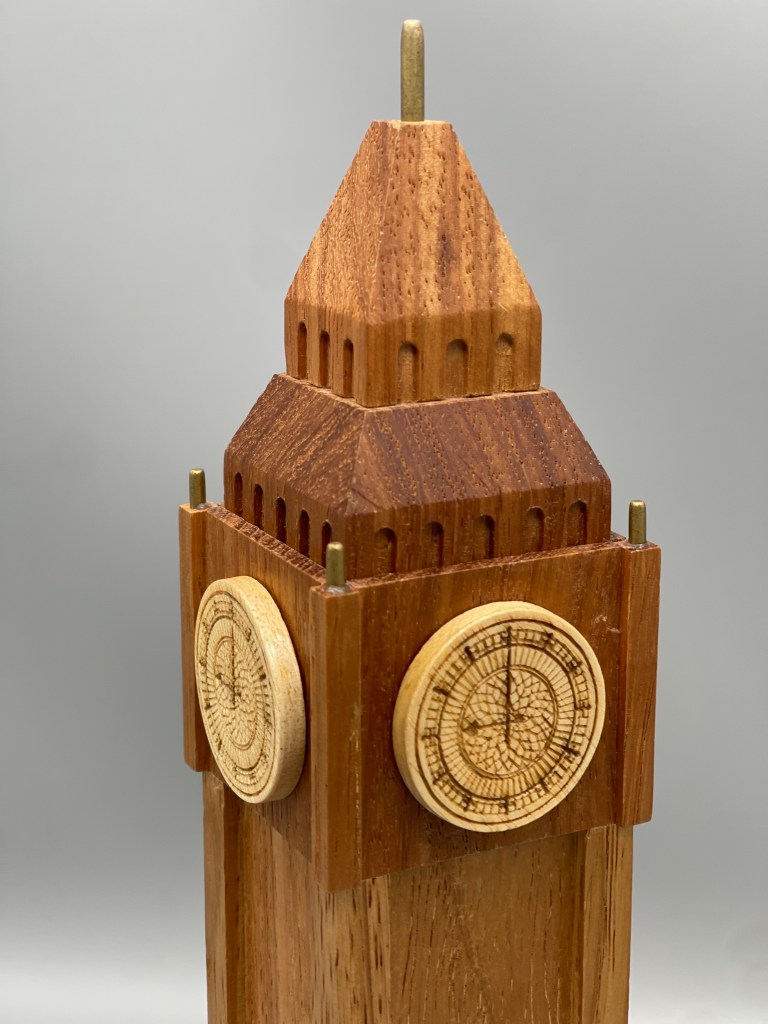
Big Ben has been on my unicorn list for quite some time – years, in fact. When I finally obtained it as part of a rather elaborate trade, I couldn’t bring myself to start working on it right away. First, I just enjoyed seeing it there, ready to solve whenever I felt like it… Then I began to worry: what if all the hype has given me unrealistic expectations? I took it down off the shelf and began working on it… fast forward an hour or two and I had my answer: my expectations were spot on – Big Ben is bad ass.

Standing at about 8.6″, Big Ben towers over many a puzzle and is especially large and complex for an IPP exchange puzzle. From what I have heard, its complexity earned it an atypically high price for an exchange puzzle… a whopping $300! (If you have seen Big Ben sell at auction in the last few years you will understand the irony in this).

Its woods are wonderfully lovely although perhaps a bit rough around the edges, especially as mine had a few micro-scratches here and there. Not that it isn’t the work of a master craftsman… Brian’s work is as impeccable as always and Ben stands up against some of the best-looking puzzles in my collection. And anyway, this was an exchange puzzle, so going up against a Karakuri or another finely crafted puzzle box might not be the fairest comparison.

The goal is neatly engraved at the bottom of the puzzle, along with some well-deserved credits: “Remove Big Ben from the tower and along the way you’ll pick up Queen Elizabeth’s gold crown.” It is worth taking a moment to admire the accuracy of this statement, which overcomes the common misconception that the tower or the clock is itself Ben… but no, it is Elizabeth Tower that stands guard over all the Griswolds trapped beneath; Big Ben is the bell within said tower and we’ve gotta find it!

The clocks begin set at 9 – the final goal of the puzzle is to reset it so that all clocks show the ninth hour. According to what the instructions said, if the clocks are not so set it may not be fully reset, so maybe reset it instead before moving ahead (tbh I don’t know that it will really take away all that much from the solution… it made a great setup for some awesome alliteration though 🤓). I appreciate a puzzle that can quickly signify whether it is in its fully reset state. This is especially the case when there is this much going on under the hood, easily earning it a sequential discovery description atop its take-apart classification.

I also love a puzzle that can rope you in with some early successes only to run you smack into a wall. It sets up a great rhythm, which Ben keeps going throughout the relatively lengthy solve with different sections requiring quite different approaches. I found my way through the early steps mainly through trial & error before finding myself stuck going in circles for quite a while as I tried to make it through what comes next – I may not have become quite as insane as poor Clark, but it was a good and, more importantly, fun challenge. I could be wrong but I seemed to feel a lot of Juno’s influence in this part of the design but, truthfully, I’ve no idea who did what.

My favorite part of the solution comes in its final steps – this is where I believe that Brian’s design style really shines, crafting delightful aha’s into a tricky and satisfying resolution. The reset has its own challenges: reversing some steps is not necessarily such a simple matter. Finally setting the clocks back at 9 as instructed, I smiled at my newly conquered conquest and returned it to my Mr. Puzzle section, which is fittingly and coincidentally close to my Pluredro section.

If only Fay Wray or Jessica Lange were here…

Big Ben was well worth the price of admission, in my sometimes humble opinion. This is a puzzle that almost certainly will not be made again, so if you get a chance to try it, take it… perhaps at a puzzle party down the road 😉

A few landmark puzzles: Big Ben alongside Brian Young’s Louvre & Keith Winegar’s Capitol Politics

All’s Well that Solves Well: Abraham’s Well by Brian Young

Abraham’s Well

Brian Young (Mr Puzzle), 4.75″ x 3.3″ x 3.1″, .93 lbs,

Brian Young of Mr Puzzle has designed some of the best, most sought-after take-apart puzzles out there: sd classics like Three Wise Bolts (reviewed by me :-), Ages, Louvre, Big Ben (with John Moore and Juno), Katie Koala…… just like the beat, the list goes on. So when he announced sometime last year that he had a new design forthcoming, puzzlers planet-wide perked up like Pavlov’s pup post-bell. Brian made the particular choice to pump up production, promising the most puzzlers possible the opportunity to purchase the piece without putting precious puzzle money towards potentially prohibitive prices. TL: he is making 500 copies so prices won’t get bonkers overnight (enough that there are still some available at Mr Puzzle at the time of this writing). Abe’s Well (AW) has led to a mass of creativity and shared discovery that I find to be as fascinating as it is unique and makes this one the most interesting puzzles I’ve seen in a while.

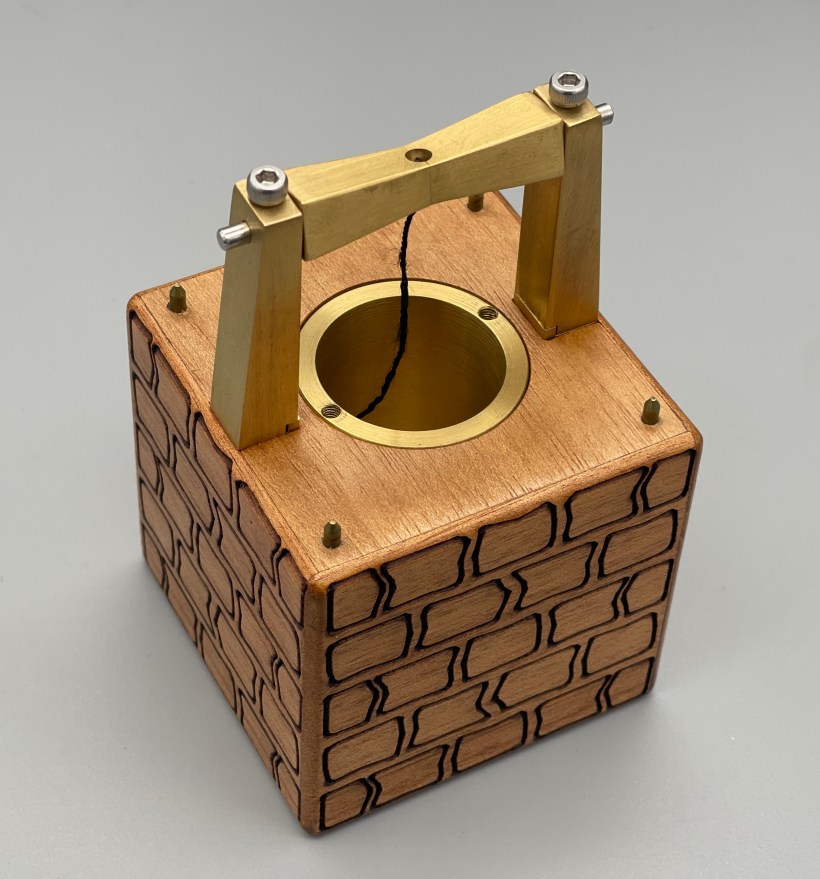
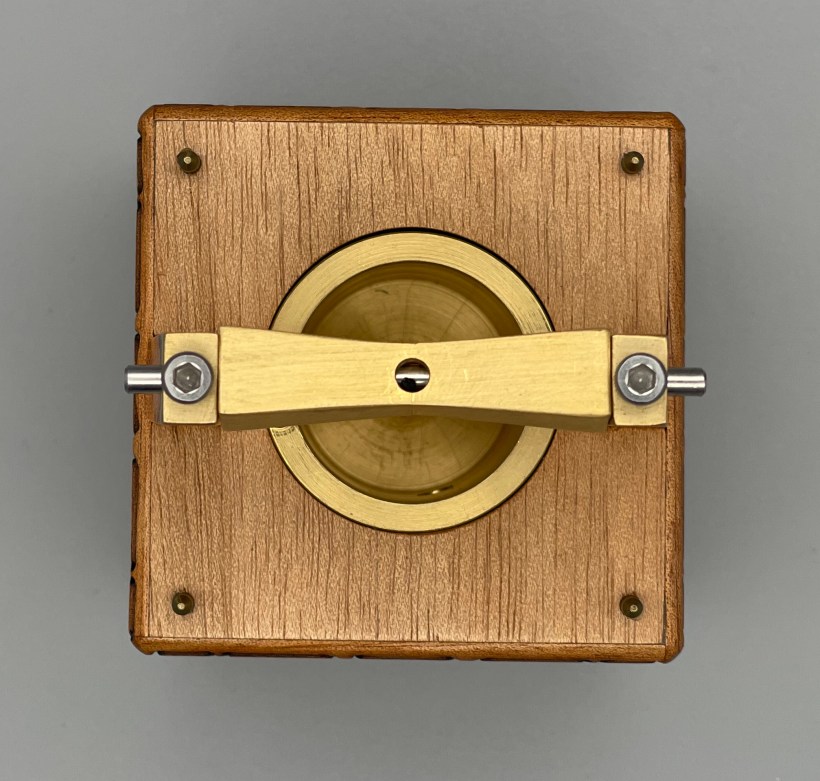
AW is a smallish but heavy (almost 1lb) wooden well, with a brass bucket frame atop it (idk if that is what it is called, but some brief googling didn’t give me anything, so I’m going with that). You can see a metal rod passing through the top of the frame (which spins freely) and a string hangs down into the well itself, which is made of a closed cylinder of brass set into the wooden box. There are also four pointy metal bits (nails?) poking up out of the wooden box at its four corners.

Brian tells us in the original description that the puzzle can be separated into 23 separate parts(!), which is more than a little intriguing to your typical sd fan. “No bashing… and no brute strength are needed,” so figuring out what can be a tool and how to use it will be a major part of the puzzle.

Of course, you cannot simply take the puzzle apart into these individual pieces; at the start, there doesn’t seem to be much to do. I tried a number of things that either did nothing or did a bit of something that didn’t help me, until I found something that might. I realized that there was some good puzzling to be done early on, as I worked to get things where they needed to go and get my toolbox (aka pile of bits) sorted.

This phase is fun and tricky: the separate elements are combined into something fairly novel, although perhaps not mindblowingly original (that comes later) – it makes a great appetizer to the main course. After a while, I was able to work my way through to where I believed I knew what I needed to do next and had a whole bunch of stuff to do it with… but no idea how! And this is where the awesomeness really kicks in.

There is a unique openness to this middle phase of the design that has led to a diversity of approaches (and diverging opinions over what follows the rules and what deviates from them), prompting discussion and the discovery and development of diverse designs that delight an open puzzled mind (and may dismay those puzzlers who prefer a more strict design) – all in a way that I believe has never been done before (and may have surprised its designer as much as anyone). ‘That step’ ensures that AW stands out as something truly new and will assuredly go down in puzzle history, even if some puzzlers take issue with it.

While my take on the matter is perhaps clear, I do not mean to deride those puzzlers who didn’t particularly enjoy ‘that step’ (wrong though they may be 😉 ) I absolutely appreciate a puzzle with a singularly defined approach to each step and believe that there is also plenty of room to appreciate the type of puzzle sandbox AW creates.

But lets not get too caught up in philosophical discussions of design modalities and keep in mind that although ‘that step’ does constitute a substantial part of the puzzle experience, it is but one step in a larger journey. If the puzzle’s novelty was the only thing that really impressed me about it, I wouldn’t be compelled to do a write-up of it, let alone enjoy it on my own as much as I did. The simple truth is that not only is ‘that step’ unique, it is pretty darn challenging – I don’t want it to sound like there are so many ways to accomplish this step that it is easy to do…. not at all: I struggled for quite a while to find something that worked… and then longer to find something that I felt wasn’t cheating at least a little… and then even longer to admit myself that I was sorta still cheating and that I may as well give into temptation (a skill I’ve honed over the years) and start perusing the several spoiler-tagged pics of creative approaches other puzzlers have come up with.

Needless to say, they were pretty much all much cooler (and more consistent with the rules) than what I had done – rather than be disappointed in my failure as a puzzler and as a human being (another skill I’ve honed over the years), I enjoyed the experience of trying out some of the other methods that had been shared. I was impressed and amused by some pretty wacky approaches, some similar or small variations upon mine or others, and some really out there…

While playing around with ‘that step,’ I had also been looking around for what might come next; the description tells us that the ultimate goal is to find a pewter token that is “uniquely Australian,” and I not only hadn’t found anything, but didn’t really see where anything could be hiding. I did notice a few things that had yet to reach their full potential (according to their parents, at least), and it was now time to move on in earnest (knowhutimean?).

Oddly enough, I think I got stuck at this point more than at any other point in the puzzle! I hobbited there and back and around again before finally requesting some pretty specific nudges (possibly more like shoves) in the direction of what I needed, only to realize that in all my wandering about (walkabouting?), I’d passed right by it numerous times. After admiring my own stupidity (yet another skill I’ve honed over time), I found what I needed and knew just what to do. The result surprised me and got a good laugh, a final aha that was a great cherry on top of an excellent puzzle sundae.

The description leaves the true significance of the token as a bit of a puzzle on its own; the object itself is recognizably Aussie but it took a bit of googling to understand its specific connection to the puzzle, a fascinating story that conceptually ties them together nicely and is just plain interesting (I found a great article about it and confirmed its relevance with Brian, if you’re curious to know more and your google button is broken).

Abraham’s Well is as challenging as it is original, and is a unique sd puzzle experience well worth your time. This is perhaps the first (and only) puzzle, that had me continuing to explore a step after having “solved” it, seeking a better approach and exploring those developed by others. While it may not meet everyone’s expectations, I would assert that perhaps it is only because it challenges them; this wonderfully exemplifies the idea that puzzle design is art, as the viewer finds meaning beyond the intent of the creator (who humbly states that claiming he foresaw the creativity ‘that step’ would engender would be “giving [him] way too much credit for thinking that far ahead”).

So solve it the best you can and then try to do better; and when you’re done, seek out some other puzzlers’ solutions to try; if you need to, challenge yourself to reconsider some assumptions over how a puzzle might be experienced. Remember: we’re here to have fun.


Originality / Fun Grade: Five Sinatras
(click here for more information on the Sinatra Scaling System, (c) John Maynard Keynes, 1944)

Three Little Bolts from School are We…

Three Wise Bolts

Mr. Puzzle, 5″ x 1.5″ x 1.25″, 330 copies made (2018)

There is nothing better than a super-timely puzzle post about something available or coming up soon….. this is not that.

I have been wanting to write about Three Wise Bolts for some time; after re-solving it recently, I remembered what a fun and original puzzle it is and the puzzling muse once again struck:

Three Wise Bolts is a 2018 release from Brian Young at Mr. Puzzle. At the time, my collection was somewhat subdued – I didn’t have much of a budget for puzzles nor did I know as much about what was out there. But something about this puzzle struck a chord with me and I jumped on it. With 330 copies made, it is much more common than many limited releases; the fact that they are not seen being sold at auction as often as many other puzzles released in much smaller quantities should tell you something.

Three Wise Bolts is a take-apart puzzle; most decidedly not a box as there is no internal space to be accessed. The purpose is quite simply to remove the three bolts spaced evenly along a horizontal block, thee Mr. Puzzle logo etched into its front. It also falls quite comfortably into the sequential discovery sub-category, as the puzzle experience has you discovering tools as you journey towards finally removing all three bolts and taking apart the frame that splits into two pieces.

You can see from the bottom that the bolts are different sizes; their complexity also differs considerably, with the puzzle bringing you along a linear journey to its eventual solution. They all spin freely (until they don’t) and small holes are found low on either side of the frame. The tops of two bolts also have a small cavity etched into its side. As with many Mr. Puzzle creations, you must think really creatively about what might be usable and how it might be used. It starts out fairly easily, winning you an early success by removing the first bolt, as you learn a bit about how the puzzle works and what is going on inside. Then the difficulty begins to scale up, with the third bolt being particularly tricky, forcing you to think hard on what might be possible using the tools at your disposal; trial and error may not get you all the way there, and you may need to step back and try that whole thinking thing.

Resetting is just a matter of reversing the steps until you are back at the start. Having first solved this puzzle some time ago, re-solving was almost a new experience; I had forgotten enough about what needed to be done that the a-ha moment, while a bit subdued, was nonetheless still quite satisfying.

Mr. Puzzle offers many great puzzles in addition to Brian’s personal creations and is the only place to get his releases without resorting to auctions or fellow puzzlers. He has a new puzzle coming up that is said to be sequential discovery in the spirit of Big Ben or the Louvre, two pieces with excellent reputations (neither of which I have had the pleasure of solving). And, in a welcome and rare twist, they have said that this will not be as limited a release, in the hopes of ensuring that everyone who wants one will be able to get one – so no setting alarms and hoping the puzzle doesn’t disappear from your cart while you are checking out. Apparently, he is now in the prototype phase and we shouldn’t expect it to become available until mid-2021. So, if you haven’t already, be sure to sign up for their blog – they won’t bombard your inbox and you will be sure to know more about it as we get closer to release.


Originality: 5 Sinatras

Difficulty: Four Sinatras