Get Lost: FastMaze by Dan Fast

FastMaze 1

Designed by Dan Fast
Produced by CubicDissection
Aluminum & Brass, 3″ x 1″

I got the chance to try an early copy of one of FastMaze 1 (designed by Dan Fast and produced by CubicDissection), and “fast” is not one of the words I would use to describe it: smooth, yes; fun, certainly; challenging, absolutely; but fast? Nope. Not for me anyway.
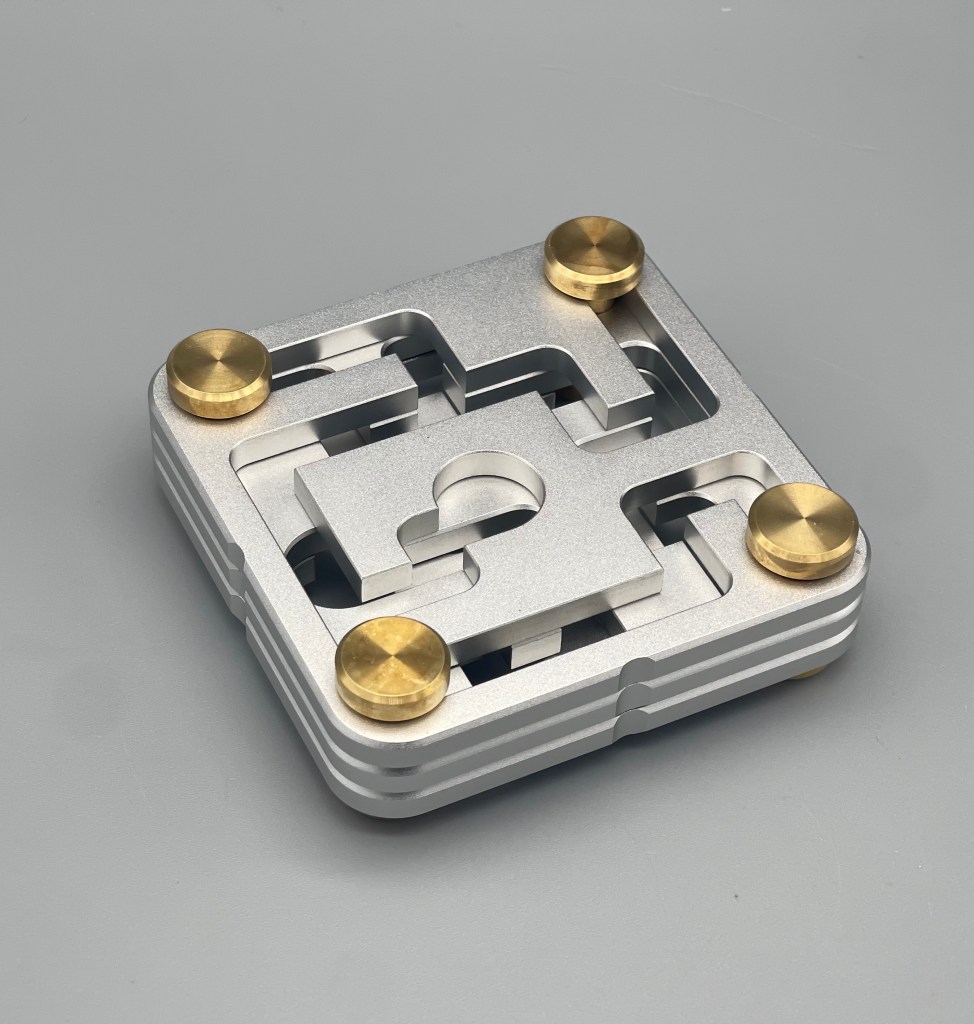
Dan has designed many a high level burr, including the relatively recent Stir the Coffee produced by Pelikan; PWBP shows more than 100 puzzles designed by him, a level of prolificacy shared by few others, including the rather iconic Superman and Batman burrs (also produced by Pelikan). FastMaze 1 is one of a series of three new puzzles being produced by the excellent craftspeople at CubicDissection, whose recent equipment expansion allows them to create more affordable challenges that still meet Eric’s extremely high quality demands (perhaps the hallmark of CD creations).

FastMazes 1 – 3 are three-level square mazes in which you must navigate pins in each of the four corners to a hole that will allow them to be removed one at a time; of course, this hole is in a totally different spot on each of the three levels so getting them to line up is no small feat. FastMaze 1 is the “easiest” of the three – I say this with my tongue firmly set into my cheek as its 137 moves is far from easy. Not only is that a lot of moves total, but once you have removed the first piece you still have another 83 moves to go for complete disassembly (the full solution is 54.28.24.28). FastMazes 2 and 3 are levels 160 and 196 respectively (#3 requires 121 moves just for the first piece!). This may sound intimidating but while it is most definitely a challenge, it is by no means unapproachable.

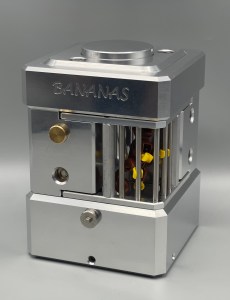
CD has produced the series of 3 puzzles in metal, with super smooth aluminum mazes navigated by four brass pins. The puzzles have been designed to easily come apart, allowing for a simple reset that makes the puzzle much less terrifying. The quality is apparent from the moment you pick it up: the metal is smooth to the touch, the pieces gliding over one another softly and easily. Notches marking the edition of the puzzle have been built into the center of each side, a nice aesthetic detail that helps you maintain control over the puzzle, especially once the levels start getting spread out as you progress through the solution. This happens quickly as the paths block one another unless you are able to have all pins situated such that the maze levels can shift. After a little while, it becomes possible to rotate one or more levels, something that I am still not sure whether it helped or hindered my progress. Apparently, the second of the three designs requires rotations, which I plan on confirming once they all become available. Regardless, the rotations are similarly smooth and, importantly, feel controlled – this is not like a burr that has become unmanageable with pieces rotating against your will. Its size fits perfectly into two hands (or your pocket for easy transport), allowing for easy control even as the pieces spread apart into its various contortionist configurations.

At first, I simply appreciated the construction and fit, the pins refusing to move until sliding smoothly and freely once a path becomes available. I began playing with it just to get to know its movements, finding it has a fun fidget friendly factor as an added bonus (it was also oddly satisfying to pinch one of the pins and swing the puzzle back and forth….. maybe that’s just me lol). It quickly became clear that such an approach was not going to afford me much progress: I was going to have to apply some brain power if I wanted to get anywhere as random fiddling isn’t going to get this little guy apart on its own (eventually, I suppose, but there might be a monkey Shakespeare by the time you get there). The exposed top and bottom levels allow you to work out a lot of where you need to go, but the center layer is largely hidden, confused by the paths above and below it through which you can try to make it out. As you work through the solution, of course, more of this layer is revealed and you must adjust your intentions and goals accordingly. Solving multiple mazes simultaneously with multiple moving restrictions is much more than the sum of its parts: dead ends exist in most any maze but here you must sometimes take advantage of these, working pins somewhere just so you can allow another to move elsewhere before backtracking once again. This makes for a great balance of experimentation and logic in working towards the solution, which will sometimes seem so close only to slide away once more. After finally releasing the first pin, I thought things would open up and become easy but in fact there was still plenty of puzzling left, the logic somewhat simplified but still significant in the strategy required to solve it.

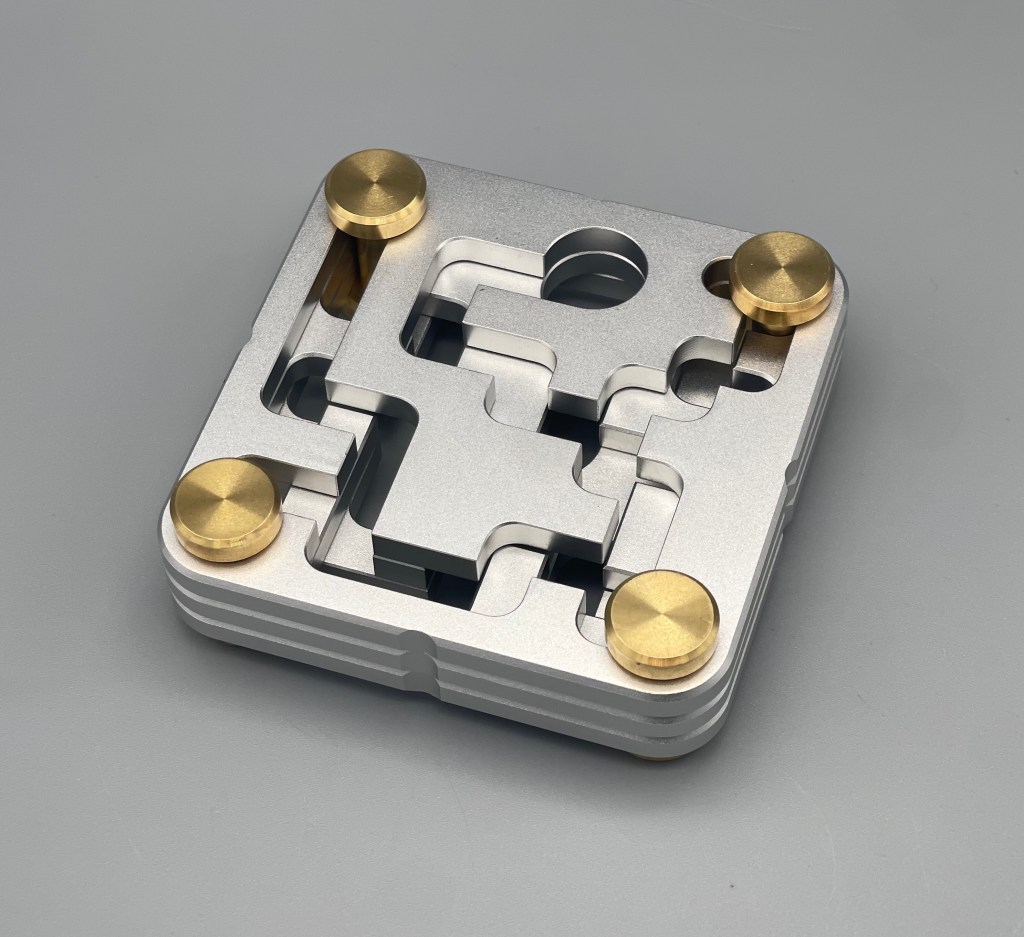
FastMazes 1 -3 were released today, August 29th, 2022, available individually or as a set of three. I found that as soon as I had solved mine I wished I could reach for another, so I will definitely be picking up at least one more (who am I kidding, like my compulsive completionism will allow me to have just 2 of 3…). These are a fun challenge at an affordable price point with no sacrifice of quality (as we expect from our friends at CD), bringing excellent puzzling value to whatever puzzle shelves it will soon grace. You can find FastMaze 1 here and the others here.

Keep on Puzzlin’ w/ Stickman’s Keep Locked

Keep Locked (Stickman #36)

Rob Yarger, 52 copies, 7″ x 6″ x 6″

Dude. I seriously love this puzzle.

You probably know of Rob Yarger a/k/a Stickman and if you don’t, head over to the Google and do the Googling because you are missing out (check out one of my go-to videos to show non-puzzlers the coolness of puzzling: the amazing Wisteria Cabinet he made with Craig Thibodeau). Rob is a master woodworker and a downright deviously cool puzzle-maker. I have a few of his boxes and have been fortunate enough to try (and even solve in the case of one or two) some of his puzzles at the Puzzle Palace (while it was still in FL). However, most of his puzzles sit at the top of my unicorn list (something in which I am hardly unique): Checkmate, Lighthouse, Burl Tile…. the list goes on and on. And his (comparatively) more easily obtained puzzles such as One-Hand and Chopsticks are still totally badass bonkers (he also helped Jesse Born create the wonderful Sun Dial).

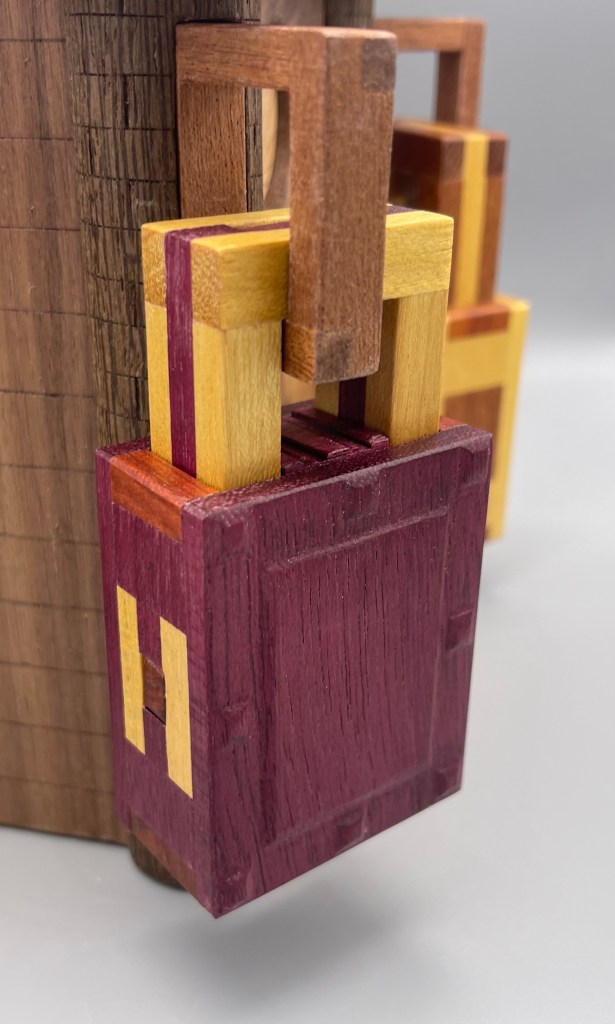
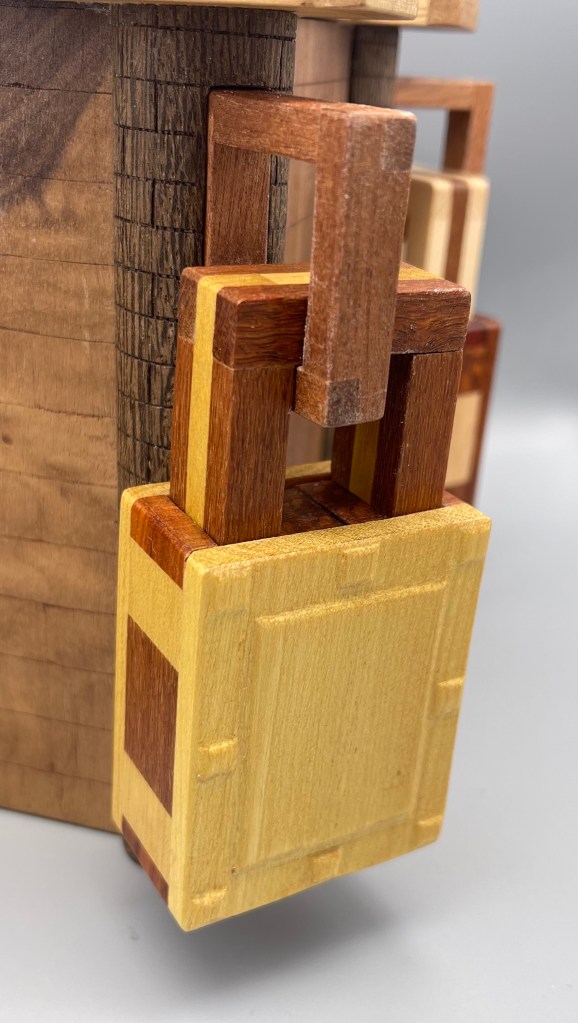
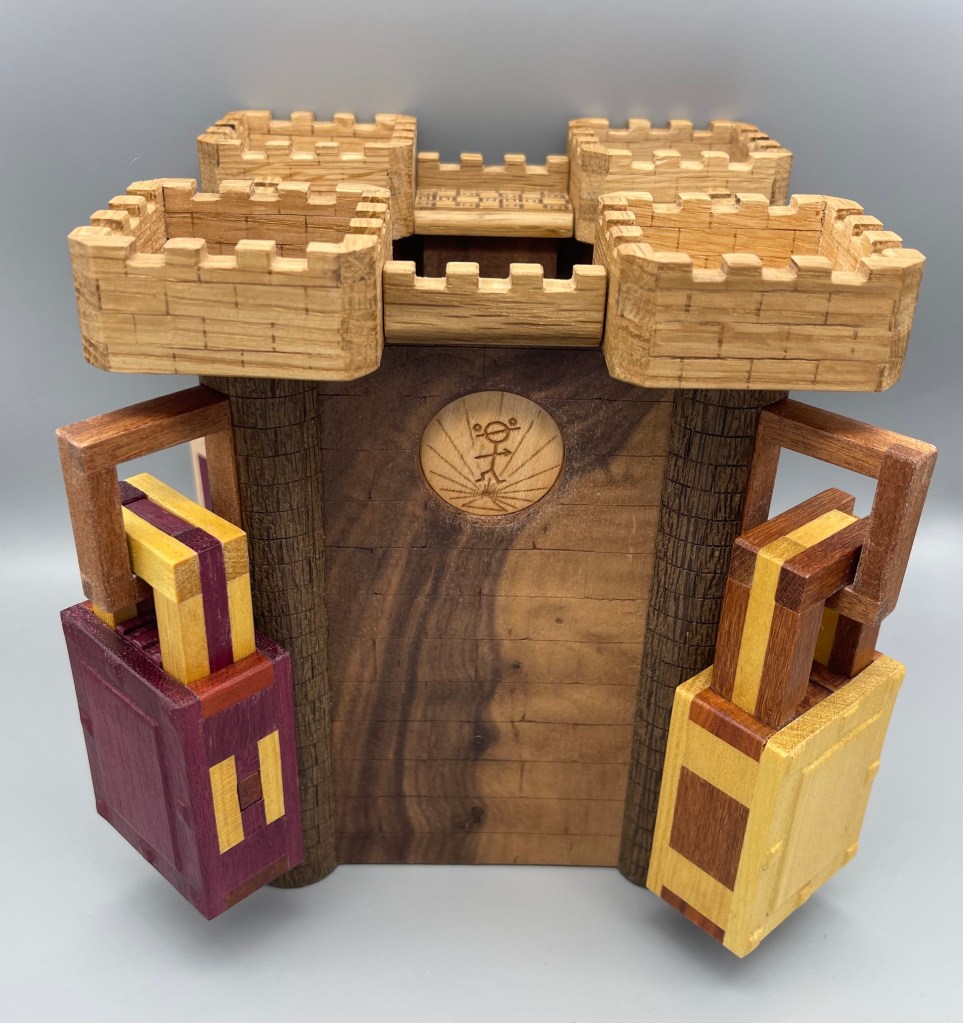
I was fortunate enough to have the chance to get Keep Locked and gratefully responded: “yes please.” Fast forward several weeks and it arrived! Keep Locked is essentially a castle with locks attached to the four towers of the battlement; each lock uses different woods, focusing on one primary species with several others integrated for smaller details – I believe that they are Leopardwood, Maple, Purpleheart, & Yellowheart. One features the Stickman logo, which is also displayed on the back of the castle, opposite from the metal lion above a portcullis and door on the front. The roof of each tower matches the neighboring lock. The castle is itself constructed of several more woods (I am not sure how many different woods are used, but it has to be around ten by my layperson’s count). As with any of Rob’s puzzles, it is wonderfully made, the quality readily apparent from afar but even more so when you start with the puzzling.

And as pretty as it is, the puzzling is better. While the ultimate goal is unclear (as it is a puzzlebox there must be some hidden compartment but we are not told where… although I had my suspicions I’ve learned to be careful. Starting out, it seems pretty clear that each of the four locks must be removed and, man, there is enough puzzling there to sate my puzzle thirst, sequential discovery abounds and one must question every assumption as Rob is able to hide mechanisms in plain sight almost as easily as he can hide them. If you have solved the lock he used on his Pirate Wallet (and reproduced on its own by Eric Fuller of CubicDissection), you have an idea as to how much puzzling he can fit into a 2″ by 3.5″ lock.

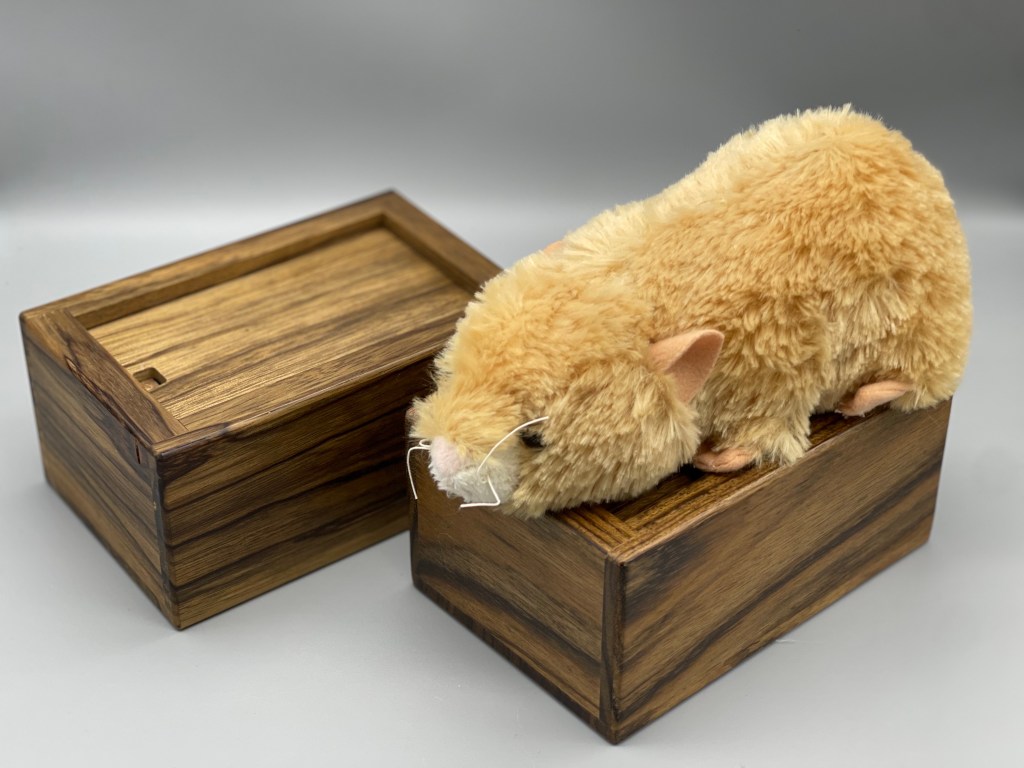
After finding nothing more than a few small things, I knew this siege might well be a war of attrition, therefore staring intently at the box while assuring it that I would deprive it of food and water until it gave up its secrets. The castle seemed indifferent to such threats and I therefore constructed a catapult with which to launch a Trojan Hamster until realizing that this was insane and went back to the staring. This proved equally ineffective and I returned to my poking and prodding until I began finding…. things that did things! Huzzah! The townspeople rejoiced! After an hour or two of puzzling, I had managed to remove some locks and determine that I had no idea what to do next.

I will admit that I asked my wife to confirm a couple things in the solution for me, nudging me in the right direction (the copies are only just rolling out, so hints from other puzzlers were still pretty sparse). The nudge having been nudged, I got through some more sections of the puzzle before, you guessed it, hitting another wall. I simply could not see what else I needed to do and left the box for a couple days to allow my subconscious to go to work. Lo and behold, I had an idea, realizing I hadn’t tried something and, huzzah once more! Further rejoicing by the imaginary townspeople! I had found…. things that did other things! All this occurred in little fits and starts over the course of a week or so, interminable wall after wall confounding me in between as I explored the significant extent of puzzling hidden within.

The certainty of my brilliance faded as I realized that I, once again, had no idea what to do. Fast forward a few more days of staring and, wait a sec, is that…? OMG of course! More progress ensued until, finally, I was pretty sure I was at the end but…. wtf dude. There must be something wrong. This is obviously supposed to do this and it’s not. Another wife check and she confirmed something she learned long ago in the 17 years we have been together: I am an idiot. Rob’s subtle sneakiness had worked its magic and a small nudge afforded me the aha! I needed. Uh…. no it didn’t. Yes, I had found a cool thing but, no, I was not done. I found my way to this last step after a bit longer and happily discovered the compartment that had eluded me. I basked in my glory and reversed course to reset everything. By this time my horrible memory had allowed to forget a few details, giving me a bit more fun re-solving the locks that I’d reset previously for safe-keeping.

Keep Locked is one of the best puzzles I have tried in a while, which is saying a lot considering how many great puzzles have been rolling out this year. It will most definitely not be going anywhere – I will consume the rest of my puzzles and pets (not necessarily in that order) before admitting defeat in any war of attrition levied at me (and the townspeople were happy).


Quoth the Puzzle, “Ever-poor” – Rav’n by Ken Snache (w/art by Janice Bell)

Rav’n

Kel Snache (w/artist Janice Bell), 15 copies, 10″ x 13″ x 6″

The line between art and puzzle is oftentimes vague: many a Karakuri’s craftsmanship outweighs its complexity as a puzzle, while challenging, original puzzles may not always be the prettiest. Kel Snache runs the gamut: repurposed tea boxes are fun but a bit rough (which really is part of the charm), whereas EWE UFO and Puzzleduck Pastures are as pretty as they come.

Cue one of his newest releases, Rav’n, a collaboration with artist Janice Bell (who is also contributing to the Dragos boxes). As soon as I saw a pic, my puzzlie senses began tingling: a unique trick-opening puzzle reminiscent of an Edgar Allen Poe story?! Um, yes please.

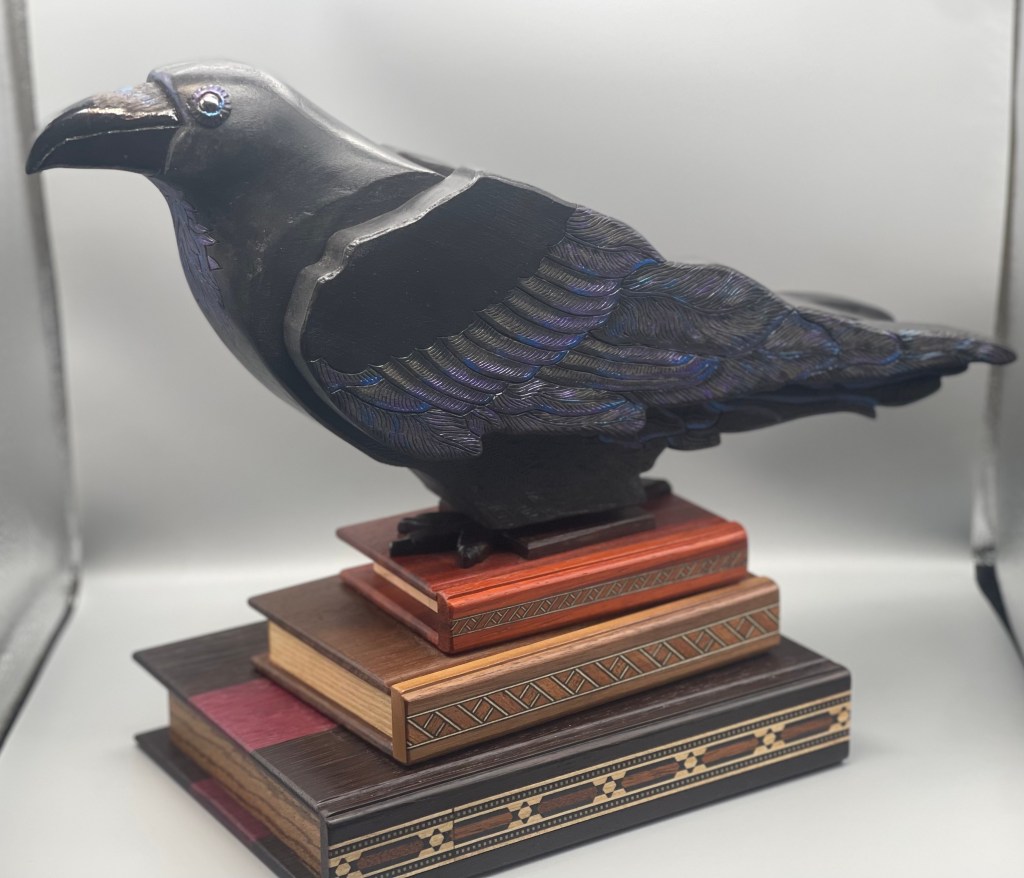
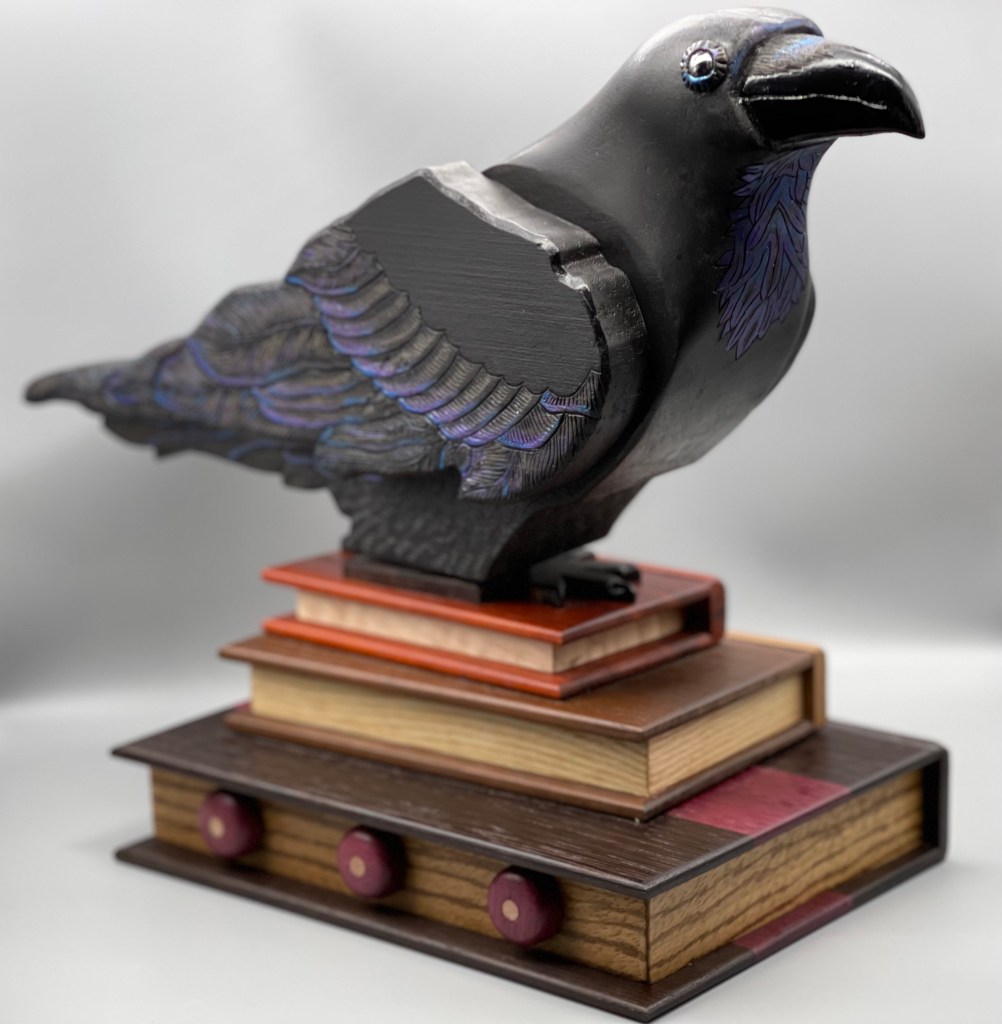
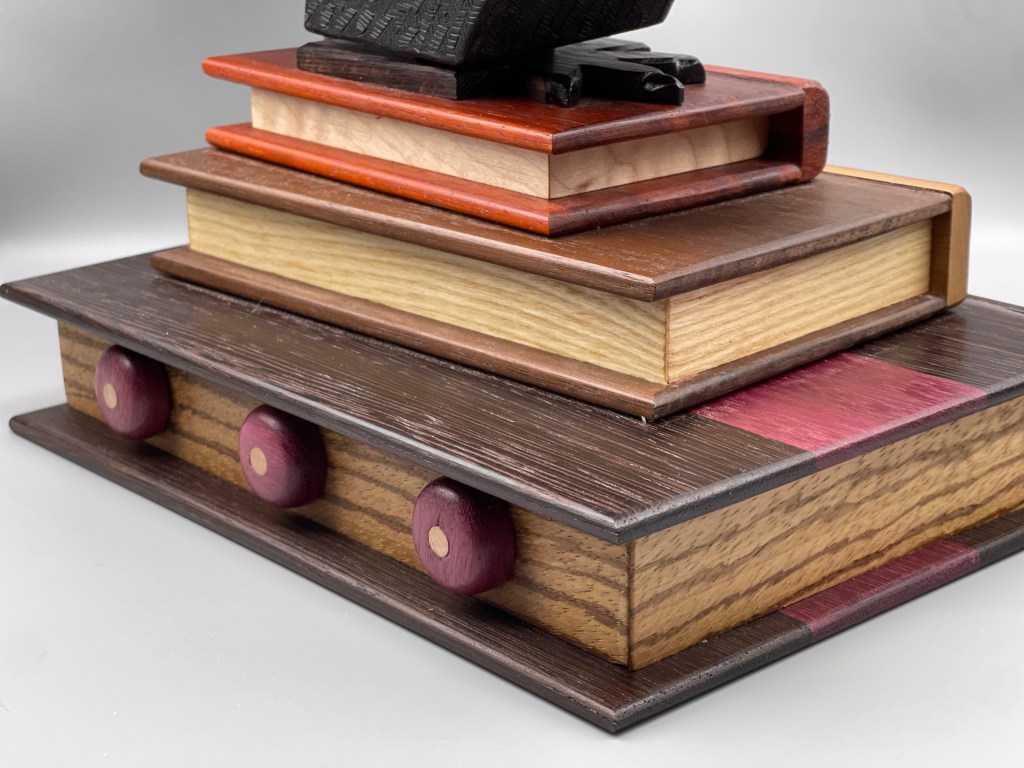
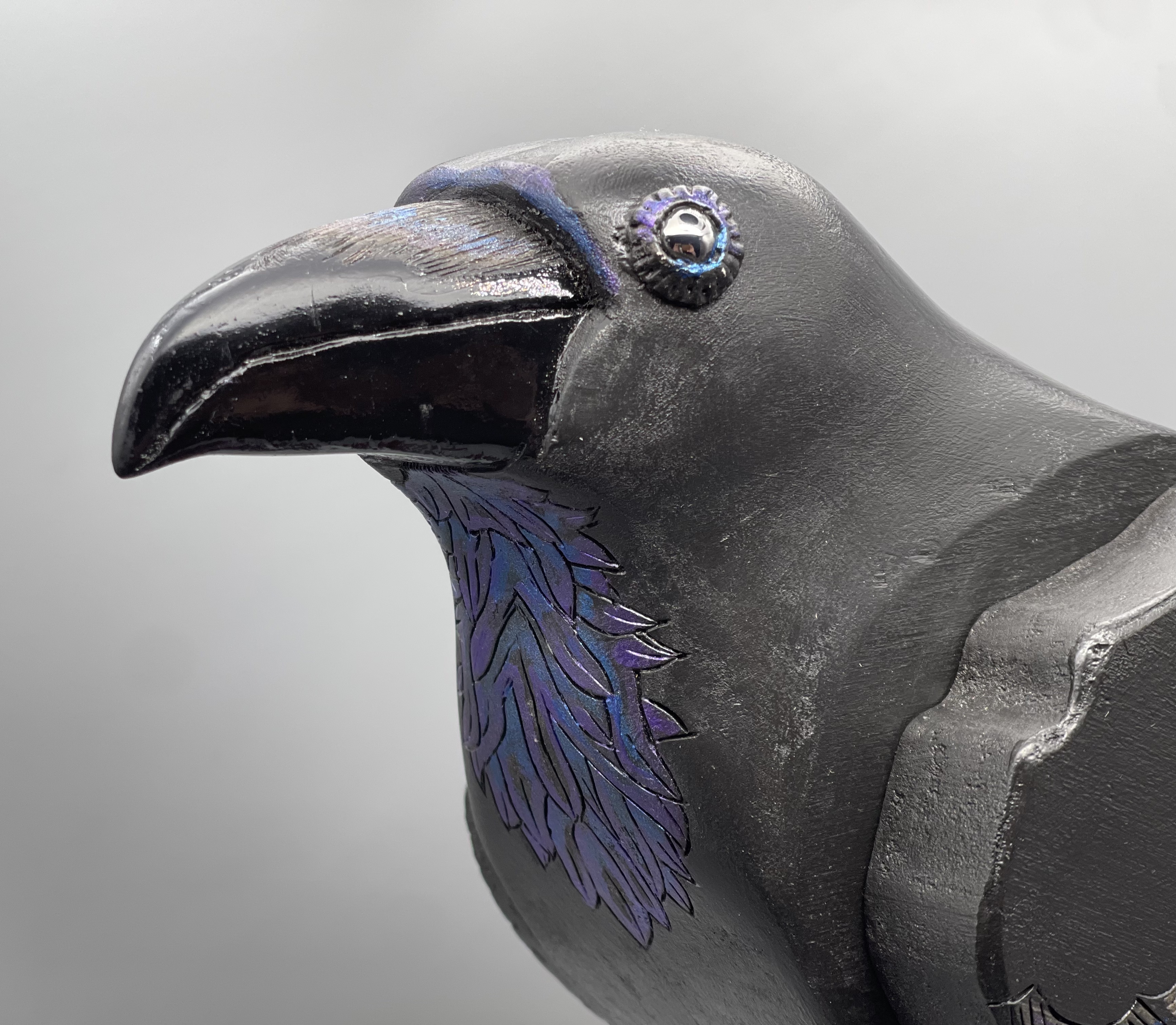
Several weeks later and a big box arrived, containing the sizable wooden bird affixed atop three beautifully made wooden books. Bigger than I expected at more than a foot from beak to tail and almost as tall, the bird is a gorgeous black with shimmering purple and blue detailing on its head, eyes, neck and wings and feather carvings throughout; the bird stands one-legged upon the smallest of the three books, their spines crafted with yosegi-like details and “pages” that exploit the wood grain for a fitting look, akin to Bill Sheckel’s book boxes.

The goal of the puzzle is quite unique: open the wings! This originality was almost as enticing as the aesthetic (almost). While not insanely difficult, with around a dozen sd-lite steps it still proved to be a fun challenge for me. Further, the inner spaces behind the wings are adorable in typical Kel fashion. Similarly, the three knobs on the pages of the bottom book are classic Kel and fit wonderfully with the woods used elsewhere.
After ooh’ing and ahh’ing my way around the piece, I showed it off to my wife who was actually impressed, earning it an “oh! that’s really cool” rather than the typical “that’s nice, babe” that the majority of puzzles receive. Admittedly, she is even more of a Poe fan than me, which may contribute to the response, but it doesn’t change the fact that it is just so damn pretty a puzzle!

It was a solid challenge for me, as I managed to solve it in three dedicated sessions; there are some fun mechanisms that, in typical Kel fashion, are at least as aesthetically pleasing as they are tricky. Needless to say, this piece of puzzle art (art puzzle?) earned its place Downstairs, where many of the prettiest and coolest of my collection lurk. It is a great puzzle to show to non-puzzling passersby, who invariably had assumed it could not be a part of that odd collection of wood and metal things this weirdo rather obsessively collects (but hey, who’s judging!).

Kel continues to work his way through the Dragos boxes; check back in a year or so and perhaps I will be able to share my Lovecraftian dragon box with you 😉 Rav’n is, I believe, fully claimed, so obtaining one may be difficult; hopefully these pics will tide you over until you have a chance to visit one being held in captivity for our puzzling pleasure.

Part of my Kel collection: (from left to right) Puzzleduck Pastures, EWE UFO, Rav’n, There Goes Bill & Flor Fina 2

Bananas is bananas.

Bananas

Jon Keegan, 8.5 x 8.5 x 11.5cm, 1.45kg

I was trying to explain to my wife how puzzling can be a mindful experience (she’s a therapist… I’m just cool like that ;-P ) as you may spend an hour or more in near silence, focused on every sound or perceived resistance or reaction to determine just what in the heck is going on, divining patterns from some series of stimuli, some so subtle as to cause concern that it’s just me doing something wrong or hearing or feeling something that isn’t there. But when finally this intense focus bears fruit and you get that aha! midnfulness is out the window with the dopamine hit you’re getting, earned with the eye strain and aching back from contorting yourself to try and look down some tiny hole or shaft.
And what fruit hath been bear-ed? I’m sure you didn’t click on this write-up to read me ramble vaguely about puzzling in general but rather to read me ramble vaguely about Bananas, the new puzzle by Jon Keegan (his follow-up to Jewel Thief). And if the paragraph above ap-peals to you, then your interest in Bananas is anything but bananas (because you see: Bananas is bananas).

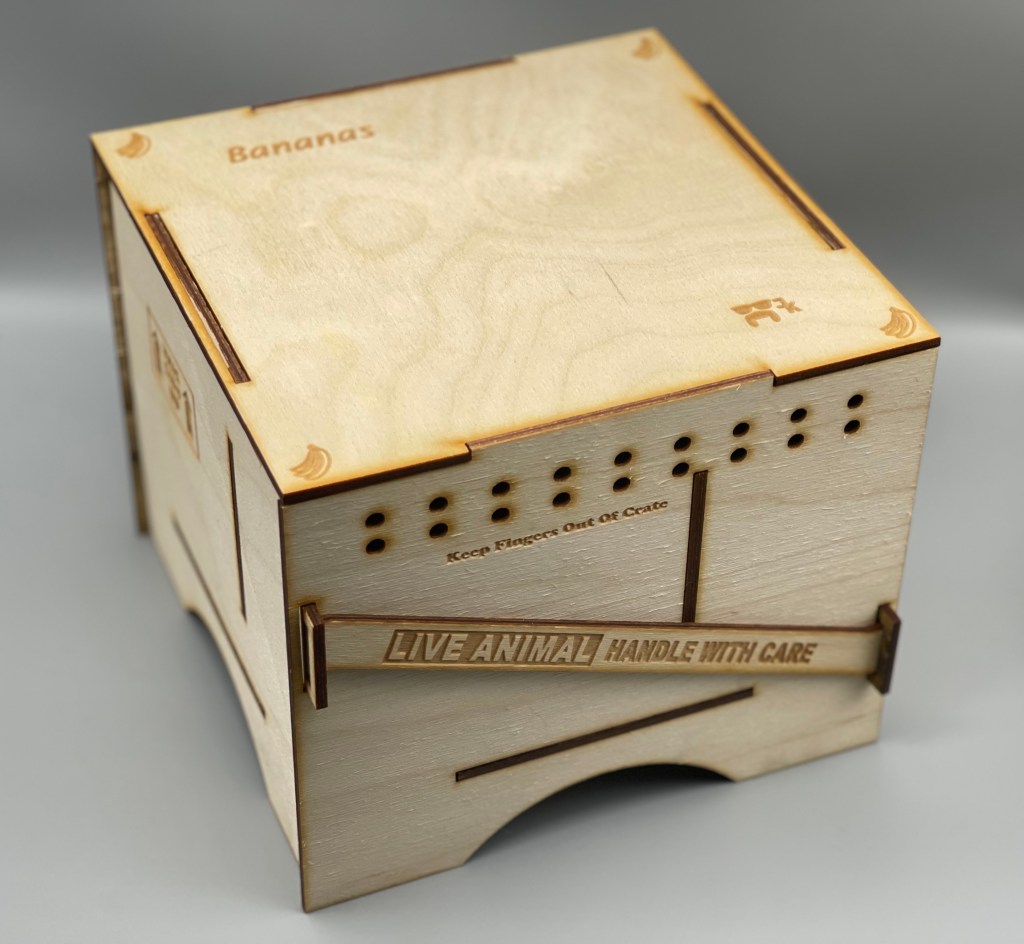
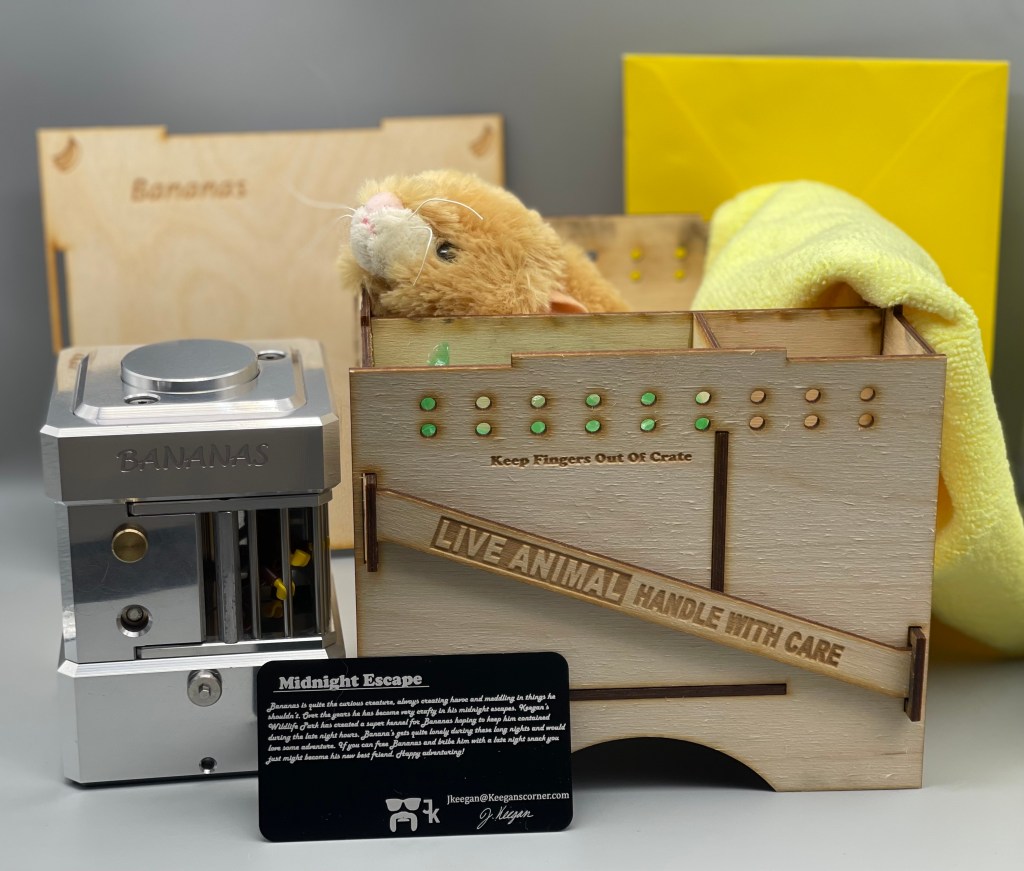
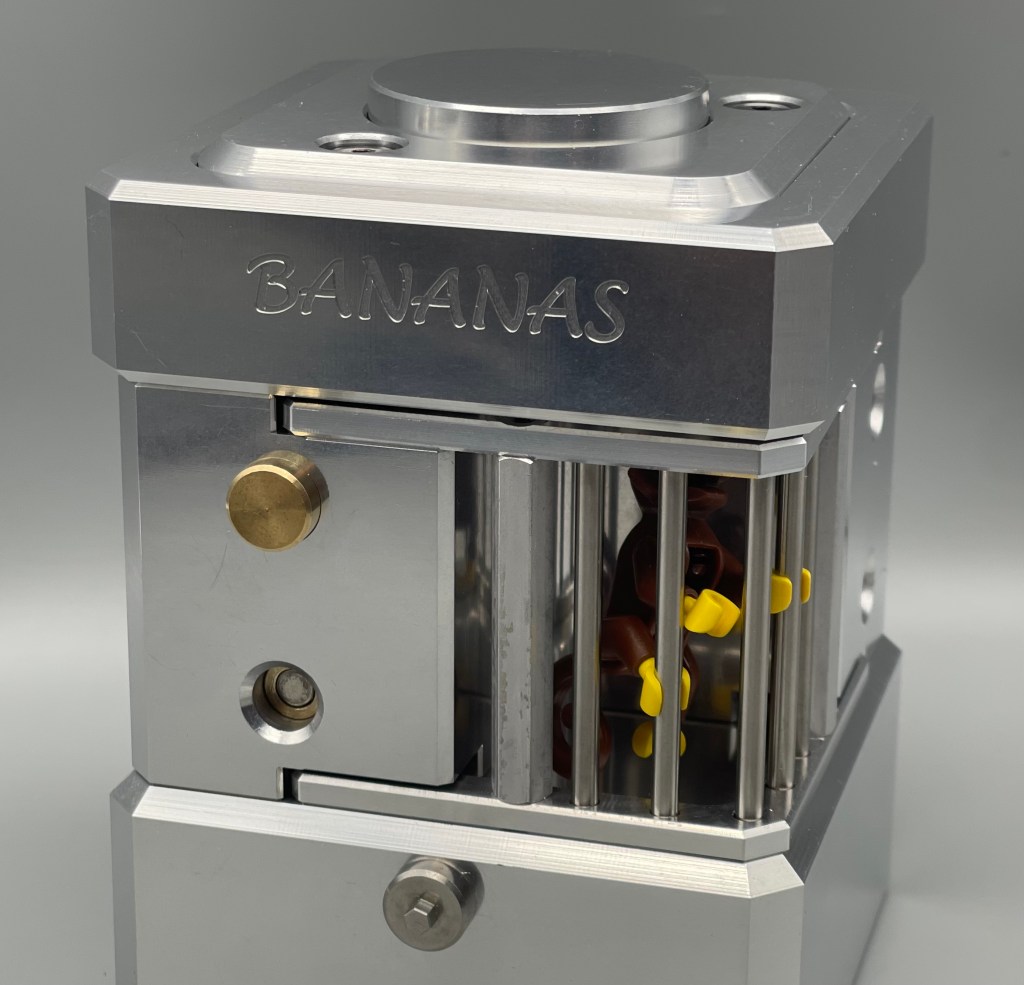
Bananas arrives wonderfully: super safely packed with a wooden shipping crate straight off the boat to Skull Island, ready to pack away something wild and dangerous. Cue a cute lego monkey caged by Keegan for our puzzling pleasure. Inside we find the puzzle, along with a metal objectives / story card, an envelope with pics of the internal mechanisms to decipher post-solve and a kindly supplied towel to protect the puzzle (and whatever surface you will be working on.

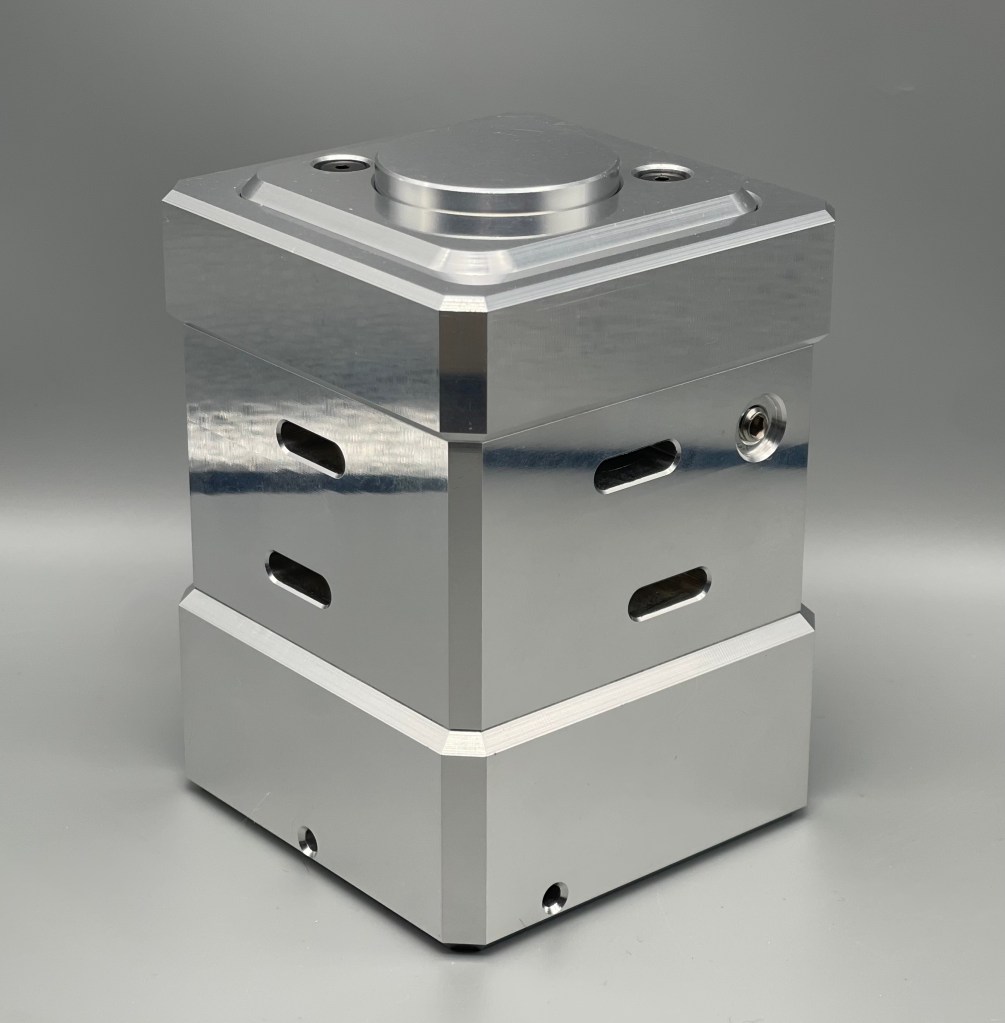
And as for the puzzle itself: Bananas is trapped in a cage set into the corner of a pretty massive block of metal replete with holes and knobbies and squares and circles to poke and prod and wonder at. Everything does something, of course, although nothing does anything just yet. The ticket in isn’t easy in itself (but you will get to understand it eventually); I struggled there for a bit and passed through with a bit of luck before too long, going on to make good progress before finding myself with a whole bunch of stuff and things to do with no clear path. Examining the puzzle does give you a sense of what is going on, at least in some areas, so I thought I know where I was shooting for, for the moment anyhow.

What follows would be a montage set to an uplifting light rock ballad about overcoming struggles as I proceeded to do what I started this post with, trying to find some magical combination of moves that would see me through to the next section. And eventually: aha! of course, and aha! again, with ever more aha!s big and small throughout the entire puzzle. There are some really great discoveries to be made before you free Bananas… and that’s the really crazy thing because you’ve only just started! The instructions tell you to solve the puzzle in 4 parts:

Bananarama!

I had done 1 and 2 but…. wtf.

So I kept going and going, through multiple additional sections, each with several variously moving bits to contend with. Eventually I sat back with pride, Banana’s snack in hand, admiring the mess of metal that had amassed around me, amidst my super-cool puzzle headgear and pleather dice trays. Such puzzling pride passes quickly though, and it’s time to reset.

The reset is tricky and challenging but not frustrating or overly confusing; I had some concerns about whether I’d be able to piece it all together after having taken a couple weeks to solve it but while it took fully understanding all that had happened to make it all ready to go again, this was not so difficult in reverse. In my typical genius fashion I had to solve and reset multiple sections multiple times due to having reset some part before some other part… I’d say I did it purposely, to better master the puzzle, but really I just do it all the time because I’m a dumbass  ¯\_(ツ)_/¯

Such dumbassery does have its benefits though: I feel now that I truly get what was happening throughout the puzzle when at first I couldn’t imagine how I ever could. What else can you ask from a puzzle? There is a fair amount of blind struggle but careful and close observation and experimentation will give you guidance, along with some subtle clues to make sense of as you go.

Bananas was released in a limited run of 225 by Jon Keegan and were all claimed (as is fairly typical with a good puzzle) long before this was written – in typical voracious puzzle fashion, we all politely and (seemingly) patiently waited with occasional but regular updates on Jon’s progress and puzzle maturation. I have to admit that I have not actually solved any other puzzle by him! My zealous overuse of multiple emails led to a snafu in which I missed my chance at a Jewel Thief… (meh, whatcha gonna do – from what I’ve heard, while it seems to be an amazing puzzle I’m pretty sure I would still be struggling with the first step lol). I did get a Scarf prototype but want to wait for the updated version coming out down the road (which just means that I haven’t been able to solve it 😉 But Bananas… the more I let it sit after finally solving and resetting I come to appreciate it more and more… quite simply, Bananas is bananas.


Posts, Doors, Drawers & Hooks: Puzzling with Michael Toulouzas

Trinity, Doors & Drawers, Hellas Cube

Designed by Michael Toulouzas
Trinity Made by Pelikan; Bubinga; 3.9″ x 3.9″ x 5.5 “
Doors & Drawers Made by (Old) Pelikan/Toulouzas; Walnut, Light & Dark Oak, Katalox & Bubinga; 4.2″ x 3.7″
Hellas Cube made by (Old) Pelikan; Jatoba & Maple; 5″

Michael Toulouzas may best be known for his sd/take-apart puzzles, such as Toolbox, Vault and Fairy Door (which led in part to Ken Snache’s Puzzleduck Pastures and Tracy Clemons’ Dark Fairy Door), but his interlocking designs are perhaps just as impressive. I thought I would write about three such designs I have had the good fortune to collect and solve this year.


Trinity

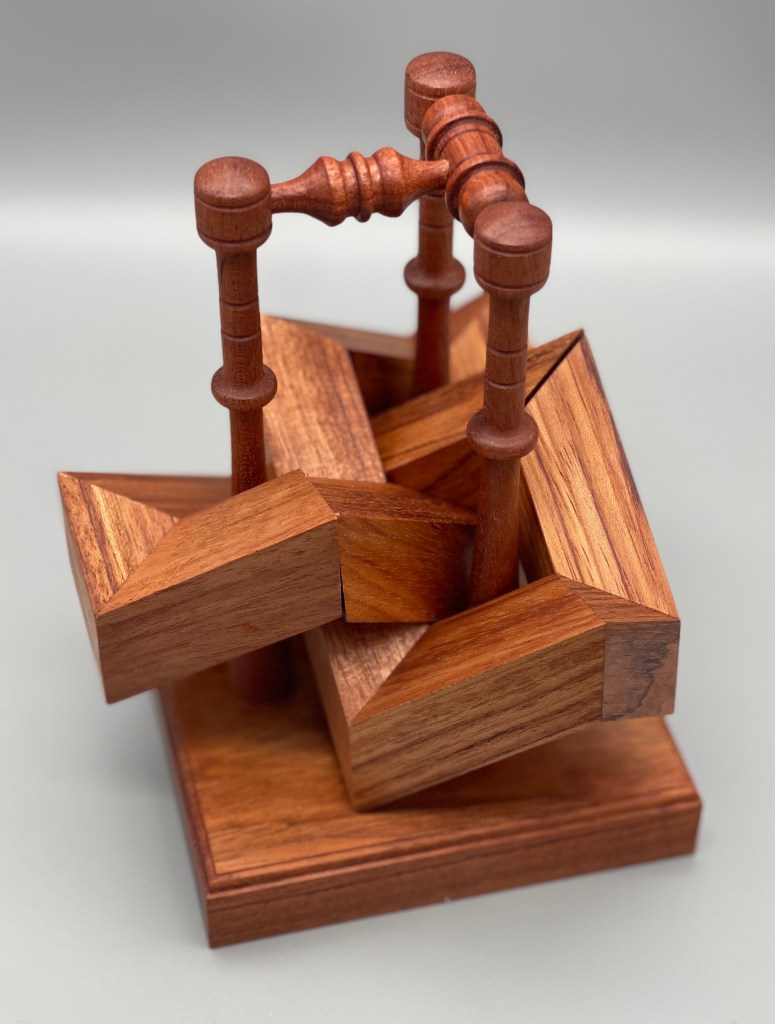
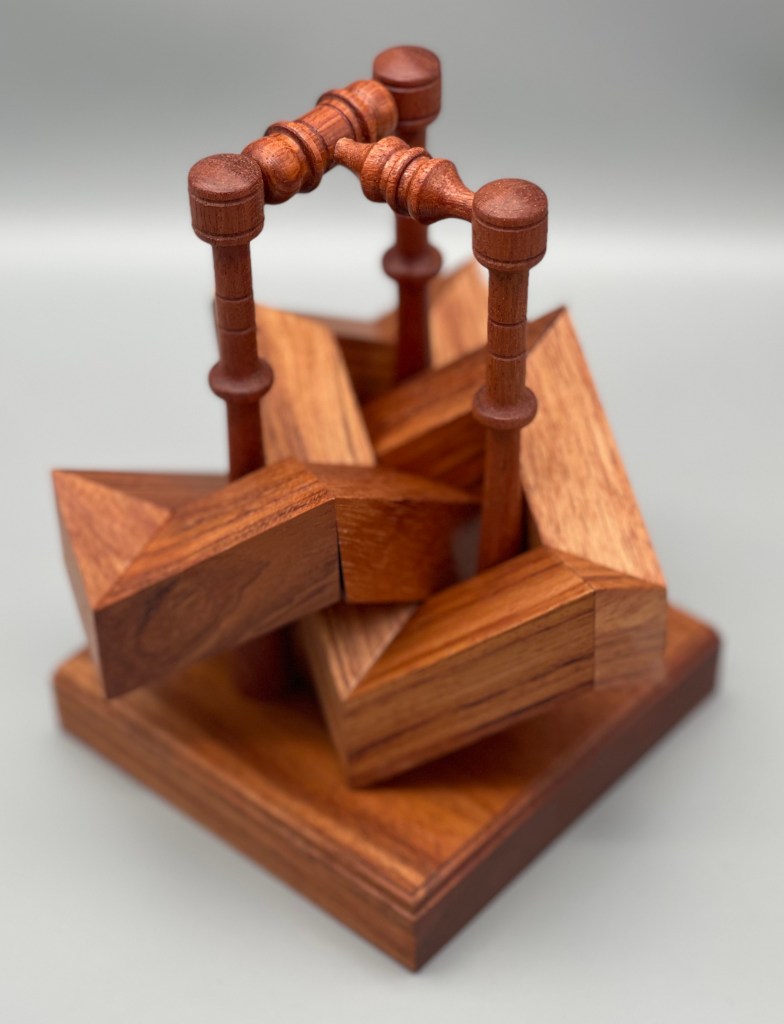
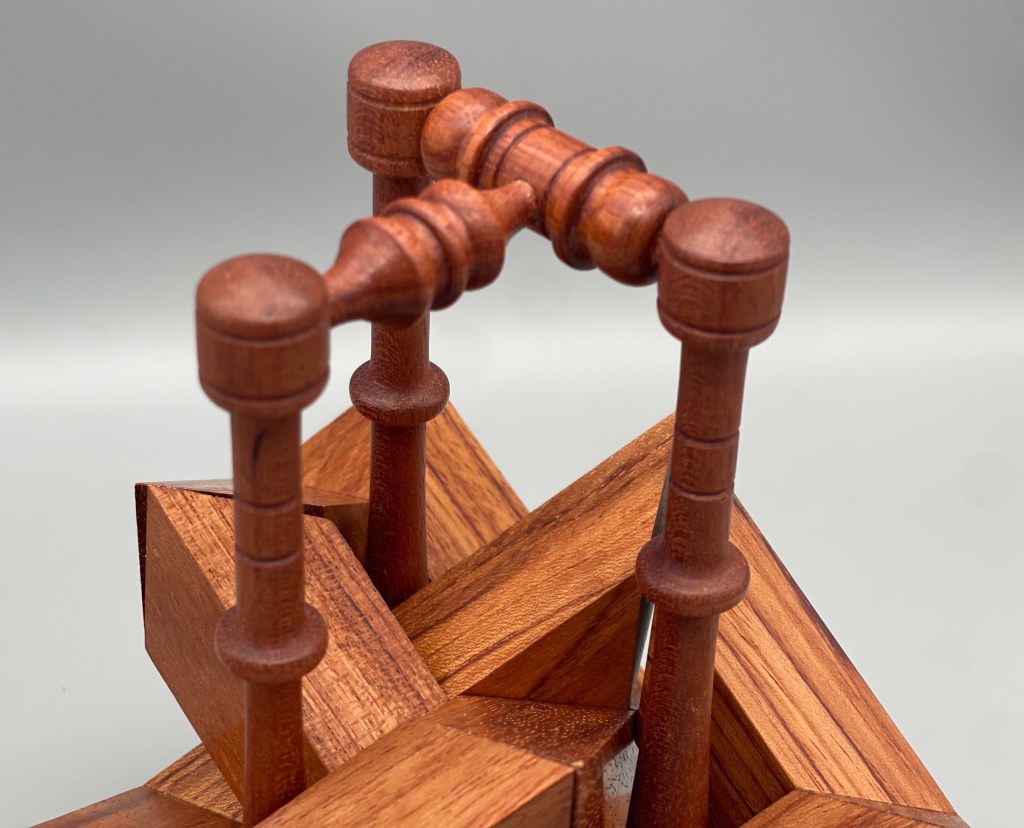
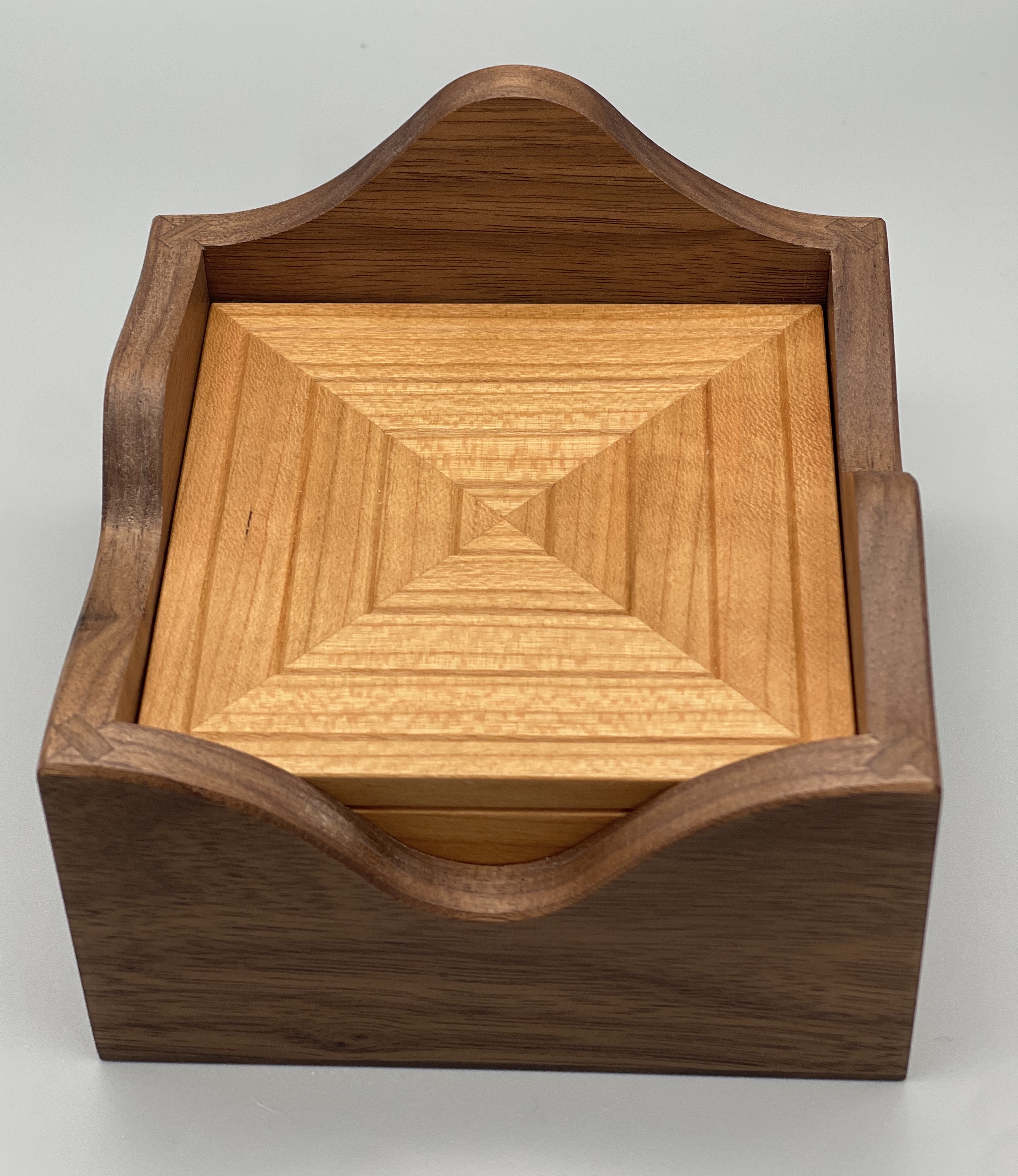
Trinity is as beautiful as it is unique: the goal is to wrap three identical pieces around three ornate posts attached to a base. The pieces feature extreme and somewhat odd angles and turns. The frame is crafted from a matching bubinga, a lovely and bright wood choice that highlights this puzzle’s double duty, exemplifying puzzles as art better than most. Between the curves of the lathed columns and the precisely sharp corners of the pieces, the crafting must have been difficult; it is no wonder that Pelikan only made 60 of these beauties but I do truly wonder how they somehow remain available on Puzzlemaster at the time of this writing (if you’re buying, be sure to use the discord affiliate link to PM).

I suppose I shouldn’t really be too surprised they are still available – I personally passed on it repeatedly over the last few years. But it is just so darn pretty, causing me to return to it time and again, contemplating its purchase… after a few more rave reviews from trusted puzzlers (thanks Puzzling Time) I nabbed one on PM before it was too late.

It arrived a bit smaller than I had originally expected (I checked the dimensions when ordering but had always had it in my head as being a bit bigger) but this turns out to be a smart choice. I knew the goal was to wrap the three pieces around and through the frame posts, but was not certain of what this might look like; I knew the configuration would be symmetrical, as I had seen the pics previously but declined to check it after receiving the puzzle. It wasn’t all that hard to find the correct build outside the frame; it follows a somewhat straightforward logic with perhaps not too many incorrect builds realistically possible.

The real puzzle comes when trying to take this configuration and build it around the precisely tight confines of the frame. This took me a while, requiring some puzzling skills that are not my strongest (assuming I actually have some strong ones). Eventually, I found that oh-so-perfect aha move, the pieces suddenly falling into place after fumbling frustratingly around. this puzzle is very much doable, not like some puzzles that make you wish for some extra hands; the size is pretty much perfect and it just takes some patience and logic to discover the winning movements.

And there it is: a cool and fun design so beautifully crafted that it easily earned its place Downstairs, its beauty there to be beheld by non-puzzling people and puzzlers alike.


Doors & Drawers

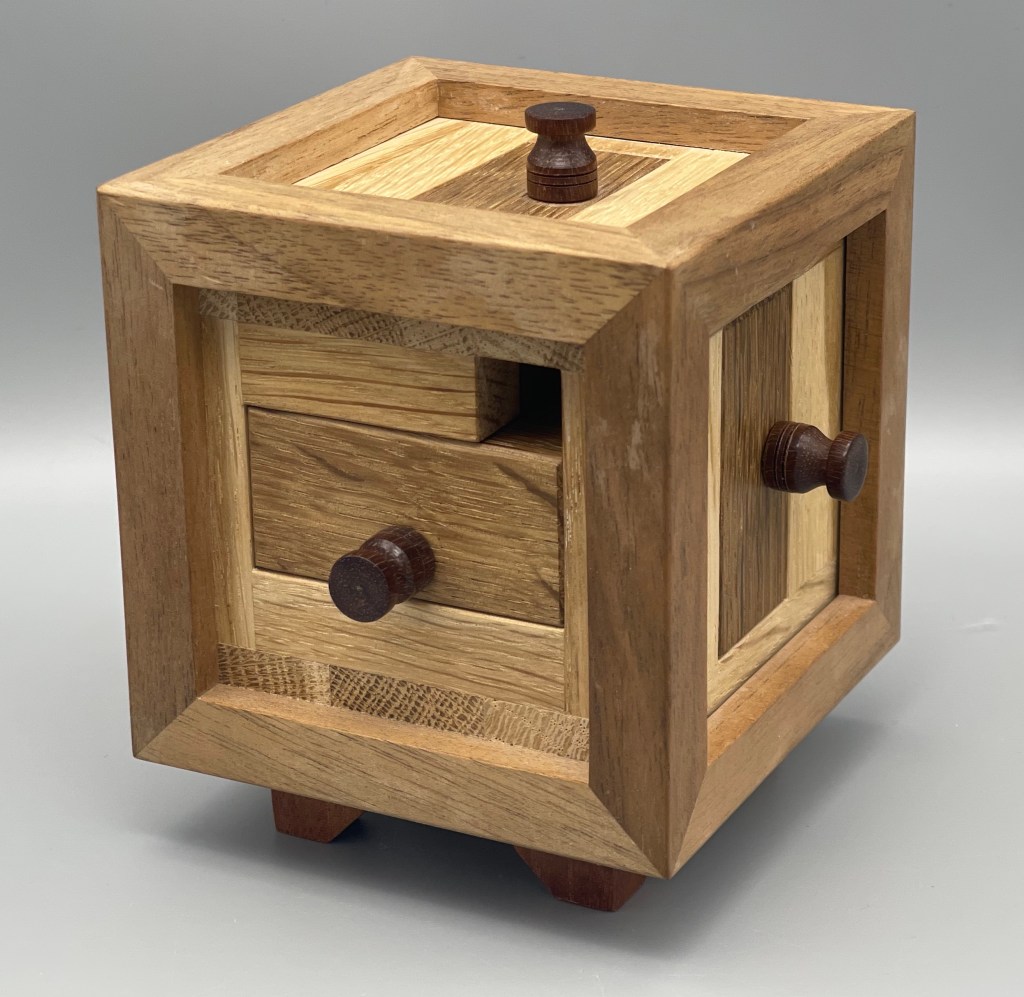
Doors & Drawers is another Toulouzas design crafted by Pelikan (the knobs and feet were crafted by the designer and highlight his excellent woodworking skills complementing those of Pelikan) and originally sold by Bernhard Schweitzer. D&D is completely different from Trinity but just as unique (perhaps a bit less beautiful, but that’s a big bar to beat). It begins as a take-apart puzzle, featuring three interlocking drawers confoundingly blocked further by some simple packing pieces hidden away in inconveniently devious places.

The puzzle looks like a cube sitting atop a base, raised on four angular feet, doorknobs fitted to drawers on most sides. It features subtly contrasting woods, with a walnut frame offset by light and dark oak pieces, the katalox and bubinga knobs creating a wonderful aesthetic somewhat reminiscent of an Escher drawing.

My copy was a bit tight at first and required a bit of boveda love (once I confirmed that it was, for once, not just my dumbassery) before I could begin solving it. The packing pieces complicate the disassembly of the interlocking pieces, requiring some precise orientations found after numerous false starts. Despite relatively few pieces overall, the design is more than complicated enough to allow for an assembly challenge when left mixed for a matter of weeks; it was really here where I began to fully appreciate the design as I had to reverse engineer the purpose of the off-center knobs – these turned out to be much more than ornamental, their asymmetric locations constricting assembly options and requiring some of that thinking stuff to figure out.

D&D is a fun challenge, blending interlocking assembly with a packing challenge wrapped up in an adorably surreal aesthetic that matches the excellent craftsmanship of multiple master woodworkers.


Hellas Cube

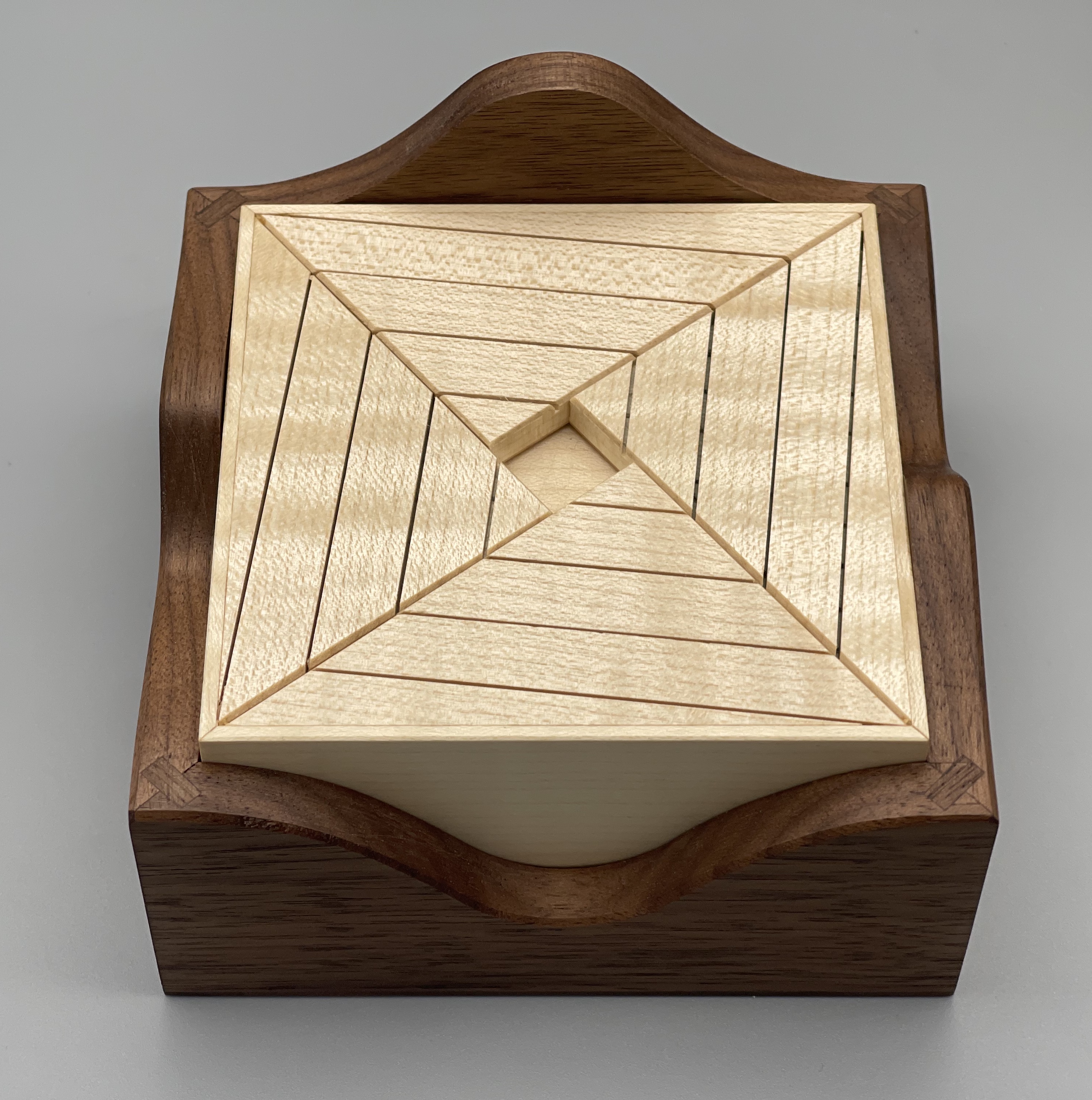
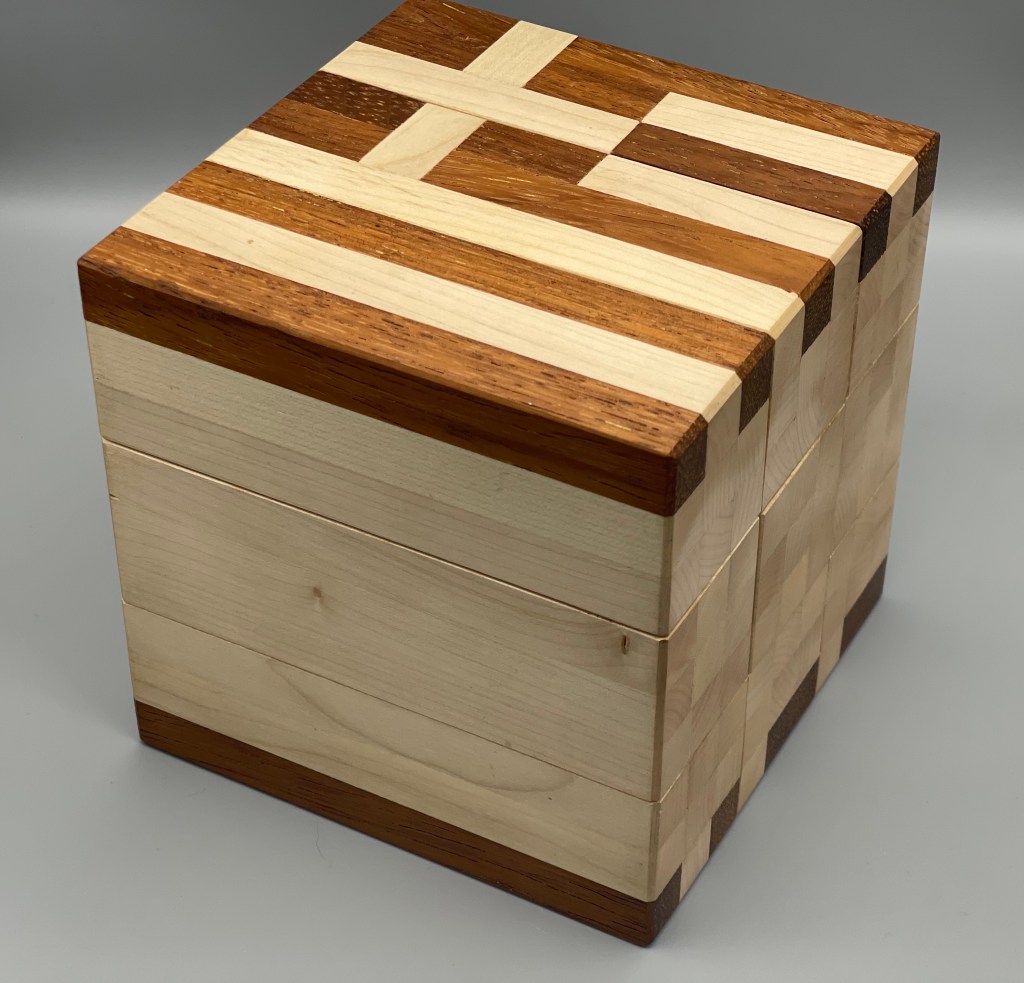
Hellas Cube seems to be a somewhat lesser known design, allowing me to pick it up on PuzzleParadise at an only slightly silly price. At 5″, it is a rather fat 3 x 3 cube, with large, 3 x 3 x 9 voxel pieces. The top and bottom feature a striped design mixed out of contrasting Jatoba and Maple woods, strongly reminiscent of the Greek flag (Hellas is the ancient name for Greece), causing the puzzle to sometimes be referred to as FlagBurr.

Michael has said that he “didn’t have the courage due to the long time and labor to make it.” Well Elijah said after making it that the many meters of sticks used would likely prevent them from making them again. Fortunately, they still took the opportunity to produce the puzzle at the direction of Bernhardt Schweitzer, which may not be as aesthetically pleasing a design as those discussed above but still displays wonderfully; to be fair, that is a very high bar to set and Hellas nonetheless makes for a strong puzzle presence, like a monument looking down on its more petite puzzling siblings.

I began pulling and pushing on the pieces until finding something that did something; the design features one or more hooks on each of the nine pieces, requiring a minimum of two moves to remove each, oftentimes more. The design is further complicated by what I can only describe as a lock that further frustrates disassembly; although this is not an overly hard challenge, it is fun, the process of discerning hook vs. lock making for an interesting puzzling experience.

Reassembly is another significant but doable challenge. The design on the top and bottom of the puzzle becomes essential, making a daunting task surmountable as we can at least put aside three of the pieces to determine which of the other pieces are on the top or bottom of the final assembly. The “lock” is no problem during assembly but its location still takes some thought (particularly if your memory is as terrible as mine); the hooks make for the real assembly challenge, with pieces similar enough to be confusing while allowing for a single, unique solution.


Michael Toulouzas has quickly become one of my favorite designers despite sadly being a challenge to collect due to his rather limited runs and releases – patience is not only a virtue when collecting puzzles, but a necessity should you hope to maintain your sanity amidst the FOMO, bonkers auctions, and ever-increasing rate of puzzle production. Most importantly, I should somewhat soon be the proud and ecstatic owner of his upcoming Xenia table: a puzzle box shaped like an ordinary (albeit shrunken) office fixture is right up my alley so I expect you may be seeing more about it on these pages (should you come looking).


Kagen and Kamei Get Twisted: Tornado Box by Kagen Sound & Akio Kamei

Tornado Box (SP-1)

Akio Kamei & Kagen Sound
Walnut, English Sycamore & Cherry
10cm x 10cm x 10cm
Amazing Puzzle Collaborations: Episode II – Get Back in your Homes (because there’s a tornado coming… not because it sort of rhymes with “Attack of the Clones”)

Hundreds of days ago, in the puzzling days of yore (i.e. 2021), Karakuri announced that they would be releasing a limited run of a new box co-designed/made by Akio Kamei and Kagen Sound. This collaboration was enough to make many a puzzle go bonkers: Kamei is The Godfather of the KCG, its oldest living member and all-around awesome designer & craftsman; Kagen is the only non-Japanese member of the Karakuri Creation Group (KCG) and also an all-around awesome designer & craftsman. Therefore, according to Puzzle Algebra: X + X = 5S, where X is an all-around awesome designer & craftsman and 5S is… well, hopefully you know what that is if you’re reading this.

Tornado Box is a beautifully smooth cube, broken along the center by a carefully crafted imperfect line. It is silky smooth to the touch, its beautiful walnut grain offsetting the two-tone interiors. It is quite a bit lighter than I had expected, particularly for a decent-sized 4″ cube. These two master craftsman collaborated on the design, as the two halves must work together to open both sides.

Kagen crafted the lovely walnut box along with the lighter, sycamore interior, sending it to Kamei to add in the cherry interior on the other side (for more information on the puzzle’s background, check out Boxes & Booze). It is important to note that separating the two halves does not require any puzzling, so showing the interior faces is not a spoiler (it is shown on the original KCG description, which FYI does have a bit of a spoiler in the written description).

Unlike most Karakuri boxes, this was announced as a limited run (other boxes could conceivably be remade at any time, although the majority, of course, are not). Despite a hefty price tag, it unsurprisingly still received more interest than there were boxes, pushing it to a member lottery, which I sadly did not win. I watched from afar as the boxes began arriving in the homes of fellow collectors, a single tear slowly slipping from my eye…

Until, out of the bottomless void that is the interweb, there ascended the kind and caring Vonsch (from the MP Discord), offering to loan it to me! I am constantly amazed by the level of trust and generosity of the MPD and the puzzling community at large. Needless to say, this was a bad idea that earned me one free puzzle box! I hope this can be a good lesson for Vonsch in the future.

Buuuuuuut seriously, I was taken aback by this kind and unsolicited offer, gratefully accepting and asking what I might have to loan in exchange (not that there was a presumed quid pro quo, I just hoped I could return the favor). Soon, there arrived the tell-tale blue box containing a Kamei Karakuri creation and I set to work. If you read these write-ups, you may have noticed that my enthusiasm for puzzles oftentimes surpasses my skill: Tornado, like oh so many others, would take me a pretty darn long time to solve. In my defense, I was even more cautious and obsessively careful than usual – this may have hindered some early progress as I kept asking Vonsch if I could do this or try that. Vonsch took it all in stride, possibly enjoying my ignorant flailing about as I went through idea after idea.

Eventually…. aha! Once more crowned the smartest person in the world, I managed to move small bits of wood that I previously could not move! I stood and shouted at this mere block of wood: “Son of Jor-El, kneel before Zod!” before remembering that not only had I not just escaped from the Phantom Zone, but I had only solved the first half of the puzzle, its solution beautifully hidden, an elegant mechanism that is probably even harder to craft than I realize.

I knew that the solution to the other half of the puzzle somehow relied on having solved the first but I nonetheless would struggle to discover it, continuing to bug Vonsch with my paranoid, high maintenance ruminations. I had some ideas (it happens every now and then) and narrowed them down until developing a fairly clear picture of (more or less) what needed to be done. And so……. aha! I found yet another graceful movement that can likely only be achieved by craftspeople of this caliber. Despite repeating the solution a few more times, I am still not exactly sure how one half works – I mean, I know what to do, I’m just not sure why it works! A nice mystery to think on, sure to be a future conversation that will leave me a little bit smarter (clearly I can use it). In the meantime, Tornado will soon be back with its rightful owner and I will return to failing to solve something else.

You got Cherry on my Sycamore!
You got Sycamore on my Cherry!

Loss, Blindness, Death, Anger…. and now Menace (the new Puzzle Box by Dee Dixon)

Menace

Dee Dixon, 5.25″ x 3.5″ x 2.5″ (available in Black Limba & Quarter or Flat Sawn Shedua)

It has been an eventful last few years: I lost my hammer, went blind, felt my way through the darkness of space, fell through a portal, went blind again, suffered being haunted, and survived the Walt-acalpyse……. all this only to have Dee send me something truly menacing. Needless to say (not that this ever stops me), I have gratefully enjoyed every moment of it as DEDwood Crafts has consistently produced some of the best puzzle boxes to grace my shelves.

Flat Sawn Shedua in the Front & Black Limba in the Back

Following up on Angry Walter is no small thing: it has received consistently positive praise from puzzle box enthusiasts new and old (here is my post on that beaut of a box). And yet Dee has managed to keep putting out beautiful, challenging boxes since WMH appeared just a few, long years ago. So it should not surprise anyone to hear that his newest box once again succeeds at bringing us a fun in a pretty package.

Menace uses a single wood to create a clean, sleek aesthetic that may be his prettiest box since the totally different, asymmetrically complex style of WMH. I first got a prototype in Shedua that is just gorgeous in its apparent simplicity: no protrusions, buttons or panels… just a locked lid inset into the top with a small hole to one side. Picking it up, there is no clear indication as to how one can begin to open it and I spent quite a bit of time searching for whatever first step Dee had designed.

I began developing some assumptions (quite likely as Dee intended) that would (unsurprisingly) prove incorrect, something that I would repeat a few more times before I would discover the box’s final secret. After discovering a well-hidden aha, Dee teases you with the idea that you may have already solved the puzzle; of course, this turns out to be well before the puzzle has actually been solved (which you would know if you had actually read the brief instructions….. duh). The puzzle’s length is more or less consistent with the majority of his boxes but fell into the trap of thinking I had reached the end before realizing I had not: the instructions tell us that we must find some sort of prize and, since no such prize had been found, clearly I was not yet done.

Experimentation will only get you so far with this one – I had to take a step back and rethink what I was doing and what I was trying to do, questioning my assumptions and trying to look at the box in a new way to see what else I might be able to do. With a good aha, I realized something and began following that trail to eventual success. The final compartment is pretty ingenious and most definitely sneaky – not what I had been expecting, which is always a welcome finale to any puzzle.

The prototype’s “prize” was not really all that much of a prize lol (perhaps more of a placeholder) – not that I needed the added incentive, but this did help me to justify my “need” for a copy of the final puzzle (in a different wood, of course – I’m not (totally) crazy). I had been out of town for a while and had not solved the box in long enough that I already found I had forgotten which of my many assumptions had proven incorrect! I know that I don’t generally make claims to brilliance on (or off) these virtual pages but this was a bit ridiculous (and perhaps not the greatest thing for my on-again, off-again relationship with confidence). Fortunately, it did mean that I got to repeat an aha or two, albeit it with more a sense of relief at not being a complete idiot than at the typical puzzle-solving feeling that I was the greatest mind of all time for having made a piece of wood move a few inches that way.

The prototype and final are mostly identical – Dee did tweak one thing that makes the solution’s finale a bit more difficult to do. In doing so, some of my methods worked against me – I found that the slight change makes that last bit require a better understanding of what I am trying to do, forcing me to approach the puzzle more carefully, looking back at some hints I had previously missed before I would get that final aha (enough reworking that I did indeed feel a brief bit of brilliance before coming back to reality.

The final surprise legitimately made me laugh out loud – Dee has given us another taste of his humor as in some previous boxes (Spirit and the original run of WMH, in particular). I re-solved the box several more times to marvel both at my mastery and the design…. not to mention to grin a few more times at that last laugh.

Menace will be available July 2, 2022, on the DEDwood Crafts site. It may not last long but I suspect Dee may do another run or two before moving on to whatever the next bit of fun he has planned for us.


Run Away! Run Away! A horse with a warrior by Osamu Kasho (KCG)

A horse with a warrior

Osamu Kasko; Walnut, Mizuki & Wenge; 7″ x 8″ x 3.5″
Warrior Figure by Kobo Alp

Considering my love for Karakuri, the ratio of karakuri: non-karakuri puzzles on this site might seem rather low. KCG was there at the start and ne’er hath my love for them wavered… and yet, it is not always the case that a new karakuri will smack me upside the head with the kind of “must-write-about-me”-ness that the majority of puzzles on this site hath so smacked. My reasoning for selecting puzzles to ramble about is far from scientific: even when I know that one is deserving of all five Sinatras, it probably won’t get the write-up it deserves due to a lack of temporal resources and an ironically over-active lethargy gland.

But sometimes a karakuri box will just not let go, refusing to silence the whispering “duuuuuuuuuuuuude” that is the precursor to any written rambling contained on these virtual pages: Cue March 2022 when the KCG exhibition theme of “Ancient Times” snuck its way into our puzzling hearts and shelves with an intriguing and satisfying slate of new boxes. I unfortunately missed out on Kikuchi’s MOAi as well as Tsuburai’s Ox Car but was very happy with the four I was able to get.

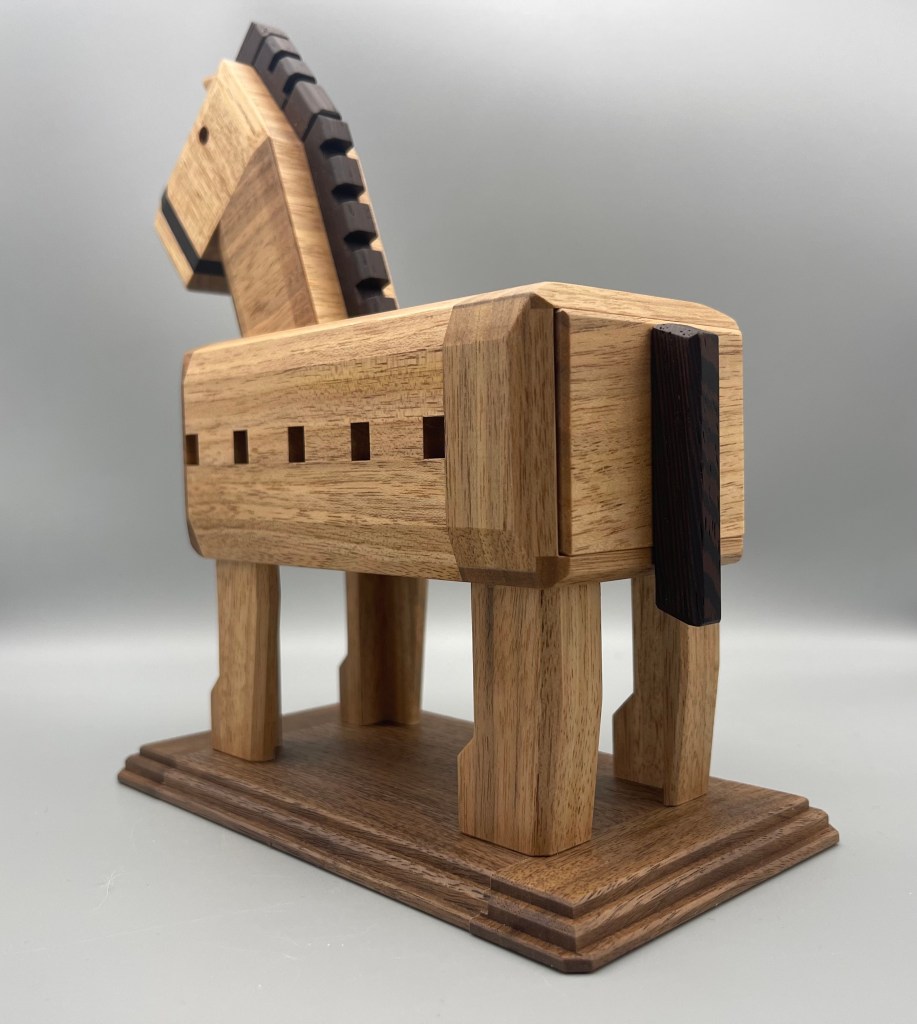
The highlight of the boxes I won from this release is Kasho’s A horse with a warrior: a Trojan horse-themed puzzle box with a few secrets that had even my NPSO laughing. The puzzle consists of a fairly large wooden horse with little windows running along both sides of its body, confirming the Greek homage while perhaps undermining its utility for surreptitiously breaching an enemy’s gates (which I suppose is still more effective than a badger…..If you would like to learn more about the historical significance of the puzzle’s inspiration, check out this excellent 1975 historical treatise). The horse is mounted on a tiered wooden base and features some sd-lite trickery that I found particularly engaging.

I was able to discover the first of its compartments fairly quickly; a couple steps later I had discovered the first laughable moment in the solution (there would be more). I got stuck around here for a while, enjoying the mechanism while attempting to discern the path ahead; I had a pretty clear idea as to where I needed to go but getting there required some experimentation and thought.

I would eventually find my way through the next section, laughing once again upon getting a glimpse of the tiny warrior hiding inside the puzzle (not a spoiler as it is referred to in the description). The hidden figure was crafted by Kobo Alp and adds a touch of whimsy to the puzzle; if you look closely, you may see him before you have finished solving the puzzle (Id.) but you will have to find all the secrets the puzzle holds to be able to poke him in his little wooden face and tell him to get his teeny wooden butt back to Greece faster than you can say “kallisti” (yeah, you better run, tiny wooden person).

Horse has a tricky, multi-step solution that is fun and relatively lengthy, particularly for a Karakuri. I found myself struggling to find my way forward more than once and was delighted by its multiple aha moments and uniquely thematic secrets.

A horse with a warrior has now joined my short list of go-to puzzles to share with any non-puzzling guests or passers-by foolish enough to show even the vaguest curiosity at the siren-songs crowding my puzzle shelves, unknowingly tempting the fates that would lure us ever deeper into the Puzzled seas.


Sun Dial’s Art of Puzzling (UPDATED: Now with more puzzling!)

Sun Dial

Jesse Born & Rob Yarger
Ipe, Katalox & Brass
2.75 lbs, 7″ x 4″
Box 2 in the Voyager Series (Sea Chest, Sun Dial, Alien)
(Ed. A couple weeks after posting this, I discovered that there was still quite a bit of puzzling left after I had thought the puzzle had been solved! See below for more)

Well, the past several weeks have been busy here in the 5S household, getting in the way of my puzzling (much to my dismay). But the wonderfully unrelenting onslaught of new puzzles has only seemed to increase its pace, with several excellent puzzles arriving during this none-too-brief, unplanned hiatus. I realize that this break has not been difficult for you, but fear not: plenty a puzzle ramble awaits you!

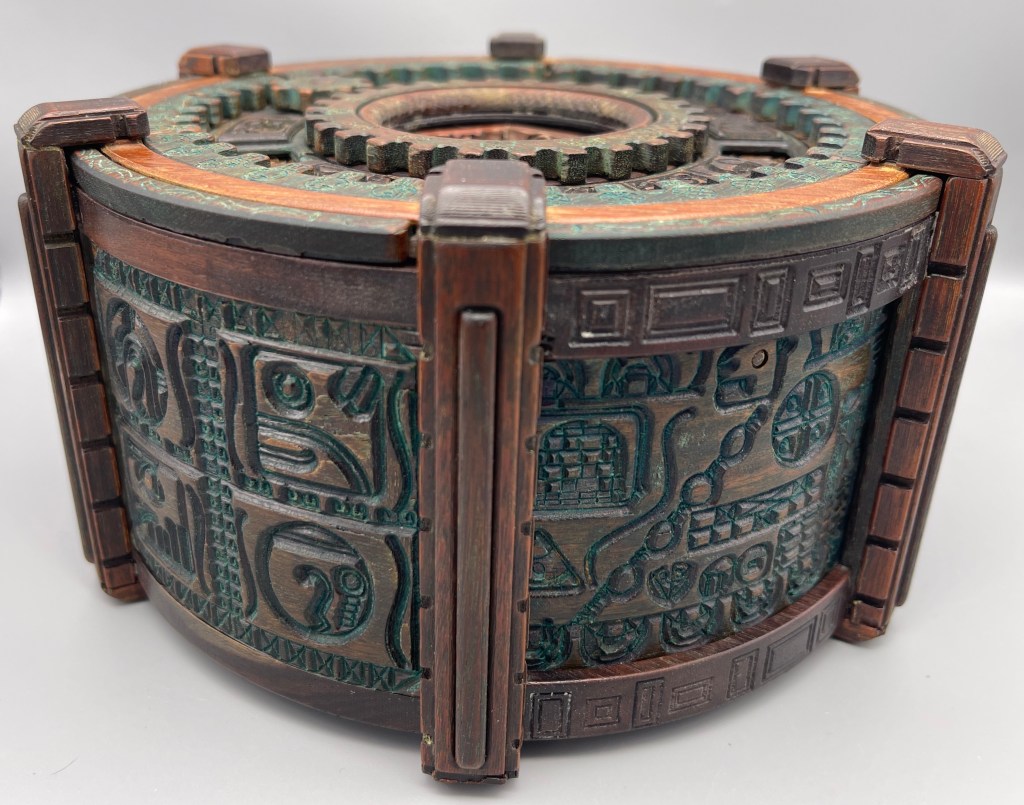
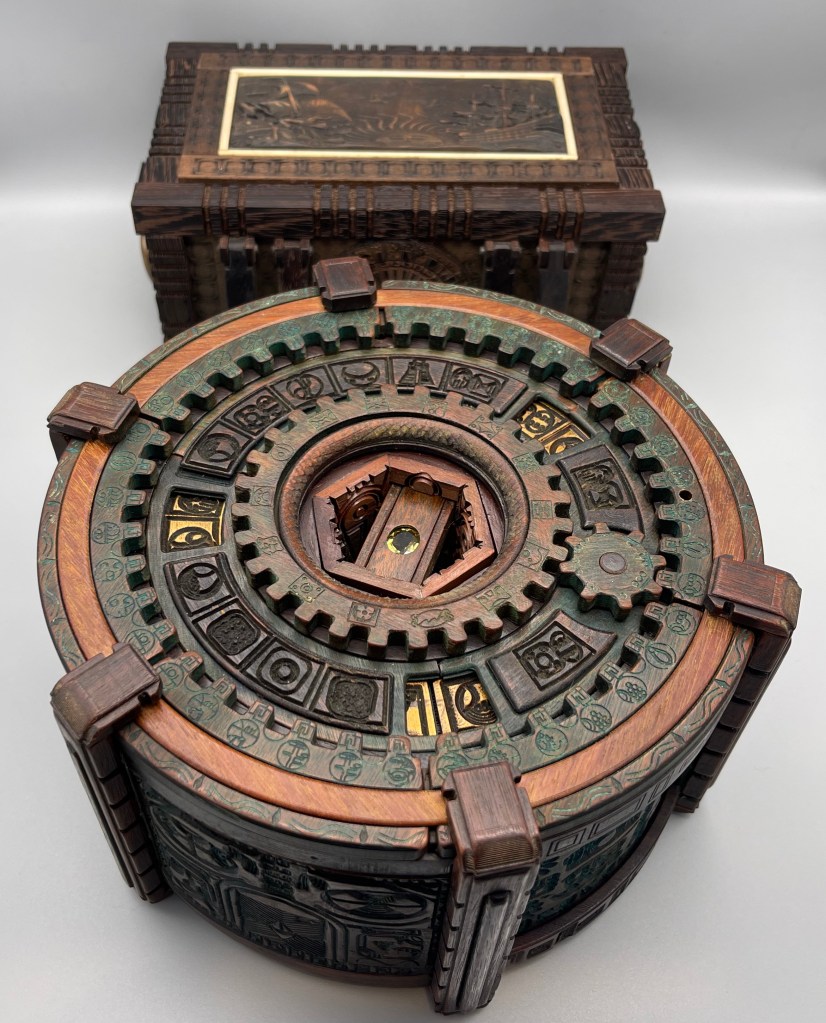
And what better puzzle with which to break this devastating dearth of dear old me than Sun Dial, Jesse Born’s follow-up to 2020’s excellent Sea Chest (reviewed by me here); Sun is co-designed with Rob Yarger (a/k/a The Great and Wonderful Stickman) and mostly made by Jesse (Rob did some laminating on the curved side panels, which are constructed of multiple layers of hand-carved veneer crafted by Jesse). Sun Dial is a circular box (?!), painstakingly covered in some rather intricate etchings and distressed in a fashion similar to its elder sibling. Jesse has plans for a third and final entry in the Voyager Series that will presumably share in this aesthetic, crafted to create the impression of a discovered Alien artifact that must be opened to access its other-worldly treasure. What pirates were to Sea Chest, the ancient Aztecs are to Sun Dial, with myriad markings and hidden secrets that invoke this lost world in the psyche of the spelunking (s)puzzler.

Jesse is one of those designers whose puzzles I would happily buy sight unseen (his Secretum Cista is quite probably the coolest puzzle I own). Rob is (of course) another such designer , so when I heard that Rob was designing Sun Dial with Jesse, I began drooling more than Pavlov’s dog at a doorbell store. (Rob was a big big fan of Sea Chest, which is especially high praise from the creator of some of the most insanely awesome puzzles ever to reach us mere mortals). Jesse and Rob went back and forth over a period of months, trading ideas and CAD models as they refined the design that Jesse would ultimately craft (for a more in-depth look at the design process, check out Boxes & Booze’s excellent post).

At a relatively hefty 2 lbs, 12 oz, the 7″ x 4″ Sun Dial is no small box. As part of its intentionally distressed appearance, its aromatic woods appear to have been partially stained, a greenish tint furthering its lost artifact aesthetic. It is shaped something like a flattened donut, with a citrine gem nestled into a piece of wood bridging the top of its center shaft. The outer wall is broken into 6 sections, 4 of which are covered by inset panels that have a noticeable bit of give when reset. The top alludes to the circular calendar of the Aztec civilization, a series of concentric circles and layers surrounding a set of gears that promise to put the mechanical in mechanical puzzling.

Sun Dial vs. Aztec Calendar (12 ft./25 tons, discovered in Mexico City in 1790)

In its reset state, Sun allows for some quality mechanical playtime – I first spent several minutes just playing and giggling at the smoothly tactile movements possible in its initial state. Other than some admittedly puerile fun, this did not immediately lead me anywhere productive; it would take some keen and careful observation before that first aha moment, which soon led me into the puzzling depths that await within.

Over the next few weeks, I would progress in fits and starts; discovering things that must help (while unsure of exactly how) as I pieced together the path through its various compartments. Well-hidden, subtle clues abound, some more important than others in clearing the way forward. Venturing into the puzzle’s interior gave me a sense of adventure, akin to Indiana Jones-ing (Quartermaining?) my way into an ancient temple, replete with treasure and cool discoveries that could be decorative, essential, or both.

I knew I had to be reaching the end when I was surprised by the results of a particular step that I repeated a few times with a goofy grin. Some final details discovered, I held my prize in my hand, admiring how Jesse and Rob managed to bring things full circle, like the cyclical nature of time perceived by the Aztec culture.

(This paragraph was added a few weeks after posting this) OMG! Turns out not only was I not actually finished solving the puzzle, there was quite a bit of puzzling still left! There is one aha that is particularly satisfying and we are left with a sense that more is yet to come…… Once again, Jesse has brought us something great only to add some icing to make it excellent. I found this last section to bring back memories of Sea Chest, which also hid some final secrets that took me a few weeks to discover still laid in wait after I’d thought I had reached the end. Gotta love a puzzle that keeps on giving!

After resetting the puzzle and going through the solution once more (now a few more times!), I followed a QR code printed on the back of the Certificate of Authenticity (signed by both Jesse and Rob) to a short video in which Jesse walks us through the solution. I smiled at a few details whose significance had escaped me and ran back through the solve one more time, appreciating the puzzle’s rhythm and flow.

The puzzle’s mechanics do not rely on blind mechanisms, instead favoring discrete steps that must sometimes be worked out beforehand to properly progress – I suppose it could be possible to cluelessly solve certain sections through experimental trial & error but the design provides ample direction to see you through, if you can slow down and do some of that thinking stuff the kids are all talking about these days. Either way, the mechanics are clear and purposeful, laying out a meandering path to its final treasure.

Jesse decided to increase this run to 400 copies, a big jump from the 100 Sea Chests that had (officially) been produced (let alone the 30 copies of Secretum Cista). I imagine that all 400 will not have trouble finding a home: if a collaboration between two great puzzle box-makers wasn’t enough to convince you, the positive praise that has followed its premiere will probably do the trick. The larger run may help prevent the puzzle from immediately skyrocketing on the secondhand market but I don’t expect too many collectors will want to let this one escape anytime soon (there will always be solvers and flippers, of course, but hopefully the box will remain in the realm of relative reasonableness, for a while at least). While officially sold out, (at the time of writing) the boxes are still being produced in batches and there is a drop-off list for spots that might open up should puzzlers decide to give theirs up, so be sure to swing by Jesse’s site before they’re all gone.


Changing It Up: Pennytentiary by Eric Fuller

Pennytentiary

Eric Fuller

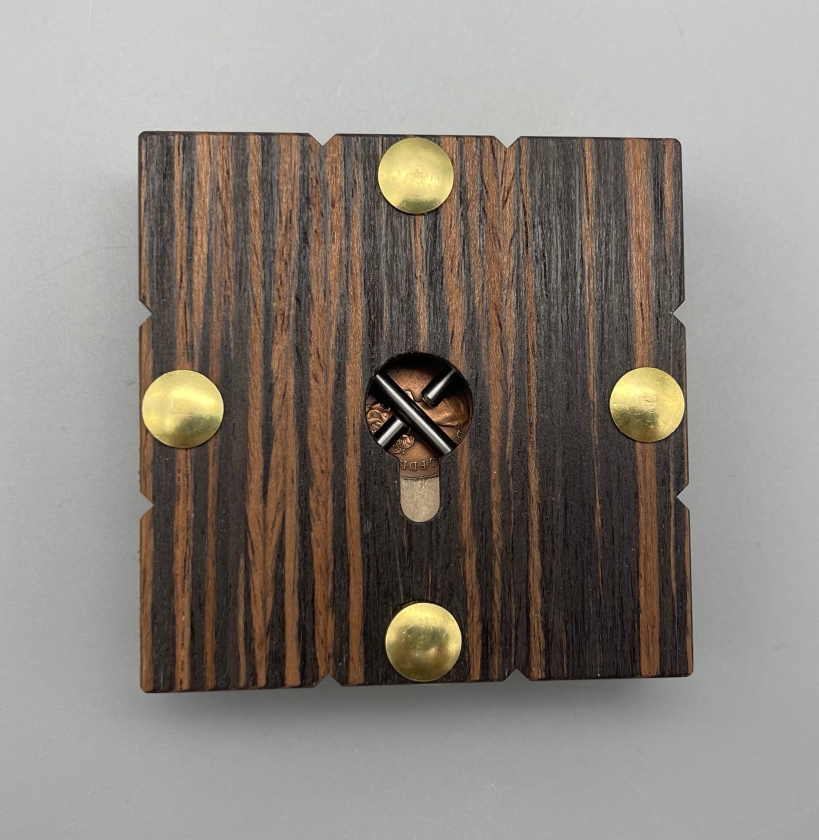
Eric Fuller (of CubicDissection) has gone and got hisself a laser cutter machiney thing that can… cut… uhh…. lasers? (that doesn’t sound right…) Whatever the thing may do for mere mortals, in the hands of an adept puzzle designer like Eric, it means that we will soon be seeing some cool new challenges coming our way. I had the good luck to solve the first of these: Eric’s newest take-apart puzzle, Pennytentiary, a sequential discovery square of coin releasiness that had me smiling (once I finally stopped being stuck).

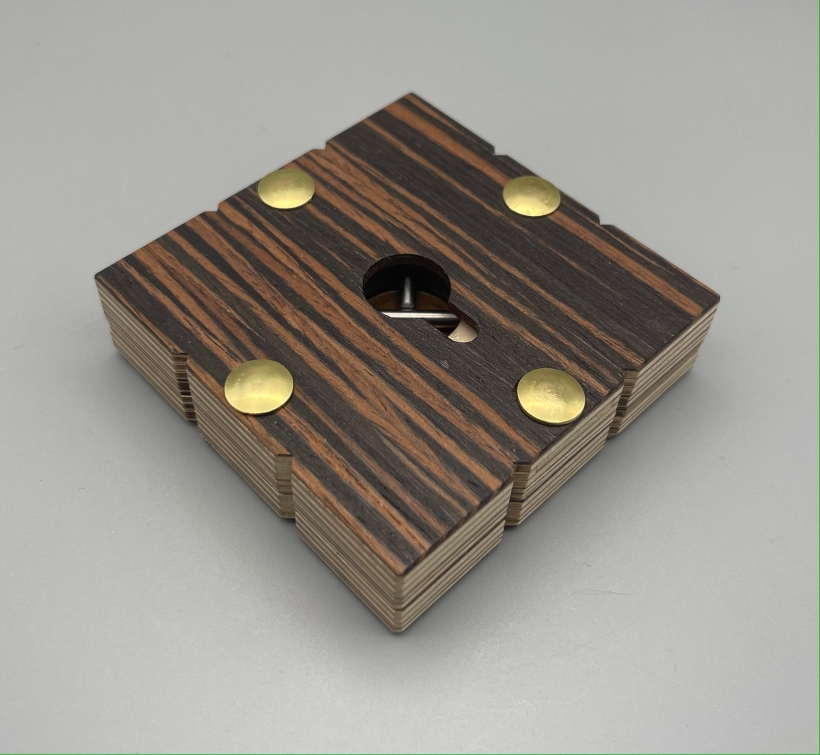
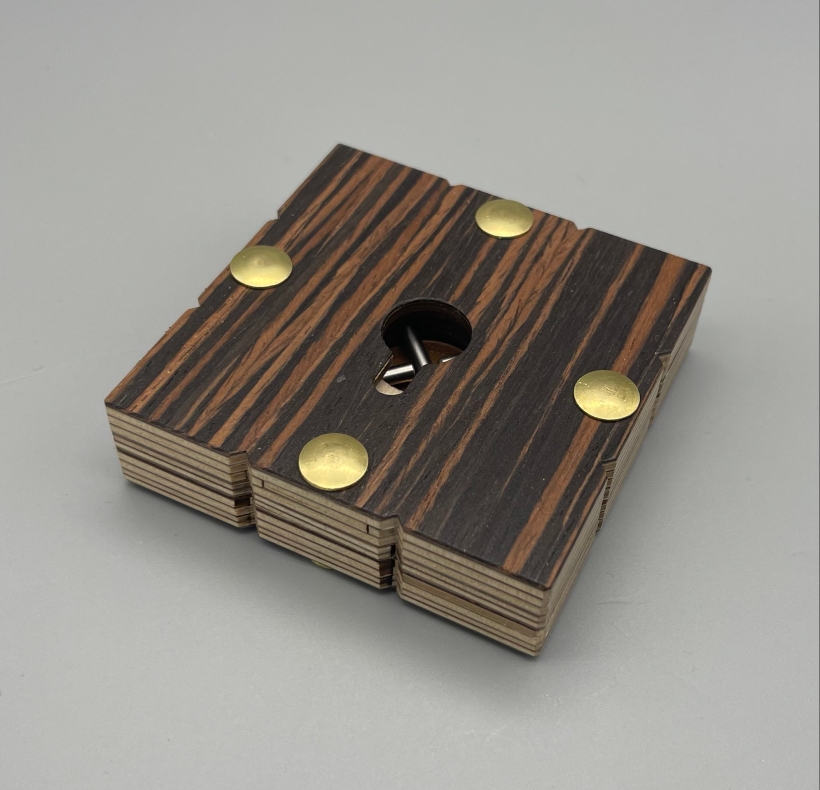
Consistent with Eric’s modus opuzzerandi, he makes laser-cut wood look good, with dark-grained panels adorning the top and bottom of the layered sides that are eye-catching and give the puzzle an added sense of class. Notches are spaced evenly around its perimeter, with a centered top “keyhole” in which a coin rests, trapped below 4 diagonal bars that slide easily back and forth with even casual movement. There is nothing else immediately visible, although close inspection may prove that to be a false assumption (a concept that crops up frequently in Eric’s designs). At about 3″ x 0.75″, it feels good in your hands; it isn’t overly heavy but neither is it light and its size is well-suited for most (human) hands. The final version will include a thin layer of acrlyic in one the middle layers, adding some strength and a mixed-medium aesthetic that I am sure will look cool.

When first looking at it, I felt compelled to attempt a pretty basic puzzle move that couldn’t help but come to mind; I assumed it wouldn’t do much of anything and (for once) my assumption proved correct, leaving me with a nice new puzzle that didn’t see to do much of anything (aside from having some potential as a maraca). Of course, this would prove to be not at all true – after a while spent exploring and experimenting, I found a well-designed aha that led me to some good initial progress, giving me plenty to work with while getting me no closer to actually solving the puzzle. I got stuck here for quite a while. And then a while more.

It took some trial & error and careful observation to make sense (cents?) of a short semi-blind sequence that stood between me and further progress; there is plenty of feedback and it is possible to deduce most of what needs to happen, assuming you paid attention during your initial explorations. I eventually got to where I thought I needed to go, foolishly thinking I might be nearing the end, only to figure something out that forced me to laugh at the puzzle’s deviousness. Following on that realization is a trick that I just think is super neat and lends a sense of magic to the solution.

I continued to make considerable progress, working my way through the kind of well-designed sd discoveries and hidden trickery that we associate with Eric’s work. I managed to get nice and stuck (again) towards the end – unsurprisingly, it turned out to largely be my idiocy that was keeping me from overcoming this last hurdle; I was fairly certain of what needed to happen and aware of some of the things that would help it happen, while apparently missing some other thing(s) that needed to happen so that it could happen. Pretty straightforward, no?

I back-and-forth-tracked for a while, thinking I would see something I had missed; the puzzle moves you along quite nicely as you solve it, and I kept looking to see if I had missed a turn. There is a lot to discover in a relatively small package and I had yet to find a purpose for every discovery; the puzzle does an excellent job of communicating where you need to go while simultaneously obfuscating how to get there. I got to be pretty certain of what and where and even how (or so I thought) – but, in classic Eric fashion, even though I was sure I knew the how, I still couldn’t find it…… there was a subtle twist that had me working against myself until I realized I had made an assumption so small I didn’t even realize it was an assumption and that last aha finally hit, allowing me to find the step that had been eluding me only to realize it was not the last aha after all! I thought for sure I would be removing the coin but it turns out there was still another sneaky sequence to suss out before the coin could be captured.

After gleefully removing the coin, I worked my way backwards through the reset – a couple sections still a bit tricky as I continued to develop my understanding of the puzzling at play. After re-solving and re-setting it a couple more times, I can confidently claim to completely comprehend the confounding cadre of coin release mechanisms nestling within this deceptively simple-seeming puzzle. And what a fun puzzle it is! It has an excellent rhythm as you work through several muti-step sequences that rely on discrete mechanisms and well-hidden sd discoveries: imagine if Rex’s best had a child with the Bolt Action series and then went on to marry Ansel and have a brief affair with Free Me 6. And if that doesn’t entice you, then I don’t know what you’re doing reading this post (unless you’re my Mom…. in which case: Hi Mom).

Pennytentiary will probably be the first of a series of coin release puzzles from CD, with ideas for other currency currently in the works. It was originally set for CD’s Feb 2022 release but due to the need to wait for some delayed hardware (and I think perhaps Eric’s admirable and ongoing quest for puzzle perfection) has been pushed to the March 21 release: it looks like this is going to be a pretty exciting drop, with a number of new and re-released puzzles to choose from. There is a chance that the relative efficiency afforded by the (sharkless) lasers may make it a design that will not need to suffer from the same level of scarcity that can sometimes affect other new CD designs – a great thing for newer puzzlers, in particular, who may be taken aback by the fervor that surrounds the typical CD release. Regardless, it is a puzzle you will not want to miss, so plan accordingly when you set your CD release alarm for next week.

Super-Sneaky Grade: Five Sinatras
(click here for more information on the Sinatra Scaling System, (c) John Maynard Keynes, 1944)


  1. Roy Elliott's avatar