
Welp, Dee as done it twice more with his most recent releases, Orbit and Uplift: I got there eventually but it took me quite a while to do it, with a nudge or three needed along the way (although I suppose I find that just talking about what I am doing is sometimes the most helpful part – more often than not in the process of explaining where I am and what I’ve done I clarify what I haven’t done and aha!…. that or I am just trying to make myself feel better about frequently asking for help from other, better puzzlers).

Oddly, both of these totally different boxes feature a freely spinning center piece in a frame – but that is where the similarity ends (other than Dee’s excellent craftsmanship, as always). Both look and feel great, as with any of Dee’s work in my sometimes humble opinion; Uplift has received some aesthetic comparisons to Bad Moon, which I can see, but really they both have that Dee look you can’t quite put your finger on but can still readily see. Uplift is especially gorgeous and I suspect that producing it is particularly no easy task. Neither box is an overly long solve but both had me stuck for quite a while, so my experience with both was nonetheless quite long… and of course they look great alongside their ever-growing set of siblings – delightfully, Dee definitely didn’t disappoint.
Orbit

In the hours (and hours) I spent going in circles with Orbit, I will admit there were times I was certain the solution must be too blind… I was convinced I was going to be annoyed by the solution but in reality this was not at all the case once I actually figured things out. You are given plenty of information and just need to bring some patient observation to make sense of things. It is extremely unlikely to just randomly open this box, although there were times when I was sure I was close (and found out later how wrong I probably was). This is the kind of puzzle where you really need to work out what is happening to be able to reach the solution. There are many puzzlers out there better at this than I, who may well have had an easier time, but I really had to struggle to get there.
Eventually I made some sense of the box and was sure I could solve it only to be confronted with a problem I eventually worked out with a laugh. Again, the information was there if I stopped and thought about it (and I appreciated how Dee incorporated something that in another puzzle may have felt disappointing but still managed here to feel novel… it’s hard to say more without crossing the line into SpoilerLand (which I’d say is like CandyLand but that would give too much away)).

Having solved Orbit I can now get through the solve in a few minutes – a testament to how not-really-at-all-blind the puzzle is, once you’ve worked it out; in my experience, a truly blind puzzle can stump me even once I know how to do it. Here, there is no way to get lost once you know where you are going.
Uplift
Uplift goes back to Dee’s SD roots with an SD-lite solve in what is an absolutely stunning circular “box.” It had me stuck spinning myself nowhere on more than one occasion, with a particularly delightful aha! at the start. I had spent a few hours (yes, sigh) going in circles, doing everything I could think of… everything but the one thing that would actually do something. I found a bunch of feedback that did nothing more than to distract me from finding my way into the start of the solve and when that aha! hit… you just gotta love that dopamine, bruh.
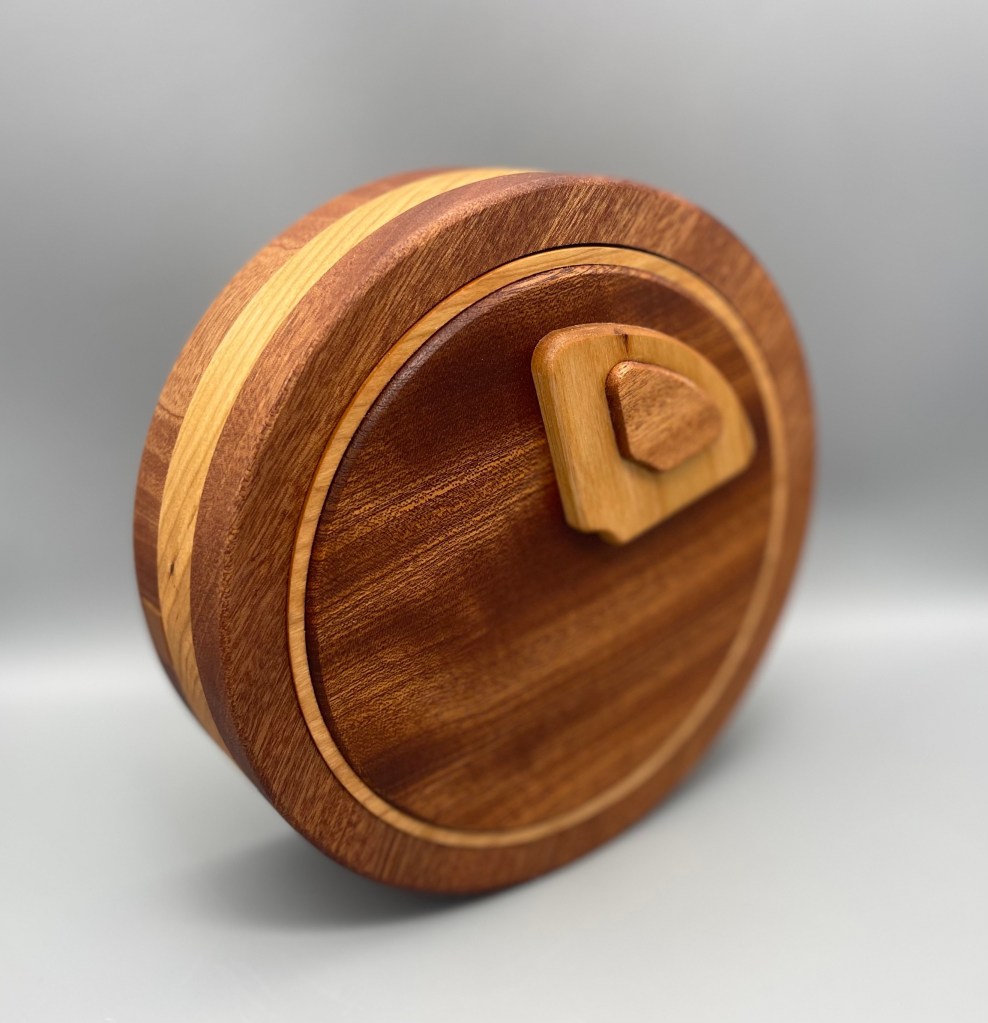
From there, I got stuck one or two more times but was able to get through the rest of the solve in a couple focused sessions. Dee messes with us as the puzzles progresses, causing me to fall down a rabbit hole or two along the way. Fortunately, I was able to get back on track without help, all by my big boy self. Overall, it was not a super long trek to the end once I got past that first wall; I managed to hit that last step with a laugh when I saw where Dee goofs us once more.
I know of one rather vocal critic of Uplift, someone who I suppose solved the puzzle quickly and felt it should have been longer (not a Karakuri collector, I imagine). To me, this first leaves out the importance of respecting the difficulty and complexity of physically producing a beautiful box, which is much of where the value of a collectible puzzle is derived. If you only care about how long it takes you to solve something, than you may not appreciate puzzles like Karakuri’s, for example, which, to some, may be solved quickly – I care more about the elegance of a solve, the flow from step to step, how it integrates with a novel aesthetic built with immense care… although I suppose it may be easy for me to say, since I rarely solve anything quickly (I never claimed to be smart… just circumlocutory and loquacious 😉
But, really, I do not want to give the impression that Uplift is a short puzzle; I don’t like giving a step count unless asked but, by my count, the length of the solve is about average (in terms of steps) for Dee’s work. Most important to me, I was never disappointed with my experience solving it. At the end of the day, I may have spent more time on Uplift than on Walter’s Radio, which does feature more steps (and is one of my favorite Dee boxes) and seems to have stumped some puzzlers as being too complex. Radio is the harder puzzle I think, but Uplift really got me looking in the wrong direction on more than one occasion, which just goes to show you how random the puzzling experience can be and how subjective our perspectives inevitably are.

One of the great things about Dee’s work is that he gets a lot of feedback before releasing puzzles – between prototype testers and a few early releases, he gets a lot of information before calling anything done, oftentimes even giving the public a look into the puzzle from a blogger or two before public release (not that you should listen to anything those guys say, cough cough). It should be no surprise that his puzzles are rarely, if ever, the subject of controversy or contention (and oftentimes the subject of confusion).
Dee has brought us two more beautiful and tricky puzzles that hit different price points and scratch different itches, both leaving me with the lovely feeling of success that solving a good puzzle can provide. Somehow, Dee is apparently putting the final touches on yet another puzzle so I may be back soon… assuming I can solve the darn thing.
 Puzzle Ramblings
I definitely feel like I (colind) was the most vocal critic of Uplift, but I’m also genuinely happy when I hear people enjoyed a puzzle. When they got stuck, and especially when people feel like they were misdirected and their assumptions were played with, I feel they got a good value out of the experience. Everyone is looking for different kinds of puzzles, when I hear people loving the experience of brutally hard burrs it’s baffling to me. I also know that karakuri are in a whole different category, and I honestly do love them for what they are. Some of my favorite puzzles ever are things by Kawashima like the bars boxes, sbbb, asymmetrical 5, twin 4. The moves are sublime, the smoothness of everything is mind blowing, and the craftsmanship at such a small size is also hard to understand. I feel like he must have a workshop of 1/4 sized tools, it’s the only thing that makes sense. So to your point, I love that there’s such a huge variety of puzzles that match all the different interests and preferences and price points. I don’t want to yuck someone else’s yum as my kid would say.
I feel like something that did bother me about Uplift specifically which got lost in all the chaos and discussions was the lack of info on the product page about the solve. I know this is common among many puzzles for sale, not just from Dee, but at the price point of $430 it had a little extra sting. I am a collector of Dees stuff, as is anyone who’s played with Where’s my Hammer and others, you can’t help but get hooked. And maybe it’s because of his past showings with other things like Angry Walter, Walters Radio, and even Menace and Bad Moon, that we have come to expect a certain type of puzzle from him if it’s classified as SD in the $400+ price point with no other info given. Unrestricted expectations can be a killer of a puzzling experience, like going into the sequel of your favorite movie ever without reading any reviews first. Maybe it will meet your expectations, but most likely not.
Being a Dee fan, most of us just bought the puzzle on faith, going on no information besides his past work, the looks, the SD classification, and the price hinting at something very special. It was an expensive gamble that everyone felt lucky they had a chance to take.
Some people had a positive experience, maybe some like you felt it was really difficult and took many sessions, others like me and a few I talked with were left surprised that it was too short (one quick session) and simple. The goal on the card was also misleading and had me wondering if I even finished the puzzle, and I had more than one other person asking the same. “Find the hidden compartment” is obscure when this thing is full of hidden compartments.
Buying a simple puzzle that is very expensive because of the craftsmanship, wood, etc is something many of us choose to do. Designers like Kagen and Krasnow are well known and respected for this type of work. But for 99% of puzzles in a normal price range, I feel clear information about the type of puzzle, number of steps, and materials used should be given so the buyer can make an informed buying choice instead of buying on faith. Uplift has what I would consider to be 5 steps and 1 very simple tool, and although it has a unique look and nice wood, that kind of solve should be shared so people know it’s on the easier side compared to Dee’s normal SD things recently. If I had known the puzzle type it was and still made the choice to buy at that price, my expectations would have been set more reasonably and I would have been much happier with my purchase. Hopefully this feedback was heard by a few designers and helps encourage them in the future to give more information ahead of time to avoid this kind of negative feedback purely because of the puzzle simply being “too easy” or “too hard”.
LikeLike
I appreciate the comment and you sharing your perspective – I hope I didn’t single you out or anything, I debated bringing it up at all but thought the conversation was interesting and worth sharing my one cent. I agree that experiences will wildly vary, with any particular puzzler’s appreciation for any particular puzzle ranging from one to the next – I can only share mine and hope someone finds it useful or entertaining.
I hope that it is clear to readers that I am not providing a review or critique with my write-ups, simply sharing my experience as I went about solving it. Careful readers can oftentimes infer things like the length of a puzzle and such (pre-MPD I scoured the blogs trying to read between the lines for hints lol) but I only write about puzzles I really enjoyed, whether for the beauty and craftsmanship, the puzzling or both. To that end, I intentionally leave price out of the picture – while I know that of course price affects expectations, I try to look at puzzles separate from this (sometimes easier said than done). There are puzzles out there, such as by Kagen Sound, that have very high prices (much higher than Dee’s) but may not necessarily have a ton of steps – my understanding is that the price point is being determined by the cost of materials, the time spent on design, and the time spent on production. (I also know that Dee spends a lot of time designing and prototyping and testing puzzles before releasing them into the wild).
I also hope that my write-ups are not perceived as mere “hype” – I truly only write if I feel like a puzzle is worth it, and focus my attention on whatever it is that attracted me to the puzzle, sharing my experience while rambling about what makes me like whichever puzzle – careful readers may also infer a lot from this, I suppose. I used to rate them (using the Keynes methodology) but only rated whatever aspect I most liked (so it might be beauty or it might be difficulty or it might be uniqueness or whatever). I stopped doing this a while back though.
I’ve often thought that collectors appear on a spectrum, from those motivated by the art of the work (KCG collectors are a good example) and those more concerned with the challenge (some will call this collectors vs solvers, but collectors can collect based on challenge and solvers can certainly appreciate the beauty of a well-crafted puzzle). I suppose I fall somewhere in the middle but tend to lean towards puzzles as art and not just a challenge. Fortunately, these days there are lots of challenging puzzles at reasonable price points, with new designers working with 3D printing – a few years ago this was basically just Rex Perez (at least as far as SD and take-aparts are concerned).
Anyway, thought-provoking comments are most appreciated so thank you!!!
LikeLike