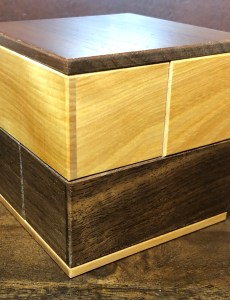
Shiro Tajima, 2016, Monarch Birch, Black Walnut and Japanese Cherry, 4” x 4” x 4”
Shiro Tajima was creating puzzle boxes with the Karakuri Group until a few years ago; his Hermit Crab and Goblet boxes are probably the most recognized of his boxes, as they have been produced in larger numbers. I reviewed his Uroboros box a few months ago (with one of the few solution vids I’ve done, as it was requested by a fellow puzzler). Kakoi is quite different, not only from Uroboros but from any box I’ve seen or done.
Kakoi consistently gets listed in community polls as being among puzzlers’ favorite boxes; in fact, it won the 2017 Nob Yoshigahara Puzzle Design Competition Jury Grand Prize, which is basically a long way of saying it’s a damn good puzzle. The only reason it likely doesn’t get an even better showing is simply due to its rarity.
It is a bit bigger than your typical Karakuri box and eschews the traditional panels for a look that is anything but traditional (or a panel). Your first impulse is pretty clear from looking at it and it does in fact lead to some success, or at least it seems to: this is one of those puzzles where movement early on doesn’t necessarily give you much info on how to proceed from there. While I have chosen not to post pics that display these early movements, a simple search will let you see some slight spoilers for said steps.
After futzing with it for a while, essentially just poking the same few things back and forth, I began to get a sense of what might be possible and started experimenting. This is one of those puzzles where things have to be juuuust right before you’re able to proceed, and it’s not so easy to see what that is until things are, in fact, just right, a tautological conundrum that helps to build the aha into something truly satisfactory.
One you find that perfect setting and the move it permits, the main movement is quite elegant and unique. Having accomplished this, it doesn’t take much to find the final steps, allowing you to access a total of four(!) hidden compartments.
Opening the compartments makes the puzzle impossible to close and it is pretty easy to get turned around such that knowing how to close it and actually doing so are not quite the same thing, at least for a few moments. This forces you to really look at how everything works together to first prevent and then permit the main movement. Once again you need to find the exact right arrangement before you can reverse the main step; when closing it you can really appreciate the close tolerances, a bit of a vacuum is even created, with the displaced air acting as excellent evidence of this precision.
Resetting the box is quite satisfying: enough so that Kakoi is among the puzzles that I have a tendency to re-solve most frequently. There is something about that main movement that I find to be so pleasant to do; the fine adjustments never seem to get easier, such that a moment of confusion feels inevitable with each run-through.
Shiro Tajima’s Kakoi is an excellent example of the uniqueness of Karakuri boxes; its aesthetic and movement stand apart from other boxes and offer an elegant and fun solution that relies on high levels of precision that others might sometimes struggle to obtain. If you happen to see this one available somewhere, I’d recommend considering it – it certainly sits comfortably amongst my favorite Karakuri.
Art Deco Clock Box, Book Puzzle Box (Volumes 1, 3, & 4)
Bill Sheckels
Bill Sheckels (blackdogpuzzleworks on Etsy) has been making custom, fine furniture since the 70’s and it shows in the amazing craftsmanship of his puzzles. I had seen some of his work around and when I saw his Art Deco Clock Box I quickly reached out to see if any of his boxes might be available. Since that time, I have happily collected a few pieces and look forward to growing my library of book boxes (so my bookshelves will actually get to hold some books….. sort of).
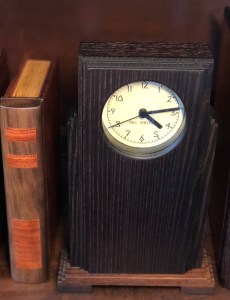
When I first got in contact with Bill, he had recently sold the last of 25 copies of his Art Deco Box and offered the Artist Proof copy at a discount; the only difference is that the back panel juts out a couple mm from the back (it is otherwise the same in terms of aesthetics and mechanics) and so I jumped at the chance. I love the idea of a puzzle clock and was quite pleased to be able to get a copy. The puzzle is a good size: 9.5″ x 2″ x 6″, and looks absolutely great on the shelf. In fact, its beautiful, dark wood and lovely Art Deco style was sufficient to earn it a place Downstairs, where only the most worthy of puzzles are permitted. Sitting down to work on it, it took me a while to find anything that did anything; I was eventually pleasantly surprised to find that the 5 or 6 steps required to access the hidden compartment included some elements of sequential discovery. The solution is tricky but not overly difficult and uses a couple steps that I, at least, have not seen used anywhere else. Aside from it being beautiful and a cool puzzle, I just love having a functional object that is also secretly a puzzle box – I can’t help but smile to myself almost daily as I walk through the Living Room. A puzzle box with an actual function is an oddly rare concept, and this is an elegant and attractive example of such a concept.
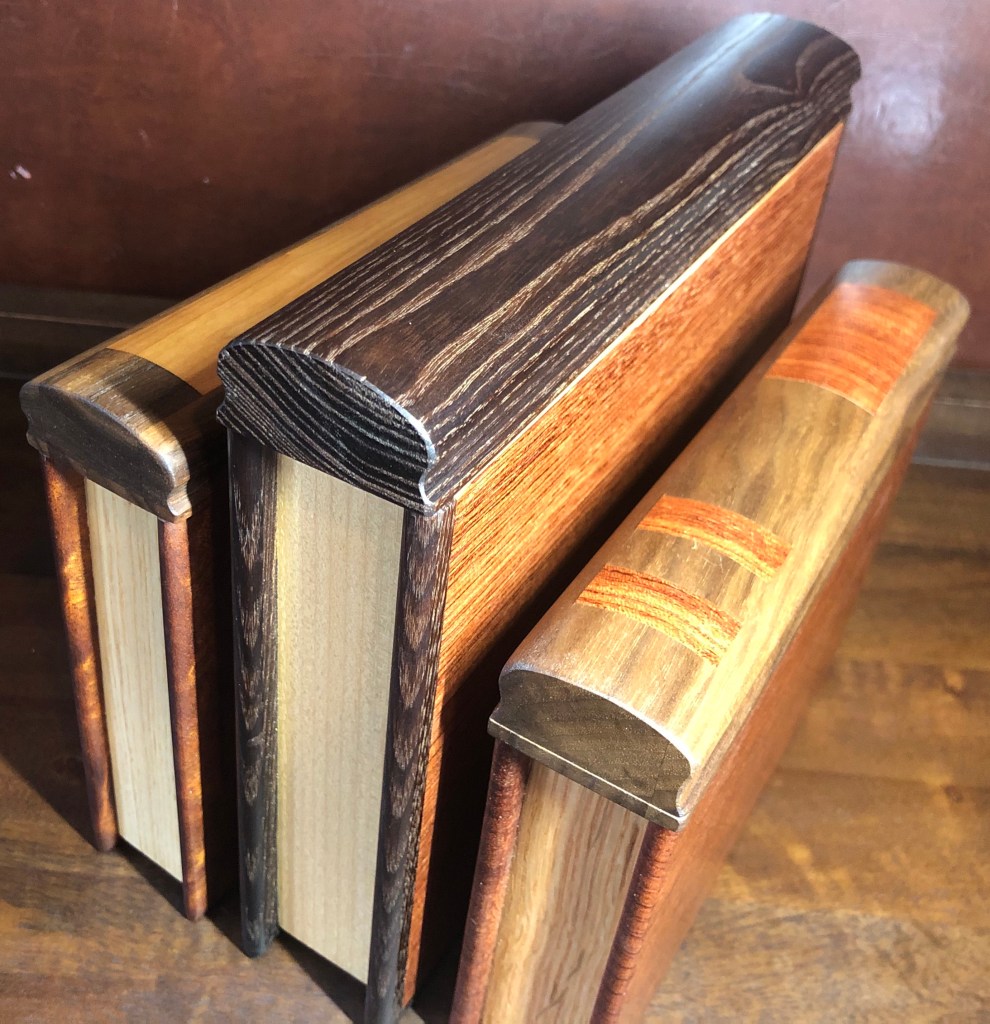
Around the same time, he had copies of the third volume of his book boxes available. He generally offers multiple wood options, and I was lucky enough to get my first choice: Figured Makore with a Walnut spine, Ash pages, and Cherry inlay. The pictures really do not do it justice: it is a gorgeous piece, the two-tone spine contrasting wonderfully with the figured front and back; the ash is carefully cut so that the natural wood grains mimic paper quite well, and the overall look is simultaneously artistic and convincing. It is a decent sized box at 6″ x 1.5″ x 7.25″ and is certainly an excellent example of woodworking, but how is it as a puzzle? It was hard enough that the solution eluded me for quite some time: the drawer is unlocked in one step and then another is required to open it. Although I would not say that it was overly difficult, I do enjoy the final unlocking and opening of the hidden drawer. As an added bonus, I was quite pleased to find a copy of his Three Piece Dilemma (available on Etsy) inside; this consists of three different flat shapes that must somehow be combined into the shape of a kite and a triangle – both challenges are much harder than one would think, although this kind of spatial reasoning is far from being my strong suit.
A couple months later, I heard from Bill that he was remaking his original Book Box in 6 different woods; I acted quickly but even still my first choice (Walnut Burl) was gone. Fortunately, all of the options were beautiful, and I got my second choice: a two-toned Bubinga frame using a black spine to set off the reddish-brown covers, the light-colored wood “pages” again featuring natural grain to subtly mimic the pages of the book. This box is significantly larger, coming in at 9″ x 1.75″ x 7.5″. I was able to solve this one a bit quicker, primarily as it has some features in common with another puzzle I had recently solved. The mechanics also share some similarities with the Art Deco Clock Box: a similar nod to sequential discovery albeit with fewer steps. The compartment is accessed in a pretty unique way for a book box, with some unexpected moves that I found quite enjoyable. Overall, I enjoyed the mechanics more than Vol. 3, although Vol. 3’s figured covers are hard to beat.
Flashforward a few more months, and Bill emails to say that he has designed a fourth book box: obviously, I jump on it quickly, managing to get my preferred wood choice: Figured Bubinga with a Walnut spine, Red Oak pages, and a Bubinga inlay. Although it shares the primary wood with the previous book box, it looks significantly different: the figuring makes the covers have ample texture that contrasts nicely with the more minimalist (and larger) original Book Box. Its spine features matching Bubinga in a few asymmetric rectangular shapes that help to create its rather convincing bookish appearance. It is a bit smaller than Vol. 3 at 5.5″ x 1.3″ x 5.5″. I’d like to tell you about the puzzling but, to be honest, I have still not managed to solve it! I have figured out a couple things without making any actual progress. I count this as being a good thing, obviously, as I will continue to pick it up and spend some time futzing with it until I can find my way through to the solution. I am guessing that it features a drawer, similar to the third Book Box, but this assumption could certainly prove to be incorrect.
Basically, Bill’s Book Boxes are absolutely beautiful: they feel solid and smooth and his 40+ years of fine woodworking is quite clear from the moment you see them. Book Boxes have a tendency to not be the most difficult of puzzles, but these are not what I would call easy – both the craftsmanship and the clever mechanisms are more than enough for me to hope to see him remake the second Book Box (because completism runs strong in me), as well as future designs. The Clock Box will continue to play its double role as an actual clock, amusing me with the secret it contains unbeknownst to passersby (who probably wouldn’t really care, but it’s still fun for me), although once the secret door to my puzzle room (slash home office) is done, I plan on keeping it there rather than downstairs (likely alongside its Book Box brethren).
Bill has several puzzles available on his Etsy store; the boxes tend to sell out before they have a chance to make it there, although I believe some copies of the Art Deco Clock Boxes were sold there at some point. However, he sells a number of interlocking, burr, and packing puzzles that are of equal craftsmanship and good price points; the selection changes over time, so be sure to favorite the store as something you like will likely pop up before too long.
Bill has submitted some very cool puzzles to IPP competitions over the years, none of which have I had the pleasure of solving, something that I hope to someday remedy. His Caged Coin and Packed Pyramid are of particular interest to me, and I hope to find them at auction one day (ideally at a reasonable price), or perhaps remade and available at his store (hint hint). Until then, I will continue to keep an eye out for Bill’s Book Boxes, which share a common aesthetic while managing to be quite unique from one another, both in terms of style and mechanics.
Mr. Puzzle, 5″ x 1.5″ x 1.25″, 330 copies made (2018)
There is nothing better than a super-timely puzzle post about something available or coming up soon….. this is not that.
I have been wanting to write about Three Wise Bolts for some time; after re-solving it recently, I remembered what a fun and original puzzle it is and the puzzling muse once again struck:
Three Wise Bolts is a 2018 release from Brian Young at Mr. Puzzle. At the time, my collection was somewhat subdued – I didn’t have much of a budget for puzzles nor did I know as much about what was out there. But something about this puzzle struck a chord with me and I jumped on it. With 330 copies made, it is much more common than many limited releases; the fact that they are not seen being sold at auction as often as many other puzzles released in much smaller quantities should tell you something.
Three Wise Bolts is a take-apart puzzle; most decidedly not a box as there is no internal space to be accessed. The purpose is quite simply to remove the three bolts spaced evenly along a horizontal block, thee Mr. Puzzle logo etched into its front. It also falls quite comfortably into the sequential discovery sub-category, as the puzzle experience has you discovering tools as you journey towards finally removing all three bolts and taking apart the frame that splits into two pieces.
You can see from the bottom that the bolts are different sizes; their complexity also differs considerably, with the puzzle bringing you along a linear journey to its eventual solution. They all spin freely (until they don’t) and small holes are found low on either side of the frame. The tops of two bolts also have a small cavity etched into its side. As with many Mr. Puzzle creations, you must think really creatively about what might be usable and how it might be used. It starts out fairly easily, winning you an early success by removing the first bolt, as you learn a bit about how the puzzle works and what is going on inside. Then the difficulty begins to scale up, with the third bolt being particularly tricky, forcing you to think hard on what might be possible using the tools at your disposal; trial and error may not get you all the way there, and you may need to step back and try that whole thinking thing.
Resetting is just a matter of reversing the steps until you are back at the start. Having first solved this puzzle some time ago, re-solving was almost a new experience; I had forgotten enough about what needed to be done that the a-ha moment, while a bit subdued, was nonetheless still quite satisfying.
Mr. Puzzle offers many great puzzles in addition to Brian’s personal creations and is the only place to get his releases without resorting to auctions or fellow puzzlers. He has a new puzzle coming up that is said to be sequential discovery in the spirit of Big Ben or the Louvre, two pieces with excellent reputations (neither of which I have had the pleasure of solving). And, in a welcome and rare twist, they have said that this will not be as limited a release, in the hopes of ensuring that everyone who wants one will be able to get one – so no setting alarms and hoping the puzzle doesn’t disappear from your cart while you are checking out. Apparently, he is now in the prototype phase and we shouldn’t expect it to become available until mid-2021. So, if you haven’t already, be sure to sign up for their blog – they won’t bombard your inbox and you will be sure to know more about it as we get closer to release.
The Silver Age of Puzzling is surely upon us; perhaps Puzzle Renaissance is more accurate. The Golden Age would be that time a decade or two in the past when mechanical puzzles began showing up more and more, with amazing makers making amazing puzzles, almost all of which are now unicorns. However, the puzzle world was perhaps more limited: fewer makers, fewer collectors, fewer puzzles, fewer dollars……
With YouTubers encouraging a growing awareness of mechanical puzzles, an increasing number of people are being drawn into the puzzling world – the initial interest fostered by the growing presence on Reddit and (of course) Discord (go team!). This has brought more makers out of the woodwork (sorry) as the demand for new and unique puzzles grows:
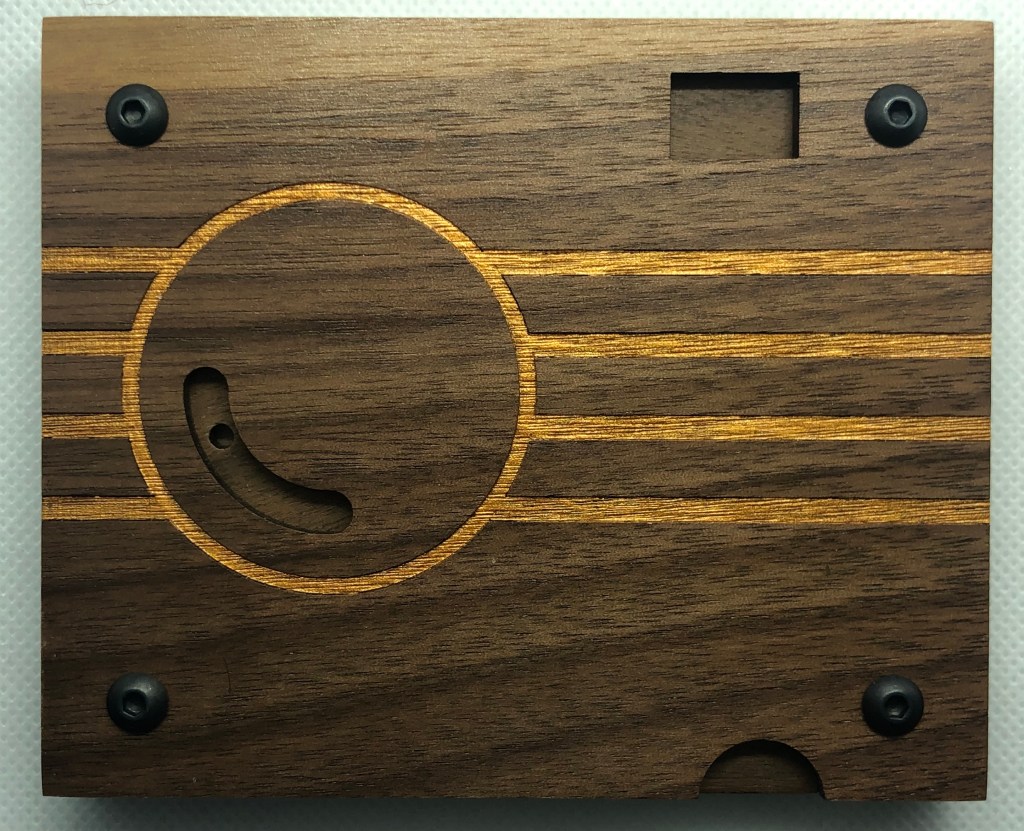
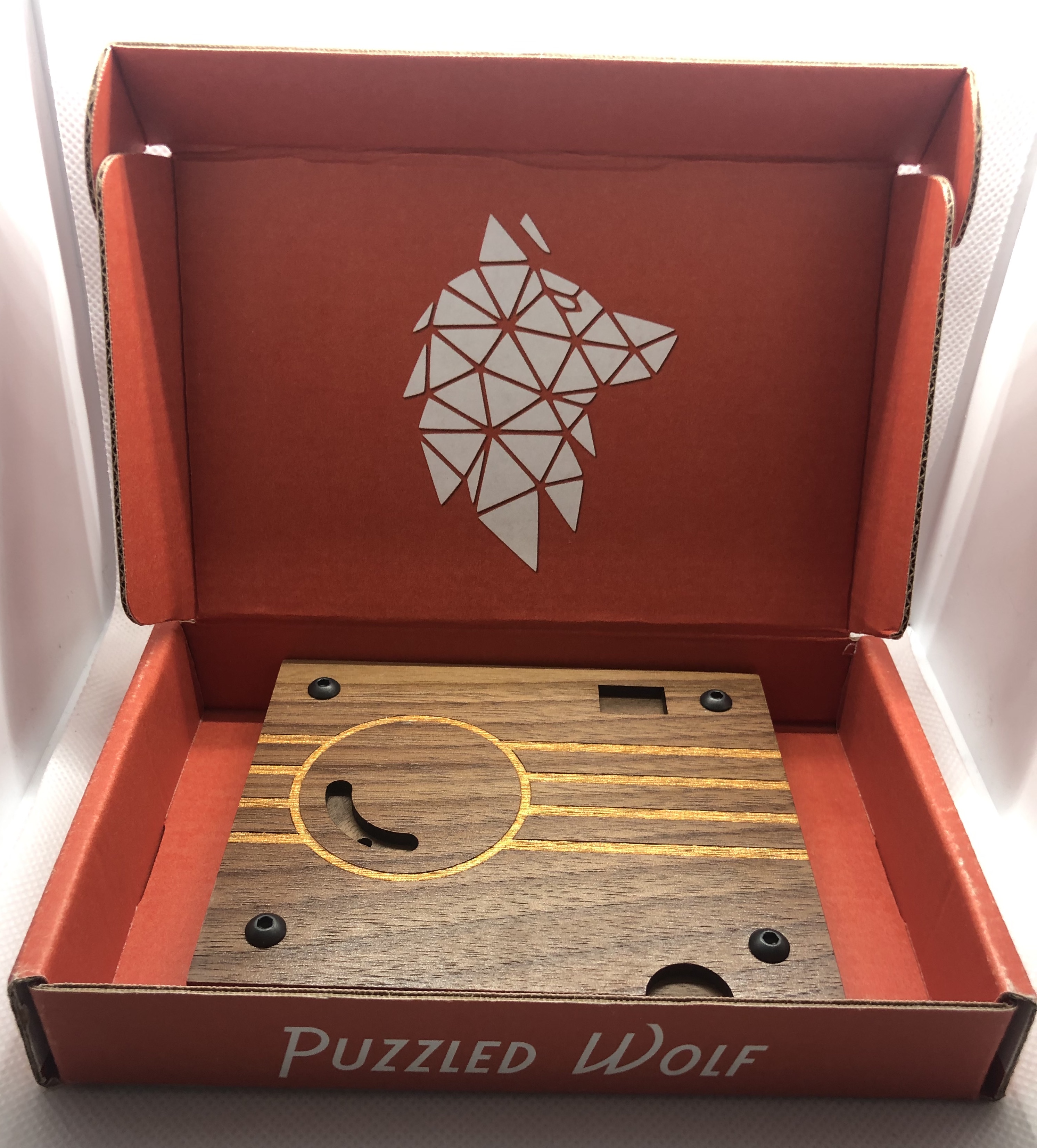
Cue PuzzledWolf, busting out with Ansel: The List (LIST!!!) was born in May with shipping and public sale soon starting in June (2020). (There are plans for additional releases at the time of this writing, with a likely hiatus to allow for the development of future puzzles)
Ansel itself is a wooden rectangle with a relatively slight depth, its appearance a line-drawing take on a classic camera (and we can now understand its name). The puzzle’s goal is extremely unique: the camera’s view-finder is stuck and we need to open it. This makes classifying it a bit tricky: its thematic journey has the feel of an SD take-apart but really the goal is the most puzzle-y of puzzle goals: move this bit of wood here to just a little bit over there! (A Puzzler can most definitely appreciate the joy of figuring out how to move a piece of wood a couple inches and doing so here is extremely satisfying)
I would be remiss if I did not reflect momentarily upon the puzzle’s presentation: PW pulled out all the stops, branded by an eye-catching color and distinct wolf mark adorning a custom box intentionally made with Ansel in mind.
Pretty much everyone I’ve heard speak of Ansel got stuck right off the bat, taking some time to find what is one of my favorite first steps in a while: I thought it was one thing or another and it turned out to be a totally different thing and even though I generally like being able to make a little bit of progress before getting stuck, the sneakiness of it makes me smile. The early struggle satisfyingly resolved, one can move on to a bit of study: patient observation mixed with trial and error as you work your way through the puzzle, which still has some surprises up its lens.
Resetting Ansel is relatively straightforward (following the obligatory photo of a pet or puzzle through its now-open viewfinder). I found myself fidgeting with it after solving it and have picked it up several times since to enjoy one moment in particular.
Ansel is quite original, very well-made, and offers really good puzzling at a great price point. It’s thematic and has an aesthetic that is readily recognizable as a puzzle while also being totally different from pretty much anything I’ve seen before. I look forward to PuzzledWolf’s (hopefully relatively imminent) follow-up to Ansel – a Washing Machine puzzle currently in development, which seems to maintain some aesthetic consistency with Ansel while also appearing totally unique, which is itself pretty cool (perhaps to be called the Alva after none other than Alva Fisher, the man sometimes considered to be the inventor of the electric washing machine, apparently unjustly but it sounds cool as a name and is quite wonderfully alliterative….. and yes, I had to look that up).
Originality and Presentation: Five Sinatras
Difficulty: Four Sinatras
Midcentury American Photography Signification: One Adams











 Puzzle Ramblings