Going in Circles: Orbit and Uplift by Dee Dixon

Welp, Dee as done it twice more with his most recent releases, Orbit and Uplift: I got there eventually but it took me quite a while to do it, with a nudge or three needed along the way (although I suppose I find that just talking about what I am doing is sometimes the most helpful part – more often than not in the process of explaining where I am and what I’ve done I clarify what I haven’t done and aha!…. that or I am just trying to make myself feel better about frequently asking for help from other, better puzzlers).

Oddly, both of these totally different boxes feature a freely spinning center piece in a frame – but that is where the similarity ends (other than Dee’s excellent craftsmanship, as always). Both look and feel great, as with any of Dee’s work in my sometimes humble opinion; Uplift has received some aesthetic comparisons to Bad Moon, which I can see, but really they both have that Dee look you can’t quite put your finger on but can still readily see. Uplift is especially gorgeous and I suspect that producing it is particularly no easy task. Neither box is an overly long solve but both had me stuck for quite a while, so my experience with both was nonetheless quite long… and of course they look great alongside their ever-growing set of siblings – delightfully, Dee definitely didn’t disappoint.


Orbit

In the hours (and hours) I spent going in circles with Orbit, I will admit there were times I was certain the solution must be too blind… I was convinced I was going to be annoyed by the solution but in reality this was not at all the case once I actually figured things out. You are given plenty of information and just need to bring some patient observation to make sense of things. It is extremely unlikely to just randomly open this box, although there were times when I was sure I was close (and found out later how wrong I probably was). This is the kind of puzzle where you really need to work out what is happening to be able to reach the solution. There are many puzzlers out there better at this than I, who may well have had an easier time, but I really had to struggle to get there.

Eventually I made some sense of the box and was sure I could solve it only to be confronted with a problem I eventually worked out with a laugh. Again, the information was there if I stopped and thought about it (and I appreciated how Dee incorporated something that in another puzzle may have felt disappointing but still managed here to feel novel… it’s hard to say more without crossing the line into SpoilerLand (which I’d say is like CandyLand but that would give too much away)).

Having solved Orbit I can now get through the solve in a few minutes – a testament to how not-really-at-all-blind the puzzle is, once you’ve worked it out; in my experience, a truly blind puzzle can stump me even once I know how to do it. Here, there is no way to get lost once you know where you are going.


Uplift

Uplift goes back to Dee’s SD roots with an SD-lite solve in what is an absolutely stunning circular “box.” It had me stuck spinning myself nowhere on more than one occasion, with a particularly delightful aha! at the start. I had spent a few hours (yes, sigh) going in circles, doing everything I could think of… everything but the one thing that would actually do something. I found a bunch of feedback that did nothing more than to distract me from finding my way into the start of the solve and when that aha! hit… you just gotta love that dopamine, bruh.
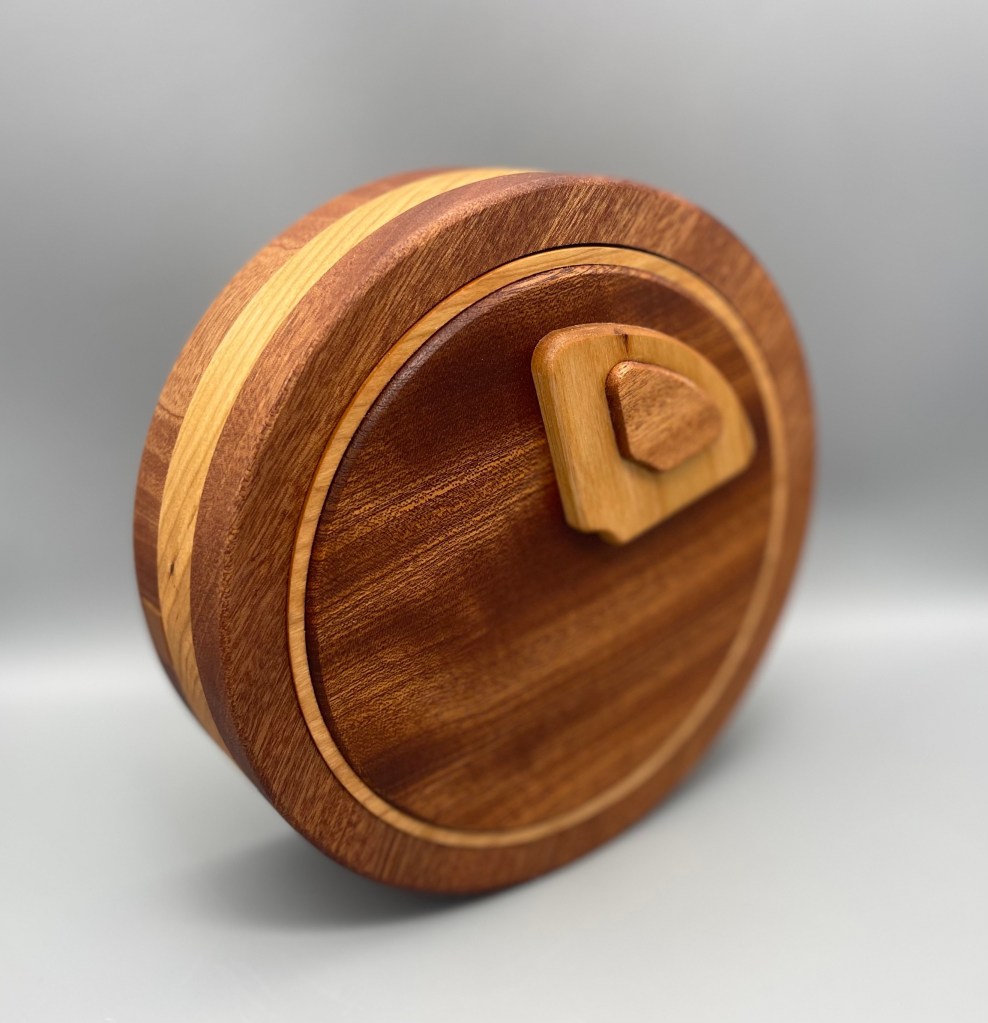
From there, I got stuck one or two more times but was able to get through the rest of the solve in a couple focused sessions. Dee messes with us as the puzzles progresses, causing me to fall down a rabbit hole or two along the way. Fortunately, I was able to get back on track without help, all by my big boy self. Overall, it was not a super long trek to the end once I got past that first wall; I managed to hit that last step with a laugh when I saw where Dee goofs us once more.

I know of one rather vocal critic of Uplift, someone who I suppose solved the puzzle quickly and felt it should have been longer (not a Karakuri collector, I imagine). To me, this first leaves out the importance of respecting the difficulty and complexity of physically producing a beautiful box, which is much of where the value of a collectible puzzle is derived. If you only care about how long it takes you to solve something, than you may not appreciate puzzles like Karakuri’s, for example, which, to some, may be solved quickly – I care more about the elegance of a solve, the flow from step to step, how it integrates with a novel aesthetic built with immense care… although I suppose it may be easy for me to say, since I rarely solve anything quickly (I never claimed to be smart… just circumlocutory and loquacious 😉

But, really, I do not want to give the impression that Uplift is a short puzzle; I don’t like giving a step count unless asked but, by my count, the length of the solve is about average (in terms of steps) for Dee’s work. Most important to me, I was never disappointed with my experience solving it. At the end of the day, I may have spent more time on Uplift than on Walter’s Radio, which does feature more steps (and is one of my favorite Dee boxes) and seems to have stumped some puzzlers as being too complex. Radio is the harder puzzle I think, but Uplift really got me looking in the wrong direction on more than one occasion, which just goes to show you how random the puzzling experience can be and how subjective our perspectives inevitably are.


One of the great things about Dee’s work is that he gets a lot of feedback before releasing puzzles – between prototype testers and a few early releases, he gets a lot of information before calling anything done, oftentimes even giving the public a look into the puzzle from a blogger or two before public release (not that you should listen to anything those guys say, cough cough). It should be no surprise that his puzzles are rarely, if ever, the subject of controversy or contention (and oftentimes the subject of confusion).

Dee has brought us two more beautiful and tricky puzzles that hit different price points and scratch different itches, both leaving me with the lovely feeling of success that solving a good puzzle can provide. Somehow, Dee is apparently putting the final touches on yet another puzzle so I may be back soon… assuming I can solve the darn thing.

If My Words Did Glow: Ripple by Peter Canham

Nary a day goes by when no-one asks me: “Hey, 5S, where the heck ya been the last few months?” Well, life happens and writing fell to the back-burner for a time. But this is not to say that my puzzling itch went anywhere – I’ve still been FOMO’ing my way through my bank account and struggling with the (many) yet unsolved puzzles in my midst (I’m looking at you, Orbit… and you, pretty much every Osanori puzzle I own).

There has been some truly great stuff to come out since the Nashville Puzzle Party (I realize that I haven’t posted since then… Wtf?!) but my favorite (solved) puzzle since then has got to be Peter Canham’s Ripple. After patiently waiting a year or so, I got an email that it was my turn! Cut several weeks ahead past some USPS shenanigans (and absolute kindness from Peter in his quest to make sure the puzzle got in my hands) and it arrived, safely packed in some laser cut plywood.

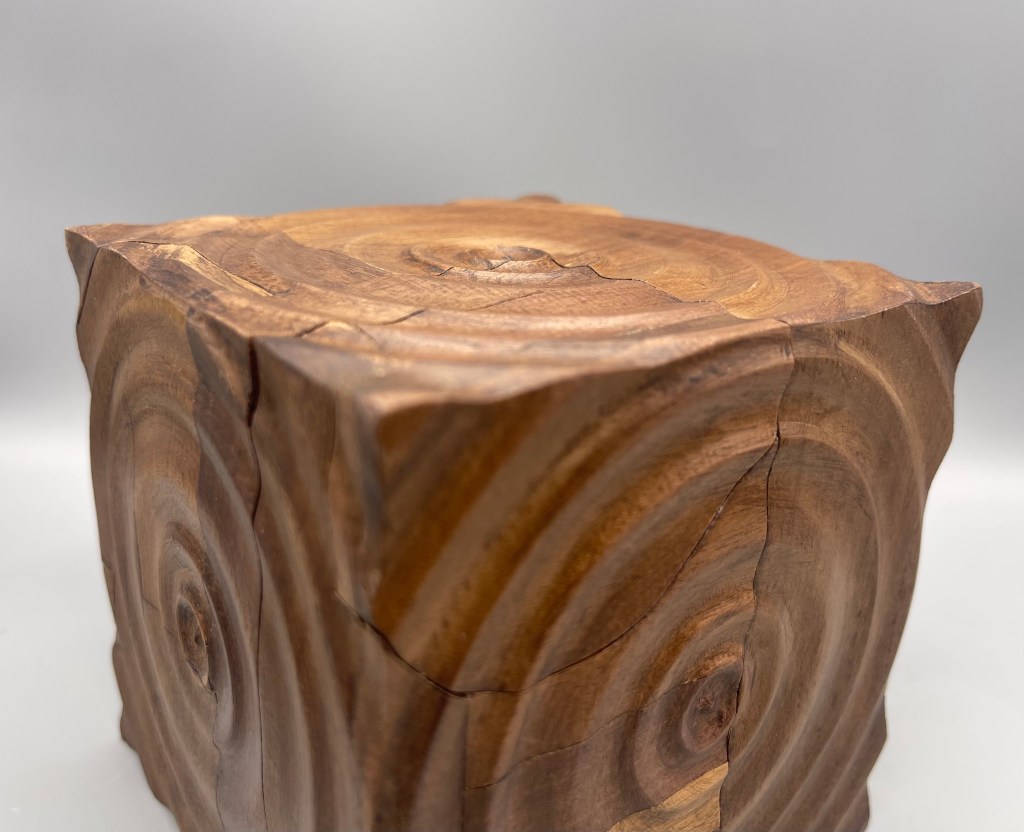
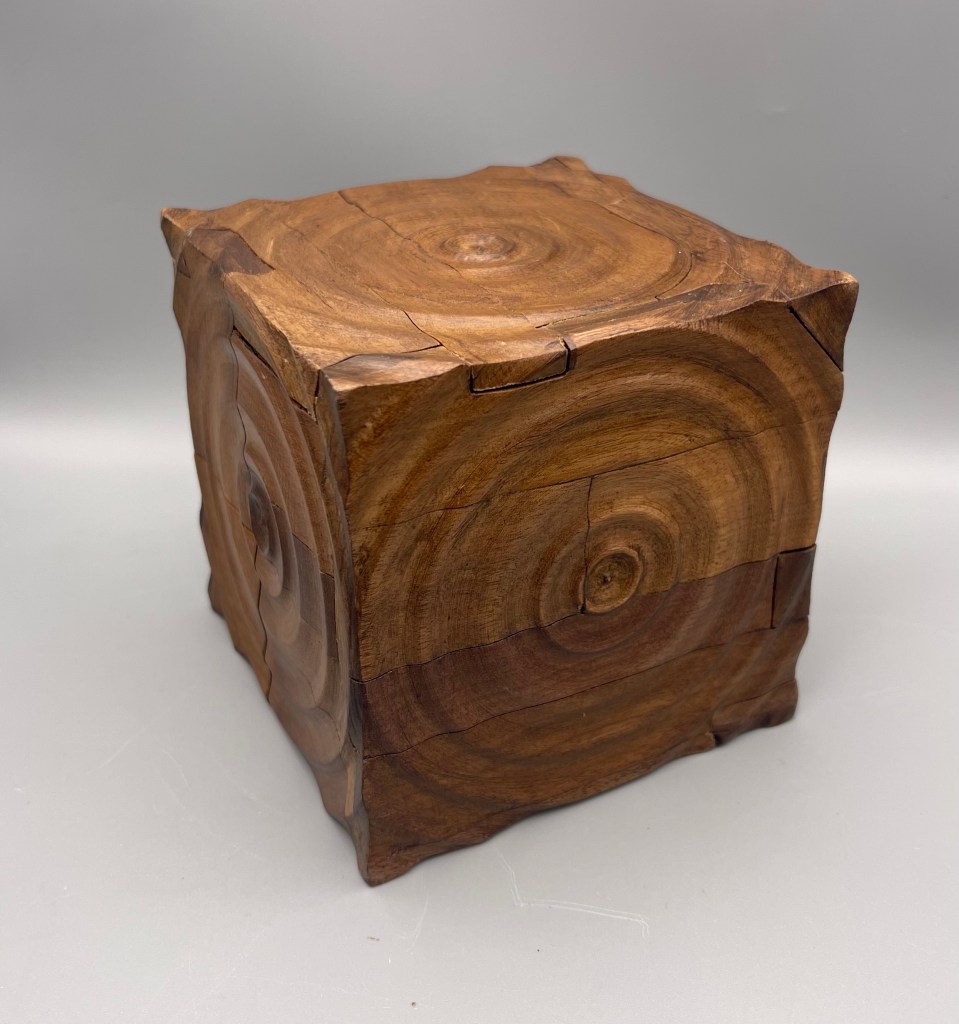
Ripple’s aesthetic mirrors its name with each face of the 4″ walnut cube featuring a series of rounded, concentric circles. These are broken by all sorts of strange and seemingly haphazard lines, giving you a hint of the complexity to come – at times these lines might prove helpful but they somehow still managed not to spoil some wildly unexpected moves. In Peter’s (comparatively succinct) words, it is “a box that was like a sequential puzzle but was non linear i.e. one move did not necessarily lead to another but possibly two or three. Like ripples in a pond interacting with each other. The biggest design challenge with the ripple box is that as the moves bifurcate the mechanisms start to interfere with each other,” resulting in a lovely cube that is seriously tricky.

After a moment appreciating the look and feel of the box, I was off: I was able to find something rather quickly but it seemed to lead nowhere, leaving me in circles that led to other not yet helpful discoveries, as I spent at least a couple hours over several days without making any real progress. Finally, after clarifying an assumption or two with Mr. Boxes and Booze, I found something odd and quite unexpected. And there I sat once more, staring into the next of what would be several walls that would lead to quite a few satisfying aha! moments. Eventually, I reached the solution and found Peter’s signature alongside the series and batch number. After basking in my brilliance for a bit, I reversed course, resetting the box and going back through the solution once again, appreciating how the moves lead into and around one another, moving through the maker’s vision to the end.

I suppose some might debate this, but I feel like it easily meets the crowdsourced Discord definition of sequential discovery, as it takes you “on a journey through a set of sequential and generally non-repeating challenges involving the discovery of hidden mechanisms” to reach the solution. SD has come to inspire some rather specific meanings that may or may not be met by this puzzle; regardless, the journey itself awards the puzzler with plenty of satisfying aha!’s. But, really, who cares: it’s a darn good puzzle, which is all that matters.

And now, what’s this? A new Dee Dixon puzzle adorns my doorstep? Ah, yes, you may yet hear from me again soon (sorry).


Hitting the Jackpot: Bandit by MW Puzzles

Bandit

MW Puzzles; 350 copies
2.5 lbs; 7.5″ x 3.75″ x 4.25″
Metal, Walnut, Acrylic

When I was a kid, I had a miniature slot machine with tiny tokens that would make the wheels spin; hitting a jackpot would release whatever tiny tokens had been inserted thus far. While entertaining to my nascent mind, there wasn’t all that much to it – pull the arm, spin the wheels, lose and repeat until you win.

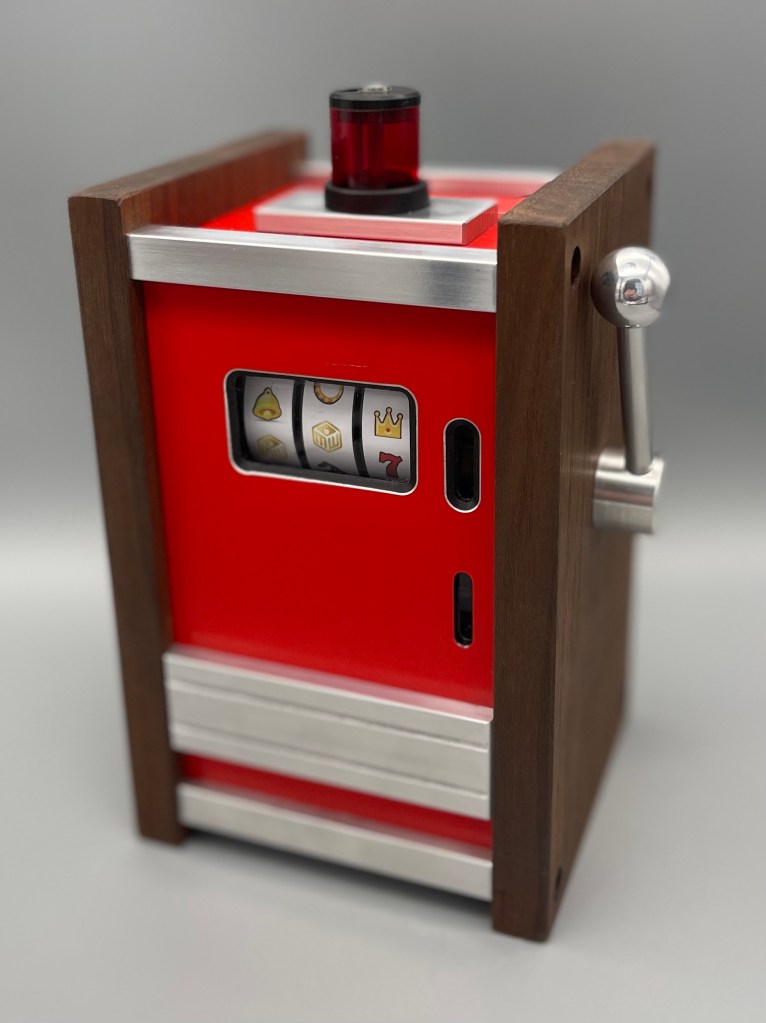
MW Puzzles has taken the classic one-armed bandit and made something fun, tricky and unique, something instantly recognizable, such that the ultimate goal is clear from the start even as the path to it is not.

This makes for something that demands to be picked up, sure to catch the eye of puzzlers and non-puzzlers alike. It begs to be handled; at 7.5″ x 3.75″ x 4.25″ and 2.5 lbs (that’s just over 1 kilo for you metric weirdos), it fits perfectly in two hands, a necessity for all the exploration it will require.

When you first sit down with MW Puzzles’ Bandit, you will almost certainly do what comes most naturally: pull the Bandit’s one-arm… and you will find it does nothing but rotate freely: the wheels don’t spin and a jackpot is most definitely not in the cards. This is sure to reel you in and pique the puzzling mind in the way that a good puzzle does, spinning you around while sucking you in so you just want to try one more thing, just like the real thing catches you with just one more quarter; the difference is that you can actually win with Bandit, should you put in the thought and effort – the payoff is in the cards, to mix casino metaphors.

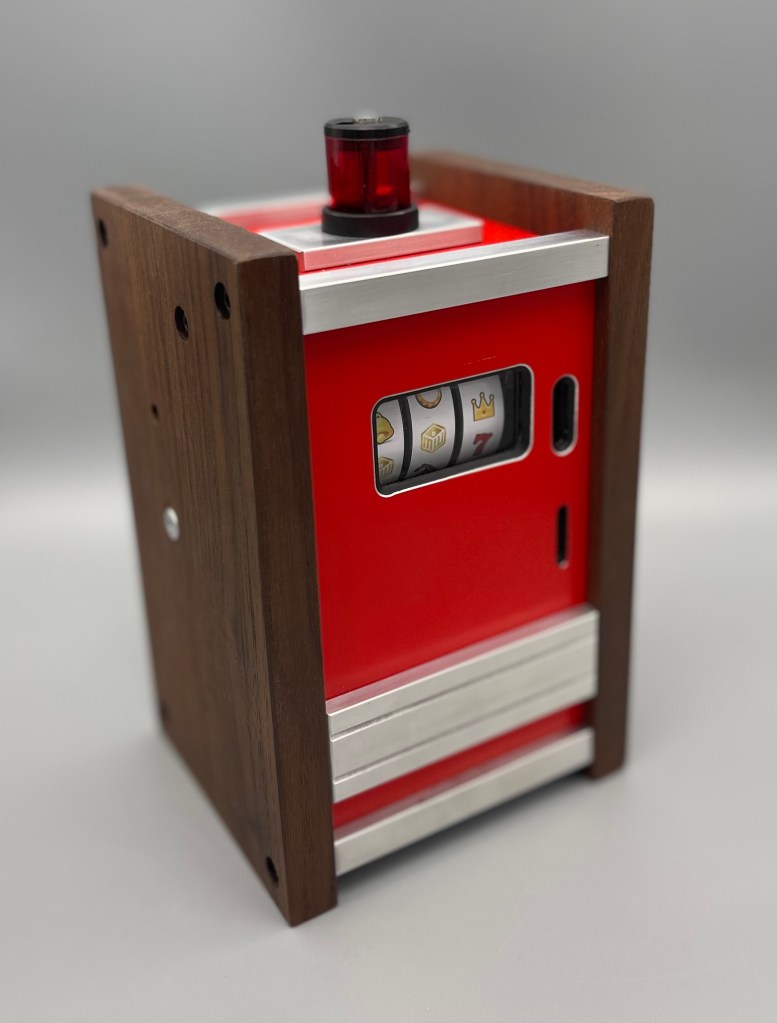
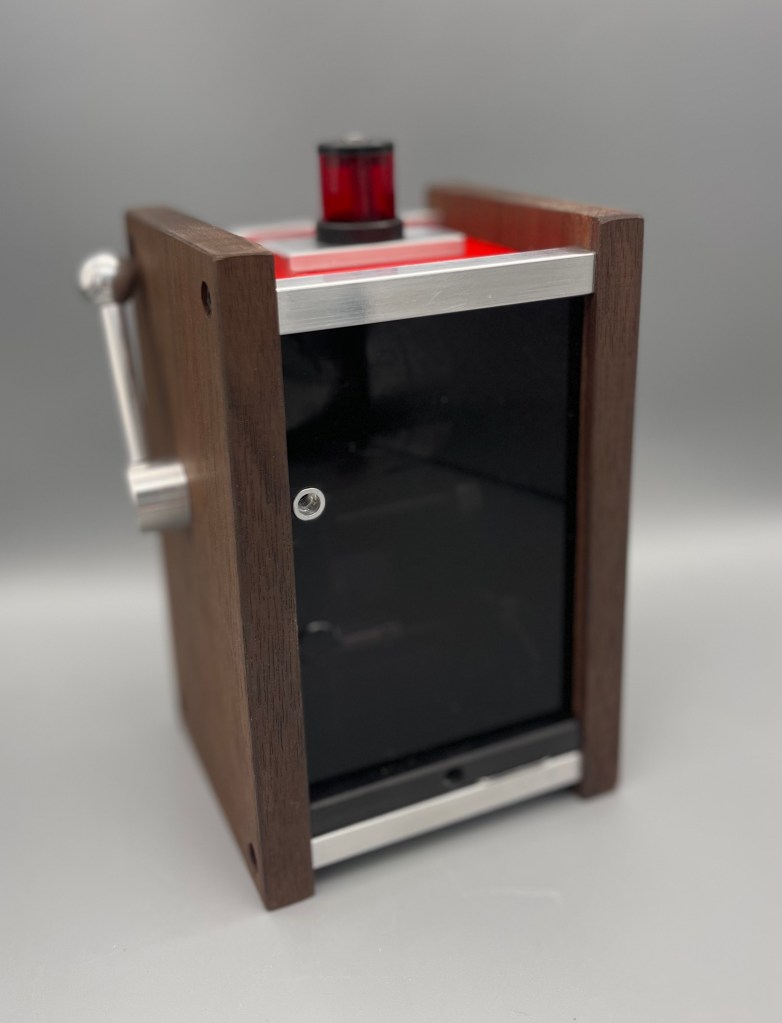
So begins a sequential discovery journey that rewards experimentation and patience, teasing you with a partial view of its inner workings through a semi-opaque acrylic back, framed by lovely walnut sides and a glistening metal frame that comes in one of four colors.

I had the welcome opportunity to test a late prototype and to compare it to the final version, getting a glimpse into the careful planning and patient meticulousness of the puzzle’s creator. This is not a hastily thrown together puzzle but is instead the result of ample thought and cast-aside proto’s – there were a few changes following even this late prototype that proved to me that MW is a puzzle maker who takes this art seriously; in seeking to entertain, it will be done with pride in a well-made product.

I shouldn’t be surprised after solving MW’s previous trilogy of metal puzzles, all reflecting their excellent craftsmanship and puzzling prowess; Bandit is a larger evolution of MW’s puzzle oeuvre that secures its place as a puzzlemaker to be followed.

Crafting a puzzle that actually looks like something is not all that easy – other than Karakuri, most makers shy away from the innate restrictions imposed by holding oneself to an existing aesthetic but MW leans into it, using the well-known game of chance to inform and obfuscate its puzzling mechanisms, with multiple tools (some quite well hidden) and a progressive puzzling journey whose finale provides the payoff one hopes for. MW has made something that is as aesthetically pleasing as it is recognizable, with puzzling that does not disappoint.

The goal is not so much to “fix” a “broken” slot machine but to discover how this strange cousin functions instead, achieving a jackpot through skill rather than stumbling upon it by luck: this is no game of chance but rather one that requires thought to understand and conquer.

MW began taking pre-orders for the initial run of Bandit a couple weeks ago; pre-orders appear to currently be closed at this time but I would reach out via discord or the website if interested, as interest seems to (unsurprisingly) be high. Bandit will be limited to 350 copies, 75 of each color with an initial run of 300 and plans for a final 50 down the line.


To every puzzler… Turn Turn Turn by Perplex Puzzles

Turn Turn Turn

Perplex Puzzles, 6 lbs, 7″ x 5″ x 2.5″

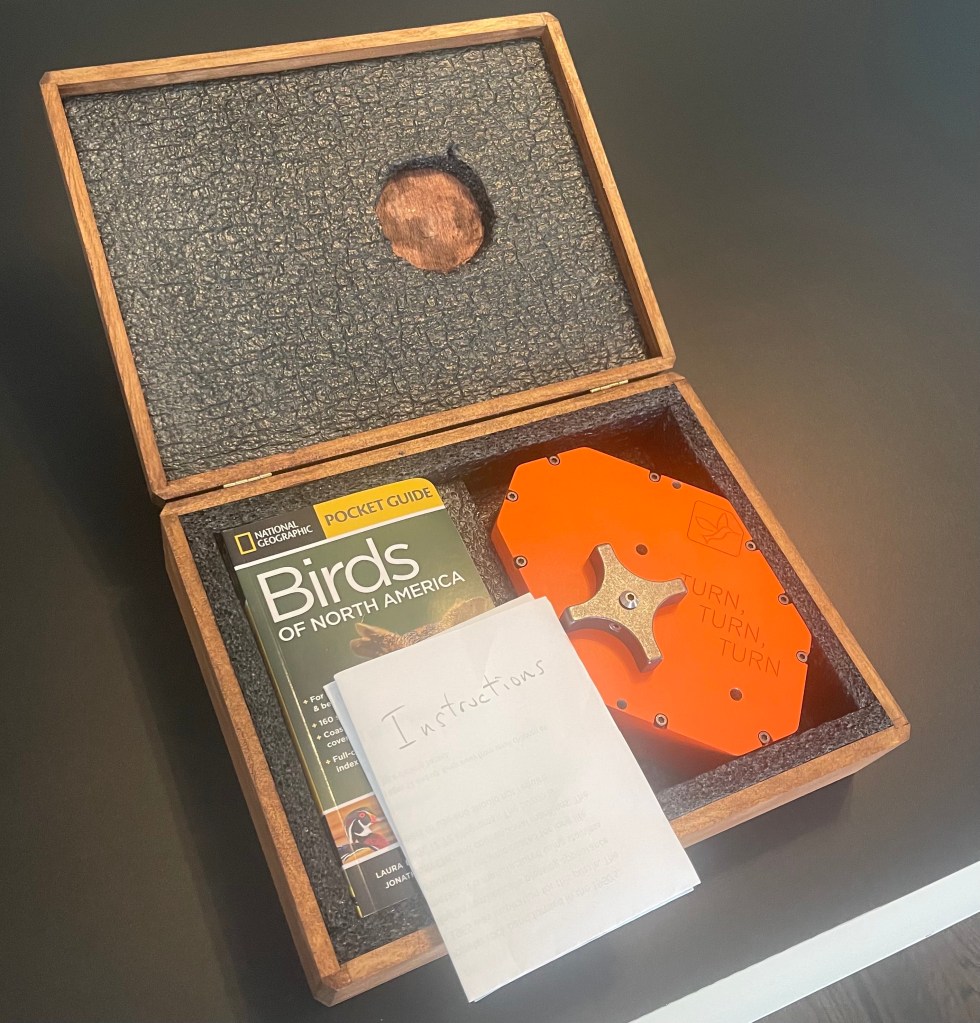
It has been a couple years since Perplex Puzzles released Wishing Well and the anticipation for his follow-up puzzle has not waned. Turn Turn Turn (found here) is bigger, heavier, sequentialier discoverier, and has the potential to drive you a bit mad. Bill B. from Perplex sent me a copy a while ago to try out and if you liked Wishing Well, I am pretty darn sure you are going to love Turn.

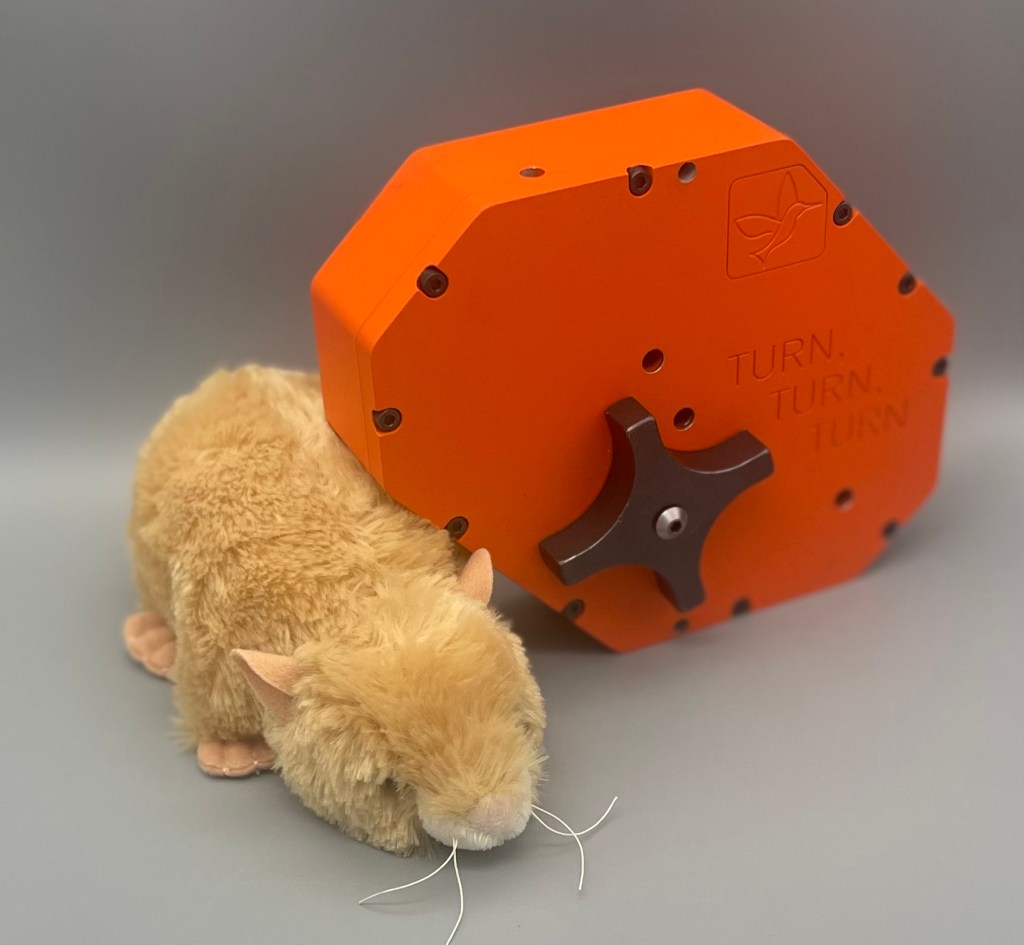
Bill has packed a lot of puzzling into this fat, orange parallelogram, which features a black handle on the front, a number of holes along the front and sides, and a protruding something emerging from its back. As with Wishing Well, Turn arrives in a large wooden box, with some instructions, a Bird guide 😉 and the aforementioned solution (in a separate manila envelope). This is 6 pounds of heavy metal puzzling and is not for the faint of heart – this is for puzzlers who want to be challenged with something that is going to take time to discover, understand and, ultimately, conquer. The enclosed laminated solution walks you through the solution and reset with fifteen pages (!) of steps (with pics!), which is to say this is neither a short, nor simple puzzling experience.

Bill is a retired machinist and his expertise is very much on display here, as well as his love of puzzles by designers such as Will Strijbos and Rainier Popp. Turn does not rely on magnets or force – it is truly and purely mechanical: discover tools, explore the various mechanisms that lay semi-hidden within the puzzle’s frame, experiment with the various moves and machinations possible while paying close (very close!) attention to the effects. This puzzle is absolutely solvable – it is not impossible as it is not blind: Bill gives you various ways to check on where you are, although it can be easy to get lost unless you are careful, developing a picture of what is going on through trial and error and close observation until you can begin to develop an understanding of how the mechanisms work, what needs to happen and how to get there.

I was able to make fast progress at first, discovering some initial tools that quickly begin to lead me into the puzzle. I would still be discovering tools and their uses over the next few hours as I progressed deeper into what can only be called a puzzle machine, slowly learning how it worked and how to manipulate it before I could zero in on how to reach the solution. Eventually I had a working understanding of the mechanisms and could orient myself towards the goal, which would take quite a bit longer to reach (along the way, I would need to decipher the included clues… and I may have asked my wife to check a thing or two against the solution for me, but I got there!).

Bill ends it with a flourish, a bit of a call-back in a moment of triumph that had me smiling – it was great to have something to clearly say: “you did it!” to acknowledge my efforts. I am confident that this is going to be a popular puzzle amongst fans of complicated metal hunks of puzzling that are difficult but solvable if you put in the time and brain power (this puzzle has an excellent ROI in terms of puzzling time, at least in my experience). The only downside: unlike some others, Turn’s shape will not lend itself towards being weaponized in a sock – Plant Cycle still earns the award for best puzzle in an apocalypse, in my opinion; otherwise, this is a novel, challenging and complicated puzzle machine to solve. They will be released in batches over the coming months, with Bill reaching out to those on his list. Pay attention as I bet they will go quickly!


When is a Door not a Door? When it’s Puzzleduck Pastures by Kel Snache

Puzzleduck Pastures

Kel Snache; 36 copies

In a land far away, under the old Sycamore tree is where you will find the cheery little fairy community of Duckbill.

These puzzle loving fairies have an obsession with all things mechanical and have nothing to do with ducks. One fairy named Lil’ Ms Fairy Pants had her tiny home newly outfitted with the crafty creations from one particular wizard named Kel Snake.

Sadly, Lil’ Ms Fairy Pants has a poor memory and has gotten herself locked out of her home, again.

Save the lovely fairy and be the gallant young knight by helping her to open her front door. She will repay you with a tiny tour of her home.

Duckbill Times

It may not be new but it is still worth writing about: I got my copy of Puzzleduck Pastures upon release way back in ye olden days of 2019. Back then, my blog was still pretty new, my tens of readers a mere fives of readers. I was writing less frequently than I am now (which really is still not as frequently as I’d like) and simply never sat down and wrote about this gem of a sequential discovery take-apart puzzle.

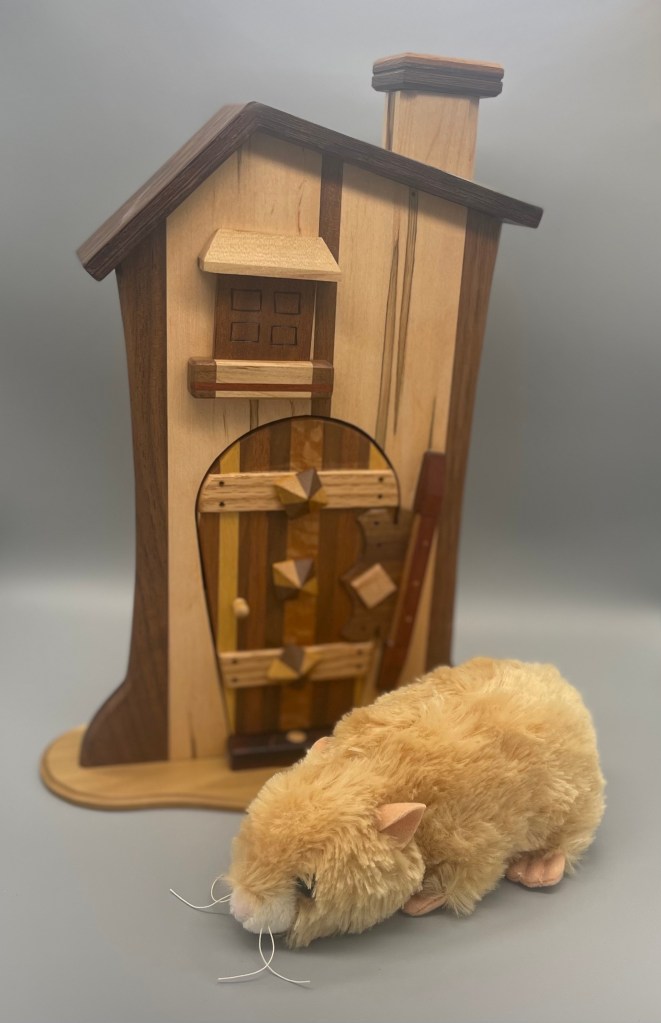
Puzzleduck Pastures is Kel’s “response” to Michael Toulouzas’ Fairy Door (and, in turn, precedes Tracy Clemons’ take: Dark Fairy Door). The puzzle looks like the facade of a playful, cartoonish home, the roof slightly askew, a bulbous door, sketched windows, and so on. The puzzle is a sizable 12″ tall and 8.5″ at its widest point on the base; at 3.5″ at its deepest, it evokes a sense of a theatrical facade from which one might expect Puck to dramatically emerge (“And those things do best please me, That befall prepost’rously.”)

And this is just part of its appeal: it’s playfulness is a manifestation of Kel’s good nature and reminds us that we are here to have fun – belying this intentionally imperfect aesthetic are the internal mechanisms that interact in varied ways, locking Lil Ms Fairy Pants’ door and tempting the puzzler with a number of holes across multiple sides.

The door is quite firmly locked: two of the three square central “locks” on the door move just a few mm, with the bottom one spinning freely. But don’t think that the rest of the puzzle can be ignored! In typical Kel fashion, you will find a number of interacting internal mechanisms keeping you from solving the puzzle and opening the door, although only the chimney appears to have any give when reset. It is quite typical of Kel’s style: multiple misdirections as you embark on a semi-linear sequential discovery journey with very few blind spots. Re-solving the puzzle after a few years, I was pleased by how well everything worked, even as I was sure something was wrong at one or two points (nope: it was me). And I was super pleased with myself when the door finally pulled open once again!

At the end of the journey you are rewarded with a view of some of the internal mechanisms as well as, even more delightfully, some lovely art of Lil Ms Fairy Pants’ home created by artist Nicole Lees for the project. (This is not a spoiler as it is stated in the description)

I love this kind of finale, bringing the story full circle and rewarding the puzzler with a good, satisfied laugh. By no means will you wonder if it is solved: it is quite clear that you’ve helped Lil Ms Fairy Pants home and you can sleep soundly knowing you’ve done a good deed for an imaginary person.

Puzzleduck is fun and tricky, Kel’s deviousness abounding throughout the puzzle’s playful frame. While not as long a solve as Kel’s EWE UFO, it is similarly smartly silly and delightful to behold (and they look adorable next to each other). Now if I could just get myself a copy of Toulouzas’ Fairy Door, I would have the trifecta, thereby opening a portal into the world of the fae!


Answer the Robocall: Walter’s Radio by Dee Dixon

When a wave of Angry Walters waged war on the world, we fought back valiantly, seeking to remove the cold fusion generators that fueled his robotic rage. Some of us succeeded, disabling the power sources in support of the sapien resistance; others struggled to make sense of the robotic systems, their patchwork patterns too puzzling, too complex to understand. The robots exploited this gap, continuing to grow in numbers as we humans faltered in the face of their fury. But the Walters soon faced a new dilemma: as they grew so too did the need for an infrastructure that could sustain the new robotic world order. As humanity sought refuge online, sharing stories of the underground at war with our new overlords, offering advice to those who could not overcome the Walters’ power, as we banded together, the Walters’ world frayed at the edges, humanity chipping away at the cracks within. The Walters scrambled to fill in these gaps, developing new communications technology that allowed for the instantaneous transfer of information between synthetic minds. Such profound development rested on the invention of the Dimensional Electronic Divergence (DED) Chip, a small transistor that disseminated data through tiny wormholes connecting the Robocall devices. 

Humanity’s hope faded as the radios allowed the robots to respond quickly to each battle, each spark of resistance snuffed out as soon as it surfaced. Humanity learned that the removal of the DED could turn the tides of the robopocalypse, diminishing the Walters’ ability to communicate. But they knew that any such success would come at a great cost and so they ensured that the removal of these devices would not be such a simple task. After humans stole what copies they could, they discovered that the removal and manipulation of the DED allowed them to transmit their own data, indistinguishable from that sent by the Walters, creating the opportunity to subvert their communications to humanity’s own ends. 

Human fighters recently secured a shipment of Robocalls that are being shared across the global resistance movement. We must find our way through the robotic defenses built into the radios to remove the DED Chip and undermine the Walters’ newest weapon in the war for our world’s future. Go forth and answer the Robocall!

Rev. 23.5 (as told to fivesinatras)


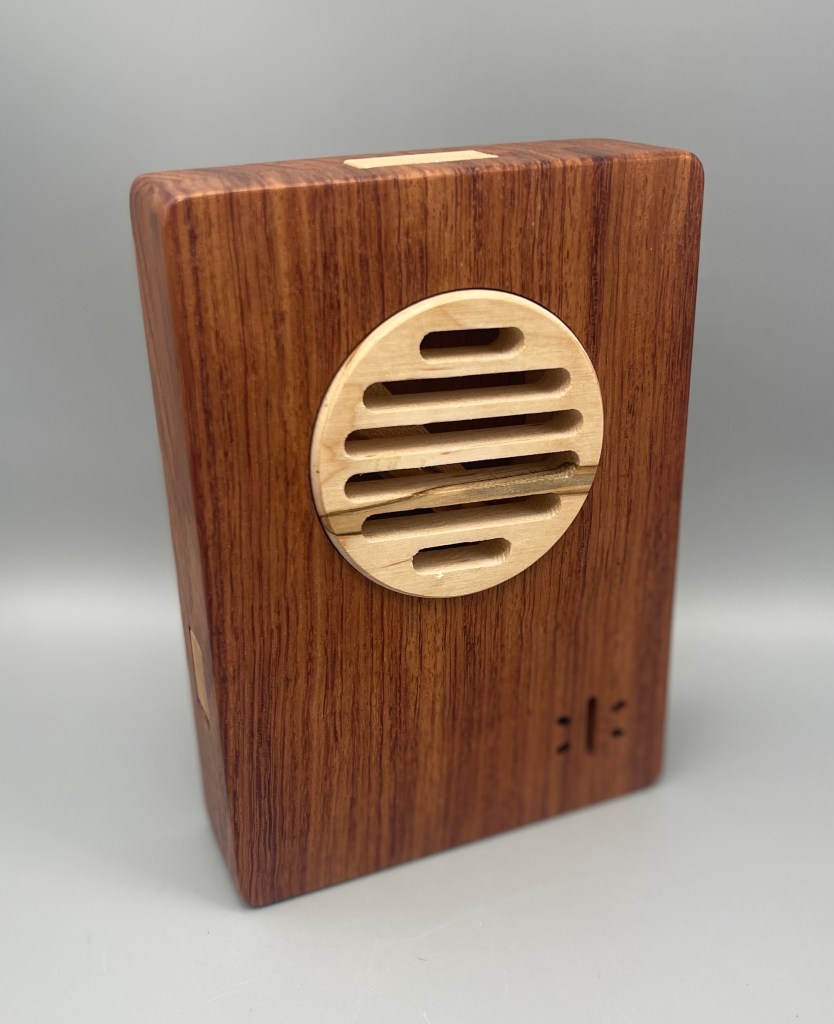
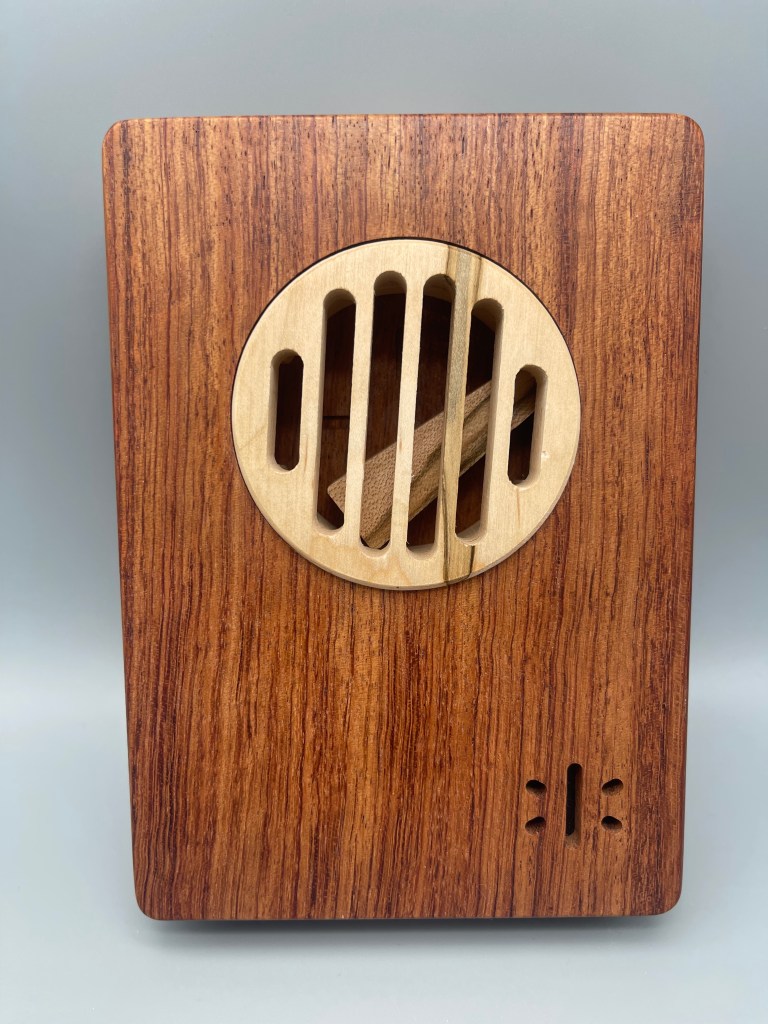
Ok, yes, I have written effusively about a lot of puzzles by Dee Dixon (cough cough all of them cough)… but it’s not my fault he keeps making great puzzles! And now, the Walter Wars rage on with his newest release: Walter’s Radio, a walkie talkie-ish sequential discovery take-apart puzzle that is as challenging and unique as it is fun: this is probably his longest puzzle in terms of discrete steps (20 – 25 by my count), and manages to taunt the puzzler despite not containing any truly blind mechanisms. Each aha! (and there are quite a few) can be clearly felt or seen, even if its purpose is not always so clear.

The puzzle consists of a rectangular block with a “speaker” at the top center that is able to spin freely, a loose block rattling around inside able to be seen through the speaker grates but not touched. At the bottom right is a symbol of some sort carved through the body, nothing special to be seen beneath. All five of the other sides show a single piece, flush with the puzzle’s body with no clear indication of what they are for or what they might do. None seem to do anything at first, with nothing more than an mm or two of wiggle room.

Some close examination and experimentation and I’m off. The central mechanism is itself quite unique and presents some entertaining trickiness to manipulate. It is possible to deduce much of the basics but it will lead you down some rabbit holes as you explore the various mechanisms that lay hidden throughout the puzzle.

I got stuck several times – this is not an easy puzzle, after all; those who may have thought Bad Moon was more pretty than hard will be pleased to find the reverse here: while by no means unattractive, with its quite lovely wooden sheen and beautiful grains, it may not be the prettiest puzzle Dee has produced (WMH and Bad Moon share that designation) but it is one of the best, in my more-or-less-humble opinion. And, yes, I know I get super excited each time Dee releases a new puzzle, but careful reads will find that this is not something I say lightly.

It is most definitely sequential discovery, with a touch of dexterity for good measure (not to worry – if I could do it with my shaky hands, anyone can). The solve is a puzzling journey that leaves you with quite a few bits and pieces by the time you obtain the Dimensional Electronic Divergence (DED) Chip that is your ultimate goal, and yet the reset is pretty straightforward and logical; as it took me a while to solve, I worried that my terrible memory would cause me great consternation when I was finally ready to reset it. But in the end, the pieces do for you what logic does not.

After resetting it, I immediately turned around to solve it again, already needing to work out a few sections that had become a bit fuzzy (I told you: my memory is terrible… didn’t I? Well, it is). There really is quite a bit going on – some sections may flow naturally but there were multiple walls that had me stuck for quite some time; on at least one occasion I managed to work out how to get past a particularly tricky few steps without the puzzle in my hands, which is always a neat thing (the same thing happened on WMH, my subconscious solving a section when I woke one fine morning).

Walter’s Radio is the newest example of Dee’s evolving design skills – he managed to come up with a unique central mechanism that allows the puzzler to navigate a number of interlocking locks and tricks in their search to remove the DED Chip that lay hidden somewhere within. It provides a darn good challenge with a great balance of difficulty and fun that I suspect puzzlers will thoroughly enjoy – I suspect I will not be the only one to say this is one of his top puzzles!

Rising to the Endless Occasion: Bad Moon & Apeiron Box by Dee Dixon

Bad Moon & Apeiron Box

Dee Dixon

You may have noticed by now that I am a fan of puzzle boxes by Dee Dixon… with six separate previous posts (plus an apocalyptic video), I have had the pleasure to write about the majority of the puzzles he has released (Space Case & WMH, Portal, Spirit, his first box as well as a Blinded III prototype, Angry Walter, and Menace, in case you were wondering and don’t mind a little self-promotist synergictivism).

And in the last few weeks I had the good fortune to try two new Dee Boxes: Bad Moon & Apeiron Box! Hells to the yeah!

Bad Moon

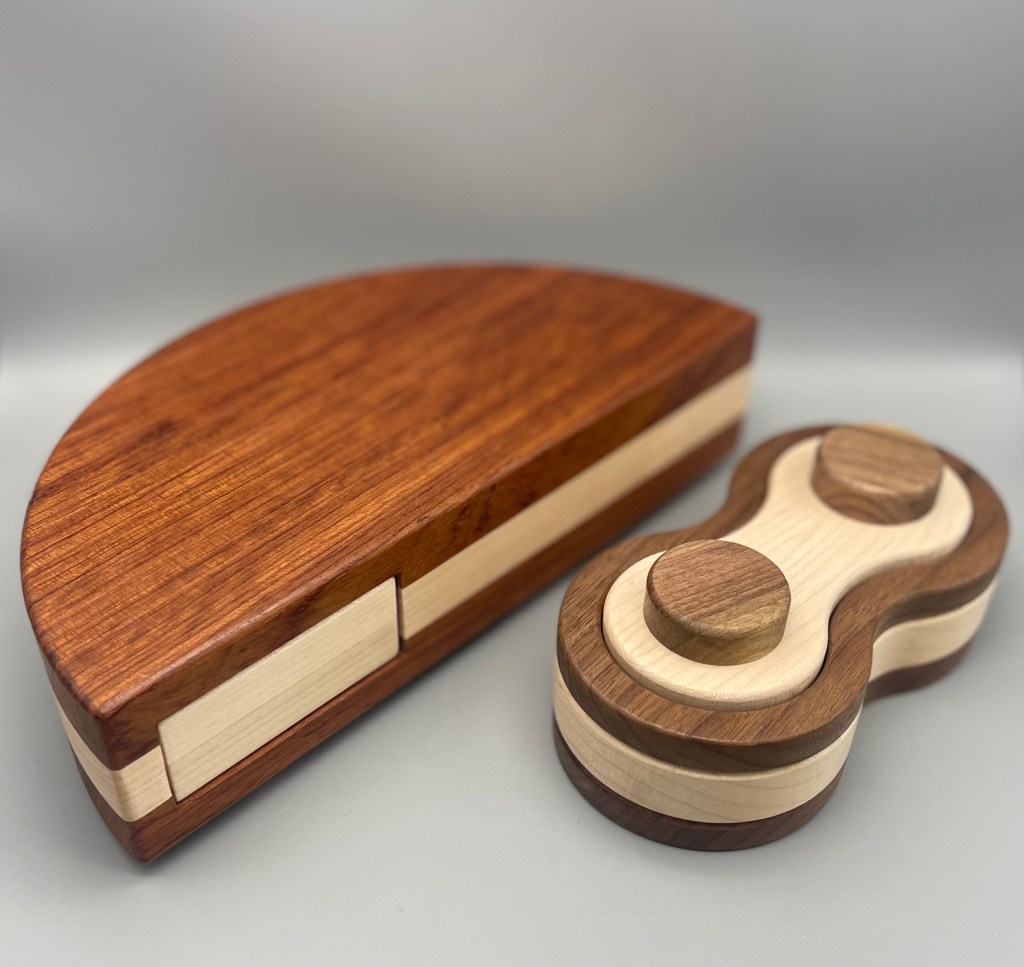
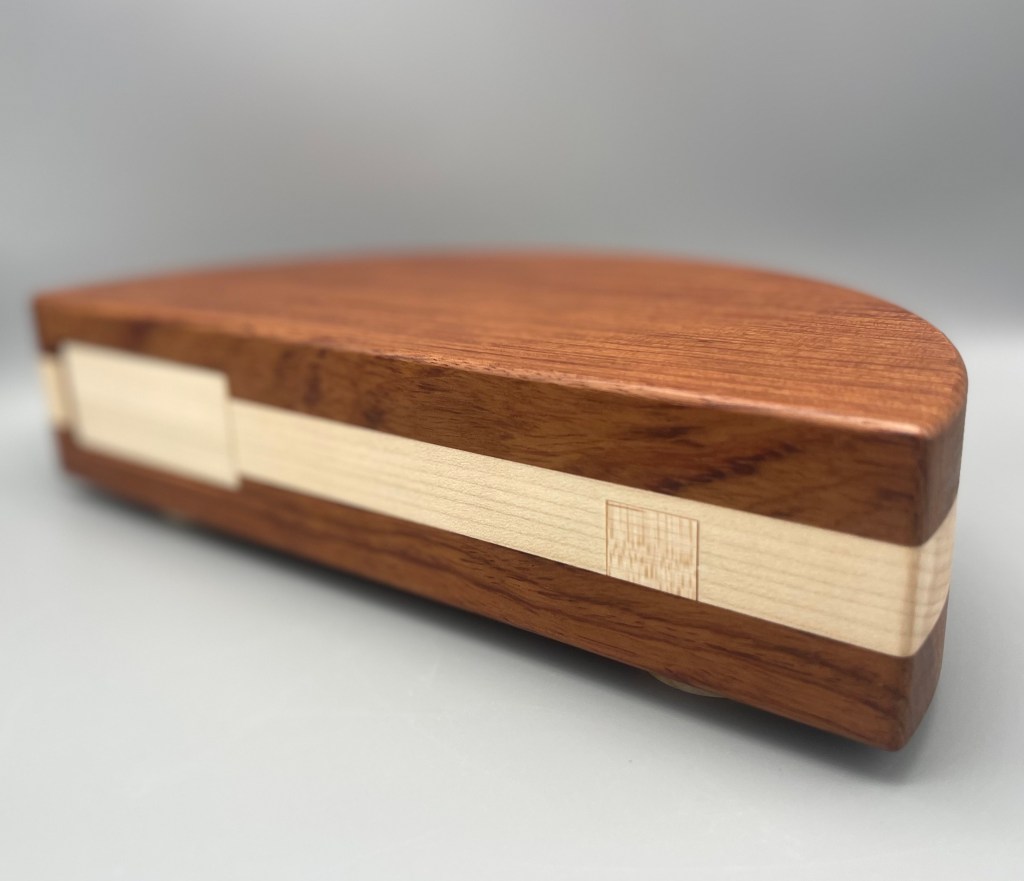
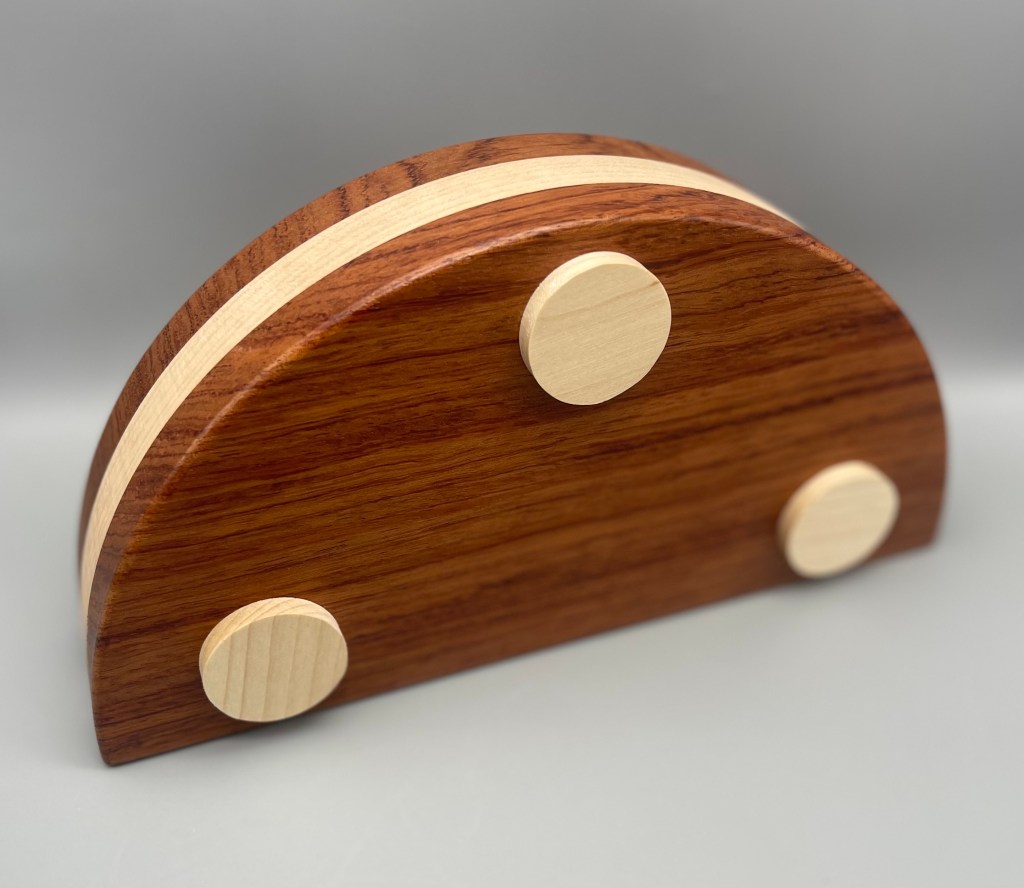
One of Dee’s two recent releases is a lovely and rather !large half-circle, sort of like a half eaten cookie with a creamy puzzle filling, the light tones of the center offsetting the darker top and bottom beautifully. This is perhaps Dee’s most beautiful box yet – it’s size (at a rather impressive 10″ x 2.5″) and distinctive shape allow it to stand out, and it is as soft and buttery as any a Dee box can be. So loathe to scratch this new addition to my Dee collection was I that I was amply pleased to find three circular feet on the bottom of the puzzle, perfect for protecting my pretty pretty precious. The only other obvious things at first are a rectangle and square on the front face, both grabbing my attention as likely targets for puzzling without giving any indication as to how to begin.

Dee doesn’t make it too difficult to get started, however, and before long I had made some progress. Bad Moon has some truly delightful mechanics and an oh so smooth series of movements overall that make opening it a delight. While it is not always clear how to proceed, you mostly know where to focus; and yet, I found myself stuck more than once as I navigated myself through the numerous, discrete steps to the end.

At one point, I found I had perhaps partly progressed through a section with at least a bit of luck – I backtracked to be sure I understood and was duly impressed by the mechanism at hand. Dee has focused this design on fun; while it is by no means easy, nor will you be banging your head against the wall in frustration as you find your way through (that said, I did notice that some well-seasoned puzzlers at a recent puzzle party struggled mightily with the puzzle, so it is most definitely not simple…). Dee tends to give you notice that you have reached the end and it is very clear when you have reached the end – even if there were no logo to find, the culmination of steps into the finale is well executed and kinda sums up the overall flow.

And the reset! This is one of those rare puzzles that contains puzzling steps that are unique to the reset (I’m looking at you, Dabbit Invasion). While resetting most boxes is simply a matter of reversing the order of the solution, I found myself needing to logic out one part of the reset after discovering something that is only put to use after having solved the puzzle (of course, no box is fully solved until it has been reset but the presence of unique puzzling makes me particularly appreciative of this puzzle). With a combination of experimentation and some of that thinking stuff, I managed to work my way through the reset, to where it flowed easily back to the starting point.

Dee’s Bad Moon is an excellent addition to an already excellent collection of boxes – I am not one to question a Dee box but, if I were, this would make it onto my list of “must-haves” (which, admittedly, I would have a hard time whittling down – not liking puzzle boxes is not my strong suit).

Apeiron Box

The second of Dee’s new puzzle boxes, Apeiron, presents a substantially different challenge – forgoing the sequential discovery chops of Bad Moon (and others), Dee turns back to some of the more blind mechanisms he has wonderfully created in the past – as someone who doesn’t generally prefer blind solves, I can say that Dee manages to walk the line between frustrating and fun extremely well – put another way, if I enjoy solving a demanding box like Space Case, whose mechanisms are hidden behind subtle cues and clues, then most any puzzler may as well.

Apeiron is not as hard as Space Case but is much trickier than Spirit – I spent a good hour or two just going in circles, which the design and name would seem to anticipate (Apeiron resembles an infinity sign (or perhaps a peanut) and its name means as much). This is how long it took for me to explore and understand all the subtle clues and feedback available, which is more than enough to develop working theories on the box’s mechanism(s). Its 6″ x 2.5″ size allows it to fit perfectly in two hands, the smooth curves begging to be explored and handled.

I took a break for a day or two and let my subconscious go to work (my brain surprises me sometimes – WMH had me stuck for weeks until I woke up one morning with a clear and correct understanding of what I was missing). Returning to the box, I found that I had developed sufficient context such that experimenting with the box now led to success: with a great aha! the box came open, allowing me to examine the inner mech as with most of Dee’s boxes (a trait which is just another reason why I love his work).

Having solved it, I opened and closed the box for a while, enjoying my newfound knowledge and hard-earned understanding and appreciating Dee’s ability to develop an idea into an entertaining reality. Dee’s skills as a puzzle designer continues to develop, his penchant for tricky but doable puzzles boxes leading to the creation of yet another box of devious trickery whose mastery had me smiling. Apeiron does not rely on random fiddling or dextrous fickleness – its solution is easily executed once understood but getting there may not be so simple (as some readers may know, my passion for puzzles sometimes outstrips my ability with them but I would not expect Apeiron to open for you without some degree of difficulty).

Bad Moon and Apeiron share an aesthetic to some extent, and look wonderful paired together amidst whatever other of Dee’s boxes you’ve had the good fortune or forethought to obtain. Both boxes should have additional releases in the near future, so keep an eye on Dee’s website for updates.


Another Brick in the Wall: aMAZEing Puzzle Box by QuizBrix (and other Lego Puzzle Creations)

aMAZEing Puzzle Box

QuizBrix

Having just solved the aMAZEing PuzzleBox from QuizBrix (reviewed below), I have been reflecting back on the first Lego puzzle boxes I saw a few years ago, the excellently complex and large designs such as Cake Box and Gift Box designed by Legolamaniac. At the time, I jumped on these new puzzling temptations, buying the designs on Rebrickable and tracking down all the various bits and pieces to build it myself (their designs are available to build here or pre-built copies can be purchased from the designer). Amazingly, the build process did not take away much from the solve, which remained a fun and unique sd challenge. I still plan on one day building their Zelda Sword box but haven’t found the time to take on the project (these are no small task!). I also built the similarly large Grandma’s Gramophone by Andrew Parr, currently available pre-built from the designer.

These large, complex designs allow for some fun experimentation – Legolamaniac’s designs get increasingly wild, with their newest treasure hunt design existing as a pretty major temptation for me (and likely inevitable buy). Their designs are solid and reliable; the Gramophone was a bit more fiddly but this is perhaps the result of me building it – even with Lego’s my thumb-filled hands likely led to a somewhat less-than-perfect build (but oh so fun to do nonetheless) Gramophone has one section in particular that had me laughing delightedly at the ingenious use of rather obscure Legos, akin to Gift Box in these rather daring mechanisms.

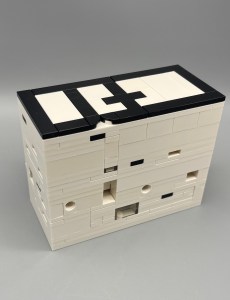
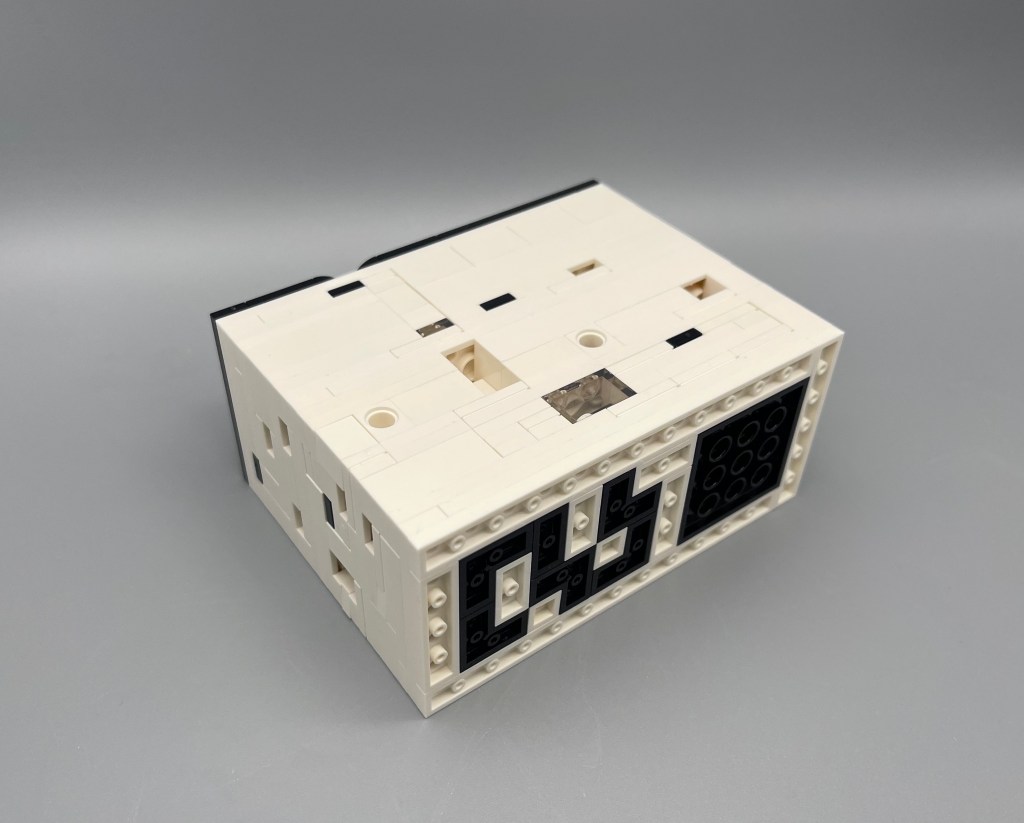
I was recently contacted by QuizBrix, a newer Lego puzzle designer who has released their first design, the aMAZEing PuzzleBox (available here); they offered to send a copy to me to solve, which I was of course happy to do (in case you haven’t noticed, I like puzzles). The box is a double handful of securely built Lego puzzling that offers quite a lot of puzzling in a reasonably sized footprint. I am impressed by their ability to fit as much puzzling into it as they did and found the solution to be both challenging and fun, with no problems or fiddly bits getting in the way of an sd solve hiding multiple aha! moments.

Starting out, there appears to be very little to do, despite the existence of numerous holes of various sizes and shapes. It took me a bit to find that first step and then off I went!…. until I couldn’t. I hit a number of walls that took me back and forth and around again, experimenting my way through its discrete steps and progressing in fits and starts. At some points, I found myself taking a leap of faith, marveling at some of the puzzling sections that worked perfectly despite my fear – one section in particular rewarded some seemingly risky trial and error with a series of seemingly semi-blind steps that would ultimately rely on a logical deconstruction of how things might work (in fact, there is even more guidance for this section that I had initially realized!). This was true for most of the puzzle – trial and error and experimentation are of course essential, but some sections really needed some thought and understanding to determine what I was trying to do and how it might work.

While some of the solve is somewhat similar to other Lego puzzles (there are some basic movements and design elements that will make up much of any Lego puzzle solve, in my experience), there were aha! moments that took me by surprise and showed ingenuity on the part of the designer. So much so that I “may” have needed a nudge from my NPSO, relying on the welcome solve video available via QR code (along with a reset video that was extremely helpful!). QuizBrix’s puzzle stands comfortably alongside these other great Lego puzzle designs – if you have not tried a Lego puzzle box, this is a great starting point – if you have some preconceptions causing you to hesitate, I can assure you that a good design such as this will not have you trying to do things you shouldn’t – it is clear what you can do and what you can’t and I did not find any trouble distinguishing one from the other.

Lego puzzles offer something tempting – while they can theoretically be built by anyone with hands, the designs are just on another level, using the finite (but broad) pieces available in seemingly limitless patterns. To manage to map out ways to get lego bits to interact in ways that avoid inadvertently disassembling rather than solving is just awe-inspiring, as devious and genius as any puzzle, simply using a different medium to express the designer’s vision.

Having enjoyed this first puzzle from QuizBrix, I look forward to seeing what other creations they will come up with – this release shows that they have a good sense of what puzzlers want and the ability to realize this in a fun and challenging way.

Three Little Puzzle Cubes Are We: MW Puzzles

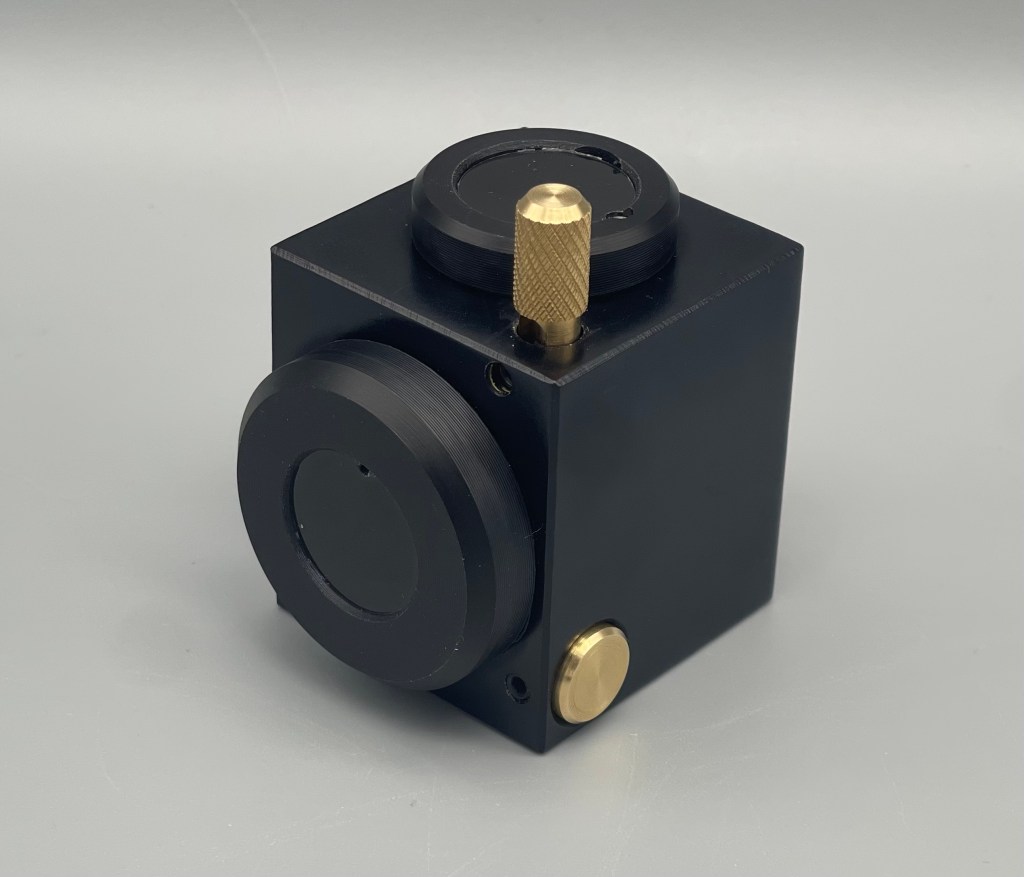
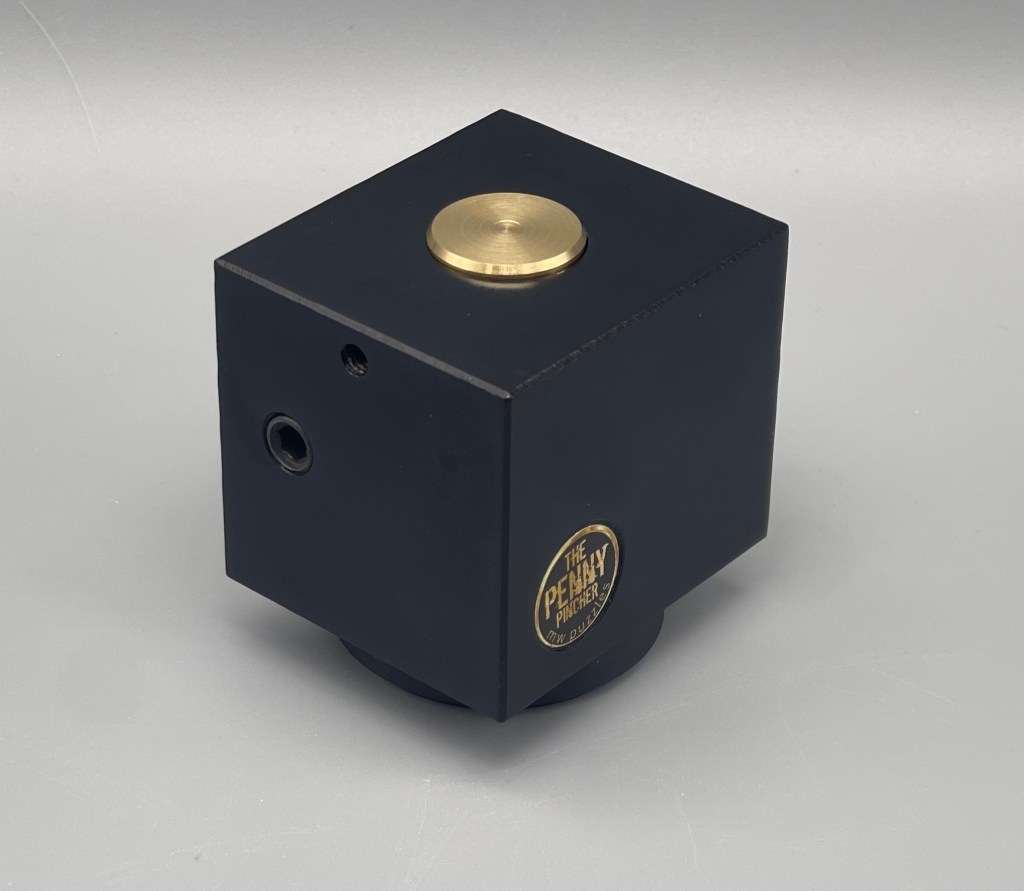
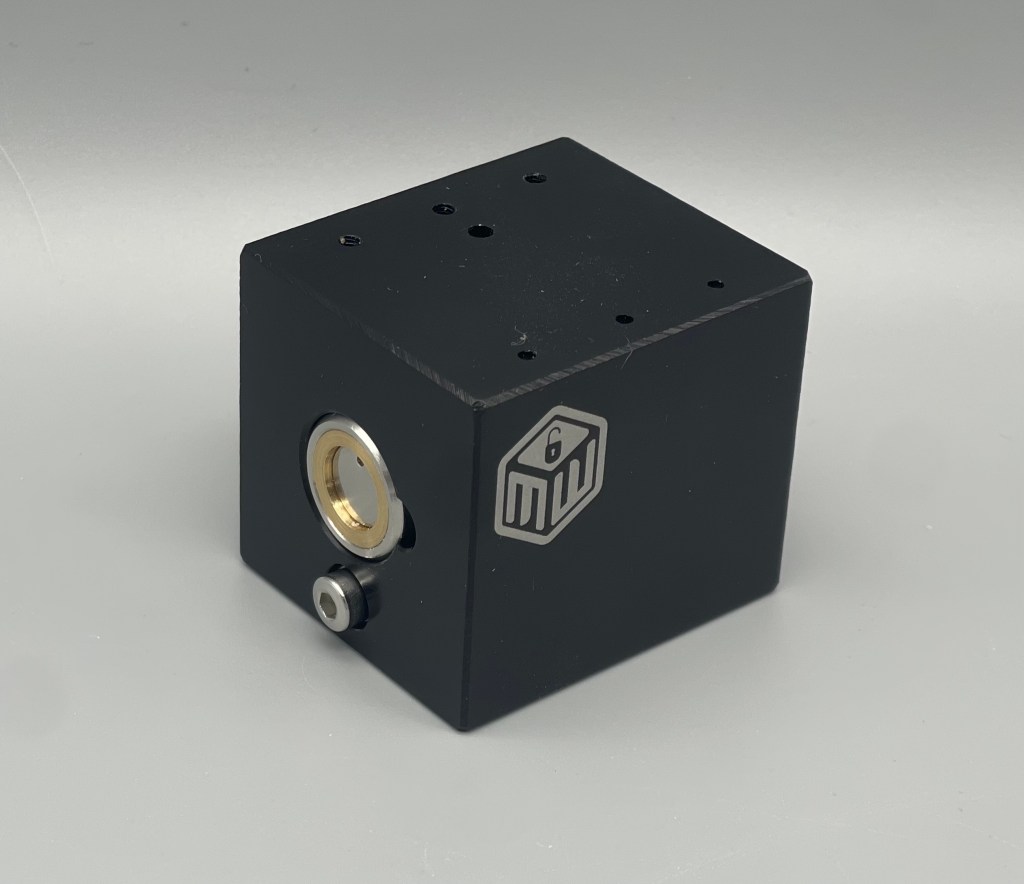
3 the Peg, Penny Pincher and Lib Orb Rate

MW Puzzles, Approx. 2″

Some months ago, MW puzzles appeared on the scene with 3 the Peg, a smallish black metal cube with enough holes and protrusions to tempt most puzzlers. I didn’t know anything about the maker but when has that stopped me from trying a new puzzle…

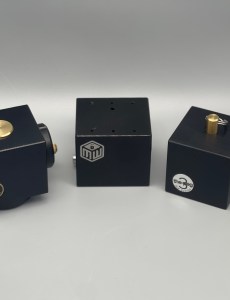
Peg and its two siblings make for a trilogy of puzzles that share an aesthetic, making for an extremely collectible group – I do love puzzles in a series that manage to have a consistent style at the same time as containing distinct mechanisms. The black metal cubes have slightly varied dimensions (more or less 2″) and the distinct protrusions and holes across their faces send a clear signal that these are wholly different from one another. The amount of puzzling contained within these relatively small footprints (particularly in the second and third in the series) reminds me of the trio of printed puzzles by Alan Lunsford (aka Layer by Layer on Etsy): Unsafe Deposit, Bolt Action & Mighty Pin, all of which offer absolutely excellent puzzling at a particularly good value. A good designer can fit a lot of puzzling into a small frame and MW’s use of metal makes for a very high quality example of this puzzling axiom.

3 the Peg

When 3 the Peg arrived, I was first taken with the overall quality of the build – there is some serious machining skills on display, with every piece placed perfectly in prime puzzle position such that pretty much any puzzler can appreciate the sleek appearance and solid feel of the puzzle.

3 the Peg is the first and the simplest of the three puzzles released by MW – this is not to subtract from the elegance of the solve which relies on a well-hidden trick that could certainly keep a puzzler stuck. I managed to solve it fairly quickly but this could at least partly be due to luck (one of my early guesses proved correct), although I would venture to guess that more experienced solvers may have a similar experience. Having found the main trick, it was not terribly difficult for me to work out the remainder of the solve. I think this is a particularly great puzzle to hand to non-puzzlers as it it not too long a solve and can show how one’s basic assumptions about the workings of a puzzle must be discarded; further, the extremely well made parts will show any non-puzzler the level of craftsmanship we tend to expect from our makers.

Penny Pincher

I missed out on buying this one on release and gratefully solved a loaner copy from a fellow Discord puzzler- and I am glad I did! This one really steps things up in terms of complexity and difficulty, with a pretty long and involved series of steps and discrete mechanisms to get through before the titular penny is released. Luck will not get you very far and even experimentation is somewhat limited as I needed to have a good sense of what I was trying to do to avoid going in circles. PP is a bit crazier looking, with plastic rings on two of its faces, almost resembling camera lenses. These bits help to create the impression that there is a lot to work with, helping to lead me down some rabbit holes at more than one point in the puzzle; one early section in particular had me smiling once I fully grokked how it works. Construction of the puzzle is still quite good, although I did have an issue with a couple bits falling off (easily fixed) but the instructions tell us that these don’t do anything, which was good to know.

Several legit aha! moments await you as you get through the sd solve, more than one of which is likely to earn a guffaw or two. While Penny may not be the prettiest of the three puzzles, it may be my favorite: the mechanisms are smart and tricky, making for a fun and satisfying challenge that rivals the next puzzle in this MW trilogy.

Lib Orb Rate

Lib Orb Rate is the newest of the three puzzles they have released and it really is a darn fine puzzle. They once again pack a lot of puzzling into a small footprint, for a multi-phase sd solve that poses a solid challenge and works smoothly. I hit a wall early on and got nudged in the right direction – I was sure that there was some blind muckery about and my own assumptions and faulty deductions were tempting frustration … until I realized everything I needed was there for me to work with. They don’t hold up a sign to focus on what that might be but the information is mostly available after some close observation and trial & error to see what’s what making it sometimes semi-blind (but totally fair).

Passing through this first phase, I moved on through the puzzle in a pretty clear, but not at all simple, progression: I never felt lost even when stuck and I eventually worked my way through the rest all by myself (golly gee). Stupidly, I forgot that the name of the puzzle tells you what you’re trying to do and briefly believed I may have solved it – it would have been an ok puzzle if it stopped at that point and I was pleased to find that it continues on to a cool mechanism that is executed quite well, with some small details that must be precisely followed, particularly on the reset. While this final section was perhaps not necessarily 100% new to me, the other puzzle that shares a somewhat similar section is rare enough that many if not most puzzlers playing today may well have missed out. Regardless, it is executed differently (and perhaps more reliably, if I’m being totally honest) and is as worthy an aha! as in that other solve, particularly as it adds additional subtle trickery. All in all, Lib is another great puzzle from MW with a solid challenge and satisfying solve.


These three quality builds from MW Puzzles has me eagerly anticipating whatever follow up they might have in store – they are a welcome designer to the puzzling world and well worth watching for whatever they will come up with next. According to the designer, it may be a while before these three are re-released, if at all but, perhaps more importantly, there will be a smaller “key ring puzzle” in time for the holidays and a major release coming in the New Year – I am looking forward to it!


Falling to Me: Angel Box by Wil Strijbos

Angel Box

Designed by Will Strijbos
PETG/PLA Version Produced by Gerard of Bayou Puzzles

One of the many (many) wonderful things about the Mechanical Puzzle Discord (MPD) Group is its puzzle library: members are able to borrow some truly amazing puzzles for just the cost of postage (subject to some MPD terms). Puzzlers have generously donated some excellent puzzles to the library, including a printed version of many a puzzler’s unicorn: Angel Box by Wil Strijbos. (Do not confuse this with my recent post on the Red Herring Box, which is not a part of the MPD library despite similarly traveling the puzzling world).

Gerard of Bayou Puzzles, designer and producer of the wonderful sd puzzle, Turtle Trip, was granted permission by Wil to produce two copies of a fully accurate 3D printed PETG / PLA version of Angel Box – I say two copies as one is for the North American MPD library and one for the ROW library (it is worth noting that he also got permission from Juno to produce and sell copies of a printed Slammed Car).

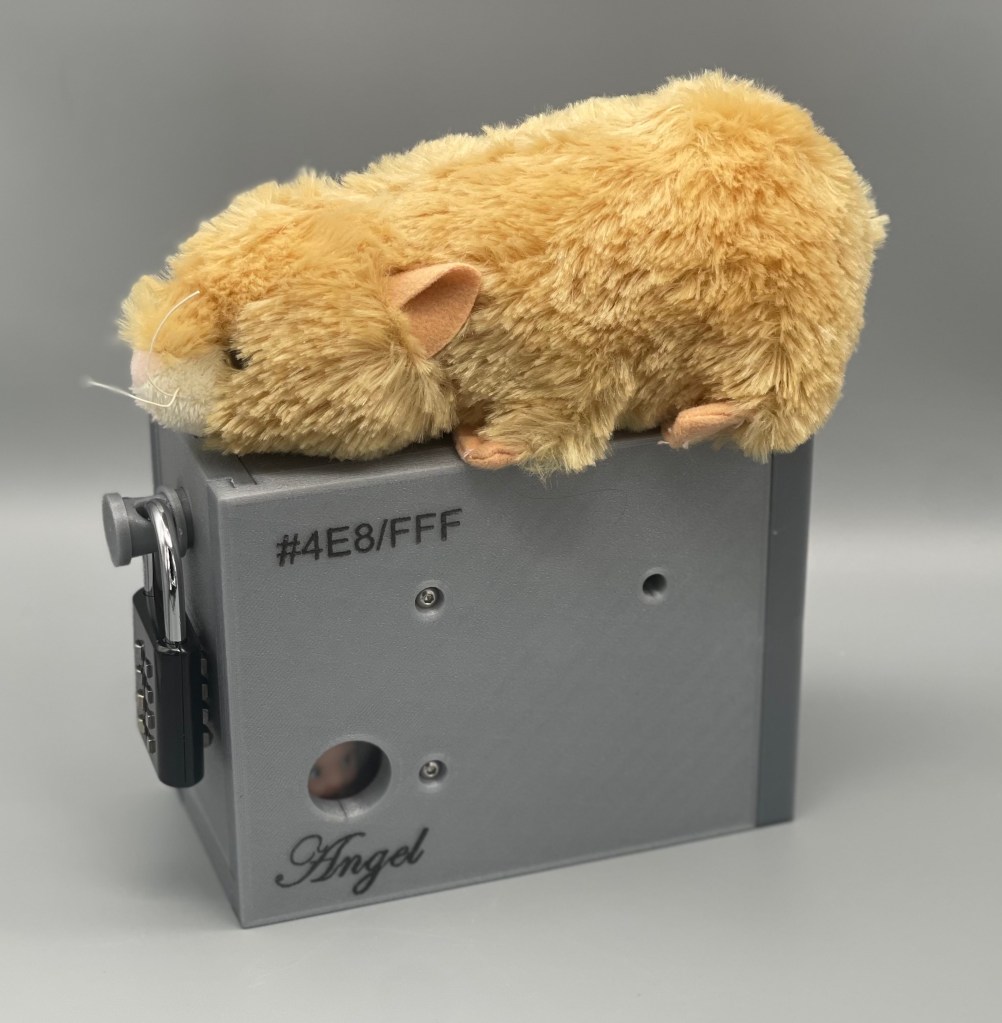
Angel is so true to the original design that it even features the eponymous cherub whose imprisoned state can be viewed through an acrylic window at the front of the box, as in the original. There have been some delays since its release into the puzzling wild due to some needed repairs but, after patiently waiting for a couple years, I finally got my turn.

Angel Baby Atop Puzzle Hamster: A Perfectly Puzzled Picture

All of Wil’s puzzles are quality designs, his sd puzzles perhaps most of all: Lotus and First Box have been known to be responsible for many a nascent puzzler’s initial descent into puzzledom and the 2020 re-release of Pachinko and Revenge Lock released waves of relief amongst the many of us who had been hoping for a chance to obtain copies. Alongside Butterfly, Pachinko, and Revenge Lock, the original Angel Box is a sizable hunk of metal, somewhat imposing in size. The PETG/PLA version is presumably a bit more wieldy but no less of a puzzle for it.

I found that it offers some excellent puzzling without being so difficult as to leave me stuck for weeks on end (as happened with Pachinko and Revenge, for example), favoring elegance over anguish. After solving Butterfly at the former Puzzle Palace a few months back, this is, I think, the last of Wil’s sd/boxes for me to solve (and, weirdly enough, the first for me to write about!). And while it may not have had me laughing at my own brilliance it was nonetheless a darn fun solve at that!

As this was a loaner from the library, I intended on solving it as quickly as possible so that it might get back on the road (ironically the next person in line is the same puzzler who recently sent me Red Herring! It really is a small puzzling world…). I was able to solve it in two focused sittings with a great balance of challenge and fun as I worked my way through the substantial aha! moments sprinkled throughout the solve. There is a great rhythm and flow that gives class to this classic puzzle. A few steps did smack me up against a nice, solid wall, but overcome them I did, albeit with perhaps the grace of a tiny, fat baby with vestigial wings. I will admit that I may have cheated a bit on the starting lock, picking it rather than taking the time to tease out the riddle (I figure I can retroactively solve this without creating delays for the remaining puzzlers on the library list); otherwise, I stayed true to the design, conquering it relatively quickly so that it might get back on the road.

The solution follows a clear logic, with discrete steps that make sense once discovered; I worried at first that the accumulated bits and pieces might pose a problem for the reset, but the mechanisms, once understood, make it easy to know how and where such pieces must reside. Before dropping it off at USPS for a short trip east, I ran through the solution a second time just to appreciate the flow of steps; there is a reason that this is design is considered a classic and I am grateful to have the chance to experience it!

And so, Angel heads back out on the road today, back once more to unicorn status for this grateful puzzler.