Puzzling With Myself: Jukebox by MoonTree Puzzles

Jukebox

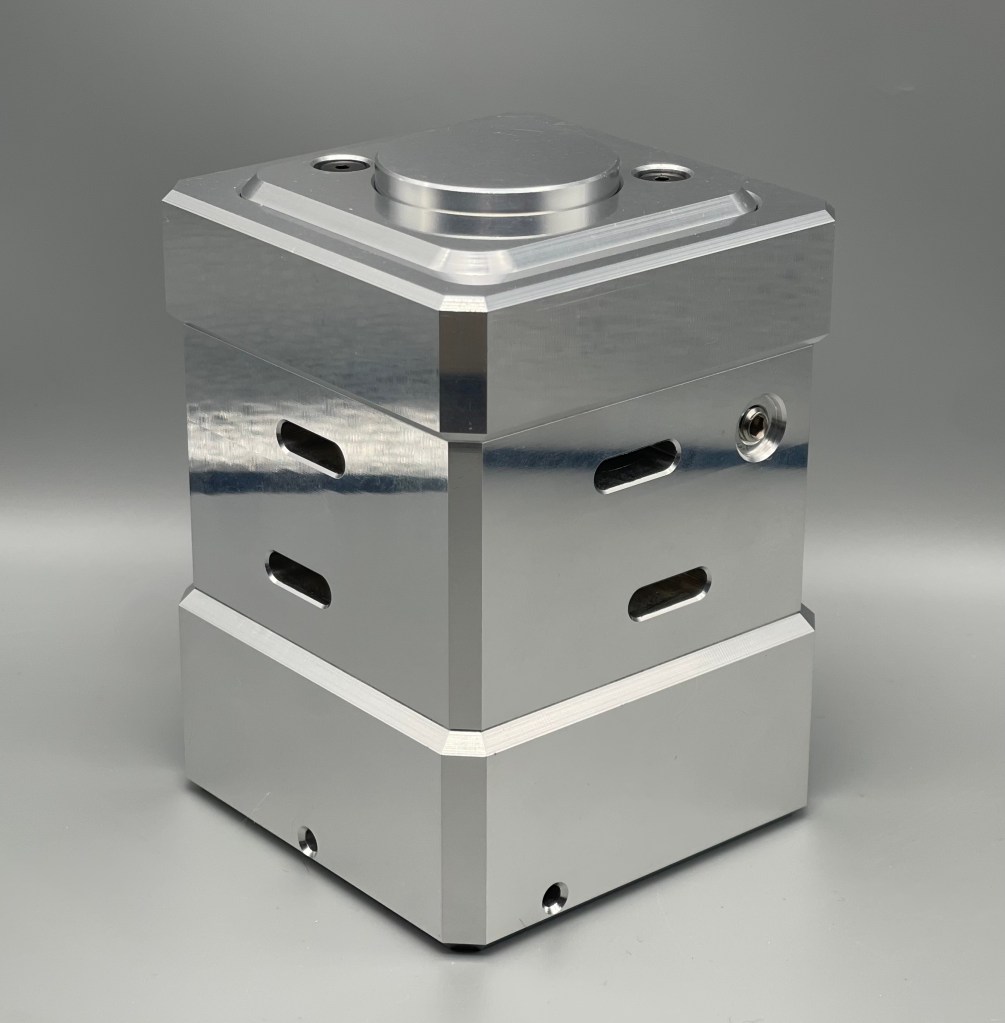
Daniel Czuriga and Tibor Folytan (MoonTree Puzzles), 4.75″ x 8.5″ x 4.1″, 6.5 lbs

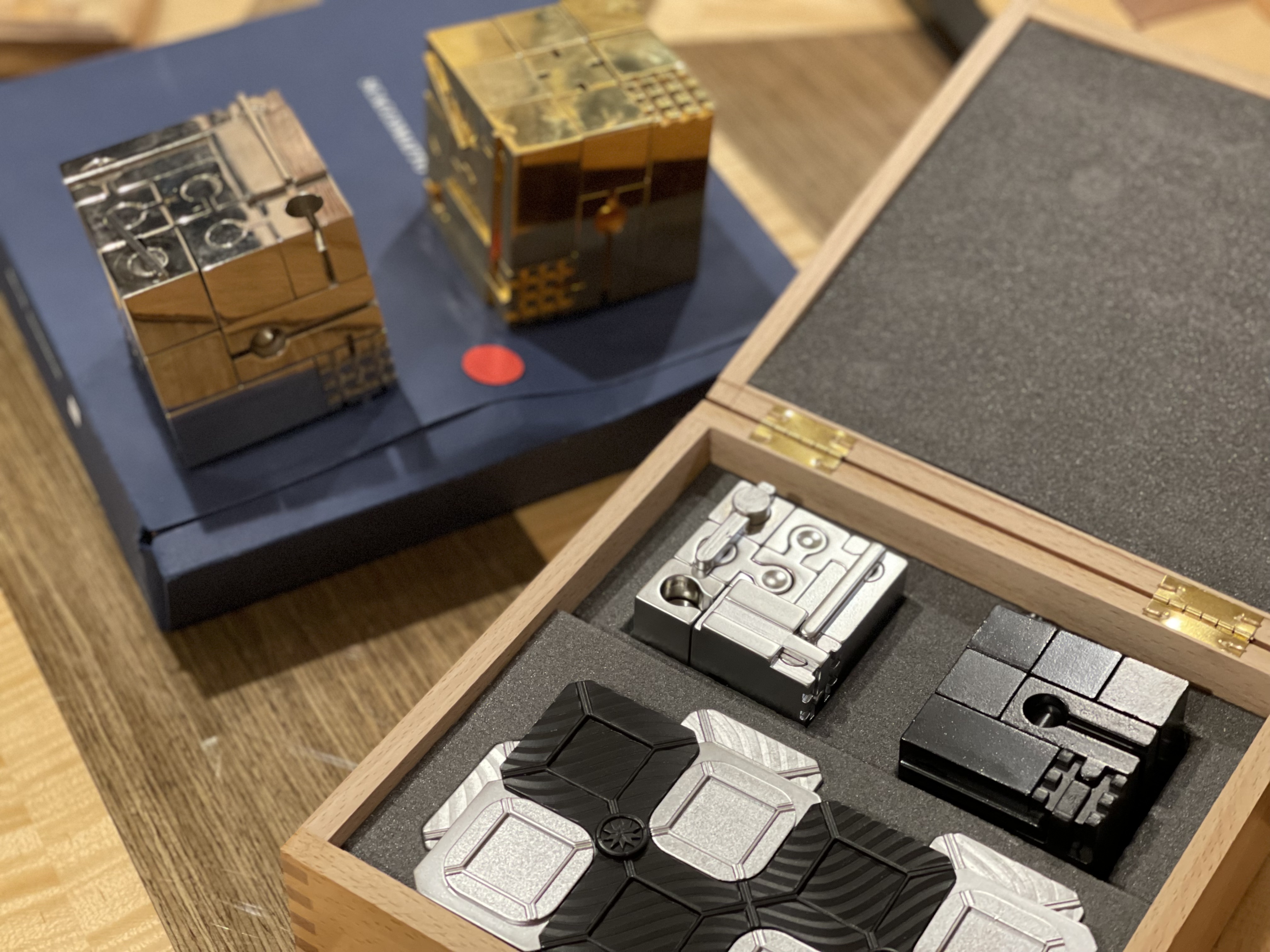
In the puzzling world, a few years can go by quite quickly – I think it was back in 2020 that Daniel Czuriga first shared with me his idea for a new sequential discovery puzzle that would take the form of a jukebox. Daniel never stopped – periodically checking in with an update or a proto pic to share (I recall a prototype pic in laser cut wood that especially piqued my interest). Such interest was further undeterred as I know his taste in puzzles is quite similar to mine and so I suspected that whatever puzzle project was in the works would be something I wouldn’t want to miss out on. Still, a first puzzle from anyone could go either way, and I knew how ambitious this particular puzzle promised to be. When Daniel told me he had his two IPP copies ready to go, I was oh so grateful to have the chance to solve a copy before it went off for official IPP judgment. As he was submitting for judgment, he asked that I not post until after the party (go over to Boxes & Booze to check out his post as well). I should mention that it deservedly won Jury Grand Prize and as you will see below, I believe this was well deserved.

Going back to a few weeks ago: so it was that a large box arrived, containing an expertly packaged metal jukebox, with an absolutely lovely brown to offset its aluminum sheen. Frankly, it is gorgeous, resembling a classic jukebox, miniaturized to about 4.75″ x 8.5″ x 4.1″ from its place of honor in Ye Olde Soda Shoppe but still significantly substantial at close to 6.5 lbs. It stands on four small legs, with some holes and what-not adorning its sides. After admiring it for some time, turning it this way and that as I poked and prodded, I found something that did something, affording me a couple early steps before hitting my first of several walls. After playing around some more, I developed an idea of what needed to happen and set about accomplishing the task.

Eventually, after a fair amount of stops and starts (and stops and starts), I was able to get somewhere new; I was already working with some tools and the next step was fairly apparent, leading me to the first of several compartments. After examining the fruits of my success I stayed stuck for some time until an aha! hit – I jumped this wall, finding that a quite cleverly crafted clue contained yet more surprises. Yet again, success afforded me some fruits to enjoy, as another wall faced me. I was sure there must be something I was missing (there was) and it took a good amount of experimentation before I found the well-hidden secret needed to progress. This would continue through step after step and compartment after compartment until I found the “satisfying ending” to which the description refers, which does little to express the originality and joy of the puzzle’s finale. I not only laughed but ran to get my lovely and typically puzzle-indifferent NPSO to show her what I had accomplished: the finale is cool enough to elicit a smile from even the most jaded of non-puzzling partners.
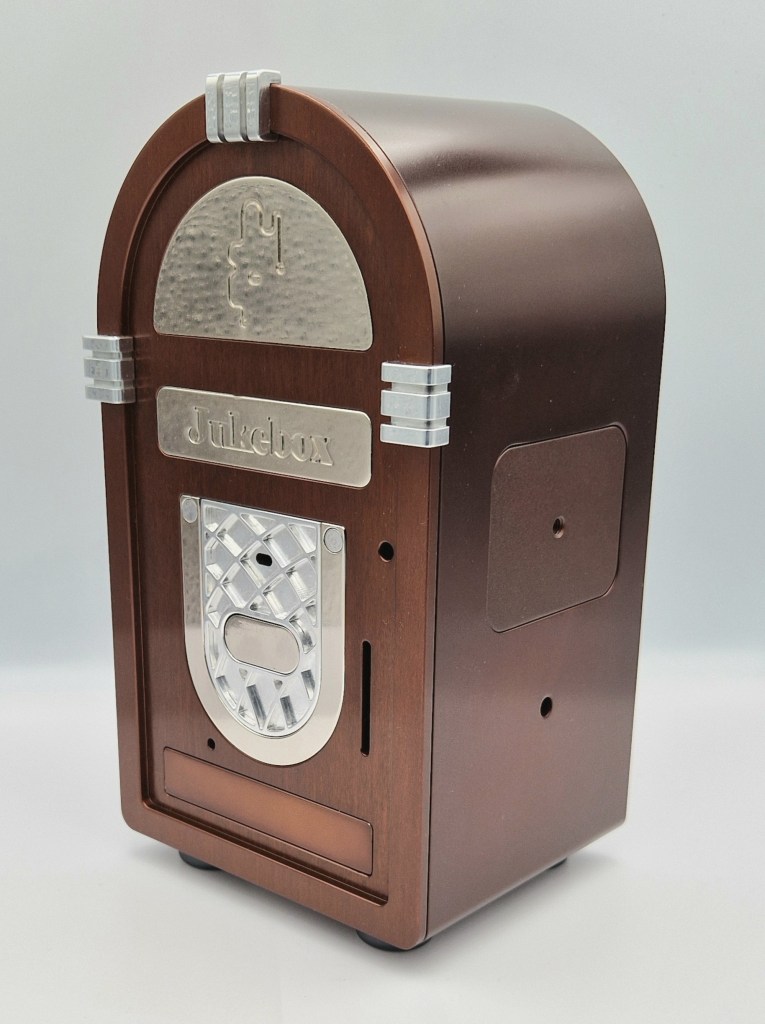
Jukebox is most definitely sequential discovery, with tools and tricks that lead you on a journey that steers close to its theme; the jukebox is not just a concept but is integral to the puzzling itself. Puzzles that look like something do not always do this – sometimes the aesthetic is purely aesthetic but not here: Jukebox relies on multiple points of thematic reference that keep you close to its concept throughout the solve.

After solving, I set about the reset, which I found to be extremely intuitive. I would solve and reset the puzzle a few times before shipping it off to be judged by the lucky band of IPP-ers chosen for the task. I will be pretty surprised if it doesn’t elicit the same level of joy I was fortunate enough to experience (which it ultimately did).

Daniel and his partner, Tibor Folytan (together: MoonTree Puzzles) have made something that is fun and unique, with a complexity that challenges but never annoys. Any time a puzzle’s description contains the word “dexterity” I tend to get a bit suspicious – this is not at all my strong suit and I worry that such steps might frustrate me. But this never happened with Jukebox; that particular section had sufficient clues and feedback that I was able to enjoy progressing through it, never feeling compelled to smack my head (or the puzzle) against a wall.

I am excited for this puzzle to be released into the wild – Daniel has put so much into making this and we puzzlers are the fortunate beneficiaries of such care. He has worked hard to try and keep the cost down so that more puzzlers have the chance to enjoy it. Because that is really what sits at the base of this project: the desire to make something cool for us to enjoy. With the amount of hours put into designing and prototyping and tweaking over a period of several years, this is assuredly not the best way to make a buck; rather, this is a project that shows puzzlers’ love for the medium. I sincerely hope that these two designers find the time to bring us a follow-up (first they need to actually begin producing these for sale – I know I will be ready to pick up a copy despite having already solved it because this one is a keeper). Be sure to keep an eye on the #upcoming-Puzzles channel on Discord and/or on their website: http://moontreepuzzles.com.
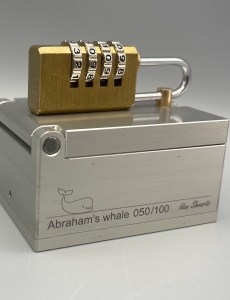

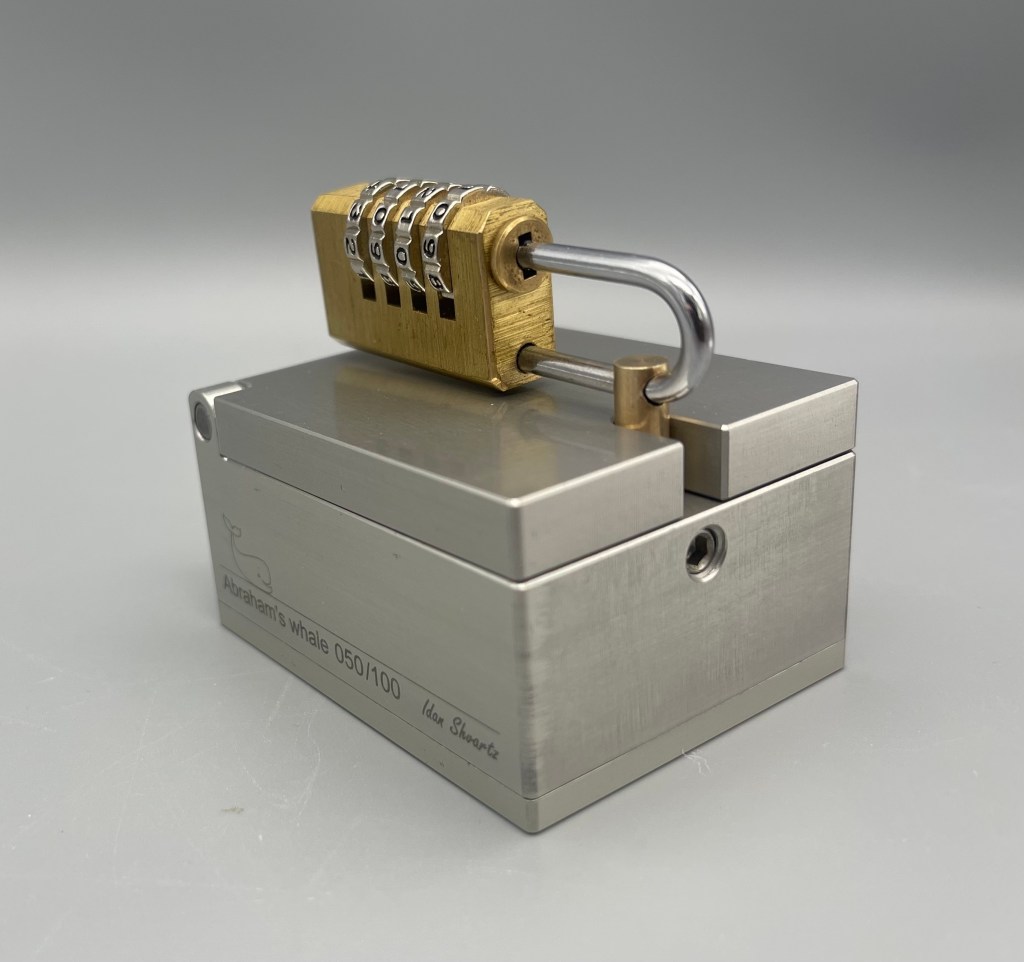
Thar She Blows! Abraham’s Whale by Idan Shvartz

Abraham’s Whale

Idan Shvartz,

The initial release of Abraham’s Whale into the wild somehow slipped by my puzzle radar – I saw this intriguing locked metal box popping up on Discord and lamented the reality that life stuff had distracted me from what really matters: puzzles. Fast forward several months and I manage to get my hands on one… I was not disappointed.
At 2.5″ x 2″ x 1.5″, the puzzle is not overly large, fitting perfectly in your hands. There are various holes on the bottom and sides but, apart from some noise, I did not initially find anything that seemed to do anything off the bat. I, like many did with this puzzle, needed some guidance getting started – the first step really does not do the puzzle justice, starting off with its weakest element. However, this quickly gave way to the satisfaction of a darn good sequential discovery puzzle as I dove in; the puzzle does a great job at directing you through its various stages, the appearance of tools or other developments helping to guide you along.

This is most definitely SD, with a rather lengthy journey in which your discoveries must be put together in novel and exciting ways. There is some serious science sitting at the base of several steps; if you did not know how some things work, you will by the end (this is rather vague of course but once you’ve solved the puzzle you will know what I mean).

The puzzle brings in a number of strategies; typically what may seem burdensome has a more graceful way of being accomplished, if you stop and do some of that thinking thing for a moment. A bit of dexterity may come into play, but overall the puzzle does a great job of getting you to figure out what you have and how it can be used to do what needs to be done.

I needed some help at a couple points (not that surprising if you’ve ever read this blog), one section posing a particularly significant amount of trouble – as is oftentimes the case, it turned out I was basically correct in what I was doing and just needed a bit of encouragement and clarification to pass through to the next section.

There are several strong aha!’s along the way, with some great moments of satisfied success as I figured out what was happening and what I needed to do. This was a puzzle that definitely required my awesome-sauce puzzling headset (combo headlamp and magnifying glasses, bruh) to seek out and discover new developments as I worked my way through.

Eventually, I did it! The whale was free! Huzzah! After an appropriate time basking in my brilliance, I set forth resetting it. The reset is mostly straightforward, moving backwards through the puzzle. Somewhat unsurprisingly, I still managed to screw this up a couple times, proceeding out of order and needing to backtrack. The good thing is that this really forced me to appreciate how the various mechanisms work and how different elements work together to create a fun, puzzling experience. One part of the reset was especially tricky and I am not ashamed to admit that I used an external tool to help myself out (is it cheating if it is just on the reset? whatevs.)

Amazingly, this is Idan’s first foray into puzzling; he is working on his follow-up and I for one can’t wait to see what he comes up with!

Hitting the Jackpot: Bandit by MW Puzzles

Bandit

MW Puzzles; 350 copies
2.5 lbs; 7.5″ x 3.75″ x 4.25″
Metal, Walnut, Acrylic

When I was a kid, I had a miniature slot machine with tiny tokens that would make the wheels spin; hitting a jackpot would release whatever tiny tokens had been inserted thus far. While entertaining to my nascent mind, there wasn’t all that much to it – pull the arm, spin the wheels, lose and repeat until you win.

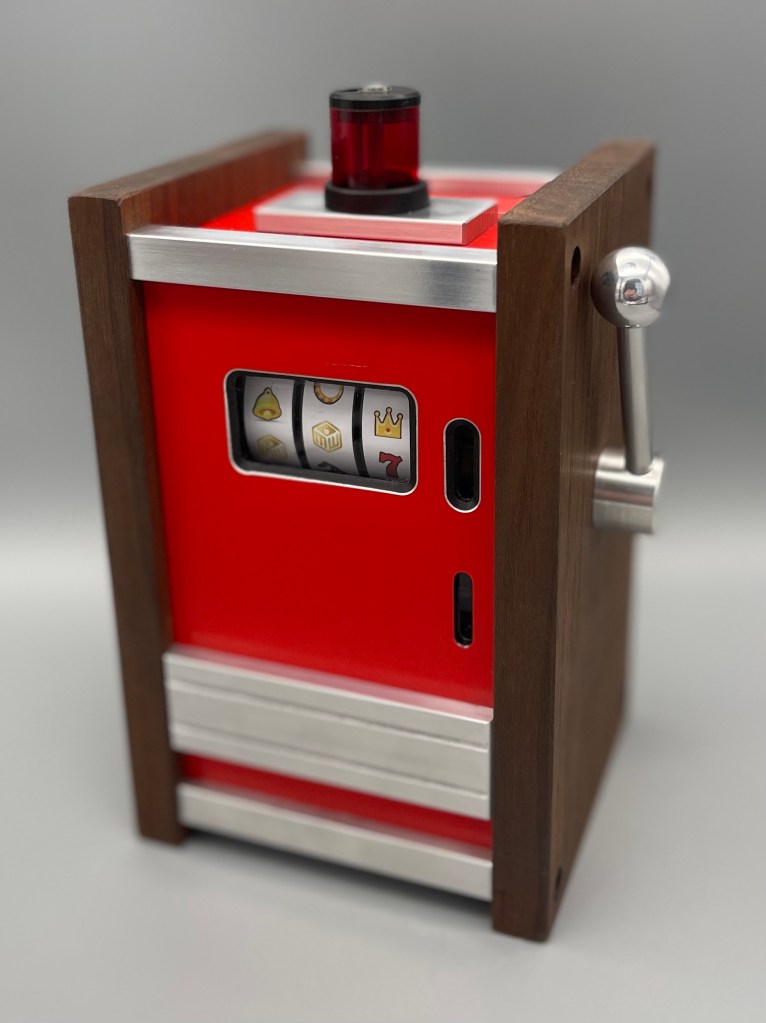
MW Puzzles has taken the classic one-armed bandit and made something fun, tricky and unique, something instantly recognizable, such that the ultimate goal is clear from the start even as the path to it is not.

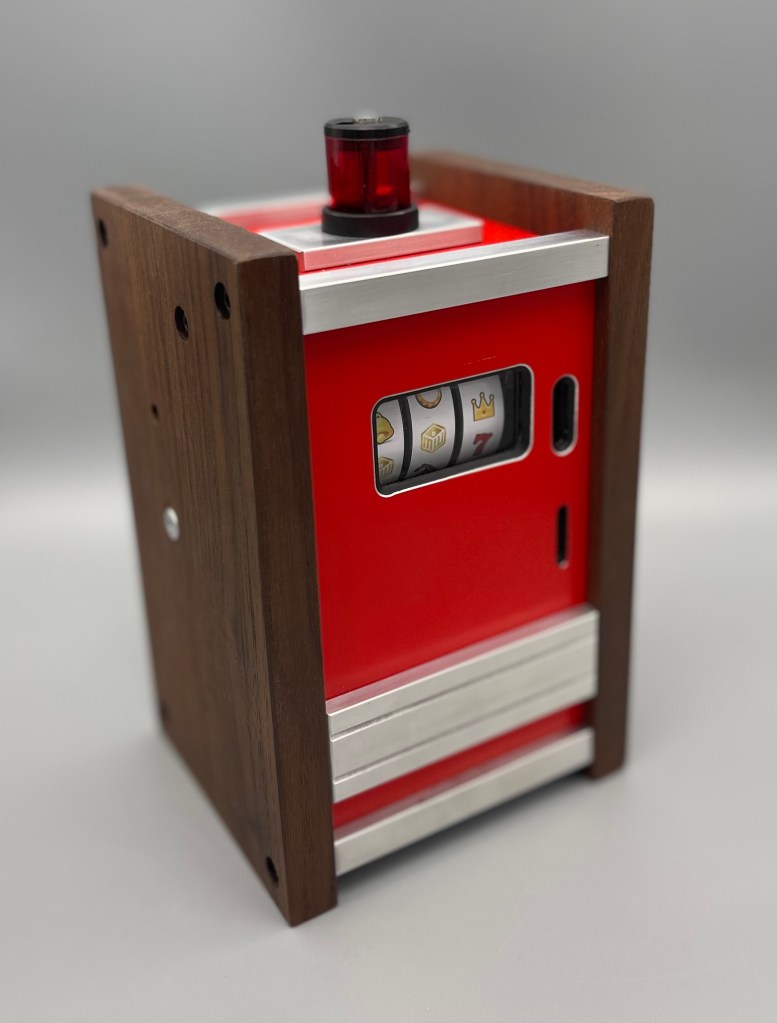
This makes for something that demands to be picked up, sure to catch the eye of puzzlers and non-puzzlers alike. It begs to be handled; at 7.5″ x 3.75″ x 4.25″ and 2.5 lbs (that’s just over 1 kilo for you metric weirdos), it fits perfectly in two hands, a necessity for all the exploration it will require.

When you first sit down with MW Puzzles’ Bandit, you will almost certainly do what comes most naturally: pull the Bandit’s one-arm… and you will find it does nothing but rotate freely: the wheels don’t spin and a jackpot is most definitely not in the cards. This is sure to reel you in and pique the puzzling mind in the way that a good puzzle does, spinning you around while sucking you in so you just want to try one more thing, just like the real thing catches you with just one more quarter; the difference is that you can actually win with Bandit, should you put in the thought and effort – the payoff is in the cards, to mix casino metaphors.

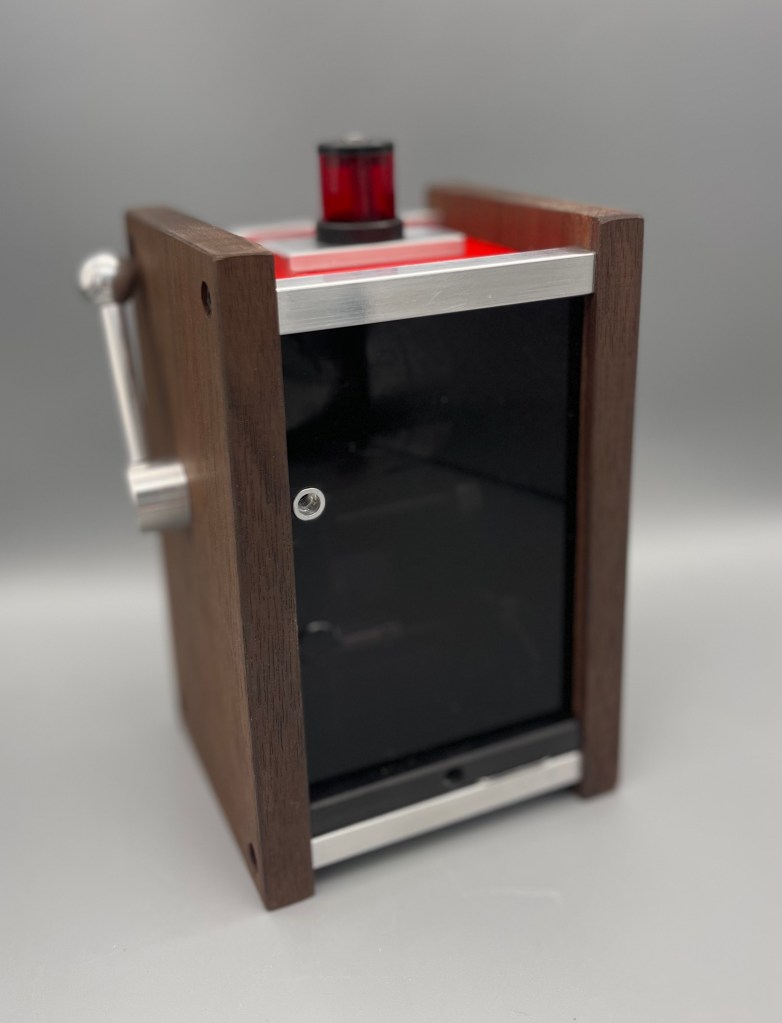
So begins a sequential discovery journey that rewards experimentation and patience, teasing you with a partial view of its inner workings through a semi-opaque acrylic back, framed by lovely walnut sides and a glistening metal frame that comes in one of four colors.

I had the welcome opportunity to test a late prototype and to compare it to the final version, getting a glimpse into the careful planning and patient meticulousness of the puzzle’s creator. This is not a hastily thrown together puzzle but is instead the result of ample thought and cast-aside proto’s – there were a few changes following even this late prototype that proved to me that MW is a puzzle maker who takes this art seriously; in seeking to entertain, it will be done with pride in a well-made product.

I shouldn’t be surprised after solving MW’s previous trilogy of metal puzzles, all reflecting their excellent craftsmanship and puzzling prowess; Bandit is a larger evolution of MW’s puzzle oeuvre that secures its place as a puzzlemaker to be followed.

Crafting a puzzle that actually looks like something is not all that easy – other than Karakuri, most makers shy away from the innate restrictions imposed by holding oneself to an existing aesthetic but MW leans into it, using the well-known game of chance to inform and obfuscate its puzzling mechanisms, with multiple tools (some quite well hidden) and a progressive puzzling journey whose finale provides the payoff one hopes for. MW has made something that is as aesthetically pleasing as it is recognizable, with puzzling that does not disappoint.

The goal is not so much to “fix” a “broken” slot machine but to discover how this strange cousin functions instead, achieving a jackpot through skill rather than stumbling upon it by luck: this is no game of chance but rather one that requires thought to understand and conquer.

MW began taking pre-orders for the initial run of Bandit a couple weeks ago; pre-orders appear to currently be closed at this time but I would reach out via discord or the website if interested, as interest seems to (unsurprisingly) be high. Bandit will be limited to 350 copies, 75 of each color with an initial run of 300 and plans for a final 50 down the line.


Get Lost: FastMaze by Dan Fast

FastMaze 1

Designed by Dan Fast
Produced by CubicDissection
Aluminum & Brass, 3″ x 1″

I got the chance to try an early copy of one of FastMaze 1 (designed by Dan Fast and produced by CubicDissection), and “fast” is not one of the words I would use to describe it: smooth, yes; fun, certainly; challenging, absolutely; but fast? Nope. Not for me anyway.

Dan has designed many a high level burr, including the relatively recent Stir the Coffee produced by Pelikan; PWBP shows more than 100 puzzles designed by him, a level of prolificacy shared by few others, including the rather iconic Superman and Batman burrs (also produced by Pelikan). FastMaze 1 is one of a series of three new puzzles being produced by the excellent craftspeople at CubicDissection, whose recent equipment expansion allows them to create more affordable challenges that still meet Eric’s extremely high quality demands (perhaps the hallmark of CD creations).

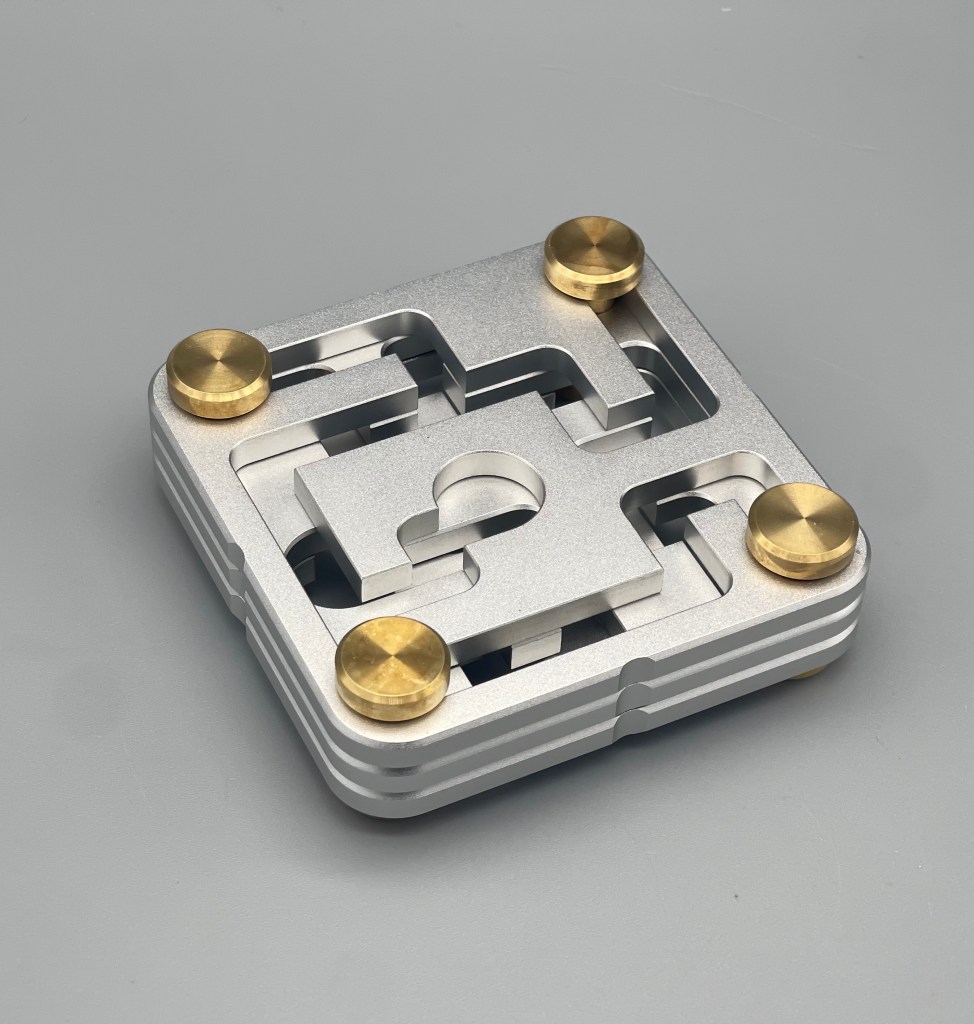
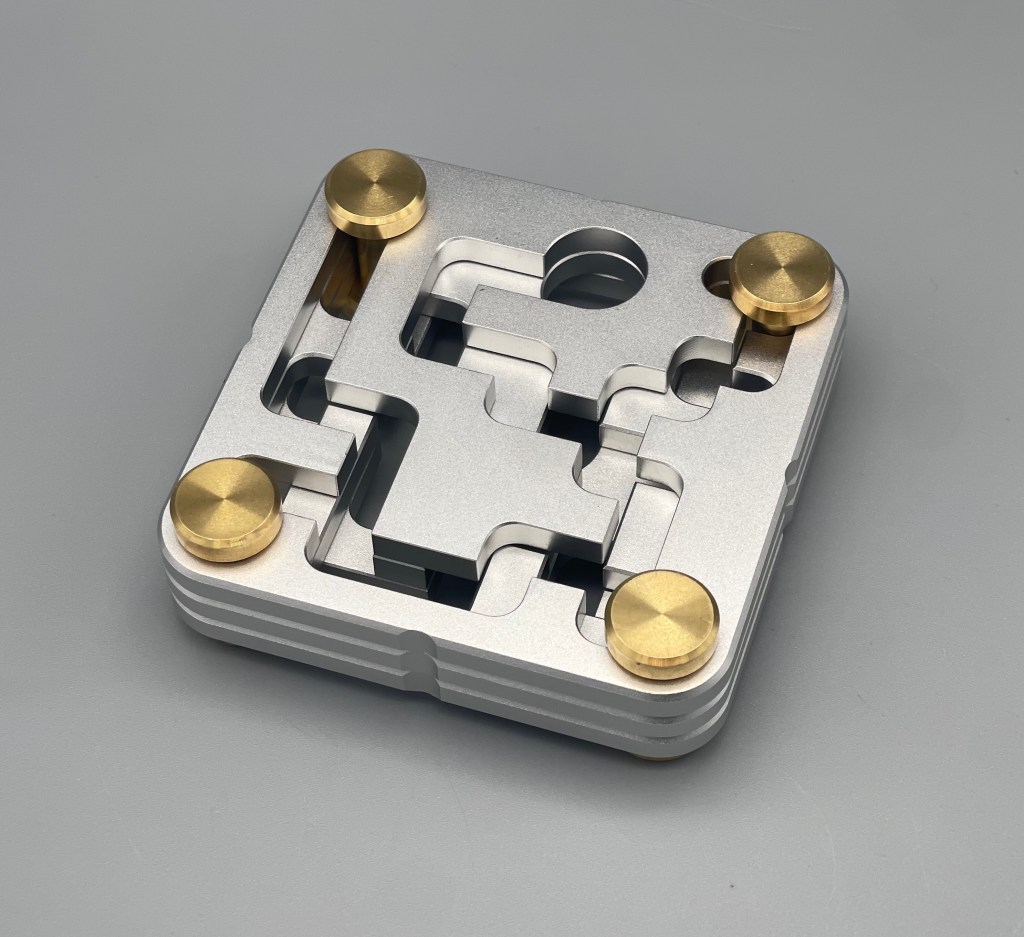
FastMazes 1 – 3 are three-level square mazes in which you must navigate pins in each of the four corners to a hole that will allow them to be removed one at a time; of course, this hole is in a totally different spot on each of the three levels so getting them to line up is no small feat. FastMaze 1 is the “easiest” of the three – I say this with my tongue firmly set into my cheek as its 137 moves is far from easy. Not only is that a lot of moves total, but once you have removed the first piece you still have another 83 moves to go for complete disassembly (the full solution is 54.28.24.28). FastMazes 2 and 3 are levels 160 and 196 respectively (#3 requires 121 moves just for the first piece!). This may sound intimidating but while it is most definitely a challenge, it is by no means unapproachable.

CD has produced the series of 3 puzzles in metal, with super smooth aluminum mazes navigated by four brass pins. The puzzles have been designed to easily come apart, allowing for a simple reset that makes the puzzle much less terrifying. The quality is apparent from the moment you pick it up: the metal is smooth to the touch, the pieces gliding over one another softly and easily. Notches marking the edition of the puzzle have been built into the center of each side, a nice aesthetic detail that helps you maintain control over the puzzle, especially once the levels start getting spread out as you progress through the solution. This happens quickly as the paths block one another unless you are able to have all pins situated such that the maze levels can shift. After a little while, it becomes possible to rotate one or more levels, something that I am still not sure whether it helped or hindered my progress. Apparently, the second of the three designs requires rotations, which I plan on confirming once they all become available. Regardless, the rotations are similarly smooth and, importantly, feel controlled – this is not like a burr that has become unmanageable with pieces rotating against your will. Its size fits perfectly into two hands (or your pocket for easy transport), allowing for easy control even as the pieces spread apart into its various contortionist configurations.

At first, I simply appreciated the construction and fit, the pins refusing to move until sliding smoothly and freely once a path becomes available. I began playing with it just to get to know its movements, finding it has a fun fidget friendly factor as an added bonus (it was also oddly satisfying to pinch one of the pins and swing the puzzle back and forth….. maybe that’s just me lol). It quickly became clear that such an approach was not going to afford me much progress: I was going to have to apply some brain power if I wanted to get anywhere as random fiddling isn’t going to get this little guy apart on its own (eventually, I suppose, but there might be a monkey Shakespeare by the time you get there). The exposed top and bottom levels allow you to work out a lot of where you need to go, but the center layer is largely hidden, confused by the paths above and below it through which you can try to make it out. As you work through the solution, of course, more of this layer is revealed and you must adjust your intentions and goals accordingly. Solving multiple mazes simultaneously with multiple moving restrictions is much more than the sum of its parts: dead ends exist in most any maze but here you must sometimes take advantage of these, working pins somewhere just so you can allow another to move elsewhere before backtracking once again. This makes for a great balance of experimentation and logic in working towards the solution, which will sometimes seem so close only to slide away once more. After finally releasing the first pin, I thought things would open up and become easy but in fact there was still plenty of puzzling left, the logic somewhat simplified but still significant in the strategy required to solve it.

FastMazes 1 -3 were released today, August 29th, 2022, available individually or as a set of three. I found that as soon as I had solved mine I wished I could reach for another, so I will definitely be picking up at least one more (who am I kidding, like my compulsive completionism will allow me to have just 2 of 3…). These are a fun challenge at an affordable price point with no sacrifice of quality (as we expect from our friends at CD), bringing excellent puzzling value to whatever puzzle shelves it will soon grace. You can find FastMaze 1 here and the others here.


Bananas is bananas.

Bananas

Jon Keegan, 8.5 x 8.5 x 11.5cm, 1.45kg

I was trying to explain to my wife how puzzling can be a mindful experience (she’s a therapist… I’m just cool like that ;-P ) as you may spend an hour or more in near silence, focused on every sound or perceived resistance or reaction to determine just what in the heck is going on, divining patterns from some series of stimuli, some so subtle as to cause concern that it’s just me doing something wrong or hearing or feeling something that isn’t there. But when finally this intense focus bears fruit and you get that aha! midnfulness is out the window with the dopamine hit you’re getting, earned with the eye strain and aching back from contorting yourself to try and look down some tiny hole or shaft.

And what fruit hath been bear-ed? I’m sure you didn’t click on this write-up to read me ramble vaguely about puzzling in general but rather to read me ramble vaguely about Bananas, the new puzzle by Jon Keegan (his follow-up to Jewel Thief). And if the paragraph above ap-peals to you, then your interest in Bananas is anything but bananas (because you see: Bananas is bananas).

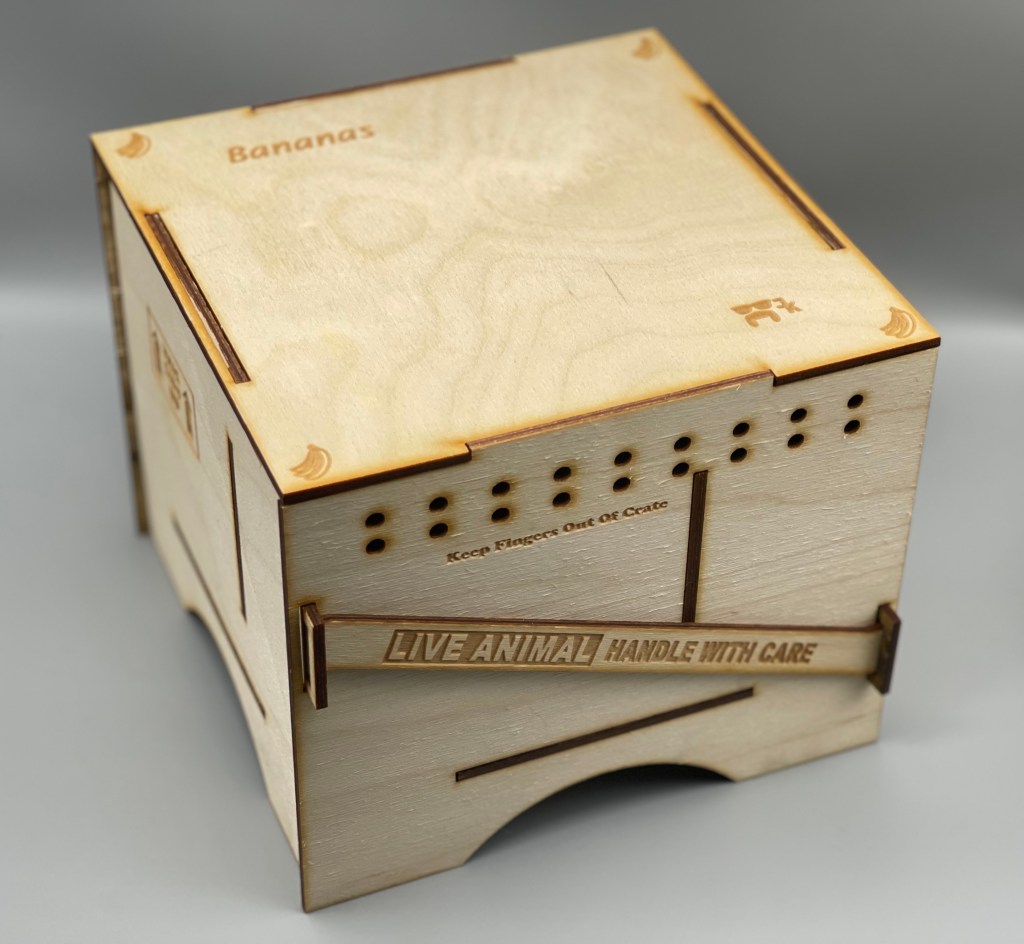
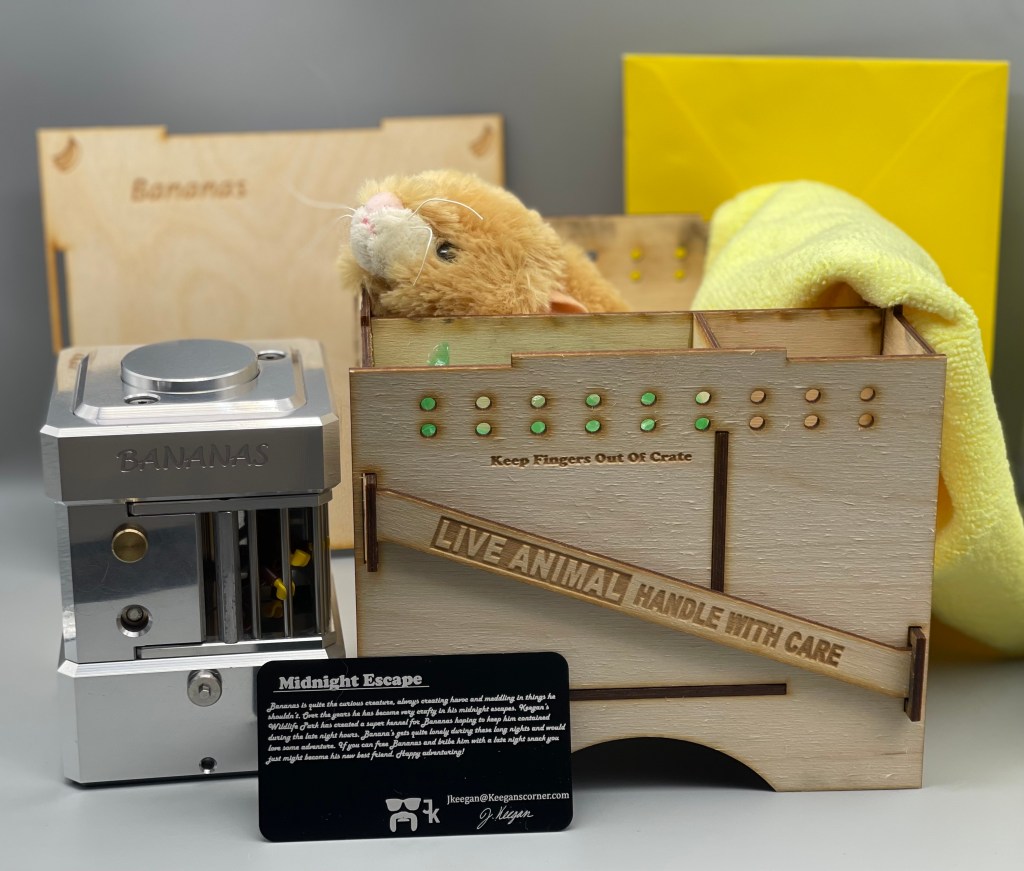
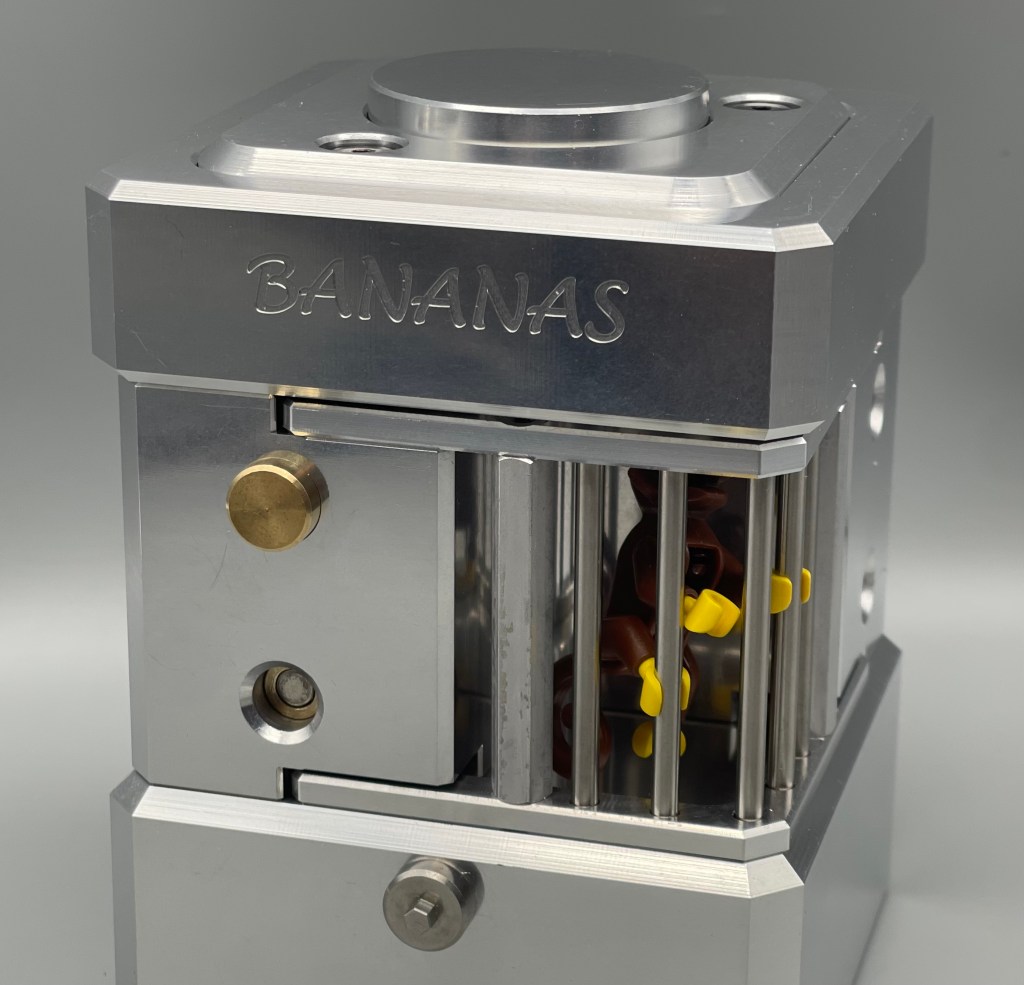
Bananas arrives wonderfully: super safely packed with a wooden shipping crate straight off the boat to Skull Island, ready to pack away something wild and dangerous. Cue a cute lego monkey caged by Keegan for our puzzling pleasure. Inside we find the puzzle, along with a metal objectives / story card, an envelope with pics of the internal mechanisms to decipher post-solve and a kindly supplied towel to protect the puzzle (and whatever surface you will be working on.

And as for the puzzle itself: Bananas is trapped in a cage set into the corner of a pretty massive block of metal replete with holes and knobbies and squares and circles to poke and prod and wonder at. Everything does something, of course, although nothing does anything just yet. The ticket in isn’t easy in itself (but you will get to understand it eventually); I struggled there for a bit and passed through with a bit of luck before too long, going on to make good progress before finding myself with a whole bunch of stuff and things to do with no clear path. Examining the puzzle does give you a sense of what is going on, at least in some areas, so I thought I know where I was shooting for, for the moment anyhow.

What follows would be a montage set to an uplifting light rock ballad about overcoming struggles as I proceeded to do what I started this post with, trying to find some magical combination of moves that would see me through to the next section. And eventually: aha! of course, and aha! again, with ever more aha!s big and small throughout the entire puzzle. There are some really great discoveries to be made before you free Bananas… and that’s the really crazy thing because you’ve only just started! The instructions tell you to solve the puzzle in 4 parts:

Bananarama!

I had done 1 and 2 but…. wtf.

So I kept going and going, through multiple additional sections, each with several variously moving bits to contend with. Eventually I sat back with pride, Banana’s snack in hand, admiring the mess of metal that had amassed around me, amidst my super-cool puzzle headgear and pleather dice trays. Such puzzling pride passes quickly though, and it’s time to reset.

The reset is tricky and challenging but not frustrating or overly confusing; I had some concerns about whether I’d be able to piece it all together after having taken a couple weeks to solve it but while it took fully understanding all that had happened to make it all ready to go again, this was not so difficult in reverse. In my typical genius fashion I had to solve and reset multiple sections multiple times due to having reset some part before some other part… I’d say I did it purposely, to better master the puzzle, but really I just do it all the time because I’m a dumbass  ¯\_(ツ)_/¯

Such dumbassery does have its benefits though: I feel now that I truly get what was happening throughout the puzzle when at first I couldn’t imagine how I ever could. What else can you ask from a puzzle? There is a fair amount of blind struggle but careful and close observation and experimentation will give you guidance, along with some subtle clues to make sense of as you go.

Bananas was released in a limited run of 225 by Jon Keegan and were all claimed (as is fairly typical with a good puzzle) long before this was written – in typical voracious puzzle fashion, we all politely and (seemingly) patiently waited with occasional but regular updates on Jon’s progress and puzzle maturation. I have to admit that I have not actually solved any other puzzle by him! My zealous overuse of multiple emails led to a snafu in which I missed my chance at a Jewel Thief… (meh, whatcha gonna do – from what I’ve heard, while it seems to be an amazing puzzle I’m pretty sure I would still be struggling with the first step lol). I did get a Scarf prototype but want to wait for the updated version coming out down the road (which just means that I haven’t been able to solve it 😉 But Bananas… the more I let it sit after finally solving and resetting I come to appreciate it more and more… quite simply, Bananas is bananas.


Paradise at the Puzzle Palace: In Xanadu, did fivesinatras a stately pleasure dome decree…

For a while now, I’d seen posts from Roxanne taking about the work she and George had been putting into what is one of the grandest puzzle projects yet: turning a house down the street from their own home (known as the Puzzle Palace) into a public (by-invitation) puzzle paradise, collecting what is technically referred to as a “crap-ton” of absolutely amazing puzzles spanning both the globe and a whole lot of decades (I believe there are some things from as far back as the late 19th Century!). I was kindly invited to the first Boca Bash, a puzzle party that shall hopefully continue to be held every couple of years far into the future (the Palace & Palace Museum are also welcoming private visits from puzzlers throughout the year).

The fact that Roxanne and George welcomed me into their home despite barely knowing me at the time just shows their openness and generosity and highlights the purpose of this project: to collect, protect, and share as many mechanical puzzles as they can possibly can, making it possible for puzzlers to solve the rarest of the rare of all types and genres. This is not just a collection – this is a public service to the puzzling world, one that they intend to outlast them (which will hopefully not be an issue for a very, very long time); they have even brought on a very cool puzzling couple (Tevin & Morgan) to act as caretakers, helping with cataloguing, protecting, and hosting solvers able to make the journey.

While my friend, Tanner (known for his excellent YouTube puzzle channel, WDIGMI), was able to spend several days there, I was only able to be there for a relatively brief 48 hrs, which was totally worth it but went by in the blink of an eye – you could spend weeks there and still only solve a fraction of what they’ve got. WDIGMI has an excellent video tour of the palace, which is good as I neglected to take many pictures while I was there (likely a testament to how good the puzzling is….. documenting the trip was not on my mind!). So be sure to check his vid out to get a visual sense of the puzzle nirvana that awaits…..

I got there pretty late following a few flight delays and was nonetheless welcomed by Roxanne and Tanner, as well as a few of our friendly, neighborhood Discord puzzlers – once we realized we had all inter-met one another, we had an especially grand ole time. After a bit of camaraderie at the Palace, a couple of us made our way down the street to the Palace Museum: at this point it was well after midnight, which most certainly did not stop Tanner and I from heading directly to the box room, where he was in the midst of solving a large Trevor Wood temple. After picking my jaw up off the floor, I walked past the enormous Thibodeau chest to where my long lost love lay waiting for me: an actual, irl Apothecary Chest! Fast forward a few hours and a few boxes later and we realized that the sun would soon be spoiling our fun, reluctantly deciding to make our way to our respective rooms.

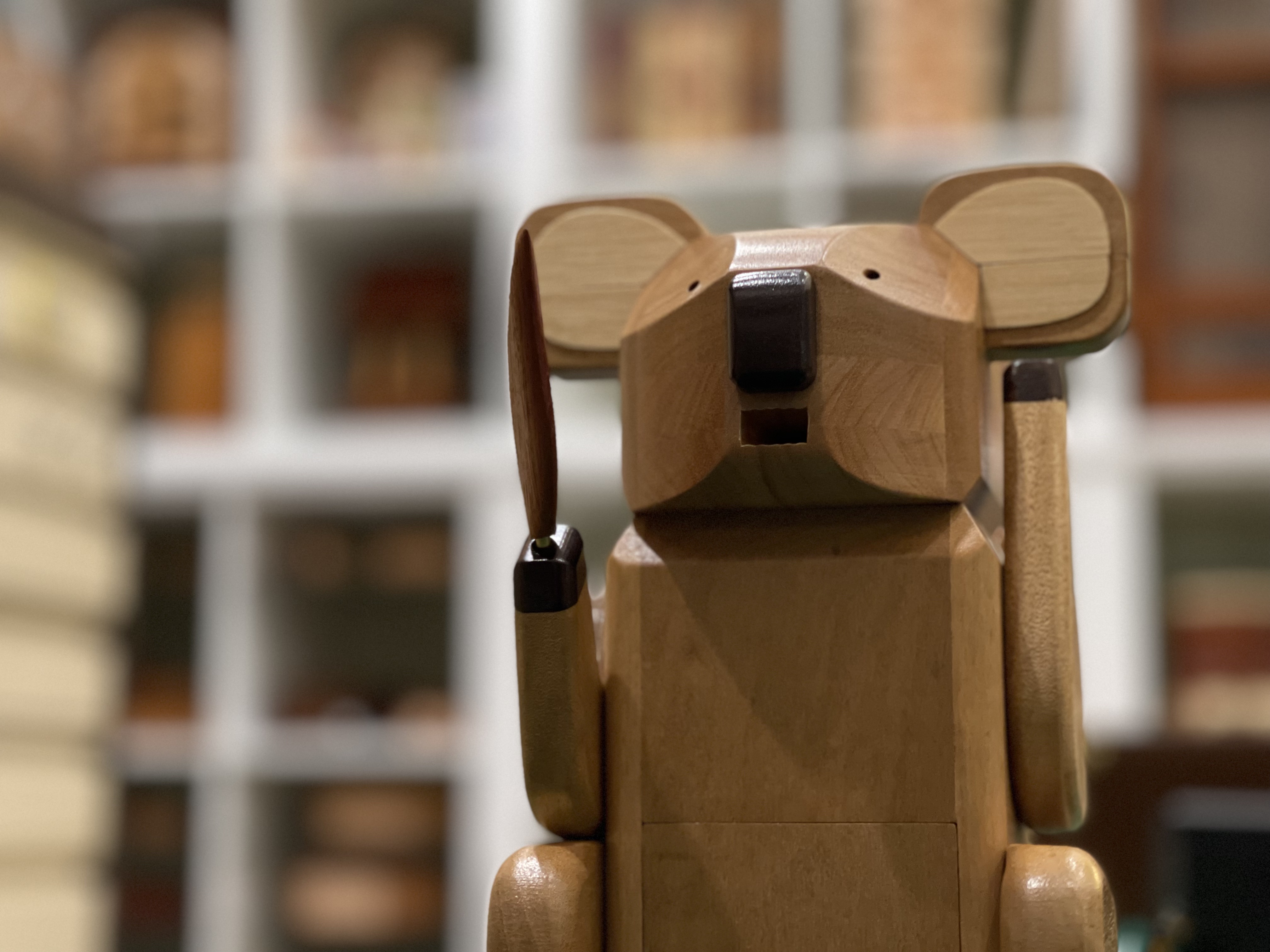
Katie Koala guarding just a few of the Palace’s boxes

The next day, I got to meet more of the puzzlers who were there for the weekend and got a slower tour of the Museum (I’d seen a bit the night before but the siren song of the box room was too strong to spend much time elsewhere at first). Later that evening, George took me on a full tour of their house; both properties are absolutely filled top to bottom with puzzles, as well as a helluva lot of material and tools for designing and making new ones.

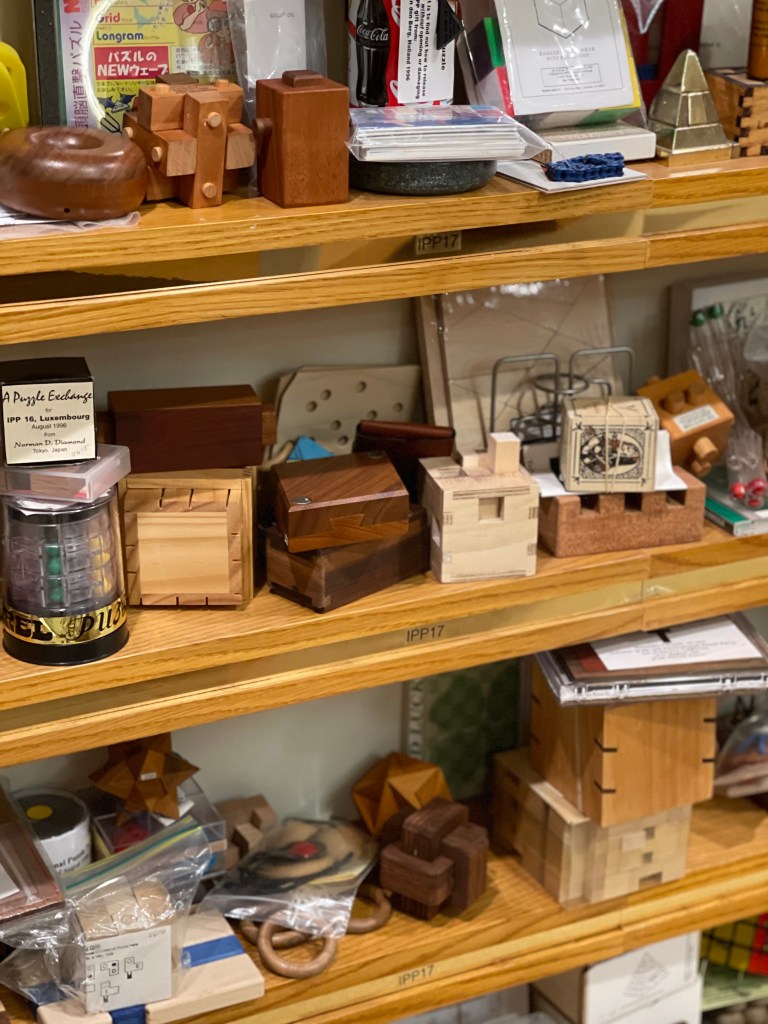
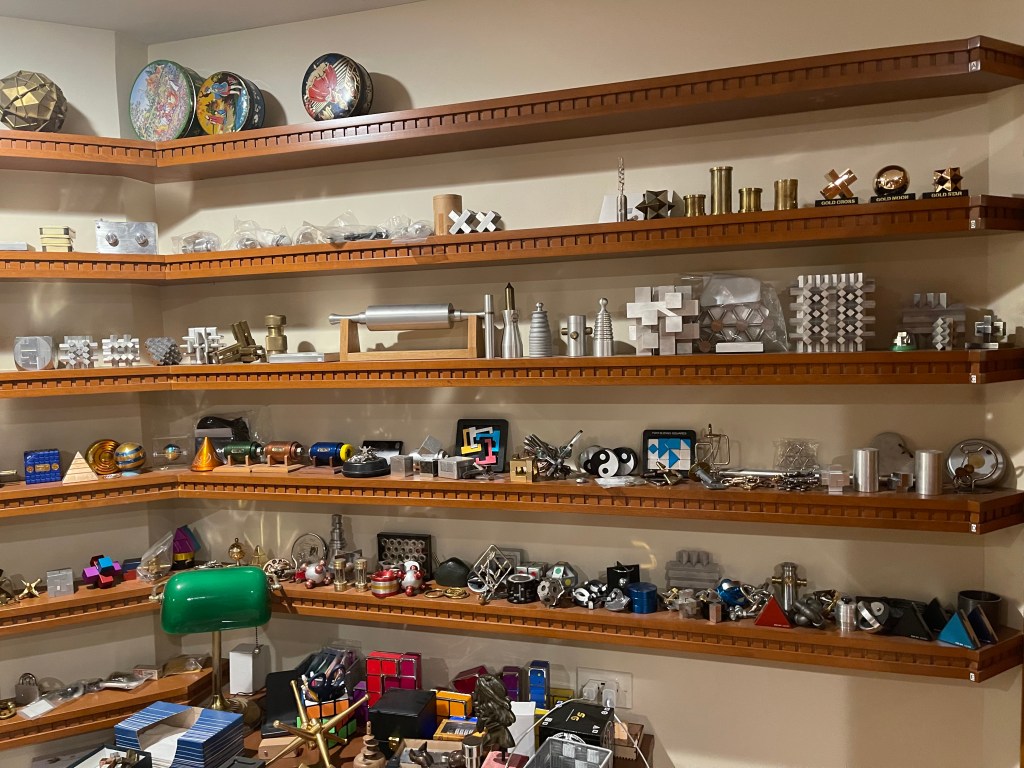
The craziest thing about being there is coming across unicorns hiding in plain sight, just sitting there as if it wouldn’t cause PuzzleParadise to explode were they to make it on there: is that Rob Yarger’s Checkmate Box on that shelf down there? Oh look, there’s a dozen or so Ninomiya boxes surrounded by dozens and dozens of other Karakuri from the floor to well over my head and deep into the shadows of the shelves. I think I saw Eric Fuller’s 51 Pound Box back there somewhere. There’s a bathroom with all four walls covered in puzzle locks – amongst them you will find some treasures such as Popplocks and even Gary Foshee’s Transparent Lock. Walking up the stairs of the Palace, past almost every Berrocal there is, I found myself in a large, open room whose curved walls contained shelf upon shelf of IPP puzzles, going back a decade or two (or three?), replete with yet more unicorns amidst unknown (to me) treasures and lots of puzzles that have never been reproduced: Sandfield dovetails, Brian Young SD’s, Lensch trickery, McDaniels and Malcolmson and Louage and dozens, if not hundreds, more. Across the room is a bedroom covered in metal puzzles by designers such as Gillen, Foshee, Roger D, and Strijbos. There is a room covered in Twisty’s, disentanglements hanging from the walls and ceiling, a towering wall of puzzle vessels, a room stacked with burrs and packing puzzles and more from the likes of Eric Fuller, Juno, Jerry McFarland, and on and on (and on).

This is just half of the IPP room
Some random pics from the IPP room of the Palace:
… and some random pics from the metal bedroom:

I got to pick up and try dozens of puzzles I have been lusting after for years, while discovering a whole bunch of stuff I’d never heard of (while trying to avoid a few things I may soon acquire, such as Jerry McFarland’s Burrnova – after patiently waiting a couple years for my name to come up, it is worth waiting a few more months until I can try my own copy 😀 ). And so many surprises, such as a room of chess puzzles that made me realize I had no idea there were so many chess puzzles! I could have spent the entire time in any one room and been more than happy for making the trip.

And, all the while, hanging and chatting with fellow puzzle-lovers: I spent some time with George putting together some cool furniture burrs from a small shop overseas and sat around with Roxanne and the gang hearing stories of puzzling days past, all the while passing around little known nuggets of preferred puzzling perfection – with puzzling in public having been impossible for the last year or two, it was great to connect with genuinely kind and cool puzzlers: some I’ve known from MPD, some whose names I’ve seen on IPP exchange puzzles or whose puzzles I’ve enjoyed (including the talented Mat Nedeljko, whose work I enjoy almost as much as his company), and some who were new to me (and just as great to meet) – new friends that I hope to puzzle with again before too long.

The only negative was that my squirrel-brain could hardly focus – there simply wasn’t enough time to actually solve most of the puzzles I picked up; if I couldn’t make progress for 15 or 20 minutes (whether getting started or getting stuck), I tended to reset whatever I was working on and put it back so I could try something else (otherwise I may have spent the whole time without trying anything other than Katie Koala and maybe a box or three from Kagen Sound, Stickman, and Michael Toulouzas, if I was lucky…. which still would have been worth the trip). Some puzzles we worked on collaboratively, allowing us to fully solve and reset a tough puzzle like Ned Kelly that I may otherwise have not managed to see the end of.

Eventually, it was time to go – as if their hospitality was not already more than enough Roxanne and George made sure I went home with a couple gifts (as did Tanner, who has been teaching himself woodworking and gifted me a lovely copy of Ichiro’s Three Cubes Puzzle that he had made). George does quite a bit of puzzle prototyping and had a trunk full of Hanamayas he helped bring to life; another trunk sits by the door for departing visitors. I even got a shirt! (fed, housed, and clothed?!)

The Puzzle Palace & Palace Museum contains an ever-growing collection and should eventually have its catalog (that’s “catalogue” to some of you) available online, making it easier to donate puzzles to help continue to grow the collection. Remember: these puzzles are there as a service to the puzzling world and, to some extent, this is going to have to be a collaborative effort long-term: spearheaded (of course) by Roxanne and George but ultimately supported and given life by the puzzling world at large – we puzzlers should help them in growing their collection, whether by donating or by assisting them in their hunt for puzzles they don’t yet have, all to give hands-on access to the puzzlers of the future. I suppose it is possible that the Museum may one day need to become a more formal institution (to protect the collection, if for no other reason); for now, it feels more like an extended family, with cousins stopping by randomly to play with the many many wooden, metal, and plastic children that live there…

Needless to say: I’ll be back as soon as I can (if they’ll have me) – until then, I can rest easy knowing it’s there, safe and sound and growing fast.


Palace Grade: The Rarely Seen, Ever-Sought Presley

(click here for more information on the Sinatra Scaling System, (c) John Maynard Keynes, 1944)
Tiger Man Elvis:
the Best of all the Elvises


It’s Electric! Boogie Woogie Woogie: Detective Box by Joe Guarini

Detective Box

Joe Guarini, 2020

Just a few days ago, some fellow puzzlers and I were discussing how there are not many puzzles that truly integrate electronics into their puzzling; there are a few great puzzles that feature electronics (I’m looking at you Turtle Trip and Snack Brake), but not necessarily as a part of the solution itself. This, however, is no longer the case: Detective Box wonderfully integrates electronic elements into the puzzling, creating a imaginatively unique and fun experience that I think of as an SD escape-room-in-a-puzzle-box.

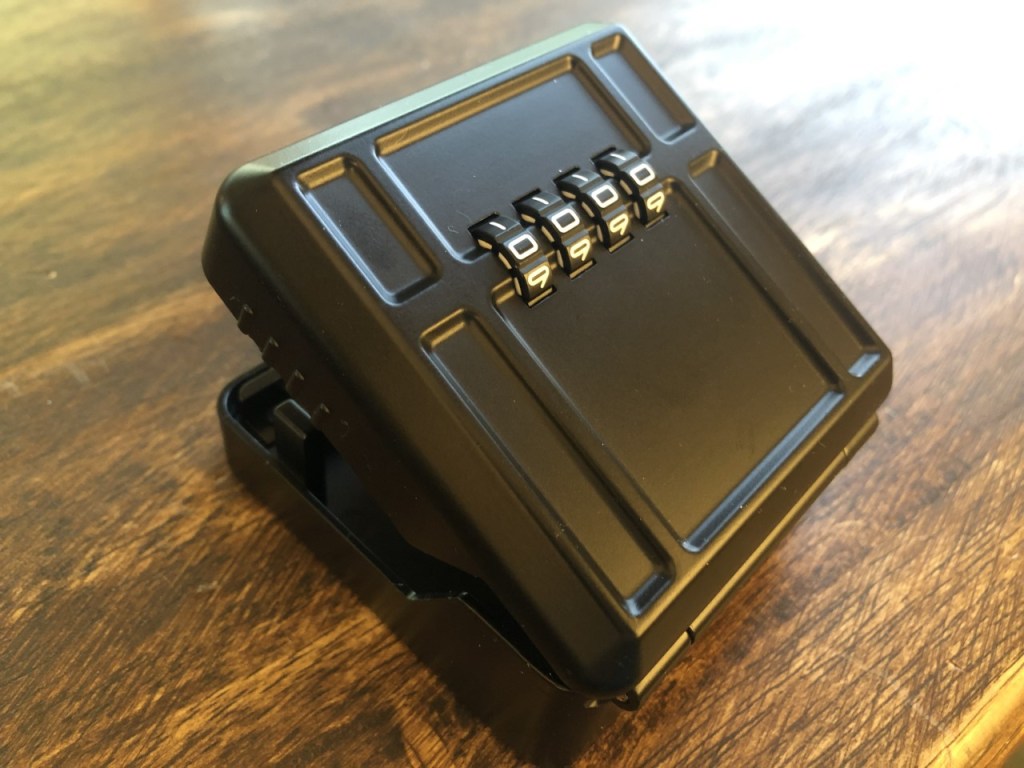
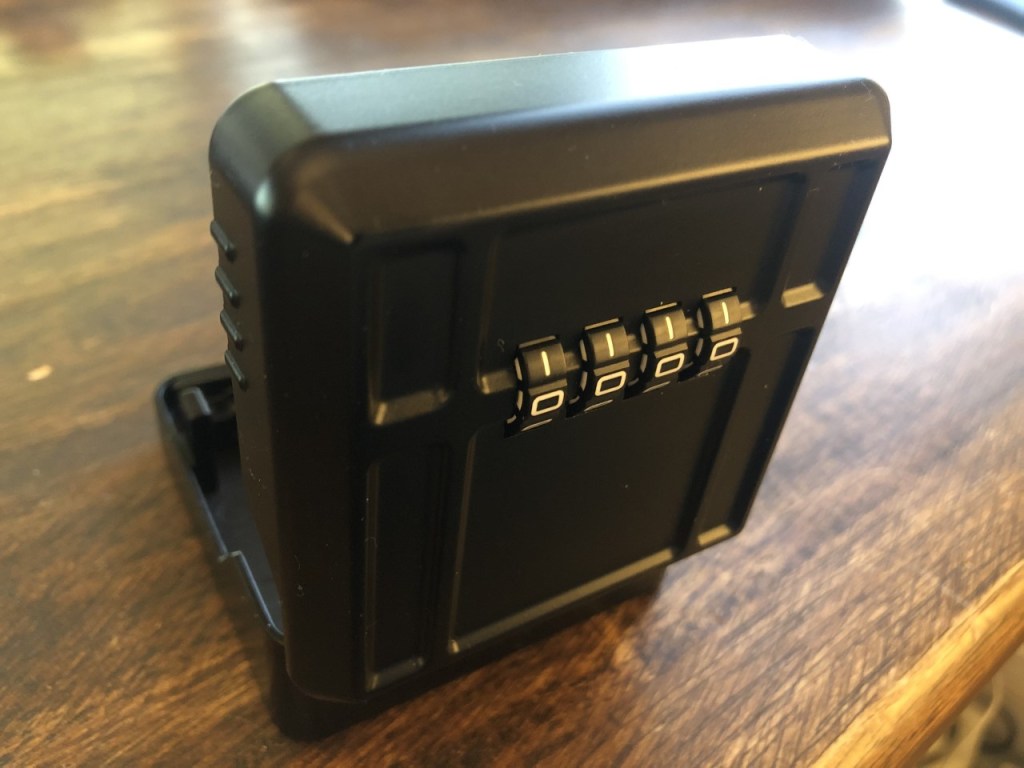
Detective Box is a seemingly unassuming 3″ x 3″ x 1.5″ metal lock box with a four number dial-lock on its face. The back shows four small holes, one of which belies its electrical nature by giving you a peek at some red wires that can be seen inside. Along with the box, there is an instruction sheet which includes our favorite rules, “no banging” and “no spinning”, along with “no gravity required” and a surprising early indicator of the puzzle’s distinctive nature, “no external tools except….” The instructions go on to explain that our goal is, essentially, to open the box and then “???…” Opening the box, we are told, requires that we “follow the clue” written on an accompanying letter and “find the box’s signal” (?!). Ultimately, the solution is not just to open the box, but to solve what is inside it (the aforementioned “???”).

After reading these instructions, I was extremely intrigued: its strange goals and reference to “a computer for your detective research” had me wholly hooked.

There is also a letter accompanying the puzzle, which gets you started (as per the instructions) and helps set the stage for the puzzle’s theme (which carefully and vaguely alludes, more or less indirectly, but probably not in any right-infringing way, to a certain flying-mammal-loving detective). The letter features a clue that will lead you to your computer (this is stated in the instructions, so no spoiler) – and, at that point, I was pretty clueless. The site does…. things…. but what could that have to do with the box? After spinning my computer availed me nothing (oddly enough), so began the electro-mechanical puzzling! After a couple cool aha moments, I managed to find the code needed to open the box. But this is by no means the end of the puzzle! Not at all – it is just the beginning.

I want to be careful not to give away too much: this really is a puzzling experience like no other I have ever had and one which I would not want to ruin. Suffice it to say that inside the box are some more electrical components that must somehow be used to solve a cypher, which will then lead you to the ultimate solution. Along the way, you will find a few more great aha moments, before you reach the puzzle’s end.

Joe clearly has some skills that are being put on display here – the functionality of its various electrical components must require a working knowledge of….. stuff….. that he is putting to good use. Although it was not necessarily an overly difficult box (for me, anyway), it is, even more importantly, a really really fun one. Sometimes puzzles seem to forego a full focus on facilitating fun in favor of bang-your-head-against-the-wall levels of difficulty (which can also be fun, of course, but sort of scratches a different itch than this novel, entertaining experience).

I am quite happy to have had the opportunity to try this puzzle out – Joe will be making them available for sale relatively soon and will likely be selling them directly, so keep an eye out on your favorite online puzzling haunt (i.e. Discord and Reddit). If you’re on Discord, he is @JHoag – you may want to hit him up with ye old LIST!!! emoji.

Originality Grade: 5 Sinatras

(click here for more information on the Sinatra Scaling System, (c) John Maynard Keynes, 1944)


The Other Best Blue Metal SD Puzzle Cube

Wishing Well

Perplex Puzzles, Stainless Steel, Aluminum, and Brass, 3.5″ x 3″ x 3″, Currently Available

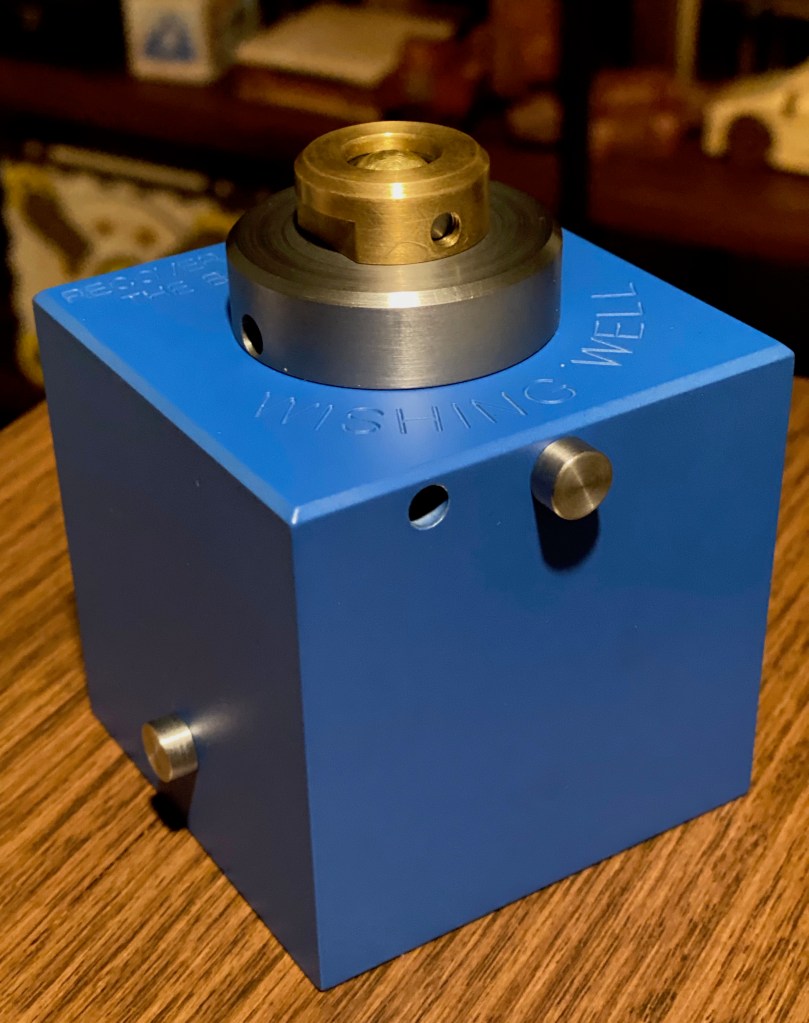
Recently, a puzzling friend of mine sent a pic of a metal puzzle box that had my puzzling parts tingling: Wishing Well is a new (currently available) puzzle from Perplex Puzzles; while seemingly a newcomer to the mechanical puzzle scene (afaik), the creator is a machinist with 39 years experience and the impeccable craftsmanship of the puzzle is definitely consistent with this expertise. At first glance, it seems somewhat similar to Will Strijbos’s First Box: it is a blue metal cube, with a cylindrical protrusion on its top. However, it is a bit bigger and significantly heavier than that puzzling classic; its blue surface is ceramic-coated “for long life,” and it has a number of holes and nubs and such located around its periphery.

Perhaps more importantly, this puzzle boasts an approximate number of 50 steps to solve(!) – this is made even more sweet by its instructions, informing us that there are no magnets, no need to spin or shake, and no smacking or excessive force needed. Described as “sequential mechanical,” after spending time with it, it most definitely falls squarely into the sequential discovery sub-genre of take-apart puzzles: it contains an “intricate assembly” of various metal parts that have been “precision machined on both CNC and conventional machines.” Presumably, this requires a lot of time and effort to make (a fact belied by its significant price tag); I took a bit of a leap of faith and bought it (who am I kidding – a brand new 50 step, SD puzzle box?! yes, please). As stated on the website, these are made in small batches: “[d]ue to the extremely close tolerances and tight fits, they are individually fit and assembled.” Yet again, music to my puzzling soul.

Made in the US, it arrived in just a couple days, arriving in a heavy wood crate with a dozen or so screws around its edges. This was obviously extremely cool and had me anticipating the puzzling experience all the more. Opening the crate, I found a wooden case with a metal clasp taking up about half its interior. Inside this unassuming (not a puzzle) box, lay Wishing Well, comfortably nestled in the foam-lined interior. Lifting it out of its perfectly-sized hole, the first thing I noticed is that it is heavy. Like really heavy. I mean, noticeably heavier than Pachinko, let alone First Box. Its ceramic coating feels smooth and softer than most metal puzzles had led me to expect, and the two-stage, two-toned protrusion on top immediately grabs my eye: a two inch metal circle (aluminum, presumably) topped by a one inch brass circle with what appears to be a brass ball nestled within. The primary directive has been etched into the surface of the box, just above the circles: “Recover the Coin from the Bottom of the” (and then, curving around the bottom of the circle) “Wishing Well.” There is something so practical about it that I like – almost like coming across an odd-looking lock box deep inside the guts of a factory.

Inside its wooden case were two folded sheets of paper: one were the instructions (see below), which included several points in addition to those listed above, instructing the puzzler to not only recover the coin, but to reassemble it completely before it can be considered solved. But the unassuming line that mechanical puzzlers will be likely to find most intriguing sits somewhere in the middle: “Disassembly and removal of the coin can be accomplished easily when taking the proper steps in the proper order.” Wunderbar! This is a puzzle that seems to follow a series of discrete steps – rather than vague movements blending into one another, I have found a tool-based mechanical progression that is by no means easy.

In addition to the instructions, there is a hint sheet – after spending a significant amount of time on the puzzle, I peeked at it, almost as much out of curiosity for the sheet’s contents as for the hint itself. Included hints are not a common occurrence with puzzles for some reason (many don’t even show up with instructions), and I found this to add to my enjoyment of the puzzle, especially as the hunts themselves are conceptual and do not really spoil anything: there are a couple quotes that provide as vague a nudge as any esoteric comment from a fellow puzzler might, as well as (wait for it) a crossword puzzle! Apparently, by solving the crossword, you can then put the words into the order provided to reveal an additional hint. The quotes were not anything particularly helpful – an experienced puzzler is likely to find them to be advice that is generally good to keep in mind when approaching a new, complicated take-apart puzzle, but I appreciate the vague nudges (and I think it is especially welcome to include something for those that may be relatively new to the puzzling world). I have not yet done the crossword, which I suspect may contain something a bit more concrete.

Along with the wooden case, there is a manila letter-sized envelope labelled “Solution.” Because of how heavy it is, I had to open it and at least peek in the top; careful not to reveal any of the actual content, I was able to see that it contains 10 laminated pages with printed text and pictures(!) – pretty awesome and likely quite thorough.

Finally, on to the puzzling experience. As I mentioned, I have not yet solved it fully (I suspect it will cause me to flounder and flail about for quite a while, which should come as no surprise if you know me at all); at this point, I have progressed through about dozen steps and I can confidently say that this thing is badass. As claimed, when you find a step, it is clearly a step; and yet, it is oftentimes totally unclear what to do – it seems like there is so much that you should be able to do, and yet at any given time it may take a while to find anything that you actually are able to do. The visible holes and nubs hide tools and inner working that change in nature as I work my way along – what did little, now does much; what was sticking out, is now sticking in; things move and potential pathways begin to open up, moving the puzzle along at a decent pace until I get to a point where I find myself yet again going in circles, able to do several things, but unsure which to do or in what way or order. Do I need to do this before I do that? Should this go here or should that go there? I am gathering intel on what lies inside the box, details emerging as I discover ways to make this or that happen. Each piece moves perfectly; this is a puzzle clearly made by an expert in the craft that knows how to get metal to do what he wants. Unlike some puzzles I have done, it does not feel like round pegs are being forced into square holes, where you are unsure whether you should do this or that – while it is by no means always clear what to do, I have found it very clear what not to do; this puzzle hides but it does not cheat.

I will end by saying this: it is very clear that this took a lot of thought to design and a lot of effort to make. The puzzling is very enjoyable, with well-concealed, discrete steps that incorporate tools and non-obvious movements that keep me interested and excited as I struggle to find my way through to the next wall. Perplex’s product page features a “Coming Soon” sign beneath Wishing Well; the new puzzle is named Turn, Turn, Turn and comes in at a slightly lower price tag. If it is anything like Wishing Well, the price is likely to be well worth it. I don’t know whether Perplex will continue to make Wishing Well after the new puzzle has been released, but I assume that once the puzzling world gets wind of these, they may start disappearing, so start saving or selling your solved stuff because this thing is seriously fun.


Craftsmanship: Five Sinatras

(No Terence Trent D’Arby jokes were made during the writing of this blog… until now)

A Puzzle with a View

Ansel

PuzzledWolf, Walnut

The Silver Age of Puzzling is surely upon us; perhaps Puzzle Renaissance is more accurate. The Golden Age would be that time a decade or two in the past when mechanical puzzles began showing up more and more, with amazing makers making amazing puzzles, almost all of which are now unicorns. However, the puzzle world was perhaps more limited: fewer makers, fewer collectors, fewer puzzles, fewer dollars……

With YouTubers encouraging a growing awareness of mechanical puzzles, an increasing number of people are being drawn into the puzzling world – the initial interest fostered by the growing presence on Reddit and (of course) Discord (go team!). This has brought more makers out of the woodwork (sorry) as the demand for new and unique puzzles grows:

Cue PuzzledWolf, busting out with Ansel: The List (LIST!!!) was born in May with shipping and public sale soon starting in June (2020). (There are plans for additional releases at the time of this writing, with a likely hiatus to allow for the development of future puzzles)

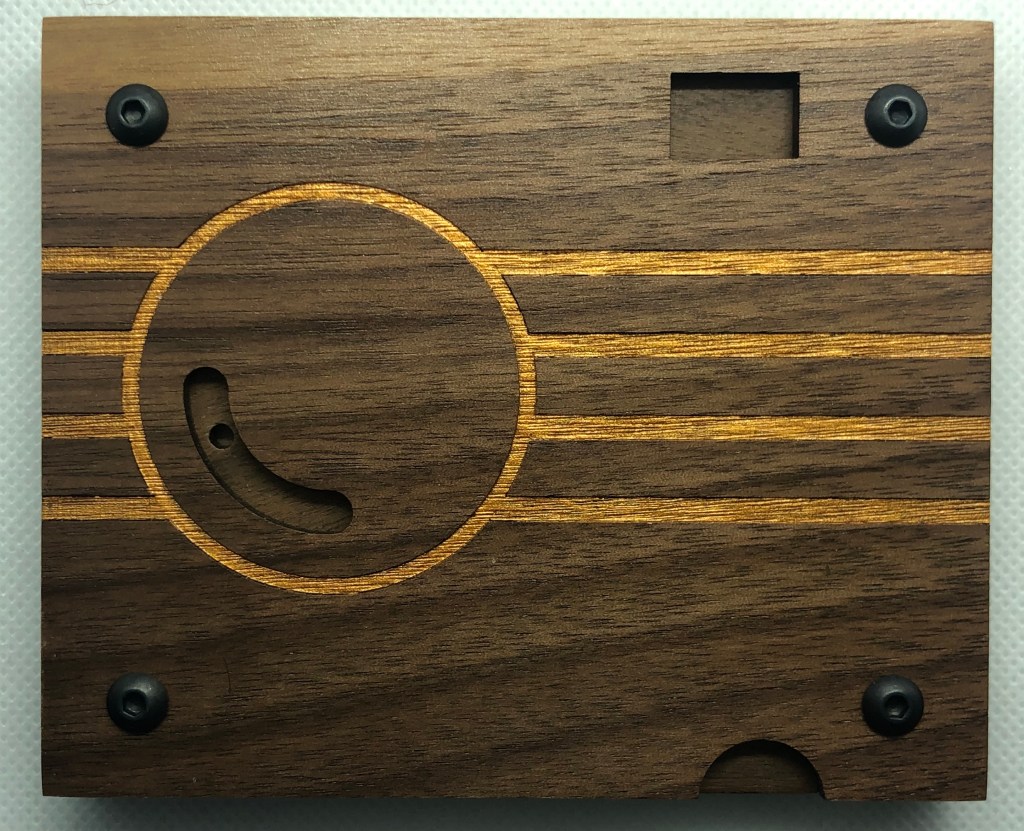
Ansel itself is a wooden rectangle with a relatively slight depth, its appearance a line-drawing take on a classic camera (and we can now understand its name). The puzzle’s goal is extremely unique: the camera’s view-finder is stuck and we need to open it. This makes classifying it a bit tricky: its thematic journey has the feel of an SD take-apart but really the goal is the most puzzle-y of puzzle goals: move this bit of wood here to just a little bit over there! (A Puzzler can most definitely appreciate the joy of figuring out how to move a piece of wood a couple inches and doing so here is extremely satisfying)

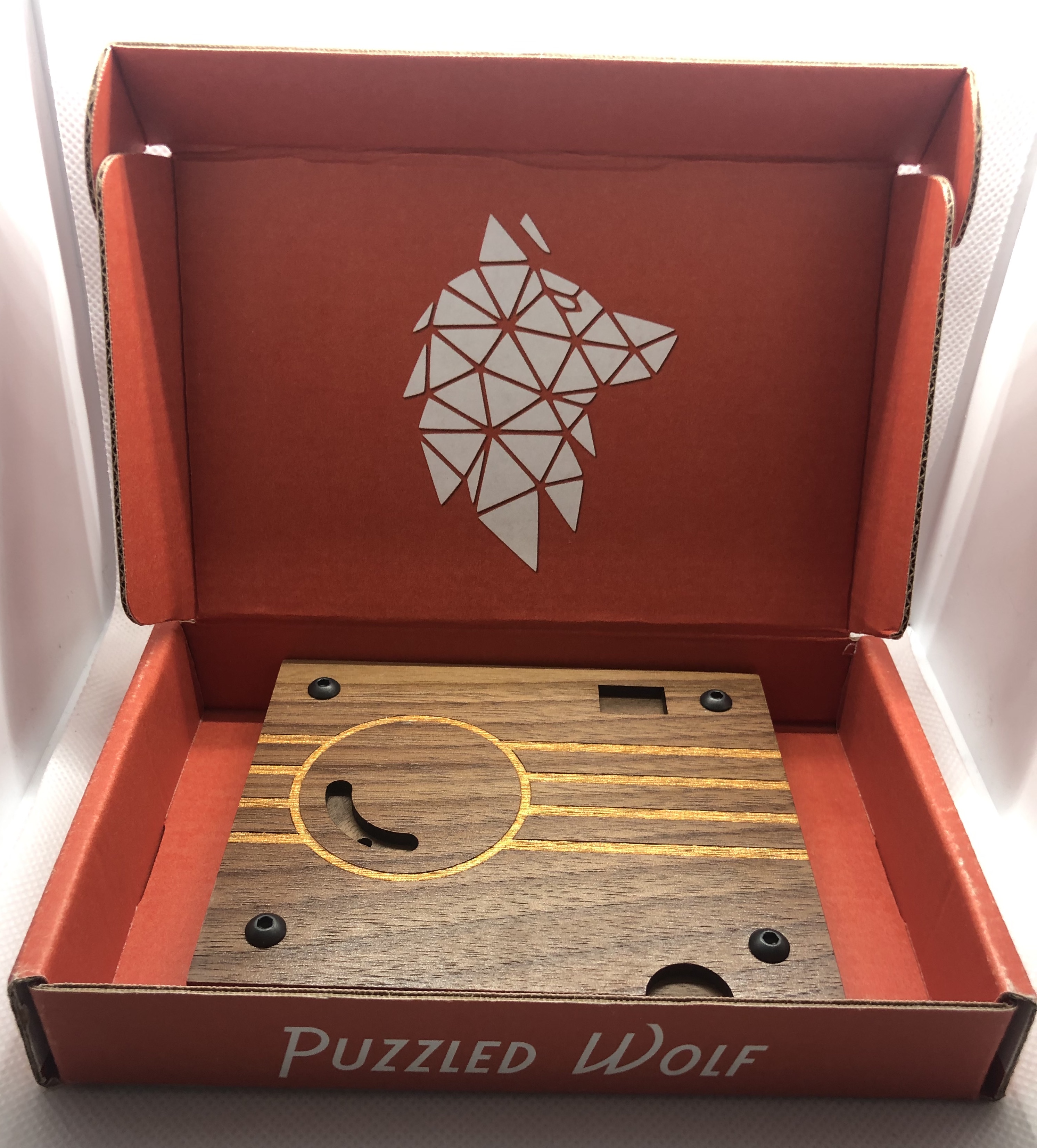
I would be remiss if I did not reflect momentarily upon the puzzle’s presentation: PW pulled out all the stops, branded by an eye-catching color and distinct wolf mark adorning a custom box intentionally made with Ansel in mind.

Pretty much everyone I’ve heard speak of Ansel got stuck right off the bat, taking some time to find what is one of my favorite first steps in a while: I thought it was one thing or another and it turned out to be a totally different thing and even though I generally like being able to make a little bit of progress before getting stuck, the sneakiness of it makes me smile. The early struggle satisfyingly resolved, one can move on to a bit of study: patient observation mixed with trial and error as you work your way through the puzzle, which still has some surprises up its lens.

Resetting Ansel is relatively straightforward (following the obligatory photo of a pet or puzzle through its now-open viewfinder). I found myself fidgeting with it after solving it and have picked it up several times since to enjoy one moment in particular.

Ansel is quite original, very well-made, and offers really good puzzling at a great price point. It’s thematic and has an aesthetic that is readily recognizable as a puzzle while also being totally different from pretty much anything I’ve seen before. I look forward to PuzzledWolf’s (hopefully relatively imminent) follow-up to Ansel – a Washing Machine puzzle currently in development, which seems to maintain some aesthetic consistency with Ansel while also appearing totally unique, which is itself pretty cool (perhaps to be called the Alva after none other than Alva Fisher, the man sometimes considered to be the inventor of the electric washing machine, apparently unjustly but it sounds cool as a name and is quite wonderfully alliterative….. and yes, I had to look that up).


Originality and Presentation: Five Sinatras

Difficulty: Four Sinatras

Midcentury American Photography Signification: One Adams


Dr. PinkLady, or How I Learned to Stop Fidgeting and Solve the Burr

Fidget Burr (a/k/a Dollar Burr, a/k/a Chin Burr)

Jerry McFarland, 3.28″ x 3.28″ x 2.92″

Recently, I was lucky enough to get a copy of Jerry McFarland’s Fidget Burr (not to be confused with the puzzle of the same name designed by Tim Alkema and recently produced by Eric. Fuller of CubicDissection). It has quickly become one of my all-time favorite puzzles, with an extremely original design replete with fun and challenging nuances.

First off, the puzzle is beautiful, consisting of 23 wood pieces crafted from walnut, maple, mahogany, and bloodwood (with the keypiece possibly made in a different exotic wood, such as Bubinga, Santos Rosewood or Cocobolo), for a interestingly contrasting aesthetic. It feels soft, presumably waxed into a delightful sheen that allows the puzzle to stand out, adding to the temptation to play and fidget beyond one’s attempts at finding the solution.

But what really makes it stand out is the addition of 22 magnets integrated into the puzzle, adding layers of novelty, difficulty, and stability that makes it stand out from its (still excellent) burr cube brethren. And last but not least, a Lego minifig can be seen, trapped within a window on one piece of the puzzle’s frame, lending the puzzle a hint of puzzle box / take-apart puzzling.


NOTE: The following paragraph reveals details of the puzzle’s first move – I feel comfortable writing about it as this has been blogged about before and is not really a hidden feature of the puzzle, but for those purists out there who want to know absolutely nothing about a puzzle, I thought I would give you fair warning – it has been formatted to make it easy enough to skip:

iIt is readily apparent which piece offers the first move (being the only piece that can move) and, when you press it, you are rewarded with a chain of clacking, automatic movements as 4 pieces are released, magnets forcing them out. This chain will most certainly be repeated again and again, both in the search of its solution, as well as the sheer entertainment value.


Following this first step, I immediately hit a wall. Fortunately, this first step is more than fun enough to play with absent any further progress. However, after numerous attempts at exploring possibilities through trial and error, I explored that other method of puzzle solving: thought. With this, I was able to narrow down the possible next steps, more quickly finding my way past this wall. Soon, it is possible to remove some pieces of the puzzle.

However, this is not the end as one must deal with some (possibly less difficult, but still non-trivial) additional steps, revealing the reason for at least one of the puzzle’s aliases. As you continue through the puzzle, you find a number of added details, magnets, chamfers, clips, and pins that really show off Jerry’s expertise, as they allow for a more consistent and stable puzzling experience (these are detailed in the included instructions in a series of notes, which would be spoilers if shared). One such detail does double duty, causing me several minutes of confusion as I lost all momentum just as I thought I was about to free my Pink Lady. Moving past this, the lovely lady can be freed (and even her window frame reveals evidence of Jerry’s thoughtful and precise approach to puzzle-making, as it is designed in such a way as to make her intended orientation obvious when looking to cruelly force her back into her wooden prison).

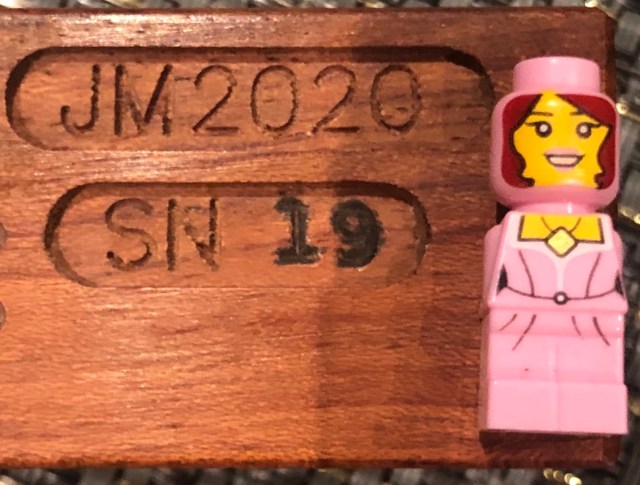
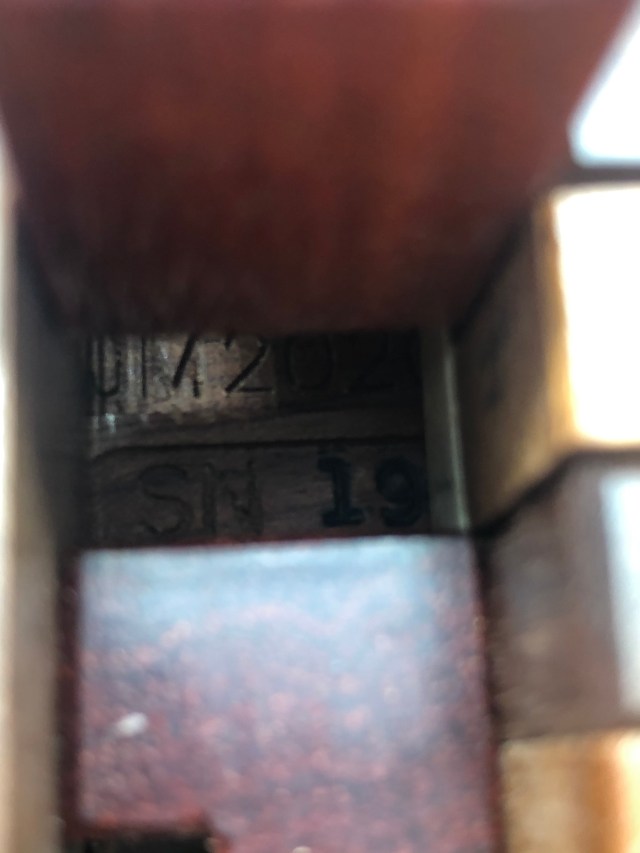
The key piece has the puzzle’s “signature,” the maker’s initials, year of creation, and serial number etched into perfectly matched frames (as seen above).

Note that this picture is also no spoiler, as Jerry designed the puzzle such that one can view the signature without having solved the puzzle – yet another unique detail that demands appreciation.

Reassembly is not overly difficult: Jerry has thoughtfully marked some of the pieces to aid with the proper orientation, allowing you to reassemble the puzzle with pleasure rather than frustration. Burrtools is unnecessary, good considering my strong suspicion that it would not provide much (or perhaps any) assistance.

As mentioned, the puzzle comes with instructions and notes: 5 pages that includes solution descriptions assembly instructions with pictures and illustrations, as well as the aforementioned notes and a general explanation of the puzzle (the latter being graciously printed on the first page to avoid any accidental and unwanted spoilers).

Fidget Burr will be entered in the 2020 IPP40 Design competition, where I would be surprised if it did not earn some significant recognition. While 2020 seems it will be a banner year for puzzling, Fidget Burr will no doubt be amongst its top designs; it is certainly amongst my puzzle favorites overall (assuming my judgment is at all reliable), not least considering its atypical replay value.


Awesome Sauce Grade: Five Sinatras