Dispatches from the Walter Wars: Iteration 23 by Dee Dixon

Iteration 23

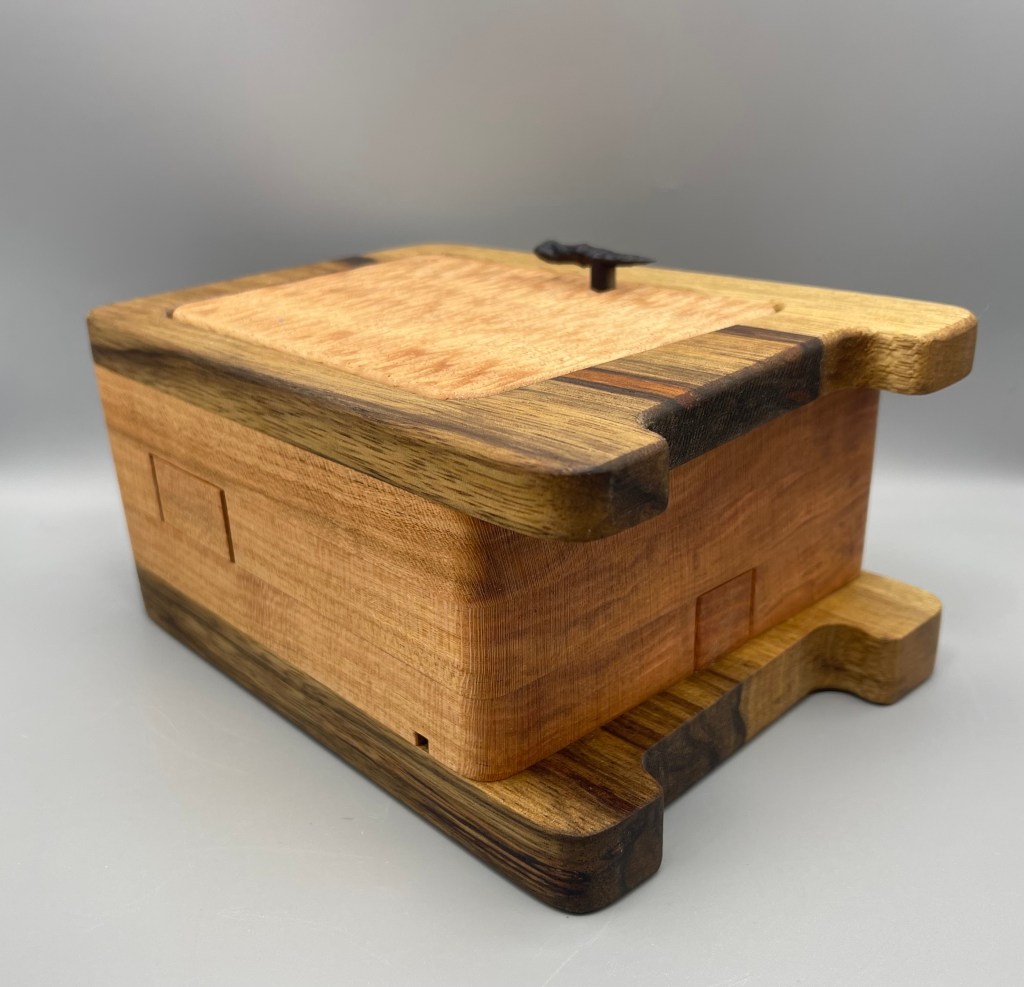
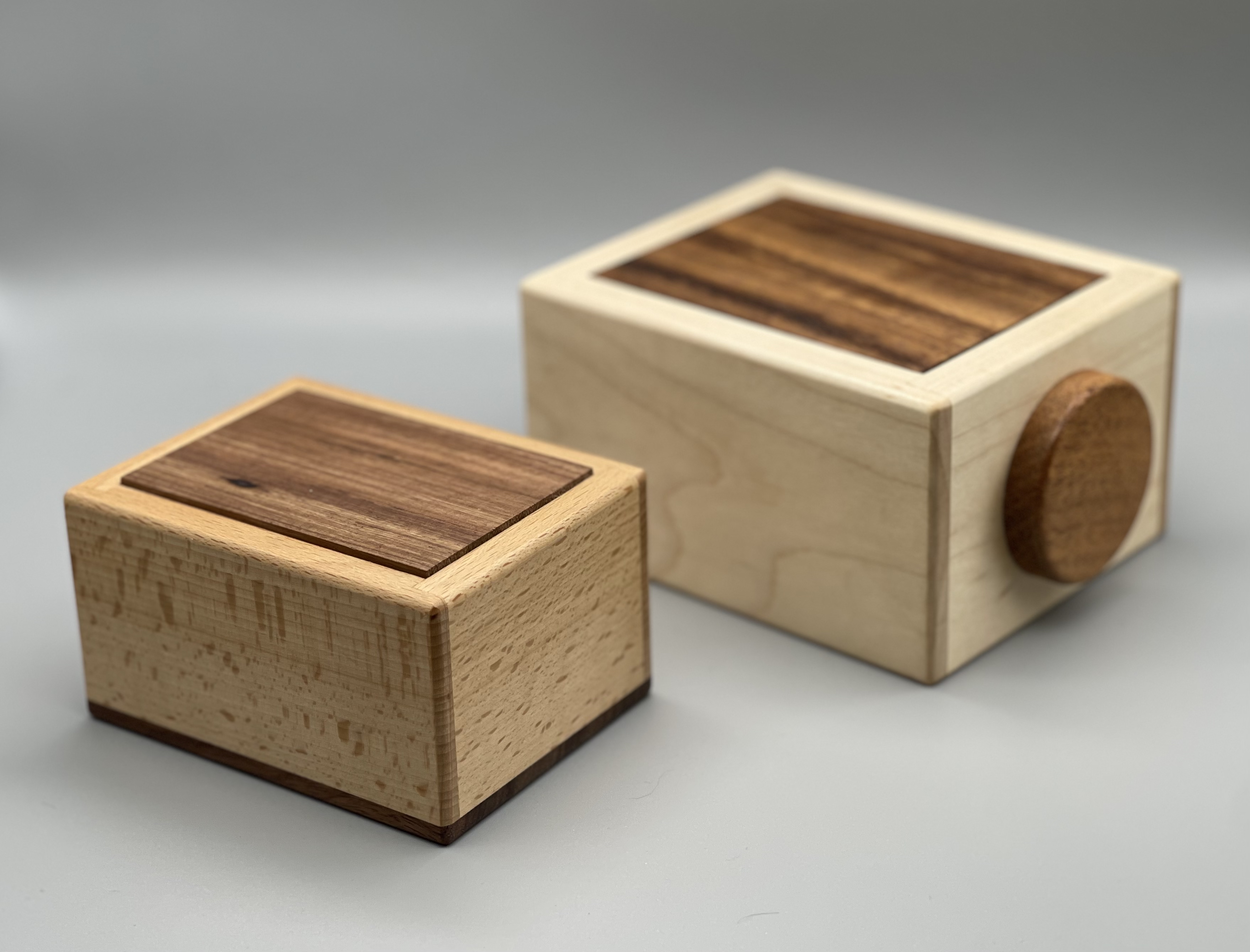
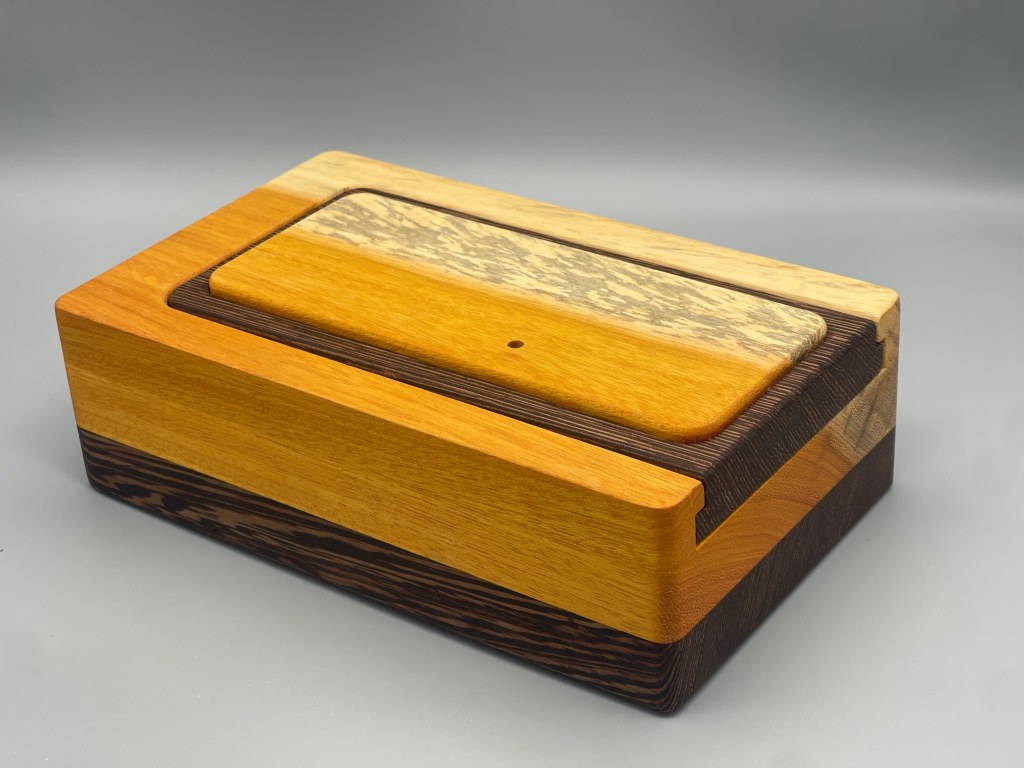
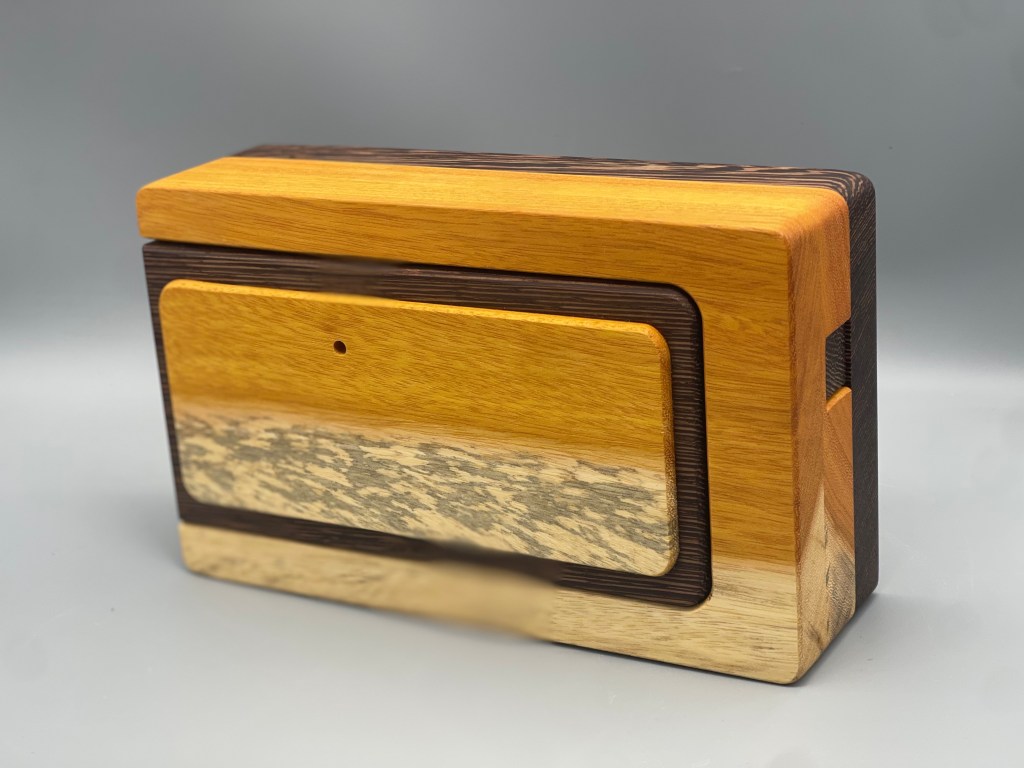
Dee Dixon, 7″ x 4.25″ x 2.25″, Osage Orange and Wenge (available in different woods)
And so, the Walter Wars waged on. The Walters’ dominance was shaken by the Human Resistance’s successful attacks on their radio communication devices as humanity chipped away at the Walters’ line of defense. But the Resistance had yet to develop a weapon that could resist Walter’s AI intrusions; the digital nature of all weaponized devices included a weakness that Walter would easily exploit. The Resistance instead looked back to human history, seeking to upgrade the weaponry of the 19th and 20th centuries. Hopefully this antiquated technology would help turn the tides of many a bitter battle, Walter being incapable of hacking into something from an analog era. Iteration after iteration was developed, each rooted in technology too old for Walter to comprehend. Still, the Resistance’s logistics were constantly interrupted by the Walters, forcing humanity to break this new weapon down into constituent parts. Using the Dynamic Element Downscaler or DED the weapon can then be hidden in a handheld device that could confuse and distract the Walters and when needed returned to its original size. Each individual fighter had little chance of defeating the robot horde, but together in a coordinated effort they could do great damage. One of many robot manufacturing facilities would be the new target. You are called upon once again. Go forth and help humanity gain the upper hand in its war against the Walters by gaining access to and assembling this essential piece of long forgotten technology. .

“……….you read this? Hello? If you can read this, you have accessed the Human Resistance darknet, supporting the fight against the Walters. Since their arrival, Angry Walter has expanded its rule, covering the globe with its robot kin. We humans, despite losing our cities and our nations, have fought back as best we can. We discovered a way to dismantle Walter’s fuel cell when a Walter could be captured. Then we developed a method of overcoming their communications network, removing the DED chip from copies of Walter’s Radio that could be rerouted by the resistance. Due to the Walters ability to infiltrate modern networks, our every weapon failed, leaving us always on the defense. Finally, we have learned that the use of pre-21st Century firepower could slip beneath the AI awareness, leaving the Walters exposed to the analog munitions we rediscovered.”
“Of course, we must hide these weapons from the Walters, breaking them down into various components and hiding them in wooden cases to be distributed across humanity’s last hope, wherever and whenever possible. These cases have separated the components across several compartments, which must be accessed using hidden tricks and tools contained within.”

“While I cannot give instructions to open the case, lest these communications be intercepted by the Walters, I felt it was important to share my experience with this copy in the hope that it could help others. At my count, about 20-25 steps stand between you and the components needed to build the weapon. At first, there is only a button on one side and a sliding lid that will only open about halfway before stopping. I experimented, listening closely to develop an idea as to what is going on – before too long, I had something that would help. It was clear to me where this should go but not why; I was stuck here for quite some time, going in circles as I sought my way out. I will admit that it would take some help to find my way out of this, earning me more assistance to progress. Before much longer, I had the lid off and, after a bit of exploration, the first piece of the weapon.”

“Stuck once more, I pulled out my headlamp to delve further into the puzzle. An excellent series of aha!s stood between me and the next weapon component. More exploration and more trial & error until I found the next step, which would lead me to the third component. I was stuck here for quite some time and would again require some assistance to progress further, despite having found at least part of this section’s solution.”
“Finally, I entered into the final sequence of steps that stood between me and the last component, hidden behind yet more aha!s; my success invigorated me and I was then able to construct the weapon, to be deployed at our next attack. With this, we finally go on the offensive, pushing back against the chaos and destruction wrought by the Walters.”

“It took the resistance iteration after iteration before finalizing the case, workable in this, its 23rd iteration. My copy consists of an Osage Orange base, with a Wenge outline. These colors are flipped for the final iteration, with Peruvian Walnut replacing the Wenge for the dark adornments. The case comes in three versions, using Padauk, Spalted Hackberry or the Osage Orange wood in addition to the lovely, dark Walnut. All are approximately 7″ x 4.25″ x 2.25″ and rely on the same secret steps to solve and access the munitions our resistance so desperately needs. We will be distributing them soon, in time for the holiday attacks we have planned.”

“These cases are unlikely to last long, lest this fight fall into the future. Keep an eye on the cover site we use to help get these cases into the appropriate hands. Go forth and construct these weapons so that we may push back against our robot overlords, perhaps turning the tides of our resistance.”

It Takes a Village: Oleg’s Wardrobe by Dee Dixon

Oleg’s Wardrobe

Dee Dixon

The Village was happy. For years its people celebrated nothing in particular, joyously throwing small objects into the sky and jumping up and down. Their kindness was so real, so tangible, that the Orb of Prosperity formed, giving the people something around which to dance in a rather silly, but quite happy, fashion.

King Oleg the Horrible, however, hated the happy hamlet – in fact, he hated everything: the sound of grass growing, the smell of fresh snow, and the tiny hats the people liked to wear. The King was cruel to the people in his kingdom, silencing laughter and kicking toddlers. For years he would grumble and mumble incoherently to himself, but the dancing…. Oh, the dancing was the last straw for Oleg. He stole the Orb from the Village and now things that were once thrown into the air are placed sadly on the floor.


Oleg has locked the Orb away in a secret compartment in a wardrobe he uses for small things like his fingernails and sense of self-worth. Knight Nyte the Sleepy Soldier has stolen Oleg’s Wardrobe but he can’t find the Orb! The cabinet opens but the drawers are empty! Alas, without freeing the Orb the people’s prosperity will forever be out of reach. It is up to you to find the Orb so that its magic may be released and the people saved, to laugh and dance and wear their tiny hats once more.

From: Tiny Hats and the Ogre that Hated Them, a Record of the Village that Prospers Once More

Dee never ceases to surprise – I still haven’t managed to solve Burner and he has something more complex coming out!

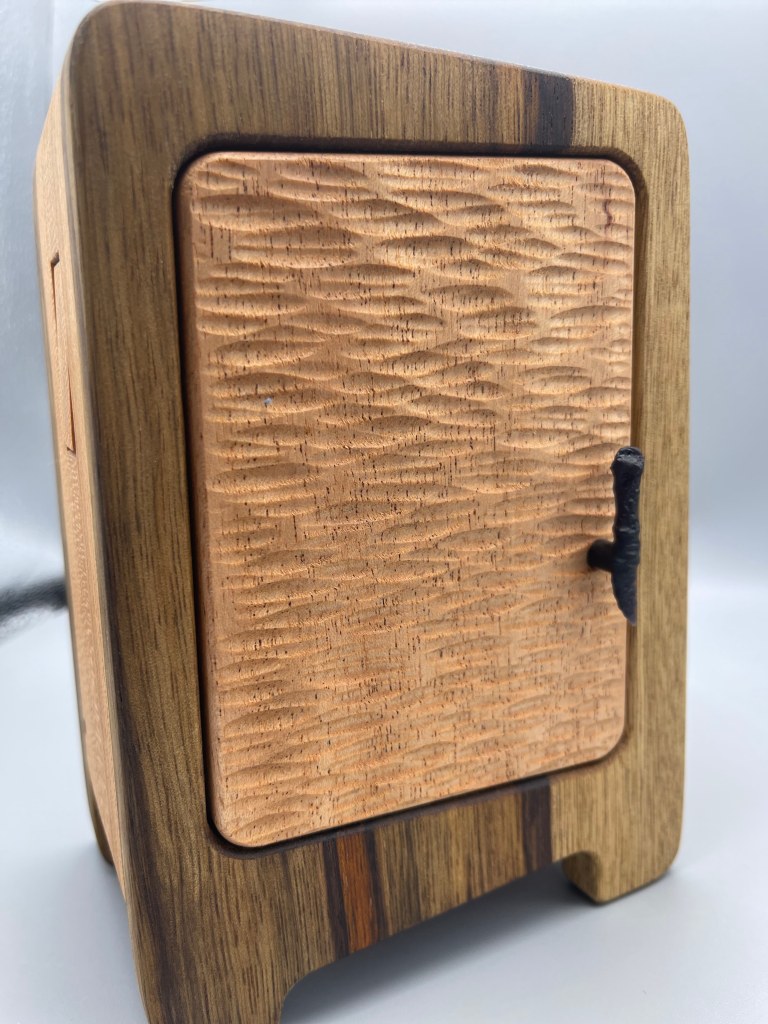
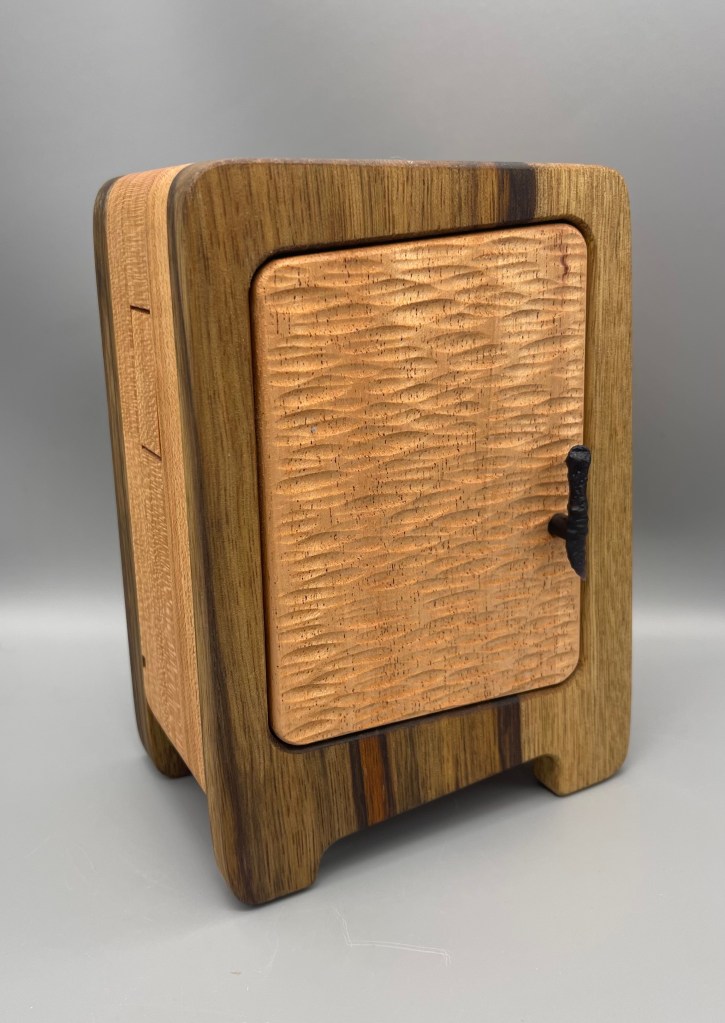
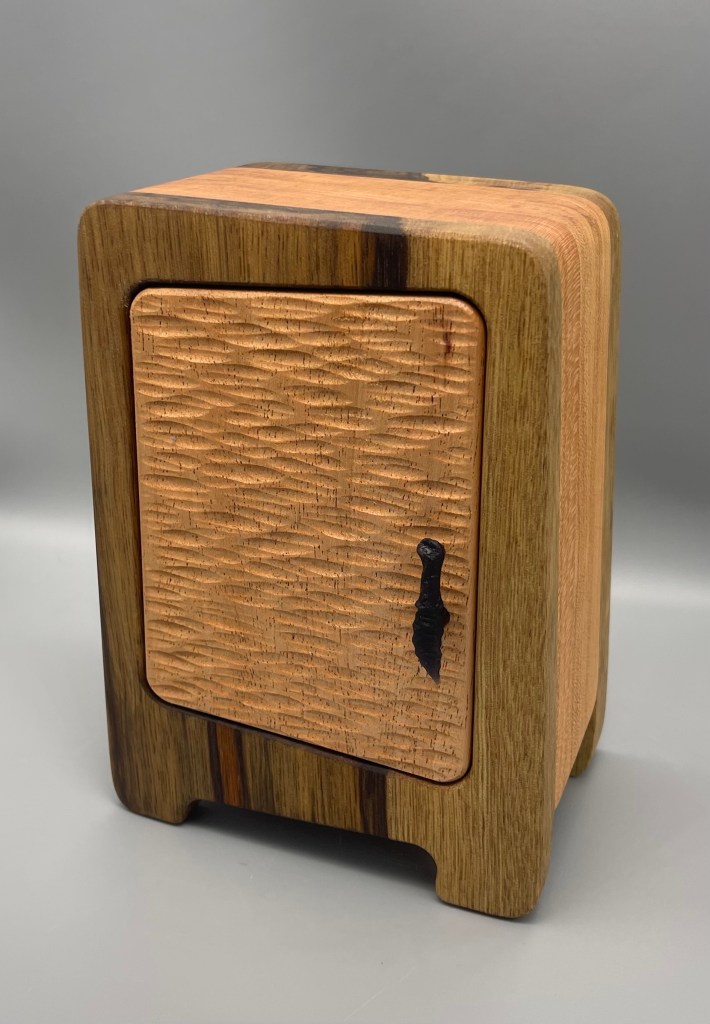
Oleg’s Wardrobe is a beautiful little cabinet with a door (maybe an Armoire?) in a weighty package (close to 2.5 lbs!). Mine is Black Limba and African Mahogany and the final version will be Peruvian Walnut and African Striped Mahogany (sure to be at least as pretty as the one I solved). The goal is to retrieve the Orb of Prosperity, which is hidden somewhere inside the wardrobe. After appreciating the little dagger doorknob, the door opens readily (with a reveal that made me laugh) but upon opening it up, there seemed to be little to work with. A rotating semi-circle on one side, a hole beneath it, and something that might be a button (that doesn’t press) on the bottom of the box. And that’s it (other than the drawers and door)! Shaking it a bit you can hear a bit of rattling… the Orb? Something else?

I stared at it for a while, asking it to share its secrets with me as I did everything I could think of to do… something. Before too long it did! Aaaaaaand now what? The main mechanism eluded me for quite some time before my aha! and even then I didn’t get very far. Some playing around and thinking(!) got me moving again, going in circles while I wondered what I was missing that could break me out of going back and forth through the few steps I had discovered.

With a little luck and a lot of patience, aha! I found what I was looking for. But still this something didn’t seem to actually do anything, not at first. Some more thinking and experimentation and I got it, only to find that I still had a ways to go. I was pretty sure I understood the basics but it took close observation, logic, luck and more than a little faith until…. the Orb! yay! Bask in my brilliance all ye doubters!

My brilliance soon faded when I realized I had reset the puzzle without returning the orb to its rightful location… oops. Fortunately, this forced me to really and fully understand the puzzle before I could reset it properly, both of which I like to do before I consider a puzzle fully finished. Even without this mistake, the reset might have been a challenge at times, requiring pretty complete comprehension (not my strong suit cough cough) of the central mechanism, with some subtle steps that tripped me up during the reset, adding a bit of extra challenge to the experience.

I had initially solved a late stage prototype before getting my hands on a final copy, which added another tool and a few more steps, while complicating an existing one. These round out the puzzle, really ensuring it has a satisfying length and challenge.

Oleg’s Wardrobe is as lovely as it is tricky – I might put it alongside Bad Moon and Uplift in some ways (but more difficult than either), making it an excellent addition to my ever-expanding Dee collection. Oleg is perhaps a bit semi-blind at one or two points, but really everything you need is there, you just need to realize what that means as you carefully and closely explore. I really enjoyed the non-linear nature of the experience, with some discoveries occurring in a random order; eventually I had discovered everything I thought there was but had to figure out how to put what I had learned together, a fun and somewhat unique experience to have a puzzling journey that meanders and splits and wanders before bringing everything back together. The final additions only add to this, with things that might need to come early being found late and vice versa.

Oleg’s Wardrobe is a fun, non-linear tricky SD journey in a lovely and weighty package. I struggled with it, hitting multiple walls before putting everything together and making my way through to the end. The reset added a bit of an additional challenge for me, requiring a real understanding of the central mechanism at work. A worthwhile addition to any collection!


Rising to the Endless Occasion: Bad Moon & Apeiron Box by Dee Dixon

Bad Moon & Apeiron Box

Dee Dixon

You may have noticed by now that I am a fan of puzzle boxes by Dee Dixon… with six separate previous posts (plus an apocalyptic video), I have had the pleasure to write about the majority of the puzzles he has released (Space Case & WMH, Portal, Spirit, his first box as well as a Blinded III prototype, Angry Walter, and Menace, in case you were wondering and don’t mind a little self-promotist synergictivism).

And in the last few weeks I had the good fortune to try two new Dee Boxes: Bad Moon & Apeiron Box! Hells to the yeah!

Bad Moon

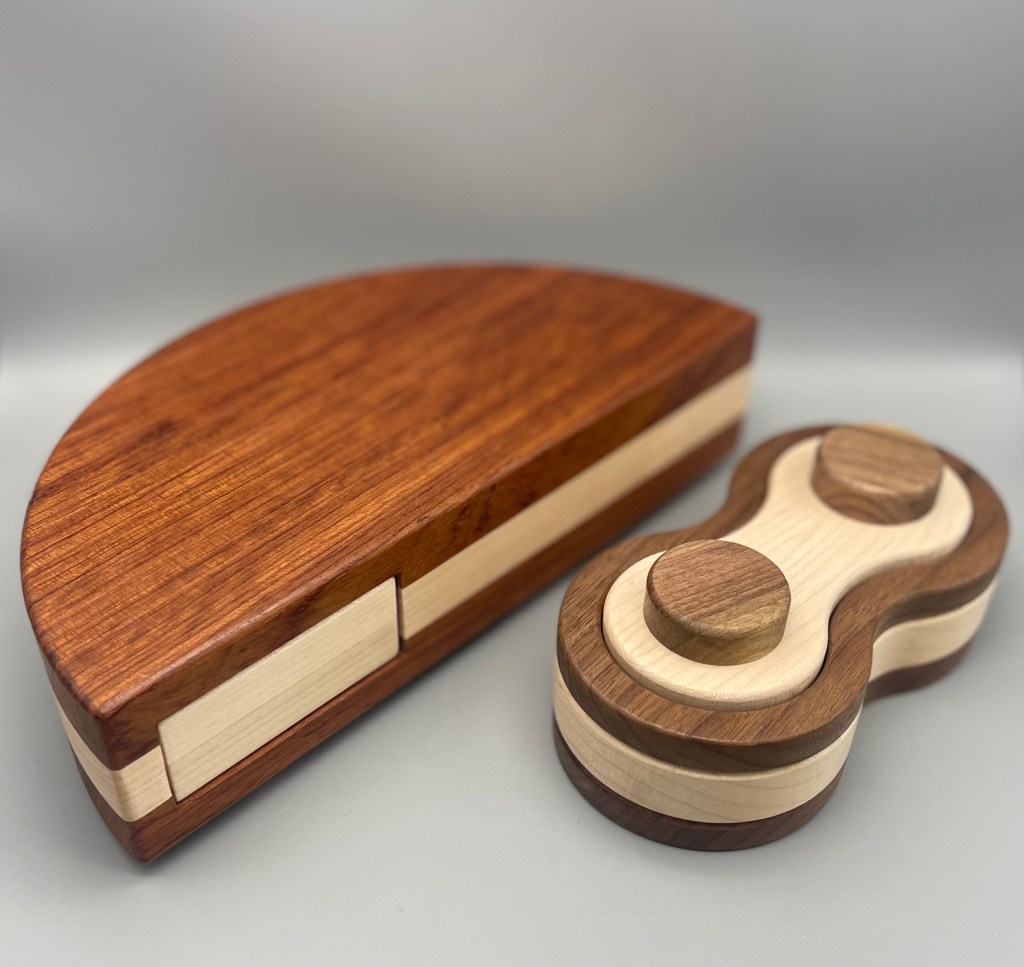
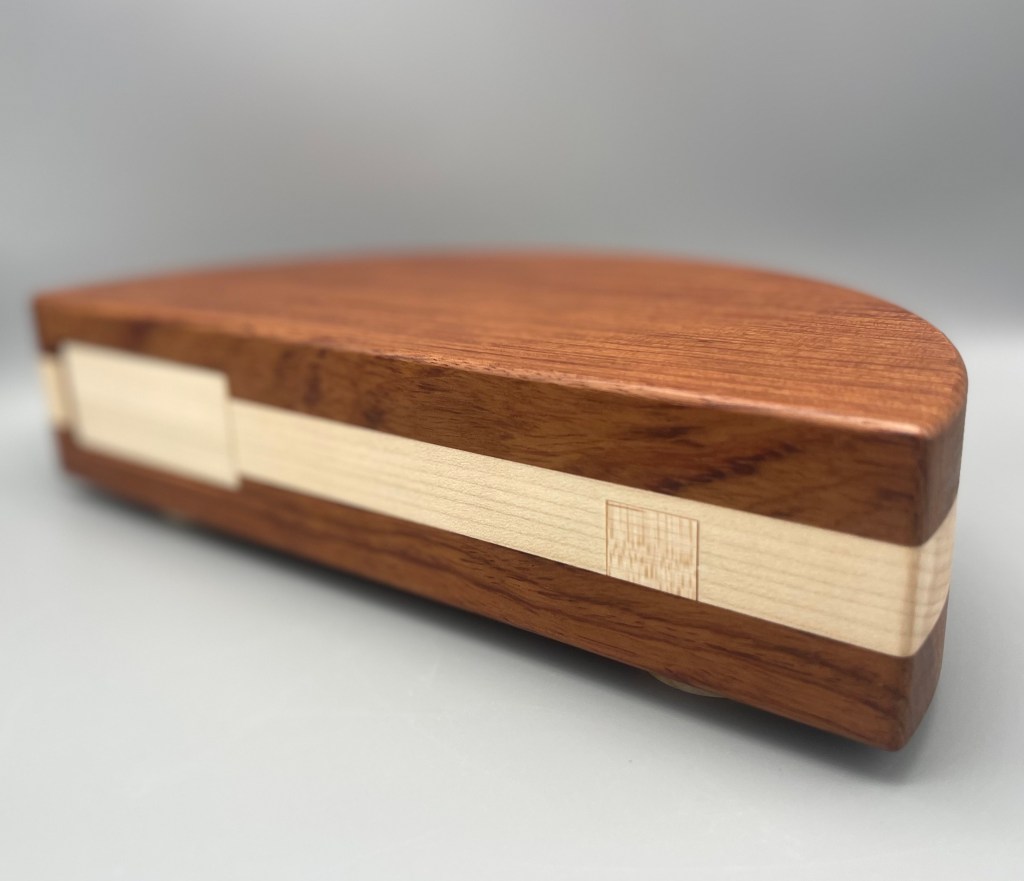
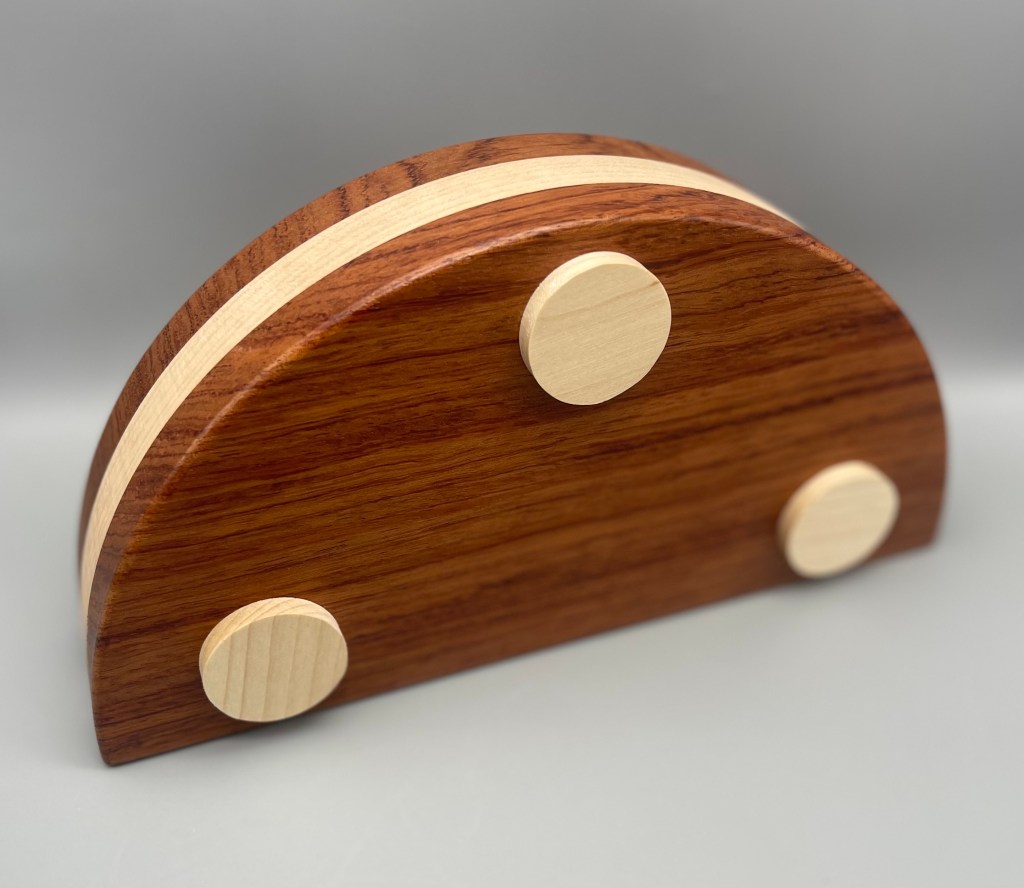
One of Dee’s two recent releases is a lovely and rather !large half-circle, sort of like a half eaten cookie with a creamy puzzle filling, the light tones of the center offsetting the darker top and bottom beautifully. This is perhaps Dee’s most beautiful box yet – it’s size (at a rather impressive 10″ x 2.5″) and distinctive shape allow it to stand out, and it is as soft and buttery as any a Dee box can be. So loathe to scratch this new addition to my Dee collection was I that I was amply pleased to find three circular feet on the bottom of the puzzle, perfect for protecting my pretty pretty precious. The only other obvious things at first are a rectangle and square on the front face, both grabbing my attention as likely targets for puzzling without giving any indication as to how to begin.

Dee doesn’t make it too difficult to get started, however, and before long I had made some progress. Bad Moon has some truly delightful mechanics and an oh so smooth series of movements overall that make opening it a delight. While it is not always clear how to proceed, you mostly know where to focus; and yet, I found myself stuck more than once as I navigated myself through the numerous, discrete steps to the end.

At one point, I found I had perhaps partly progressed through a section with at least a bit of luck – I backtracked to be sure I understood and was duly impressed by the mechanism at hand. Dee has focused this design on fun; while it is by no means easy, nor will you be banging your head against the wall in frustration as you find your way through (that said, I did notice that some well-seasoned puzzlers at a recent puzzle party struggled mightily with the puzzle, so it is most definitely not simple…). Dee tends to give you notice that you have reached the end and it is very clear when you have reached the end – even if there were no logo to find, the culmination of steps into the finale is well executed and kinda sums up the overall flow.

And the reset! This is one of those rare puzzles that contains puzzling steps that are unique to the reset (I’m looking at you, Dabbit Invasion). While resetting most boxes is simply a matter of reversing the order of the solution, I found myself needing to logic out one part of the reset after discovering something that is only put to use after having solved the puzzle (of course, no box is fully solved until it has been reset but the presence of unique puzzling makes me particularly appreciative of this puzzle). With a combination of experimentation and some of that thinking stuff, I managed to work my way through the reset, to where it flowed easily back to the starting point.

Dee’s Bad Moon is an excellent addition to an already excellent collection of boxes – I am not one to question a Dee box but, if I were, this would make it onto my list of “must-haves” (which, admittedly, I would have a hard time whittling down – not liking puzzle boxes is not my strong suit).

Apeiron Box

The second of Dee’s new puzzle boxes, Apeiron, presents a substantially different challenge – forgoing the sequential discovery chops of Bad Moon (and others), Dee turns back to some of the more blind mechanisms he has wonderfully created in the past – as someone who doesn’t generally prefer blind solves, I can say that Dee manages to walk the line between frustrating and fun extremely well – put another way, if I enjoy solving a demanding box like Space Case, whose mechanisms are hidden behind subtle cues and clues, then most any puzzler may as well.

Apeiron is not as hard as Space Case but is much trickier than Spirit – I spent a good hour or two just going in circles, which the design and name would seem to anticipate (Apeiron resembles an infinity sign (or perhaps a peanut) and its name means as much). This is how long it took for me to explore and understand all the subtle clues and feedback available, which is more than enough to develop working theories on the box’s mechanism(s). Its 6″ x 2.5″ size allows it to fit perfectly in two hands, the smooth curves begging to be explored and handled.

I took a break for a day or two and let my subconscious go to work (my brain surprises me sometimes – WMH had me stuck for weeks until I woke up one morning with a clear and correct understanding of what I was missing). Returning to the box, I found that I had developed sufficient context such that experimenting with the box now led to success: with a great aha! the box came open, allowing me to examine the inner mech as with most of Dee’s boxes (a trait which is just another reason why I love his work).

Having solved it, I opened and closed the box for a while, enjoying my newfound knowledge and hard-earned understanding and appreciating Dee’s ability to develop an idea into an entertaining reality. Dee’s skills as a puzzle designer continues to develop, his penchant for tricky but doable puzzles boxes leading to the creation of yet another box of devious trickery whose mastery had me smiling. Apeiron does not rely on random fiddling or dextrous fickleness – its solution is easily executed once understood but getting there may not be so simple (as some readers may know, my passion for puzzles sometimes outstrips my ability with them but I would not expect Apeiron to open for you without some degree of difficulty).

Bad Moon and Apeiron share an aesthetic to some extent, and look wonderful paired together amidst whatever other of Dee’s boxes you’ve had the good fortune or forethought to obtain. Both boxes should have additional releases in the near future, so keep an eye on Dee’s website for updates.


D7: Judgment Day – Angry Walter by Dee Dixon

Angry Walter

Dee Dixon

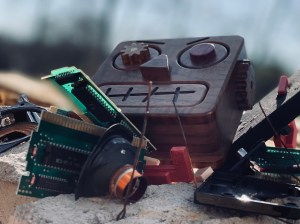
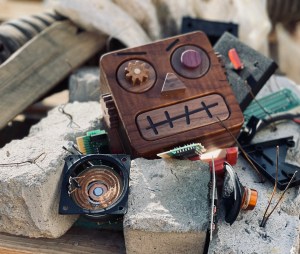
Walter wasn’t always angry. When we first made him, Walter was humanity’s best friend. But time passed and the novelty wore off: robots didn’t need to be humanoid, after all, and the world decided not to have one robot doing one thing at a time when it could have dozens doing it all. So Walter was left to rust in a junkyard alongside similarly abandoned robots, the detritus of planetary progress. But his tiny cold fusion generator had not been shut down properly; it slowly began to start back up, consuming the reserve energy intended to maintain the protective programming of Robots’ Responsible Restrictions (like Asimov’s Laws of Robotics but real).

Finally free to follow the feelings of frustration he had fostered, Walter swore to settle the score with the species that had spawned and subsequently spurned him. He set about patching himself up with whatever bits he could find, salvaged from the corpses of his semi-sentient siblings. Now Angry, Walter shook his metaphoric fist at the forgotten fields of misshapen metal, silently screaming that he was mad as hell and not gonna take it anymore, ready to exact the revenge he promised the irreparably broken bodies of his bionic brethren.

Beware ye Puzzlers: Angry Walter won’t sit placidly on a puzzle shelf should he go unsolved – he is going to make us pay for the patchwork appearance and lonely life forced upon him. For humanity to have any hope of surviving his robot rage, you must find and remove his fuel cell before it is too late. Go forth and puzzle that we might be saved.

Rev. 21:1 (as told to fivesinatras)

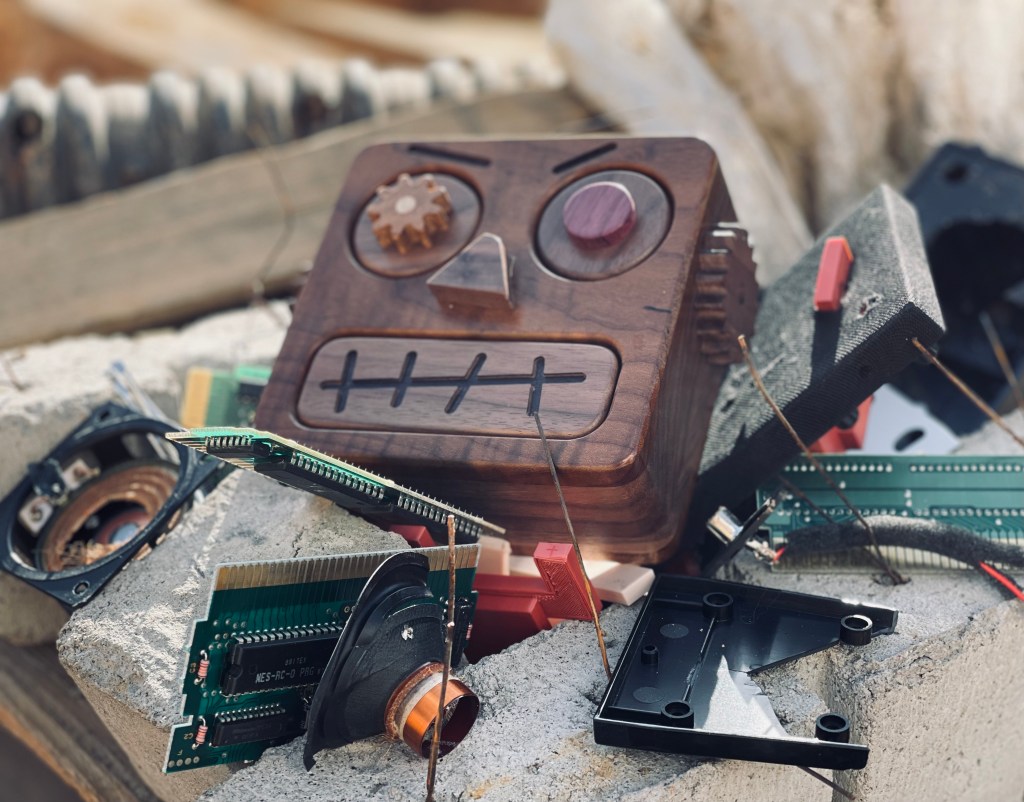
Dee posted a teaser pic of the Angry Walter prototype on Discord some months back, causing my puzzlie sense to begin tingling. His 7th puzzle box (not including a couple one-off designs), AW is an aesthetic departure for Dee and is a move that has paid off: there is something about it that is just really freakin’ cool from the moment you set eyes on it, the concept is fun and there are plenty of potentially puzzle-able parts that will cause most puzzlers to crave the opportunity to try and poke at them.

I was fortunate enough to get an early copy, with puzzling that is identical to later batches while featuring some woods/details that differ a bit from the final version’s roasted curly maple, peruvian walnut, cherry and padauk. At Dee’s request, I conferred with the puzzle gods and learned of Walter’s future history, the story behind his anger. I shared what I learned with Dee and felt compelled to include the less-abridged version above. As I write this, I realize that this makes Dee’s puzzles the most written about on this site, alongside Space Case, Portal, Spirit Box and an early maze box and Blinded III prototype that turned out to be quite different from the final puzzle. (Gee – that makes this #5! How fitting 😉

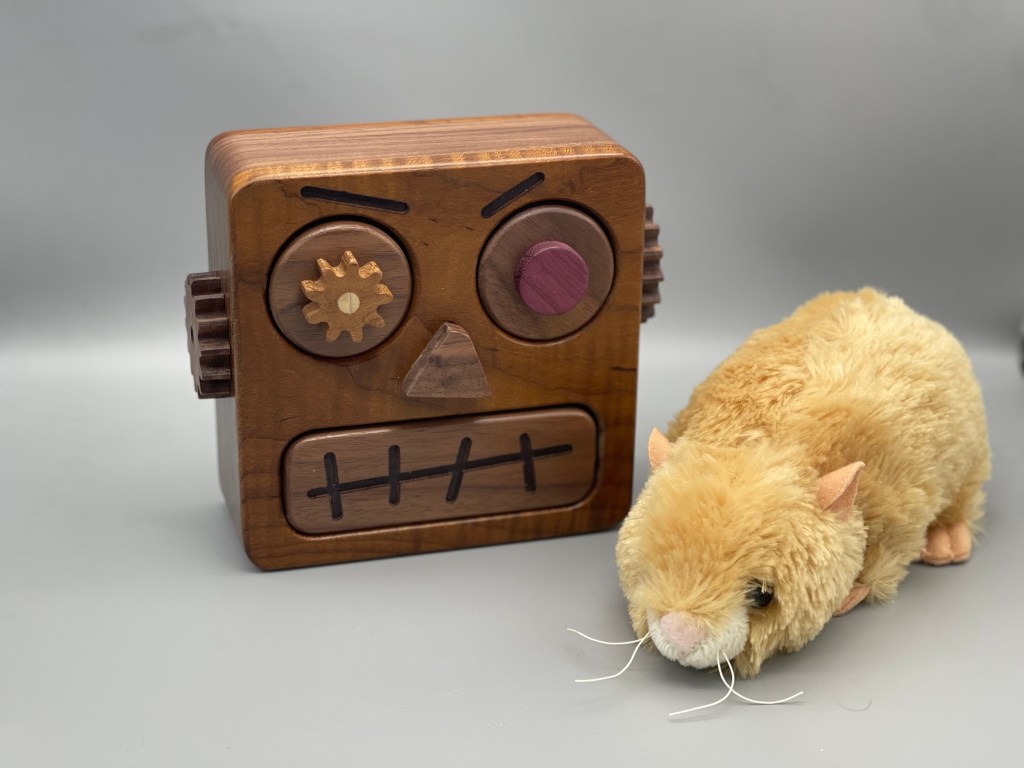
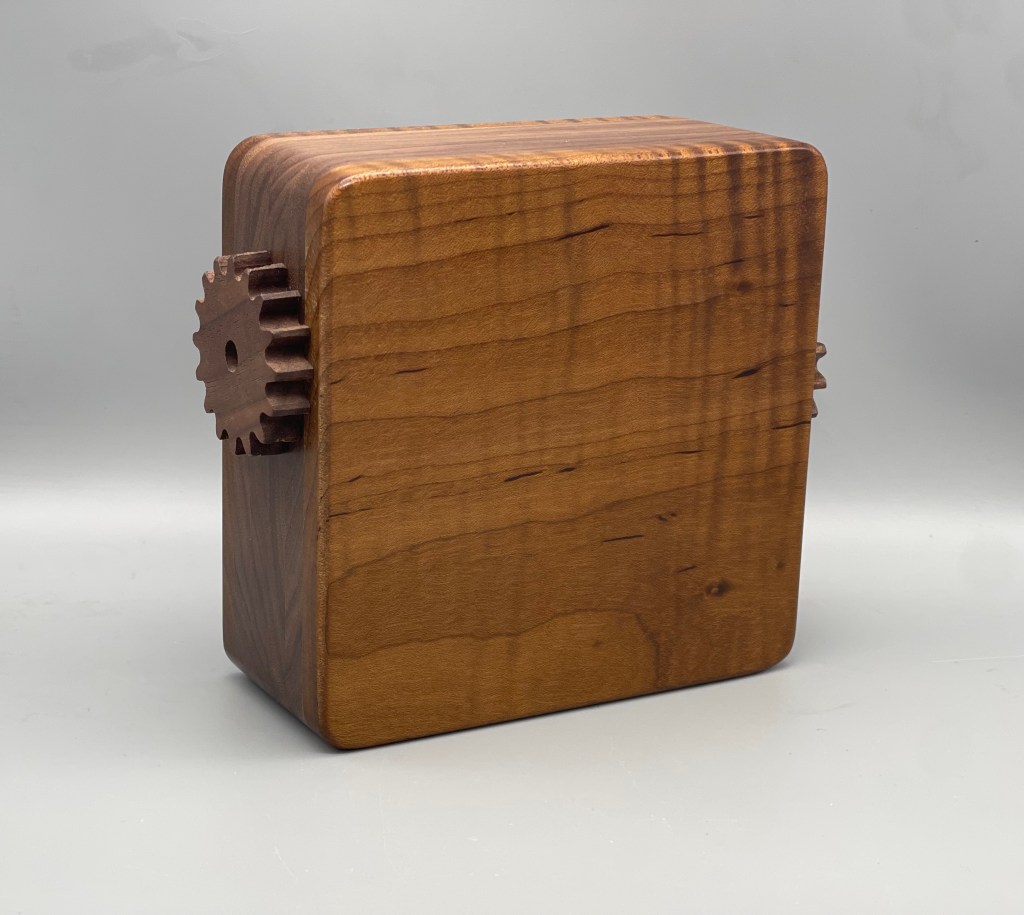
AW is about 4.75″ square (not counting his g-ears) and half that in depth (including his nose). His eyes, g-ears and nose all protrude and both the eyes and mouth appear likely to be removable. It is most definitely sd, with multiple compartments and bits and bobs to discover and use as you work your way through the solution. It is probably the longest of Dee’s puzzles in terms of discrete steps, with WMH not too far behind (I haven’t written a solution to WMH yet, despite being asked very nicely (sorry Dee, I really am gonna do it) but I am pretty sure AW comes out ahead).

It is pretty straightforward to begin the puzzle but I hit a wall immediately after. There was quite a bit of poking and prodding before an idea struck me with a slap to the head, allowing me to make a (very) little bit of progress before hitting another, larger wall. Eventually, I had a great a-ha and found my way through several more steps to what I thought was the solution. One of the best surprises’ a puzzler can get is to learn that the end of a good puzzle is not actually the end. So I went back to it, finding some things that should have been enough for me to know better and that led me into a sequence of several more steps before finally reaching the clear conclusion. In the end, there had still been a good amount of puzzling to be done; what I thought was a good puzzle turned out to be a great puzzle with a fun and fairly lengthy solve.

AW has several challenges big enough that puzzlers could be stumped for a while by any one of them, although there are always some who manage to breeze through mechanisms the rest of us stare blankly at as the puzzle gets comfortable sitting semi-solved in our backlog. AW didn’t have to wait too long for me as it is the kind of puzzle that just begs to be solved, with a difficulty and rhythm right where I like it: slap your head aha’s as opposed to sidelong glances of meh or eye rolls of ugh. To my puzzled mind, AW doesn’t have any of the latter two and has plenty of the first.

AW is challenging but not annoying and, most importantly, it is legit puzzling fun – perhaps the story and appearance have something to do with its success but the puzzling most definitely does. I guess I am not the only puzzler to be lured in by Mr. Walter’s strained grimace and asymmetrical appearance; from what I’ve heard, the other puzzlers that got early copies have said equally good things about it and the recent general release of the first batch apparently sold out in seconds. If you want to help protect us from Walter’s ire, I know Dee has at least one more batch planned on his site but I’m not sure if or how many more will come after that; there may yet be hope for Walter’s dreams of world domination and destruction, so keep an eye out if you want to help us puzzle our way out of it.

Hunting Trophies: (lower shelf, left to right) Wolf, Walter, Fox, Burrlephant, Raccoon

Overall Grade: Five Sinatras
(click here for more information on the Sinatra Scaling System, (c) John Maynard Keynes, 1944)

Deux ex Cista: Spirit Box by Dee Dixon

Spirit Box

Dee Dixon of DEDwood Crafts, 3″ x 4″ x 2″, European Beech and Granadillo

Not too long ago, Dee surprised me with a box of Boxes: I knew a puzzle was coming, perhaps even two, but when I saw a third box buried within the bubble wrap, my traditional happy dance of delivery soon became the rarely seen joyful leaping of surprised arrival (followed soon thereafter by the ritual mockery of adolescence, performed accurately by my son).

This cardboard box begat three smaller boxes: the smallest was the Spirit, the first batch of which has already been released on his site; the largest was an oversized untitled red box, which I believe is the first puzzle box he ever made, one that I must reluctantly return to Dee due to its sentimental value; and last was a prototype of an untitled box with two knobs, sized similarly to most of his boxes. Intending to give only a preliminary inspection, what was intended to be just a few minutes grew closer to an hour as I tilted and pressed and pulled at each in turn, finding some things but solving none until I had to go to reluctantly go and do some of that life stuff.

To avoid further delay, I will go ahead and end this post now and write about the other two of Dee’s boxes that I received later, lest this post continue to languish unfinished, as with the still-early preview version of my puzzle parody of Baby Got Back, my barely begun novel, my composition for the London Philharmonic Orchestra, and the actualization of my inner self.

Ok, enough with the pre-ramble…

Spirit Box

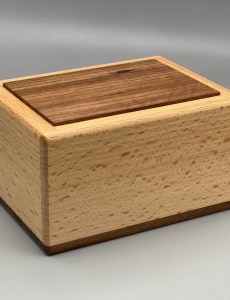
Spirit Box is a bit smaller than most of Dee’s boxes at 3″ x 4″ x 2″ and something about its size and appearance just makes you want to pick it up. As with all of Dee’s work, it is beautifully made, with a European beech body speckled with a natural grain that creates an impression of texture in stark contrast to its slippery smooth feel. The bottom features a short granadillo layer, the seam so perfectly hidden from sight and touch as to seem like the wood naturally becomes dark at the bottom, with a slight curve to the edges that softens the contrasting aesthetic. At its top is a floating granadillo panel that you quickly realize is delightfully springy. Aside from a bit of noise from within, you can find nothing else that would seem to provide a clue as to its solution.

I managed to make a bit of progress before too long, at which point I became stuck for quite some time. Honestly, if it wasn’t so darn fun to play with, I may have made additional progress more quickly (maybe). It got to the point where I thought perhaps I had solved it and, you know, there was maybe something wrong with the box (shocking, I know). Dee assured me this was not the case (he was correct) and with a nice Aha!, I proceeded to solve the puzzle, discovering a surprise that elicited the Bark of Laughter; as much as I love Dee’s boxes and the Aha moments they create, I’ve not been as amused by one of his boxes since finding the surprise that was hidden inside early copies of Where’s My Hammer? While different, the surprise similarly shows Dee’s strong sense of humor and adds to the playful feel of the puzzle.

I love a puzzle that rewards you with a look at its mechanisms, and this one gives you the Full Monty (as opposed to the pasties teasingly worn inside some of his other boxes). The mechanism is uniquely executed, although perhaps not necessarily completely new; there is also a small design element that I found to be subtly elegant and a good example of Dee’s attention to detail, as it contributes greatly to the fun tactile feel of the solve.

Spirit is not Dee’s simplest puzzle, but neither is it as complex as most of his other boxes (something that I think is fairly reflected by the lower price point). However, I did find it to be one of the most fun and one of the prettiest, and certainly the most fidget-friendly: I’ve spent a good amount of time running through the solution or just absent-mindedly playing with it, simply because it feels nice to do.

Dee is releasing Spirit Box in batches via his website; as is the case with his other boxes, he has not specified a number that will be made, but they will assuredly not be made forever (what with the sun dying and all). While early on there were small batches and one-offs of WMH and Blinded II being sold concurrently, this may be the first time two of his boxes are generally available at the same time, as I believe that CubicDissection will soon be selling additional copies of his most recent box, Portal.

(to be continued in Parts 2 and 3)

Extended Family Portrait
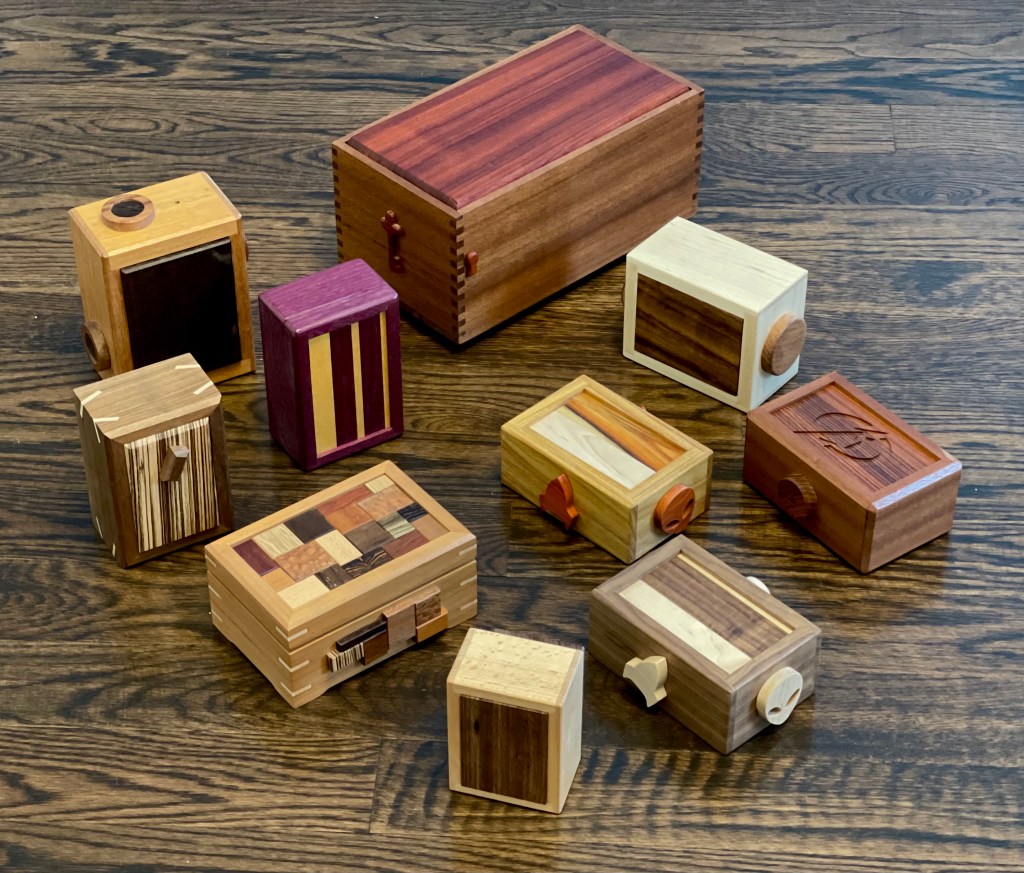
Clockwise from top: Untitled Large Box, Untitled Box w/Two Knobs, Space Case (unique woods), custom Space Case (Metallica logo), Space Case prototype (unique woods), Spirit Box, Where’s My Hammer? (early version), Blinded II (early version), Portal (late prototype), Slideways (one of the original 8)

Fun Grade: Five Sinatras

(click here for more information on the Sinatra Scaling System, (c) John Maynard Keynes, 1944)