Cards go in the Box. Box goes on the Shelf. Puzzles are on the Shelf. My Puzzles.

Jack in the Box,

Jesse Born, 2019 (Sold Out)

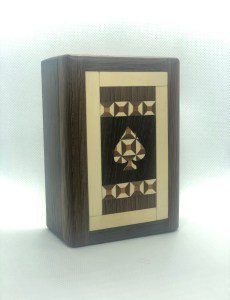
A few months ago, I received the Jack in the Box puzzle from Jesse Born. Jack is a cool concept, blending puzzle boxes with one of my other favorite collectibles, playing cards! The box allows most decks of cards to sit snugly within, allowing only the slightest feel of movement when holding the unsolved puzzle.

It arrived unsolved (duh) and the quality was immediately apparent: the wood is smooth and feels solid and weighty in your hands. The Yosegi design on the top is excellent; except for four seams that are part of the design, the breaks are not immediately noticeable by eye or hand – a difficult achievement, I am sure, and I think it is as good as any Karakuri I have.

With some inspection it becomes relatively clear where the opening will be; I could figure out where the final step would likely take place, but that was it. Nothing moves, nothing slides… like some of my favorite puzzles, it is essentially a Wonka factory (“nobody ever goes in and nobody ever comes out”).

I find it very satisfying to get a solid puzzle with no clear first step. It can of course be fun to know how to start a new puzzle before hitting a wall, but there is something about a puzzle with no indication of how one should begin. I tried all the usual stuff (spinning it, holding it at different angles, sneaking up on it to catch it unawares, etc.), before putting it back on its shelf to glare derisively at me.

I may have done this a couple more times than I like to admit; with some exceptions, I do not typically manage to solve a good puzzle right away, although I suppose this is changing as my puzzling experience levels up. I am probably just trying to make myself feel better by implying that it was before I became the esteemed Solver that I am today. Of course, that is about as likely as my inability to solve a new puzzle actually being due to the always suspected, rarely existent design defect that we oftentimes seek to blame when nothing else seems to work (typically, this occurs a few minutes before being solved, for maximum shaming effect).

Eventually I hit upon that first move, which I find to be a very satisfying move to make even now, months later. After that, it is not a hard path to find the next 4 steps before it opens. Inside, Jesse included a classic red Bicycle deck. I replaced the deck with my Red Labyrinth Cards from King’s Wild; thematic consistency is fun, and what is better to find tucked away inside a puzzle but another puzzle?

Jack in the Box is an excellent addition to my collection, and one that looks great while serving as an ambassador between these two great nations (the world-weary puzzle boxes and the upstart playing cards, like an extra-nerdy West Side Story without the singing, dancing, or blatant Romeo and Juliet rip-off….. and if it was made out of wood, metal, and paper and was sitting on my shelf…).

Jesse is currently working on the wonderfully elaborate Secretum Cista puzzle chest, which will be crazy cool, I am sure, and will be worth not much less than my entire current collection does, but he was kind enough to allow me to pay over time while he works. I will most assuredly share this with the 2 imaginary people reading this (thanks Bob Dobbs and Zaphod! I couldn’t do it without you).

I am telling myself that I will blog on here more frequently, but I’ve learned the hard way that I can’t be trusted, so we’ll see.


Grade: Four Sinatras

Puzzle Box Train(ing)

Railroad Crossing, Karakuri Puzzle Box

Akio Kamei and Shou Sugimoto,
11th Annual Idea Contest Winner, June 2019
Designed by Ichiro Sato
Unboxing Puzzle Boxes with fivesinatras

The newest puzzle box from Karakuri master Akio Kamei and Shou Sugimoto is based on a winning design of the 11th Annual Karakuri Idea Contest from Ichiro Sato. This trick box is made of Oak and Magnolia, and is a whimsical take on waiting for a train to pass, and the secrets that lurk beneath the surface, a comment on the underlying depravity of urban life and the innate search for escape…. well, maybe not, but the wood and whimsy are correct.

Not the hardest puzzle box from the Karakuri Group, as some of the more fun creations tend to be, but it still requires some creative thinking to make the few steps required to open the compartment beneath the tracks. It is pretty big and heavy, a puzzle box with some mass and heft to it, and one that looks great on my shelf, amongst its wooden friends.

And how fun it must have been for my wife to see her grown husband sitting on the floor playing train! I may have even allowed a choo-choo or two to escape my lips as I tried and failed and tried again, before showing my wife with glee the solution, complete with an imagined scene for full effect (“picture yourself in your car, the bells ringing to warn of the approaching train, searching for the correct steps that will allow you to gain access to the safety of the hidden compartment beneath your feet…..” – super cool, I know).

If you manage to get your hands on one, enjoy its weight and the light-hearted fun it carries. And let yourself play for a minute.

the most accurate metric to quantify cool

“…to produce a consistent, reliable methodology for the determination of the coolness quotient of any particular idea or product, it must be evaluated in contrast with an ideal representation of cool: therefore, any such measurement will be quantified with the most precision by calculating the number of Sinatras it contains and the quality to which it applies.”

Quantified Cool, John Maynard Keynes,
Chairman of the World Bank Commission, 1944


Quantified Cool

Quantified Cool

John Maynard Keynes, 1944

Quantified Cool, is a non-existent book not-written in 1944 and attributed to renowned economist John Maynard Keynes by the author of the present blog; any quote claimed to have been contained therein is, by definition, not-written by John Maynard Keynes, and was drafted purely for the purposes of satire, parody, humiliation, cruelty, and the scientific mockery of economists, and of humanity as a whole.

You should probably have figured out that it was not, in fact, written by John Maynard Keynes, because that would be ridiculous: John Maynard Keynes had notoriously terrible taste in music and was an unabashed fan of Andy Williams. As such, John Maynard Keynes would not have been able to construct a reliable method for the quantification of cool as he was, in point of fact, a total dork. That may be why he became an economist.

Simply put, I made it up. It is funny because it sounds like something one might think John Maynard Keynes (or any comparable dead economist) may have written. But John Maynard Keynes, in fact, did not write it. I know this because I wrote it. Recently (i.e. not in 1944).

fivesinatras, 2019
Quantified Cool

Sinatra Grading: How and Why

This may come as a shock, but there’s no such thing as the Sinatra Scaling System….. I know I try to maintain a spoiler-free zone, but that’s only for puzzles and my secret identity and, I felt I owed it to you, that rare reader to click on this teeny link.

Keynes was an economist, true, but Frank Sinatra was 11 when he died, so only Frankie’s mom knew how great he was at the time.

The name “fivesinatras” was something I spontaneously came up with when choosing my first online name as a teenager – a random and impulsive joke of the vaguely ironic “what’s cooler than one Frank Sinatra?……” Yes I do think Ol’ Blue Eyes is cool, but no, there are things cooler than he (as evidenced by my review of Secretum Cista, to which I gave the coveted Presley). Obviously, puzzles are cooler, or else I might be writing a blog called Five Puzzle Boxes, in which I used a puzzle-based rating system to talk about various Sinatra songs.

Eventually, I got into mechanical puzzles, and began seriously collecting them a couple years ago, relying frequently on the excellent puzzle blogs that have been around for years (particularly as there were far fewer puzzle YouTube channels at the time). Since I already spent so much time reading about them and working on them and had no one to talk to about them, beyond the occasional, “that’s nice, babe,” from my wife, I thought it might be fun to write about them. As I was already familiar with the name, “fivesinatras” seemed like an obvious choice (and now millions of puzzle collectors throughout the world regularly use the rating system).

So, basically, the name was a bit of an inside joke with myself, impulsively invented and used to create a blog; I’ve kept writing because it is fun and because I’ve had a person or two tell me that they found it useful, which I think is pretty cool.

You may have noticed that the “rating” system is a bit random. That is by design. If I didn’t think a puzzle was great, I wouldn’t write about it. I have not written about the majority of great puzzles I have done, as I select them randomly and impulsively, but these are some of them.

I will generally change whatever aspect of a puzzle I am specifically rating to focus on whatever it is I find compelling about that specific puzzle; a few times, I think I forgot to include a rating at all. Quite possibly, I could now look back and feel like some don’t really make sense, as I have applied it totally inconsistently (especially earlier posts). Please don’t compare one rating to another and take it to mean that I think any particular puzzle is better than any other; the rating is intended to humorously praise and acknowledge great aspects of a puzzle and not to seriously critique or condemn.

Since it has been around for a while now, I figure I should throw some sort of standard at it, so I will continue to use it as an extremely brief TL;DR, with the real knowledge being conveyed by what is being graded, more than the grade itself; rarely, a truly and utterly amazing puzzle may perhaps receive the rare Presley. If ever a puzzle disappoints me so terribly that I cannot bear to keep it a secret, it might then have bestowed upon it the dreaded Lawford (we shan’t even mention the shameful Bishop). Hopefully, this clears up the ongoing debates about the nature and scope of the rating system currently taking place in numerous town hall meetings and University classrooms across the globe.

Thank you to my tens of imaginary readers, to the excellent puzzle-bloggers whose writings have inspired and directed me, and of course to the amazing and ingenious puzzle designers and creators whose work makes it all possible. And thank you most of all to the large, fiery ball at the center of the solar system whose ongoing existence allows us to enjoy puzzles: we couldn’t do it with you. And, finally….. I’ll miss you most of all Scarecrow!

Overall Existence Grade: Four and a Half Sinatras


Notes on the Presley Standard (excerpt)

“[D]espite the justified reliance on the Sinatra as the coolness quotient upon which said methodology is based, there must simultaneously exist an indicator to be used should a commodity’s value be calculated such that the Sinatra be rendered insufficient; in this event, the Presley is the more apparent and precise control to represent the coolness being commodified insofar as it exists in excess of the standardized Sinatra metric.”